Determinants of Relationship Marketing: Ethio Telecom Bahir Dar Branch
VerifiedAdded on 2021/08/30
|8
|7210
|134
Report
AI Summary
This research article assesses the determinants of relationship marketing at Ethio Telecom's Bahir Dar branch. The study investigates the impact of various factors, including communication, trust, commitment, and conflict handling, on the overall relationship quality with customers. Using descriptive statistics, the research surveyed customers and utilized questionnaires and interviews to gather data. The findings reveal that communication has the most significant influence on relationship marketing, followed by trust and commitment. However, the study indicates that Ethio Telecom's performance in conflict handling requires improvement. Overall, the research highlights the importance of relationship marketing in the competitive telecommunications industry and provides insights into the strengths and weaknesses of Ethio Telecom's customer relationship strategies, emphasizing the need for effective customer service and conflict resolution to enhance customer loyalty and satisfaction.
ASSESSMENTS ON DETERMINANTS OF RELATIONSHIP MARKETING: THE CASE OF ETHIO
TELECOM, BAHIR DAR BRANCH
Department of Business Management, Faculty of Business and Economics, Woldia University, Ethiopia
ARTICLE INFO ABSTRACT
Businesses are living in a world of stiff competition. To be successful in this competition, considering
customer relationship is a requisite, and organizations need to investigate more on the determinants of
relationship marketing.
marketing on overall relationship quality of Ethio telec
employed descriptive statistics. Study population for the study was customers who are living in
Bahirdar city and customers who come to Bahirdar during the study period. Questionnaire and
interview were used as
got highest value on relationship marketing of Ethio telecom followed by trust, commitment.
However, only about half of the customers are happy with ET conflict handling.
show that ET relationship quality is good where as organizational ability in conflict handling is poor.
Copyright © 2016, Belay Mengstie.This is an open access article distributed under the Creative Commons Att
distribution, and reproduction in any medium, provided the original work is properly cited.
INTRODUCTION
Today, service delivery companies and institutions worldwide
compete due to the demands and expectations of the customers
induce a factor for the survival of their professional activities.
However, only those groups of the institutions will be more
successful that correctly recognize, customer is a valuable
investment. According to Kindye (2011), improved customer
satisfaction will lead to improved customer loyalty, which will
eventually improve profit. In order to satisfy our customers, we
have to focus on effective customer services to meet their
immediate needs. Besides Kotler (2002) stated
longer enough to satisfy customers unless we must delight
them. Hence customer satisfaction is critical to any product or
service as it is a strong predictor of customer retention,
customer loyalty and product repurchase. Relationship
marketing practice is different from transactional marketing
practice, transactional exchanges as transactions with a distinct
beginning, short duration, and sharp ending by performance,
whereas relational exchanges as exchanges with
commencement traces to previous agreements, longer duration,
and reflecting an ongoing process. Hence in the case of
Relationship marketing the solution is the relationship itself but
in transactional exchange the solution is the product in the form
*Corresponding author: Belay Mengstie,
Department of Business Management, Faculty of Business and
Economics, Woldia University, Ethiopia.
ISSN: 0975-833X
Article History:
Received 23rd January, 2016
Received in revised form
14th February, 2016
Accepted 16th March, 2016
Published online 26th April, 2016
Key words:
Ethio Telecom (ET),
Relationship Marketing.
Citation: Belay Mengstie, 2016. “Assessments on determinants of relationship marketing: the case of Ethio telecom, Bahir Dar branch
Journal of Current Research, 8, (04), 29944-29951.
RESEARCH ARTICLE
ASSESSMENTS ON DETERMINANTS OF RELATIONSHIP MARKETING: THE CASE OF ETHIO
TELECOM, BAHIR DAR BRANCH
*Belay Mengstie
Department of Business Management, Faculty of Business and Economics, Woldia University, Ethiopia
ABSTRACT
Businesses are living in a world of stiff competition. To be successful in this competition, considering
customer relationship is a requisite, and organizations need to investigate more on the determinants of
relationship marketing. The objective of the research is to assess determinants of relationship
marketing on overall relationship quality of Ethio telecom. To achieve this objective the researcher
employed descriptive statistics. Study population for the study was customers who are living in
Bahirdar city and customers who come to Bahirdar during the study period. Questionnaire and
interview were used as data collection tools. The result of the study shows that Communication has
got highest value on relationship marketing of Ethio telecom followed by trust, commitment.
However, only about half of the customers are happy with ET conflict handling.
show that ET relationship quality is good where as organizational ability in conflict handling is poor.
is an open access article distributed under the Creative Commons Attribution License, which
distribution, and reproduction in any medium, provided the original work is properly cited.
Today, service delivery companies and institutions worldwide
and expectations of the customers
induce a factor for the survival of their professional activities.
However, only those groups of the institutions will be more
successful that correctly recognize, customer is a valuable
improved customer
satisfaction will lead to improved customer loyalty, which will
eventually improve profit. In order to satisfy our customers, we
have to focus on effective customer services to meet their
Besides Kotler (2002) stated that, it is no
longer enough to satisfy customers unless we must delight
Hence customer satisfaction is critical to any product or
service as it is a strong predictor of customer retention,
customer loyalty and product repurchase. Relationship
ting practice is different from transactional marketing
practice, transactional exchanges as transactions with a distinct
beginning, short duration, and sharp ending by performance,
whereas relational exchanges as exchanges with
ious agreements, longer duration,
and reflecting an ongoing process. Hence in the case of
Relationship marketing the solution is the relationship itself but
in transactional exchange the solution is the product in the form
Department of Business Management, Faculty of Business and
of physical goods and service (Ganesan, 1994). He also
explained that Relationship marketing is more applicable,
especially for service provider
In the case of service marketing, it is process consumption than
outcome consumption. Relationship marketing is designed to
develop strong connections with customers by providing them
with information directly suited to th
by promoting open communication. This approach often results
in increased word-of-mouth activity, repeat business and a
willingness on the customer’s part to provide information to the
organization. Naudé and Buttle (2000) made
major constructs of relationship quality identified in the
literature. Based on their constructs relationship quality is a
combination of trust, commitment, communication, conflict
handling, etc.
However, according to different scholar
determinant‘s magnitude on the relationship quality of the
organizations is different. Different researchers identified
different determinants of relationship marketing on their
countries context and similarly it may be different in the cas
of our country’s experience. Moreover, as to the studies in
Ethiopian set up, the work of Negi (2010) is important to
mention. Negi has tried to see the antecedents of relational
marketing and customer loyalty in the case of Ethiopian
Telecommunications Corporation.
Available online at http://www.journalcra.com
International Journal of Current Research
Vol. 8, Issue, 04, pp.29944-29951, April, 2016
INTERNATIONAL
Assessments on determinants of relationship marketing: the case of Ethio telecom, Bahir Dar branch
z
ASSESSMENTS ON DETERMINANTS OF RELATIONSHIP MARKETING: THE CASE OF ETHIO
Department of Business Management, Faculty of Business and Economics, Woldia University, Ethiopia
Businesses are living in a world of stiff competition. To be successful in this competition, considering
customer relationship is a requisite, and organizations need to investigate more on the determinants of
The objective of the research is to assess determinants of relationship
om. To achieve this objective the researcher
employed descriptive statistics. Study population for the study was customers who are living in
Bahirdar city and customers who come to Bahirdar during the study period. Questionnaire and
. The result of the study shows that Communication has
got highest value on relationship marketing of Ethio telecom followed by trust, commitment.
However, only about half of the customers are happy with ET conflict handling. Descriptive results
show that ET relationship quality is good where as organizational ability in conflict handling is poor.
ribution License, which permits unrestricted use,
of physical goods and service (Ganesan, 1994). He also
explained that Relationship marketing is more applicable,
organization like Ethio telecom.
In the case of service marketing, it is process consumption than
outcome consumption. Relationship marketing is designed to
develop strong connections with customers by providing them
with information directly suited to their needs and interests and
by promoting open communication. This approach often results
mouth activity, repeat business and a
willingness on the customer’s part to provide information to the
organization. Naudé and Buttle (2000) made an overview of the
major constructs of relationship quality identified in the
literature. Based on their constructs relationship quality is a
combination of trust, commitment, communication, conflict
However, according to different scholars finding, each
determinant‘s magnitude on the relationship quality of the
organizations is different. Different researchers identified
different determinants of relationship marketing on their
countries context and similarly it may be different in the case
of our country’s experience. Moreover, as to the studies in
Ethiopian set up, the work of Negi (2010) is important to
mention. Negi has tried to see the antecedents of relational
marketing and customer loyalty in the case of Ethiopian
Corporation.
INTERNATIONAL JOURNAL
OF CURRENT RESEARCH
Assessments on determinants of relationship marketing: the case of Ethio telecom, Bahir Dar branch”, International
TELECOM, BAHIR DAR BRANCH
Department of Business Management, Faculty of Business and Economics, Woldia University, Ethiopia
ARTICLE INFO ABSTRACT
Businesses are living in a world of stiff competition. To be successful in this competition, considering
customer relationship is a requisite, and organizations need to investigate more on the determinants of
relationship marketing.
marketing on overall relationship quality of Ethio telec
employed descriptive statistics. Study population for the study was customers who are living in
Bahirdar city and customers who come to Bahirdar during the study period. Questionnaire and
interview were used as
got highest value on relationship marketing of Ethio telecom followed by trust, commitment.
However, only about half of the customers are happy with ET conflict handling.
show that ET relationship quality is good where as organizational ability in conflict handling is poor.
Copyright © 2016, Belay Mengstie.This is an open access article distributed under the Creative Commons Att
distribution, and reproduction in any medium, provided the original work is properly cited.
INTRODUCTION
Today, service delivery companies and institutions worldwide
compete due to the demands and expectations of the customers
induce a factor for the survival of their professional activities.
However, only those groups of the institutions will be more
successful that correctly recognize, customer is a valuable
investment. According to Kindye (2011), improved customer
satisfaction will lead to improved customer loyalty, which will
eventually improve profit. In order to satisfy our customers, we
have to focus on effective customer services to meet their
immediate needs. Besides Kotler (2002) stated
longer enough to satisfy customers unless we must delight
them. Hence customer satisfaction is critical to any product or
service as it is a strong predictor of customer retention,
customer loyalty and product repurchase. Relationship
marketing practice is different from transactional marketing
practice, transactional exchanges as transactions with a distinct
beginning, short duration, and sharp ending by performance,
whereas relational exchanges as exchanges with
commencement traces to previous agreements, longer duration,
and reflecting an ongoing process. Hence in the case of
Relationship marketing the solution is the relationship itself but
in transactional exchange the solution is the product in the form
*Corresponding author: Belay Mengstie,
Department of Business Management, Faculty of Business and
Economics, Woldia University, Ethiopia.
ISSN: 0975-833X
Article History:
Received 23rd January, 2016
Received in revised form
14th February, 2016
Accepted 16th March, 2016
Published online 26th April, 2016
Key words:
Ethio Telecom (ET),
Relationship Marketing.
Citation: Belay Mengstie, 2016. “Assessments on determinants of relationship marketing: the case of Ethio telecom, Bahir Dar branch
Journal of Current Research, 8, (04), 29944-29951.
RESEARCH ARTICLE
ASSESSMENTS ON DETERMINANTS OF RELATIONSHIP MARKETING: THE CASE OF ETHIO
TELECOM, BAHIR DAR BRANCH
*Belay Mengstie
Department of Business Management, Faculty of Business and Economics, Woldia University, Ethiopia
ABSTRACT
Businesses are living in a world of stiff competition. To be successful in this competition, considering
customer relationship is a requisite, and organizations need to investigate more on the determinants of
relationship marketing. The objective of the research is to assess determinants of relationship
marketing on overall relationship quality of Ethio telecom. To achieve this objective the researcher
employed descriptive statistics. Study population for the study was customers who are living in
Bahirdar city and customers who come to Bahirdar during the study period. Questionnaire and
interview were used as data collection tools. The result of the study shows that Communication has
got highest value on relationship marketing of Ethio telecom followed by trust, commitment.
However, only about half of the customers are happy with ET conflict handling.
show that ET relationship quality is good where as organizational ability in conflict handling is poor.
is an open access article distributed under the Creative Commons Attribution License, which
distribution, and reproduction in any medium, provided the original work is properly cited.
Today, service delivery companies and institutions worldwide
and expectations of the customers
induce a factor for the survival of their professional activities.
However, only those groups of the institutions will be more
successful that correctly recognize, customer is a valuable
improved customer
satisfaction will lead to improved customer loyalty, which will
eventually improve profit. In order to satisfy our customers, we
have to focus on effective customer services to meet their
Besides Kotler (2002) stated that, it is no
longer enough to satisfy customers unless we must delight
Hence customer satisfaction is critical to any product or
service as it is a strong predictor of customer retention,
customer loyalty and product repurchase. Relationship
ting practice is different from transactional marketing
practice, transactional exchanges as transactions with a distinct
beginning, short duration, and sharp ending by performance,
whereas relational exchanges as exchanges with
ious agreements, longer duration,
and reflecting an ongoing process. Hence in the case of
Relationship marketing the solution is the relationship itself but
in transactional exchange the solution is the product in the form
Department of Business Management, Faculty of Business and
of physical goods and service (Ganesan, 1994). He also
explained that Relationship marketing is more applicable,
especially for service provider
In the case of service marketing, it is process consumption than
outcome consumption. Relationship marketing is designed to
develop strong connections with customers by providing them
with information directly suited to th
by promoting open communication. This approach often results
in increased word-of-mouth activity, repeat business and a
willingness on the customer’s part to provide information to the
organization. Naudé and Buttle (2000) made
major constructs of relationship quality identified in the
literature. Based on their constructs relationship quality is a
combination of trust, commitment, communication, conflict
handling, etc.
However, according to different scholar
determinant‘s magnitude on the relationship quality of the
organizations is different. Different researchers identified
different determinants of relationship marketing on their
countries context and similarly it may be different in the cas
of our country’s experience. Moreover, as to the studies in
Ethiopian set up, the work of Negi (2010) is important to
mention. Negi has tried to see the antecedents of relational
marketing and customer loyalty in the case of Ethiopian
Telecommunications Corporation.
Available online at http://www.journalcra.com
International Journal of Current Research
Vol. 8, Issue, 04, pp.29944-29951, April, 2016
INTERNATIONAL
Assessments on determinants of relationship marketing: the case of Ethio telecom, Bahir Dar branch
z
ASSESSMENTS ON DETERMINANTS OF RELATIONSHIP MARKETING: THE CASE OF ETHIO
Department of Business Management, Faculty of Business and Economics, Woldia University, Ethiopia
Businesses are living in a world of stiff competition. To be successful in this competition, considering
customer relationship is a requisite, and organizations need to investigate more on the determinants of
The objective of the research is to assess determinants of relationship
om. To achieve this objective the researcher
employed descriptive statistics. Study population for the study was customers who are living in
Bahirdar city and customers who come to Bahirdar during the study period. Questionnaire and
. The result of the study shows that Communication has
got highest value on relationship marketing of Ethio telecom followed by trust, commitment.
However, only about half of the customers are happy with ET conflict handling. Descriptive results
show that ET relationship quality is good where as organizational ability in conflict handling is poor.
ribution License, which permits unrestricted use,
of physical goods and service (Ganesan, 1994). He also
explained that Relationship marketing is more applicable,
organization like Ethio telecom.
In the case of service marketing, it is process consumption than
outcome consumption. Relationship marketing is designed to
develop strong connections with customers by providing them
with information directly suited to their needs and interests and
by promoting open communication. This approach often results
mouth activity, repeat business and a
willingness on the customer’s part to provide information to the
organization. Naudé and Buttle (2000) made an overview of the
major constructs of relationship quality identified in the
literature. Based on their constructs relationship quality is a
combination of trust, commitment, communication, conflict
However, according to different scholars finding, each
determinant‘s magnitude on the relationship quality of the
organizations is different. Different researchers identified
different determinants of relationship marketing on their
countries context and similarly it may be different in the case
of our country’s experience. Moreover, as to the studies in
Ethiopian set up, the work of Negi (2010) is important to
mention. Negi has tried to see the antecedents of relational
marketing and customer loyalty in the case of Ethiopian
Corporation.
INTERNATIONAL JOURNAL
OF CURRENT RESEARCH
Assessments on determinants of relationship marketing: the case of Ethio telecom, Bahir Dar branch”, International

Paraphrase This Document
Need a fresh take? Get an instant paraphrase of this document with our AI Paraphraser
The works of Negi focus on customer loyalty in Ethiopian
mobile telecommunications sector. But the present study covers
all activities undertaken by Ethio Telecom with equal emphasis
to all determinants. Therefore, the current study assesses the
determinants of relationship marketing in Ethio Telecom
Bahirdar branch, and fills this gap by providing full
information about relationship marketing with its determinants.
Objective of the Study
The main objective of the study is to assess determinants of
relationship marketing on Ethio Telecom Bahir Dar branch.
However, there are also additional objectives that should be
addressed by this study work. Hence the following are specific
objectives of the study:
To assess the role trust on relationship quality of Ethio
telecom
To know the importance of commitment on relationship
quality of Ethio telecom,
To assess the role of communication on relationship quality
of Ethio telecom,
To assess the importance of conflict handling on
relationship quality of Ethio telecom
Literature review
Meaning and Definition of Relationship Marketing
The current conceptualization of relationship marketing
migrated from organizational behavior and industrial marketing
where interdependence between firms has been the foundation
of successful business-to-business alliances. Morgan and Hunt
(1994) define relationship marketing as all marketing activities
directed towards establishing, developing, and maintaining
successful relational exchanges. Relationship Marketing refers
to a long-term arrangement where both the buyer and seller
have an interest in providing a more satisfying exchange.
Mohammad et al. (2011) explain that Relationship marketing is
not about having a "buddy-buddy" relationship with your
customers. Customers do not want that kind of relationship.
Relationship Marketing uses the event-driven tactics of
customer retention marketing, but treats marketing as a process
over time rather than single unconnected events. By molding
the marketing message and tactics to the Lifecycle of the
customer, the Relationship Marketing approach achieves very
high customer satisfaction and is highly profitable.
Designing customer centric strategies and processes to realize
lifetime value of customers become a necessity for the
organizations shifting their focus from transactional to
relational exchange. This resulted in seeing firm-customer
relationship from strategic perspective by bringing a shift in
customer handling and retention. While, Hoffman and Bateson
(2002) define customer retention as focusing a firm’s
marketing efforts towards the existing customer base. Kotler
(2000) emphasizes upon the practice to devote marketing
efforts to retain existing customers by the firm rather than
attracting new customers, as there exist overwhelming
arguments supporting that it is more expensive to win new
customers than to keep existing ones (Negi, 2010).
Furthermore, customer replacement costs, like advertising,
promotion and sales expenses are high, and it takes time for
new customers to become profitable. In this regard Negi further
stated that relationship marketing aims to create develop and
enhance relationship with carefully targeted customers to
maximize customer value and corporate profitability.
Determinants of Relationship Marketing
The marketing literature has theorized key virtues that underpin
relationship marketing, such as trust (Morgan and Hunt, 1994),
commitment (Chan and Ndubisi, 2004), conflict handling
(Ndubisi and Chan, 2005; Dwyer et al., 1987), communication
(Ndubisi and Chan, 2005; Morgan and Hunt, 1994) and
satisfaction (Jones and Suh, 2000; Bojeia and Alwie, 2010);
relationship quality is a bundle of intangible value that
augments products or services and results in an expected
interchange between buyers and sellers. Additionally, Johnson
(1999) describes relationship quality as the overall depth and
climate of a business relationship. According to Negi (2010)
Trust’ and ‘commitment’ have been reported as the key
elements in managing relationship between the customers and
the firm. However, maintaining life-long relationships has its
roots in mutual exchange, fulfillment of promises, ethical
business practices, effective communication and emotional
bonding. Furthermore, Gronroos (1990) asserted that the
resources of the seller-personnel, technology and systems have
to be used in such a manner that the customer’s trust in the
resources evolved and thus, maintained and strengthened in
future course of action by supporting customer loyalty.
Trust
As competition deepens, products and services become more
indistinguishable, and markets become established, it is
becoming increasingly tougher for companies to distinguish
themselves from other industries. Simply offering customers
with technical solutions to problems does not be sufficient
anymore to be competitive and obtain and retain market share.
Various value-added services, which commence before the
actual operation begins, had gone far beyond it, so as to stay
competitive and develop customer loyalty. Trust can be defined
as “when one party has confidence in an exchange partner’s
reliability and integrity” (Morgan and Hunt, 1994). Trust is a
willingness to rely on an exchange partner in whom one has
confidence up on. Both definitions also highlight the
importance of strengthening mutual confidence. Johns and
Perrott further suggest that, trust leads to relationship
commitment, which is what marketers are striving to achieve.
Trust is also a key element for relationship success and tends to
be related to a number of elements such as competitive
advantage and satisfaction. In contrast with a discrete
transaction or sale, which has a beginning and end (Dwyer,
Shurr and Oh, 1987), relationship marketing is a longer-term
relationship where building trust and commitment is seen as
important. In order to compete effectively in the marketplace, it
is acknowledged that organizations need to be trusted
cooperators. In this regard Morgan and Hunt (1994) suggest
that Trust is generally important in any relationship because it
can be considered as a foundation of any relationship. It is the
main component of long-term business as well as personal
29945 Belay Mengstie.Assessments on determinants of relationship marketing: the case of Ethio telecom, Bahir Dar branch
mobile telecommunications sector. But the present study covers
all activities undertaken by Ethio Telecom with equal emphasis
to all determinants. Therefore, the current study assesses the
determinants of relationship marketing in Ethio Telecom
Bahirdar branch, and fills this gap by providing full
information about relationship marketing with its determinants.
Objective of the Study
The main objective of the study is to assess determinants of
relationship marketing on Ethio Telecom Bahir Dar branch.
However, there are also additional objectives that should be
addressed by this study work. Hence the following are specific
objectives of the study:
To assess the role trust on relationship quality of Ethio
telecom
To know the importance of commitment on relationship
quality of Ethio telecom,
To assess the role of communication on relationship quality
of Ethio telecom,
To assess the importance of conflict handling on
relationship quality of Ethio telecom
Literature review
Meaning and Definition of Relationship Marketing
The current conceptualization of relationship marketing
migrated from organizational behavior and industrial marketing
where interdependence between firms has been the foundation
of successful business-to-business alliances. Morgan and Hunt
(1994) define relationship marketing as all marketing activities
directed towards establishing, developing, and maintaining
successful relational exchanges. Relationship Marketing refers
to a long-term arrangement where both the buyer and seller
have an interest in providing a more satisfying exchange.
Mohammad et al. (2011) explain that Relationship marketing is
not about having a "buddy-buddy" relationship with your
customers. Customers do not want that kind of relationship.
Relationship Marketing uses the event-driven tactics of
customer retention marketing, but treats marketing as a process
over time rather than single unconnected events. By molding
the marketing message and tactics to the Lifecycle of the
customer, the Relationship Marketing approach achieves very
high customer satisfaction and is highly profitable.
Designing customer centric strategies and processes to realize
lifetime value of customers become a necessity for the
organizations shifting their focus from transactional to
relational exchange. This resulted in seeing firm-customer
relationship from strategic perspective by bringing a shift in
customer handling and retention. While, Hoffman and Bateson
(2002) define customer retention as focusing a firm’s
marketing efforts towards the existing customer base. Kotler
(2000) emphasizes upon the practice to devote marketing
efforts to retain existing customers by the firm rather than
attracting new customers, as there exist overwhelming
arguments supporting that it is more expensive to win new
customers than to keep existing ones (Negi, 2010).
Furthermore, customer replacement costs, like advertising,
promotion and sales expenses are high, and it takes time for
new customers to become profitable. In this regard Negi further
stated that relationship marketing aims to create develop and
enhance relationship with carefully targeted customers to
maximize customer value and corporate profitability.
Determinants of Relationship Marketing
The marketing literature has theorized key virtues that underpin
relationship marketing, such as trust (Morgan and Hunt, 1994),
commitment (Chan and Ndubisi, 2004), conflict handling
(Ndubisi and Chan, 2005; Dwyer et al., 1987), communication
(Ndubisi and Chan, 2005; Morgan and Hunt, 1994) and
satisfaction (Jones and Suh, 2000; Bojeia and Alwie, 2010);
relationship quality is a bundle of intangible value that
augments products or services and results in an expected
interchange between buyers and sellers. Additionally, Johnson
(1999) describes relationship quality as the overall depth and
climate of a business relationship. According to Negi (2010)
Trust’ and ‘commitment’ have been reported as the key
elements in managing relationship between the customers and
the firm. However, maintaining life-long relationships has its
roots in mutual exchange, fulfillment of promises, ethical
business practices, effective communication and emotional
bonding. Furthermore, Gronroos (1990) asserted that the
resources of the seller-personnel, technology and systems have
to be used in such a manner that the customer’s trust in the
resources evolved and thus, maintained and strengthened in
future course of action by supporting customer loyalty.
Trust
As competition deepens, products and services become more
indistinguishable, and markets become established, it is
becoming increasingly tougher for companies to distinguish
themselves from other industries. Simply offering customers
with technical solutions to problems does not be sufficient
anymore to be competitive and obtain and retain market share.
Various value-added services, which commence before the
actual operation begins, had gone far beyond it, so as to stay
competitive and develop customer loyalty. Trust can be defined
as “when one party has confidence in an exchange partner’s
reliability and integrity” (Morgan and Hunt, 1994). Trust is a
willingness to rely on an exchange partner in whom one has
confidence up on. Both definitions also highlight the
importance of strengthening mutual confidence. Johns and
Perrott further suggest that, trust leads to relationship
commitment, which is what marketers are striving to achieve.
Trust is also a key element for relationship success and tends to
be related to a number of elements such as competitive
advantage and satisfaction. In contrast with a discrete
transaction or sale, which has a beginning and end (Dwyer,
Shurr and Oh, 1987), relationship marketing is a longer-term
relationship where building trust and commitment is seen as
important. In order to compete effectively in the marketplace, it
is acknowledged that organizations need to be trusted
cooperators. In this regard Morgan and Hunt (1994) suggest
that Trust is generally important in any relationship because it
can be considered as a foundation of any relationship. It is the
main component of long-term business as well as personal
29945 Belay Mengstie.Assessments on determinants of relationship marketing: the case of Ethio telecom, Bahir Dar branch
relationships, and widely studied in the social exchange and
also in marketing literature.
Commitment
Relationship commitment is defined as “an exchange partner
believing that an ongoing relationship with another is so
important as to warrant maximum efforts at maintaining it”
(Morgan and Hunt, 1994). Commitment is seen as central
because it not only leads to such important outcomes as
decreased turnover, higher motivation, and increased
organizational citizenship behaviors, but it also results from
such things that can be influenced by the firm as recruiting and
training practices, job equity, and organizational support (Chan
et al., 2004). Commitment, as one of the important variables to
understand the strength of a marketing relationship, implies to a
higher level of obligation to make a relationship succeed and
mutually satisfying (Morgan and Hunt, 1994). Commitment,
therefore, is defined as an enduring desire to maintain a valued
relationship between business person and customers. Since
relationship quality from the customer’s perspective is
achieved through the service provider’s ability to reduce
uncertainty, firms that are highly committed to service and
relationship maintenance with customers, would be more
successful in reducing customer doubts and uncertainties and in
turn enhanced customer loyalty (Negi, 2010).
Conflict Handling
Conflict handling, as defined by Dwyer et al. (1987), is the
supplier’s ability to minimize the negative consequences of
manifest and potential conflicts. Therefore, it reflects the
supplier’s ability to avoid potential conflicts, solve manifest
conflicts before they create problems, and to discuss solutions
openly when problems arise. They concluded that the
likelihood that an individual will engage in these behaviors
depends on the degree of prior satisfaction with the
relationship, the magnitude of the person’s investment in the
relationship and an evaluation of the alternatives one has. Thus,
how conflicts are handled will ensure loyalty, as reported by
Ndubisi (2007). Morgan and Hunt (1994) clearly identify on
their research about conflict handling as a result effective
conflict handling can have a dramatic impact on customer
retention rates, redirect the spread of damaging word of mouth,
and improve end result performance. Effective resolution of
customer problems and relationship marketing are linked
closely in terms of their mutual interest in customer
satisfaction, trust, and commitment. Challenges in managing
quality, combined with the important role played by customers
in the service production process and evidence that customer
loyalty drives profitability, make conflict handling a critical
moment of truth in maintaining and developing these
relationships.
Communication
Communication can be defined as “the formal as well as
informal sharing of meaningful and timely information
between firms” (Anderson and Narus, 1990). Communication
in relationship marketing means providing information that is
trustworthy, deals with quality and fulfils promises. It is the
marketer’s task to build awareness and customer preference by
promoting quality, value, performance and other features, and
to encourage interested buyers to make purchase decisions
(Ndubisi and Chan 2005). Communication means keeping in
touch with valued customers, providing them timely and
trustworthy information on service and service changes, and
communicating proactively if a delivery problem occurs
(Ndubisi and Chan, 2005). It is also about mutual disclosure or
sharing of secrets. However, both content and style in
communication are important in building quality relationship
with customers. Anderson and Narus (1990) argued about the
view of communication as an interactive dialogue between the
company and its customers that takes place during the pre-
selling, selling, consuming and post-consuming stages.
Therefore, by assuming that when there is effective
communication between an organization and its customers,
customers will be better informed on the organization’s
initiatives and activities, thus leading to improve customer
loyalty through quality firm-customer relationship (Negi,
2010).
Summary and Identifying Knowledge Gap
Gronroos (1994) states the aim of relationship marketing as
establishing, maintaining, and enhancing relationships with
customers and other partners, at a profit, so that the objectives
of the parties involved are met. Additionally, the literature of
relationship marketing has identified a need to expand the
focus of firm-customer interaction to include relational
properties (Ndubisi, 2007; Dwyer et al., 1987), as customers
make long-term commitments in order to reduce transaction
costs. Therefore, the key objective of relationship marketing is
to foster customer loyalty, which Oliver (1999) defined as a
deeply held commitment to re-buy or re-patronize a preferred
product or service in the future, despite there are situational
influences and marketing efforts having the potential to cause
switching behavior. The review of the literature reveals the
existence of gap, and it shows that relationship marketing is not
yet fully discovered issue. Particularly in Ethiopia the concept
of relationship marketing is at its infancy level that needs
further investigation. Besides, so far to the best of the
researcher’s knowledge, there is only one study conducted on
this specific area in the context of Ethiopia, particularly in
telecom industry. Therefore, the current study will be an eye
opener for further studies in the local and regional context.
Research Methodology
This research is a descriptive research that covers the
assessment of determinants of relationship marketing. Hence
the researcher is intending to use the following methods to
collect relevant data and to handle cases related to Ethio
Telecom in general and Bahir Dar branch in particular. Both
primary and secondary data were used in the study. Primary
data was collected through questionnaire, formal and informal
interviews with, employees and customers of Ethio Telecom.
Secondary data like official documents, annual reports’ journal
articles, books and other web related materials were used in the
study. The kinds of data used as secondary sources were data
related to marketing activities and human resource aspects. The
study population was both employees and customers of Ethio
29946 International Journal of Current Research, Vol. 08, Issue, 04, pp. 29944-29951, April, 2016
also in marketing literature.
Commitment
Relationship commitment is defined as “an exchange partner
believing that an ongoing relationship with another is so
important as to warrant maximum efforts at maintaining it”
(Morgan and Hunt, 1994). Commitment is seen as central
because it not only leads to such important outcomes as
decreased turnover, higher motivation, and increased
organizational citizenship behaviors, but it also results from
such things that can be influenced by the firm as recruiting and
training practices, job equity, and organizational support (Chan
et al., 2004). Commitment, as one of the important variables to
understand the strength of a marketing relationship, implies to a
higher level of obligation to make a relationship succeed and
mutually satisfying (Morgan and Hunt, 1994). Commitment,
therefore, is defined as an enduring desire to maintain a valued
relationship between business person and customers. Since
relationship quality from the customer’s perspective is
achieved through the service provider’s ability to reduce
uncertainty, firms that are highly committed to service and
relationship maintenance with customers, would be more
successful in reducing customer doubts and uncertainties and in
turn enhanced customer loyalty (Negi, 2010).
Conflict Handling
Conflict handling, as defined by Dwyer et al. (1987), is the
supplier’s ability to minimize the negative consequences of
manifest and potential conflicts. Therefore, it reflects the
supplier’s ability to avoid potential conflicts, solve manifest
conflicts before they create problems, and to discuss solutions
openly when problems arise. They concluded that the
likelihood that an individual will engage in these behaviors
depends on the degree of prior satisfaction with the
relationship, the magnitude of the person’s investment in the
relationship and an evaluation of the alternatives one has. Thus,
how conflicts are handled will ensure loyalty, as reported by
Ndubisi (2007). Morgan and Hunt (1994) clearly identify on
their research about conflict handling as a result effective
conflict handling can have a dramatic impact on customer
retention rates, redirect the spread of damaging word of mouth,
and improve end result performance. Effective resolution of
customer problems and relationship marketing are linked
closely in terms of their mutual interest in customer
satisfaction, trust, and commitment. Challenges in managing
quality, combined with the important role played by customers
in the service production process and evidence that customer
loyalty drives profitability, make conflict handling a critical
moment of truth in maintaining and developing these
relationships.
Communication
Communication can be defined as “the formal as well as
informal sharing of meaningful and timely information
between firms” (Anderson and Narus, 1990). Communication
in relationship marketing means providing information that is
trustworthy, deals with quality and fulfils promises. It is the
marketer’s task to build awareness and customer preference by
promoting quality, value, performance and other features, and
to encourage interested buyers to make purchase decisions
(Ndubisi and Chan 2005). Communication means keeping in
touch with valued customers, providing them timely and
trustworthy information on service and service changes, and
communicating proactively if a delivery problem occurs
(Ndubisi and Chan, 2005). It is also about mutual disclosure or
sharing of secrets. However, both content and style in
communication are important in building quality relationship
with customers. Anderson and Narus (1990) argued about the
view of communication as an interactive dialogue between the
company and its customers that takes place during the pre-
selling, selling, consuming and post-consuming stages.
Therefore, by assuming that when there is effective
communication between an organization and its customers,
customers will be better informed on the organization’s
initiatives and activities, thus leading to improve customer
loyalty through quality firm-customer relationship (Negi,
2010).
Summary and Identifying Knowledge Gap
Gronroos (1994) states the aim of relationship marketing as
establishing, maintaining, and enhancing relationships with
customers and other partners, at a profit, so that the objectives
of the parties involved are met. Additionally, the literature of
relationship marketing has identified a need to expand the
focus of firm-customer interaction to include relational
properties (Ndubisi, 2007; Dwyer et al., 1987), as customers
make long-term commitments in order to reduce transaction
costs. Therefore, the key objective of relationship marketing is
to foster customer loyalty, which Oliver (1999) defined as a
deeply held commitment to re-buy or re-patronize a preferred
product or service in the future, despite there are situational
influences and marketing efforts having the potential to cause
switching behavior. The review of the literature reveals the
existence of gap, and it shows that relationship marketing is not
yet fully discovered issue. Particularly in Ethiopia the concept
of relationship marketing is at its infancy level that needs
further investigation. Besides, so far to the best of the
researcher’s knowledge, there is only one study conducted on
this specific area in the context of Ethiopia, particularly in
telecom industry. Therefore, the current study will be an eye
opener for further studies in the local and regional context.
Research Methodology
This research is a descriptive research that covers the
assessment of determinants of relationship marketing. Hence
the researcher is intending to use the following methods to
collect relevant data and to handle cases related to Ethio
Telecom in general and Bahir Dar branch in particular. Both
primary and secondary data were used in the study. Primary
data was collected through questionnaire, formal and informal
interviews with, employees and customers of Ethio Telecom.
Secondary data like official documents, annual reports’ journal
articles, books and other web related materials were used in the
study. The kinds of data used as secondary sources were data
related to marketing activities and human resource aspects. The
study population was both employees and customers of Ethio
29946 International Journal of Current Research, Vol. 08, Issue, 04, pp. 29944-29951, April, 2016
⊘ This is a preview!⊘
Do you want full access?
Subscribe today to unlock all pages.

Trusted by 1+ million students worldwide
Telecom of Bahir Dar branch which is found at Bahir Dar city.
Convenient sampling techniques were used to select customers
to fill the questionnaire .The purpose of using questionnaire is
to secure data from many people at a time and for its natural
characteristics that allow informants express their idea and
opinion freely. Judgmental sampling techniques employed to
select employees for interview .This is because all employees
may not provide genuine information. Moreover, the concept of
relationship marketing is known only in certain employees. To
determine sample size the scientific method is used. When
sample size scientifically determine: purpose of the study,
population size, the level of precision (sampling error), the
level of confidence interval, and the degree of variability in the
attributes being measured should be considered (Miaoulis and
Micher, 1976). Confidence level for this study was 95% (CL)
and Degree of variability (Proportion) 50%, Maximum
tolerable error was 5%.
N = Z2 x (p) x (1 – p)
E2
Where: ‘Z’ is 1.96. Since the value of ‘Z’ is depend on
tolerable error
N = (1.962) x .5 x .5 =384
.052
Based on the assumption the sample size for infinite population
of the study was calculated and found to be 384. But due non
response and incomplete filled questionnaire 304
questionnaires were valid for analysis. The internal consistency
of the instruments was tested via reliability analysis by
different researchers in Ethiopian as well as developed
countries starting from 1994 by Morgan and Hunt to date.
Since each determinant item has been adopted, the researcher
did not go further to take pilot study for checking the internal
consistency of the instruments. The data collected from
questionnaire were tabulated. Percentiles and averages were
calculated and the data were analyzed using descriptive
statistics. The collected and analyzed data interpreted in an
effort to draw meaning for the research work conducted.
Secondary data were used to strength data collected from
primary data and descriptive analysis used where findings
presented in percentages.
Data Analysis, Presentation and Discussions
The purpose of this study was to assess determinant of
relationship marketing on Ethio telecom Bahirdar branch.
Accordingly, this topic presents the data gathered from the
field, the analysis of the collected data and findings of the
study. The findings of the study were also presented in
percentages and frequency distributions.
Commitment
As shown in table 1 below the activity of Ethio Telecom on
offering customized telecommunication service is fair and
above (58%) but about 32% of the respondents rated as poor.
With regard to Adjustments of ET to suit individual
telecommunication services need nearly 70 % of the
respondents value fair and above with 34% good and 10% very
good. Similarly, ET flexibility in providing telecommunication
services of various type is good (43%), fair (30%), poor (12%),
very good (10%), very poor (5%) respectively. The respondents
valued commitment of employees of the organization
positively in such a way that more than 40% of the respondents
valued commitment of the staff as good and above. However,
nearly 30% of the respondents evaluated commitment as poor
and very poor. This shows that the commitment of the staff is
far from expectation. An informal interview with some
employees also has revealed the same result. Therefore, the
organization needs to work hard to satisfy the needs of its
customers pertaining to commitment of the staff.
Conflict Handling
Conflict handling is an important relationship builder. Since it
is difficult to achieve perfect service all the time, it is better to
have problem solving strategy like reactive and proactive.
Table 2 below indicated that majority of the respondents
(58%) are not happy with regard to avoiding
conflict/complaint. Only one fourth of the respondents are
valued good and very good on conflict handling. 28% of the
respondents valued ET ability to openly discuss solutions when
problem arises followed by 26% poor and 24% good. Ethio
Telecom’s potential in avoiding conflict/complaint is somewhat
poor and many customers utter their unhappiness about this
issue. They were thinking conflict handling procedure was
lengthy time taking, most of the time the outcome was also in
favor of service provider. nearly one fourth of the respondents
valued the employees have the habit of discussing with
customers when problem arises; are very active to respond for
the manifestation of the customer when problems arises; they
also provide fast response for the customers, and they are
advocating the proactive problem solving methods. On average
20 % of conflict handling is as good and above. However,
nearly 40 % of the respondents evaluated it as poor. This shows
that the conflict handling of the employees is far from the
standard set by the organization. Therefore, ET employees’ are
highly needed to improve their means and habits of conflict
handling. The findings of the descriptive revealed that conflict
handling in Ethio Telecom lags behind the expectation of
customers. So, the problem seems very much serious and
should work more in this area extensively. As pointed out by
Negi (2010) Since it is difficult to achieve in total the
avoidance of conflicts, it is important that ET put in place
effective conflict resolution or problem solving mechanism, as
what could drive a customer to become dissatisfied thus
separated from behaving loyally, will not be occurrence of a
problem by itself, but how the problem was handled. However,
the ultimate approach in this regard may be avoiding potential
conflicts by blocking the sources of their occurrence, or solving
conflicts before they manifest. These efforts if directed
properly would bring about better firm-customer relationship
that in turn, ensures customer loyalty.
Trust
Maintaining and developing trust has a positive contribution to
firm customer relation quality.
On average 50% of the respondents valued ET is concerned in
providing secured services to customer as good and above.
29947 Belay Mengstie.Assessments on determinants of relationship marketing: the case of Ethio telecom, Bahir Dar branch
Convenient sampling techniques were used to select customers
to fill the questionnaire .The purpose of using questionnaire is
to secure data from many people at a time and for its natural
characteristics that allow informants express their idea and
opinion freely. Judgmental sampling techniques employed to
select employees for interview .This is because all employees
may not provide genuine information. Moreover, the concept of
relationship marketing is known only in certain employees. To
determine sample size the scientific method is used. When
sample size scientifically determine: purpose of the study,
population size, the level of precision (sampling error), the
level of confidence interval, and the degree of variability in the
attributes being measured should be considered (Miaoulis and
Micher, 1976). Confidence level for this study was 95% (CL)
and Degree of variability (Proportion) 50%, Maximum
tolerable error was 5%.
N = Z2 x (p) x (1 – p)
E2
Where: ‘Z’ is 1.96. Since the value of ‘Z’ is depend on
tolerable error
N = (1.962) x .5 x .5 =384
.052
Based on the assumption the sample size for infinite population
of the study was calculated and found to be 384. But due non
response and incomplete filled questionnaire 304
questionnaires were valid for analysis. The internal consistency
of the instruments was tested via reliability analysis by
different researchers in Ethiopian as well as developed
countries starting from 1994 by Morgan and Hunt to date.
Since each determinant item has been adopted, the researcher
did not go further to take pilot study for checking the internal
consistency of the instruments. The data collected from
questionnaire were tabulated. Percentiles and averages were
calculated and the data were analyzed using descriptive
statistics. The collected and analyzed data interpreted in an
effort to draw meaning for the research work conducted.
Secondary data were used to strength data collected from
primary data and descriptive analysis used where findings
presented in percentages.
Data Analysis, Presentation and Discussions
The purpose of this study was to assess determinant of
relationship marketing on Ethio telecom Bahirdar branch.
Accordingly, this topic presents the data gathered from the
field, the analysis of the collected data and findings of the
study. The findings of the study were also presented in
percentages and frequency distributions.
Commitment
As shown in table 1 below the activity of Ethio Telecom on
offering customized telecommunication service is fair and
above (58%) but about 32% of the respondents rated as poor.
With regard to Adjustments of ET to suit individual
telecommunication services need nearly 70 % of the
respondents value fair and above with 34% good and 10% very
good. Similarly, ET flexibility in providing telecommunication
services of various type is good (43%), fair (30%), poor (12%),
very good (10%), very poor (5%) respectively. The respondents
valued commitment of employees of the organization
positively in such a way that more than 40% of the respondents
valued commitment of the staff as good and above. However,
nearly 30% of the respondents evaluated commitment as poor
and very poor. This shows that the commitment of the staff is
far from expectation. An informal interview with some
employees also has revealed the same result. Therefore, the
organization needs to work hard to satisfy the needs of its
customers pertaining to commitment of the staff.
Conflict Handling
Conflict handling is an important relationship builder. Since it
is difficult to achieve perfect service all the time, it is better to
have problem solving strategy like reactive and proactive.
Table 2 below indicated that majority of the respondents
(58%) are not happy with regard to avoiding
conflict/complaint. Only one fourth of the respondents are
valued good and very good on conflict handling. 28% of the
respondents valued ET ability to openly discuss solutions when
problem arises followed by 26% poor and 24% good. Ethio
Telecom’s potential in avoiding conflict/complaint is somewhat
poor and many customers utter their unhappiness about this
issue. They were thinking conflict handling procedure was
lengthy time taking, most of the time the outcome was also in
favor of service provider. nearly one fourth of the respondents
valued the employees have the habit of discussing with
customers when problem arises; are very active to respond for
the manifestation of the customer when problems arises; they
also provide fast response for the customers, and they are
advocating the proactive problem solving methods. On average
20 % of conflict handling is as good and above. However,
nearly 40 % of the respondents evaluated it as poor. This shows
that the conflict handling of the employees is far from the
standard set by the organization. Therefore, ET employees’ are
highly needed to improve their means and habits of conflict
handling. The findings of the descriptive revealed that conflict
handling in Ethio Telecom lags behind the expectation of
customers. So, the problem seems very much serious and
should work more in this area extensively. As pointed out by
Negi (2010) Since it is difficult to achieve in total the
avoidance of conflicts, it is important that ET put in place
effective conflict resolution or problem solving mechanism, as
what could drive a customer to become dissatisfied thus
separated from behaving loyally, will not be occurrence of a
problem by itself, but how the problem was handled. However,
the ultimate approach in this regard may be avoiding potential
conflicts by blocking the sources of their occurrence, or solving
conflicts before they manifest. These efforts if directed
properly would bring about better firm-customer relationship
that in turn, ensures customer loyalty.
Trust
Maintaining and developing trust has a positive contribution to
firm customer relation quality.
On average 50% of the respondents valued ET is concerned in
providing secured services to customer as good and above.
29947 Belay Mengstie.Assessments on determinants of relationship marketing: the case of Ethio telecom, Bahir Dar branch
Paraphrase This Document
Need a fresh take? Get an instant paraphrase of this document with our AI Paraphraser
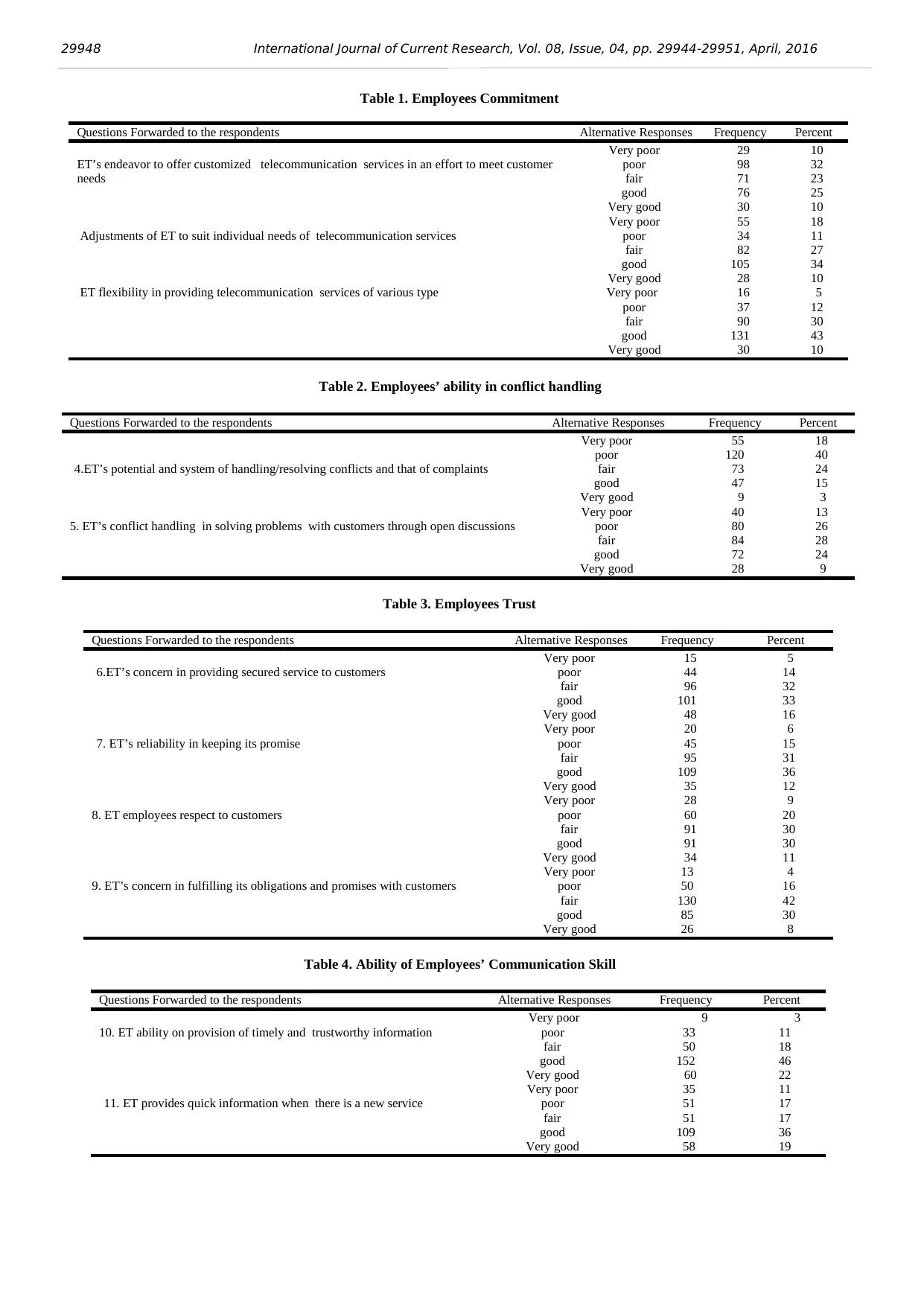
Table 1. Employees Commitment
Questions Forwarded to the respondents Alternative Responses Frequency Percent
ET’s endeavor to offer customized telecommunication services in an effort to meet customer
needs
Very poor 29 10
poor 98 32
fair 71 23
good 76 25
Very good 30 10
Adjustments of ET to suit individual needs of telecommunication services
Very poor 55 18
poor 34 11
fair 82 27
good 105 34
Very good 28 10
ET flexibility in providing telecommunication services of various type Very poor 16 5
poor 37 12
fair 90 30
good 131 43
Very good 30 10
Table 2. Employees’ ability in conflict handling
Questions Forwarded to the respondents Alternative Responses Frequency Percent
4.ET’s potential and system of handling/resolving conflicts and that of complaints
Very poor 55 18
poor 120 40
fair 73 24
good 47 15
Very good 9 3
5. ET’s conflict handling in solving problems with customers through open discussions
Very poor 40 13
poor 80 26
fair 84 28
good 72 24
Very good 28 9
Table 3. Employees Trust
Questions Forwarded to the respondents Alternative Responses Frequency Percent
6.ET’s concern in providing secured service to customers
Very poor 15 5
poor 44 14
fair 96 32
good 101 33
Very good 48 16
7. ET’s reliability in keeping its promise
Very poor 20 6
poor 45 15
fair 95 31
good 109 36
Very good 35 12
8. ET employees respect to customers
Very poor 28 9
poor 60 20
fair 91 30
good 91 30
Very good 34 11
9. ET’s concern in fulfilling its obligations and promises with customers
Very poor 13 4
poor 50 16
fair 130 42
good 85 30
Very good 26 8
Table 4. Ability of Employees’ Communication Skill
Questions Forwarded to the respondents Alternative Responses Frequency Percent
10. ET ability on provision of timely and trustworthy information
Very poor 9 3
poor 33 11
fair 50 18
good 152 46
Very good 60 22
11. ET provides quick information when there is a new service
Very poor 35 11
poor 51 17
fair 51 17
good 109 36
Very good 58 19
29948 International Journal of Current Research, Vol. 08, Issue, 04, pp. 29944-29951, April, 2016
Questions Forwarded to the respondents Alternative Responses Frequency Percent
ET’s endeavor to offer customized telecommunication services in an effort to meet customer
needs
Very poor 29 10
poor 98 32
fair 71 23
good 76 25
Very good 30 10
Adjustments of ET to suit individual needs of telecommunication services
Very poor 55 18
poor 34 11
fair 82 27
good 105 34
Very good 28 10
ET flexibility in providing telecommunication services of various type Very poor 16 5
poor 37 12
fair 90 30
good 131 43
Very good 30 10
Table 2. Employees’ ability in conflict handling
Questions Forwarded to the respondents Alternative Responses Frequency Percent
4.ET’s potential and system of handling/resolving conflicts and that of complaints
Very poor 55 18
poor 120 40
fair 73 24
good 47 15
Very good 9 3
5. ET’s conflict handling in solving problems with customers through open discussions
Very poor 40 13
poor 80 26
fair 84 28
good 72 24
Very good 28 9
Table 3. Employees Trust
Questions Forwarded to the respondents Alternative Responses Frequency Percent
6.ET’s concern in providing secured service to customers
Very poor 15 5
poor 44 14
fair 96 32
good 101 33
Very good 48 16
7. ET’s reliability in keeping its promise
Very poor 20 6
poor 45 15
fair 95 31
good 109 36
Very good 35 12
8. ET employees respect to customers
Very poor 28 9
poor 60 20
fair 91 30
good 91 30
Very good 34 11
9. ET’s concern in fulfilling its obligations and promises with customers
Very poor 13 4
poor 50 16
fair 130 42
good 85 30
Very good 26 8
Table 4. Ability of Employees’ Communication Skill
Questions Forwarded to the respondents Alternative Responses Frequency Percent
10. ET ability on provision of timely and trustworthy information
Very poor 9 3
poor 33 11
fair 50 18
good 152 46
Very good 60 22
11. ET provides quick information when there is a new service
Very poor 35 11
poor 51 17
fair 51 17
good 109 36
Very good 58 19
29948 International Journal of Current Research, Vol. 08, Issue, 04, pp. 29944-29951, April, 2016
However, nearly 14% of the respondents evaluated it as poor
and 5% valued as very poor. This result shows that ETs
concern in providing secure services to customer of the
employees is still needs little improvement. As to ETs
reliability in keeping its promise, 33% of the respondents
answered well, 32% fair, while the remaining 16% said very
well and 14% poor. ETs reliability in keeping its promise most
of the respondents (79%) are positive and valued fair and above
21 % (15% poor and 6% very poor) of the respondents claimed
that the ETs reliability in keeping its promise is not up to the
expectation of customers and the organization standard.
customers were asked whether ETs employees with whom they
contacted in the past had paid respect to them, most of the
customers have got proper respect from Ethio Telecom
employees (30% good, 30% fair 11 % very good) and the
remaining 29% (20% poor, 9% very poor) customers are not
happy with performance of Ethio Telecom employees on the
area of customer respect. The responses of majority
respondents for the question ETs concern in fulfilling its
obligations and promises with customers give an impression
that 80% of the respondents valued fair and above (42% fair,
30% good, and 8% very good). The remaining 16% and 4% are
evaluating poor and very poor respectively. Interview made
with the manager of Bahir Dar branch direct channel
Management Division of ET, has revealed that the direct
channel division has devised ways to tackle problems with
regard to discharging the organization’s responsibility. An
administrative decision is to be taken on the basis of
employee’s performance in fulfilling their duty in particular
and the organization obligation in general. Trust is an important
foundation of relationship marketing is particularly important
in building quality relationship as individuals seek predictable
and consistent behavior on the part of their partner such that a
relatively high degree of certainty is attached to future rewards.
Besides, it reduces transaction costs as there is less necessity to
establish expensive controlling mechanisms; lower costs in
turn increases the probability continuing the relationship in the
future and, therefore, increases commitment to the relationship
quality because, both parties are relied upon each other
(Ganesan, 1994).
The descriptive result of the study shows that about 80% of the
study participants evaluated the degree of trustworthiness of
employees of the organization as fair and above. However, still
there is formidable proportion of customers who were not
happy with trustworthiness of employees showing that the
Ethio Telecom has to address this gap of employees.
Communication
To measure the overall role of communication on relationship
marketing, two questions were forwarded to respondents as
shown in table 4. The first one is ETs ability on provision of
timely and trustworthy information and the other one is,
whether ET provides quick information when there is a new
service or not. For the first one, ETs ability on provision of
timely and trustworthy information, the respondents valued
46% good, 22% very good, and 18% fair. However, small
proportion of the respondents (11% poor and 3% very poor)
responded negatively to this particular variable. For the second
one, whether ET provides quick information when there is a
new service or not, 55% of the respondents responded good
and above and 17% fair. The remaining respondents responded
that 17% poor and 11% very poor. The interview conducted
with some managers of the ET of Bahir Dar branch shows that
communication skill of employees is increasing after the
Ethiopian telecommunication corporation reborn as Ethio
Telecom which the management system is under taken by
France telecom. They further explained that, after the change of
management the communication system between employees
and top managers is short and direct. Similarly the customer is
free to communicate with front line employees and top level
managers as well. Moreover, ET is good at promotion and
advertisements of its products and services using different
Medias like television, radio, and written Medias including
massages sent through Cell Phones. Discount and price
reduction is made with holidays and other occasions. Gronroos
(1994) pointed out that the outcome of an ongoing
communication may offer a feeling of control, security, a sense
of trust, minimized purchasing risks and, importantly, reduce
cost to the customer. So, devising effective personal
communication is a fundamental part of relationship marketing
and that dialogue is a key feature that makes each customer feel
special and unique. In addition to this, effective communication
helps to shape realistic expectations between partners and
develops a sense of closeness and ease in the relationship.
When there is effective communication between the
organization and its customers, customers are better informed
about the organization initiatives or plan and activities,
uncertainty will reduce and relationship quality will also
improve, because the ability of employees to communicate well
contributes to good relationship quality of Ethio Telecom with
its customers.
Conclusion
Relationship marketing is an important strategy for every
business organizations in general and service organizations in
particular since service by its very nature needs the interaction
and physical presence. To achieve good relationship quality
with the customer the knowledge of determinants of
relationship marketing is important. And the most important
determinants of relationship marketing are: commitment, trust,
conflict handling, and communication. In line with the
theoretical contributions of these determinants briefly stated,
this study assess determinants of relationship marketing in
Ethio Telecom Bahir dar branch by examining the
organizations activity with recently developed concepts. From
descriptive analysis it is possible to conclude that each
relationship determinants are important on relationship
marketing of Ethio telecom. Communication has got the
highest valu of customers which 79% of the customers have
positive attitude towards their communication with Ethio
Telecom. The next most important variable for relationship
marketing is trust, which accounts 78% of customers able to
develop trust on ET in general ET employees in particular. The
third determinants of relationship marketing is commitment in
which 71% of the respondents were committed to continue
their relationship, satisfied with Ethio Telecom. The last
determinant is Conflict handling; which only about 52% of the
customers are happy with ET conflict or complaint handling.
Nearly equal number of customers (48%) did not get proper
29949 Belay Mengstie.Assessments on determinants of relationship marketing: the case of Ethio telecom, Bahir Dar branch
and 5% valued as very poor. This result shows that ETs
concern in providing secure services to customer of the
employees is still needs little improvement. As to ETs
reliability in keeping its promise, 33% of the respondents
answered well, 32% fair, while the remaining 16% said very
well and 14% poor. ETs reliability in keeping its promise most
of the respondents (79%) are positive and valued fair and above
21 % (15% poor and 6% very poor) of the respondents claimed
that the ETs reliability in keeping its promise is not up to the
expectation of customers and the organization standard.
customers were asked whether ETs employees with whom they
contacted in the past had paid respect to them, most of the
customers have got proper respect from Ethio Telecom
employees (30% good, 30% fair 11 % very good) and the
remaining 29% (20% poor, 9% very poor) customers are not
happy with performance of Ethio Telecom employees on the
area of customer respect. The responses of majority
respondents for the question ETs concern in fulfilling its
obligations and promises with customers give an impression
that 80% of the respondents valued fair and above (42% fair,
30% good, and 8% very good). The remaining 16% and 4% are
evaluating poor and very poor respectively. Interview made
with the manager of Bahir Dar branch direct channel
Management Division of ET, has revealed that the direct
channel division has devised ways to tackle problems with
regard to discharging the organization’s responsibility. An
administrative decision is to be taken on the basis of
employee’s performance in fulfilling their duty in particular
and the organization obligation in general. Trust is an important
foundation of relationship marketing is particularly important
in building quality relationship as individuals seek predictable
and consistent behavior on the part of their partner such that a
relatively high degree of certainty is attached to future rewards.
Besides, it reduces transaction costs as there is less necessity to
establish expensive controlling mechanisms; lower costs in
turn increases the probability continuing the relationship in the
future and, therefore, increases commitment to the relationship
quality because, both parties are relied upon each other
(Ganesan, 1994).
The descriptive result of the study shows that about 80% of the
study participants evaluated the degree of trustworthiness of
employees of the organization as fair and above. However, still
there is formidable proportion of customers who were not
happy with trustworthiness of employees showing that the
Ethio Telecom has to address this gap of employees.
Communication
To measure the overall role of communication on relationship
marketing, two questions were forwarded to respondents as
shown in table 4. The first one is ETs ability on provision of
timely and trustworthy information and the other one is,
whether ET provides quick information when there is a new
service or not. For the first one, ETs ability on provision of
timely and trustworthy information, the respondents valued
46% good, 22% very good, and 18% fair. However, small
proportion of the respondents (11% poor and 3% very poor)
responded negatively to this particular variable. For the second
one, whether ET provides quick information when there is a
new service or not, 55% of the respondents responded good
and above and 17% fair. The remaining respondents responded
that 17% poor and 11% very poor. The interview conducted
with some managers of the ET of Bahir Dar branch shows that
communication skill of employees is increasing after the
Ethiopian telecommunication corporation reborn as Ethio
Telecom which the management system is under taken by
France telecom. They further explained that, after the change of
management the communication system between employees
and top managers is short and direct. Similarly the customer is
free to communicate with front line employees and top level
managers as well. Moreover, ET is good at promotion and
advertisements of its products and services using different
Medias like television, radio, and written Medias including
massages sent through Cell Phones. Discount and price
reduction is made with holidays and other occasions. Gronroos
(1994) pointed out that the outcome of an ongoing
communication may offer a feeling of control, security, a sense
of trust, minimized purchasing risks and, importantly, reduce
cost to the customer. So, devising effective personal
communication is a fundamental part of relationship marketing
and that dialogue is a key feature that makes each customer feel
special and unique. In addition to this, effective communication
helps to shape realistic expectations between partners and
develops a sense of closeness and ease in the relationship.
When there is effective communication between the
organization and its customers, customers are better informed
about the organization initiatives or plan and activities,
uncertainty will reduce and relationship quality will also
improve, because the ability of employees to communicate well
contributes to good relationship quality of Ethio Telecom with
its customers.
Conclusion
Relationship marketing is an important strategy for every
business organizations in general and service organizations in
particular since service by its very nature needs the interaction
and physical presence. To achieve good relationship quality
with the customer the knowledge of determinants of
relationship marketing is important. And the most important
determinants of relationship marketing are: commitment, trust,
conflict handling, and communication. In line with the
theoretical contributions of these determinants briefly stated,
this study assess determinants of relationship marketing in
Ethio Telecom Bahir dar branch by examining the
organizations activity with recently developed concepts. From
descriptive analysis it is possible to conclude that each
relationship determinants are important on relationship
marketing of Ethio telecom. Communication has got the
highest valu of customers which 79% of the customers have
positive attitude towards their communication with Ethio
Telecom. The next most important variable for relationship
marketing is trust, which accounts 78% of customers able to
develop trust on ET in general ET employees in particular. The
third determinants of relationship marketing is commitment in
which 71% of the respondents were committed to continue
their relationship, satisfied with Ethio Telecom. The last
determinant is Conflict handling; which only about 52% of the
customers are happy with ET conflict or complaint handling.
Nearly equal number of customers (48%) did not get proper
29949 Belay Mengstie.Assessments on determinants of relationship marketing: the case of Ethio telecom, Bahir Dar branch
⊘ This is a preview!⊘
Do you want full access?
Subscribe today to unlock all pages.
Trusted by 1+ million students worldwide
treatment while they got problem on the service of ET. To sum
up, ET has different means of checking whether employees are
trusted, committed to their responsibility as well as for their
customers by conducting audit, and monitoring each
employee’s daily activities by the immediate supervisor. In
addition to this, ET providing continuous training for these
lower performers as well as other employees to make the
service more attractive than before.
Recommendations
Based on the major findings obtained from the study, the
researcher provided the following recommendations.
The study indicated that nearly one third of the employees
of Ethio Telecom are not committed to their work. ET is at
transition period there by some employees feel insecurity to
their job and there is knowledge gap to perform the new
working process. Therefore, it is advisable that ET should
provide encouragement and training to employees in order
to improve their commitment and there by develop good
relationship with customers.
ET’s potential in avoiding conflict/complaint is poor.
Supporting employees with formal conflict handling
training will further enhance their skill in improving the
existing moderate relationship between employees of ET
and its customers. Therefore, ET needs to identify its
weakness and provide the appropriate training.
Furthermore, it is better to introduce complete changes in
customer complaint handling system and its outcome by
giving clear cut instructions to the concerned sections for
legitimate evaluation on customer complaints.
There is some proportion of customers who were not happy
with the degree of trustworthiness and communication, lack
of awareness about trust, communication and their proper
use will have immeasurable importance on relationship
marketing. Thus managements of ET should arrange
awareness creation program to employees on trust and
communication determinants in particular and relationship
marketing in general.
Further Research Directions
This study focused on determinants of relationship marketing
on Bahirdar branch. This hence limiting generalization of the
results to all Ethio telecom in Ethiopia. Further studies may
thus focus on Ethio telecom other branches. Future research
can also investigate other determinants of marketing using a
broader framework to measure relationship quality.
REFERENCES
Abdul-Muhmin, A G 2005, ‘Instrumental and interpersonal
determinants of relationship satisfaction and commitment
in Industrial markets’, Journal of Business Research,
vol.58, pp.619–628.
Adanech G 2014, ‘Relationship marketing :the case of
Ethiopian air line’, MA thesis, Addis Ababa university,
Ethiopia
Adrian, P. 1995, Relationship marketing for competitive
advantage: winning and keeping customers, London,
Butterworth-Heinemann Ltd.
Anderson, E. and Narus, J. 1990, ‘A model of Distributor Firm
and Manufacturer Firm Working Partnerships’, Journal of
Marketing, 54, 42-58
Auh, S 2005, ‘The effects of soft and hard service attributes on
loyalty: the mediating role of trust’, Journal of Services
Marketing, 19(2):PP. 81–92.
Berry, L 1987, ‘Big ideas in services marketing, Int. Journal of
Services Marketing (1): pp.5-.9.
Bogazzi 1979, Towards a formal theory of marketing
exchange, south western publishing.
Bojeia and Alwie 2010, ‘The influence of relationship quality
on loyalty in service sector’, Int. Journal of Economics and
Management, (1): PP.81– 100
Browning, Kathy 2007, Conflict management and resolution,
McGraw hill Publisher.
Chan K and Ndubisi, N 2004, ‘Building customer loyalty in the
digital age through relationship marketing and the
mediation effect of trust’, in Proceedings of the 5th
International Conference on Operations and Quantitative
Management, Seoul, South Korea, pp.293–302.
Dwyer R, paul H, Schurr, A, Oh S 1987, ‘Developing buyer
seller relationships’, Journal of Marketing,vol.51, pp.11-27.
Ganesan S 1994. ‘Determinants of long-term orientation in
buyer-seller relationships’, Journal of Marketing, 58: pp.
1-19.
Grönroos, C. 1990. ‘Relationship approach to the marketing
function in service contexts: the marketing and
organizational behavior interface’, Journal of Business
Research, Vol. 20, No. 1, pp.3–12.
Grönroos, C. 1994. ‘From marketing mix to relationship
marketing: towards a paradigm shift in marketing’,
Management Decision, Vol. 32, No. 2, pp. 4-20.
Hoffman, K.D. and Bateson, J.E.G. 2002, Essentials of
Services Marketing: Concepts, Strategies & Cases,
Harcourt College Publishers.
Houn-Gee Chen, Edward T. Chen, Ayi Yeh 2001. The Effects
of Relationship Commitment and Trust on Business to
Consumer Electronic Commerce, Taiwan.
Johnson, J.L. 1999. ‘Strategic integration in industrial
distribution channels: managing the interfirm relationship
as a strategic asset’, Journal of the Academy of Marketing
Science, Vol. 27, No.1, pp.4–18.
Jones, M A and Suh, J 2000. ‘Transaction-specific satisfaction
and overall satisfaction: an empirical analysis’, Journal of
Services Marketing, 14(2): pp. 147-159.
Kindye Esa 2011. ‘Effect of after sale services on customer
satisfaction and loyalty in automotive industry of Ethiopia’,
MBA thesis, Addis Ababa university, Ethiopia.
Kotler, P 2002. Marketing Management Millennium Edition:
Custom Edition for University of Phoenix, 10th ed. USA:
Pearson Custom Publishing.
Kotler, P. 2000. Marketing Management, 10th International
ed., Prentice Hall.
Maznah W 2000. ‘The Mediating Effect of Cognitive and
Emotional Satisfaction on Customer Loyalty’, Malaysia.
McDonald, G. W. 1981, ‘Structural Exchange and Marital
Interaction’, Journal of Marriage and the Family.
Meyer, J P. and Smith, C A 2000, ‘Human resource
management practices and organizational commitment: test
of a mediation model’, Canadian Journal of Administrative
Sciences, vol.14 (.4): pp .319-31.
29950 International Journal of Current Research, Vol. 08, Issue, 04, pp. 29944-29951, April, 2016
up, ET has different means of checking whether employees are
trusted, committed to their responsibility as well as for their
customers by conducting audit, and monitoring each
employee’s daily activities by the immediate supervisor. In
addition to this, ET providing continuous training for these
lower performers as well as other employees to make the
service more attractive than before.
Recommendations
Based on the major findings obtained from the study, the
researcher provided the following recommendations.
The study indicated that nearly one third of the employees
of Ethio Telecom are not committed to their work. ET is at
transition period there by some employees feel insecurity to
their job and there is knowledge gap to perform the new
working process. Therefore, it is advisable that ET should
provide encouragement and training to employees in order
to improve their commitment and there by develop good
relationship with customers.
ET’s potential in avoiding conflict/complaint is poor.
Supporting employees with formal conflict handling
training will further enhance their skill in improving the
existing moderate relationship between employees of ET
and its customers. Therefore, ET needs to identify its
weakness and provide the appropriate training.
Furthermore, it is better to introduce complete changes in
customer complaint handling system and its outcome by
giving clear cut instructions to the concerned sections for
legitimate evaluation on customer complaints.
There is some proportion of customers who were not happy
with the degree of trustworthiness and communication, lack
of awareness about trust, communication and their proper
use will have immeasurable importance on relationship
marketing. Thus managements of ET should arrange
awareness creation program to employees on trust and
communication determinants in particular and relationship
marketing in general.
Further Research Directions
This study focused on determinants of relationship marketing
on Bahirdar branch. This hence limiting generalization of the
results to all Ethio telecom in Ethiopia. Further studies may
thus focus on Ethio telecom other branches. Future research
can also investigate other determinants of marketing using a
broader framework to measure relationship quality.
REFERENCES
Abdul-Muhmin, A G 2005, ‘Instrumental and interpersonal
determinants of relationship satisfaction and commitment
in Industrial markets’, Journal of Business Research,
vol.58, pp.619–628.
Adanech G 2014, ‘Relationship marketing :the case of
Ethiopian air line’, MA thesis, Addis Ababa university,
Ethiopia
Adrian, P. 1995, Relationship marketing for competitive
advantage: winning and keeping customers, London,
Butterworth-Heinemann Ltd.
Anderson, E. and Narus, J. 1990, ‘A model of Distributor Firm
and Manufacturer Firm Working Partnerships’, Journal of
Marketing, 54, 42-58
Auh, S 2005, ‘The effects of soft and hard service attributes on
loyalty: the mediating role of trust’, Journal of Services
Marketing, 19(2):PP. 81–92.
Berry, L 1987, ‘Big ideas in services marketing, Int. Journal of
Services Marketing (1): pp.5-.9.
Bogazzi 1979, Towards a formal theory of marketing
exchange, south western publishing.
Bojeia and Alwie 2010, ‘The influence of relationship quality
on loyalty in service sector’, Int. Journal of Economics and
Management, (1): PP.81– 100
Browning, Kathy 2007, Conflict management and resolution,
McGraw hill Publisher.
Chan K and Ndubisi, N 2004, ‘Building customer loyalty in the
digital age through relationship marketing and the
mediation effect of trust’, in Proceedings of the 5th
International Conference on Operations and Quantitative
Management, Seoul, South Korea, pp.293–302.
Dwyer R, paul H, Schurr, A, Oh S 1987, ‘Developing buyer
seller relationships’, Journal of Marketing,vol.51, pp.11-27.
Ganesan S 1994. ‘Determinants of long-term orientation in
buyer-seller relationships’, Journal of Marketing, 58: pp.
1-19.
Grönroos, C. 1990. ‘Relationship approach to the marketing
function in service contexts: the marketing and
organizational behavior interface’, Journal of Business
Research, Vol. 20, No. 1, pp.3–12.
Grönroos, C. 1994. ‘From marketing mix to relationship
marketing: towards a paradigm shift in marketing’,
Management Decision, Vol. 32, No. 2, pp. 4-20.
Hoffman, K.D. and Bateson, J.E.G. 2002, Essentials of
Services Marketing: Concepts, Strategies & Cases,
Harcourt College Publishers.
Houn-Gee Chen, Edward T. Chen, Ayi Yeh 2001. The Effects
of Relationship Commitment and Trust on Business to
Consumer Electronic Commerce, Taiwan.
Johnson, J.L. 1999. ‘Strategic integration in industrial
distribution channels: managing the interfirm relationship
as a strategic asset’, Journal of the Academy of Marketing
Science, Vol. 27, No.1, pp.4–18.
Jones, M A and Suh, J 2000. ‘Transaction-specific satisfaction
and overall satisfaction: an empirical analysis’, Journal of
Services Marketing, 14(2): pp. 147-159.
Kindye Esa 2011. ‘Effect of after sale services on customer
satisfaction and loyalty in automotive industry of Ethiopia’,
MBA thesis, Addis Ababa university, Ethiopia.
Kotler, P 2002. Marketing Management Millennium Edition:
Custom Edition for University of Phoenix, 10th ed. USA:
Pearson Custom Publishing.
Kotler, P. 2000. Marketing Management, 10th International
ed., Prentice Hall.
Maznah W 2000. ‘The Mediating Effect of Cognitive and
Emotional Satisfaction on Customer Loyalty’, Malaysia.
McDonald, G. W. 1981, ‘Structural Exchange and Marital
Interaction’, Journal of Marriage and the Family.
Meyer, J P. and Smith, C A 2000, ‘Human resource
management practices and organizational commitment: test
of a mediation model’, Canadian Journal of Administrative
Sciences, vol.14 (.4): pp .319-31.
29950 International Journal of Current Research, Vol. 08, Issue, 04, pp. 29944-29951, April, 2016
Paraphrase This Document
Need a fresh take? Get an instant paraphrase of this document with our AI Paraphraser
Miaoulis, George, and R. D. Michener, 1976. An introduction
to sampling, Dubuque Iowa, Kendall/Hunt Publishing
Company.
Mohammad T., Shaeir B., Shahram G. 2011. The Relationship
between Customer Satisfaction and Relationship Marketing
Benefits.
Morgan, R. M. and Hunt, S. D. 1994, ‘The Commitment-Trust
Theory of Relationship Marketing’, Journal of Marketing,
20-38
Mouri, N. 2005. ‘A Consumer-Based Assessment of Alliance
Performance: An Examination of Consumer Value,
Satisfaction and Post-Purchase Behavior’, Doctor of
Philosophy Dissertation, University of Central Florida.
Naudé P and Buttle F 2000. ‘Assessing relationship quality’,
Industrial Management, vol. 29(4): pp. 351-361.
Ndubisi, N. and Chan, K 2005. ‘Factorial and discriminate
analyses of the underpinnings of relationship marketing and
customer satisfaction’, International Journal of Bank
Marketing, Vol. 23, No. 7, pp.542–557.
Ndubisi, N.O 2007, ‘Relationship marketing and customer
loyalty’, Marketing Intelligence & Planning, Vol. 25, No.
1, pp.98–106
Negi, R. 2010. ‘Factorial and regression analyses of
relationship marketing antecedents and customer loyalty:
the Ethiopian telecommunications perspective’, Int. J.
Electronic Customer Relationship Management, Vol. 4, No.
3, pp.252–263.
Patricia S 2002. Relationship marketing strategy, College of
Business, Rochester Institute of Technology.
Rajasekhara M 2010. ‘An assessment of Ethiopian telecom
customer satisfaction’, Global Journal of Management and
Business Research.
Stauss, B 2000. Using New Media for Customer Interaction: A
Challenge for Relationship Marketing, Berlin.
Tse D and Wilton P. 1988. ‘models of customer satisfaction
formation’, Journal of Marketing Research, vol. 25 no 1 pp
204-212
Wilson and Jantrania 1994. ‘Understanding the value of
relationship’, Australia Marketing Journal, Vol2. no.1
Zeithamal, V.A., Berry, L L and Parasuraman A 1996, ‘The
behavioral consequences of service quality’, Journal of
Marketing, 60, pp. 31-46.
Zeithmal, V and Bitner, M. 2000. service marketing second
edition, McGraw hill Publisher.
*******
29951 Belay Mengstie.Assessments on determinants of relationship marketing: the case of Ethio telecom, Bahir Dar branch
to sampling, Dubuque Iowa, Kendall/Hunt Publishing
Company.
Mohammad T., Shaeir B., Shahram G. 2011. The Relationship
between Customer Satisfaction and Relationship Marketing
Benefits.
Morgan, R. M. and Hunt, S. D. 1994, ‘The Commitment-Trust
Theory of Relationship Marketing’, Journal of Marketing,
20-38
Mouri, N. 2005. ‘A Consumer-Based Assessment of Alliance
Performance: An Examination of Consumer Value,
Satisfaction and Post-Purchase Behavior’, Doctor of
Philosophy Dissertation, University of Central Florida.
Naudé P and Buttle F 2000. ‘Assessing relationship quality’,
Industrial Management, vol. 29(4): pp. 351-361.
Ndubisi, N. and Chan, K 2005. ‘Factorial and discriminate
analyses of the underpinnings of relationship marketing and
customer satisfaction’, International Journal of Bank
Marketing, Vol. 23, No. 7, pp.542–557.
Ndubisi, N.O 2007, ‘Relationship marketing and customer
loyalty’, Marketing Intelligence & Planning, Vol. 25, No.
1, pp.98–106
Negi, R. 2010. ‘Factorial and regression analyses of
relationship marketing antecedents and customer loyalty:
the Ethiopian telecommunications perspective’, Int. J.
Electronic Customer Relationship Management, Vol. 4, No.
3, pp.252–263.
Patricia S 2002. Relationship marketing strategy, College of
Business, Rochester Institute of Technology.
Rajasekhara M 2010. ‘An assessment of Ethiopian telecom
customer satisfaction’, Global Journal of Management and
Business Research.
Stauss, B 2000. Using New Media for Customer Interaction: A
Challenge for Relationship Marketing, Berlin.
Tse D and Wilton P. 1988. ‘models of customer satisfaction
formation’, Journal of Marketing Research, vol. 25 no 1 pp
204-212
Wilson and Jantrania 1994. ‘Understanding the value of
relationship’, Australia Marketing Journal, Vol2. no.1
Zeithamal, V.A., Berry, L L and Parasuraman A 1996, ‘The
behavioral consequences of service quality’, Journal of
Marketing, 60, pp. 31-46.
Zeithmal, V and Bitner, M. 2000. service marketing second
edition, McGraw hill Publisher.
*******
29951 Belay Mengstie.Assessments on determinants of relationship marketing: the case of Ethio telecom, Bahir Dar branch

1 out of 8


Your All-in-One AI-Powered Toolkit for Academic Success.
+13062052269
info@desklib.com
Available 24*7 on WhatsApp / Email
![[object Object]](/_next/static/media/star-bottom.7253800d.svg)
Unlock your academic potential
Copyright © 2020–2026 A2Z Services. All Rights Reserved. Developed and managed by ZUCOL.