Business Project Plan: Teamwork, Culture, and Project Evaluation
VerifiedAdded on 2023/06/11
|11
|4450
|148
Report
AI Summary
This report outlines a business plan for a marketing campaign aimed at promoting Tasmania International Academics (TIA). It emphasizes the significance of teamwork and a positive workplace culture in achieving project success. The report delves into strategies for ensuring effective teamwork, fostering a conducive work environment, and evaluating the project plan. Key aspects include clear communication, defined project goals, conflict management, and motivational leadership. Furthermore, it addresses potential negative synergies and proposes methods for improving employee cooperation. The ultimate goal is to create a balanced work culture that drives competitive advantage and revenue generation for TIA. This document is available on Desklib, where students can access a wealth of solved assignments and study resources.

580Developing a plan for Business Project

Paraphrase This Document
Need a fresh take? Get an instant paraphrase of this document with our AI Paraphraser
Name ID Assignment Number
Contents
Executive Summary...............................................................................................................................2
Introduction...........................................................................................................................................2
Task-1 Ensuring Team Work in the Workplace......................................................................................2
Task-2 Fostering a Positive Workplace Culture......................................................................................2
Task-3 Evaluating a Project....................................................................................................................3
Conclusion.............................................................................................................................................3
References.............................................................................................................................................3
1
Contents
Executive Summary...............................................................................................................................2
Introduction...........................................................................................................................................2
Task-1 Ensuring Team Work in the Workplace......................................................................................2
Task-2 Fostering a Positive Workplace Culture......................................................................................2
Task-3 Evaluating a Project....................................................................................................................3
Conclusion.............................................................................................................................................3
References.............................................................................................................................................3
1
Name ID Assignment Number
Executive Summary
This report depicts the importance of developing a business plan mainly for a market campaign
required for promoting an institution named as Tasmania International Academics (TIA). In order to
meet the requirements of the marketing campaign it is necessary for the business organization to
take necessary team work actions in the workplace. In addition to this fostering a positive workplace
culture is also important to be considered besides the evaluation of a perfect project plan. In order
to create a balanced work culture within the workplace, it is necessary for the business organization
to evaluate a project plan. It has been found that with the help of a positive work culture the
company will be able to gain competitive advantages and structure revenue simultaneously. From
the details of the business background it has been found that, based on marketing strategy a
communication plan, should have to be developed so that, collaboration among the project team
members can be generated. However, the quality of the educational service of the institution is a
low price strategy which targets the consumers so that an accurate business plan can be
implemented. For any business, the target customers are referred to as one of the most important
assets. Both national and international customers are target for the institution thus, after analyzing
and understanding the basics of international and national academics need proper guidelines are to
be implemented by the project managers. The demand of the national and international students
differs a lot thus both the academics demands are to be considered by the project manager who is
responsible to develop the project plan.
Introduction
The academics project plan developed by the institution is mainly focused on the requirements of
the students. However, the purpose of Tasmania International Academics (TIA) is to establish a
business plan and based on that an accurate workplace culture so that the project team members
can keep themselves engage to their job roles. A positive workplace culture will give competitive
advantages and advertisement model to the institution Tasmania International Academics (TIA). In
order to promote the business the Tasmania International Academics (TIA) is looking for developing
new and advanced market campaigning. It is expected that with the successful implementation of
the business plan the issues of competitive advantages will be completely resolved. The adopted
positive workplace culture and based on that the project plan that has been developed is also
elaborated in this report.
2
Executive Summary
This report depicts the importance of developing a business plan mainly for a market campaign
required for promoting an institution named as Tasmania International Academics (TIA). In order to
meet the requirements of the marketing campaign it is necessary for the business organization to
take necessary team work actions in the workplace. In addition to this fostering a positive workplace
culture is also important to be considered besides the evaluation of a perfect project plan. In order
to create a balanced work culture within the workplace, it is necessary for the business organization
to evaluate a project plan. It has been found that with the help of a positive work culture the
company will be able to gain competitive advantages and structure revenue simultaneously. From
the details of the business background it has been found that, based on marketing strategy a
communication plan, should have to be developed so that, collaboration among the project team
members can be generated. However, the quality of the educational service of the institution is a
low price strategy which targets the consumers so that an accurate business plan can be
implemented. For any business, the target customers are referred to as one of the most important
assets. Both national and international customers are target for the institution thus, after analyzing
and understanding the basics of international and national academics need proper guidelines are to
be implemented by the project managers. The demand of the national and international students
differs a lot thus both the academics demands are to be considered by the project manager who is
responsible to develop the project plan.
Introduction
The academics project plan developed by the institution is mainly focused on the requirements of
the students. However, the purpose of Tasmania International Academics (TIA) is to establish a
business plan and based on that an accurate workplace culture so that the project team members
can keep themselves engage to their job roles. A positive workplace culture will give competitive
advantages and advertisement model to the institution Tasmania International Academics (TIA). In
order to promote the business the Tasmania International Academics (TIA) is looking for developing
new and advanced market campaigning. It is expected that with the successful implementation of
the business plan the issues of competitive advantages will be completely resolved. The adopted
positive workplace culture and based on that the project plan that has been developed is also
elaborated in this report.
2
⊘ This is a preview!⊘
Do you want full access?
Subscribe today to unlock all pages.

Trusted by 1+ million students worldwide
Name ID Assignment Number
Task-1 Ensuring Team Work in the Workplace
1. In order to implement any project it is necessary for the project manager and the
project team members work professionally on their allotted job roles. How fast
the project team is running can be measured with the help of the performance
measurement matrix. No inter organization and intra organizational conflict is
allowed during the project development phase within the project team. This is
the responsibility of the project manager to take necessary actions through
which the project team members will free to share their point of views to each
other. In addition to this, it will also help them to keep themselves engaged to
their job roles. Strong bonding among the project team members with high level
of trust and cooperativeness can only build a professional and successful project
team for Tasmania International Academics (TIA). Togetherness among the project
team members will only help the project team members to meet the project objectives
and shared business goal accurately. Due to successful project team it has been most of
the times found that the outcome of the project is even more than what have been
imagined by the project manager and the consumers. Generally these types of project
teams often have some special characteristics. Strong project team increases the overall
efficiency and effectiveness of the project team. The key characteristics of this type of
project team are as follows:
Clearly defined project goal and Clearly defined project goal:: For the successful
accomplishment of any project it is necessary for the project team members to have a
clearly defined project goal. If the project goal is clear to the project team then, both the
project manager and the project team members will feel free to define the exact project
objective. It is not necessary that all time projects will have a single goal rather a project
may have several goals. With the help clear definition those objectives can be easily
reached by the project manager.
Besides the clearly defined project goal the project team members should have clear idea about
their job roles. Based on the background of the Tasmania International Academics (TIA) project
the stakeholders and the resources of the project should be adopted by the project manager. In
addition to this, after measuring their skills and knowledge the roles and responsibilities of the
project team members should be divided.
Open and clear communication, Effective decision making and balanced participation: The Tasmania
International Academics (TIA) business should adopt open communication so that the project head
can share their innovation and creativity with the rest of the project team members.
With the help of open communication the business of Tasmania International Academics (TIA) will
be able to take effective decision for the institution. The high performances of the project team
members help them to meet the project objectives.
The project manager and the project team members are required to participate in the project
implementation plan equally. They should play active roles for meeting the project objectives. Their
professional attention to their job roles will divide the overall work load. Workplace work division
among the project team member will simply evaluate and implement any project successfully within
the estimated time and budget.
3
Task-1 Ensuring Team Work in the Workplace
1. In order to implement any project it is necessary for the project manager and the
project team members work professionally on their allotted job roles. How fast
the project team is running can be measured with the help of the performance
measurement matrix. No inter organization and intra organizational conflict is
allowed during the project development phase within the project team. This is
the responsibility of the project manager to take necessary actions through
which the project team members will free to share their point of views to each
other. In addition to this, it will also help them to keep themselves engaged to
their job roles. Strong bonding among the project team members with high level
of trust and cooperativeness can only build a professional and successful project
team for Tasmania International Academics (TIA). Togetherness among the project
team members will only help the project team members to meet the project objectives
and shared business goal accurately. Due to successful project team it has been most of
the times found that the outcome of the project is even more than what have been
imagined by the project manager and the consumers. Generally these types of project
teams often have some special characteristics. Strong project team increases the overall
efficiency and effectiveness of the project team. The key characteristics of this type of
project team are as follows:
Clearly defined project goal and Clearly defined project goal:: For the successful
accomplishment of any project it is necessary for the project team members to have a
clearly defined project goal. If the project goal is clear to the project team then, both the
project manager and the project team members will feel free to define the exact project
objective. It is not necessary that all time projects will have a single goal rather a project
may have several goals. With the help clear definition those objectives can be easily
reached by the project manager.
Besides the clearly defined project goal the project team members should have clear idea about
their job roles. Based on the background of the Tasmania International Academics (TIA) project
the stakeholders and the resources of the project should be adopted by the project manager. In
addition to this, after measuring their skills and knowledge the roles and responsibilities of the
project team members should be divided.
Open and clear communication, Effective decision making and balanced participation: The Tasmania
International Academics (TIA) business should adopt open communication so that the project head
can share their innovation and creativity with the rest of the project team members.
With the help of open communication the business of Tasmania International Academics (TIA) will
be able to take effective decision for the institution. The high performances of the project team
members help them to meet the project objectives.
The project manager and the project team members are required to participate in the project
implementation plan equally. They should play active roles for meeting the project objectives. Their
professional attention to their job roles will divide the overall work load. Workplace work division
among the project team member will simply evaluate and implement any project successfully within
the estimated time and budget.
3
Paraphrase This Document
Need a fresh take? Get an instant paraphrase of this document with our AI Paraphraser
Name ID Assignment Number
Managed conflict, Positive workplace environment, Participative relationship and cooperative
relationship: The allotted project manager for the project must have the ability to manage any
project professionally with high level motivational power and leadership. Leadership of the project
manager and co-operation of the project team members will resolve those components that may
cause intra organizational conflict.
In order to meet the project objectives the project manager and the project team member should
create such a workplace ambiance where all the project team members will feel free to pay active
attention o their job roles. A positive workplace environment will motivate the project team
members.
Besides the above mentioned perspectives the other features that the project team members should
adopt include cooperative relationship and participative relationship. The team goal can be easily
reached and creativity within the project is defined as very much helpful elements to be considered
to develop a successful project team. It has been found that clearly defined project goal can enhance
the project team unity and can also create ownership among the project. Innate skills related and
job related both components are to be measured and measured by the project manager and the
project executives to make effective project decision. Proper team meeting needs certain essential
roles those are to be played by the project manager and the project team members. The
responsibilities are also the individual roles those are to be played by the project managers.
2. a) There are different techniques through which positive synergy among the
project tem and the project manager can be evaluated. It is the responsibilities of
the project manager to consider all necessary components those are important
to implement workplace positive synergy. It has been found that human
discrepancy like individual priority, talent, interest, ego, habits and strength are
the basic components for which the workplace culture can be negatively
impacted. The by product of the team synergy issues in essence is currently
result to low productivity, cultural gap, lower productivity, lack of responsibility,
lower performance etc. the two different techniques that may ensure the
business is capable to develop positive synergy in the project team are as
follows:
Share project mission, vision and goals: The core values of any project team are its goal,
value and shared goal. It is the responsibility of the project manager to meet the project
target that may help the business to reach the project objectives. The project goal should be
clearly understood by each of the project team members. The different associate project
risks and risks with cultural overlapping that may negatively impact the project goals are to
should be minimized by the project team members. Stronger relationship between the
project manager and the project team members will improve the overall work efficiency of
the project. Undefined project goal may also lead to major project failure. In order to make
these possible proper reviews of the project goal and project vision and mission statements
are also important.
The project manager should pay the role of both project leader and project manager
simultaneously. Again with professional motivation the project team members will be able
to keep themselves engaged to their allotted job roles. In most of the cases, the roles of
leadership are emphasized but simultaneously the importance of the followers are not
4
Managed conflict, Positive workplace environment, Participative relationship and cooperative
relationship: The allotted project manager for the project must have the ability to manage any
project professionally with high level motivational power and leadership. Leadership of the project
manager and co-operation of the project team members will resolve those components that may
cause intra organizational conflict.
In order to meet the project objectives the project manager and the project team member should
create such a workplace ambiance where all the project team members will feel free to pay active
attention o their job roles. A positive workplace environment will motivate the project team
members.
Besides the above mentioned perspectives the other features that the project team members should
adopt include cooperative relationship and participative relationship. The team goal can be easily
reached and creativity within the project is defined as very much helpful elements to be considered
to develop a successful project team. It has been found that clearly defined project goal can enhance
the project team unity and can also create ownership among the project. Innate skills related and
job related both components are to be measured and measured by the project manager and the
project executives to make effective project decision. Proper team meeting needs certain essential
roles those are to be played by the project manager and the project team members. The
responsibilities are also the individual roles those are to be played by the project managers.
2. a) There are different techniques through which positive synergy among the
project tem and the project manager can be evaluated. It is the responsibilities of
the project manager to consider all necessary components those are important
to implement workplace positive synergy. It has been found that human
discrepancy like individual priority, talent, interest, ego, habits and strength are
the basic components for which the workplace culture can be negatively
impacted. The by product of the team synergy issues in essence is currently
result to low productivity, cultural gap, lower productivity, lack of responsibility,
lower performance etc. the two different techniques that may ensure the
business is capable to develop positive synergy in the project team are as
follows:
Share project mission, vision and goals: The core values of any project team are its goal,
value and shared goal. It is the responsibility of the project manager to meet the project
target that may help the business to reach the project objectives. The project goal should be
clearly understood by each of the project team members. The different associate project
risks and risks with cultural overlapping that may negatively impact the project goals are to
should be minimized by the project team members. Stronger relationship between the
project manager and the project team members will improve the overall work efficiency of
the project. Undefined project goal may also lead to major project failure. In order to make
these possible proper reviews of the project goal and project vision and mission statements
are also important.
The project manager should pay the role of both project leader and project manager
simultaneously. Again with professional motivation the project team members will be able
to keep themselves engaged to their allotted job roles. In most of the cases, the roles of
leadership are emphasized but simultaneously the importance of the followers are not
4
Name ID Assignment Number
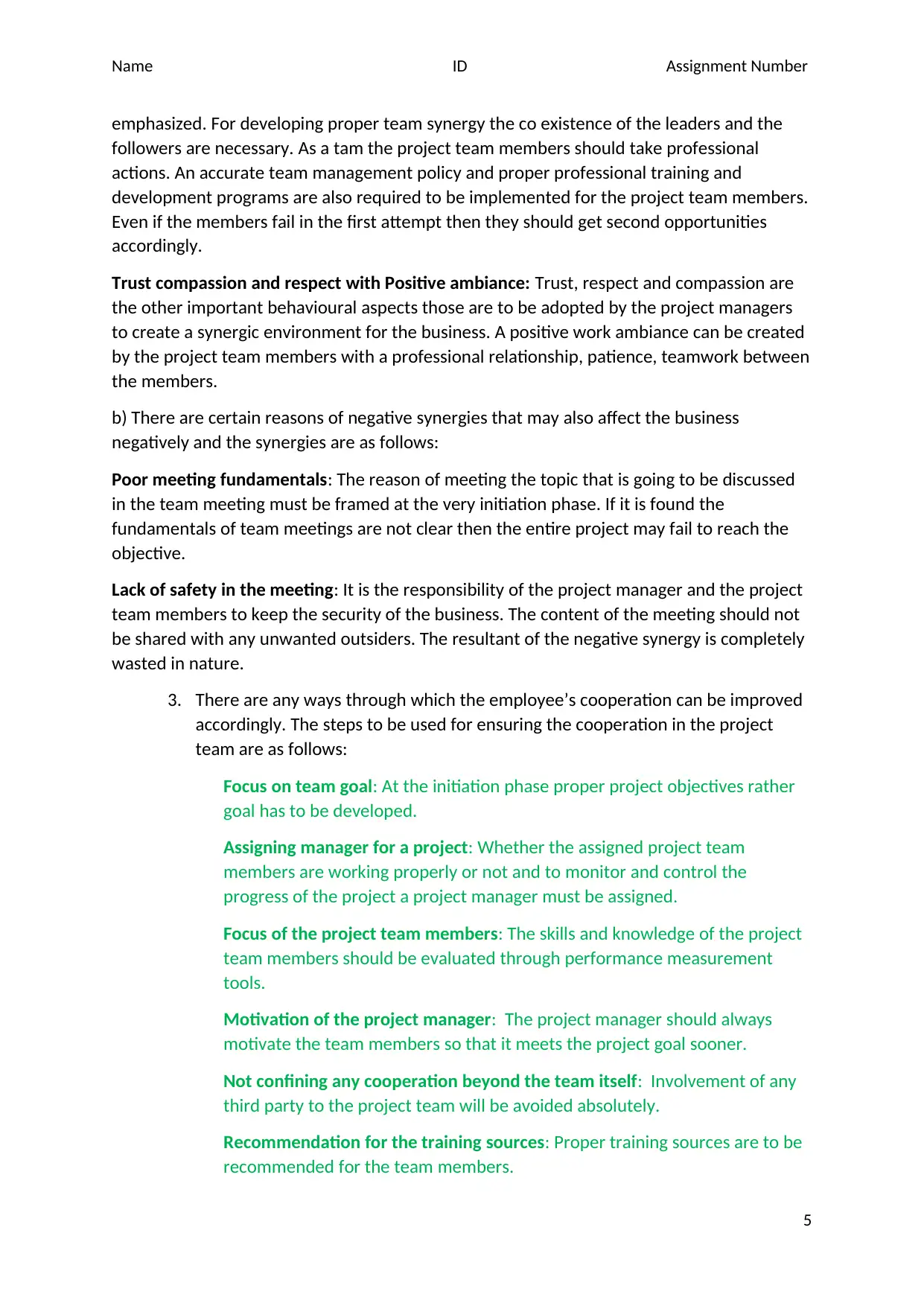
emphasized. For developing proper team synergy the co existence of the leaders and the
followers are necessary. As a tam the project team members should take professional
actions. An accurate team management policy and proper professional training and
development programs are also required to be implemented for the project team members.
Even if the members fail in the first attempt then they should get second opportunities
accordingly.
Trust compassion and respect with Positive ambiance: Trust, respect and compassion are
the other important behavioural aspects those are to be adopted by the project managers
to create a synergic environment for the business. A positive work ambiance can be created
by the project team members with a professional relationship, patience, teamwork between
the members.
b) There are certain reasons of negative synergies that may also affect the business
negatively and the synergies are as follows:
Poor meeting fundamentals: The reason of meeting the topic that is going to be discussed
in the team meeting must be framed at the very initiation phase. If it is found the
fundamentals of team meetings are not clear then the entire project may fail to reach the
objective.
Lack of safety in the meeting: It is the responsibility of the project manager and the project
team members to keep the security of the business. The content of the meeting should not
be shared with any unwanted outsiders. The resultant of the negative synergy is completely
wasted in nature.
3. There are any ways through which the employee’s cooperation can be improved
accordingly. The steps to be used for ensuring the cooperation in the project
team are as follows:
Focus on team goal: At the initiation phase proper project objectives rather
goal has to be developed.
Assigning manager for a project: Whether the assigned project team
members are working properly or not and to monitor and control the
progress of the project a project manager must be assigned.
Focus of the project team members: The skills and knowledge of the project
team members should be evaluated through performance measurement
tools.
Motivation of the project manager: The project manager should always
motivate the team members so that it meets the project goal sooner.
Not confining any cooperation beyond the team itself: Involvement of any
third party to the project team will be avoided absolutely.
Recommendation for the training sources: Proper training sources are to be
recommended for the team members.
5
emphasized. For developing proper team synergy the co existence of the leaders and the
followers are necessary. As a tam the project team members should take professional
actions. An accurate team management policy and proper professional training and
development programs are also required to be implemented for the project team members.
Even if the members fail in the first attempt then they should get second opportunities
accordingly.
Trust compassion and respect with Positive ambiance: Trust, respect and compassion are
the other important behavioural aspects those are to be adopted by the project managers
to create a synergic environment for the business. A positive work ambiance can be created
by the project team members with a professional relationship, patience, teamwork between
the members.
b) There are certain reasons of negative synergies that may also affect the business
negatively and the synergies are as follows:
Poor meeting fundamentals: The reason of meeting the topic that is going to be discussed
in the team meeting must be framed at the very initiation phase. If it is found the
fundamentals of team meetings are not clear then the entire project may fail to reach the
objective.
Lack of safety in the meeting: It is the responsibility of the project manager and the project
team members to keep the security of the business. The content of the meeting should not
be shared with any unwanted outsiders. The resultant of the negative synergy is completely
wasted in nature.
3. There are any ways through which the employee’s cooperation can be improved
accordingly. The steps to be used for ensuring the cooperation in the project
team are as follows:
Focus on team goal: At the initiation phase proper project objectives rather
goal has to be developed.
Assigning manager for a project: Whether the assigned project team
members are working properly or not and to monitor and control the
progress of the project a project manager must be assigned.
Focus of the project team members: The skills and knowledge of the project
team members should be evaluated through performance measurement
tools.
Motivation of the project manager: The project manager should always
motivate the team members so that it meets the project goal sooner.
Not confining any cooperation beyond the team itself: Involvement of any
third party to the project team will be avoided absolutely.
Recommendation for the training sources: Proper training sources are to be
recommended for the team members.
5
⊘ This is a preview!⊘
Do you want full access?
Subscribe today to unlock all pages.
Trusted by 1+ million students worldwide
Name ID Assignment Number
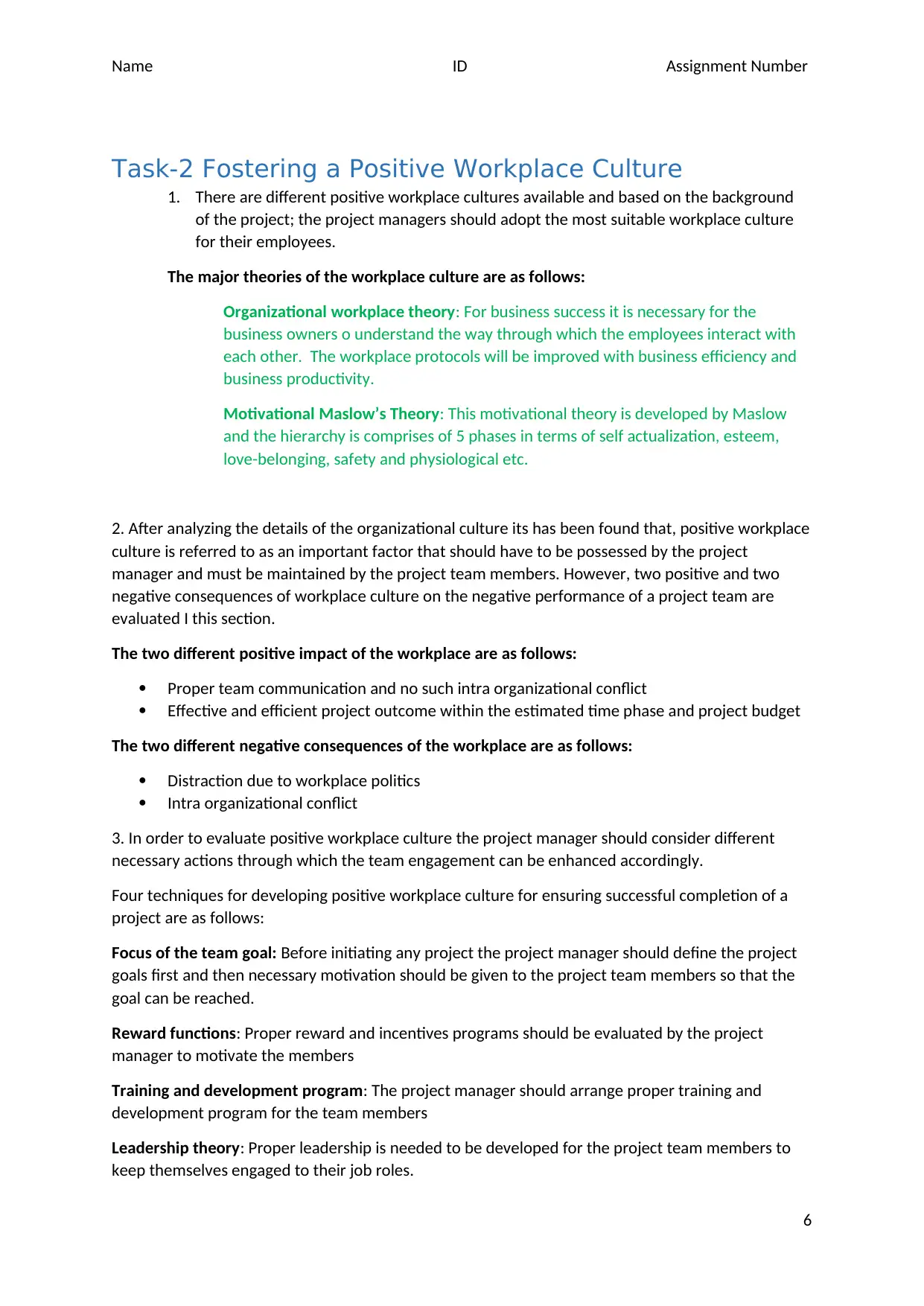
Task-2 Fostering a Positive Workplace Culture
1. There are different positive workplace cultures available and based on the background
of the project; the project managers should adopt the most suitable workplace culture
for their employees.
The major theories of the workplace culture are as follows:
Organizational workplace theory: For business success it is necessary for the
business owners o understand the way through which the employees interact with
each other. The workplace protocols will be improved with business efficiency and
business productivity.
Motivational Maslow’s Theory: This motivational theory is developed by Maslow
and the hierarchy is comprises of 5 phases in terms of self actualization, esteem,
love-belonging, safety and physiological etc.
2. After analyzing the details of the organizational culture its has been found that, positive workplace
culture is referred to as an important factor that should have to be possessed by the project
manager and must be maintained by the project team members. However, two positive and two
negative consequences of workplace culture on the negative performance of a project team are
evaluated I this section.
The two different positive impact of the workplace are as follows:
Proper team communication and no such intra organizational conflict
Effective and efficient project outcome within the estimated time phase and project budget
The two different negative consequences of the workplace are as follows:
Distraction due to workplace politics
Intra organizational conflict
3. In order to evaluate positive workplace culture the project manager should consider different
necessary actions through which the team engagement can be enhanced accordingly.
Four techniques for developing positive workplace culture for ensuring successful completion of a
project are as follows:
Focus of the team goal: Before initiating any project the project manager should define the project
goals first and then necessary motivation should be given to the project team members so that the
goal can be reached.
Reward functions: Proper reward and incentives programs should be evaluated by the project
manager to motivate the members
Training and development program: The project manager should arrange proper training and
development program for the team members
Leadership theory: Proper leadership is needed to be developed for the project team members to
keep themselves engaged to their job roles.
6
Task-2 Fostering a Positive Workplace Culture
1. There are different positive workplace cultures available and based on the background
of the project; the project managers should adopt the most suitable workplace culture
for their employees.
The major theories of the workplace culture are as follows:
Organizational workplace theory: For business success it is necessary for the
business owners o understand the way through which the employees interact with
each other. The workplace protocols will be improved with business efficiency and
business productivity.
Motivational Maslow’s Theory: This motivational theory is developed by Maslow
and the hierarchy is comprises of 5 phases in terms of self actualization, esteem,
love-belonging, safety and physiological etc.
2. After analyzing the details of the organizational culture its has been found that, positive workplace
culture is referred to as an important factor that should have to be possessed by the project
manager and must be maintained by the project team members. However, two positive and two
negative consequences of workplace culture on the negative performance of a project team are
evaluated I this section.
The two different positive impact of the workplace are as follows:
Proper team communication and no such intra organizational conflict
Effective and efficient project outcome within the estimated time phase and project budget
The two different negative consequences of the workplace are as follows:
Distraction due to workplace politics
Intra organizational conflict
3. In order to evaluate positive workplace culture the project manager should consider different
necessary actions through which the team engagement can be enhanced accordingly.
Four techniques for developing positive workplace culture for ensuring successful completion of a
project are as follows:
Focus of the team goal: Before initiating any project the project manager should define the project
goals first and then necessary motivation should be given to the project team members so that the
goal can be reached.
Reward functions: Proper reward and incentives programs should be evaluated by the project
manager to motivate the members
Training and development program: The project manager should arrange proper training and
development program for the team members
Leadership theory: Proper leadership is needed to be developed for the project team members to
keep themselves engaged to their job roles.
6
Paraphrase This Document
Need a fresh take? Get an instant paraphrase of this document with our AI Paraphraser
Name ID Assignment Number
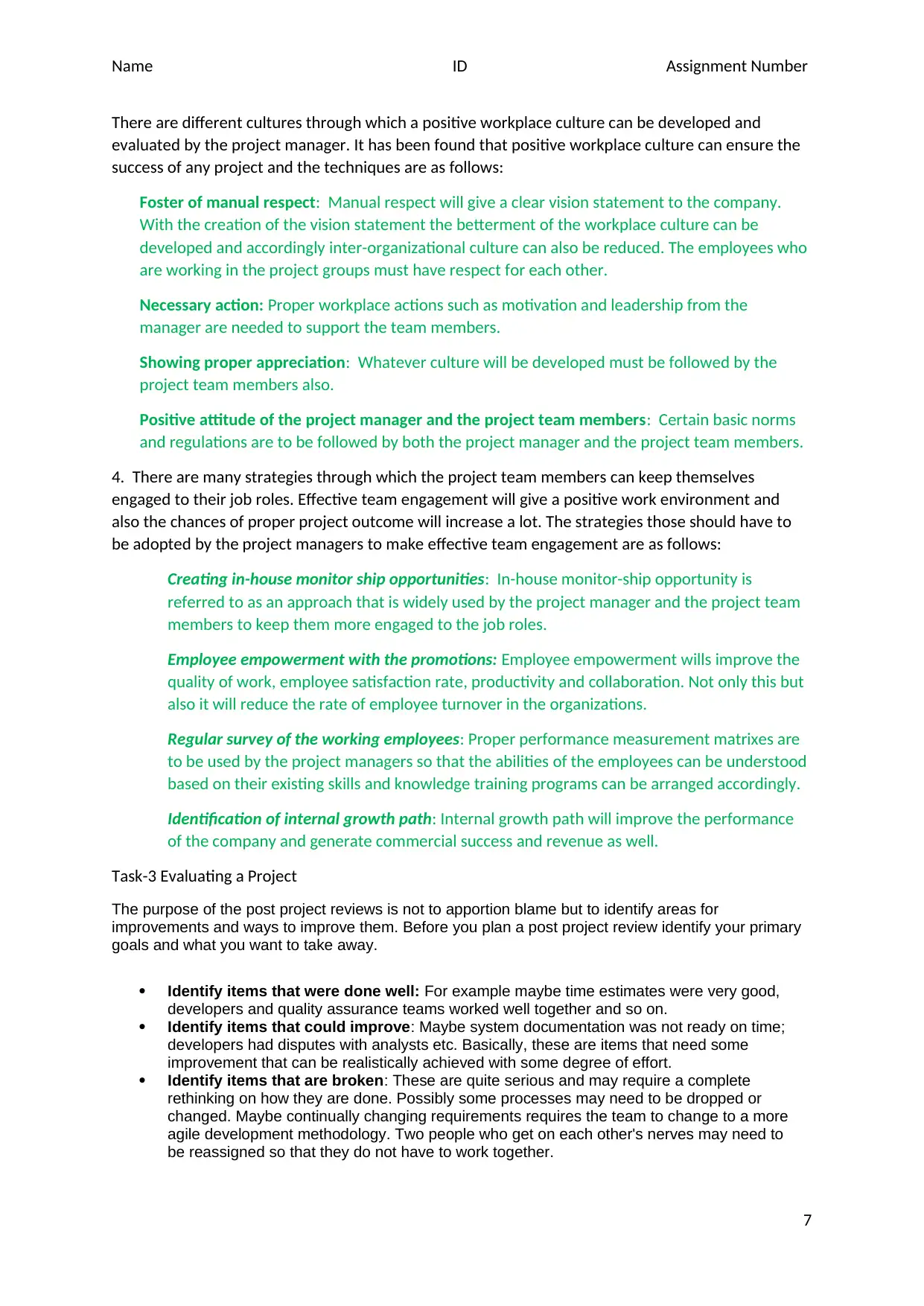
There are different cultures through which a positive workplace culture can be developed and
evaluated by the project manager. It has been found that positive workplace culture can ensure the
success of any project and the techniques are as follows:
Foster of manual respect: Manual respect will give a clear vision statement to the company.
With the creation of the vision statement the betterment of the workplace culture can be
developed and accordingly inter-organizational culture can also be reduced. The employees who
are working in the project groups must have respect for each other.
Necessary action: Proper workplace actions such as motivation and leadership from the
manager are needed to support the team members.
Showing proper appreciation: Whatever culture will be developed must be followed by the
project team members also.
Positive attitude of the project manager and the project team members: Certain basic norms
and regulations are to be followed by both the project manager and the project team members.
4. There are many strategies through which the project team members can keep themselves
engaged to their job roles. Effective team engagement will give a positive work environment and
also the chances of proper project outcome will increase a lot. The strategies those should have to
be adopted by the project managers to make effective team engagement are as follows:
Creating in-house monitor ship opportunities: In-house monitor-ship opportunity is
referred to as an approach that is widely used by the project manager and the project team
members to keep them more engaged to the job roles.
Employee empowerment with the promotions: Employee empowerment wills improve the
quality of work, employee satisfaction rate, productivity and collaboration. Not only this but
also it will reduce the rate of employee turnover in the organizations.
Regular survey of the working employees: Proper performance measurement matrixes are
to be used by the project managers so that the abilities of the employees can be understood
based on their existing skills and knowledge training programs can be arranged accordingly.
Identification of internal growth path: Internal growth path will improve the performance
of the company and generate commercial success and revenue as well.
Task-3 Evaluating a Project
The purpose of the post project reviews is not to apportion blame but to identify areas for
improvements and ways to improve them. Before you plan a post project review identify your primary
goals and what you want to take away.
Identify items that were done well: For example maybe time estimates were very good,
developers and quality assurance teams worked well together and so on.
Identify items that could improve: Maybe system documentation was not ready on time;
developers had disputes with analysts etc. Basically, these are items that need some
improvement that can be realistically achieved with some degree of effort.
Identify items that are broken: These are quite serious and may require a complete
rethinking on how they are done. Possibly some processes may need to be dropped or
changed. Maybe continually changing requirements requires the team to change to a more
agile development methodology. Two people who get on each other's nerves may need to
be reassigned so that they do not have to work together.
7
There are different cultures through which a positive workplace culture can be developed and
evaluated by the project manager. It has been found that positive workplace culture can ensure the
success of any project and the techniques are as follows:
Foster of manual respect: Manual respect will give a clear vision statement to the company.
With the creation of the vision statement the betterment of the workplace culture can be
developed and accordingly inter-organizational culture can also be reduced. The employees who
are working in the project groups must have respect for each other.
Necessary action: Proper workplace actions such as motivation and leadership from the
manager are needed to support the team members.
Showing proper appreciation: Whatever culture will be developed must be followed by the
project team members also.
Positive attitude of the project manager and the project team members: Certain basic norms
and regulations are to be followed by both the project manager and the project team members.
4. There are many strategies through which the project team members can keep themselves
engaged to their job roles. Effective team engagement will give a positive work environment and
also the chances of proper project outcome will increase a lot. The strategies those should have to
be adopted by the project managers to make effective team engagement are as follows:
Creating in-house monitor ship opportunities: In-house monitor-ship opportunity is
referred to as an approach that is widely used by the project manager and the project team
members to keep them more engaged to the job roles.
Employee empowerment with the promotions: Employee empowerment wills improve the
quality of work, employee satisfaction rate, productivity and collaboration. Not only this but
also it will reduce the rate of employee turnover in the organizations.
Regular survey of the working employees: Proper performance measurement matrixes are
to be used by the project managers so that the abilities of the employees can be understood
based on their existing skills and knowledge training programs can be arranged accordingly.
Identification of internal growth path: Internal growth path will improve the performance
of the company and generate commercial success and revenue as well.
Task-3 Evaluating a Project
The purpose of the post project reviews is not to apportion blame but to identify areas for
improvements and ways to improve them. Before you plan a post project review identify your primary
goals and what you want to take away.
Identify items that were done well: For example maybe time estimates were very good,
developers and quality assurance teams worked well together and so on.
Identify items that could improve: Maybe system documentation was not ready on time;
developers had disputes with analysts etc. Basically, these are items that need some
improvement that can be realistically achieved with some degree of effort.
Identify items that are broken: These are quite serious and may require a complete
rethinking on how they are done. Possibly some processes may need to be dropped or
changed. Maybe continually changing requirements requires the team to change to a more
agile development methodology. Two people who get on each other's nerves may need to
be reassigned so that they do not have to work together.
7
Name ID Assignment Number
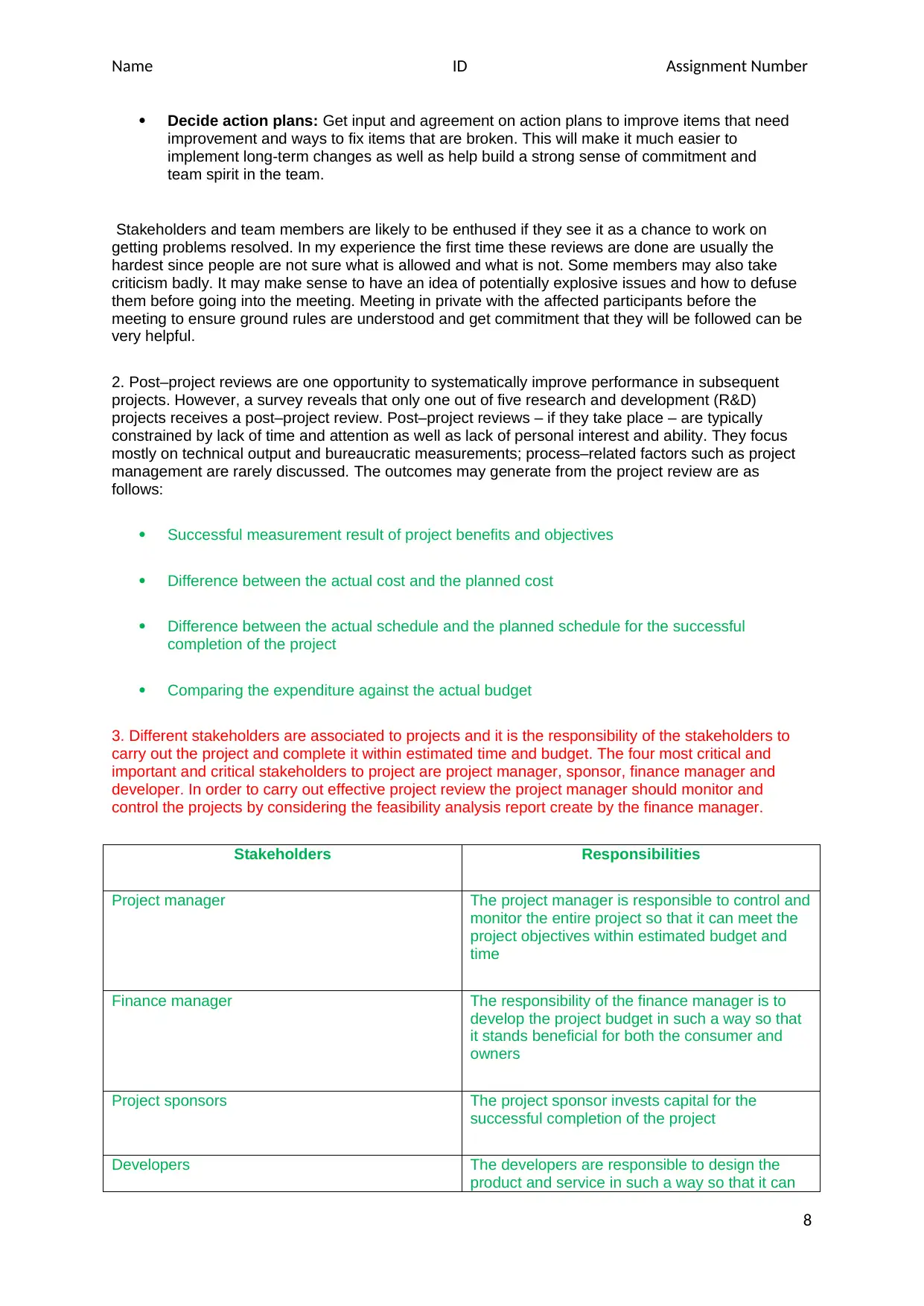
Decide action plans: Get input and agreement on action plans to improve items that need
improvement and ways to fix items that are broken. This will make it much easier to
implement long-term changes as well as help build a strong sense of commitment and
team spirit in the team.
Stakeholders and team members are likely to be enthused if they see it as a chance to work on
getting problems resolved. In my experience the first time these reviews are done are usually the
hardest since people are not sure what is allowed and what is not. Some members may also take
criticism badly. It may make sense to have an idea of potentially explosive issues and how to defuse
them before going into the meeting. Meeting in private with the affected participants before the
meeting to ensure ground rules are understood and get commitment that they will be followed can be
very helpful.
2. Post–project reviews are one opportunity to systematically improve performance in subsequent
projects. However, a survey reveals that only one out of five research and development (R&D)
projects receives a post–project review. Post–project reviews – if they take place – are typically
constrained by lack of time and attention as well as lack of personal interest and ability. They focus
mostly on technical output and bureaucratic measurements; process–related factors such as project
management are rarely discussed. The outcomes may generate from the project review are as
follows:
Successful measurement result of project benefits and objectives
Difference between the actual cost and the planned cost
Difference between the actual schedule and the planned schedule for the successful
completion of the project
Comparing the expenditure against the actual budget
3. Different stakeholders are associated to projects and it is the responsibility of the stakeholders to
carry out the project and complete it within estimated time and budget. The four most critical and
important and critical stakeholders to project are project manager, sponsor, finance manager and
developer. In order to carry out effective project review the project manager should monitor and
control the projects by considering the feasibility analysis report create by the finance manager.
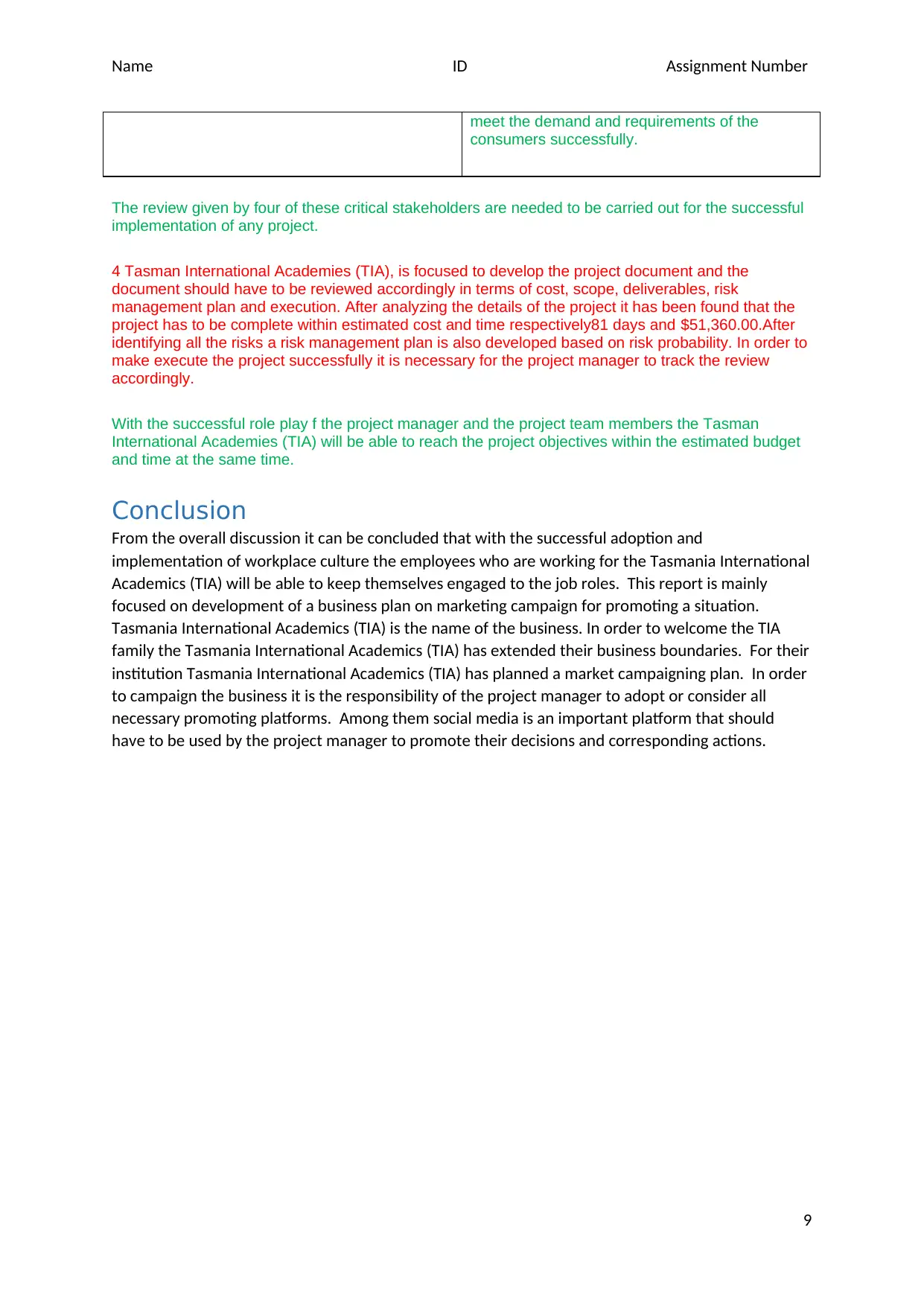
Stakeholders Responsibilities
Project manager The project manager is responsible to control and
monitor the entire project so that it can meet the
project objectives within estimated budget and
time
Finance manager The responsibility of the finance manager is to
develop the project budget in such a way so that
it stands beneficial for both the consumer and
owners
Project sponsors The project sponsor invests capital for the
successful completion of the project
Developers The developers are responsible to design the
product and service in such a way so that it can
8
Decide action plans: Get input and agreement on action plans to improve items that need
improvement and ways to fix items that are broken. This will make it much easier to
implement long-term changes as well as help build a strong sense of commitment and
team spirit in the team.
Stakeholders and team members are likely to be enthused if they see it as a chance to work on
getting problems resolved. In my experience the first time these reviews are done are usually the
hardest since people are not sure what is allowed and what is not. Some members may also take
criticism badly. It may make sense to have an idea of potentially explosive issues and how to defuse
them before going into the meeting. Meeting in private with the affected participants before the
meeting to ensure ground rules are understood and get commitment that they will be followed can be
very helpful.
2. Post–project reviews are one opportunity to systematically improve performance in subsequent
projects. However, a survey reveals that only one out of five research and development (R&D)
projects receives a post–project review. Post–project reviews – if they take place – are typically
constrained by lack of time and attention as well as lack of personal interest and ability. They focus
mostly on technical output and bureaucratic measurements; process–related factors such as project
management are rarely discussed. The outcomes may generate from the project review are as
follows:
Successful measurement result of project benefits and objectives
Difference between the actual cost and the planned cost
Difference between the actual schedule and the planned schedule for the successful
completion of the project
Comparing the expenditure against the actual budget
3. Different stakeholders are associated to projects and it is the responsibility of the stakeholders to
carry out the project and complete it within estimated time and budget. The four most critical and
important and critical stakeholders to project are project manager, sponsor, finance manager and
developer. In order to carry out effective project review the project manager should monitor and
control the projects by considering the feasibility analysis report create by the finance manager.
Stakeholders Responsibilities
Project manager The project manager is responsible to control and
monitor the entire project so that it can meet the
project objectives within estimated budget and
time
Finance manager The responsibility of the finance manager is to
develop the project budget in such a way so that
it stands beneficial for both the consumer and
owners
Project sponsors The project sponsor invests capital for the
successful completion of the project
Developers The developers are responsible to design the
product and service in such a way so that it can
8
⊘ This is a preview!⊘
Do you want full access?
Subscribe today to unlock all pages.
Trusted by 1+ million students worldwide
Name ID Assignment Number
meet the demand and requirements of the
consumers successfully.
The review given by four of these critical stakeholders are needed to be carried out for the successful
implementation of any project.
4 Tasman International Academies (TIA), is focused to develop the project document and the
document should have to be reviewed accordingly in terms of cost, scope, deliverables, risk
management plan and execution. After analyzing the details of the project it has been found that the
project has to be complete within estimated cost and time respectively81 days and $51,360.00.After
identifying all the risks a risk management plan is also developed based on risk probability. In order to
make execute the project successfully it is necessary for the project manager to track the review
accordingly.
With the successful role play f the project manager and the project team members the Tasman
International Academies (TIA) will be able to reach the project objectives within the estimated budget
and time at the same time.
Conclusion
From the overall discussion it can be concluded that with the successful adoption and
implementation of workplace culture the employees who are working for the Tasmania International
Academics (TIA) will be able to keep themselves engaged to the job roles. This report is mainly
focused on development of a business plan on marketing campaign for promoting a situation.
Tasmania International Academics (TIA) is the name of the business. In order to welcome the TIA
family the Tasmania International Academics (TIA) has extended their business boundaries. For their
institution Tasmania International Academics (TIA) has planned a market campaigning plan. In order
to campaign the business it is the responsibility of the project manager to adopt or consider all
necessary promoting platforms. Among them social media is an important platform that should
have to be used by the project manager to promote their decisions and corresponding actions.
9
meet the demand and requirements of the
consumers successfully.
The review given by four of these critical stakeholders are needed to be carried out for the successful
implementation of any project.
4 Tasman International Academies (TIA), is focused to develop the project document and the
document should have to be reviewed accordingly in terms of cost, scope, deliverables, risk
management plan and execution. After analyzing the details of the project it has been found that the
project has to be complete within estimated cost and time respectively81 days and $51,360.00.After
identifying all the risks a risk management plan is also developed based on risk probability. In order to
make execute the project successfully it is necessary for the project manager to track the review
accordingly.
With the successful role play f the project manager and the project team members the Tasman
International Academies (TIA) will be able to reach the project objectives within the estimated budget
and time at the same time.
Conclusion
From the overall discussion it can be concluded that with the successful adoption and
implementation of workplace culture the employees who are working for the Tasmania International
Academics (TIA) will be able to keep themselves engaged to the job roles. This report is mainly
focused on development of a business plan on marketing campaign for promoting a situation.
Tasmania International Academics (TIA) is the name of the business. In order to welcome the TIA
family the Tasmania International Academics (TIA) has extended their business boundaries. For their
institution Tasmania International Academics (TIA) has planned a market campaigning plan. In order
to campaign the business it is the responsibility of the project manager to adopt or consider all
necessary promoting platforms. Among them social media is an important platform that should
have to be used by the project manager to promote their decisions and corresponding actions.
9
Paraphrase This Document
Need a fresh take? Get an instant paraphrase of this document with our AI Paraphraser
Name ID Assignment Number
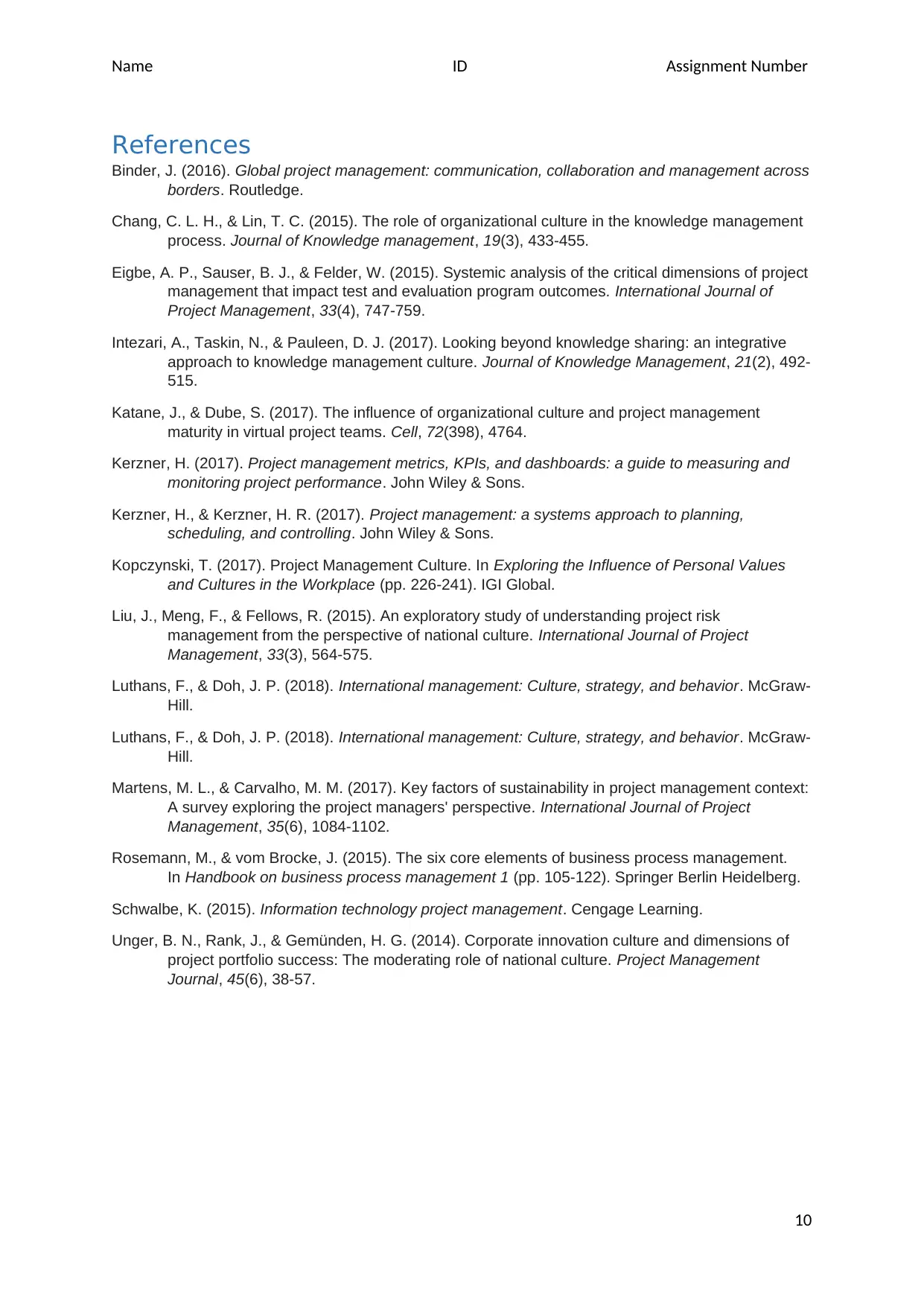
References
Binder, J. (2016). Global project management: communication, collaboration and management across
borders. Routledge.
Chang, C. L. H., & Lin, T. C. (2015). The role of organizational culture in the knowledge management
process. Journal of Knowledge management, 19(3), 433-455.
Eigbe, A. P., Sauser, B. J., & Felder, W. (2015). Systemic analysis of the critical dimensions of project
management that impact test and evaluation program outcomes. International Journal of
Project Management, 33(4), 747-759.
Intezari, A., Taskin, N., & Pauleen, D. J. (2017). Looking beyond knowledge sharing: an integrative
approach to knowledge management culture. Journal of Knowledge Management, 21(2), 492-
515.
Katane, J., & Dube, S. (2017). The influence of organizational culture and project management
maturity in virtual project teams. Cell, 72(398), 4764.
Kerzner, H. (2017). Project management metrics, KPIs, and dashboards: a guide to measuring and
monitoring project performance. John Wiley & Sons.
Kerzner, H., & Kerzner, H. R. (2017). Project management: a systems approach to planning,
scheduling, and controlling. John Wiley & Sons.
Kopczynski, T. (2017). Project Management Culture. In Exploring the Influence of Personal Values
and Cultures in the Workplace (pp. 226-241). IGI Global.
Liu, J., Meng, F., & Fellows, R. (2015). An exploratory study of understanding project risk
management from the perspective of national culture. International Journal of Project
Management, 33(3), 564-575.
Luthans, F., & Doh, J. P. (2018). International management: Culture, strategy, and behavior. McGraw-
Hill.
Luthans, F., & Doh, J. P. (2018). International management: Culture, strategy, and behavior. McGraw-
Hill.
Martens, M. L., & Carvalho, M. M. (2017). Key factors of sustainability in project management context:
A survey exploring the project managers' perspective. International Journal of Project
Management, 35(6), 1084-1102.
Rosemann, M., & vom Brocke, J. (2015). The six core elements of business process management.
In Handbook on business process management 1 (pp. 105-122). Springer Berlin Heidelberg.
Schwalbe, K. (2015). Information technology project management. Cengage Learning.
Unger, B. N., Rank, J., & Gemünden, H. G. (2014). Corporate innovation culture and dimensions of
project portfolio success: The moderating role of national culture. Project Management
Journal, 45(6), 38-57.
10
References
Binder, J. (2016). Global project management: communication, collaboration and management across
borders. Routledge.
Chang, C. L. H., & Lin, T. C. (2015). The role of organizational culture in the knowledge management
process. Journal of Knowledge management, 19(3), 433-455.
Eigbe, A. P., Sauser, B. J., & Felder, W. (2015). Systemic analysis of the critical dimensions of project
management that impact test and evaluation program outcomes. International Journal of
Project Management, 33(4), 747-759.
Intezari, A., Taskin, N., & Pauleen, D. J. (2017). Looking beyond knowledge sharing: an integrative
approach to knowledge management culture. Journal of Knowledge Management, 21(2), 492-
515.
Katane, J., & Dube, S. (2017). The influence of organizational culture and project management
maturity in virtual project teams. Cell, 72(398), 4764.
Kerzner, H. (2017). Project management metrics, KPIs, and dashboards: a guide to measuring and
monitoring project performance. John Wiley & Sons.
Kerzner, H., & Kerzner, H. R. (2017). Project management: a systems approach to planning,
scheduling, and controlling. John Wiley & Sons.
Kopczynski, T. (2017). Project Management Culture. In Exploring the Influence of Personal Values
and Cultures in the Workplace (pp. 226-241). IGI Global.
Liu, J., Meng, F., & Fellows, R. (2015). An exploratory study of understanding project risk
management from the perspective of national culture. International Journal of Project
Management, 33(3), 564-575.
Luthans, F., & Doh, J. P. (2018). International management: Culture, strategy, and behavior. McGraw-
Hill.
Luthans, F., & Doh, J. P. (2018). International management: Culture, strategy, and behavior. McGraw-
Hill.
Martens, M. L., & Carvalho, M. M. (2017). Key factors of sustainability in project management context:
A survey exploring the project managers' perspective. International Journal of Project
Management, 35(6), 1084-1102.
Rosemann, M., & vom Brocke, J. (2015). The six core elements of business process management.
In Handbook on business process management 1 (pp. 105-122). Springer Berlin Heidelberg.
Schwalbe, K. (2015). Information technology project management. Cengage Learning.
Unger, B. N., Rank, J., & Gemünden, H. G. (2014). Corporate innovation culture and dimensions of
project portfolio success: The moderating role of national culture. Project Management
Journal, 45(6), 38-57.
10

1 out of 11


Related Documents


Your All-in-One AI-Powered Toolkit for Academic Success.
+13062052269
info@desklib.com
Available 24*7 on WhatsApp / Email
![[object Object]](/_next/static/media/star-bottom.7253800d.svg)
Unlock your academic potential
Copyright © 2020–2026 A2Z Services. All Rights Reserved. Developed and managed by ZUCOL.