Developing an Enterprise Culture: A Comprehensive Dell Analysis
VerifiedAdded on 2020/10/05
|11
|2705
|64
Report
AI Summary
This report delves into the concept of enterprise culture, highlighting its importance in modern business environments. It defines enterprise and entrepreneurial culture, emphasizing the role of innovation, risk-taking, and strategic management. The report uses Dell as a case study, examining its history, organizational culture, and innovative techniques. It analyzes how Dell has successfully employed an entrepreneurial culture to achieve its organizational goals, including market diversification, product development, and customer-centric strategies. The analysis covers Dell's evolution, its adaptation to technological advancements, and its approach to stakeholder engagement. The report evaluates Dell's culture, concluding that it embodies entrepreneurial principles by balancing innovation with brand value and customer support, and by utilizing market research to mitigate risks and foster effective communication. It emphasizes Dell's commitment to continuous improvement, customer satisfaction, and ethical considerations in its business practices.
Developing an enterprise
culture
culture

Paraphrase This Document
Need a fresh take? Get an instant paraphrase of this document with our AI Paraphraser
EXECUTIVE SUMMARY
The enterprise and entrepreneurial culture are the latest marketing trends of the successful
business. Thus, it is essential for the organisations to understand the principles and concepts of
these concepts. The report has defined the enterprise and its culture with the example and
overview of Dell which is among leading organisations. It has described the history and the
innovation techniques used by the Dell which has helped organisation to succeed and employ the
entrepreneurial culture. The report has analysed the organisational culture of Dell which has
utilised the concepts of enterprises to achieve its organisational goals.
The enterprise and entrepreneurial culture are the latest marketing trends of the successful
business. Thus, it is essential for the organisations to understand the principles and concepts of
these concepts. The report has defined the enterprise and its culture with the example and
overview of Dell which is among leading organisations. It has described the history and the
innovation techniques used by the Dell which has helped organisation to succeed and employ the
entrepreneurial culture. The report has analysed the organisational culture of Dell which has
utilised the concepts of enterprises to achieve its organisational goals.
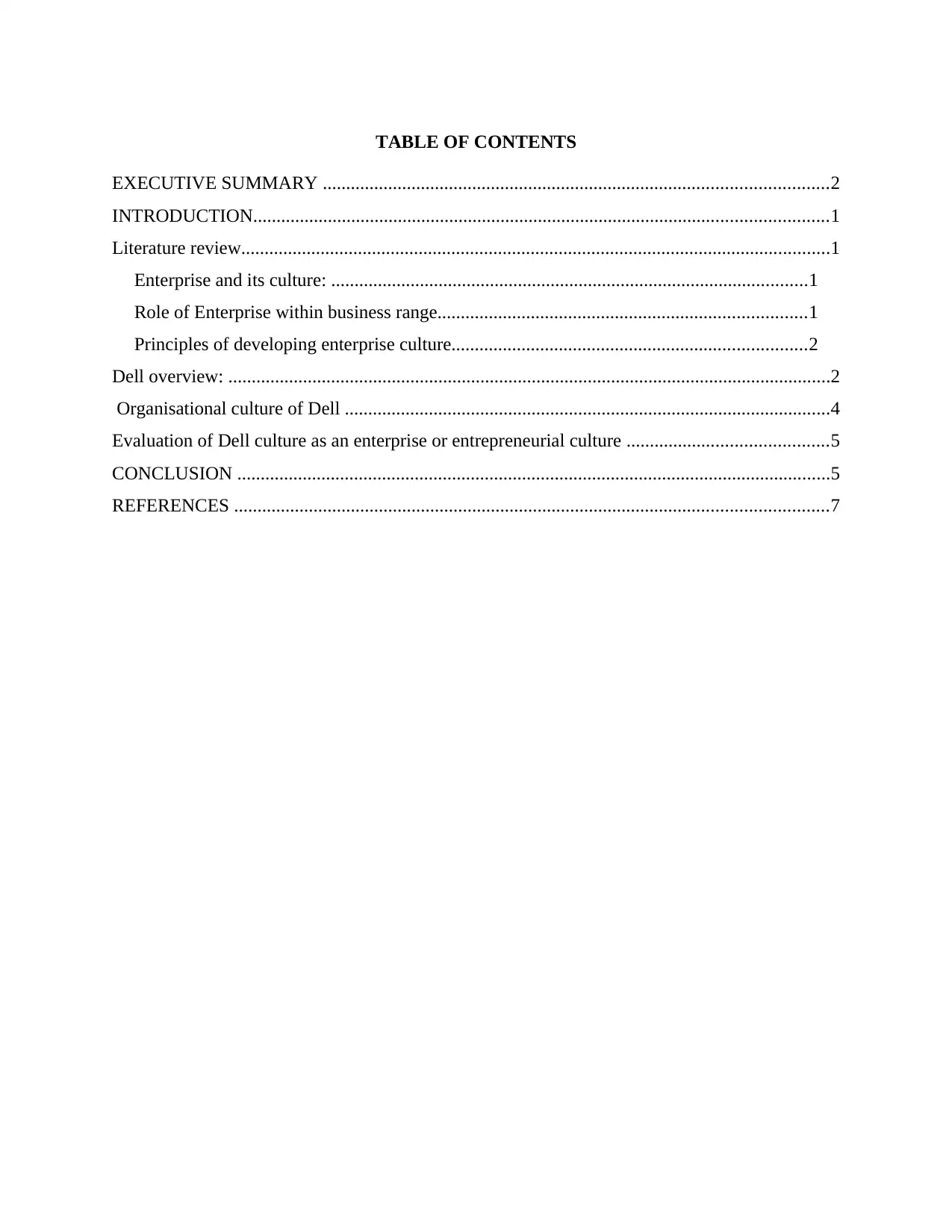
TABLE OF CONTENTS
EXECUTIVE SUMMARY ............................................................................................................2
INTRODUCTION...........................................................................................................................1
Literature review..............................................................................................................................1
Enterprise and its culture: ......................................................................................................1
Role of Enterprise within business range...............................................................................1
Principles of developing enterprise culture............................................................................2
Dell overview: .................................................................................................................................2
Organisational culture of Dell ........................................................................................................4
Evaluation of Dell culture as an enterprise or entrepreneurial culture ...........................................5
CONCLUSION ...............................................................................................................................5
REFERENCES ...............................................................................................................................7
EXECUTIVE SUMMARY ............................................................................................................2
INTRODUCTION...........................................................................................................................1
Literature review..............................................................................................................................1
Enterprise and its culture: ......................................................................................................1
Role of Enterprise within business range...............................................................................1
Principles of developing enterprise culture............................................................................2
Dell overview: .................................................................................................................................2
Organisational culture of Dell ........................................................................................................4
Evaluation of Dell culture as an enterprise or entrepreneurial culture ...........................................5
CONCLUSION ...............................................................................................................................5
REFERENCES ...............................................................................................................................7
⊘ This is a preview!⊘
Do you want full access?
Subscribe today to unlock all pages.

Trusted by 1+ million students worldwide
INTRODUCTION
Enterprise is defined as the large organisations which aims at generating profits by taking
calculated risks with their financial resources and business related strategies (Drucker, 2014). In
order to sustain in the highly competitive and advanced market it is essential for all enterprises to
create and maintain an effective culture in which profit generation, goal achievements is
encouraged and is considered as the primary goal of enterprises. The report will explain the
concepts and characteristics of enterprise and impact of enterprising culture. It will describe the
entrepreneurial culture in relation with the case study of Dell which is one of the most successful
and largest organisation in the technological sector. The report will also analyse the
organisational culture of Dell and will evaluate that whether Dell exhibit an entrepreneurial
culture or enterprise.
Literature review
Enterprise and its culture:
Enterprise is known as the business structures which involves regular participation of
innovations, challenges, risks as well as management of strategies. Therefore, in order to succeed
it is essential for the organisations to include entrepreneurial culture as the basic element in their
functional activities. With changing trends, enterprises are giving priority to creativity and
imagination in their culture and to plan effective strategy for possible risks. As per the Audretsch
and et.al. (2017) Enterprise culture is considered as distinguishing element which differentiate
enterprises. In this culture organisation assume that all stakeholders have share and contribution
in the success of organisation and thus business strategies must be adopted in a way that it
provides the benefits to all people associated with the enterprise while providing optimized
benefits to enterprise.
Role of Enterprise within business range
Enterprise can also be defined as the ability to identify the opportunities from every
corner of the possibility and to develop strategies which can extract the maximum profits from
the emerging opportunities. Business Enterprise helps organisation to organise and manage all its
available resources for generating great profits. Entrepreneurial strategies include methods like
market diversification, product development and appropriate implementation of resources as per
the demand. Enterprise culture brings the skills to make clear and concise decisions on time so
1
Enterprise is defined as the large organisations which aims at generating profits by taking
calculated risks with their financial resources and business related strategies (Drucker, 2014). In
order to sustain in the highly competitive and advanced market it is essential for all enterprises to
create and maintain an effective culture in which profit generation, goal achievements is
encouraged and is considered as the primary goal of enterprises. The report will explain the
concepts and characteristics of enterprise and impact of enterprising culture. It will describe the
entrepreneurial culture in relation with the case study of Dell which is one of the most successful
and largest organisation in the technological sector. The report will also analyse the
organisational culture of Dell and will evaluate that whether Dell exhibit an entrepreneurial
culture or enterprise.
Literature review
Enterprise and its culture:
Enterprise is known as the business structures which involves regular participation of
innovations, challenges, risks as well as management of strategies. Therefore, in order to succeed
it is essential for the organisations to include entrepreneurial culture as the basic element in their
functional activities. With changing trends, enterprises are giving priority to creativity and
imagination in their culture and to plan effective strategy for possible risks. As per the Audretsch
and et.al. (2017) Enterprise culture is considered as distinguishing element which differentiate
enterprises. In this culture organisation assume that all stakeholders have share and contribution
in the success of organisation and thus business strategies must be adopted in a way that it
provides the benefits to all people associated with the enterprise while providing optimized
benefits to enterprise.
Role of Enterprise within business range
Enterprise can also be defined as the ability to identify the opportunities from every
corner of the possibility and to develop strategies which can extract the maximum profits from
the emerging opportunities. Business Enterprise helps organisation to organise and manage all its
available resources for generating great profits. Entrepreneurial strategies include methods like
market diversification, product development and appropriate implementation of resources as per
the demand. Enterprise culture brings the skills to make clear and concise decisions on time so
1
Paraphrase This Document
Need a fresh take? Get an instant paraphrase of this document with our AI Paraphraser
that profit making opportunities are not missed. According to Burns (2016) enterprise not only
assure creativity in business practices but it also helps organisation to approach for a more
appealing vision. The entrepreneurs always enhance the persistence in their business culture.
They always consider the failure as challenge and instead of demotivating enterprises try to learn
the skills from the experience and policies of failures.
Principles of developing enterprise culture
In order to develop entrepreneurial culture, it is essential that people focus on achievable
objectives instead of making strategies without market research. Enterprises must recognize the
importance of networking and planning. When goals are achieved with planned strategies then,
they provide more effective results within desired time duration. Enterprise culture can give
more effective results when individuals have positive attitude towards learning and enhancing
their skills. The associated leaders and people are very confident and motivated.
They are orientated around generating profits and goals achievement but when they fail
to achieve their business targets then they consider the failure as an opportunity which can
provide them guidance about the future framework. Innovation is essential component of
entrepreneurial culture but every innovation does not guarantee success, so this culture monitors
the probable impact of innovations and their failures on performance of enterprise. The
enterprise cannot achieve its goals without network and communication. As stated by Terjesen,
Hessels and Li (2016) it is necessary for the entrepreneurs to develop skills which can be helpful
for them so that they can influence and convince others. In order to succeed enterprises must
involve market researches and advancements as an integral part of their culture.
Dell overview:
Dell is a multinational company which is among leading technological giants. The
organisation was founded in 1984 with its head quarter in USA. It deals in computers,
networking and storage devices, peripherals, software's and other electronics. Michael Dell,
founder of Dell laid the foundation of organisation in 1984 with the aim of selling IBM PC
computers. His main strategy was that by directly selling computers to customers without
involving intermediate suppliers or dealers they can develop deeper understanding of
requirements and issues of their target customers. In the same year the organisation also
2
assure creativity in business practices but it also helps organisation to approach for a more
appealing vision. The entrepreneurs always enhance the persistence in their business culture.
They always consider the failure as challenge and instead of demotivating enterprises try to learn
the skills from the experience and policies of failures.
Principles of developing enterprise culture
In order to develop entrepreneurial culture, it is essential that people focus on achievable
objectives instead of making strategies without market research. Enterprises must recognize the
importance of networking and planning. When goals are achieved with planned strategies then,
they provide more effective results within desired time duration. Enterprise culture can give
more effective results when individuals have positive attitude towards learning and enhancing
their skills. The associated leaders and people are very confident and motivated.
They are orientated around generating profits and goals achievement but when they fail
to achieve their business targets then they consider the failure as an opportunity which can
provide them guidance about the future framework. Innovation is essential component of
entrepreneurial culture but every innovation does not guarantee success, so this culture monitors
the probable impact of innovations and their failures on performance of enterprise. The
enterprise cannot achieve its goals without network and communication. As stated by Terjesen,
Hessels and Li (2016) it is necessary for the entrepreneurs to develop skills which can be helpful
for them so that they can influence and convince others. In order to succeed enterprises must
involve market researches and advancements as an integral part of their culture.
Dell overview:
Dell is a multinational company which is among leading technological giants. The
organisation was founded in 1984 with its head quarter in USA. It deals in computers,
networking and storage devices, peripherals, software's and other electronics. Michael Dell,
founder of Dell laid the foundation of organisation in 1984 with the aim of selling IBM PC
computers. His main strategy was that by directly selling computers to customers without
involving intermediate suppliers or dealers they can develop deeper understanding of
requirements and issues of their target customers. In the same year the organisation also
2
launched its first designed computer with Intel 8088 processor. It provided consumers the better
choices with lower prices (Dell technologies, 2018). Thus, the organisation experienced its first
success with this model. In 1987 Dell began to expand globally and effectively established its
brand. With the emergence of 1990 organisation also started selling products via superstores or
warehouses but due to lower success rate it again shifted towards its direct selling model (3
Decades of Dell: From Dorm Room Inspiration to Multi-Billion Dollar Acquisition, 2013). To
cope up with the technical advancements and to target more audience Dell began to sell
computers through its website also by the beginning of 1996. In order to explore the organisation
beyond computers, in 2003 the investors and shareholders of Dell agreed to decision of changing
its name to Dell Inc.
In the year 2002 the organisation included televisions, audio and video players to expand
the product line of Dell. In the duration 1997 to 2004 the organisation witnessed the steady
growth and gave strong competition to the other vendors. Until 2009 the organisation had its
dominance as hardware vendors but in 2009 its acquisition with Perot systems helped Dell to
improve the existence of Dell in IT sector. In 2001 before launching of Window XP by one of
the biggest competitor of Dell, Microsoft the organisation was experiencing the high ratings in
terms of reliability and consumer and technical support.
The organisation suffered from critical situations in 2005 when despite increasing profits
and sales Dell observed decline in its growth rate. At that time the key analysis and findings of
organisation determined the need to increase participation of Dell into non computer segments
such as storage devices, servers and networking devices. In 2016 the organisation undergoes a
merger with EMC which was one of the leading organisation in providing services of data
storage. The merger was considered as the one of the biggest technical merger. It helped
organisation to boost the extent of its dominance over the technical market.
In the fourth quarter of year 2017 the organisation generated consolidated revenue of
$20.1 billion and revenue of $20.6 billion from non-GAAP. In the same quarter Dell generated
$1.7 billion as its operating losses. For the entire year of 2017 the organisation received
consolidated revenue of $61.6 billion while receiving $62.8 billion from non-GAAp. Thus, in
2017 the organisation experiences the profits by maintaining the constant momentum of growth
3
choices with lower prices (Dell technologies, 2018). Thus, the organisation experienced its first
success with this model. In 1987 Dell began to expand globally and effectively established its
brand. With the emergence of 1990 organisation also started selling products via superstores or
warehouses but due to lower success rate it again shifted towards its direct selling model (3
Decades of Dell: From Dorm Room Inspiration to Multi-Billion Dollar Acquisition, 2013). To
cope up with the technical advancements and to target more audience Dell began to sell
computers through its website also by the beginning of 1996. In order to explore the organisation
beyond computers, in 2003 the investors and shareholders of Dell agreed to decision of changing
its name to Dell Inc.
In the year 2002 the organisation included televisions, audio and video players to expand
the product line of Dell. In the duration 1997 to 2004 the organisation witnessed the steady
growth and gave strong competition to the other vendors. Until 2009 the organisation had its
dominance as hardware vendors but in 2009 its acquisition with Perot systems helped Dell to
improve the existence of Dell in IT sector. In 2001 before launching of Window XP by one of
the biggest competitor of Dell, Microsoft the organisation was experiencing the high ratings in
terms of reliability and consumer and technical support.
The organisation suffered from critical situations in 2005 when despite increasing profits
and sales Dell observed decline in its growth rate. At that time the key analysis and findings of
organisation determined the need to increase participation of Dell into non computer segments
such as storage devices, servers and networking devices. In 2016 the organisation undergoes a
merger with EMC which was one of the leading organisation in providing services of data
storage. The merger was considered as the one of the biggest technical merger. It helped
organisation to boost the extent of its dominance over the technical market.
In the fourth quarter of year 2017 the organisation generated consolidated revenue of
$20.1 billion and revenue of $20.6 billion from non-GAAP. In the same quarter Dell generated
$1.7 billion as its operating losses. For the entire year of 2017 the organisation received
consolidated revenue of $61.6 billion while receiving $62.8 billion from non-GAAp. Thus, in
2017 the organisation experiences the profits by maintaining the constant momentum of growth
3
⊘ This is a preview!⊘
Do you want full access?
Subscribe today to unlock all pages.
Trusted by 1+ million students worldwide

as compare to the previous years. Dell encounters the investment and cash balance of around
$15.3 billion which was $287 million higher than the third quarter of the same year (Dell
Technologies Reports Fiscal Year 2018 Fourth Quarter and Full Year Financial Results, 2018).
Organisational culture of Dell
The key factor in the success journey of Dell is the continuous innovation with market
research and formulation of strategies in accordance with the welfare of all of its stakeholders.
The major principle of organisation culture of Dell is the innovation. The organisation regularly
brings innovations in its products and operational areas whether it may be technological or
management related. As more and more consumers are adopting digital trends of facilities on
single click the organisation has adopted these changes with the same pace. Dell is improving
and involving technical advancements which provides more security to its devices and servers.
With the upcoming trends of biometric security, the organisation aims at maintaining continuous
researches in the same field so that before its leading competitors emerge with new idea
organisation can start serving its consumers (uckley and Ghauri, 2015).
Another latest trend which is getting popular among leading enterprises is the integration
of climate and environmental concerns in their product development. Instead of avoiding the
upcoming challenges Dell believes in facing the challenges. Thus, organisation is still adopting
the environment friendly strategies in its business actions. The environment friendly approaches
of Dell presents organisation as a socially responsible enterprise and it also inspires its
consumers to integrate the science and technology with environment. The effective human
resources and management cannot be neglected in the evaluation of success. In the organisation
culture of same Dell value its resources and deeply understand the value of these resources. To
retain the skilled employee's organisation believes that the computer developers must be given
proper training with the knowledge of ethical consideration so that they can use their skills for
the welfare of society as well as for the benefit of an organisation (Fayolle, Liñán and Moriano,
2014). In order to keep its employee's upgraded with the advanced technologies Dell regularly
conduct training and development session.
The organisation culture of Dell aims at providing high quality services and to retain its
customers so that irrespective of brand value of other enterprises the customers always prefers
Dell. To achieve this the organisation has developed a culture in which the customer satisfaction
4
$15.3 billion which was $287 million higher than the third quarter of the same year (Dell
Technologies Reports Fiscal Year 2018 Fourth Quarter and Full Year Financial Results, 2018).
Organisational culture of Dell
The key factor in the success journey of Dell is the continuous innovation with market
research and formulation of strategies in accordance with the welfare of all of its stakeholders.
The major principle of organisation culture of Dell is the innovation. The organisation regularly
brings innovations in its products and operational areas whether it may be technological or
management related. As more and more consumers are adopting digital trends of facilities on
single click the organisation has adopted these changes with the same pace. Dell is improving
and involving technical advancements which provides more security to its devices and servers.
With the upcoming trends of biometric security, the organisation aims at maintaining continuous
researches in the same field so that before its leading competitors emerge with new idea
organisation can start serving its consumers (uckley and Ghauri, 2015).
Another latest trend which is getting popular among leading enterprises is the integration
of climate and environmental concerns in their product development. Instead of avoiding the
upcoming challenges Dell believes in facing the challenges. Thus, organisation is still adopting
the environment friendly strategies in its business actions. The environment friendly approaches
of Dell presents organisation as a socially responsible enterprise and it also inspires its
consumers to integrate the science and technology with environment. The effective human
resources and management cannot be neglected in the evaluation of success. In the organisation
culture of same Dell value its resources and deeply understand the value of these resources. To
retain the skilled employee's organisation believes that the computer developers must be given
proper training with the knowledge of ethical consideration so that they can use their skills for
the welfare of society as well as for the benefit of an organisation (Fayolle, Liñán and Moriano,
2014). In order to keep its employee's upgraded with the advanced technologies Dell regularly
conduct training and development session.
The organisation culture of Dell aims at providing high quality services and to retain its
customers so that irrespective of brand value of other enterprises the customers always prefers
Dell. To achieve this the organisation has developed a culture in which the customer satisfaction
4
Paraphrase This Document
Need a fresh take? Get an instant paraphrase of this document with our AI Paraphraser
is the foremost priority. And to achieve this goal Dell keep great focus on its price, technologies,
quality of services and minimization of technical errors. Dell also ensure that consumer
feedbacks and suggestions are solved at the first priority of the organisation. The suppliers and
investors of Dell are important part of the organisational culture. Thus, organisation strictly aims
at meeting the expectations of all of its stakeholders.
Evaluation of Dell culture as an enterprise or entrepreneurial culture
Dell is well established brand name all over the world. Thus, it cannot be considered as
an enterprise which only focus on innovation and generating profit. With the continuous growth
the organisation has reached to stage where instead of acting as an enterprise it is serving as an
entrepreneurial culture. The innovations are important part of the organisational culture of Dell
but it also considers that the innovations do not compromise its established brand value or
customer support. Within entrepreneurial culture Dell uses great communication path to ensure
that its global expansion and huge network comprising great number of customers do not
compromise with the quality standards associated with the brand name of Dell.
With the enterprise the major aim of the organisation is to include risks with the
innovative strategies but with the entrepreneurial culture of the Dell, organisation is assuring that
the risk should be taken to only that extent which could be recovered in case of failures (Spigel,
2017). Before implementation of any innovative strategies or financial risks Dell used to carry
the market research for analysing the behaviour of consumers, the possible response of its
competitors as well as the future impact of proposed strategies. With enterprise the organisation
limits their communication with the external business factor but the entrepreneurial culture of
Dell considers the communication as the important aspect of achieving goals and minimizing
risks. Dell uses various methods like feedbacks from its customers, group discussions and skill
development sessions for its employee's market analysis and evaluation of possible errors and
risks along with their elimination strategies (Wyrwich, Stuetzer and Sternberg, 2016). These
approaches have helped organisation to emerge as one of the leading technical giant all over the
world without geographical boundaries.
CONCLUSION
From the report it can be concluded that principles of entrepreneurship are essential for
sustaining the growth and development of organisation. The report has explained the concepts of
5
quality of services and minimization of technical errors. Dell also ensure that consumer
feedbacks and suggestions are solved at the first priority of the organisation. The suppliers and
investors of Dell are important part of the organisational culture. Thus, organisation strictly aims
at meeting the expectations of all of its stakeholders.
Evaluation of Dell culture as an enterprise or entrepreneurial culture
Dell is well established brand name all over the world. Thus, it cannot be considered as
an enterprise which only focus on innovation and generating profit. With the continuous growth
the organisation has reached to stage where instead of acting as an enterprise it is serving as an
entrepreneurial culture. The innovations are important part of the organisational culture of Dell
but it also considers that the innovations do not compromise its established brand value or
customer support. Within entrepreneurial culture Dell uses great communication path to ensure
that its global expansion and huge network comprising great number of customers do not
compromise with the quality standards associated with the brand name of Dell.
With the enterprise the major aim of the organisation is to include risks with the
innovative strategies but with the entrepreneurial culture of the Dell, organisation is assuring that
the risk should be taken to only that extent which could be recovered in case of failures (Spigel,
2017). Before implementation of any innovative strategies or financial risks Dell used to carry
the market research for analysing the behaviour of consumers, the possible response of its
competitors as well as the future impact of proposed strategies. With enterprise the organisation
limits their communication with the external business factor but the entrepreneurial culture of
Dell considers the communication as the important aspect of achieving goals and minimizing
risks. Dell uses various methods like feedbacks from its customers, group discussions and skill
development sessions for its employee's market analysis and evaluation of possible errors and
risks along with their elimination strategies (Wyrwich, Stuetzer and Sternberg, 2016). These
approaches have helped organisation to emerge as one of the leading technical giant all over the
world without geographical boundaries.
CONCLUSION
From the report it can be concluded that principles of entrepreneurship are essential for
sustaining the growth and development of organisation. The report has explained the concepts of
5
enterprise and enterprise culture. It has also described the role of an enterprise within business
environment. The principles of enterprise play a key role in developing a business culture which
promotes continuous growth and ability to sustain the growth in highly competitive market
scenario.
The report has evaluated the organisational culture employed by the Dell. It has also
analysed the impact of this culture on the growth and success of organisation. From the report it
can also be analysed that whether Dell is an enterprise or it adopts entrepreneurial environment
for achieving its long term business goals. Thus, it can be concluded from the report that
enterprise culture must be analysed and adopted by organisations effectively in order to achieve
their business objectives.
6
environment. The principles of enterprise play a key role in developing a business culture which
promotes continuous growth and ability to sustain the growth in highly competitive market
scenario.
The report has evaluated the organisational culture employed by the Dell. It has also
analysed the impact of this culture on the growth and success of organisation. From the report it
can also be analysed that whether Dell is an enterprise or it adopts entrepreneurial environment
for achieving its long term business goals. Thus, it can be concluded from the report that
enterprise culture must be analysed and adopted by organisations effectively in order to achieve
their business objectives.
6
⊘ This is a preview!⊘
Do you want full access?
Subscribe today to unlock all pages.
Trusted by 1+ million students worldwide
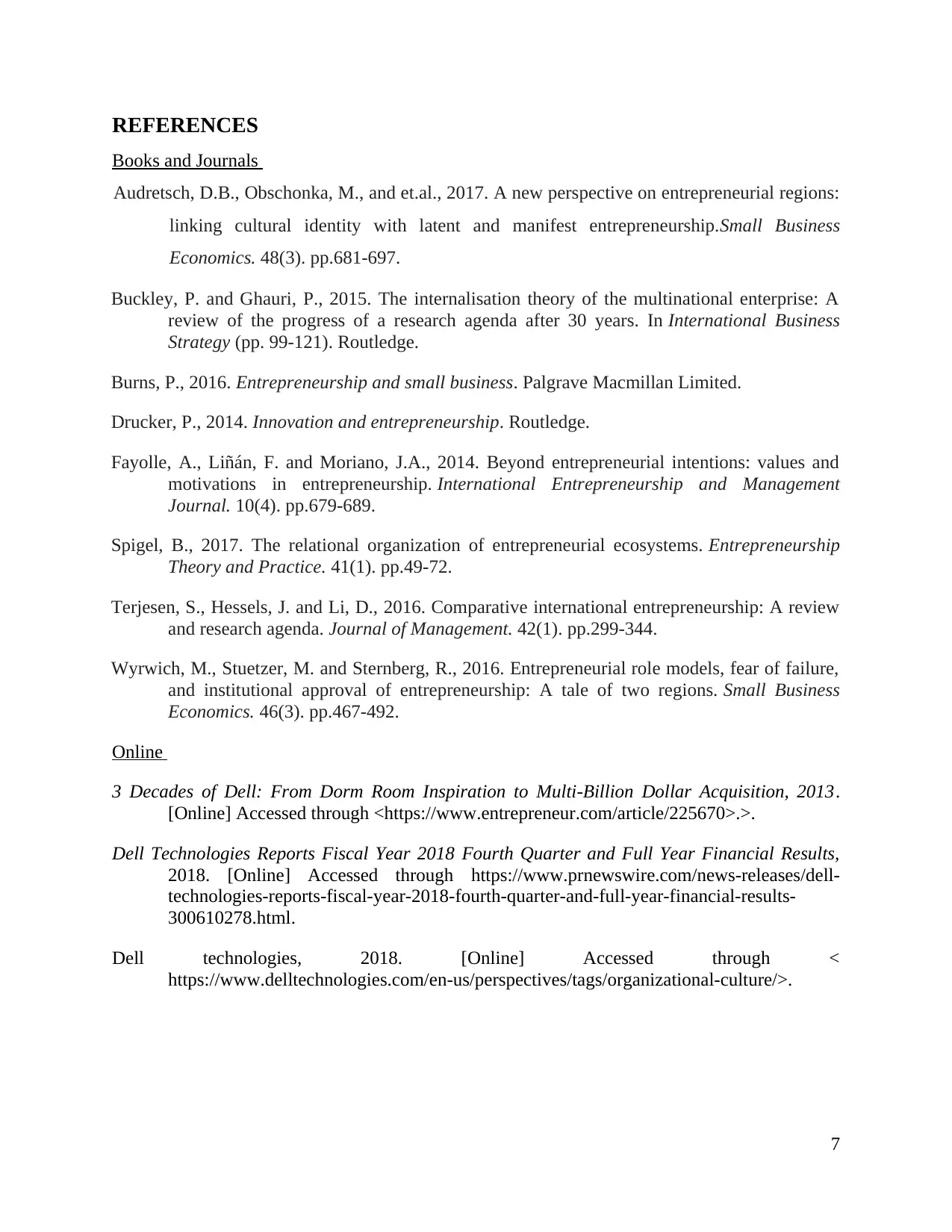
REFERENCES
Books and Journals
Audretsch, D.B., Obschonka, M., and et.al., 2017. A new perspective on entrepreneurial regions:
linking cultural identity with latent and manifest entrepreneurship.Small Business
Economics. 48(3). pp.681-697.
Buckley, P. and Ghauri, P., 2015. The internalisation theory of the multinational enterprise: A
review of the progress of a research agenda after 30 years. In International Business
Strategy (pp. 99-121). Routledge.
Burns, P., 2016. Entrepreneurship and small business. Palgrave Macmillan Limited.
Drucker, P., 2014. Innovation and entrepreneurship. Routledge.
Fayolle, A., Liñán, F. and Moriano, J.A., 2014. Beyond entrepreneurial intentions: values and
motivations in entrepreneurship. International Entrepreneurship and Management
Journal. 10(4). pp.679-689.
Spigel, B., 2017. The relational organization of entrepreneurial ecosystems. Entrepreneurship
Theory and Practice. 41(1). pp.49-72.
Terjesen, S., Hessels, J. and Li, D., 2016. Comparative international entrepreneurship: A review
and research agenda. Journal of Management. 42(1). pp.299-344.
Wyrwich, M., Stuetzer, M. and Sternberg, R., 2016. Entrepreneurial role models, fear of failure,
and institutional approval of entrepreneurship: A tale of two regions. Small Business
Economics. 46(3). pp.467-492.
Online
3 Decades of Dell: From Dorm Room Inspiration to Multi-Billion Dollar Acquisition, 2013.
[Online] Accessed through <https://www.entrepreneur.com/article/225670>.>.
Dell Technologies Reports Fiscal Year 2018 Fourth Quarter and Full Year Financial Results,
2018. [Online] Accessed through https://www.prnewswire.com/news-releases/dell-
technologies-reports-fiscal-year-2018-fourth-quarter-and-full-year-financial-results-
300610278.html.
Dell technologies, 2018. [Online] Accessed through <
https://www.delltechnologies.com/en-us/perspectives/tags/organizational-culture/>.
7
Books and Journals
Audretsch, D.B., Obschonka, M., and et.al., 2017. A new perspective on entrepreneurial regions:
linking cultural identity with latent and manifest entrepreneurship.Small Business
Economics. 48(3). pp.681-697.
Buckley, P. and Ghauri, P., 2015. The internalisation theory of the multinational enterprise: A
review of the progress of a research agenda after 30 years. In International Business
Strategy (pp. 99-121). Routledge.
Burns, P., 2016. Entrepreneurship and small business. Palgrave Macmillan Limited.
Drucker, P., 2014. Innovation and entrepreneurship. Routledge.
Fayolle, A., Liñán, F. and Moriano, J.A., 2014. Beyond entrepreneurial intentions: values and
motivations in entrepreneurship. International Entrepreneurship and Management
Journal. 10(4). pp.679-689.
Spigel, B., 2017. The relational organization of entrepreneurial ecosystems. Entrepreneurship
Theory and Practice. 41(1). pp.49-72.
Terjesen, S., Hessels, J. and Li, D., 2016. Comparative international entrepreneurship: A review
and research agenda. Journal of Management. 42(1). pp.299-344.
Wyrwich, M., Stuetzer, M. and Sternberg, R., 2016. Entrepreneurial role models, fear of failure,
and institutional approval of entrepreneurship: A tale of two regions. Small Business
Economics. 46(3). pp.467-492.
Online
3 Decades of Dell: From Dorm Room Inspiration to Multi-Billion Dollar Acquisition, 2013.
[Online] Accessed through <https://www.entrepreneur.com/article/225670>.>.
Dell Technologies Reports Fiscal Year 2018 Fourth Quarter and Full Year Financial Results,
2018. [Online] Accessed through https://www.prnewswire.com/news-releases/dell-
technologies-reports-fiscal-year-2018-fourth-quarter-and-full-year-financial-results-
300610278.html.
Dell technologies, 2018. [Online] Accessed through <
https://www.delltechnologies.com/en-us/perspectives/tags/organizational-culture/>.
7
Paraphrase This Document
Need a fresh take? Get an instant paraphrase of this document with our AI Paraphraser

8

1 out of 11


Related Documents


Your All-in-One AI-Powered Toolkit for Academic Success.
+13062052269
info@desklib.com
Available 24*7 on WhatsApp / Email
![[object Object]](/_next/static/media/star-bottom.7253800d.svg)
Unlock your academic potential
Copyright © 2020–2026 A2Z Services. All Rights Reserved. Developed and managed by ZUCOL.