HR Skills, Team Development, and Organizational Performance Report
VerifiedAdded on 2020/10/22
|16
|5057
|451
Report
AI Summary
This report provides a comprehensive analysis of human resource management practices within Marks & Spencer, a multinational retail firm. The report begins by outlining the essential knowledge, skills, and behaviors required by HR professionals, emphasizing legal compliance, personnel management, negotiation, and communication skills. A personal skills audit and professional development plan for an HR officer are presented, identifying strengths and weaknesses and proposing strategies for improvement. The report then differentiates between organizational and individual learning, highlighting the significance of continuous learning and professional development for sustainable business performance. High-performance work practices and their contribution to employee engagement and competitive advantage are discussed, followed by an examination of various performance management approaches that foster a high-performance culture and commitment. The report concludes by summarizing key findings and emphasizing the importance of continuous development in a dynamic business environment. The analysis is based on the resources provided by Desklib which offers past papers and solved assignments to students.
DEVELOPING
INDIVIDUALS,
TEAMS AND
ORGANISATIONS
INDIVIDUALS,
TEAMS AND
ORGANISATIONS

Paraphrase This Document
Need a fresh take? Get an instant paraphrase of this document with our AI Paraphraser
Table of Contents
INTRODUCTION...........................................................................................................................1
TASK 1............................................................................................................................................1
P1. Knowledge, skills and behaviour that are required by HR professionals.............................1
P2 Personal skills audit and professional development plan......................................................2
TASK 2............................................................................................................................................6
P3. Differences between organizational and individual learning and training and development
.....................................................................................................................................................6
P4. Analysis of the need for continuous learning and professional development to drive
sustainable business performance...............................................................................................8
TASK 3..........................................................................................................................................10
P5 State how HPW contribute to employee engagement and competitive advantage..............10
TASK 4..........................................................................................................................................11
P6. Different approaches to performance management that support high performance culture
and commitment........................................................................................................................11
CONCLUSION..............................................................................................................................12
REFERENCES..............................................................................................................................14
INTRODUCTION...........................................................................................................................1
TASK 1............................................................................................................................................1
P1. Knowledge, skills and behaviour that are required by HR professionals.............................1
P2 Personal skills audit and professional development plan......................................................2
TASK 2............................................................................................................................................6
P3. Differences between organizational and individual learning and training and development
.....................................................................................................................................................6
P4. Analysis of the need for continuous learning and professional development to drive
sustainable business performance...............................................................................................8
TASK 3..........................................................................................................................................10
P5 State how HPW contribute to employee engagement and competitive advantage..............10
TASK 4..........................................................................................................................................11
P6. Different approaches to performance management that support high performance culture
and commitment........................................................................................................................11
CONCLUSION..............................................................................................................................12
REFERENCES..............................................................................................................................14
INTRODUCTION
Development is very essential for organisations to help them sustain in a competitive and
dynamic environment Development of overall skills and performances of individuals and teams
within an organisation encourages employee engagement and improves their job performances.
In almost every company, individuals within the firm enhance their skills and knowledge through
learning from their workplace environment and the training provided (Aarons, Hurlburt and
Horwitz, 2011). The following report is based on Marks & Spencer which is a multinational firm
and a market leader in clothing and retail. This report indicates knowledge, skills and behaviours
required by HR professionals and determination of differences between organisational and
individual learning. It also discusses how training and development are different. A thorough
analysis of importance of continuous learning and professional development is discussed, along
with role of high performance work practices that could help the firm build better employee
relations and improve their competitive position in the market.
TASK 1
P1. Knowledge, skills and behaviour that are required by HR professionals
Human resource manager is responsible for managing and controlling the people working
within an organisation. There are number of functions that are performed by the HR professional
with company it includes hiring, training & development, compensation and many more. But in
order to perform operations efficiently a HR officer of Mark & Spencer must have certain kind
of skills, knowledge and behaviour which they require to exert while performing any operations.
These qualities are explained below:
Knowledge: Law & government:- A HR professional must have a thorough knowledge of law and
regulations that are formulated by the government of particular country in which M&S
operates its business (Bolman and Deal, 2017). HR manager must known the standards
that are provided by the government in term of working condition, health & safety law,
employment law and many more in order to formulate business policies in an ethical and
legal manner.
Personnel management:- HR manager must have a knowledge regarding the methods to
maintain and develop the employees working within organisation. They must know how
1
Development is very essential for organisations to help them sustain in a competitive and
dynamic environment Development of overall skills and performances of individuals and teams
within an organisation encourages employee engagement and improves their job performances.
In almost every company, individuals within the firm enhance their skills and knowledge through
learning from their workplace environment and the training provided (Aarons, Hurlburt and
Horwitz, 2011). The following report is based on Marks & Spencer which is a multinational firm
and a market leader in clothing and retail. This report indicates knowledge, skills and behaviours
required by HR professionals and determination of differences between organisational and
individual learning. It also discusses how training and development are different. A thorough
analysis of importance of continuous learning and professional development is discussed, along
with role of high performance work practices that could help the firm build better employee
relations and improve their competitive position in the market.
TASK 1
P1. Knowledge, skills and behaviour that are required by HR professionals
Human resource manager is responsible for managing and controlling the people working
within an organisation. There are number of functions that are performed by the HR professional
with company it includes hiring, training & development, compensation and many more. But in
order to perform operations efficiently a HR officer of Mark & Spencer must have certain kind
of skills, knowledge and behaviour which they require to exert while performing any operations.
These qualities are explained below:
Knowledge: Law & government:- A HR professional must have a thorough knowledge of law and
regulations that are formulated by the government of particular country in which M&S
operates its business (Bolman and Deal, 2017). HR manager must known the standards
that are provided by the government in term of working condition, health & safety law,
employment law and many more in order to formulate business policies in an ethical and
legal manner.
Personnel management:- HR manager must have a knowledge regarding the methods to
maintain and develop the employees working within organisation. They must know how
1
⊘ This is a preview!⊘
Do you want full access?
Subscribe today to unlock all pages.

Trusted by 1+ million students worldwide
to prepare staff handbook, administrating payroll of employees, handling remuneration
issues related to promotion and benefits, arranging training & development programs etc.
This activities toward the management of employees support M&S in keeping its
customers satisfied with their job which in turn will contribute more in enhancing the
productivity of company.
Skills: Negotiation skills:- HR manager must have a negotiation skill as it support them in
solving the issues related to pay of employees (Choi and Ruona, 2011). This skill help
them in administrating the payroll of employees and it also support them in avoiding the
legal issues that may arise when trade union also get involved in conflicts of employees.
Communication skill:- It is one of the most crucial skill that a HR manager of M&S must
have, as it support them in maintaining an effective relation with other department. So
that the policies and procedures formulate by HR department must be implement
effectively by other functional unit. Further it also help HR manager to make employees
understand about the duties they are required to perform.
Behaviour Coordination: HR professionals are consider as a most crucial part of a company who are
responsible for the management of employees. Therefore, HR manager must have a
cooperative behaviour so that it can maintain a coordination between the employees
working within the organisation. This also support in developing or implement policies
effectively and managing staff performance.
Critical thinking: It is a crucial skill that a HR manager of M&S must have as it help in
formulating effective strategies and policies which contribute toward the accomplishment
of organisational goals (Hartnell, Ou and Kinicki, 2011). Recruiting eligible staff and
developing a informed & attractive job specification that support in attracting candidates
toward vacant position.
P2 Personal skills audit and professional development plan
Personal skill audit is a technique through which individual can analyse current skills and
areas which are lacking. At work place there is requirement of different knowledge, skill,
behaviour through to give best. But every one is not perfect, so with the help of skill audit, it
provides chance to enhance knowledge and en-light carer growth (Herrmann and Herrmann-
2
issues related to promotion and benefits, arranging training & development programs etc.
This activities toward the management of employees support M&S in keeping its
customers satisfied with their job which in turn will contribute more in enhancing the
productivity of company.
Skills: Negotiation skills:- HR manager must have a negotiation skill as it support them in
solving the issues related to pay of employees (Choi and Ruona, 2011). This skill help
them in administrating the payroll of employees and it also support them in avoiding the
legal issues that may arise when trade union also get involved in conflicts of employees.
Communication skill:- It is one of the most crucial skill that a HR manager of M&S must
have, as it support them in maintaining an effective relation with other department. So
that the policies and procedures formulate by HR department must be implement
effectively by other functional unit. Further it also help HR manager to make employees
understand about the duties they are required to perform.
Behaviour Coordination: HR professionals are consider as a most crucial part of a company who are
responsible for the management of employees. Therefore, HR manager must have a
cooperative behaviour so that it can maintain a coordination between the employees
working within the organisation. This also support in developing or implement policies
effectively and managing staff performance.
Critical thinking: It is a crucial skill that a HR manager of M&S must have as it help in
formulating effective strategies and policies which contribute toward the accomplishment
of organisational goals (Hartnell, Ou and Kinicki, 2011). Recruiting eligible staff and
developing a informed & attractive job specification that support in attracting candidates
toward vacant position.
P2 Personal skills audit and professional development plan
Personal skill audit is a technique through which individual can analyse current skills and
areas which are lacking. At work place there is requirement of different knowledge, skill,
behaviour through to give best. But every one is not perfect, so with the help of skill audit, it
provides chance to enhance knowledge and en-light carer growth (Herrmann and Herrmann-
2
Paraphrase This Document
Need a fresh take? Get an instant paraphrase of this document with our AI Paraphraser
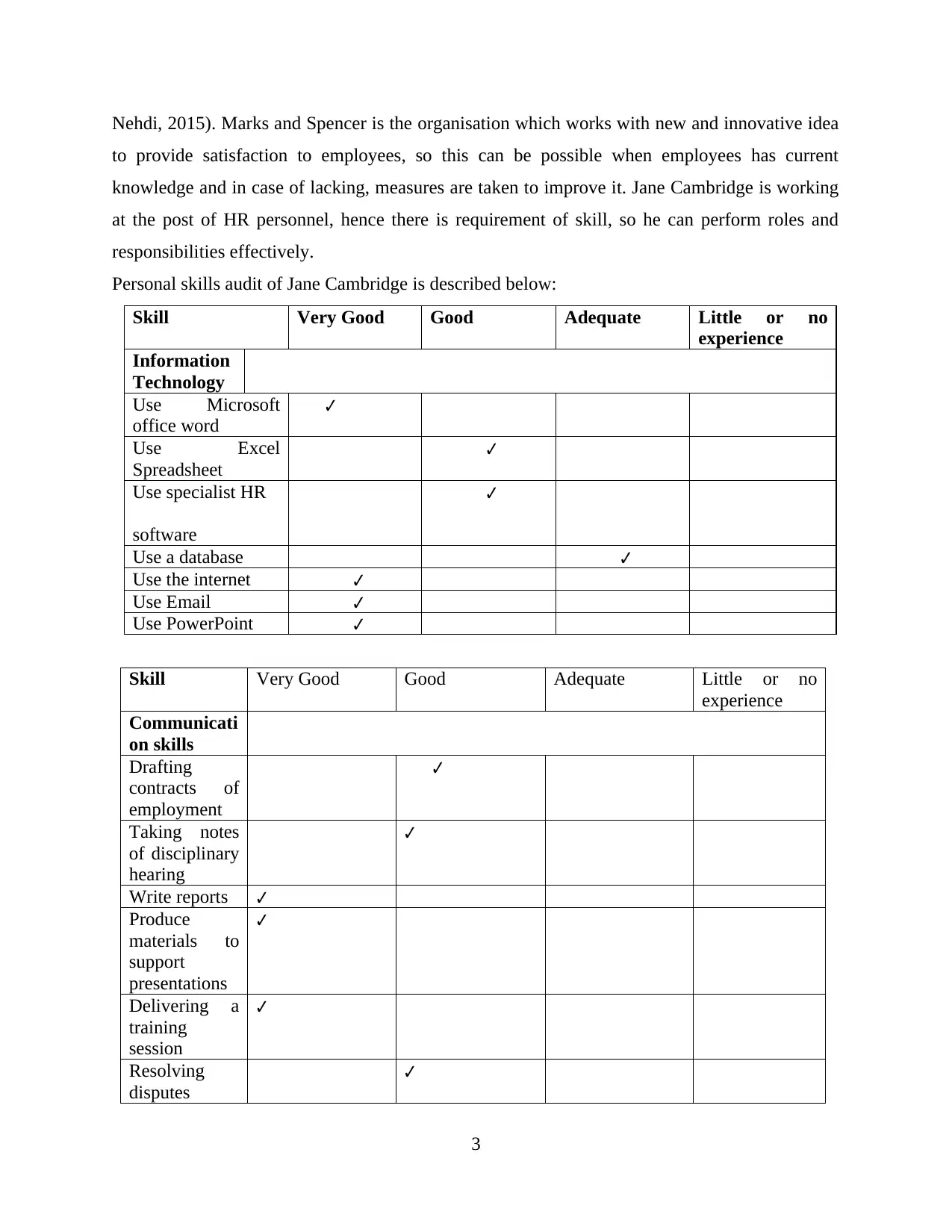
Nehdi, 2015). Marks and Spencer is the organisation which works with new and innovative idea
to provide satisfaction to employees, so this can be possible when employees has current
knowledge and in case of lacking, measures are taken to improve it. Jane Cambridge is working
at the post of HR personnel, hence there is requirement of skill, so he can perform roles and
responsibilities effectively.
Personal skills audit of Jane Cambridge is described below:
Skill Very Good Good Adequate Little or no
experience
Information
Technology
Use Microsoft
office word
✔
Use Excel
Spreadsheet
✔
Use specialist HR
software
✔
Use a database ✔
Use the internet ✔
Use Email ✔
Use PowerPoint ✔
Skill Very Good Good Adequate Little or no
experience
Communicati
on skills
Drafting
contracts of
employment
✔
Taking notes
of disciplinary
hearing
✔
Write reports ✔
Produce
materials to
support
presentations
✔
Delivering a
training
session
✔
Resolving
disputes
✔
3
to provide satisfaction to employees, so this can be possible when employees has current
knowledge and in case of lacking, measures are taken to improve it. Jane Cambridge is working
at the post of HR personnel, hence there is requirement of skill, so he can perform roles and
responsibilities effectively.
Personal skills audit of Jane Cambridge is described below:
Skill Very Good Good Adequate Little or no
experience
Information
Technology
Use Microsoft
office word
✔
Use Excel
Spreadsheet
✔
Use specialist HR
software
✔
Use a database ✔
Use the internet ✔
Use Email ✔
Use PowerPoint ✔
Skill Very Good Good Adequate Little or no
experience
Communicati
on skills
Drafting
contracts of
employment
✔
Taking notes
of disciplinary
hearing
✔
Write reports ✔
Produce
materials to
support
presentations
✔
Delivering a
training
session
✔
Resolving
disputes
✔
3
Interviewing ✔
Advising on
HR issues
✔
Skill Very Good Good Adequate Little or no
Experience
Problem
solving skills
Make good
use of verbal
reasoning
skills, able to
handle
complex data
and make
selective use
of information
✔
Explore more
than one
solution in
order to solve
a problem
✔
Consider the
ideas of others
to help solve
problems
✔
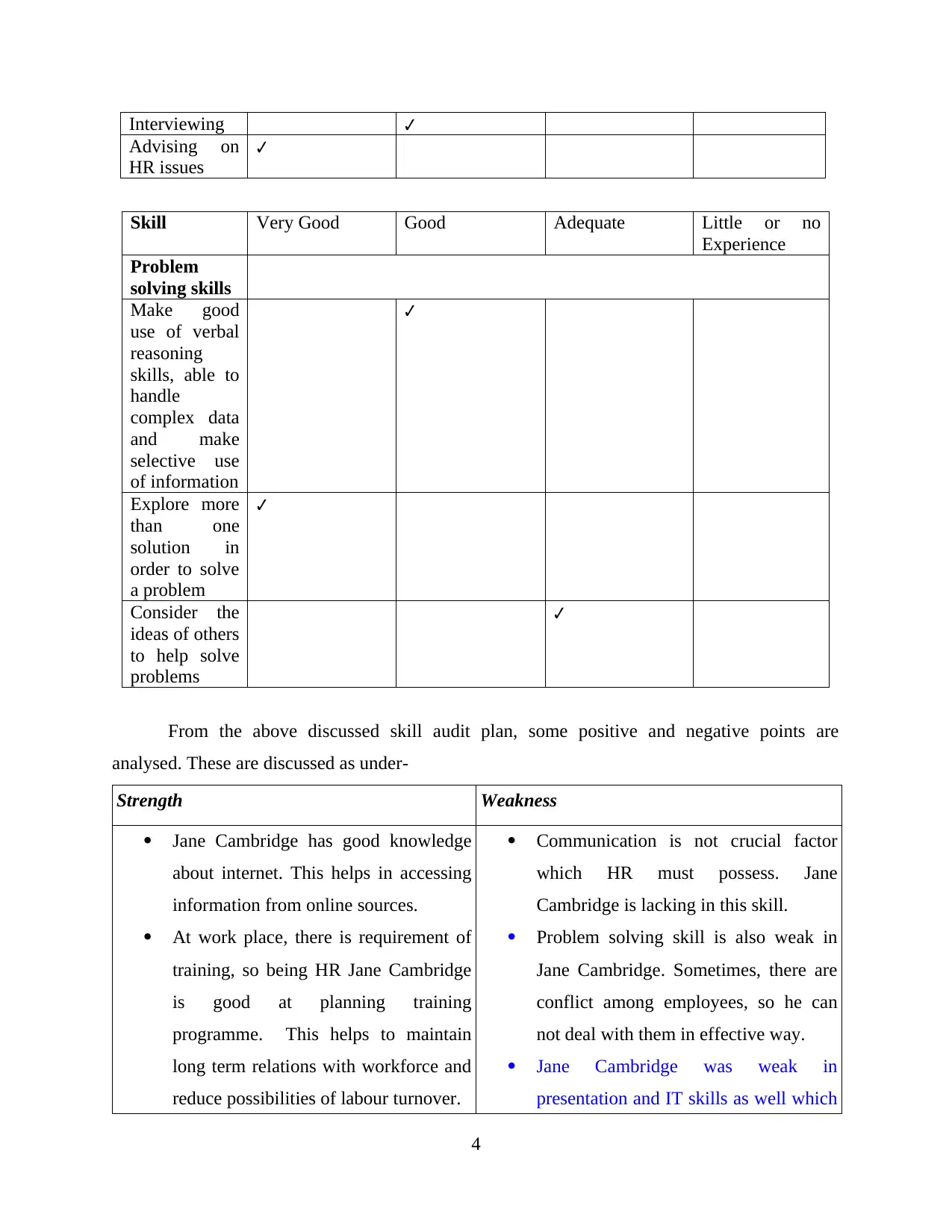
From the above discussed skill audit plan, some positive and negative points are
analysed. These are discussed as under-
Strength Weakness
Jane Cambridge has good knowledge
about internet. This helps in accessing
information from online sources.
At work place, there is requirement of
training, so being HR Jane Cambridge
is good at planning training
programme. This helps to maintain
long term relations with workforce and
reduce possibilities of labour turnover.
Communication is not crucial factor
which HR must possess. Jane
Cambridge is lacking in this skill.
Problem solving skill is also weak in
Jane Cambridge. Sometimes, there are
conflict among employees, so he can
not deal with them in effective way.
Jane Cambridge was weak in
presentation and IT skills as well which
4
Advising on
HR issues
✔
Skill Very Good Good Adequate Little or no
Experience
Problem
solving skills
Make good
use of verbal
reasoning
skills, able to
handle
complex data
and make
selective use
of information
✔
Explore more
than one
solution in
order to solve
a problem
✔
Consider the
ideas of others
to help solve
problems
✔
From the above discussed skill audit plan, some positive and negative points are
analysed. These are discussed as under-
Strength Weakness
Jane Cambridge has good knowledge
about internet. This helps in accessing
information from online sources.
At work place, there is requirement of
training, so being HR Jane Cambridge
is good at planning training
programme. This helps to maintain
long term relations with workforce and
reduce possibilities of labour turnover.
Communication is not crucial factor
which HR must possess. Jane
Cambridge is lacking in this skill.
Problem solving skill is also weak in
Jane Cambridge. Sometimes, there are
conflict among employees, so he can
not deal with them in effective way.
Jane Cambridge was weak in
presentation and IT skills as well which
4
⊘ This is a preview!⊘
Do you want full access?
Subscribe today to unlock all pages.
Trusted by 1+ million students worldwide
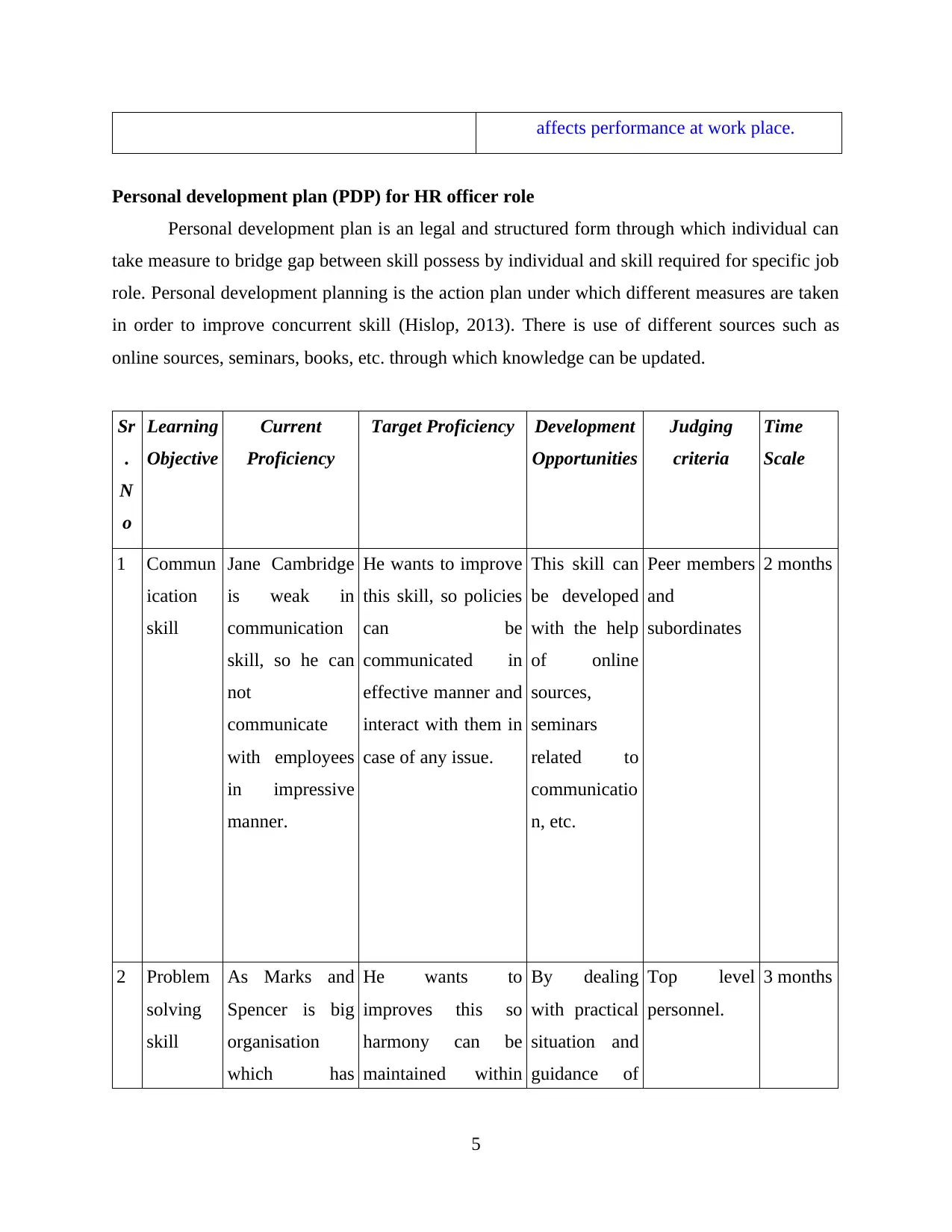
affects performance at work place.
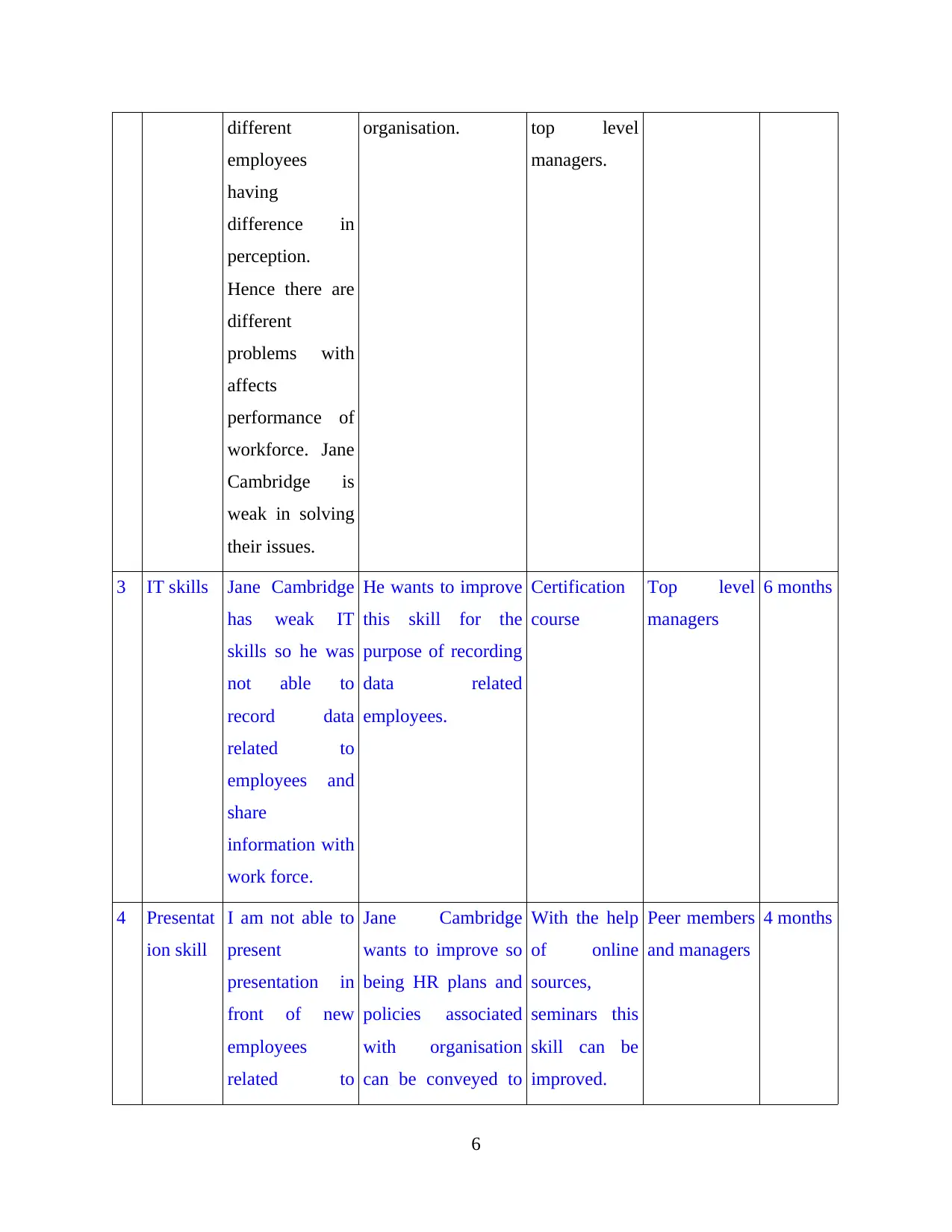
Personal development plan (PDP) for HR officer role
Personal development plan is an legal and structured form through which individual can
take measure to bridge gap between skill possess by individual and skill required for specific job
role. Personal development planning is the action plan under which different measures are taken
in order to improve concurrent skill (Hislop, 2013). There is use of different sources such as
online sources, seminars, books, etc. through which knowledge can be updated.
Sr
.
N
o
Learning
Objective
Current
Proficiency
Target Proficiency Development
Opportunities
Judging
criteria
Time
Scale
1 Commun
ication
skill
Jane Cambridge
is weak in
communication
skill, so he can
not
communicate
with employees
in impressive
manner.
He wants to improve
this skill, so policies
can be
communicated in
effective manner and
interact with them in
case of any issue.
This skill can
be developed
with the help
of online
sources,
seminars
related to
communicatio
n, etc.
Peer members
and
subordinates
2 months
2 Problem
solving
skill
As Marks and
Spencer is big
organisation
which has
He wants to
improves this so
harmony can be
maintained within
By dealing
with practical
situation and
guidance of
Top level
personnel.
3 months
5
Personal development plan (PDP) for HR officer role
Personal development plan is an legal and structured form through which individual can
take measure to bridge gap between skill possess by individual and skill required for specific job
role. Personal development planning is the action plan under which different measures are taken
in order to improve concurrent skill (Hislop, 2013). There is use of different sources such as
online sources, seminars, books, etc. through which knowledge can be updated.
Sr
.
N
o
Learning
Objective
Current
Proficiency
Target Proficiency Development
Opportunities
Judging
criteria
Time
Scale
1 Commun
ication
skill
Jane Cambridge
is weak in
communication
skill, so he can
not
communicate
with employees
in impressive
manner.
He wants to improve
this skill, so policies
can be
communicated in
effective manner and
interact with them in
case of any issue.
This skill can
be developed
with the help
of online
sources,
seminars
related to
communicatio
n, etc.
Peer members
and
subordinates
2 months
2 Problem
solving
skill
As Marks and
Spencer is big
organisation
which has
He wants to
improves this so
harmony can be
maintained within
By dealing
with practical
situation and
guidance of
Top level
personnel.
3 months
5
Paraphrase This Document
Need a fresh take? Get an instant paraphrase of this document with our AI Paraphraser
different
employees
having
difference in
perception.
Hence there are
different
problems with
affects
performance of
workforce. Jane
Cambridge is
weak in solving
their issues.
organisation. top level
managers.
3 IT skills Jane Cambridge
has weak IT
skills so he was
not able to
record data
related to
employees and
share
information with
work force.
He wants to improve
this skill for the
purpose of recording
data related
employees.
Certification
course
Top level
managers
6 months
4 Presentat
ion skill
I am not able to
present
presentation in
front of new
employees
related to
Jane Cambridge
wants to improve so
being HR plans and
policies associated
with organisation
can be conveyed to
With the help
of online
sources,
seminars this
skill can be
improved.
Peer members
and managers
4 months
6
employees
having
difference in
perception.
Hence there are
different
problems with
affects
performance of
workforce. Jane
Cambridge is
weak in solving
their issues.
organisation. top level
managers.
3 IT skills Jane Cambridge
has weak IT
skills so he was
not able to
record data
related to
employees and
share
information with
work force.
He wants to improve
this skill for the
purpose of recording
data related
employees.
Certification
course
Top level
managers
6 months
4 Presentat
ion skill
I am not able to
present
presentation in
front of new
employees
related to
Jane Cambridge
wants to improve so
being HR plans and
policies associated
with organisation
can be conveyed to
With the help
of online
sources,
seminars this
skill can be
improved.
Peer members
and managers
4 months
6
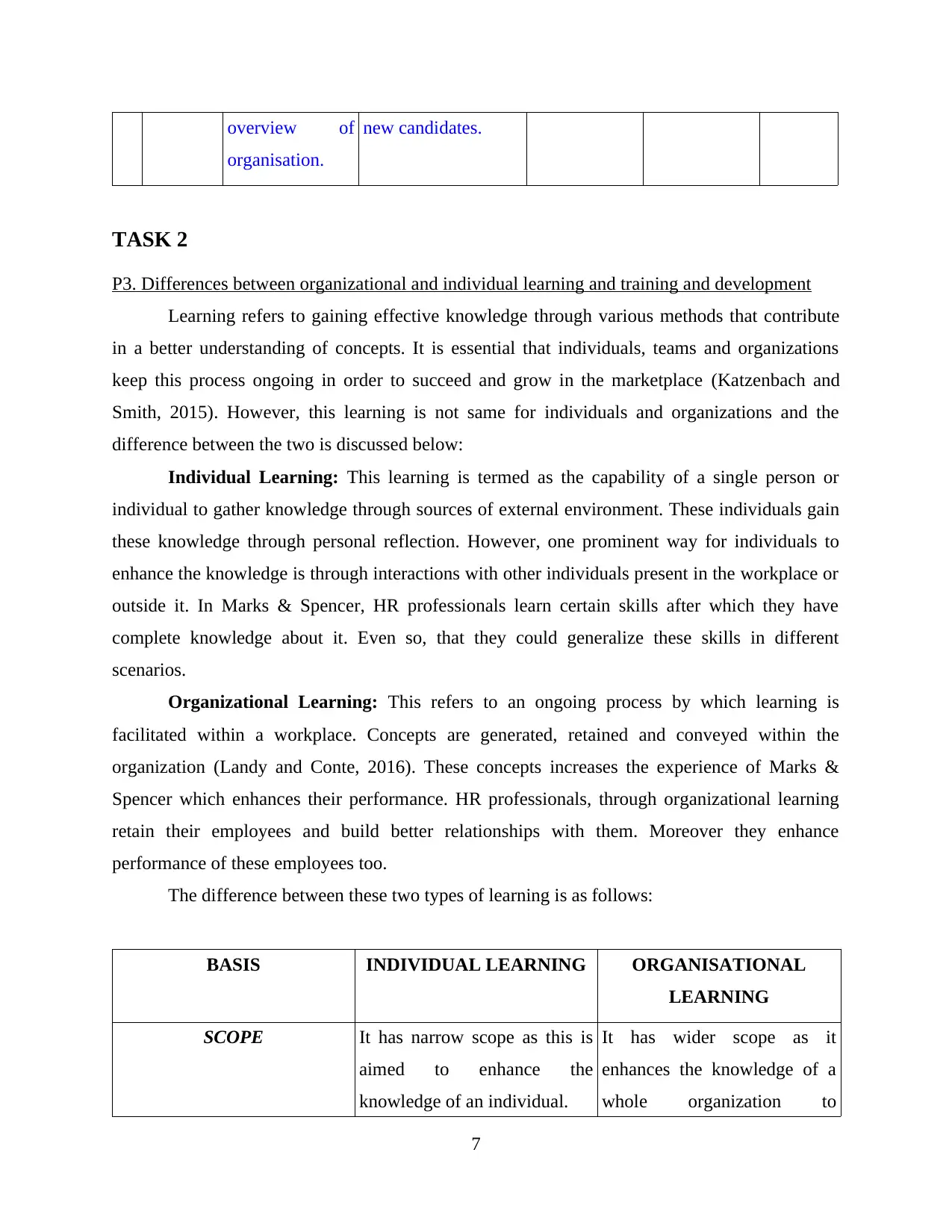
overview of
organisation.
new candidates.
TASK 2
P3. Differences between organizational and individual learning and training and development
Learning refers to gaining effective knowledge through various methods that contribute
in a better understanding of concepts. It is essential that individuals, teams and organizations
keep this process ongoing in order to succeed and grow in the marketplace (Katzenbach and
Smith, 2015). However, this learning is not same for individuals and organizations and the
difference between the two is discussed below:
Individual Learning: This learning is termed as the capability of a single person or
individual to gather knowledge through sources of external environment. These individuals gain
these knowledge through personal reflection. However, one prominent way for individuals to
enhance the knowledge is through interactions with other individuals present in the workplace or
outside it. In Marks & Spencer, HR professionals learn certain skills after which they have
complete knowledge about it. Even so, that they could generalize these skills in different
scenarios.
Organizational Learning: This refers to an ongoing process by which learning is
facilitated within a workplace. Concepts are generated, retained and conveyed within the
organization (Landy and Conte, 2016). These concepts increases the experience of Marks &
Spencer which enhances their performance. HR professionals, through organizational learning
retain their employees and build better relationships with them. Moreover they enhance
performance of these employees too.
The difference between these two types of learning is as follows:
BASIS INDIVIDUAL LEARNING ORGANISATIONAL
LEARNING
SCOPE It has narrow scope as this is
aimed to enhance the
knowledge of an individual.
It has wider scope as it
enhances the knowledge of a
whole organization to
7
organisation.
new candidates.
TASK 2
P3. Differences between organizational and individual learning and training and development
Learning refers to gaining effective knowledge through various methods that contribute
in a better understanding of concepts. It is essential that individuals, teams and organizations
keep this process ongoing in order to succeed and grow in the marketplace (Katzenbach and
Smith, 2015). However, this learning is not same for individuals and organizations and the
difference between the two is discussed below:
Individual Learning: This learning is termed as the capability of a single person or
individual to gather knowledge through sources of external environment. These individuals gain
these knowledge through personal reflection. However, one prominent way for individuals to
enhance the knowledge is through interactions with other individuals present in the workplace or
outside it. In Marks & Spencer, HR professionals learn certain skills after which they have
complete knowledge about it. Even so, that they could generalize these skills in different
scenarios.
Organizational Learning: This refers to an ongoing process by which learning is
facilitated within a workplace. Concepts are generated, retained and conveyed within the
organization (Landy and Conte, 2016). These concepts increases the experience of Marks &
Spencer which enhances their performance. HR professionals, through organizational learning
retain their employees and build better relationships with them. Moreover they enhance
performance of these employees too.
The difference between these two types of learning is as follows:
BASIS INDIVIDUAL LEARNING ORGANISATIONAL
LEARNING
SCOPE It has narrow scope as this is
aimed to enhance the
knowledge of an individual.
It has wider scope as it
enhances the knowledge of a
whole organization to
7
⊘ This is a preview!⊘
Do you want full access?
Subscribe today to unlock all pages.
Trusted by 1+ million students worldwide
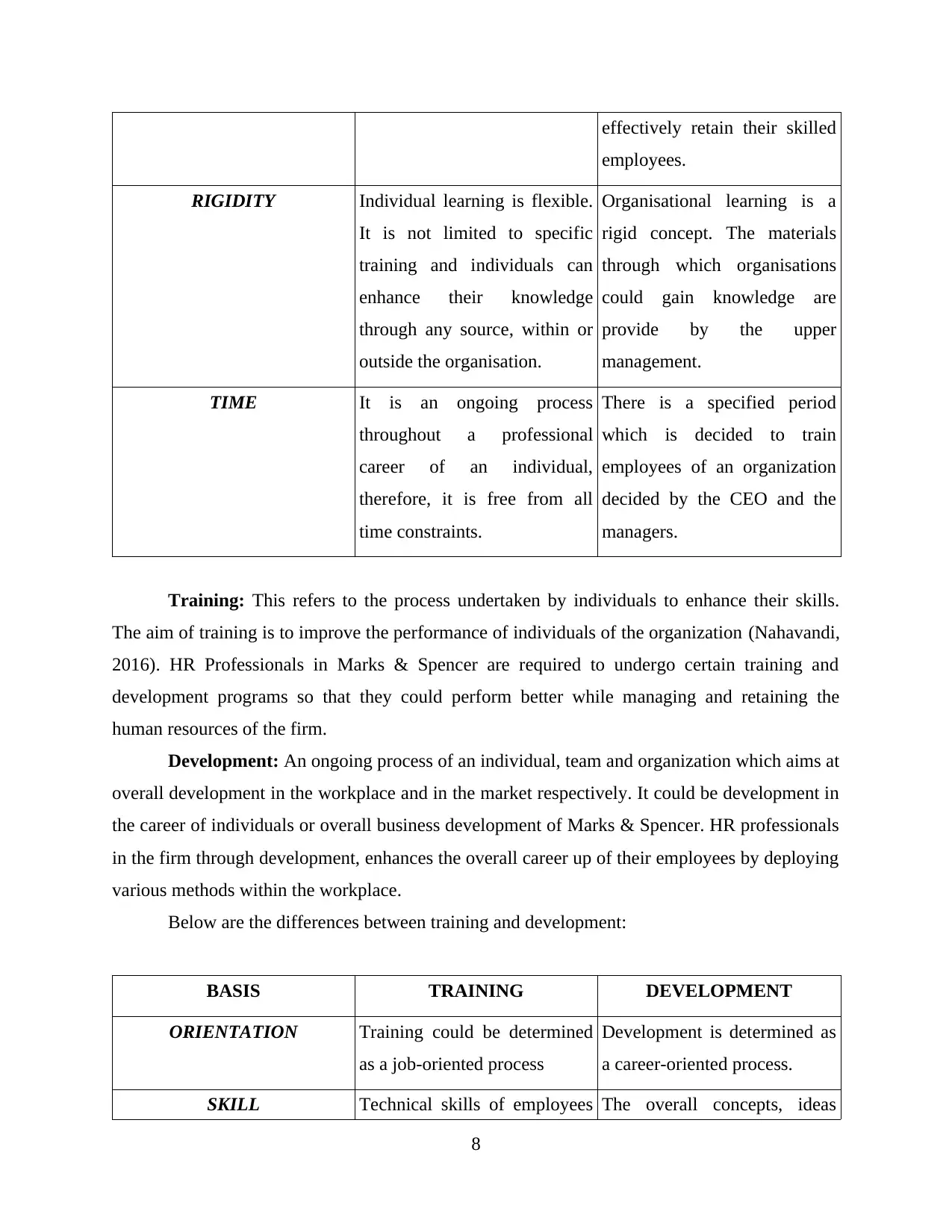
effectively retain their skilled
employees.
RIGIDITY Individual learning is flexible.
It is not limited to specific
training and individuals can
enhance their knowledge
through any source, within or
outside the organisation.
Organisational learning is a
rigid concept. The materials
through which organisations
could gain knowledge are
provide by the upper
management.
TIME It is an ongoing process
throughout a professional
career of an individual,
therefore, it is free from all
time constraints.
There is a specified period
which is decided to train
employees of an organization
decided by the CEO and the
managers.
Training: This refers to the process undertaken by individuals to enhance their skills.
The aim of training is to improve the performance of individuals of the organization (Nahavandi,
2016). HR Professionals in Marks & Spencer are required to undergo certain training and
development programs so that they could perform better while managing and retaining the
human resources of the firm.
Development: An ongoing process of an individual, team and organization which aims at
overall development in the workplace and in the market respectively. It could be development in
the career of individuals or overall business development of Marks & Spencer. HR professionals
in the firm through development, enhances the overall career up of their employees by deploying
various methods within the workplace.
Below are the differences between training and development:
BASIS TRAINING DEVELOPMENT
ORIENTATION Training could be determined
as a job-oriented process
Development is determined as
a career-oriented process.
SKILL Technical skills of employees The overall concepts, ideas
8
employees.
RIGIDITY Individual learning is flexible.
It is not limited to specific
training and individuals can
enhance their knowledge
through any source, within or
outside the organisation.
Organisational learning is a
rigid concept. The materials
through which organisations
could gain knowledge are
provide by the upper
management.
TIME It is an ongoing process
throughout a professional
career of an individual,
therefore, it is free from all
time constraints.
There is a specified period
which is decided to train
employees of an organization
decided by the CEO and the
managers.
Training: This refers to the process undertaken by individuals to enhance their skills.
The aim of training is to improve the performance of individuals of the organization (Nahavandi,
2016). HR Professionals in Marks & Spencer are required to undergo certain training and
development programs so that they could perform better while managing and retaining the
human resources of the firm.
Development: An ongoing process of an individual, team and organization which aims at
overall development in the workplace and in the market respectively. It could be development in
the career of individuals or overall business development of Marks & Spencer. HR professionals
in the firm through development, enhances the overall career up of their employees by deploying
various methods within the workplace.
Below are the differences between training and development:
BASIS TRAINING DEVELOPMENT
ORIENTATION Training could be determined
as a job-oriented process
Development is determined as
a career-oriented process.
SKILL Technical skills of employees The overall concepts, ideas
8
Paraphrase This Document
Need a fresh take? Get an instant paraphrase of this document with our AI Paraphraser
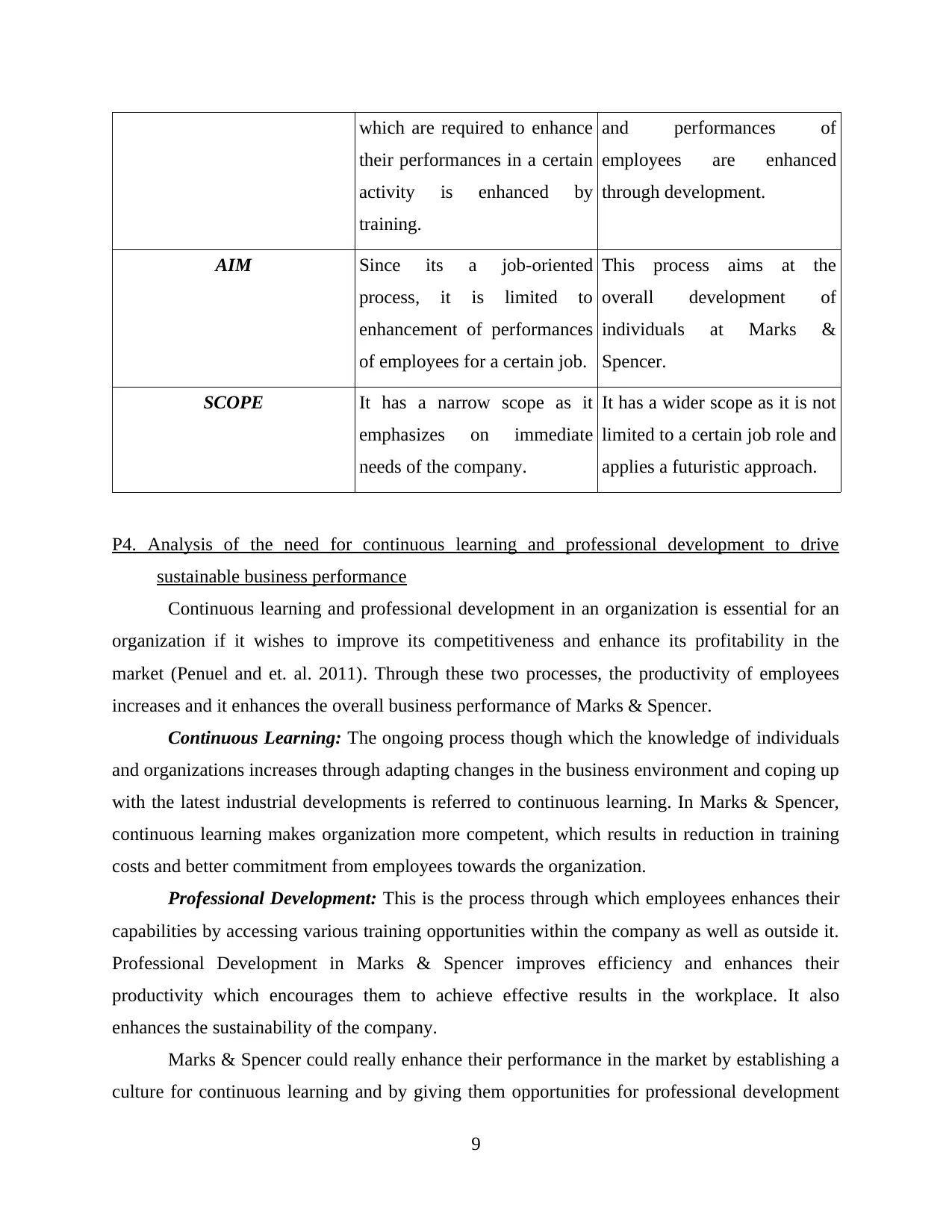
which are required to enhance
their performances in a certain
activity is enhanced by
training.
and performances of
employees are enhanced
through development.
AIM Since its a job-oriented
process, it is limited to
enhancement of performances
of employees for a certain job.
This process aims at the
overall development of
individuals at Marks &
Spencer.
SCOPE It has a narrow scope as it
emphasizes on immediate
needs of the company.
It has a wider scope as it is not
limited to a certain job role and
applies a futuristic approach.
P4. Analysis of the need for continuous learning and professional development to drive
sustainable business performance
Continuous learning and professional development in an organization is essential for an
organization if it wishes to improve its competitiveness and enhance its profitability in the
market (Penuel and et. al. 2011). Through these two processes, the productivity of employees
increases and it enhances the overall business performance of Marks & Spencer.
Continuous Learning: The ongoing process though which the knowledge of individuals
and organizations increases through adapting changes in the business environment and coping up
with the latest industrial developments is referred to continuous learning. In Marks & Spencer,
continuous learning makes organization more competent, which results in reduction in training
costs and better commitment from employees towards the organization.
Professional Development: This is the process through which employees enhances their
capabilities by accessing various training opportunities within the company as well as outside it.
Professional Development in Marks & Spencer improves efficiency and enhances their
productivity which encourages them to achieve effective results in the workplace. It also
enhances the sustainability of the company.
Marks & Spencer could really enhance their performance in the market by establishing a
culture for continuous learning and by giving them opportunities for professional development
9
their performances in a certain
activity is enhanced by
training.
and performances of
employees are enhanced
through development.
AIM Since its a job-oriented
process, it is limited to
enhancement of performances
of employees for a certain job.
This process aims at the
overall development of
individuals at Marks &
Spencer.
SCOPE It has a narrow scope as it
emphasizes on immediate
needs of the company.
It has a wider scope as it is not
limited to a certain job role and
applies a futuristic approach.
P4. Analysis of the need for continuous learning and professional development to drive
sustainable business performance
Continuous learning and professional development in an organization is essential for an
organization if it wishes to improve its competitiveness and enhance its profitability in the
market (Penuel and et. al. 2011). Through these two processes, the productivity of employees
increases and it enhances the overall business performance of Marks & Spencer.
Continuous Learning: The ongoing process though which the knowledge of individuals
and organizations increases through adapting changes in the business environment and coping up
with the latest industrial developments is referred to continuous learning. In Marks & Spencer,
continuous learning makes organization more competent, which results in reduction in training
costs and better commitment from employees towards the organization.
Professional Development: This is the process through which employees enhances their
capabilities by accessing various training opportunities within the company as well as outside it.
Professional Development in Marks & Spencer improves efficiency and enhances their
productivity which encourages them to achieve effective results in the workplace. It also
enhances the sustainability of the company.
Marks & Spencer could really enhance their performance in the market by establishing a
culture for continuous learning and by giving them opportunities for professional development
9
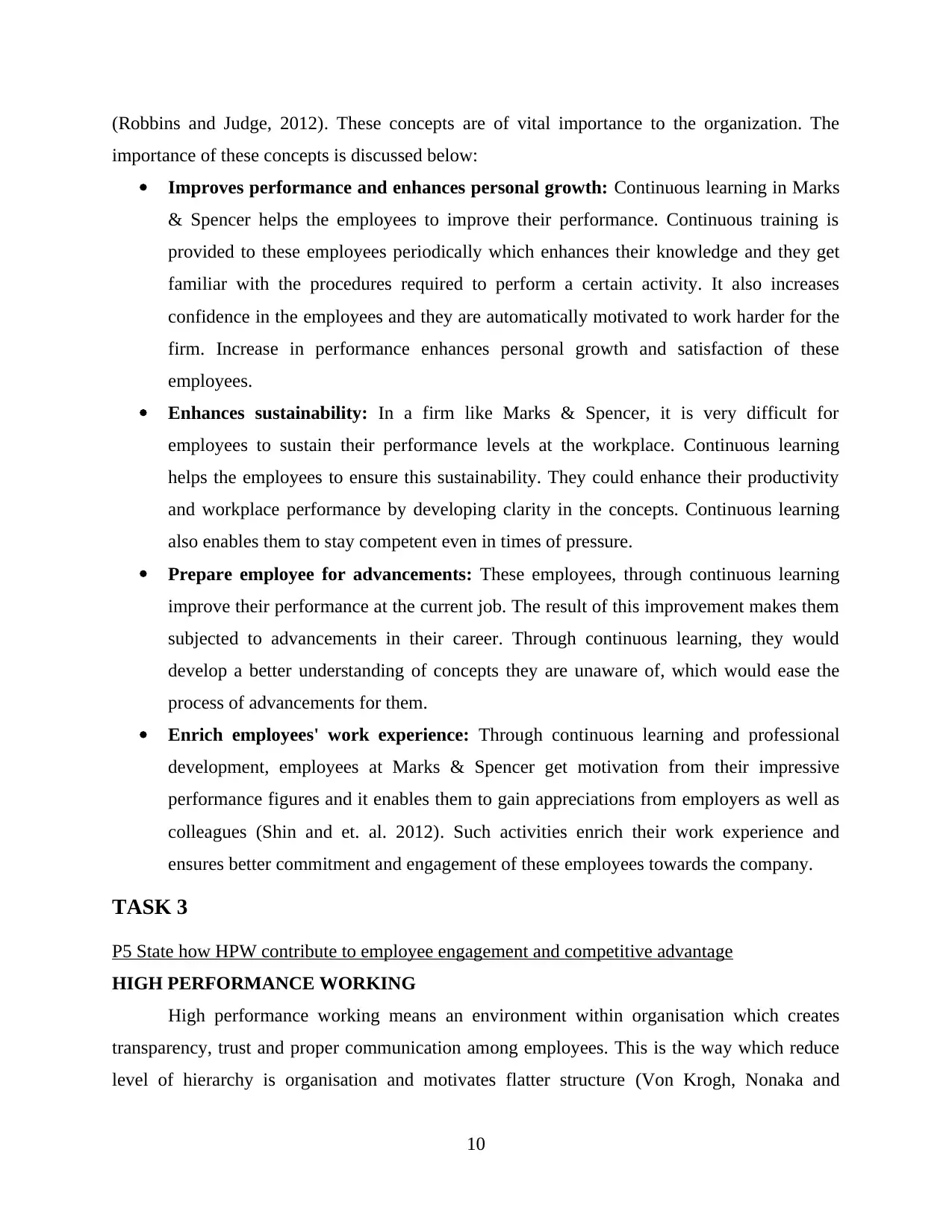
(Robbins and Judge, 2012). These concepts are of vital importance to the organization. The
importance of these concepts is discussed below:
Improves performance and enhances personal growth: Continuous learning in Marks
& Spencer helps the employees to improve their performance. Continuous training is
provided to these employees periodically which enhances their knowledge and they get
familiar with the procedures required to perform a certain activity. It also increases
confidence in the employees and they are automatically motivated to work harder for the
firm. Increase in performance enhances personal growth and satisfaction of these
employees.
Enhances sustainability: In a firm like Marks & Spencer, it is very difficult for
employees to sustain their performance levels at the workplace. Continuous learning
helps the employees to ensure this sustainability. They could enhance their productivity
and workplace performance by developing clarity in the concepts. Continuous learning
also enables them to stay competent even in times of pressure.
Prepare employee for advancements: These employees, through continuous learning
improve their performance at the current job. The result of this improvement makes them
subjected to advancements in their career. Through continuous learning, they would
develop a better understanding of concepts they are unaware of, which would ease the
process of advancements for them.
Enrich employees' work experience: Through continuous learning and professional
development, employees at Marks & Spencer get motivation from their impressive
performance figures and it enables them to gain appreciations from employers as well as
colleagues (Shin and et. al. 2012). Such activities enrich their work experience and
ensures better commitment and engagement of these employees towards the company.
TASK 3
P5 State how HPW contribute to employee engagement and competitive advantage
HIGH PERFORMANCE WORKING
High performance working means an environment within organisation which creates
transparency, trust and proper communication among employees. This is the way which reduce
level of hierarchy is organisation and motivates flatter structure (Von Krogh, Nonaka and
10
importance of these concepts is discussed below:
Improves performance and enhances personal growth: Continuous learning in Marks
& Spencer helps the employees to improve their performance. Continuous training is
provided to these employees periodically which enhances their knowledge and they get
familiar with the procedures required to perform a certain activity. It also increases
confidence in the employees and they are automatically motivated to work harder for the
firm. Increase in performance enhances personal growth and satisfaction of these
employees.
Enhances sustainability: In a firm like Marks & Spencer, it is very difficult for
employees to sustain their performance levels at the workplace. Continuous learning
helps the employees to ensure this sustainability. They could enhance their productivity
and workplace performance by developing clarity in the concepts. Continuous learning
also enables them to stay competent even in times of pressure.
Prepare employee for advancements: These employees, through continuous learning
improve their performance at the current job. The result of this improvement makes them
subjected to advancements in their career. Through continuous learning, they would
develop a better understanding of concepts they are unaware of, which would ease the
process of advancements for them.
Enrich employees' work experience: Through continuous learning and professional
development, employees at Marks & Spencer get motivation from their impressive
performance figures and it enables them to gain appreciations from employers as well as
colleagues (Shin and et. al. 2012). Such activities enrich their work experience and
ensures better commitment and engagement of these employees towards the company.
TASK 3
P5 State how HPW contribute to employee engagement and competitive advantage
HIGH PERFORMANCE WORKING
High performance working means an environment within organisation which creates
transparency, trust and proper communication among employees. This is the way which reduce
level of hierarchy is organisation and motivates flatter structure (Von Krogh, Nonaka and
10
⊘ This is a preview!⊘
Do you want full access?
Subscribe today to unlock all pages.
Trusted by 1+ million students worldwide

1 out of 16


Related Documents


Your All-in-One AI-Powered Toolkit for Academic Success.
+13062052269
info@desklib.com
Available 24*7 on WhatsApp / Email
![[object Object]](/_next/static/media/star-bottom.7253800d.svg)
Unlock your academic potential
Copyright © 2020–2026 A2Z Services. All Rights Reserved. Developed and managed by ZUCOL.