Developing Individuals, Teams, and Organisation at Morrisons
VerifiedAdded on 2023/01/18
|11
|2665
|38
Report
AI Summary
This report delves into the critical role of Human Resource (HR) management in fostering the development of individuals, teams, and the overall organization, using Morrisons as a case study. The report begins by analyzing the skills, knowledge, and behaviors essential for an HR manager, specifically within the context of a marketing manager role, and includes a personal skill audit. It then compares organizational and individual learning, training, and development approaches, emphasizing the importance of continuous learning and professional development. High-performance working (HPW) is examined in the context of Morrisons, outlining its key elements and contributions. Finally, the report explores various approaches to performance management that Morrisons could implement to enhance its operations and achieve its objectives. This assignment provides a comprehensive overview of HR functions, highlighting their impact on organizational success and employee engagement.
Developing
Individuals, Teams
and Organisation
Individuals, Teams
and Organisation

Paraphrase This Document
Need a fresh take? Get an instant paraphrase of this document with our AI Paraphraser
Table of Contents
INTRODUCTION ..........................................................................................................................3
TASK 1 ...........................................................................................................................................3
P1 Analysing Skills, Knowledge and Behaviour of HR manager for the job role of marketing
manager.......................................................................................................................................3
P2 Personal Skill audit for the job role of marketing manager...................................................4
TASK 2............................................................................................................................................6
P3 Comparison between organisational and individual learning, training and development.....6
P4 Analysis of needs of continuous learning and professional development.............................7
TASK 3............................................................................................................................................8
P5 Contribution of HPW in Morrisons.......................................................................................8
TASK 4............................................................................................................................................9
P6 Approaches of performance management.............................................................................9
CONCLUSION................................................................................................................................9
REFERENCES .............................................................................................................................11
INTRODUCTION ..........................................................................................................................3
TASK 1 ...........................................................................................................................................3
P1 Analysing Skills, Knowledge and Behaviour of HR manager for the job role of marketing
manager.......................................................................................................................................3
P2 Personal Skill audit for the job role of marketing manager...................................................4
TASK 2............................................................................................................................................6
P3 Comparison between organisational and individual learning, training and development.....6
P4 Analysis of needs of continuous learning and professional development.............................7
TASK 3............................................................................................................................................8
P5 Contribution of HPW in Morrisons.......................................................................................8
TASK 4............................................................................................................................................9
P6 Approaches of performance management.............................................................................9
CONCLUSION................................................................................................................................9
REFERENCES .............................................................................................................................11
INTRODUCTION
Developing individuals, teams and organisations is duty of human resource managers of
an entity. HR managers are the professionals who are responsible for managing the expertise and
required talent in company for betterment of entity and for attaining expected goals. HR
managers perform various activities from identifying the needs of their team to maintaining and
retaining staff. HR managers plays very important role in every organisation, they brings
appropriate staff in accordance with the needs of company for enhancing the ability and
capabilities of it(Barratt, 2018). In this assignment, various functions which an HR professional
performs for an organisation is seen in order to develop their teams and company. Morrisons is
the chosen organisation for this report, which is fourth largest supermarket chain of UK.
Morrisons was founded by William Morrison in 1899 and headquartered in Bradford, West
Yorkshire, England.
TASK 1
P1 Analysing Skills, Knowledge and Behaviour of HR manager for the job role of marketing
manager
A marketing manager is a professional who's primary task is to manage the marketing
actions of an organisation in relation with all the products and services offered by it. Their job is
varied according to the requirement of company and the size, they manages the promotional and
market research function on behalf of their respective firm.
Knowledge
It refers to the theoretical learning a marketing managers have of several functions of
marketing which they need to perform on company's behalf. Marketing manager of Morrisons
should has some specific knowledge which are given in the box below.
Skills
These are the set of abilities in an marketing individual has within them or develops after
practising and proper implementation of acquired knowledge. Skills which are specifically
required for the job role of marketing manager takes time to develop. Some of the skills which
Morrisons HR manager is looking while appointing marketing manager for company are
mentioned in the box below(Gao and Bernard, 2018).
Behaviour
Developing individuals, teams and organisations is duty of human resource managers of
an entity. HR managers are the professionals who are responsible for managing the expertise and
required talent in company for betterment of entity and for attaining expected goals. HR
managers perform various activities from identifying the needs of their team to maintaining and
retaining staff. HR managers plays very important role in every organisation, they brings
appropriate staff in accordance with the needs of company for enhancing the ability and
capabilities of it(Barratt, 2018). In this assignment, various functions which an HR professional
performs for an organisation is seen in order to develop their teams and company. Morrisons is
the chosen organisation for this report, which is fourth largest supermarket chain of UK.
Morrisons was founded by William Morrison in 1899 and headquartered in Bradford, West
Yorkshire, England.
TASK 1
P1 Analysing Skills, Knowledge and Behaviour of HR manager for the job role of marketing
manager
A marketing manager is a professional who's primary task is to manage the marketing
actions of an organisation in relation with all the products and services offered by it. Their job is
varied according to the requirement of company and the size, they manages the promotional and
market research function on behalf of their respective firm.
Knowledge
It refers to the theoretical learning a marketing managers have of several functions of
marketing which they need to perform on company's behalf. Marketing manager of Morrisons
should has some specific knowledge which are given in the box below.
Skills
These are the set of abilities in an marketing individual has within them or develops after
practising and proper implementation of acquired knowledge. Skills which are specifically
required for the job role of marketing manager takes time to develop. Some of the skills which
Morrisons HR manager is looking while appointing marketing manager for company are
mentioned in the box below(Gao and Bernard, 2018).
Behaviour
⊘ This is a preview!⊘
Do you want full access?
Subscribe today to unlock all pages.

Trusted by 1+ million students worldwide
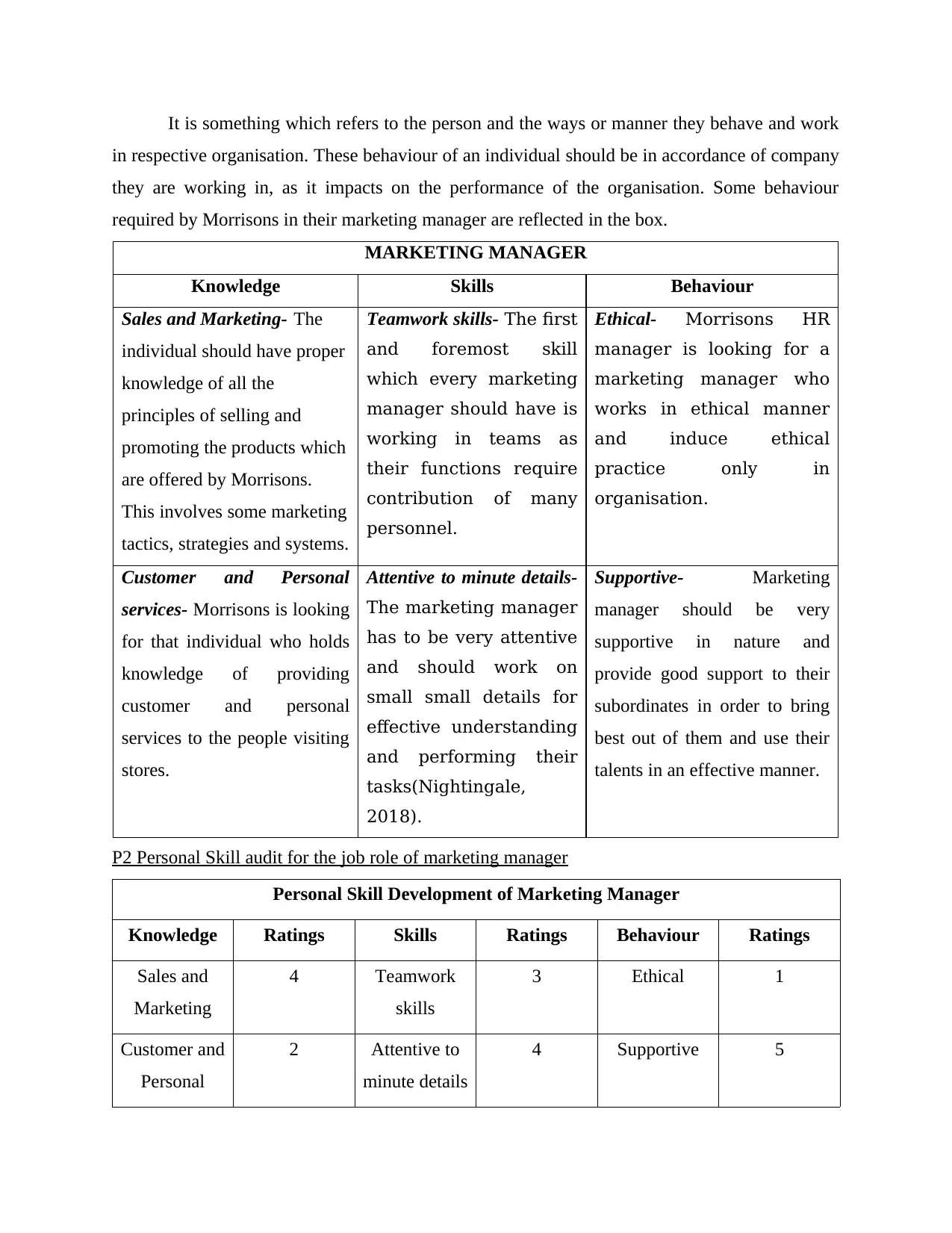
It is something which refers to the person and the ways or manner they behave and work
in respective organisation. These behaviour of an individual should be in accordance of company
they are working in, as it impacts on the performance of the organisation. Some behaviour
required by Morrisons in their marketing manager are reflected in the box.
MARKETING MANAGER
Knowledge Skills Behaviour
Sales and Marketing- The
individual should have proper
knowledge of all the
principles of selling and
promoting the products which
are offered by Morrisons.
This involves some marketing
tactics, strategies and systems.
Teamwork skills- The first
and foremost skill
which every marketing
manager should have is
working in teams as
their functions require
contribution of many
personnel.
Ethical- Morrisons HR
manager is looking for a
marketing manager who
works in ethical manner
and induce ethical
practice only in
organisation.
Customer and Personal
services- Morrisons is looking
for that individual who holds
knowledge of providing
customer and personal
services to the people visiting
stores.
Attentive to minute details-
The marketing manager
has to be very attentive
and should work on
small small details for
effective understanding
and performing their
tasks(Nightingale,
2018).
Supportive- Marketing
manager should be very
supportive in nature and
provide good support to their
subordinates in order to bring
best out of them and use their
talents in an effective manner.
P2 Personal Skill audit for the job role of marketing manager
Personal Skill Development of Marketing Manager
Knowledge Ratings Skills Ratings Behaviour Ratings
Sales and
Marketing
4 Teamwork
skills
3 Ethical 1
Customer and
Personal
2 Attentive to
minute details
4 Supportive 5
in respective organisation. These behaviour of an individual should be in accordance of company
they are working in, as it impacts on the performance of the organisation. Some behaviour
required by Morrisons in their marketing manager are reflected in the box.
MARKETING MANAGER
Knowledge Skills Behaviour
Sales and Marketing- The
individual should have proper
knowledge of all the
principles of selling and
promoting the products which
are offered by Morrisons.
This involves some marketing
tactics, strategies and systems.
Teamwork skills- The first
and foremost skill
which every marketing
manager should have is
working in teams as
their functions require
contribution of many
personnel.
Ethical- Morrisons HR
manager is looking for a
marketing manager who
works in ethical manner
and induce ethical
practice only in
organisation.
Customer and Personal
services- Morrisons is looking
for that individual who holds
knowledge of providing
customer and personal
services to the people visiting
stores.
Attentive to minute details-
The marketing manager
has to be very attentive
and should work on
small small details for
effective understanding
and performing their
tasks(Nightingale,
2018).
Supportive- Marketing
manager should be very
supportive in nature and
provide good support to their
subordinates in order to bring
best out of them and use their
talents in an effective manner.
P2 Personal Skill audit for the job role of marketing manager
Personal Skill Development of Marketing Manager
Knowledge Ratings Skills Ratings Behaviour Ratings
Sales and
Marketing
4 Teamwork
skills
3 Ethical 1
Customer and
Personal
2 Attentive to
minute details
4 Supportive 5
Paraphrase This Document
Need a fresh take? Get an instant paraphrase of this document with our AI Paraphraser
services
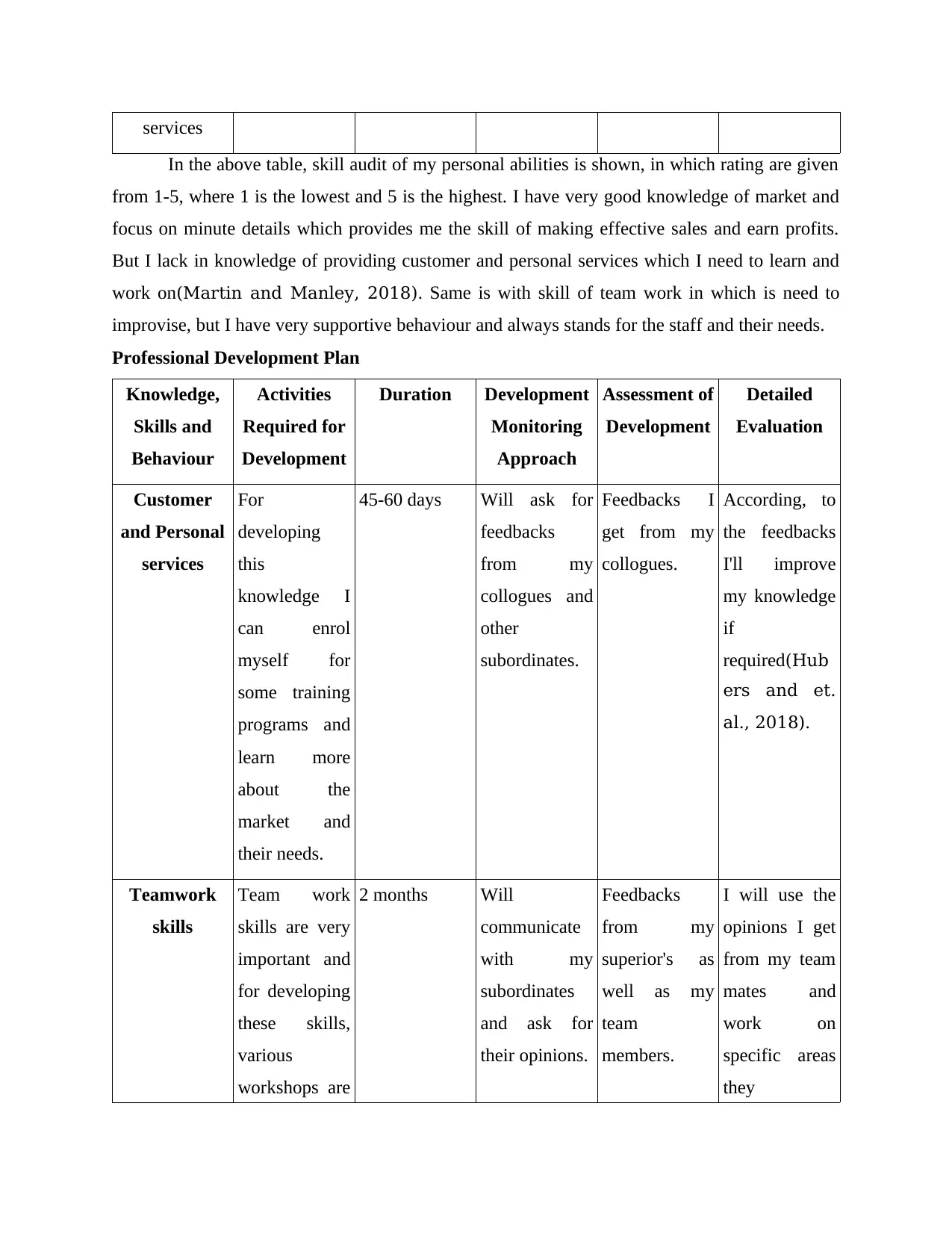
In the above table, skill audit of my personal abilities is shown, in which rating are given
from 1-5, where 1 is the lowest and 5 is the highest. I have very good knowledge of market and
focus on minute details which provides me the skill of making effective sales and earn profits.
But I lack in knowledge of providing customer and personal services which I need to learn and
work on(Martin and Manley, 2018). Same is with skill of team work in which is need to
improvise, but I have very supportive behaviour and always stands for the staff and their needs.
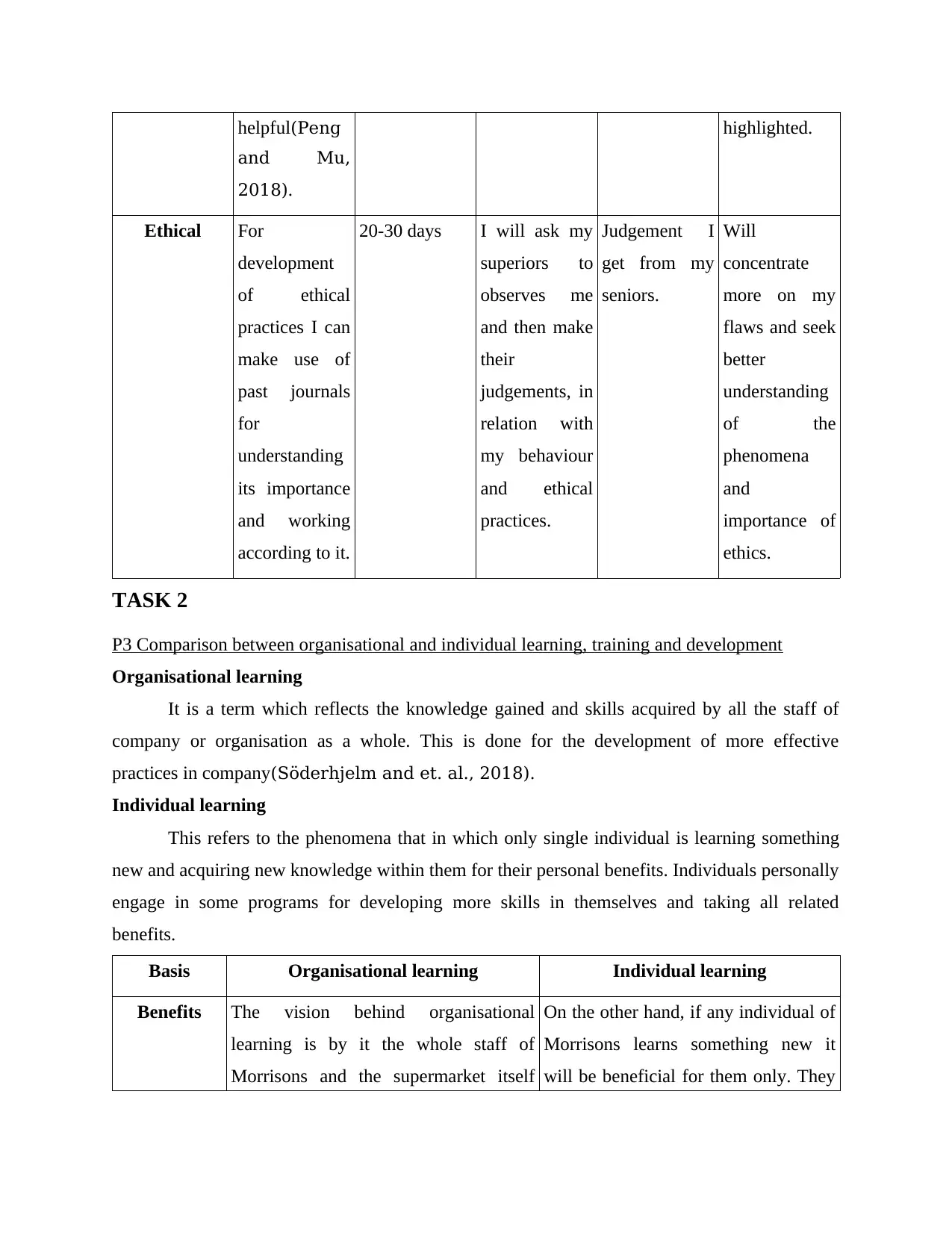
Professional Development Plan
Knowledge,
Skills and
Behaviour
Activities
Required for
Development
Duration Development
Monitoring
Approach
Assessment of
Development
Detailed
Evaluation
Customer
and Personal
services
For
developing
this
knowledge I
can enrol
myself for
some training
programs and
learn more
about the
market and
their needs.
45-60 days Will ask for
feedbacks
from my
collogues and
other
subordinates.
Feedbacks I
get from my
collogues.
According, to
the feedbacks
I'll improve
my knowledge
if
required(Hub
ers and et.
al., 2018).
Teamwork
skills
Team work
skills are very
important and
for developing
these skills,
various
workshops are
2 months Will
communicate
with my
subordinates
and ask for
their opinions.
Feedbacks
from my
superior's as
well as my
team
members.
I will use the
opinions I get
from my team
mates and
work on
specific areas
they
In the above table, skill audit of my personal abilities is shown, in which rating are given
from 1-5, where 1 is the lowest and 5 is the highest. I have very good knowledge of market and
focus on minute details which provides me the skill of making effective sales and earn profits.
But I lack in knowledge of providing customer and personal services which I need to learn and
work on(Martin and Manley, 2018). Same is with skill of team work in which is need to
improvise, but I have very supportive behaviour and always stands for the staff and their needs.
Professional Development Plan
Knowledge,
Skills and
Behaviour
Activities
Required for
Development
Duration Development
Monitoring
Approach
Assessment of
Development
Detailed
Evaluation
Customer
and Personal
services
For
developing
this
knowledge I
can enrol
myself for
some training
programs and
learn more
about the
market and
their needs.
45-60 days Will ask for
feedbacks
from my
collogues and
other
subordinates.
Feedbacks I
get from my
collogues.
According, to
the feedbacks
I'll improve
my knowledge
if
required(Hub
ers and et.
al., 2018).
Teamwork
skills
Team work
skills are very
important and
for developing
these skills,
various
workshops are
2 months Will
communicate
with my
subordinates
and ask for
their opinions.
Feedbacks
from my
superior's as
well as my
team
members.
I will use the
opinions I get
from my team
mates and
work on
specific areas
they
helpful(Peng
and Mu,
2018).
highlighted.
Ethical For
development
of ethical
practices I can
make use of
past journals
for
understanding
its importance
and working
according to it.
20-30 days I will ask my
superiors to
observes me
and then make
their
judgements, in
relation with
my behaviour
and ethical
practices.
Judgement I
get from my
seniors.
Will
concentrate
more on my
flaws and seek
better
understanding
of the
phenomena
and
importance of
ethics.
TASK 2
P3 Comparison between organisational and individual learning, training and development
Organisational learning
It is a term which reflects the knowledge gained and skills acquired by all the staff of
company or organisation as a whole. This is done for the development of more effective
practices in company(Söderhjelm and et. al., 2018).
Individual learning
This refers to the phenomena that in which only single individual is learning something
new and acquiring new knowledge within them for their personal benefits. Individuals personally
engage in some programs for developing more skills in themselves and taking all related
benefits.
Basis Organisational learning Individual learning
Benefits The vision behind organisational
learning is by it the whole staff of
Morrisons and the supermarket itself
On the other hand, if any individual of
Morrisons learns something new it
will be beneficial for them only. They
and Mu,
2018).
highlighted.
Ethical For
development
of ethical
practices I can
make use of
past journals
for
understanding
its importance
and working
according to it.
20-30 days I will ask my
superiors to
observes me
and then make
their
judgements, in
relation with
my behaviour
and ethical
practices.
Judgement I
get from my
seniors.
Will
concentrate
more on my
flaws and seek
better
understanding
of the
phenomena
and
importance of
ethics.
TASK 2
P3 Comparison between organisational and individual learning, training and development
Organisational learning
It is a term which reflects the knowledge gained and skills acquired by all the staff of
company or organisation as a whole. This is done for the development of more effective
practices in company(Söderhjelm and et. al., 2018).
Individual learning
This refers to the phenomena that in which only single individual is learning something
new and acquiring new knowledge within them for their personal benefits. Individuals personally
engage in some programs for developing more skills in themselves and taking all related
benefits.
Basis Organisational learning Individual learning
Benefits The vision behind organisational
learning is by it the whole staff of
Morrisons and the supermarket itself
On the other hand, if any individual of
Morrisons learns something new it
will be beneficial for them only. They
⊘ This is a preview!⊘
Do you want full access?
Subscribe today to unlock all pages.
Trusted by 1+ million students worldwide
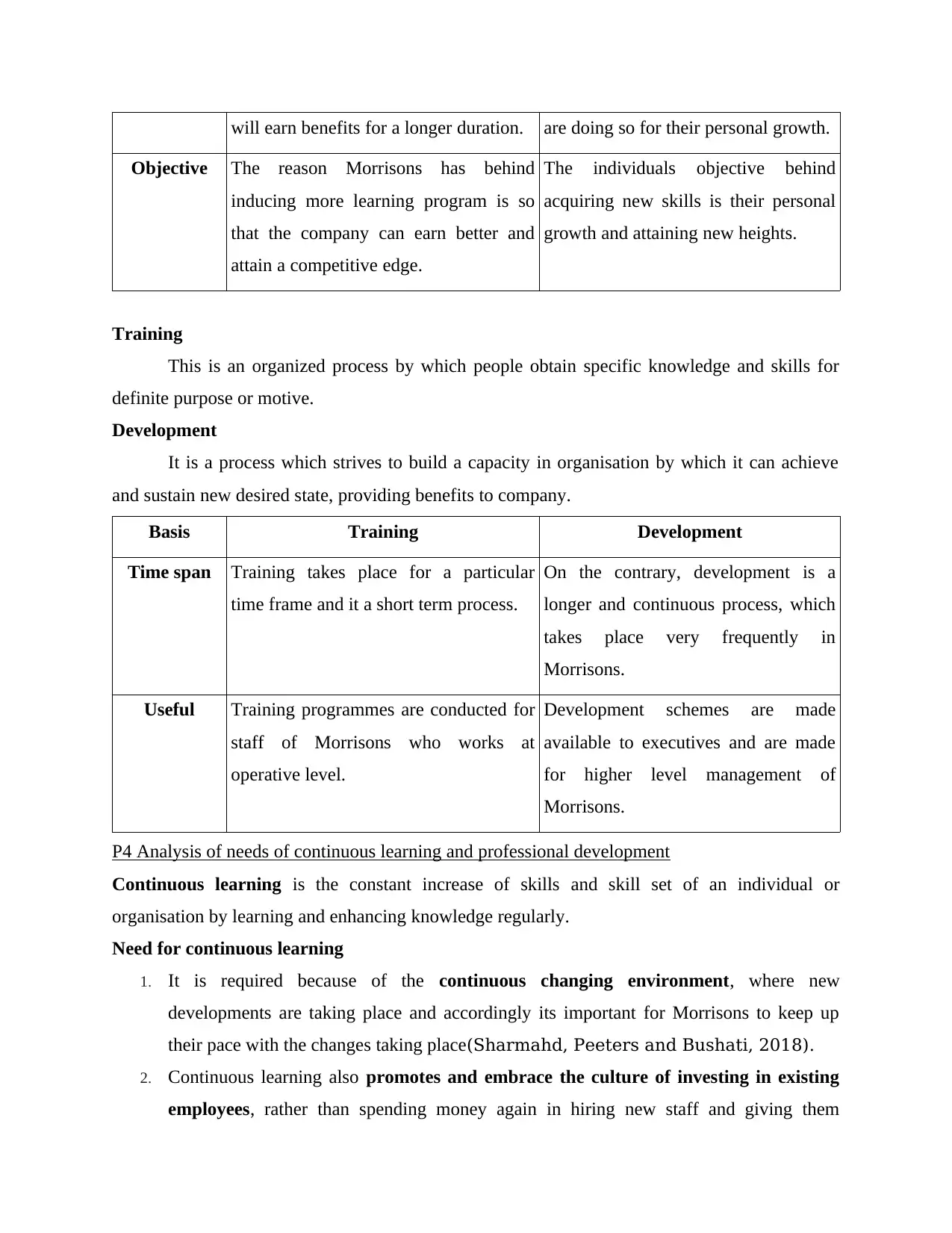
will earn benefits for a longer duration. are doing so for their personal growth.
Objective The reason Morrisons has behind
inducing more learning program is so
that the company can earn better and
attain a competitive edge.
The individuals objective behind
acquiring new skills is their personal
growth and attaining new heights.
Training
This is an organized process by which people obtain specific knowledge and skills for
definite purpose or motive.
Development
It is a process which strives to build a capacity in organisation by which it can achieve
and sustain new desired state, providing benefits to company.
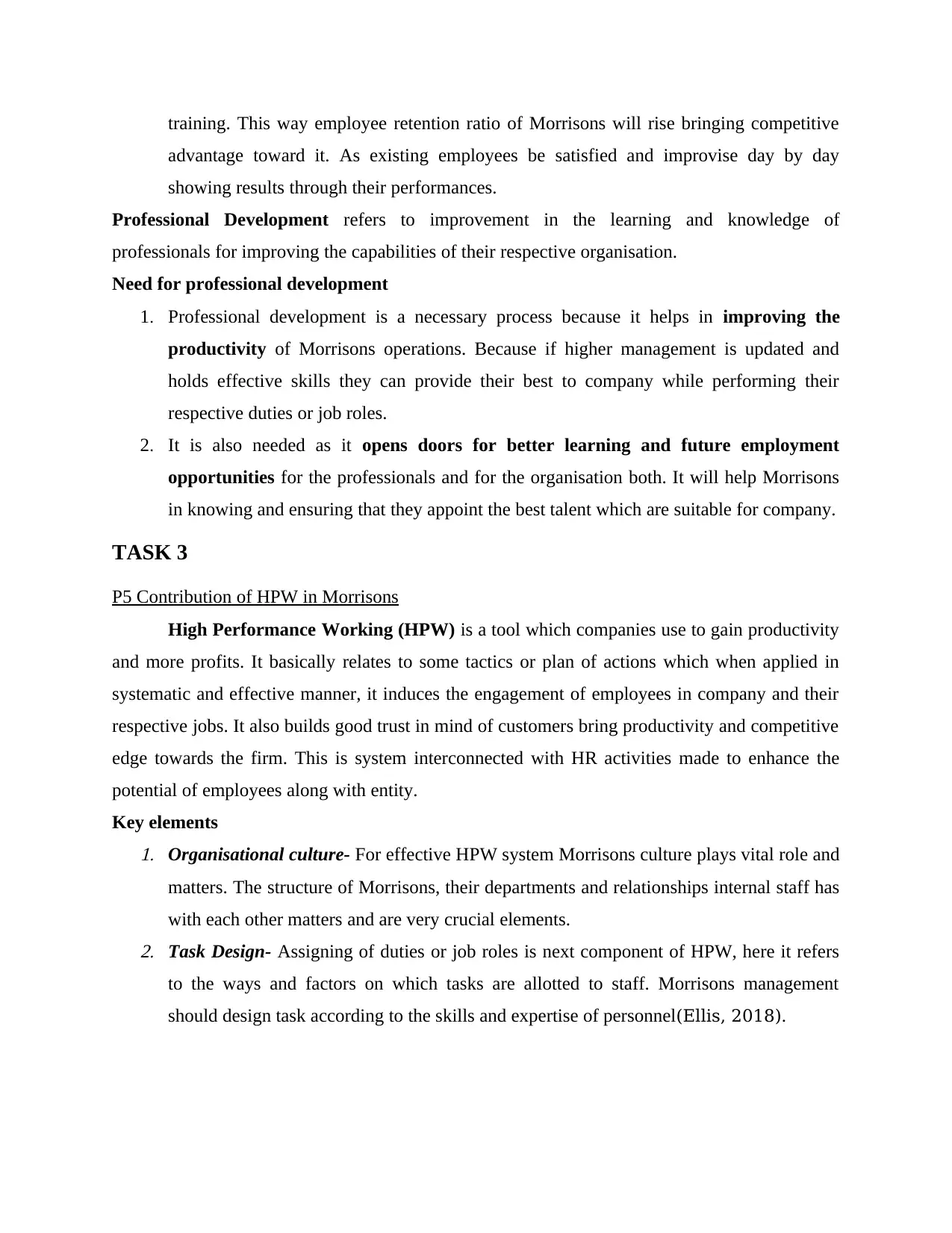
Basis Training Development
Time span Training takes place for a particular
time frame and it a short term process.
On the contrary, development is a
longer and continuous process, which
takes place very frequently in
Morrisons.
Useful Training programmes are conducted for
staff of Morrisons who works at
operative level.
Development schemes are made
available to executives and are made
for higher level management of
Morrisons.
P4 Analysis of needs of continuous learning and professional development
Continuous learning is the constant increase of skills and skill set of an individual or
organisation by learning and enhancing knowledge regularly.
Need for continuous learning
1. It is required because of the continuous changing environment, where new
developments are taking place and accordingly its important for Morrisons to keep up
their pace with the changes taking place(Sharmahd, Peeters and Bushati, 2018).
2. Continuous learning also promotes and embrace the culture of investing in existing
employees, rather than spending money again in hiring new staff and giving them
Objective The reason Morrisons has behind
inducing more learning program is so
that the company can earn better and
attain a competitive edge.
The individuals objective behind
acquiring new skills is their personal
growth and attaining new heights.
Training
This is an organized process by which people obtain specific knowledge and skills for
definite purpose or motive.
Development
It is a process which strives to build a capacity in organisation by which it can achieve
and sustain new desired state, providing benefits to company.
Basis Training Development
Time span Training takes place for a particular
time frame and it a short term process.
On the contrary, development is a
longer and continuous process, which
takes place very frequently in
Morrisons.
Useful Training programmes are conducted for
staff of Morrisons who works at
operative level.
Development schemes are made
available to executives and are made
for higher level management of
Morrisons.
P4 Analysis of needs of continuous learning and professional development
Continuous learning is the constant increase of skills and skill set of an individual or
organisation by learning and enhancing knowledge regularly.
Need for continuous learning
1. It is required because of the continuous changing environment, where new
developments are taking place and accordingly its important for Morrisons to keep up
their pace with the changes taking place(Sharmahd, Peeters and Bushati, 2018).
2. Continuous learning also promotes and embrace the culture of investing in existing
employees, rather than spending money again in hiring new staff and giving them
Paraphrase This Document
Need a fresh take? Get an instant paraphrase of this document with our AI Paraphraser
training. This way employee retention ratio of Morrisons will rise bringing competitive
advantage toward it. As existing employees be satisfied and improvise day by day
showing results through their performances.
Professional Development refers to improvement in the learning and knowledge of
professionals for improving the capabilities of their respective organisation.
Need for professional development
1. Professional development is a necessary process because it helps in improving the
productivity of Morrisons operations. Because if higher management is updated and
holds effective skills they can provide their best to company while performing their
respective duties or job roles.
2. It is also needed as it opens doors for better learning and future employment
opportunities for the professionals and for the organisation both. It will help Morrisons
in knowing and ensuring that they appoint the best talent which are suitable for company.
TASK 3
P5 Contribution of HPW in Morrisons
High Performance Working (HPW) is a tool which companies use to gain productivity
and more profits. It basically relates to some tactics or plan of actions which when applied in
systematic and effective manner, it induces the engagement of employees in company and their
respective jobs. It also builds good trust in mind of customers bring productivity and competitive
edge towards the firm. This is system interconnected with HR activities made to enhance the
potential of employees along with entity.
Key elements1. Organisational culture- For effective HPW system Morrisons culture plays vital role and
matters. The structure of Morrisons, their departments and relationships internal staff has
with each other matters and are very crucial elements.2. Task Design- Assigning of duties or job roles is next component of HPW, here it refers
to the ways and factors on which tasks are allotted to staff. Morrisons management
should design task according to the skills and expertise of personnel(Ellis, 2018).
advantage toward it. As existing employees be satisfied and improvise day by day
showing results through their performances.
Professional Development refers to improvement in the learning and knowledge of
professionals for improving the capabilities of their respective organisation.
Need for professional development
1. Professional development is a necessary process because it helps in improving the
productivity of Morrisons operations. Because if higher management is updated and
holds effective skills they can provide their best to company while performing their
respective duties or job roles.
2. It is also needed as it opens doors for better learning and future employment
opportunities for the professionals and for the organisation both. It will help Morrisons
in knowing and ensuring that they appoint the best talent which are suitable for company.
TASK 3
P5 Contribution of HPW in Morrisons
High Performance Working (HPW) is a tool which companies use to gain productivity
and more profits. It basically relates to some tactics or plan of actions which when applied in
systematic and effective manner, it induces the engagement of employees in company and their
respective jobs. It also builds good trust in mind of customers bring productivity and competitive
edge towards the firm. This is system interconnected with HR activities made to enhance the
potential of employees along with entity.
Key elements1. Organisational culture- For effective HPW system Morrisons culture plays vital role and
matters. The structure of Morrisons, their departments and relationships internal staff has
with each other matters and are very crucial elements.2. Task Design- Assigning of duties or job roles is next component of HPW, here it refers
to the ways and factors on which tasks are allotted to staff. Morrisons management
should design task according to the skills and expertise of personnel(Ellis, 2018).
3. People- Then comes the employees of Morrisons in order to have effective HPW, they
are the key resources of Morrisons. On the basis of personnel company can bring
competitive advantage and gain higher position in marketplace.
4. Reward System- Its required for Morrisons to motivate and encourage their personnel in
order to gain utmost benefits from them and make effective use of their talent. This is
done with various reward schemes company makes and new ways of appreciating the
performances of personnel.
TASK 4
P6 Approaches of performance management
Performance Management is a tool established to measure the performance of company
in relation with their set objective and aims. It focuses on the actions of different divisions
present in companies structure in order to monitor and administrate specific tasks or actions.
Morrisons can use different approaches for measuring their performance which are as follows:
1. Collaborative approach- This method induce the idea of working together in order to
achieve the shared goals. Collaborative approach of performance management is an
ongoing process of communication between superior's and subordinates of Morrisons
during an long performance management cycle. By which employees are motivated by
leaders and continuous watched so that effective results at the end can be achieved by
company.
2. Result approach- This is an easy progressive conception in which employees are rated on
the basis of their performance and efforts they put in for completing given tasks. This
approach focuses on four perspectives target audience, finance, growth and
learning(Bjarnason, Bern and Svedberg, 2018). For instance Morrisons can use
this approach and develop a rating system for staff according to their performances and
results attained by them.
CONCLUSION
From the assignment above, it is summarised that development of individuals, teams and
organisation is a very essential process as the market is changing regularly and on very fast
speed. Therefore, with changing market conditions it's compulsory for develop updated skills
and behaviour by updating their knowledge and learning new things regularly. Individual
are the key resources of Morrisons. On the basis of personnel company can bring
competitive advantage and gain higher position in marketplace.
4. Reward System- Its required for Morrisons to motivate and encourage their personnel in
order to gain utmost benefits from them and make effective use of their talent. This is
done with various reward schemes company makes and new ways of appreciating the
performances of personnel.
TASK 4
P6 Approaches of performance management
Performance Management is a tool established to measure the performance of company
in relation with their set objective and aims. It focuses on the actions of different divisions
present in companies structure in order to monitor and administrate specific tasks or actions.
Morrisons can use different approaches for measuring their performance which are as follows:
1. Collaborative approach- This method induce the idea of working together in order to
achieve the shared goals. Collaborative approach of performance management is an
ongoing process of communication between superior's and subordinates of Morrisons
during an long performance management cycle. By which employees are motivated by
leaders and continuous watched so that effective results at the end can be achieved by
company.
2. Result approach- This is an easy progressive conception in which employees are rated on
the basis of their performance and efforts they put in for completing given tasks. This
approach focuses on four perspectives target audience, finance, growth and
learning(Bjarnason, Bern and Svedberg, 2018). For instance Morrisons can use
this approach and develop a rating system for staff according to their performances and
results attained by them.
CONCLUSION
From the assignment above, it is summarised that development of individuals, teams and
organisation is a very essential process as the market is changing regularly and on very fast
speed. Therefore, with changing market conditions it's compulsory for develop updated skills
and behaviour by updating their knowledge and learning new things regularly. Individual
⊘ This is a preview!⊘
Do you want full access?
Subscribe today to unlock all pages.
Trusted by 1+ million students worldwide
development is required as they are the one's who take the entity in direction of profits and
effective returns. High Performance Working system is an effective tool for development and
achievement of expected results. Some approaches like collaborative can be used by
management in their respective organisation in order to manage performance of their staff and
ultimately of the company.
effective returns. High Performance Working system is an effective tool for development and
achievement of expected results. Some approaches like collaborative can be used by
management in their respective organisation in order to manage performance of their staff and
ultimately of the company.
Paraphrase This Document
Need a fresh take? Get an instant paraphrase of this document with our AI Paraphraser
REFERENCES
Books and Journal
Barratt, C., 2018. Developing resilience: the role of nurses, healthcare teams and
organisations. Nursing Standard. 33(7). pp.43-49.
Bjarnason, E., Bern, B. G. and Svedberg, L., 2018, May. A case study of distances in a large co-
located software development organisation. In 2018 IEEE/ACM 11th International
Workshop on Cooperative and Human Aspects of Software Engineering (CHASE) (pp.
1-8). IEEE.
Ellis, P., 2018. Leadership, management and team working in nursing. Learning Matters.
Gao, J. and Bernard, A., 2018. An overview of knowledge sharing in new product
development. The International Journal of Advanced Manufacturing Technology. 94(5-
8). pp.1545-1550.
Hubers, M. D. and et. al., 2018. Share and succeed: the development of knowledge sharing and
brokerage in data teams’ network structures. ReseaRch PaPeRs in education. 33(2).
pp.216-238.
Martin, A. and Manley, K., 2018. Developing standards for an integrated approach to workplace
facilitation for interprofessional teams in health and social care contexts: a Delphi
study. Journal of interprofessional care. 32(1). pp.41-51.
Nightingale, A., 2018. Developing the organisational culture in a healthcare setting. Nursing
Standard. 32(21). pp.53-63.
Peng, G. and Mu, J., 2018. Do modular products lead to modular organisations? Evidence from
open source software development. International Journal of Production
Research. 56(20). pp.6719-6733.
Sharmahd, N., Peeters, J. and Bushati, M., 2018. Towards continuous professional development:
Experiencing group reflection to analyse practice. European Journal of
Education. 53(1). pp.58-65.
Söderhjelm, T. and et. al., 2018. Academic leadership: management of groups or leadership of
teams? A multiple-case study on designing and implementing a team-based
development programme for academic leadership. Studies in Higher Education. 43(2).
pp.201-216.
Books and Journal
Barratt, C., 2018. Developing resilience: the role of nurses, healthcare teams and
organisations. Nursing Standard. 33(7). pp.43-49.
Bjarnason, E., Bern, B. G. and Svedberg, L., 2018, May. A case study of distances in a large co-
located software development organisation. In 2018 IEEE/ACM 11th International
Workshop on Cooperative and Human Aspects of Software Engineering (CHASE) (pp.
1-8). IEEE.
Ellis, P., 2018. Leadership, management and team working in nursing. Learning Matters.
Gao, J. and Bernard, A., 2018. An overview of knowledge sharing in new product
development. The International Journal of Advanced Manufacturing Technology. 94(5-
8). pp.1545-1550.
Hubers, M. D. and et. al., 2018. Share and succeed: the development of knowledge sharing and
brokerage in data teams’ network structures. ReseaRch PaPeRs in education. 33(2).
pp.216-238.
Martin, A. and Manley, K., 2018. Developing standards for an integrated approach to workplace
facilitation for interprofessional teams in health and social care contexts: a Delphi
study. Journal of interprofessional care. 32(1). pp.41-51.
Nightingale, A., 2018. Developing the organisational culture in a healthcare setting. Nursing
Standard. 32(21). pp.53-63.
Peng, G. and Mu, J., 2018. Do modular products lead to modular organisations? Evidence from
open source software development. International Journal of Production
Research. 56(20). pp.6719-6733.
Sharmahd, N., Peeters, J. and Bushati, M., 2018. Towards continuous professional development:
Experiencing group reflection to analyse practice. European Journal of
Education. 53(1). pp.58-65.
Söderhjelm, T. and et. al., 2018. Academic leadership: management of groups or leadership of
teams? A multiple-case study on designing and implementing a team-based
development programme for academic leadership. Studies in Higher Education. 43(2).
pp.201-216.

1 out of 11


Related Documents


Your All-in-One AI-Powered Toolkit for Academic Success.
+13062052269
info@desklib.com
Available 24*7 on WhatsApp / Email
![[object Object]](/_next/static/media/star-bottom.7253800d.svg)
Unlock your academic potential
Copyright © 2020–2026 A2Z Services. All Rights Reserved. Developed and managed by ZUCOL.