Developing Individuals, Teams and Organizations Report for Tesco
VerifiedAdded on 2023/01/12
|18
|5392
|75
Report
AI Summary
This report provides a comprehensive analysis of developing individuals, teams, and organizations within a business context, using Tesco as a case study. It explores the essential skills, knowledge, and behaviors required for HR professionals, including leadership, management, communication, technical, and problem-solving skills. The report includes a personal skill audit, SWOT analysis, and a professional development plan. It also differentiates between organizational and individual learning, training, and development, emphasizing the need for continuous learning. High-performance working, employee engagement, and performance management approaches are discussed, offering insights into how these elements contribute to competitive advantage and organizational success. The report concludes with a discussion on the importance of continuous learning and development for sustainable business development.

Developing Individuals,
Teams and Organizations
1
Teams and Organizations
1

Paraphrase This Document
Need a fresh take? Get an instant paraphrase of this document with our AI Paraphraser
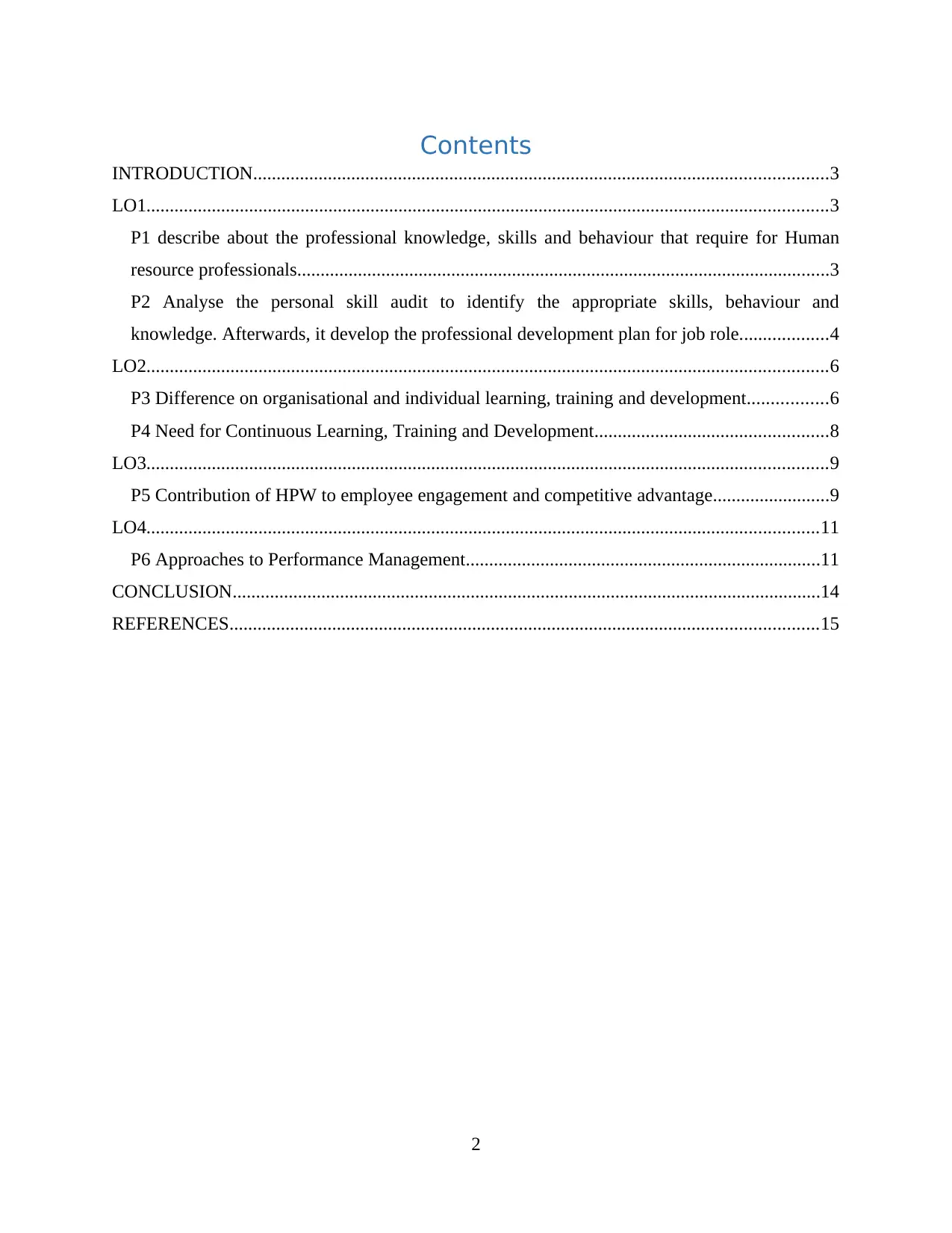
Contents
INTRODUCTION...........................................................................................................................3
LO1..................................................................................................................................................3
P1 describe about the professional knowledge, skills and behaviour that require for Human
resource professionals..................................................................................................................3
P2 Analyse the personal skill audit to identify the appropriate skills, behaviour and
knowledge. Afterwards, it develop the professional development plan for job role...................4
LO2..................................................................................................................................................6
P3 Difference on organisational and individual learning, training and development.................6
P4 Need for Continuous Learning, Training and Development..................................................8
LO3..................................................................................................................................................9
P5 Contribution of HPW to employee engagement and competitive advantage.........................9
LO4................................................................................................................................................11
P6 Approaches to Performance Management............................................................................11
CONCLUSION..............................................................................................................................14
REFERENCES..............................................................................................................................15
2
INTRODUCTION...........................................................................................................................3
LO1..................................................................................................................................................3
P1 describe about the professional knowledge, skills and behaviour that require for Human
resource professionals..................................................................................................................3
P2 Analyse the personal skill audit to identify the appropriate skills, behaviour and
knowledge. Afterwards, it develop the professional development plan for job role...................4
LO2..................................................................................................................................................6
P3 Difference on organisational and individual learning, training and development.................6
P4 Need for Continuous Learning, Training and Development..................................................8
LO3..................................................................................................................................................9
P5 Contribution of HPW to employee engagement and competitive advantage.........................9
LO4................................................................................................................................................11
P6 Approaches to Performance Management............................................................................11
CONCLUSION..............................................................................................................................14
REFERENCES..............................................................................................................................15
2
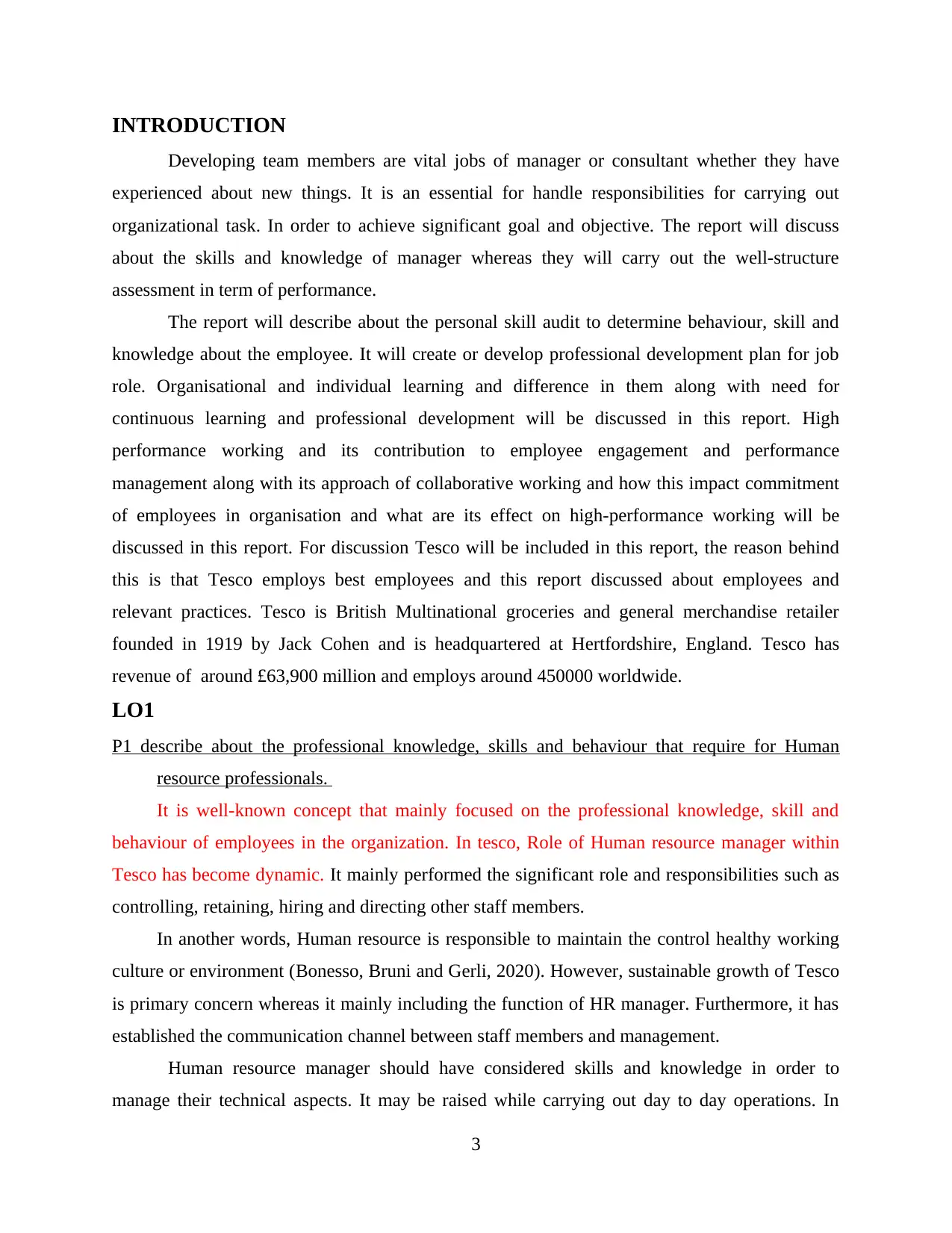
INTRODUCTION
Developing team members are vital jobs of manager or consultant whether they have
experienced about new things. It is an essential for handle responsibilities for carrying out
organizational task. In order to achieve significant goal and objective. The report will discuss
about the skills and knowledge of manager whereas they will carry out the well-structure
assessment in term of performance.
The report will describe about the personal skill audit to determine behaviour, skill and
knowledge about the employee. It will create or develop professional development plan for job
role. Organisational and individual learning and difference in them along with need for
continuous learning and professional development will be discussed in this report. High
performance working and its contribution to employee engagement and performance
management along with its approach of collaborative working and how this impact commitment
of employees in organisation and what are its effect on high-performance working will be
discussed in this report. For discussion Tesco will be included in this report, the reason behind
this is that Tesco employs best employees and this report discussed about employees and
relevant practices. Tesco is British Multinational groceries and general merchandise retailer
founded in 1919 by Jack Cohen and is headquartered at Hertfordshire, England. Tesco has
revenue of around £63,900 million and employs around 450000 worldwide.
LO1
P1 describe about the professional knowledge, skills and behaviour that require for Human
resource professionals.
It is well-known concept that mainly focused on the professional knowledge, skill and
behaviour of employees in the organization. In tesco, Role of Human resource manager within
Tesco has become dynamic. It mainly performed the significant role and responsibilities such as
controlling, retaining, hiring and directing other staff members.
In another words, Human resource is responsible to maintain the control healthy working
culture or environment (Bonesso, Bruni and Gerli, 2020). However, sustainable growth of Tesco
is primary concern whereas it mainly including the function of HR manager. Furthermore, it has
established the communication channel between staff members and management.
Human resource manager should have considered skills and knowledge in order to
manage their technical aspects. It may be raised while carrying out day to day operations. In
3
Developing team members are vital jobs of manager or consultant whether they have
experienced about new things. It is an essential for handle responsibilities for carrying out
organizational task. In order to achieve significant goal and objective. The report will discuss
about the skills and knowledge of manager whereas they will carry out the well-structure
assessment in term of performance.
The report will describe about the personal skill audit to determine behaviour, skill and
knowledge about the employee. It will create or develop professional development plan for job
role. Organisational and individual learning and difference in them along with need for
continuous learning and professional development will be discussed in this report. High
performance working and its contribution to employee engagement and performance
management along with its approach of collaborative working and how this impact commitment
of employees in organisation and what are its effect on high-performance working will be
discussed in this report. For discussion Tesco will be included in this report, the reason behind
this is that Tesco employs best employees and this report discussed about employees and
relevant practices. Tesco is British Multinational groceries and general merchandise retailer
founded in 1919 by Jack Cohen and is headquartered at Hertfordshire, England. Tesco has
revenue of around £63,900 million and employs around 450000 worldwide.
LO1
P1 describe about the professional knowledge, skills and behaviour that require for Human
resource professionals.
It is well-known concept that mainly focused on the professional knowledge, skill and
behaviour of employees in the organization. In tesco, Role of Human resource manager within
Tesco has become dynamic. It mainly performed the significant role and responsibilities such as
controlling, retaining, hiring and directing other staff members.
In another words, Human resource is responsible to maintain the control healthy working
culture or environment (Bonesso, Bruni and Gerli, 2020). However, sustainable growth of Tesco
is primary concern whereas it mainly including the function of HR manager. Furthermore, it has
established the communication channel between staff members and management.
Human resource manager should have considered skills and knowledge in order to
manage their technical aspects. It may be raised while carrying out day to day operations. In
3
⊘ This is a preview!⊘
Do you want full access?
Subscribe today to unlock all pages.

Trusted by 1+ million students worldwide
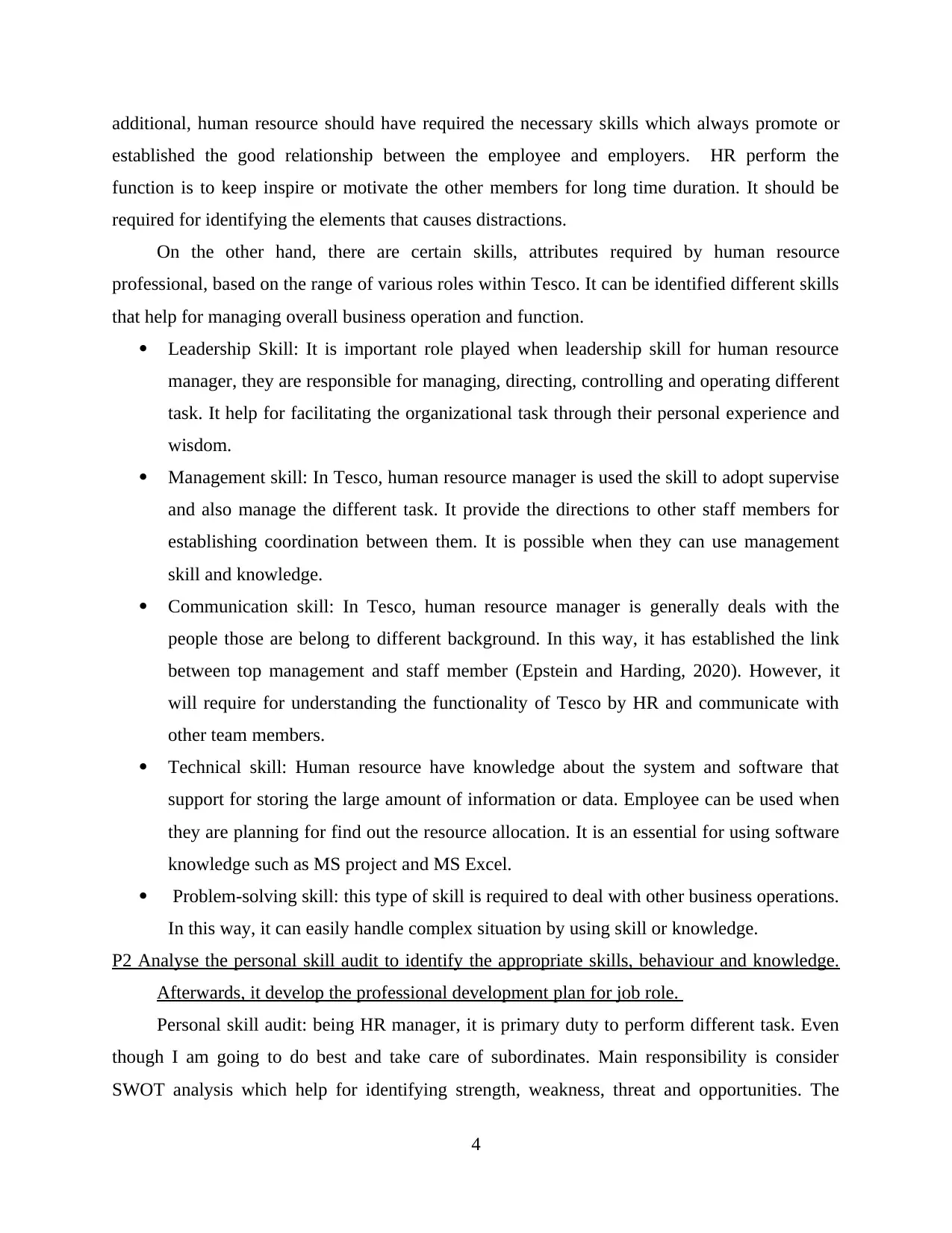
additional, human resource should have required the necessary skills which always promote or
established the good relationship between the employee and employers. HR perform the
function is to keep inspire or motivate the other members for long time duration. It should be
required for identifying the elements that causes distractions.
On the other hand, there are certain skills, attributes required by human resource
professional, based on the range of various roles within Tesco. It can be identified different skills
that help for managing overall business operation and function.
Leadership Skill: It is important role played when leadership skill for human resource
manager, they are responsible for managing, directing, controlling and operating different
task. It help for facilitating the organizational task through their personal experience and
wisdom.
Management skill: In Tesco, human resource manager is used the skill to adopt supervise
and also manage the different task. It provide the directions to other staff members for
establishing coordination between them. It is possible when they can use management
skill and knowledge.
Communication skill: In Tesco, human resource manager is generally deals with the
people those are belong to different background. In this way, it has established the link
between top management and staff member (Epstein and Harding, 2020). However, it
will require for understanding the functionality of Tesco by HR and communicate with
other team members.
Technical skill: Human resource have knowledge about the system and software that
support for storing the large amount of information or data. Employee can be used when
they are planning for find out the resource allocation. It is an essential for using software
knowledge such as MS project and MS Excel.
Problem-solving skill: this type of skill is required to deal with other business operations.
In this way, it can easily handle complex situation by using skill or knowledge.
P2 Analyse the personal skill audit to identify the appropriate skills, behaviour and knowledge.
Afterwards, it develop the professional development plan for job role.
Personal skill audit: being HR manager, it is primary duty to perform different task. Even
though I am going to do best and take care of subordinates. Main responsibility is consider
SWOT analysis which help for identifying strength, weakness, threat and opportunities. The
4
established the good relationship between the employee and employers. HR perform the
function is to keep inspire or motivate the other members for long time duration. It should be
required for identifying the elements that causes distractions.
On the other hand, there are certain skills, attributes required by human resource
professional, based on the range of various roles within Tesco. It can be identified different skills
that help for managing overall business operation and function.
Leadership Skill: It is important role played when leadership skill for human resource
manager, they are responsible for managing, directing, controlling and operating different
task. It help for facilitating the organizational task through their personal experience and
wisdom.
Management skill: In Tesco, human resource manager is used the skill to adopt supervise
and also manage the different task. It provide the directions to other staff members for
establishing coordination between them. It is possible when they can use management
skill and knowledge.
Communication skill: In Tesco, human resource manager is generally deals with the
people those are belong to different background. In this way, it has established the link
between top management and staff member (Epstein and Harding, 2020). However, it
will require for understanding the functionality of Tesco by HR and communicate with
other team members.
Technical skill: Human resource have knowledge about the system and software that
support for storing the large amount of information or data. Employee can be used when
they are planning for find out the resource allocation. It is an essential for using software
knowledge such as MS project and MS Excel.
Problem-solving skill: this type of skill is required to deal with other business operations.
In this way, it can easily handle complex situation by using skill or knowledge.
P2 Analyse the personal skill audit to identify the appropriate skills, behaviour and knowledge.
Afterwards, it develop the professional development plan for job role.
Personal skill audit: being HR manager, it is primary duty to perform different task. Even
though I am going to do best and take care of subordinates. Main responsibility is consider
SWOT analysis which help for identifying strength, weakness, threat and opportunities. The
4
Paraphrase This Document
Need a fresh take? Get an instant paraphrase of this document with our AI Paraphraser
leadership skills support for providing better direction to staff members so that they can easily
achieve goal and objective (Zafar, 2020). On the other hand, communication skill is another
important for HR manager that help to establish coordination with other staff members. In order
to achieve the significant goal and objective. First of all, it is require the basic functionality of
Tesco during staff induction. It is to be considered the supervisory skills and management that
would take feedback on regular basis.
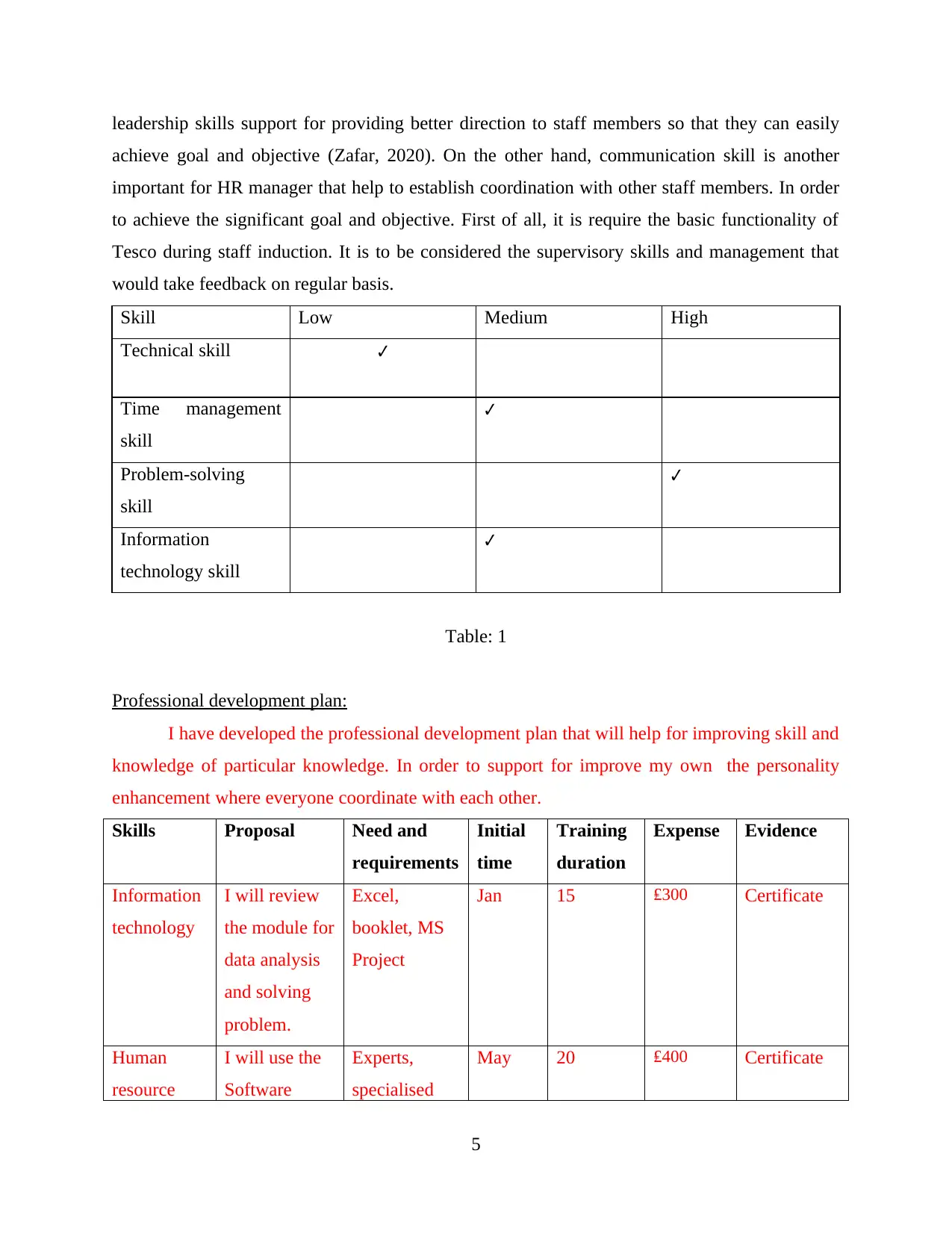
Skill Low Medium High
Technical skill ✔
Time management
skill
✔
Problem-solving
skill
✔
Information
technology skill
✔
Table: 1
Professional development plan:
I have developed the professional development plan that will help for improving skill and
knowledge of particular knowledge. In order to support for improve my own the personality
enhancement where everyone coordinate with each other.
Skills Proposal Need and
requirements
Initial
time
Training
duration
Expense Evidence
Information
technology
I will review
the module for
data analysis
and solving
problem.
Excel,
booklet, MS
Project
Jan 15 ₤300 Certificate
Human
resource
I will use the
Software
Experts,
specialised
May 20 ₤400 Certificate
5
achieve goal and objective (Zafar, 2020). On the other hand, communication skill is another
important for HR manager that help to establish coordination with other staff members. In order
to achieve the significant goal and objective. First of all, it is require the basic functionality of
Tesco during staff induction. It is to be considered the supervisory skills and management that
would take feedback on regular basis.
Skill Low Medium High
Technical skill ✔
Time management
skill
✔
Problem-solving
skill
✔
Information
technology skill
✔
Table: 1
Professional development plan:
I have developed the professional development plan that will help for improving skill and
knowledge of particular knowledge. In order to support for improve my own the personality
enhancement where everyone coordinate with each other.
Skills Proposal Need and
requirements
Initial
time
Training
duration
Expense Evidence
Information
technology
I will review
the module for
data analysis
and solving
problem.
Excel,
booklet, MS
Project
Jan 15 ₤300 Certificate
Human
resource
I will use the
Software
Experts,
specialised
May 20 ₤400 Certificate
5
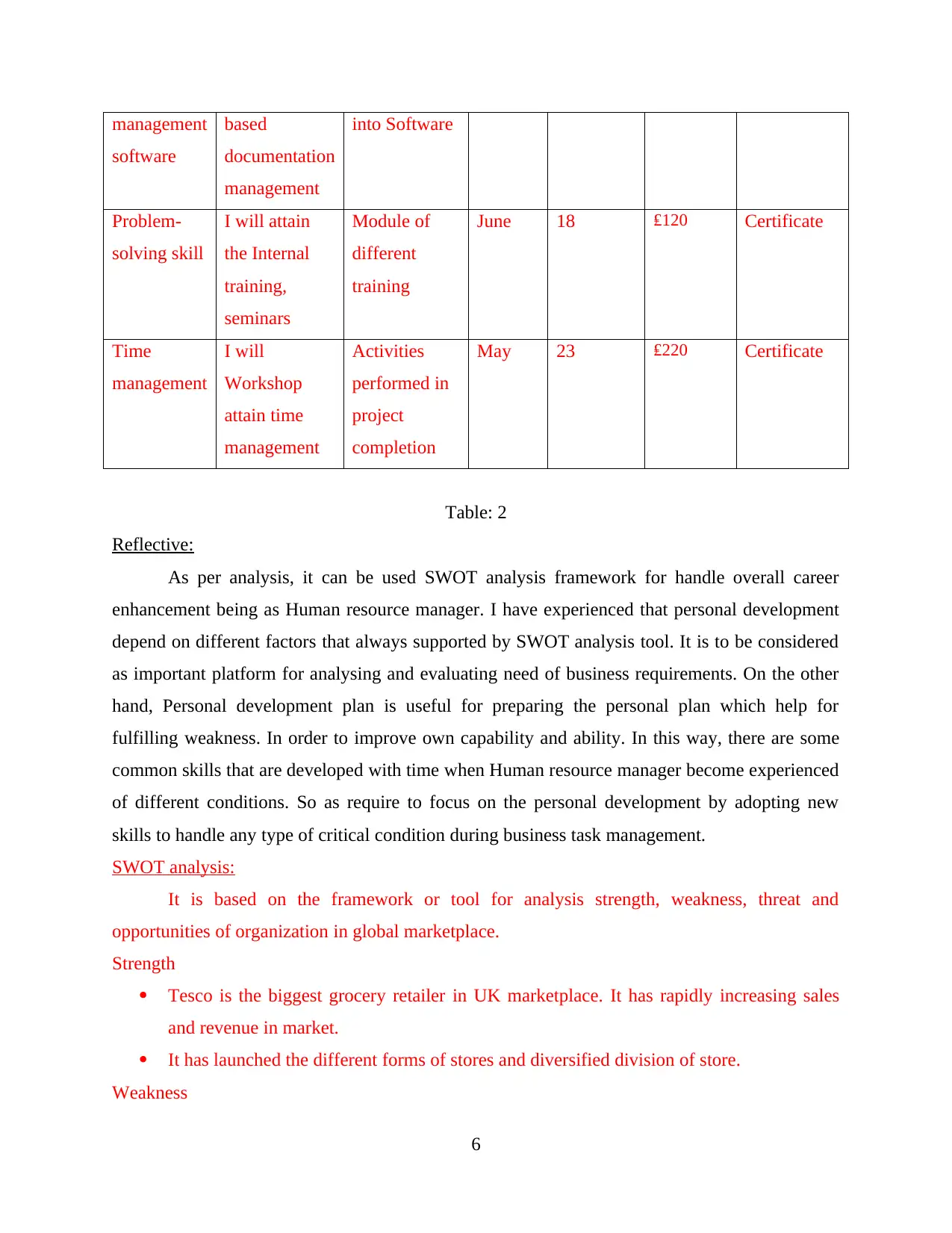
management
software
based
documentation
management
into Software
Problem-
solving skill
I will attain
the Internal
training,
seminars
Module of
different
training
June 18 ₤120 Certificate
Time
management
I will
Workshop
attain time
management
Activities
performed in
project
completion
May 23 ₤220 Certificate
Table: 2
Reflective:
As per analysis, it can be used SWOT analysis framework for handle overall career
enhancement being as Human resource manager. I have experienced that personal development
depend on different factors that always supported by SWOT analysis tool. It is to be considered
as important platform for analysing and evaluating need of business requirements. On the other
hand, Personal development plan is useful for preparing the personal plan which help for
fulfilling weakness. In order to improve own capability and ability. In this way, there are some
common skills that are developed with time when Human resource manager become experienced
of different conditions. So as require to focus on the personal development by adopting new
skills to handle any type of critical condition during business task management.
SWOT analysis:
It is based on the framework or tool for analysis strength, weakness, threat and
opportunities of organization in global marketplace.
Strength
Tesco is the biggest grocery retailer in UK marketplace. It has rapidly increasing sales
and revenue in market.
It has launched the different forms of stores and diversified division of store.
Weakness
6
software
based
documentation
management
into Software
Problem-
solving skill
I will attain
the Internal
training,
seminars
Module of
different
training
June 18 ₤120 Certificate
Time
management
I will
Workshop
attain time
management
Activities
performed in
project
completion
May 23 ₤220 Certificate
Table: 2
Reflective:
As per analysis, it can be used SWOT analysis framework for handle overall career
enhancement being as Human resource manager. I have experienced that personal development
depend on different factors that always supported by SWOT analysis tool. It is to be considered
as important platform for analysing and evaluating need of business requirements. On the other
hand, Personal development plan is useful for preparing the personal plan which help for
fulfilling weakness. In order to improve own capability and ability. In this way, there are some
common skills that are developed with time when Human resource manager become experienced
of different conditions. So as require to focus on the personal development by adopting new
skills to handle any type of critical condition during business task management.
SWOT analysis:
It is based on the framework or tool for analysis strength, weakness, threat and
opportunities of organization in global marketplace.
Strength
Tesco is the biggest grocery retailer in UK marketplace. It has rapidly increasing sales
and revenue in market.
It has launched the different forms of stores and diversified division of store.
Weakness
6
⊘ This is a preview!⊘
Do you want full access?
Subscribe today to unlock all pages.
Trusted by 1+ million students worldwide
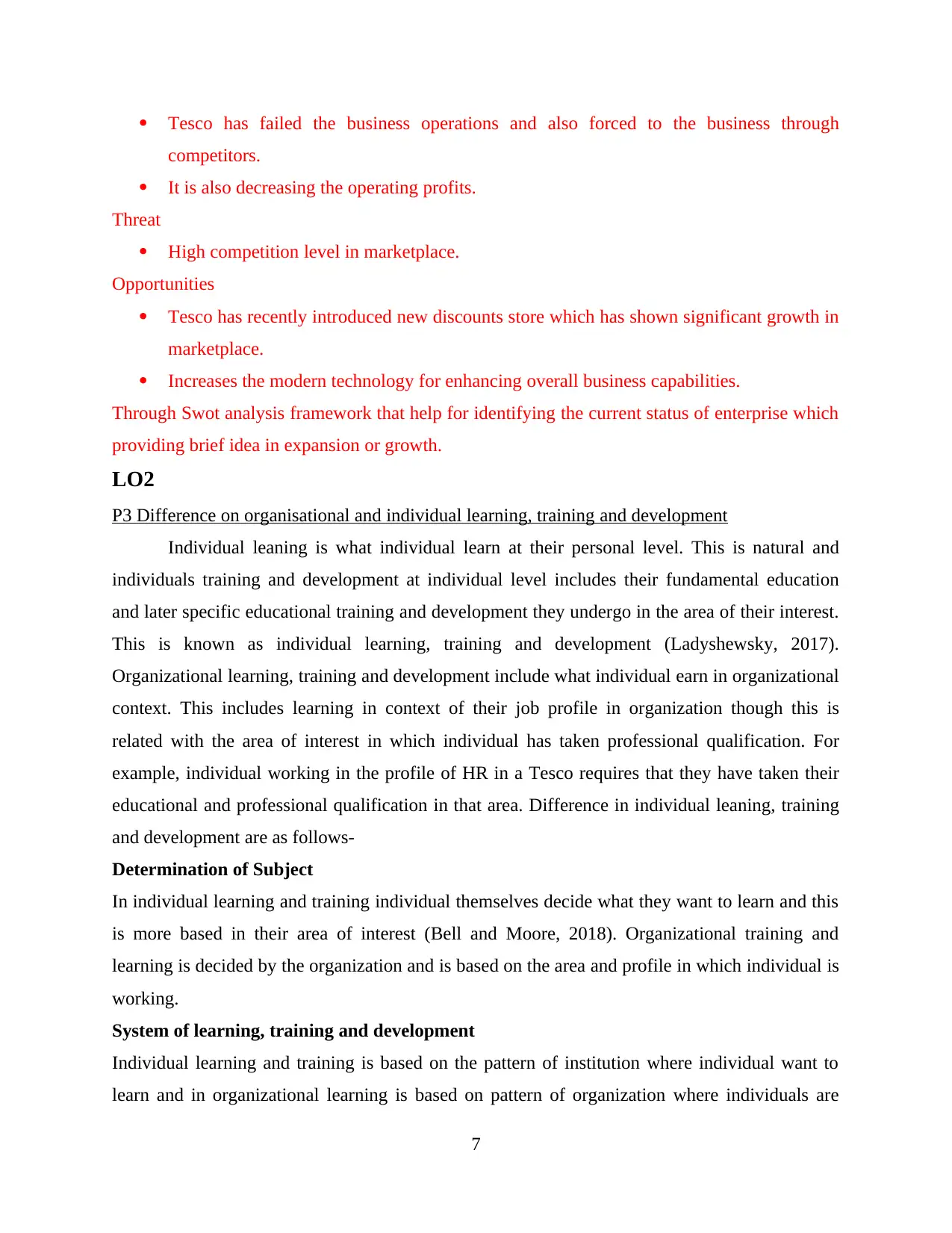
Tesco has failed the business operations and also forced to the business through
competitors.
It is also decreasing the operating profits.
Threat
High competition level in marketplace.
Opportunities
Tesco has recently introduced new discounts store which has shown significant growth in
marketplace.
Increases the modern technology for enhancing overall business capabilities.
Through Swot analysis framework that help for identifying the current status of enterprise which
providing brief idea in expansion or growth.
LO2
P3 Difference on organisational and individual learning, training and development
Individual leaning is what individual learn at their personal level. This is natural and
individuals training and development at individual level includes their fundamental education
and later specific educational training and development they undergo in the area of their interest.
This is known as individual learning, training and development (Ladyshewsky, 2017).
Organizational learning, training and development include what individual earn in organizational
context. This includes learning in context of their job profile in organization though this is
related with the area of interest in which individual has taken professional qualification. For
example, individual working in the profile of HR in a Tesco requires that they have taken their
educational and professional qualification in that area. Difference in individual leaning, training
and development are as follows-
Determination of Subject
In individual learning and training individual themselves decide what they want to learn and this
is more based in their area of interest (Bell and Moore, 2018). Organizational training and
learning is decided by the organization and is based on the area and profile in which individual is
working.
System of learning, training and development
Individual learning and training is based on the pattern of institution where individual want to
learn and in organizational learning is based on pattern of organization where individuals are
7
competitors.
It is also decreasing the operating profits.
Threat
High competition level in marketplace.
Opportunities
Tesco has recently introduced new discounts store which has shown significant growth in
marketplace.
Increases the modern technology for enhancing overall business capabilities.
Through Swot analysis framework that help for identifying the current status of enterprise which
providing brief idea in expansion or growth.
LO2
P3 Difference on organisational and individual learning, training and development
Individual leaning is what individual learn at their personal level. This is natural and
individuals training and development at individual level includes their fundamental education
and later specific educational training and development they undergo in the area of their interest.
This is known as individual learning, training and development (Ladyshewsky, 2017).
Organizational learning, training and development include what individual earn in organizational
context. This includes learning in context of their job profile in organization though this is
related with the area of interest in which individual has taken professional qualification. For
example, individual working in the profile of HR in a Tesco requires that they have taken their
educational and professional qualification in that area. Difference in individual leaning, training
and development are as follows-
Determination of Subject
In individual learning and training individual themselves decide what they want to learn and this
is more based in their area of interest (Bell and Moore, 2018). Organizational training and
learning is decided by the organization and is based on the area and profile in which individual is
working.
System of learning, training and development
Individual learning and training is based on the pattern of institution where individual want to
learn and in organizational learning is based on pattern of organization where individuals are
7
Paraphrase This Document
Need a fresh take? Get an instant paraphrase of this document with our AI Paraphraser
working. Individual learning are of pattern in which individuals are required to learn and train
themselves by going to classes and joining institutions but organizational learning and training is
provided in two patterns and forms which are on the job training and off the job training.
Objective
Individual learning is aimed that individual can develop themselves and the difference after
learning and training is visible in individual personality and grades are indicator of their
effectiveness of learning and training and development. Organizational learning, training and
development on the other hand is aimed at improvement in performance of employee and
difference is visible through performance of individual in Tesco. Efficiency of individual
learning, training and development is seen through improves professional results like increased
customer satisfaction, reduced cost and better handling of team and work groups.
Time for Learning Program
Individual learning and training are of longer time and organizational learning, training is limited
to a fixed period which is undertaken by individual after joining the organization and in case
work pattern of individual gets changed or modified (Schultz and et.al., 2019). Generally one
session of training and development in individual context includes a period of one year and in
context of organizational training in case it is not continuous learning, then generally
organizational training is of few weeks or few months.
Scope
Individual learning, training and development have varied scope as they can get any result out of
their learning and training. They can also learn more than one subjects at a time even if they are
not interrelated (Xiong, 2017). Individual learning often includes that learner is learning more
than one subject and on the other hand in organizational learning individual and employees are
learning only what is important for them to learn so that they improve their performance and they
can improve their results in context of their performance.
P4 Need for Continuous Learning, Training and Development
Individual learning does not really stop but individual training stop once individual has
completed their fundamental and professional qualification (Jones and Thessin, 2017). But in
relation with organizational learning, training and development it is very important that
individual employee keep learning and developing as this is beneficial for their growth in
8
themselves by going to classes and joining institutions but organizational learning and training is
provided in two patterns and forms which are on the job training and off the job training.
Objective
Individual learning is aimed that individual can develop themselves and the difference after
learning and training is visible in individual personality and grades are indicator of their
effectiveness of learning and training and development. Organizational learning, training and
development on the other hand is aimed at improvement in performance of employee and
difference is visible through performance of individual in Tesco. Efficiency of individual
learning, training and development is seen through improves professional results like increased
customer satisfaction, reduced cost and better handling of team and work groups.
Time for Learning Program
Individual learning and training are of longer time and organizational learning, training is limited
to a fixed period which is undertaken by individual after joining the organization and in case
work pattern of individual gets changed or modified (Schultz and et.al., 2019). Generally one
session of training and development in individual context includes a period of one year and in
context of organizational training in case it is not continuous learning, then generally
organizational training is of few weeks or few months.
Scope
Individual learning, training and development have varied scope as they can get any result out of
their learning and training. They can also learn more than one subjects at a time even if they are
not interrelated (Xiong, 2017). Individual learning often includes that learner is learning more
than one subject and on the other hand in organizational learning individual and employees are
learning only what is important for them to learn so that they improve their performance and they
can improve their results in context of their performance.
P4 Need for Continuous Learning, Training and Development
Individual learning does not really stop but individual training stop once individual has
completed their fundamental and professional qualification (Jones and Thessin, 2017). But in
relation with organizational learning, training and development it is very important that
individual employee keep learning and developing as this is beneficial for their growth in
8
organization and this is also important for personal development. Some of the needs of
continuous learning and professional development so that individuals working in Tesco can drive
sustainable business development are as follows-
To stay relevant
To stay relevant with current trends of work and present professional trends it is
important that individuals keep learn. Through continuous development individuals can ensure
that they are well versed with new skill set which is required to work in retail industry. This is
required so that they can perform effectively and efficiently.
Increased confidence
No matter in what profile and industry individual is working but confidence is important
for everyone (Stosich, Bocala and Forman, 2018). This is very important so that individual can
perform effectively and does not depend on others all the time for guidance and assistance. This
is possible to increase confidence only when individual is having knowledge of current skills and
updated with latest knowledge.
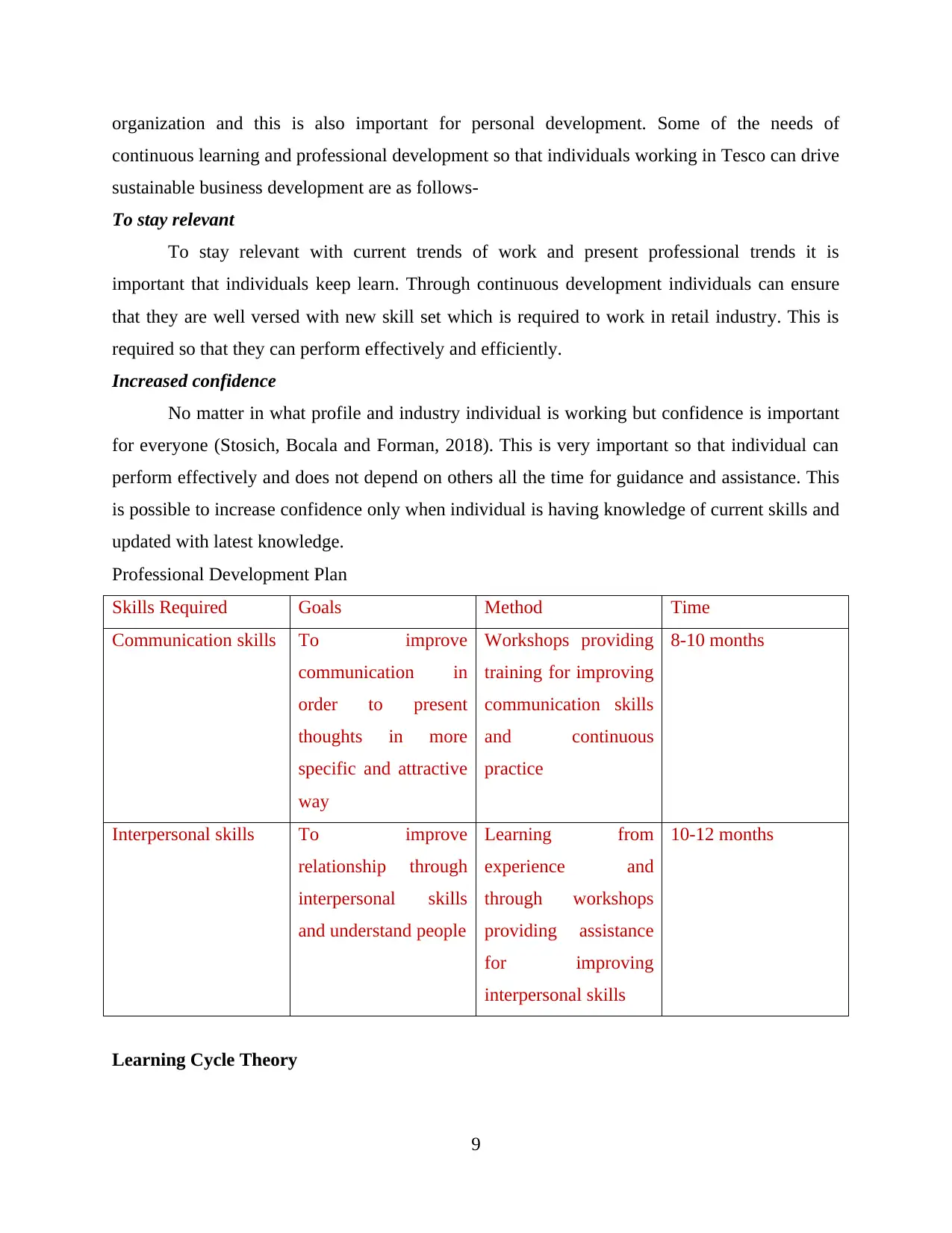
Professional Development Plan
Skills Required Goals Method Time
Communication skills To improve
communication in
order to present
thoughts in more
specific and attractive
way
Workshops providing
training for improving
communication skills
and continuous
practice
8-10 months
Interpersonal skills To improve
relationship through
interpersonal skills
and understand people
Learning from
experience and
through workshops
providing assistance
for improving
interpersonal skills
10-12 months
Learning Cycle Theory
9
continuous learning and professional development so that individuals working in Tesco can drive
sustainable business development are as follows-
To stay relevant
To stay relevant with current trends of work and present professional trends it is
important that individuals keep learn. Through continuous development individuals can ensure
that they are well versed with new skill set which is required to work in retail industry. This is
required so that they can perform effectively and efficiently.
Increased confidence
No matter in what profile and industry individual is working but confidence is important
for everyone (Stosich, Bocala and Forman, 2018). This is very important so that individual can
perform effectively and does not depend on others all the time for guidance and assistance. This
is possible to increase confidence only when individual is having knowledge of current skills and
updated with latest knowledge.
Professional Development Plan
Skills Required Goals Method Time
Communication skills To improve
communication in
order to present
thoughts in more
specific and attractive
way
Workshops providing
training for improving
communication skills
and continuous
practice
8-10 months
Interpersonal skills To improve
relationship through
interpersonal skills
and understand people
Learning from
experience and
through workshops
providing assistance
for improving
interpersonal skills
10-12 months
Learning Cycle Theory
9
⊘ This is a preview!⊘
Do you want full access?
Subscribe today to unlock all pages.
Trusted by 1+ million students worldwide
Learning cycle theory includes four stages that individual go through in the learning. This
cycle includes cycle for continuous learning. The stages in this are-
Concrete Experience
This stage of the cycle involves that while working in Tesco its employee encounters a
new experience and go through something which create new experience. This can also be
considered as reinterpretation of existing experience. Various incidences happens while working
that present the existing experience in a new form (Prashar and Antony, 2018). This stage is
important as continuous learning based more on experience rather than any theory. Some
incidences happened at Tesco through which I realized that my communication skills are not as
effective and attractive as it should be and I also get to experience my weakness in interpersonal
skills. Most of these experience happened with customers and teammates.
Reflective Observation of the new pattern
Learner in this stage takes time from their work and look back to the experience and
incidence that they faced. This is thinking about what they have done and experienced. This also
involves other members of the team and organization and open channels of communication. This
also includes articulating what has been experienced and done by the employees. When I
experienced my failure in some of the incidence I took time and thought for the reason because
of which this experienced occurred and this observation realized me that because of weak
communication and interpersonal skills this experiences happened with me.
Abstract Conceptualization
This stage of the cycle involves that team members and individual employee inn Tesco
make effort to understand what has happened and interpretation of events along with making and
identifying relationship between them. This is important as only having experience will not
create any learning for the individual they have to make sense of their experience to convert into
the learning. Learners also make comparison between what they have done, reflect upon and
what they already know. They can also link this with theories and models they have learned and
previous experience they and their colleagues have had. This was followed by my determination
and planning to improve my communication and interpersonal skills because these incidences
made me realize that these are important in my professional success.
Active Experimentation
10
cycle includes cycle for continuous learning. The stages in this are-
Concrete Experience
This stage of the cycle involves that while working in Tesco its employee encounters a
new experience and go through something which create new experience. This can also be
considered as reinterpretation of existing experience. Various incidences happens while working
that present the existing experience in a new form (Prashar and Antony, 2018). This stage is
important as continuous learning based more on experience rather than any theory. Some
incidences happened at Tesco through which I realized that my communication skills are not as
effective and attractive as it should be and I also get to experience my weakness in interpersonal
skills. Most of these experience happened with customers and teammates.
Reflective Observation of the new pattern
Learner in this stage takes time from their work and look back to the experience and
incidence that they faced. This is thinking about what they have done and experienced. This also
involves other members of the team and organization and open channels of communication. This
also includes articulating what has been experienced and done by the employees. When I
experienced my failure in some of the incidence I took time and thought for the reason because
of which this experienced occurred and this observation realized me that because of weak
communication and interpersonal skills this experiences happened with me.
Abstract Conceptualization
This stage of the cycle involves that team members and individual employee inn Tesco
make effort to understand what has happened and interpretation of events along with making and
identifying relationship between them. This is important as only having experience will not
create any learning for the individual they have to make sense of their experience to convert into
the learning. Learners also make comparison between what they have done, reflect upon and
what they already know. They can also link this with theories and models they have learned and
previous experience they and their colleagues have had. This was followed by my determination
and planning to improve my communication and interpersonal skills because these incidences
made me realize that these are important in my professional success.
Active Experimentation
10
Paraphrase This Document
Need a fresh take? Get an instant paraphrase of this document with our AI Paraphraser
This involves that learner put their learning and new experience into practice (Choy and
Chua, 2019). They start this from planning and translating it into prediction in relation with what
can happen and what actions they should take. I worked on improving my skills and was able to
experience improvement in my working and this also enhanced my presentation skills and I was
better able to present my thoughts.
LO3
P5 Contribution of HPW to employee engagement and competitive advantage
High performance working is an approach of organisation where organisation is managed
in such way that they can achieve sustainable high performance of the organisation. The aim of
HPW in Tesco is to create and develop high- performance culture of Tesco and in this values and
norms of organisation along with HR practices combine so that they can create a climate in
which the achievement of high level of performance is a way of life for the people of Tesco
(Ananthram and et.al., 2018). Tesco has best and high performing employees and this have
enabled it to develop organisational culture which is high performing. Some of the
characteristics of High-Performing Working are-
Tesco and its management clearly defines what they require so that they can shape
performance improvements so that employees and organisation can achieve their goals.
Tesco also includes alternative work practices like autonomous work teams, team
briefing and flexible working.
In Tesco all its employees are aware of the expectation from them in relation with their
performance.
People are empowered so that they can contribute their maximum performance.
HPW link selection and promotion to its models of competency to validate it.
Tesco also enacts compensation and performance management policies that it is able to
attract, retain and motivate high performance employees.
HPW is an effective approach through which organization can keep their employees engaged
(Akhtar and et.al., 2016). Employee engagement refers to employees feeling of being passionate
for their job and committed for their organization. There are various ways in which HPW
contributes to employee engagement. Some of them are as follows-
Employees are aware of Tesco’s expectation from them this requires that they are
focused for their job and put their maximum efforts in improving their performance.
11
Chua, 2019). They start this from planning and translating it into prediction in relation with what
can happen and what actions they should take. I worked on improving my skills and was able to
experience improvement in my working and this also enhanced my presentation skills and I was
better able to present my thoughts.
LO3
P5 Contribution of HPW to employee engagement and competitive advantage
High performance working is an approach of organisation where organisation is managed
in such way that they can achieve sustainable high performance of the organisation. The aim of
HPW in Tesco is to create and develop high- performance culture of Tesco and in this values and
norms of organisation along with HR practices combine so that they can create a climate in
which the achievement of high level of performance is a way of life for the people of Tesco
(Ananthram and et.al., 2018). Tesco has best and high performing employees and this have
enabled it to develop organisational culture which is high performing. Some of the
characteristics of High-Performing Working are-
Tesco and its management clearly defines what they require so that they can shape
performance improvements so that employees and organisation can achieve their goals.
Tesco also includes alternative work practices like autonomous work teams, team
briefing and flexible working.
In Tesco all its employees are aware of the expectation from them in relation with their
performance.
People are empowered so that they can contribute their maximum performance.
HPW link selection and promotion to its models of competency to validate it.
Tesco also enacts compensation and performance management policies that it is able to
attract, retain and motivate high performance employees.
HPW is an effective approach through which organization can keep their employees engaged
(Akhtar and et.al., 2016). Employee engagement refers to employees feeling of being passionate
for their job and committed for their organization. There are various ways in which HPW
contributes to employee engagement. Some of them are as follows-
Employees are aware of Tesco’s expectation from them this requires that they are
focused for their job and put their maximum efforts in improving their performance.
11
Practices such as looking after job satisfaction of employees in various forms like their
pay, working condition, work flexibility etc. ensures employee engagement in
organization.
Recruitment and promotion policies and decisions of organization are also in direction
where Tesco can ensure that it has employees who can remain engaged with organization.
Practices like performance management also helps employee engagement by removing
any type of ambiguity that employees might ace while working. This helps in avoiding
any unnecessary stress that employees could have.
Training and development practices of Tesco which is a part of HPW approach also helps
in employee engagement.
HPW develops trust and respect in employees for organization and for their fellow
employees and this also contributes in employee engagement.
HPW approach of Tesco also undertakes practices for employee motivation and this also
contributes in employee engagement in the Tesco.
Another important factor which is contributed by HPW is Competitive Advantage (Eisenberger,
Malone and Presson, 2016). Competitive advantage means having element in the organization
which can give it the benefit in competition over its competitors.
Competent employees are key assets for the organization and they are important and enable
organization to achieve competitive advantage. Some of the important element which enable
firm to achieve competitive advantages are creativity, exceptional performance, unique and
qualitative products, efficient customer service etc. in relation with Tesco this is very apt that
employees allow organization to achieve competitive advantage. This is also important that
competent employees will be able to achieve competitive advantage only when they are managed
properly and organization have all the system to ensure that they are working to their best
potential. One such system is high performance working. Contribution of high performance
working in achieve competitive advantage are-
Employees are working to their best potential this means employees are creative and they are
using their creativity for improving work practices of the organization.
Reputation and image is also an important element in ensuring competitive advantage. High
performance working ensures that employees who are brand ambassador of the Tesco create
positive and favorable image of the Tesco outside Tesco.
12
pay, working condition, work flexibility etc. ensures employee engagement in
organization.
Recruitment and promotion policies and decisions of organization are also in direction
where Tesco can ensure that it has employees who can remain engaged with organization.
Practices like performance management also helps employee engagement by removing
any type of ambiguity that employees might ace while working. This helps in avoiding
any unnecessary stress that employees could have.
Training and development practices of Tesco which is a part of HPW approach also helps
in employee engagement.
HPW develops trust and respect in employees for organization and for their fellow
employees and this also contributes in employee engagement.
HPW approach of Tesco also undertakes practices for employee motivation and this also
contributes in employee engagement in the Tesco.
Another important factor which is contributed by HPW is Competitive Advantage (Eisenberger,
Malone and Presson, 2016). Competitive advantage means having element in the organization
which can give it the benefit in competition over its competitors.
Competent employees are key assets for the organization and they are important and enable
organization to achieve competitive advantage. Some of the important element which enable
firm to achieve competitive advantages are creativity, exceptional performance, unique and
qualitative products, efficient customer service etc. in relation with Tesco this is very apt that
employees allow organization to achieve competitive advantage. This is also important that
competent employees will be able to achieve competitive advantage only when they are managed
properly and organization have all the system to ensure that they are working to their best
potential. One such system is high performance working. Contribution of high performance
working in achieve competitive advantage are-
Employees are working to their best potential this means employees are creative and they are
using their creativity for improving work practices of the organization.
Reputation and image is also an important element in ensuring competitive advantage. High
performance working ensures that employees who are brand ambassador of the Tesco create
positive and favorable image of the Tesco outside Tesco.
12
⊘ This is a preview!⊘
Do you want full access?
Subscribe today to unlock all pages.
Trusted by 1+ million students worldwide

1 out of 18


Related Documents


Your All-in-One AI-Powered Toolkit for Academic Success.
+13062052269
info@desklib.com
Available 24*7 on WhatsApp / Email
![[object Object]](/_next/static/media/star-bottom.7253800d.svg)
Unlock your academic potential
Copyright © 2020–2026 A2Z Services. All Rights Reserved. Developed and managed by ZUCOL.