University Nursing: Developing Professional Practice Portfolio

Verified

Added on  2022/08/13

|9
|1948
|17
Report
AI Summary
This report focuses on the development of a professional practice portfolio within the context of nursing. It emphasizes the portfolio's role in documenting skills, experiences, and professional achievements, serving as a tool for career advancement and self-reflection. The report outlines the components of a professional practice portfolio, including educational qualifications, assessment plans, letters of recommendation, reflective practices, and documented events and achievements. It highlights the benefits of using a practice portfolio in nursing, such as enhancing professional development, career planning, and demonstrating expertise. Challenges, such as racism and time constraints, are also discussed. Furthermore, the report explores the interrelation of management and leadership in nursing practice, emphasizing their importance in ensuring patient safety and promoting efficient healthcare delivery. The application of professional standards is exemplified through a case study on hand hygiene, demonstrating how competence and skills gained can impact the lives of others and the community. The report concludes by referencing various sources to support the information presented.
Document Page
F CT C TFDEVELOPING PRO ESSIONAL PRA I E POR OLIO
tudent s na eS m
a e of t e ni ersitN m h U v y
tabler-icon-diamond-filled.svg

Paraphrase This Document

Need a fresh take? Get an instant paraphrase of this document with our AI Paraphraser
Document Page
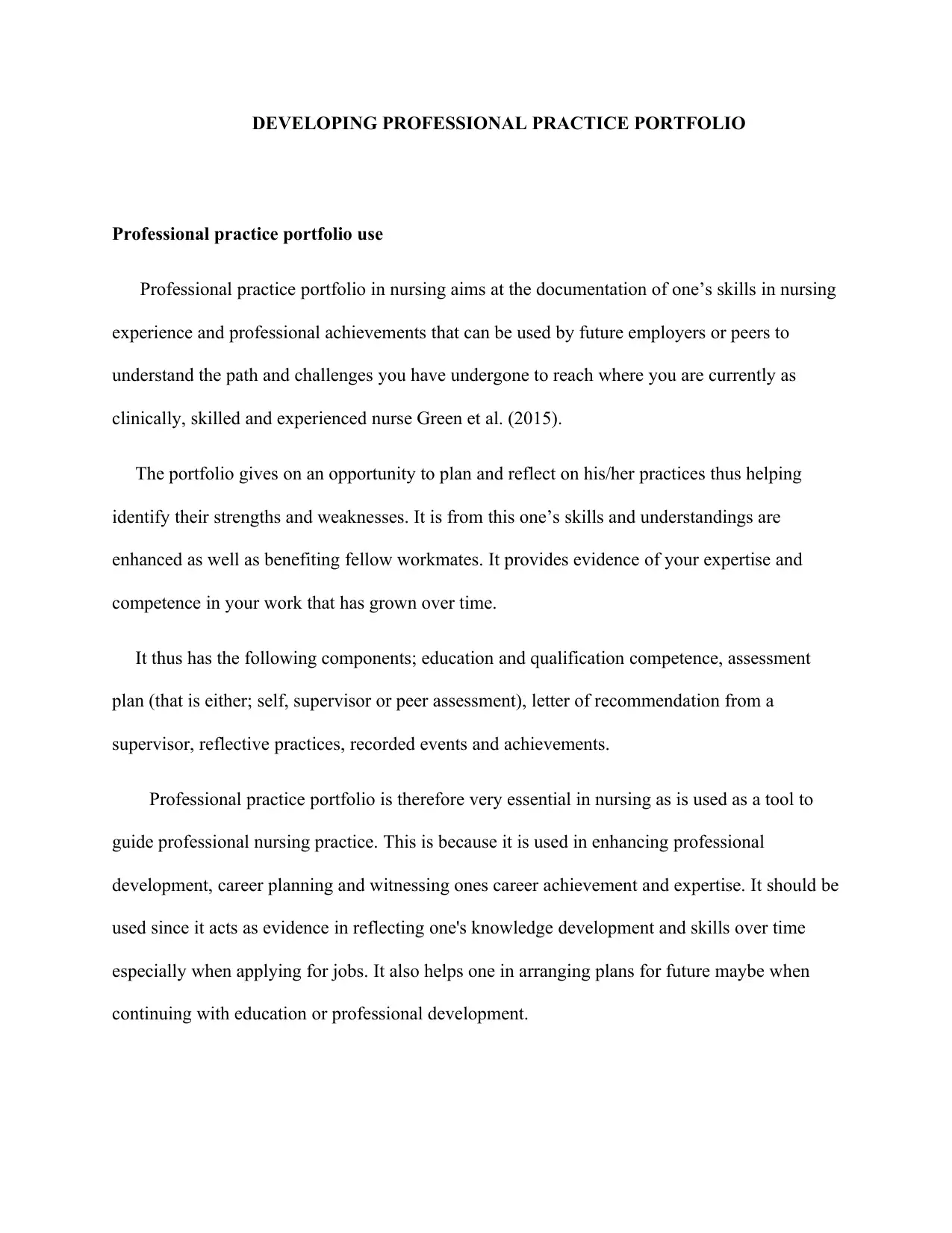
DEVELOPING PROFESSIONAL PRACTICE PORTFOLIO
Professional practice portfolio use
Professional practice portfolio in nursing aims at the documentation of one’s skills in nursing
experience and professional achievements that can be used by future employers or peers to
understand the path and challenges you have undergone to reach where you are currently as
clinically, skilled and experienced nurse Green et al. (2015).
The portfolio gives on an opportunity to plan and reflect on his/her practices thus helping
identify their strengths and weaknesses. It is from this one’s skills and understandings are
enhanced as well as benefiting fellow workmates. It provides evidence of your expertise and
competence in your work that has grown over time.
It thus has the following components; education and qualification competence, assessment
plan (that is either; self, supervisor or peer assessment), letter of recommendation from a
supervisor, reflective practices, recorded events and achievements.
Professional practice portfolio is therefore very essential in nursing as is used as a tool to
guide professional nursing practice. This is because it is used in enhancing professional
development, career planning and witnessing ones career achievement and expertise. It should be
used since it acts as evidence in reflecting one's knowledge development and skills over time
especially when applying for jobs. It also helps one in arranging plans for future maybe when
continuing with education or professional development.
Document Page
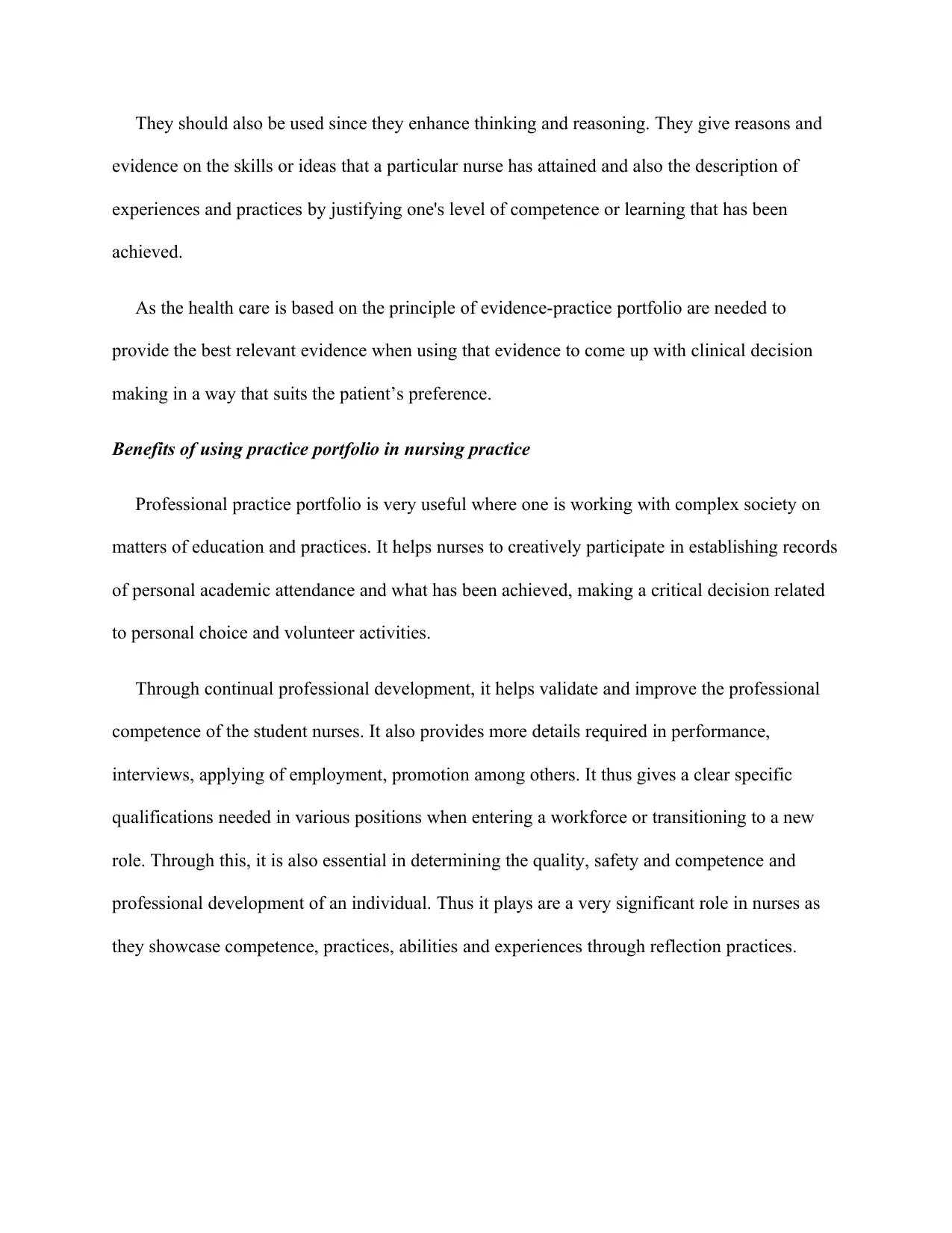
They should also be used since they enhance thinking and reasoning. They give reasons and
evidence on the skills or ideas that a particular nurse has attained and also the description of
experiences and practices by justifying one's level of competence or learning that has been
achieved.
As the health care is based on the principle of evidence-practice portfolio are needed to
provide the best relevant evidence when using that evidence to come up with clinical decision
making in a way that suits the patient’s preference.
Benefits of using practice portfolio in nursing practice
Professional practice portfolio is very useful where one is working with complex society on
matters of education and practices. It helps nurses to creatively participate in establishing records
of personal academic attendance and what has been achieved, making a critical decision related
to personal choice and volunteer activities.
Through continual professional development, it helps validate and improve the professional
competence of the student nurses. It also provides more details required in performance,
interviews, applying of employment, promotion among others. It thus gives a clear specific
qualifications needed in various positions when entering a workforce or transitioning to a new
role. Through this, it is also essential in determining the quality, safety and competence and
professional development of an individual. Thus it plays are a very significant role in nurses as
they showcase competence, practices, abilities and experiences through reflection practices.
Document Page
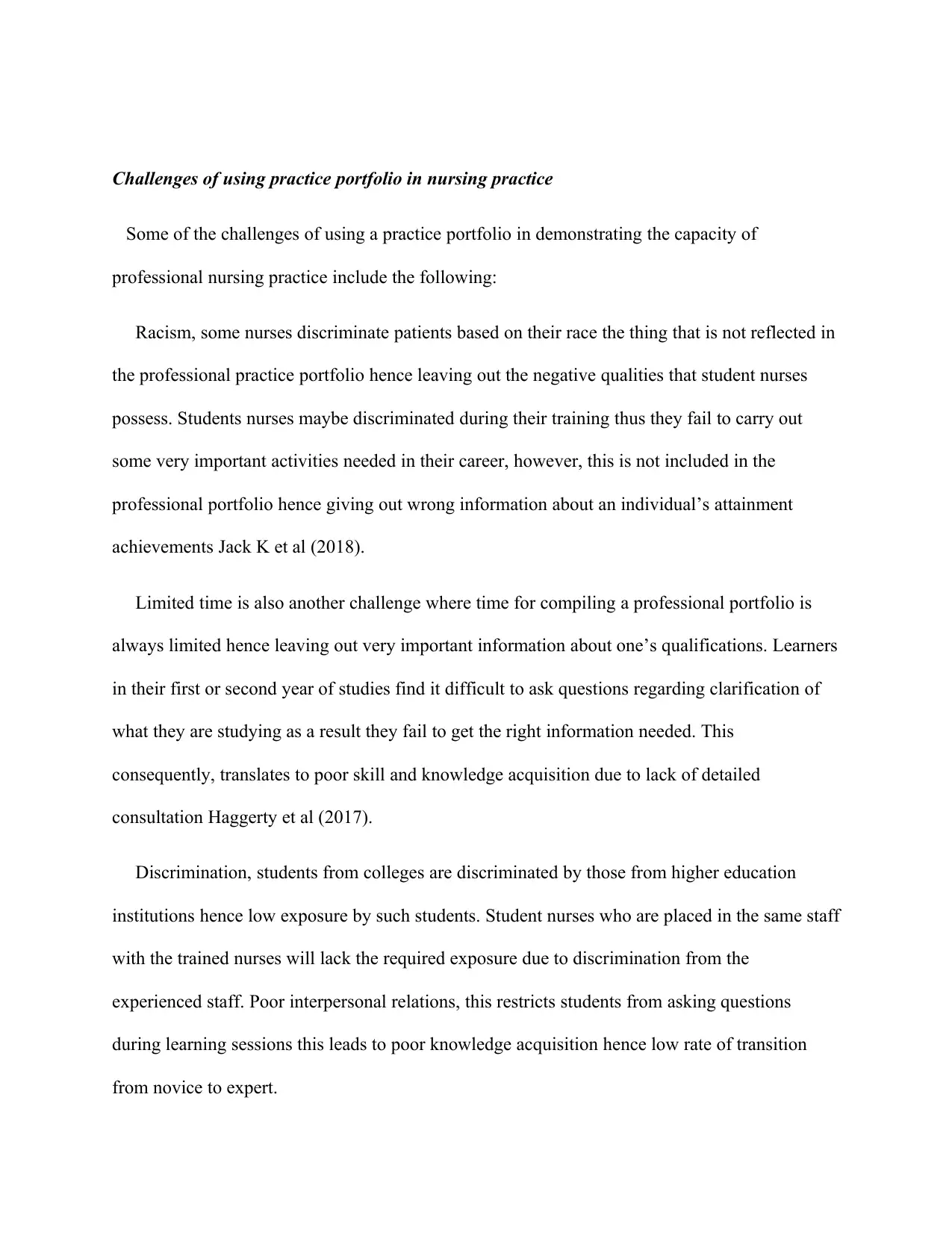
Challenges of using practice portfolio in nursing practice
Some of the challenges of using a practice portfolio in demonstrating the capacity of
professional nursing practice include the following:
Racism, some nurses discriminate patients based on their race the thing that is not reflected in
the professional practice portfolio hence leaving out the negative qualities that student nurses
possess. Students nurses maybe discriminated during their training thus they fail to carry out
some very important activities needed in their career, however, this is not included in the
professional portfolio hence giving out wrong information about an individual’s attainment
achievements Jack K et al (2018).
Limited time is also another challenge where time for compiling a professional portfolio is
always limited hence leaving out very important information about one’s qualifications. Learners
in their first or second year of studies find it difficult to ask questions regarding clarification of
what they are studying as a result they fail to get the right information needed. This
consequently, translates to poor skill and knowledge acquisition due to lack of detailed
consultation Haggerty et al (2017).
Discrimination, students from colleges are discriminated by those from higher education
institutions hence low exposure by such students. Student nurses who are placed in the same staff
with the trained nurses will lack the required exposure due to discrimination from the
experienced staff. Poor interpersonal relations, this restricts students from asking questions
during learning sessions this leads to poor knowledge acquisition hence low rate of transition
from novice to expert.
tabler-icon-diamond-filled.svg

Paraphrase This Document

Need a fresh take? Get an instant paraphrase of this document with our AI Paraphraser
Document Page
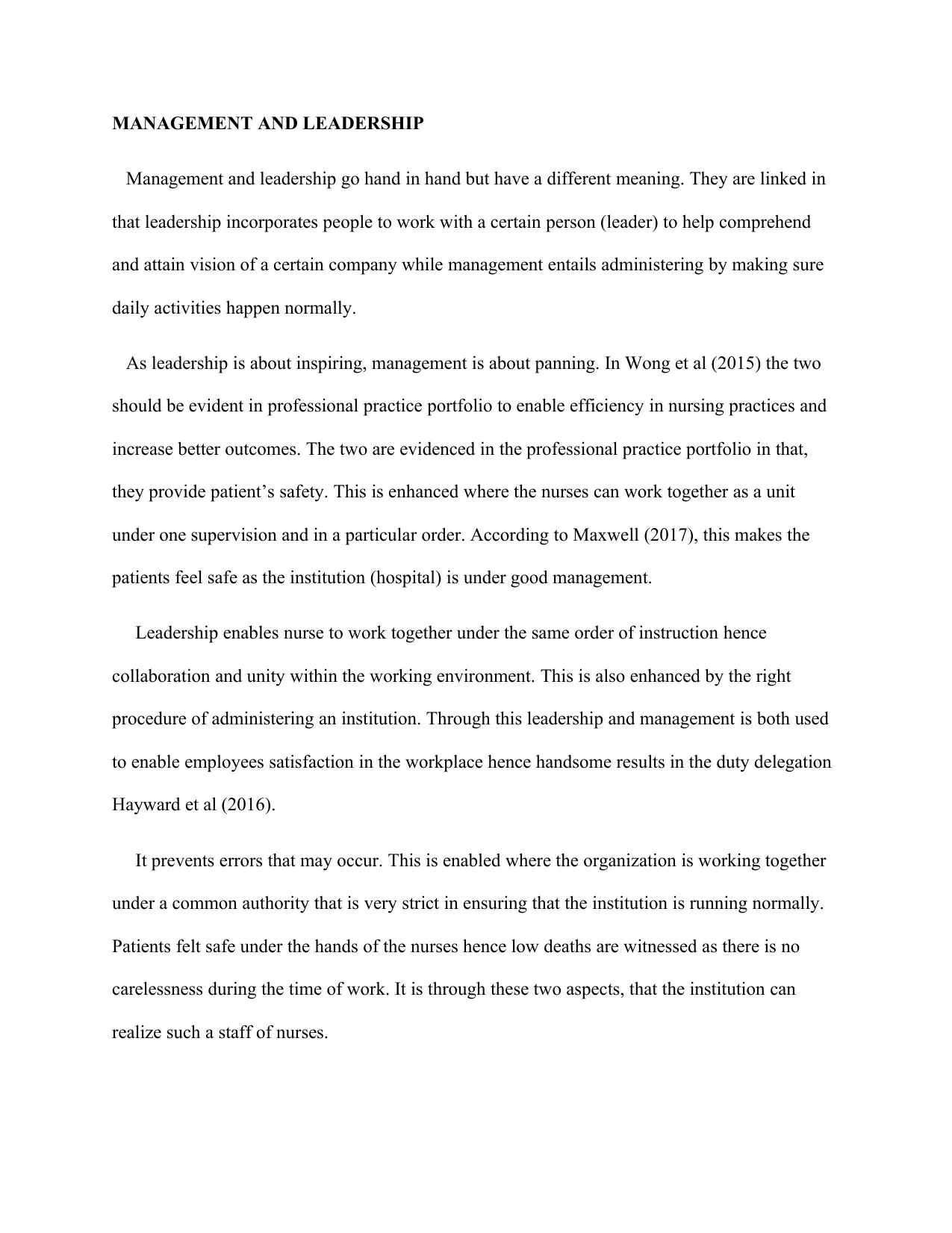
MANAGEMENT AND LEADERSHIP
Management and leadership go hand in hand but have a different meaning. They are linked in
that leadership incorporates people to work with a certain person (leader) to help comprehend
and attain vision of a certain company while management entails administering by making sure
daily activities happen normally.
As leadership is about inspiring, management is about panning. In Wong et al (2015) the two
should be evident in professional practice portfolio to enable efficiency in nursing practices and
increase better outcomes. The two are evidenced in the professional practice portfolio in that,
they provide patient’s safety. This is enhanced where the nurses can work together as a unit
under one supervision and in a particular order. According to Maxwell (2017), this makes the
patients feel safe as the institution (hospital) is under good management.
Leadership enables nurse to work together under the same order of instruction hence
collaboration and unity within the working environment. This is also enhanced by the right
procedure of administering an institution. Through this leadership and management is both used
to enable employees satisfaction in the workplace hence handsome results in the duty delegation
Hayward et al (2016).
It prevents errors that may occur. This is enabled where the organization is working together
under a common authority that is very strict in ensuring that the institution is running normally.
Patients felt safe under the hands of the nurses hence low deaths are witnessed as there is no
carelessness during the time of work. It is through these two aspects, that the institution can
realize such a staff of nurses.
Document Page
Problem-solving skills are developed in that leadership involves being in a position to handle
conflicts among employees. Through management, such conflicts are avoided hence helping the
employees to strictly adhere to their duties. Through this aspects evident in nurses they will be
able to solve their problems in their own hence quality output in their work deliverance.
APPLICATION OF PROFESSIONAL STANDARDS
Registered nurses should maintain; critical thinking, analyzing nursing practice, engaging in
professional relation, maintaining the capability of practice, conducting assessment, developing
nursing plans, maintaining safe and quality nursing practices and evaluating outcomes Hadid et
al (2017).
For example, I was placed in a health institution as a hand hygiene officer, I was able to
engage the patients and my fellow workers. I was delegated to ensure that every patient and even
workers washed their hands before doing any activity. Hand hygiene had been the problem that
had brought untidiness in the institution and the environment around. It had caused skin diseases,
especially among children.
I enacted these duty by teaching them the importance of the activity to the community and
showing them how it should be perfectly be done. I used photos to demonstrate the best way to
wash hands. Drying hands after washing was one of the very essential parts when creating such
awareness and I even performed it personally to them for better understanding. Some of the ways
I used to enact those duties where; teaching its importance to the people, teaching how to do it
efficiently, drying hands after washing, hand hygiene procedures and when to perform it.
Document Page
These led to handsome results after a certain period in that it minimized infection especially
among the young children, low death rates from diseases like cholera and minimized pneumonia
that killed many people there before. These become a daily routine among the workers, patients
and the society around the institution. In many cases, children grew healthy and the number of
children who came to seek medical attention reduced greatly.
Application of professional standards
Through the activity I delegated of hand hygiene I demonstrated the application of professional
standards in my work where I used the skills and competence gained to influence and positively
impact the lives of those whom I taught. I used the best approaches to deal with the people I
interacted with aiming at changing their lives from unhygienic to hygienic personnel. My
professional standards didn’t only aim at changing a person but also had an impact in changing
the whole community to ensure safety and wellness in the surrounding.
Professional standards I applied in when delegating my duty in hand hygiene included
empowering patients with the responsibility of their care, this helped them be responsible for
their health rather than depending too much on the hospitals for treatments. They realized they
can prevent diseases caused by poor hygiene. Through this, they realized that they can take care
of themselves and that prevention is better than cure.
They agreed to participate in creating awareness of the way by which a wider society can be
enlightened. This professional standard saw me have reduced work since everybody participated
in the work. Hand washing increased hence reduced cases of infections among the people in the
society. This led to the creation of a more hygienic society with the health of children being
valued.
tabler-icon-diamond-filled.svg

Paraphrase This Document

Need a fresh take? Get an instant paraphrase of this document with our AI Paraphraser
Document Page
REFERENCES
Bright S, (2016). Portfolios, social constructivism and assessment. Hamilton, New Zealand:
University of Waikato Press.
Hadid S, (2017). Factors influencing nursing student self-assessment in relation to
Instructor assessment, 56:70-98.
Haggerty C, (2017). The challenges of incorporating portfolio in undergraduate nursing
Program. Open Praxis 9:245.
Jack K, Hamshire C, Harris W, E, et al, (2018). Perceived unfairness experienced by
Nursing Students in clinical practice, 34:34-67
Hayward D, et al (2016). A qualitative study of experienced nurse’s voluntary turnover:
Learning from perspective. Journal of clinical nursing. 25: 9-10.
J. Green, A. Willy, D. Jackson, (2014). Nursing education practice. Journal of nursing
Management, 32: 45-78.
Okanda J, Yamaminzu Y, Fakai K, (2016). Effectiveness of hand hygiene depends on the
Patient’s health and environment, 54:23.54.
Stec M, Garritano N, (2016). Portfolio implementation as a mean for achievement of
Standards, 45; 23-43.
Wong C, et al (2015). Connecting nursing to leadership and patient outcomes: State of
Document Page
Science. Journal of nursing management. 23:3.
World Health Organization guideline on hand hygiene on health care (2019),
Available online: https://www.who.int/gpsc/5may.
chevron_up_icon
1 out of 9
circle_padding
hide_on_mobile
zoom_out_icon
[object Object]