Development and Social Change: Ethnic and Racial Conflicts in Africa
VerifiedAdded on 2023/06/10
|12
|4730
|269
Essay
AI Summary
This essay delves into the intricate relationship between ethnic and racial conflicts and their detrimental impact on development and social change, particularly within impoverished nations. It examines various factors contributing to these conflicts, including poverty, inequality, political instability, and historical legacies such as colonialism and racism. The essay highlights Africa as a prime example, analyzing how internal conflicts, often rooted in ethnic and racial divisions, have significantly hindered socio-economic progress and perpetuated cycles of violence and instability. It explores different theoretical perspectives, such as conflictual modernization and melting pot theories, to understand the dynamics of these conflicts. Furthermore, the essay investigates the role of economic factors, such as competition for resources and unequal distribution of wealth, in exacerbating ethnic tensions. By examining case studies and historical events, the essay underscores the urgent need for sustainable solutions that address the root causes of conflict and promote inclusive development.
Running Head: Development and Social Change
Development and Social Change
Ethnic and Racial Conflict in Poor Countries
Development and Social Change
Ethnic and Racial Conflict in Poor Countries

Paraphrase This Document
Need a fresh take? Get an instant paraphrase of this document with our AI Paraphraser
Development and Social Change 1
The racial or ethnic conflict is a very simple and basic process in the social lives of human
beings and both such conflicts could be vicious and consistent. In several scenarios, it might
prove to be destructive for some communities and can act as the cohesive force for other
people. Both racial and ethnic groups might be the foundation and the outcome of two sides
of social conflicts which act as the limit marker in between the communities that look at
themselves uniquely in their interests and values from other groups. Since last 50 years, the
researchers have been struggling with the various opinions of the conflicts which have
focussed on the different factors of the critical and integrative atmosphere of the process.
People who research practically tends to downplay the pessimistic forces whereas theorists of
conflict try to implement the vital role in order to challenge the status quo and to bring about
the original social change.
The conflicts which are known have been internal and not in between countries. They might
range in the wars with regards to religion, liberation, civil wars or they might be rebelling
ones too. The crisis those are internal ethnic conflicts might rise up due to a number of
reasons. These might range from the ideological, cultural, religion or racial factors and
sometimes also political factors(Chogugudza, 2008).
Some of the data and statistics display that, in South Africa, the one third of the population in
terms of income is poor and one quarter is poor with respect to the UNDP’s Human
Development Index. When talked about the poor countries or continent that did not develop
because of the conflict on Ethnicity and racism, Africa comes on the top of all the in the
whole world. Most of the people who live in Africa in countries like Zimbabwe or Kenya etc
have a record of developing in the most mediocre way irrespective of the measurement index
they are applied to and also have the slowest growth in the economy.Almost 1/2 of the
African nations have experienced minimum one year of conflict with in past 30 years (Assies
& Salman, 2005).
With respect to the heterogeneous past experiences, ethnicity is unavoidable and intangible
concept which is the kind of identity that can easily be influenced for political factors or
purposes and hence changed. The conflict is understood as large scale violence within the
group of people who have not achieved statehood(Ericson & Widmark, 2015).
If the inception of the ethnic conflict is foreseen, then the era of World War two should be
considered. At the time of World War Two, the growth was taken to be as primary condition
for peace in the inter ethnic relationships. The theorists of melting pot believed that as the
nations which are poor continue to become developing, the ethnicity would become out of
The racial or ethnic conflict is a very simple and basic process in the social lives of human
beings and both such conflicts could be vicious and consistent. In several scenarios, it might
prove to be destructive for some communities and can act as the cohesive force for other
people. Both racial and ethnic groups might be the foundation and the outcome of two sides
of social conflicts which act as the limit marker in between the communities that look at
themselves uniquely in their interests and values from other groups. Since last 50 years, the
researchers have been struggling with the various opinions of the conflicts which have
focussed on the different factors of the critical and integrative atmosphere of the process.
People who research practically tends to downplay the pessimistic forces whereas theorists of
conflict try to implement the vital role in order to challenge the status quo and to bring about
the original social change.
The conflicts which are known have been internal and not in between countries. They might
range in the wars with regards to religion, liberation, civil wars or they might be rebelling
ones too. The crisis those are internal ethnic conflicts might rise up due to a number of
reasons. These might range from the ideological, cultural, religion or racial factors and
sometimes also political factors(Chogugudza, 2008).
Some of the data and statistics display that, in South Africa, the one third of the population in
terms of income is poor and one quarter is poor with respect to the UNDP’s Human
Development Index. When talked about the poor countries or continent that did not develop
because of the conflict on Ethnicity and racism, Africa comes on the top of all the in the
whole world. Most of the people who live in Africa in countries like Zimbabwe or Kenya etc
have a record of developing in the most mediocre way irrespective of the measurement index
they are applied to and also have the slowest growth in the economy.Almost 1/2 of the
African nations have experienced minimum one year of conflict with in past 30 years (Assies
& Salman, 2005).
With respect to the heterogeneous past experiences, ethnicity is unavoidable and intangible
concept which is the kind of identity that can easily be influenced for political factors or
purposes and hence changed. The conflict is understood as large scale violence within the
group of people who have not achieved statehood(Ericson & Widmark, 2015).
If the inception of the ethnic conflict is foreseen, then the era of World War two should be
considered. At the time of World War Two, the growth was taken to be as primary condition
for peace in the inter ethnic relationships. The theorists of melting pot believed that as the
nations which are poor continue to become developing, the ethnicity would become out of
Development and Social Change 2
date and will result into peace. Melting pot discussion necessarily advices that as the
modernization arrives, the sub state ethnic identities becomes politically non significant and
are passed by national identities and at the same time the tensions and conflicts between the
ethnic groups would mostly not exists as the outcome. Since it is believed that the conflicts
starts from the sources which are limited, the melting pot theorists in the decade 1950 to 1960
believed that modernization, growth of economy and development could make sure of the
conditions of the conflict to not rise and hence peace would come(Dzimiri, et al., 2014).
For example, according to Deutsch (1953) and Huntington (1968), with the development of
the economy there develops and nurture political peace. This develops the situation for ethnic
groups to strive and reduce the impact of the ethnic attachments. This is the certain argument
which can be evaluated by the case of Mauritius which is ethnically diverse. Example: Few of
the African Countries which might have achieved economic growth and might have managed
to ignore the ethnic conflicts with the combination of the development of the economy and
political projects that are put out of mobilization. Till 1970’s came, the conflictual
modernization theory incepted for advocating that growth actually is a reason of conflict
rather than the enabler of peace. This was just in the opposition of what melting pot theorists
claimed. If this perspective is taken, then the growth and modernization imply raised up
growth of economy which will mostly not are enough and neither distributed equally. But the
economic growth is mostly not being inclusive in such type of countries but only partial
modernization happened due to the multiple state organizations not being efficient in
delivering the full advantages of that development to the wider segment of people. The theory
of conflictual modernization is characterized by two various schools of thought in terms of
how the growth efficiently takes towards the conflict(Venkatasawmy, 2015).
This could be stated by the example of Sharia law that started ethnic tensions in Northern
Nigeria till the point of violence in the year 2000. Also, the murders in Kaduna state where
percentage of Muslims and Christians were equal and hence confirming as to how concerns
of religion and ethnicity have known the speed of growth in Nigeria after independence in
1960. According to Langer, Mustapha and Stewart (2009), further adds that in the late
1950’s, various ethnic groups compete over the representation of Nigeria Government and
State Organizations. The discrimination feeling which is based on the ethnicity or religion
within the groups were not sufficiently represented and this in return aggravated tensions and
conflicts in Nigeria Civil War(Brysk & Wise , 1995).
date and will result into peace. Melting pot discussion necessarily advices that as the
modernization arrives, the sub state ethnic identities becomes politically non significant and
are passed by national identities and at the same time the tensions and conflicts between the
ethnic groups would mostly not exists as the outcome. Since it is believed that the conflicts
starts from the sources which are limited, the melting pot theorists in the decade 1950 to 1960
believed that modernization, growth of economy and development could make sure of the
conditions of the conflict to not rise and hence peace would come(Dzimiri, et al., 2014).
For example, according to Deutsch (1953) and Huntington (1968), with the development of
the economy there develops and nurture political peace. This develops the situation for ethnic
groups to strive and reduce the impact of the ethnic attachments. This is the certain argument
which can be evaluated by the case of Mauritius which is ethnically diverse. Example: Few of
the African Countries which might have achieved economic growth and might have managed
to ignore the ethnic conflicts with the combination of the development of the economy and
political projects that are put out of mobilization. Till 1970’s came, the conflictual
modernization theory incepted for advocating that growth actually is a reason of conflict
rather than the enabler of peace. This was just in the opposition of what melting pot theorists
claimed. If this perspective is taken, then the growth and modernization imply raised up
growth of economy which will mostly not are enough and neither distributed equally. But the
economic growth is mostly not being inclusive in such type of countries but only partial
modernization happened due to the multiple state organizations not being efficient in
delivering the full advantages of that development to the wider segment of people. The theory
of conflictual modernization is characterized by two various schools of thought in terms of
how the growth efficiently takes towards the conflict(Venkatasawmy, 2015).
This could be stated by the example of Sharia law that started ethnic tensions in Northern
Nigeria till the point of violence in the year 2000. Also, the murders in Kaduna state where
percentage of Muslims and Christians were equal and hence confirming as to how concerns
of religion and ethnicity have known the speed of growth in Nigeria after independence in
1960. According to Langer, Mustapha and Stewart (2009), further adds that in the late
1950’s, various ethnic groups compete over the representation of Nigeria Government and
State Organizations. The discrimination feeling which is based on the ethnicity or religion
within the groups were not sufficiently represented and this in return aggravated tensions and
conflicts in Nigeria Civil War(Brysk & Wise , 1995).
⊘ This is a preview!⊘
Do you want full access?
Subscribe today to unlock all pages.

Trusted by 1+ million students worldwide
Development and Social Change 3
Africa is one of the continents which have seen devastating results in the past due to the
ethnic and racial conflicts. Civil unrest is the most cliché phenomena across the world. The
most regretting things out of all this is that the continuity and the frequency of such conflicts
stops the socio economic development of the nations(Irobi, 2005). According to Ibrahim
(2008), the complicated element in African economic background very openly invites the
religious and ethnic conflicts on various nationalities or groups which make up the structure
of the continent. Similarly, according to Donatus and Ozigi (2008), claimed that ethnic and
racial conflicts in the country Nigeria mostly ended in full blown conflicts with very
devastating outcomes in terms of the development and stability of the country as corporate
entity. Since the time of restoration of the democratic rule in the year 1999 in Nigeria, it has
seen the number of conflicts originating from the ethnic and racial backgrounds. According to
Omorogbe (2005) and Imobighe (2002), declare that in Nigeria’s case, there is a reason for
everyone to worry about the rise of ethno-racial conflicts(Vincent, 2009). This is certainly in
the view of the fact that conflicts have dysfunctional and disruptive effects on the society like
deaths, property destruction, breaking up the polity, dislocation and chaos and also the
scarcity of the resources from development perspectives. The reasons of the causes of these
conflicts have many dimensions and they are interrelated. The commentators of politics have
every time attributed racial and ethnic conflicts in Africa to huge amount of poverty,
intolerance in religion, explosion in demographics, differences in politics, social
fragmentation and moral values background(Caselli & Coleman, 2012).
Poverty as a problem has many dimensions which go above economics to be involved under
additional things like societal, political and civilizing problems. Researchers always try to
create a hypothetical method to scarcity and also for conflict from long time. Few of the
scholars such as John Burton in the year 1997, Laune Nathan in the year 2003, Richard
Sandbrook in the year 1982 and Ted Gurr in the year 1970 indeed consent that scarcity as the
outcome of being short of human requirements takes to situations and response that results in
conflicts (Mohammadzadeh, 2016). The people requires that theory given by Burton in which
he argues that there are conflicts and no stability in countries which are developing as people
are deprived of their biological requirements and also psychological requirements which
relates to the expansion and development. The intervening significance of this theory is that
in completely realizes that requirements mainly food, water and shelter and not like the
importance cannot be dealt or negotiated and hence, any effort of doing this will lead to
conflict (Eller, 2011). There is no Government which can grip the stability and peace when it
Africa is one of the continents which have seen devastating results in the past due to the
ethnic and racial conflicts. Civil unrest is the most cliché phenomena across the world. The
most regretting things out of all this is that the continuity and the frequency of such conflicts
stops the socio economic development of the nations(Irobi, 2005). According to Ibrahim
(2008), the complicated element in African economic background very openly invites the
religious and ethnic conflicts on various nationalities or groups which make up the structure
of the continent. Similarly, according to Donatus and Ozigi (2008), claimed that ethnic and
racial conflicts in the country Nigeria mostly ended in full blown conflicts with very
devastating outcomes in terms of the development and stability of the country as corporate
entity. Since the time of restoration of the democratic rule in the year 1999 in Nigeria, it has
seen the number of conflicts originating from the ethnic and racial backgrounds. According to
Omorogbe (2005) and Imobighe (2002), declare that in Nigeria’s case, there is a reason for
everyone to worry about the rise of ethno-racial conflicts(Vincent, 2009). This is certainly in
the view of the fact that conflicts have dysfunctional and disruptive effects on the society like
deaths, property destruction, breaking up the polity, dislocation and chaos and also the
scarcity of the resources from development perspectives. The reasons of the causes of these
conflicts have many dimensions and they are interrelated. The commentators of politics have
every time attributed racial and ethnic conflicts in Africa to huge amount of poverty,
intolerance in religion, explosion in demographics, differences in politics, social
fragmentation and moral values background(Caselli & Coleman, 2012).
Poverty as a problem has many dimensions which go above economics to be involved under
additional things like societal, political and civilizing problems. Researchers always try to
create a hypothetical method to scarcity and also for conflict from long time. Few of the
scholars such as John Burton in the year 1997, Laune Nathan in the year 2003, Richard
Sandbrook in the year 1982 and Ted Gurr in the year 1970 indeed consent that scarcity as the
outcome of being short of human requirements takes to situations and response that results in
conflicts (Mohammadzadeh, 2016). The people requires that theory given by Burton in which
he argues that there are conflicts and no stability in countries which are developing as people
are deprived of their biological requirements and also psychological requirements which
relates to the expansion and development. The intervening significance of this theory is that
in completely realizes that requirements mainly food, water and shelter and not like the
importance cannot be dealt or negotiated and hence, any effort of doing this will lead to
conflict (Eller, 2011). There is no Government which can grip the stability and peace when it
Paraphrase This Document
Need a fresh take? Get an instant paraphrase of this document with our AI Paraphraser
Development and Social Change 4
is made on the ocean of shortage. In Africa, there was always lack of food, clothing and
shelter and it is due to the seed of conflict. Poverty is the incident or scenario in which none
of the individual would be satisfied amid due to the ache which pursue the scarcity of
essential needs. Hence, people mostly act negatively in such type of situations in order to
display their pain and dissatisfaction and especially when the Government is corrupt (Esteban
& Ray, 2011). Africa being the blend of poverty and conflict has regularly persistent to be
very badly grown and urbanized. Hence, till poverty is still there in Arica, the conflicts will
always remain intact (Klasnja & Novta, 2016).
Some of the economic factors are known to be one of huge and main reasons of conflict in
Africa. The scholars consider that the scarcity of the assets is a cliché aspect in mostly of the
ethnic conflicts in Africa. In the civilization which is multi ethnic such as Nigeria and South
Africa, the ethnic groups battle for the human rights, jobs, studies, culture and lingo, basic
facilities and best health. According to Okwudiba Nnoli (1980), he found so many examples
associated with socio-financial features till ethnic conflict in Nigeria (Mbowura, 2014).
In case study of South Africa, Gerhard Mare affirms that the ethnic conflict seems to be
answer to non even growth in South Africa that helped the groups to assemble to battle with
the assets with the ethnic outline. Countries which are multi ethnic will most probably
experience conflicts which are distributional (Tomchak, 2017).
Both the countries Nigeria and South Africa exists with the troubling histories of colonialism
and white oppression that generates hate and conflict within various communities (Anyanwu,
2004).
In South Africa, people were deprived of the fruits of modernization and development
because of racism. The white rulers saw the Africans only as the thorn in their body and
continuously differentiated against Zulus, Xhosas and several other black ethnic groups
(Noyoo, 2000). In 1910 and 1947 displayed as to how economic racism combined the
structures of white dominance and black disenfranchisement & misuse. This was actually
being done via racialist legislation which was totally in opposition to the bulk of black
people. Such laws pushed the Africans to relocate to the main cities and shift to isolated
locations in a broke part of the nation. In the year 1912, the African elites started a rebel by
creating the ANC (African National Congress) that meant to stand for and protect black
African rights(Torbjornsson, 2016).
is made on the ocean of shortage. In Africa, there was always lack of food, clothing and
shelter and it is due to the seed of conflict. Poverty is the incident or scenario in which none
of the individual would be satisfied amid due to the ache which pursue the scarcity of
essential needs. Hence, people mostly act negatively in such type of situations in order to
display their pain and dissatisfaction and especially when the Government is corrupt (Esteban
& Ray, 2011). Africa being the blend of poverty and conflict has regularly persistent to be
very badly grown and urbanized. Hence, till poverty is still there in Arica, the conflicts will
always remain intact (Klasnja & Novta, 2016).
Some of the economic factors are known to be one of huge and main reasons of conflict in
Africa. The scholars consider that the scarcity of the assets is a cliché aspect in mostly of the
ethnic conflicts in Africa. In the civilization which is multi ethnic such as Nigeria and South
Africa, the ethnic groups battle for the human rights, jobs, studies, culture and lingo, basic
facilities and best health. According to Okwudiba Nnoli (1980), he found so many examples
associated with socio-financial features till ethnic conflict in Nigeria (Mbowura, 2014).
In case study of South Africa, Gerhard Mare affirms that the ethnic conflict seems to be
answer to non even growth in South Africa that helped the groups to assemble to battle with
the assets with the ethnic outline. Countries which are multi ethnic will most probably
experience conflicts which are distributional (Tomchak, 2017).
Both the countries Nigeria and South Africa exists with the troubling histories of colonialism
and white oppression that generates hate and conflict within various communities (Anyanwu,
2004).
In South Africa, people were deprived of the fruits of modernization and development
because of racism. The white rulers saw the Africans only as the thorn in their body and
continuously differentiated against Zulus, Xhosas and several other black ethnic groups
(Noyoo, 2000). In 1910 and 1947 displayed as to how economic racism combined the
structures of white dominance and black disenfranchisement & misuse. This was actually
being done via racialist legislation which was totally in opposition to the bulk of black
people. Such laws pushed the Africans to relocate to the main cities and shift to isolated
locations in a broke part of the nation. In the year 1912, the African elites started a rebel by
creating the ANC (African National Congress) that meant to stand for and protect black
African rights(Torbjornsson, 2016).
Development and Social Change 5
If given importance to history of ethnic conflicts in Africa, there was winning of right
division racist national party in the year 1948 and the opening of apartheid. Winning of the
Afrikaner Nationalist Party combined white benefit in political and financial area. This party
reinforced the rule that were discriminatory and campaigner faith that Africans were lower
both in biological and cultural point of view as compared to the whites and are not capable of
administrating their self dealings. Apartheid system served as dived & rule approach which
restricted black mobility & involvement in social economic functions in nation by putting
them at the structural drawback (Annan, 2014).
Apartheid created the lives of people who were black very tough in terms of the rising up
scarcity of the mother country. Small that dripped in was battled for & in many cases turned
out to be a way of structuring patronages for elites. The researchers had faith that Zulu
traditional ruler, Chief Mongosuthu Buthelezi & his inkatha freedom movement referred to
the assertive instance of how the assets were being distorted for patronage set of connections
in his mother country (Olaosebikan , 2010).
The very much immediate reasons of the conflict can easily be associated with the high rate
of poverty, no jobs in the countries & politicization of each tad of life in motherlands. It is
very relevant to put in this discussion that conditions which are social mostly frequently
supported in the ethnic capitalist to mobilize particular groups aligned with the other groups
(Cocodia, 2008). Conflicts at that time were called black or black conflicts and they were
provided with the ethnic nuance by expression coming from the inkatha group. This type of
conflict developed tough limitations in between the Zulus and Xhosas and strengthened the
human killing and the township destruction. It should be approved that the different South
African governments since 1983 have tried their best to find put the resolution to the conflicts
but their hard work were on surface as they were biased towards the Inkatha and the while
Afrikaners. Moreover, the allegations by Nelson Mandela and the ANC that South African
Government was providing the logistical and equipped hold up to the inkatha exhausted trust
from the labors the government was creating to divide the martial groups(Mlambo, 2013).
Similar is the case of Nigeria. History and the conflicts in Nigeria also take a reverse to the
colonial offense which pushed the groups of the north & south province in becoming a body
called Nigeria in year 1914. Since dissimilar ethnic groups were livelihood in such regions
were not asked about the amalgamation, the British colonial policy was despotic and not
If given importance to history of ethnic conflicts in Africa, there was winning of right
division racist national party in the year 1948 and the opening of apartheid. Winning of the
Afrikaner Nationalist Party combined white benefit in political and financial area. This party
reinforced the rule that were discriminatory and campaigner faith that Africans were lower
both in biological and cultural point of view as compared to the whites and are not capable of
administrating their self dealings. Apartheid system served as dived & rule approach which
restricted black mobility & involvement in social economic functions in nation by putting
them at the structural drawback (Annan, 2014).
Apartheid created the lives of people who were black very tough in terms of the rising up
scarcity of the mother country. Small that dripped in was battled for & in many cases turned
out to be a way of structuring patronages for elites. The researchers had faith that Zulu
traditional ruler, Chief Mongosuthu Buthelezi & his inkatha freedom movement referred to
the assertive instance of how the assets were being distorted for patronage set of connections
in his mother country (Olaosebikan , 2010).
The very much immediate reasons of the conflict can easily be associated with the high rate
of poverty, no jobs in the countries & politicization of each tad of life in motherlands. It is
very relevant to put in this discussion that conditions which are social mostly frequently
supported in the ethnic capitalist to mobilize particular groups aligned with the other groups
(Cocodia, 2008). Conflicts at that time were called black or black conflicts and they were
provided with the ethnic nuance by expression coming from the inkatha group. This type of
conflict developed tough limitations in between the Zulus and Xhosas and strengthened the
human killing and the township destruction. It should be approved that the different South
African governments since 1983 have tried their best to find put the resolution to the conflicts
but their hard work were on surface as they were biased towards the Inkatha and the while
Afrikaners. Moreover, the allegations by Nelson Mandela and the ANC that South African
Government was providing the logistical and equipped hold up to the inkatha exhausted trust
from the labors the government was creating to divide the martial groups(Mlambo, 2013).
Similar is the case of Nigeria. History and the conflicts in Nigeria also take a reverse to the
colonial offense which pushed the groups of the north & south province in becoming a body
called Nigeria in year 1914. Since dissimilar ethnic groups were livelihood in such regions
were not asked about the amalgamation, the British colonial policy was despotic and not
⊘ This is a preview!⊘
Do you want full access?
Subscribe today to unlock all pages.
Trusted by 1+ million students worldwide
Development and Social Change 6
democratic & hence, took to the conflict. Due to this people were deprived of the basic needs
of the contribution, parity and social well being (Murambadoro & Wielenga, 2015).
The inception of the indirect rule in Nigeria was done by Lord Fredrick who was the chief
minister and was not an apt means for organizationethnicbitterness in the colony. The system
not just toughened ethnic divisions but it also made the task difficult of bonding the diverse
factors into Nigerian Nation. This type of strategy of governance made distance between the
ethnic groups from one another. Lugard provided the authority to the conventional rulers who
immorally used that in the villages to accumulate prosperity, property and create support
networks and that in the long term are motivated tribalism and nepotism (Mabhena, 2014).
The separation of the colony of Nigeria was also created and supported by the colonial laws
which unperfected the mobility of the Christian from south till Muslims from the North,
made the different defrayal for non-indigenous citizens in the north and even incomplete
acquisitions of land outside of one’s own region(Hilal & Wani, 2013). Prejudice and disgust
became widespread in the shires as dissimilar ethnic groups ongoing looking at each other
shiftily in all compasses of contact. Uneven and discrepancy treatment of ethnic groups was
accountable for the strong competition in Nigerian society. It created difference in
educational attainment and broadened the political and economic holesamong northern and
southern Nigeria.
Addition to ethno-religious conflict in Nigeria was the Yorubas' boycott of 1994 legitimate
conference set by General Abacha's government. The meeting was to determine the
nationwide discussion on ethnicity. Enthused by pan- Yoruba militant groups, the Afenifere
and Oduduwa people’s Congress (OPC) in southwestern Nigeria endangered secession &
intensify sadistic remonstrations crosswise nation (Jacob & Saad, 2011).
Ethnic conflicts in Nigeria sustained from side to side to the self-governing change. Olusegun
Obasanjo, a civilian, had been president for few years. Though, conflict carried on to rise, as
different ethnic communities insist a political reformation. The federal structure developed
profound cracks & demands immediate acts for mending it. But the worrying part was the
angle of religion of ethnic battle for power & wealth of oil in the country Nigeria. Much
ethno religion battled in the north cities like Kano, Kaduna, Jos & Zamfara spring from the
inception of Muslim courts & the south area needed for Autonomy. This continued battle in
Nigeria lacked efficient means for managing ethnic conflicts (Kalejaiye & Alliyu, 2013).
democratic & hence, took to the conflict. Due to this people were deprived of the basic needs
of the contribution, parity and social well being (Murambadoro & Wielenga, 2015).
The inception of the indirect rule in Nigeria was done by Lord Fredrick who was the chief
minister and was not an apt means for organizationethnicbitterness in the colony. The system
not just toughened ethnic divisions but it also made the task difficult of bonding the diverse
factors into Nigerian Nation. This type of strategy of governance made distance between the
ethnic groups from one another. Lugard provided the authority to the conventional rulers who
immorally used that in the villages to accumulate prosperity, property and create support
networks and that in the long term are motivated tribalism and nepotism (Mabhena, 2014).
The separation of the colony of Nigeria was also created and supported by the colonial laws
which unperfected the mobility of the Christian from south till Muslims from the North,
made the different defrayal for non-indigenous citizens in the north and even incomplete
acquisitions of land outside of one’s own region(Hilal & Wani, 2013). Prejudice and disgust
became widespread in the shires as dissimilar ethnic groups ongoing looking at each other
shiftily in all compasses of contact. Uneven and discrepancy treatment of ethnic groups was
accountable for the strong competition in Nigerian society. It created difference in
educational attainment and broadened the political and economic holesamong northern and
southern Nigeria.
Addition to ethno-religious conflict in Nigeria was the Yorubas' boycott of 1994 legitimate
conference set by General Abacha's government. The meeting was to determine the
nationwide discussion on ethnicity. Enthused by pan- Yoruba militant groups, the Afenifere
and Oduduwa people’s Congress (OPC) in southwestern Nigeria endangered secession &
intensify sadistic remonstrations crosswise nation (Jacob & Saad, 2011).
Ethnic conflicts in Nigeria sustained from side to side to the self-governing change. Olusegun
Obasanjo, a civilian, had been president for few years. Though, conflict carried on to rise, as
different ethnic communities insist a political reformation. The federal structure developed
profound cracks & demands immediate acts for mending it. But the worrying part was the
angle of religion of ethnic battle for power & wealth of oil in the country Nigeria. Much
ethno religion battled in the north cities like Kano, Kaduna, Jos & Zamfara spring from the
inception of Muslim courts & the south area needed for Autonomy. This continued battle in
Nigeria lacked efficient means for managing ethnic conflicts (Kalejaiye & Alliyu, 2013).
Paraphrase This Document
Need a fresh take? Get an instant paraphrase of this document with our AI Paraphraser
Development and Social Change 7
While there is no doubt about the debate that development is impediment and has negative
impacts on the poor country when there is ethnic and racial conflict. The below data is from
the World Bank that displays gross domestic product/ capita.
Country Before After
Rwanda $306 $181
Burundi $207 $143
DRC $122 $103
Guinea-B $240 $176
Sierra Leona $214 $150
GDP p capita signifies the financial facet of progress and in actuality the financial influence
is inferior than calculated by such figures. For example, government expenditure may not
drip much but what it applies that money on is touched. In its place of financing in
solidification the economic viewpoint of a country, for example viasubstructuregrowths, it is
now spending that money on the military.
In Uganda in the year 1970, the exclusion of the rich Asian merchant class was another
example of the scenario where the ethnic and racism was used as the political tool. In Zambia
in year 1990, the President Fredrick Chiluba tries to stop political competitor and former
President Dr. Kenneth Kaunda from standing for firm in the basis that his parents were from
Malawi and hence, he was adjudged not to completely be a Zambian citizen. This was again
the case of the ethnicity conflict. Similar incident occurred in the Cote d’Ivoire where PM
was stopped form participating in the elections on the basis of his parents being from Bukrina
Faso.
Issues of ethnicity divide once repressed by European Colonial governments in Africa have
become growing increasing predictions for a myriad of conflicts in most of the African states.
Illogically, before the independence, some colonial administers influenced ethnic fights
within native populations by recruiting a strategy of divide and rule. This was the strategy
that made enmity and doubts within the African people and the scenario has not importantly
changed.
While there is no doubt about the debate that development is impediment and has negative
impacts on the poor country when there is ethnic and racial conflict. The below data is from
the World Bank that displays gross domestic product/ capita.
Country Before After
Rwanda $306 $181
Burundi $207 $143
DRC $122 $103
Guinea-B $240 $176
Sierra Leona $214 $150
GDP p capita signifies the financial facet of progress and in actuality the financial influence
is inferior than calculated by such figures. For example, government expenditure may not
drip much but what it applies that money on is touched. In its place of financing in
solidification the economic viewpoint of a country, for example viasubstructuregrowths, it is
now spending that money on the military.
In Uganda in the year 1970, the exclusion of the rich Asian merchant class was another
example of the scenario where the ethnic and racism was used as the political tool. In Zambia
in year 1990, the President Fredrick Chiluba tries to stop political competitor and former
President Dr. Kenneth Kaunda from standing for firm in the basis that his parents were from
Malawi and hence, he was adjudged not to completely be a Zambian citizen. This was again
the case of the ethnicity conflict. Similar incident occurred in the Cote d’Ivoire where PM
was stopped form participating in the elections on the basis of his parents being from Bukrina
Faso.
Issues of ethnicity divide once repressed by European Colonial governments in Africa have
become growing increasing predictions for a myriad of conflicts in most of the African states.
Illogically, before the independence, some colonial administers influenced ethnic fights
within native populations by recruiting a strategy of divide and rule. This was the strategy
that made enmity and doubts within the African people and the scenario has not importantly
changed.
Development and Social Change 8
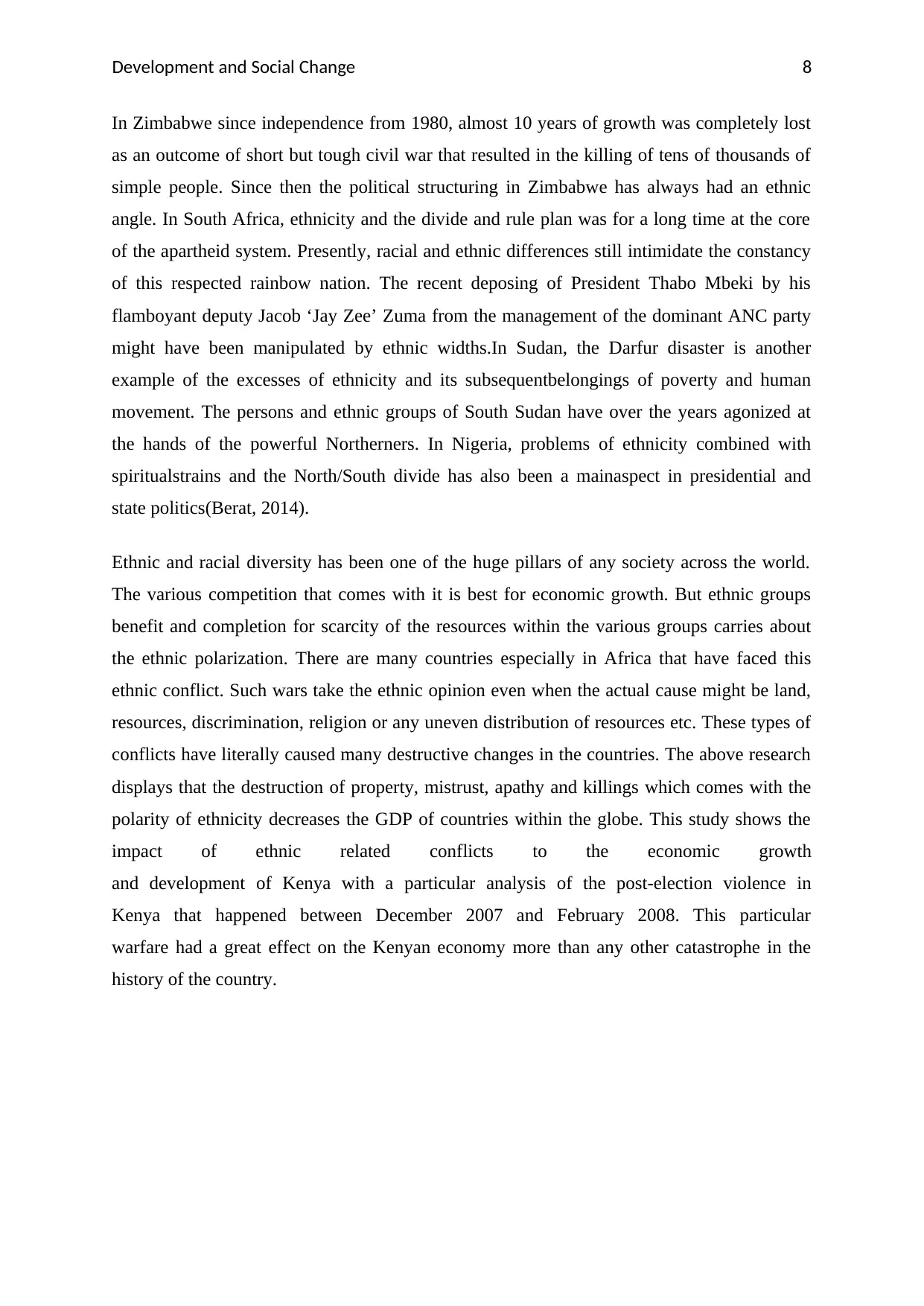
In Zimbabwe since independence from 1980, almost 10 years of growth was completely lost
as an outcome of short but tough civil war that resulted in the killing of tens of thousands of
simple people. Since then the political structuring in Zimbabwe has always had an ethnic
angle. In South Africa, ethnicity and the divide and rule plan was for a long time at the core
of the apartheid system. Presently, racial and ethnic differences still intimidate the constancy
of this respected rainbow nation. The recent deposing of President Thabo Mbeki by his
flamboyant deputy Jacob ‘Jay Zee’ Zuma from the management of the dominant ANC party
might have been manipulated by ethnic widths.In Sudan, the Darfur disaster is another
example of the excesses of ethnicity and its subsequentbelongings of poverty and human
movement. The persons and ethnic groups of South Sudan have over the years agonized at
the hands of the powerful Northerners. In Nigeria, problems of ethnicity combined with
spiritualstrains and the North/South divide has also been a mainaspect in presidential and
state politics(Berat, 2014).
Ethnic and racial diversity has been one of the huge pillars of any society across the world.
The various competition that comes with it is best for economic growth. But ethnic groups
benefit and completion for scarcity of the resources within the various groups carries about
the ethnic polarization. There are many countries especially in Africa that have faced this
ethnic conflict. Such wars take the ethnic opinion even when the actual cause might be land,
resources, discrimination, religion or any uneven distribution of resources etc. These types of
conflicts have literally caused many destructive changes in the countries. The above research
displays that the destruction of property, mistrust, apathy and killings which comes with the
polarity of ethnicity decreases the GDP of countries within the globe. This study shows the
impact of ethnic related conflicts to the economic growth
and development of Kenya with a particular analysis of the post-election violence in
Kenya that happened between December 2007 and February 2008. This particular
warfare had a great effect on the Kenyan economy more than any other catastrophe in the
history of the country.
In Zimbabwe since independence from 1980, almost 10 years of growth was completely lost
as an outcome of short but tough civil war that resulted in the killing of tens of thousands of
simple people. Since then the political structuring in Zimbabwe has always had an ethnic
angle. In South Africa, ethnicity and the divide and rule plan was for a long time at the core
of the apartheid system. Presently, racial and ethnic differences still intimidate the constancy
of this respected rainbow nation. The recent deposing of President Thabo Mbeki by his
flamboyant deputy Jacob ‘Jay Zee’ Zuma from the management of the dominant ANC party
might have been manipulated by ethnic widths.In Sudan, the Darfur disaster is another
example of the excesses of ethnicity and its subsequentbelongings of poverty and human
movement. The persons and ethnic groups of South Sudan have over the years agonized at
the hands of the powerful Northerners. In Nigeria, problems of ethnicity combined with
spiritualstrains and the North/South divide has also been a mainaspect in presidential and
state politics(Berat, 2014).
Ethnic and racial diversity has been one of the huge pillars of any society across the world.
The various competition that comes with it is best for economic growth. But ethnic groups
benefit and completion for scarcity of the resources within the various groups carries about
the ethnic polarization. There are many countries especially in Africa that have faced this
ethnic conflict. Such wars take the ethnic opinion even when the actual cause might be land,
resources, discrimination, religion or any uneven distribution of resources etc. These types of
conflicts have literally caused many destructive changes in the countries. The above research
displays that the destruction of property, mistrust, apathy and killings which comes with the
polarity of ethnicity decreases the GDP of countries within the globe. This study shows the
impact of ethnic related conflicts to the economic growth
and development of Kenya with a particular analysis of the post-election violence in
Kenya that happened between December 2007 and February 2008. This particular
warfare had a great effect on the Kenyan economy more than any other catastrophe in the
history of the country.
⊘ This is a preview!⊘
Do you want full access?
Subscribe today to unlock all pages.
Trusted by 1+ million students worldwide
Development and Social Change 9
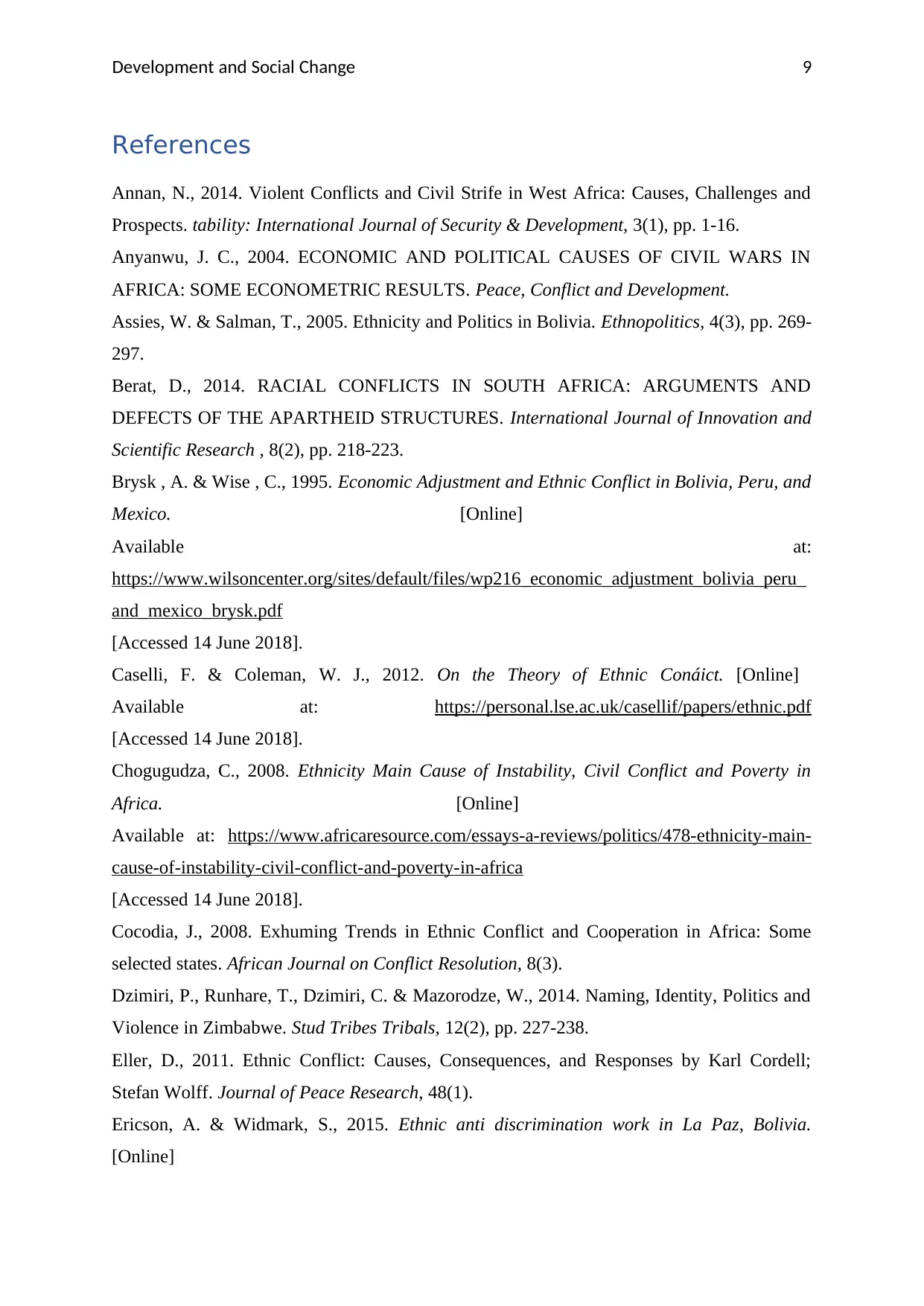
References
Annan, N., 2014. Violent Conflicts and Civil Strife in West Africa: Causes, Challenges and
Prospects. tability: International Journal of Security & Development, 3(1), pp. 1-16.
Anyanwu, J. C., 2004. ECONOMIC AND POLITICAL CAUSES OF CIVIL WARS IN
AFRICA: SOME ECONOMETRIC RESULTS. Peace, Conflict and Development.
Assies, W. & Salman, T., 2005. Ethnicity and Politics in Bolivia. Ethnopolitics, 4(3), pp. 269-
297.
Berat, D., 2014. RACIAL CONFLICTS IN SOUTH AFRICA: ARGUMENTS AND
DEFECTS OF THE APARTHEID STRUCTURES. International Journal of Innovation and
Scientific Research , 8(2), pp. 218-223.
Brysk , A. & Wise , C., 1995. Economic Adjustment and Ethnic Conflict in Bolivia, Peru, and
Mexico. [Online]
Available at:
https://www.wilsoncenter.org/sites/default/files/wp216_economic_adjustment_bolivia_peru_
and_mexico_brysk.pdf
[Accessed 14 June 2018].
Caselli, F. & Coleman, W. J., 2012. On the Theory of Ethnic Conáict. [Online]
Available at: https://personal.lse.ac.uk/casellif/papers/ethnic.pdf
[Accessed 14 June 2018].
Chogugudza, C., 2008. Ethnicity Main Cause of Instability, Civil Conflict and Poverty in
Africa. [Online]
Available at: https://www.africaresource.com/essays-a-reviews/politics/478-ethnicity-main-
cause-of-instability-civil-conflict-and-poverty-in-africa
[Accessed 14 June 2018].
Cocodia, J., 2008. Exhuming Trends in Ethnic Conflict and Cooperation in Africa: Some
selected states. African Journal on Conflict Resolution, 8(3).
Dzimiri, P., Runhare, T., Dzimiri, C. & Mazorodze, W., 2014. Naming, Identity, Politics and
Violence in Zimbabwe. Stud Tribes Tribals, 12(2), pp. 227-238.
Eller, D., 2011. Ethnic Conflict: Causes, Consequences, and Responses by Karl Cordell;
Stefan Wolff. Journal of Peace Research, 48(1).
Ericson, A. & Widmark, S., 2015. Ethnic anti discrimination work in La Paz, Bolivia.
[Online]
References
Annan, N., 2014. Violent Conflicts and Civil Strife in West Africa: Causes, Challenges and
Prospects. tability: International Journal of Security & Development, 3(1), pp. 1-16.
Anyanwu, J. C., 2004. ECONOMIC AND POLITICAL CAUSES OF CIVIL WARS IN
AFRICA: SOME ECONOMETRIC RESULTS. Peace, Conflict and Development.
Assies, W. & Salman, T., 2005. Ethnicity and Politics in Bolivia. Ethnopolitics, 4(3), pp. 269-
297.
Berat, D., 2014. RACIAL CONFLICTS IN SOUTH AFRICA: ARGUMENTS AND
DEFECTS OF THE APARTHEID STRUCTURES. International Journal of Innovation and
Scientific Research , 8(2), pp. 218-223.
Brysk , A. & Wise , C., 1995. Economic Adjustment and Ethnic Conflict in Bolivia, Peru, and
Mexico. [Online]
Available at:
https://www.wilsoncenter.org/sites/default/files/wp216_economic_adjustment_bolivia_peru_
and_mexico_brysk.pdf
[Accessed 14 June 2018].
Caselli, F. & Coleman, W. J., 2012. On the Theory of Ethnic Conáict. [Online]
Available at: https://personal.lse.ac.uk/casellif/papers/ethnic.pdf
[Accessed 14 June 2018].
Chogugudza, C., 2008. Ethnicity Main Cause of Instability, Civil Conflict and Poverty in
Africa. [Online]
Available at: https://www.africaresource.com/essays-a-reviews/politics/478-ethnicity-main-
cause-of-instability-civil-conflict-and-poverty-in-africa
[Accessed 14 June 2018].
Cocodia, J., 2008. Exhuming Trends in Ethnic Conflict and Cooperation in Africa: Some
selected states. African Journal on Conflict Resolution, 8(3).
Dzimiri, P., Runhare, T., Dzimiri, C. & Mazorodze, W., 2014. Naming, Identity, Politics and
Violence in Zimbabwe. Stud Tribes Tribals, 12(2), pp. 227-238.
Eller, D., 2011. Ethnic Conflict: Causes, Consequences, and Responses by Karl Cordell;
Stefan Wolff. Journal of Peace Research, 48(1).
Ericson, A. & Widmark, S., 2015. Ethnic anti discrimination work in La Paz, Bolivia.
[Online]
Paraphrase This Document
Need a fresh take? Get an instant paraphrase of this document with our AI Paraphraser
Development and Social Change
10
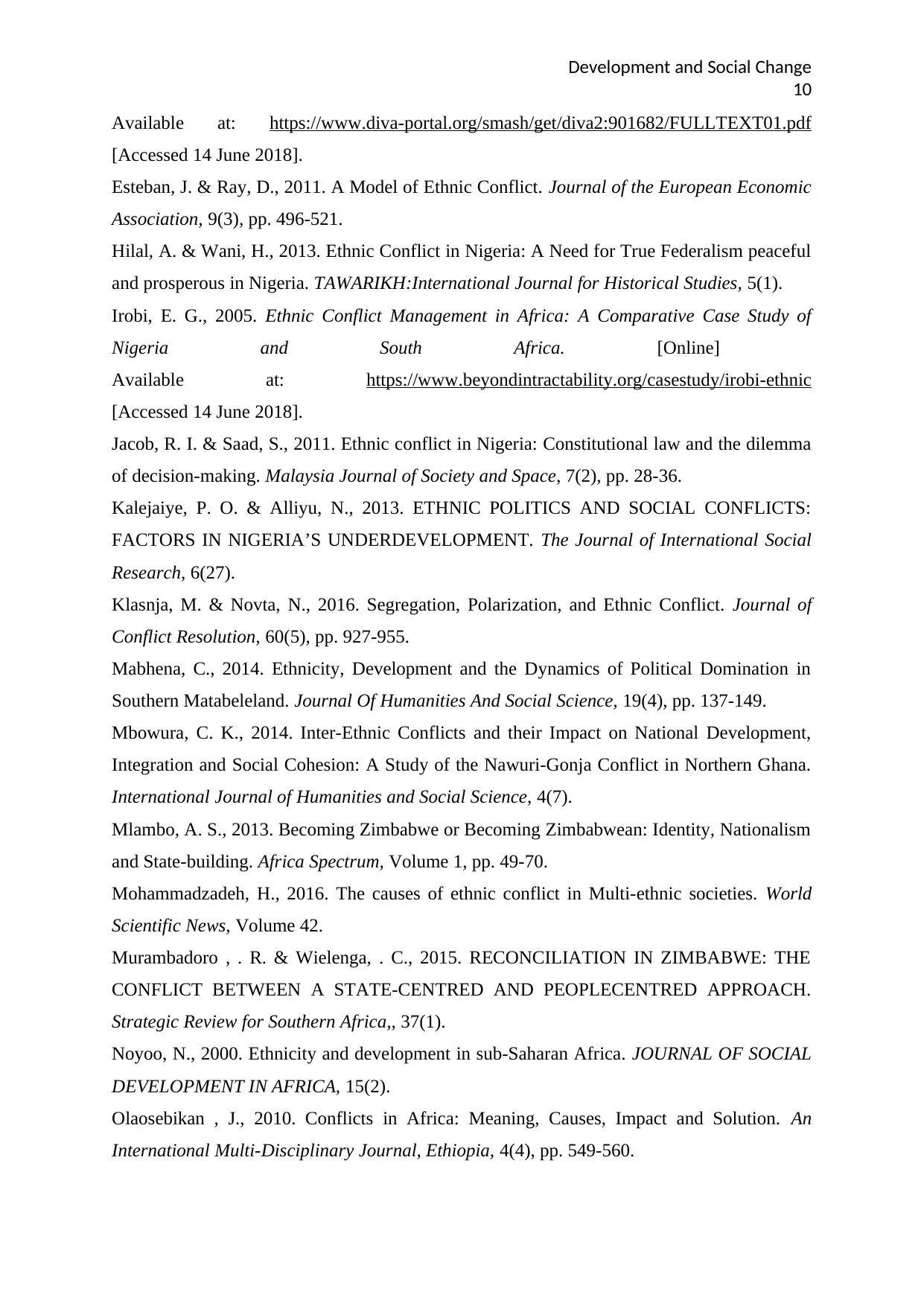
Available at: https://www.diva-portal.org/smash/get/diva2:901682/FULLTEXT01.pdf
[Accessed 14 June 2018].
Esteban, J. & Ray, D., 2011. A Model of Ethnic Conflict. Journal of the European Economic
Association, 9(3), pp. 496-521.
Hilal, A. & Wani, H., 2013. Ethnic Conflict in Nigeria: A Need for True Federalism peaceful
and prosperous in Nigeria. TAWARIKH:International Journal for Historical Studies, 5(1).
Irobi, E. G., 2005. Ethnic Conflict Management in Africa: A Comparative Case Study of
Nigeria and South Africa. [Online]
Available at: https://www.beyondintractability.org/casestudy/irobi-ethnic
[Accessed 14 June 2018].
Jacob, R. I. & Saad, S., 2011. Ethnic conflict in Nigeria: Constitutional law and the dilemma
of decision-making. Malaysia Journal of Society and Space, 7(2), pp. 28-36.
Kalejaiye, P. O. & Alliyu, N., 2013. ETHNIC POLITICS AND SOCIAL CONFLICTS:
FACTORS IN NIGERIA’S UNDERDEVELOPMENT. The Journal of International Social
Research, 6(27).
Klasnja, M. & Novta, N., 2016. Segregation, Polarization, and Ethnic Conflict. Journal of
Conflict Resolution, 60(5), pp. 927-955.
Mabhena, C., 2014. Ethnicity, Development and the Dynamics of Political Domination in
Southern Matabeleland. Journal Of Humanities And Social Science, 19(4), pp. 137-149.
Mbowura, C. K., 2014. Inter-Ethnic Conflicts and their Impact on National Development,
Integration and Social Cohesion: A Study of the Nawuri-Gonja Conflict in Northern Ghana.
International Journal of Humanities and Social Science, 4(7).
Mlambo, A. S., 2013. Becoming Zimbabwe or Becoming Zimbabwean: Identity, Nationalism
and State-building. Africa Spectrum, Volume 1, pp. 49-70.
Mohammadzadeh, H., 2016. The causes of ethnic conflict in Multi-ethnic societies. World
Scientific News, Volume 42.
Murambadoro , . R. & Wielenga, . C., 2015. RECONCILIATION IN ZIMBABWE: THE
CONFLICT BETWEEN A STATE-CENTRED AND PEOPLECENTRED APPROACH.
Strategic Review for Southern Africa,, 37(1).
Noyoo, N., 2000. Ethnicity and development in sub-Saharan Africa. JOURNAL OF SOCIAL
DEVELOPMENT IN AFRICA, 15(2).
Olaosebikan , J., 2010. Conflicts in Africa: Meaning, Causes, Impact and Solution. An
International Multi-Disciplinary Journal, Ethiopia, 4(4), pp. 549-560.
10
Available at: https://www.diva-portal.org/smash/get/diva2:901682/FULLTEXT01.pdf
[Accessed 14 June 2018].
Esteban, J. & Ray, D., 2011. A Model of Ethnic Conflict. Journal of the European Economic
Association, 9(3), pp. 496-521.
Hilal, A. & Wani, H., 2013. Ethnic Conflict in Nigeria: A Need for True Federalism peaceful
and prosperous in Nigeria. TAWARIKH:International Journal for Historical Studies, 5(1).
Irobi, E. G., 2005. Ethnic Conflict Management in Africa: A Comparative Case Study of
Nigeria and South Africa. [Online]
Available at: https://www.beyondintractability.org/casestudy/irobi-ethnic
[Accessed 14 June 2018].
Jacob, R. I. & Saad, S., 2011. Ethnic conflict in Nigeria: Constitutional law and the dilemma
of decision-making. Malaysia Journal of Society and Space, 7(2), pp. 28-36.
Kalejaiye, P. O. & Alliyu, N., 2013. ETHNIC POLITICS AND SOCIAL CONFLICTS:
FACTORS IN NIGERIA’S UNDERDEVELOPMENT. The Journal of International Social
Research, 6(27).
Klasnja, M. & Novta, N., 2016. Segregation, Polarization, and Ethnic Conflict. Journal of
Conflict Resolution, 60(5), pp. 927-955.
Mabhena, C., 2014. Ethnicity, Development and the Dynamics of Political Domination in
Southern Matabeleland. Journal Of Humanities And Social Science, 19(4), pp. 137-149.
Mbowura, C. K., 2014. Inter-Ethnic Conflicts and their Impact on National Development,
Integration and Social Cohesion: A Study of the Nawuri-Gonja Conflict in Northern Ghana.
International Journal of Humanities and Social Science, 4(7).
Mlambo, A. S., 2013. Becoming Zimbabwe or Becoming Zimbabwean: Identity, Nationalism
and State-building. Africa Spectrum, Volume 1, pp. 49-70.
Mohammadzadeh, H., 2016. The causes of ethnic conflict in Multi-ethnic societies. World
Scientific News, Volume 42.
Murambadoro , . R. & Wielenga, . C., 2015. RECONCILIATION IN ZIMBABWE: THE
CONFLICT BETWEEN A STATE-CENTRED AND PEOPLECENTRED APPROACH.
Strategic Review for Southern Africa,, 37(1).
Noyoo, N., 2000. Ethnicity and development in sub-Saharan Africa. JOURNAL OF SOCIAL
DEVELOPMENT IN AFRICA, 15(2).
Olaosebikan , J., 2010. Conflicts in Africa: Meaning, Causes, Impact and Solution. An
International Multi-Disciplinary Journal, Ethiopia, 4(4), pp. 549-560.
Development and Social Change
11
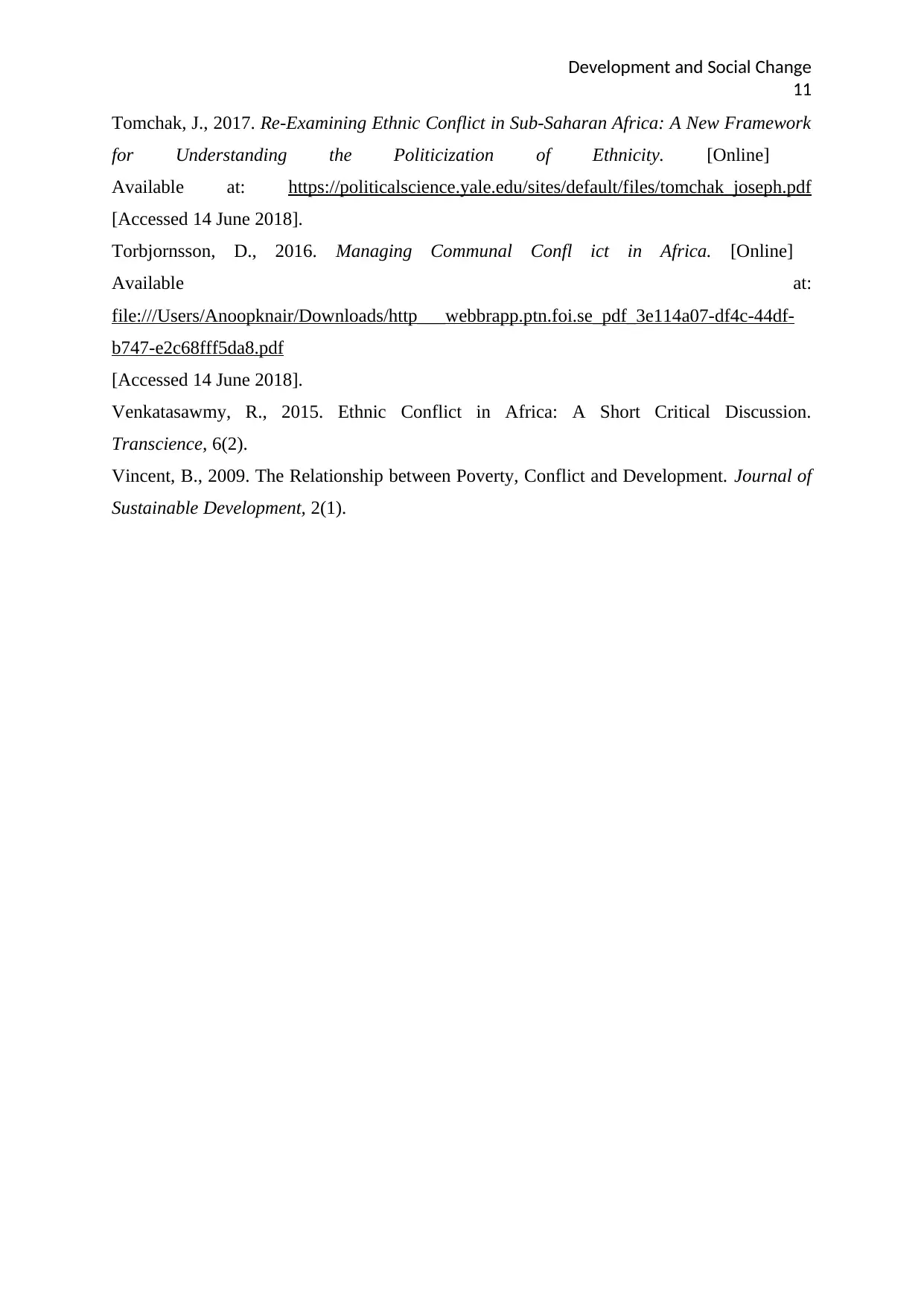
Tomchak, J., 2017. Re-Examining Ethnic Conflict in Sub-Saharan Africa: A New Framework
for Understanding the Politicization of Ethnicity. [Online]
Available at: https://politicalscience.yale.edu/sites/default/files/tomchak_joseph.pdf
[Accessed 14 June 2018].
Torbjornsson, D., 2016. Managing Communal Confl ict in Africa. [Online]
Available at:
file:///Users/Anoopknair/Downloads/http___webbrapp.ptn.foi.se_pdf_3e114a07-df4c-44df-
b747-e2c68fff5da8.pdf
[Accessed 14 June 2018].
Venkatasawmy, R., 2015. Ethnic Conflict in Africa: A Short Critical Discussion.
Transcience, 6(2).
Vincent, B., 2009. The Relationship between Poverty, Conflict and Development. Journal of
Sustainable Development, 2(1).
11
Tomchak, J., 2017. Re-Examining Ethnic Conflict in Sub-Saharan Africa: A New Framework
for Understanding the Politicization of Ethnicity. [Online]
Available at: https://politicalscience.yale.edu/sites/default/files/tomchak_joseph.pdf
[Accessed 14 June 2018].
Torbjornsson, D., 2016. Managing Communal Confl ict in Africa. [Online]
Available at:
file:///Users/Anoopknair/Downloads/http___webbrapp.ptn.foi.se_pdf_3e114a07-df4c-44df-
b747-e2c68fff5da8.pdf
[Accessed 14 June 2018].
Venkatasawmy, R., 2015. Ethnic Conflict in Africa: A Short Critical Discussion.
Transcience, 6(2).
Vincent, B., 2009. The Relationship between Poverty, Conflict and Development. Journal of
Sustainable Development, 2(1).
⊘ This is a preview!⊘
Do you want full access?
Subscribe today to unlock all pages.
Trusted by 1+ million students worldwide

1 out of 12


Related Documents


Your All-in-One AI-Powered Toolkit for Academic Success.
+13062052269
info@desklib.com
Available 24*7 on WhatsApp / Email
![[object Object]](/_next/static/media/star-bottom.7253800d.svg)
Unlock your academic potential
Copyright © 2020–2026 A2Z Services. All Rights Reserved. Developed and managed by ZUCOL.