Evaluating Purchasing Structure for Devillier Group: A Report
VerifiedAdded on 2021/02/19
|12
|3373
|168
Report
AI Summary
This report evaluates the purchasing structure of the Devillier Group, an engineering firm operating in multiple divisions. It begins with an introduction to the company and a literature review on purchasing structures, exploring centralized and decentralized models, their merits, and demerits. A case study analysis is then conducted, focusing on factors to consider when advising the Devillier Group, information needed for decision-making, and approaches to divisional managing directors. The Kraljic Matrix is applied to guide purchasing activities, followed by an evaluation and recommendation for the most suitable purchasing structure. The report concludes with personal reflections and a conclusion summarizing the findings and recommendations. References support the analysis.
Evaluate Purchasing
Structure of Devillier Group
Structure of Devillier Group

Paraphrase This Document
Need a fresh take? Get an instant paraphrase of this document with our AI Paraphraser
Table of Contents
1. INTRODUCTION ......................................................................................................................3
Company Background and Purpose............................................................................................3
2. LITERATURE REVIEW............................................................................................................3
3. CASE STUDY.............................................................................................................................6
3.1 Analysis of Purchasing Structure..........................................................................................6
3.1.1. Factors considering when advising Devillier Group on the most suitable purchasing
structure.......................................................................................................................................6
3.1.2 Information require to inform the decision........................................................................6
3.1.3 Way to approach the divisional managing directors..........................................................7
3.1.4 Different options for structures and the merits and demerits of each option.....................7
3.2 Evaluation/ Measurement......................................................................................................8
3.3 Suggestion...........................................................................................................................10
4. PERSONAL REFLECTION.....................................................................................................10
5. CONCLUSION..........................................................................................................................10
REFERENCES..............................................................................................................................11
1. INTRODUCTION ......................................................................................................................3
Company Background and Purpose............................................................................................3
2. LITERATURE REVIEW............................................................................................................3
3. CASE STUDY.............................................................................................................................6
3.1 Analysis of Purchasing Structure..........................................................................................6
3.1.1. Factors considering when advising Devillier Group on the most suitable purchasing
structure.......................................................................................................................................6
3.1.2 Information require to inform the decision........................................................................6
3.1.3 Way to approach the divisional managing directors..........................................................7
3.1.4 Different options for structures and the merits and demerits of each option.....................7
3.2 Evaluation/ Measurement......................................................................................................8
3.3 Suggestion...........................................................................................................................10
4. PERSONAL REFLECTION.....................................................................................................10
5. CONCLUSION..........................................................................................................................10
REFERENCES..............................................................................................................................11
1. INTRODUCTION
Purchase structures are the models that defines the design and function of purchasing
department and the manner it is configured within, and linked to the wider organisational
business model and design (Chiu, Tzeng and Li, 2013). In this report, the chosen firm is Devillier
Group which is engaged in engaged in specific work areas, each of which trading as operating
division. This report covers company background and purpose and the literature review about
purchasing structure. It also includes case study analysis of referred firm in which Kraljic Matrix
is applied to guide purchase activities within firm and provide appropriate suggestion. At last,
personal reflection and conclusion are given based on the entire discussion in report.
Company Background and Purpose
The Devillier group is an engineering firm which has its headquarters in United Kingdom
and engaged in particular work areas includes Rail and Transportation services, Facilities
Management, Specialist Engineering and Civil Engineering, each one mercantilism as an
operating division. The total turnover of company is £980 million from which around 88% is
generated in UK and remaining 12% from Germany and France. There has been resistance in the
company to group purchasing concept as the divisional managing directors argued that they
should be allowed to control expenditures according to them. The main purpose of company is
to find out the most appropriate purchasing structure so that operational efficiencies can be
improved.
2. LITERATURE REVIEW
The purchasing function of the company is crucial to its long term business success. It
involves bureaucracy, level of authority and formality needed in a company for issuance of
purchase order. It varies as per the size, operational specialization and management culture of
firm. According to Dana Sparks, 2019, it is not necessary that the structure of one purchasing
division look similar to another, although some positions are there that seems within most
hierarchies. The purchasing department work closely in team approach and each member handle
specific tasks, but come in collaboration as a whole in order to make crucial decisions
(Seyedghorban, Matanda and LaPlaca, 2016).
Ian Linton, 2019, said that procurement structures types range from single individual with
purchasing responsibility to a large decentralized or centralized department with procurement
Purchase structures are the models that defines the design and function of purchasing
department and the manner it is configured within, and linked to the wider organisational
business model and design (Chiu, Tzeng and Li, 2013). In this report, the chosen firm is Devillier
Group which is engaged in engaged in specific work areas, each of which trading as operating
division. This report covers company background and purpose and the literature review about
purchasing structure. It also includes case study analysis of referred firm in which Kraljic Matrix
is applied to guide purchase activities within firm and provide appropriate suggestion. At last,
personal reflection and conclusion are given based on the entire discussion in report.
Company Background and Purpose
The Devillier group is an engineering firm which has its headquarters in United Kingdom
and engaged in particular work areas includes Rail and Transportation services, Facilities
Management, Specialist Engineering and Civil Engineering, each one mercantilism as an
operating division. The total turnover of company is £980 million from which around 88% is
generated in UK and remaining 12% from Germany and France. There has been resistance in the
company to group purchasing concept as the divisional managing directors argued that they
should be allowed to control expenditures according to them. The main purpose of company is
to find out the most appropriate purchasing structure so that operational efficiencies can be
improved.
2. LITERATURE REVIEW
The purchasing function of the company is crucial to its long term business success. It
involves bureaucracy, level of authority and formality needed in a company for issuance of
purchase order. It varies as per the size, operational specialization and management culture of
firm. According to Dana Sparks, 2019, it is not necessary that the structure of one purchasing
division look similar to another, although some positions are there that seems within most
hierarchies. The purchasing department work closely in team approach and each member handle
specific tasks, but come in collaboration as a whole in order to make crucial decisions
(Seyedghorban, Matanda and LaPlaca, 2016).
Ian Linton, 2019, said that procurement structures types range from single individual with
purchasing responsibility to a large decentralized or centralized department with procurement
⊘ This is a preview!⊘
Do you want full access?
Subscribe today to unlock all pages.

Trusted by 1+ million students worldwide
professionals who works in separate business units or location. It is very essential for
organisation to get right structure as procurement accounts for half of expenditure of an
organisation. It plays major part in competitive strategy of firm.
As stated by Martin Murray, 2018, the purchasing function of firm highly contributes in
its success. The operational inefficiencies of this department can lead to product inconsistencies,
high material cost and customer dissatisfaction. Unlike large businesses, small firms tends to
have midget purchasing desks that are run solely by an individual who cultivates individualized
relationships with vendors and may act quickly when any issue arise. As the a firm grow, the
individuals can become overwhelmed with relationship management and delivery tracking
responsibilities (Wang, Li, Barnes and Ahn, 2012).
Christoph H. Glock and Simon Hochrein, 2011 stated that high degree of influence is
exerted by centralized purchasing department on major activities of business in comparison to
decentralized division and enjoys a high strategic role. In purchase function, more technical
specialists and personnel are included in the process which maximizes the buying centre size.
There is a relationship between structural variables and environmental uncertainty as when it
increases, firms may decide to execute a less bureaucratic and more flexible structure to aid free
flow of information.
As per the view point of Sydney Lazarus, 2017, the majority of procurement firms are
somewhere in between fully centralized and decentralized. Which structure is better among both
is rely on various factors like location, size, purchasing category, expansion rate and industry of
firm. It is generally recommended to large organisations to implement decentralized purchasing
structure. If an organisation has offices in all over the world then, it is not practically possible for
purchases to go through a respective central office. If a firm is undergoing rapid growth, then it
is more important that the decentralized model has flexibility (Ha and Janda, 2012).
In an industry, the choice of among procurement systems can speedily become make or
break decision. Glodin Peiser & Peiser, 2017, said that on an average, the centralized
procurement system run more effectively with manufacturing and ordering costs operating
around 10% low in comparison to decentralized alternatives. As compared to decentralized
regimes, the centralized firms can finish the purchase order process more quickly. When it
comes to supply level and inventory, centralized system do not tolerate deviance.
organisation to get right structure as procurement accounts for half of expenditure of an
organisation. It plays major part in competitive strategy of firm.
As stated by Martin Murray, 2018, the purchasing function of firm highly contributes in
its success. The operational inefficiencies of this department can lead to product inconsistencies,
high material cost and customer dissatisfaction. Unlike large businesses, small firms tends to
have midget purchasing desks that are run solely by an individual who cultivates individualized
relationships with vendors and may act quickly when any issue arise. As the a firm grow, the
individuals can become overwhelmed with relationship management and delivery tracking
responsibilities (Wang, Li, Barnes and Ahn, 2012).
Christoph H. Glock and Simon Hochrein, 2011 stated that high degree of influence is
exerted by centralized purchasing department on major activities of business in comparison to
decentralized division and enjoys a high strategic role. In purchase function, more technical
specialists and personnel are included in the process which maximizes the buying centre size.
There is a relationship between structural variables and environmental uncertainty as when it
increases, firms may decide to execute a less bureaucratic and more flexible structure to aid free
flow of information.
As per the view point of Sydney Lazarus, 2017, the majority of procurement firms are
somewhere in between fully centralized and decentralized. Which structure is better among both
is rely on various factors like location, size, purchasing category, expansion rate and industry of
firm. It is generally recommended to large organisations to implement decentralized purchasing
structure. If an organisation has offices in all over the world then, it is not practically possible for
purchases to go through a respective central office. If a firm is undergoing rapid growth, then it
is more important that the decentralized model has flexibility (Ha and Janda, 2012).
In an industry, the choice of among procurement systems can speedily become make or
break decision. Glodin Peiser & Peiser, 2017, said that on an average, the centralized
procurement system run more effectively with manufacturing and ordering costs operating
around 10% low in comparison to decentralized alternatives. As compared to decentralized
regimes, the centralized firms can finish the purchase order process more quickly. When it
comes to supply level and inventory, centralized system do not tolerate deviance.
Paraphrase This Document
Need a fresh take? Get an instant paraphrase of this document with our AI Paraphraser
According to Elaine Porteous, 2016, the centre-led procurement firms emphasize more on
defining policy and strategy along with application of best practices to both direct and indirect
procurement. A category management structure is employed by these organisations that
facilitates the roll out of their directing to regional level and business unit. Firms with centre-led
procurement outperform non centre-led similitude, in spend under supply cost reductions and
management (Weske, 2012).
Lydia Bals and Virpi Turkulainen, 2017, stated that global sourcing is the main issue in
supply management and purchasing from the perspective of an organisational design. The
companies which are located in various locations and have number of operating divisions have
choice of running decentralized or centralized procurement models. Essential supplies are needed
by firm like critical engineering elements or if the company wants to concord quality across
various suppliers, has moved to long term relationships with supply partners from traditional
purchase practices.
According to Jackie Lohrey, 2019, centralized purchasing involves completely centre-led
and centralized organisational structures. The purchasing department develops standard
operating procedures and purchasing policies for business. It offers different procedural
advantages that are not available in decentralized organisational structure and eliminates
duplicated and redundant efforts (Forsgren and Johanson, 2014).
According to Jason Busch, 2014, the centralized centres perceived as main cost centres
and can be bureaucratic. The centralized process can assist in driving more successful supplier
diversity, risk management and initiatives related to corporate social responsibility. The
centralized purchasing structures are often created by large organisations where a team of people
is lead by purchasing executive, housed in central location. With use of this approach, a firm
would purchase materials for all its plants. It provides an advantage to purchasers to buy in bulk,
for low overall cost. The professionals in centralized purchasing structure are provided with
clenched control over the process of purchasing.
defining policy and strategy along with application of best practices to both direct and indirect
procurement. A category management structure is employed by these organisations that
facilitates the roll out of their directing to regional level and business unit. Firms with centre-led
procurement outperform non centre-led similitude, in spend under supply cost reductions and
management (Weske, 2012).
Lydia Bals and Virpi Turkulainen, 2017, stated that global sourcing is the main issue in
supply management and purchasing from the perspective of an organisational design. The
companies which are located in various locations and have number of operating divisions have
choice of running decentralized or centralized procurement models. Essential supplies are needed
by firm like critical engineering elements or if the company wants to concord quality across
various suppliers, has moved to long term relationships with supply partners from traditional
purchase practices.
According to Jackie Lohrey, 2019, centralized purchasing involves completely centre-led
and centralized organisational structures. The purchasing department develops standard
operating procedures and purchasing policies for business. It offers different procedural
advantages that are not available in decentralized organisational structure and eliminates
duplicated and redundant efforts (Forsgren and Johanson, 2014).
According to Jason Busch, 2014, the centralized centres perceived as main cost centres
and can be bureaucratic. The centralized process can assist in driving more successful supplier
diversity, risk management and initiatives related to corporate social responsibility. The
centralized purchasing structures are often created by large organisations where a team of people
is lead by purchasing executive, housed in central location. With use of this approach, a firm
would purchase materials for all its plants. It provides an advantage to purchasers to buy in bulk,
for low overall cost. The professionals in centralized purchasing structure are provided with
clenched control over the process of purchasing.
3. CASE STUDY
3.1 Analysis of Purchasing Structure
3.1.1. Factors considering when advising Devillier Group on the most suitable purchasing
structure
There are various factors that needs to be consider while advising appropriate purchasing
structure to Devillier Group. These factors includes size of business, location, product, abilities
of personnel etc. Some of the factors are mentioned below in detail.
Size of business: It indicates scale of operations of business. It is the significant factor
that governs cost, profitability and efficiency of company. The tasks of small firms are
centralized and they do not require vast purchase framework. Whereas, large organisations
require more powerful purchase structure. So, while advising purchasing structure, it is necessary
to consider business size (Savrul, Incekara and Sener, 2014).
Location of business: It is also an another factor that needs to be consider while advising
a purchasing structure for organisation. When implementing or adopting any purchasing
structure it is necessary to consider whether the organisation is located at limited places or at
many locations. If an organisation is located at various locations, then the centralized structure is
not appropriate for it.
Industry: Consideration of industry in which firm operates its business operations is
needed when advising purchasing structure to it. For example: In oil and gas or automotive
industry, where products are less or more around the world, the centralized structure is better
for those industries.
3.1.2 Information require to inform the decision
At the time of making purchase structure decision, it is necessary to have information
regarding suppliers (Monczka and et. al., 2015). The choice of supplier will rely on numerous
factors like a quality, service, value of money, reliability etc. The most impelling suppliers are
those that provides the products that exceeds or match the requirements of business. So, while
making any purchase decision, it is necessary for Devillier Group to have proper information
about suppliers and the needs and requirements of business as it helps it in taking right decision.
The cost of transport, distance between storage and production centre, company's policy about
3.1 Analysis of Purchasing Structure
3.1.1. Factors considering when advising Devillier Group on the most suitable purchasing
structure
There are various factors that needs to be consider while advising appropriate purchasing
structure to Devillier Group. These factors includes size of business, location, product, abilities
of personnel etc. Some of the factors are mentioned below in detail.
Size of business: It indicates scale of operations of business. It is the significant factor
that governs cost, profitability and efficiency of company. The tasks of small firms are
centralized and they do not require vast purchase framework. Whereas, large organisations
require more powerful purchase structure. So, while advising purchasing structure, it is necessary
to consider business size (Savrul, Incekara and Sener, 2014).
Location of business: It is also an another factor that needs to be consider while advising
a purchasing structure for organisation. When implementing or adopting any purchasing
structure it is necessary to consider whether the organisation is located at limited places or at
many locations. If an organisation is located at various locations, then the centralized structure is
not appropriate for it.
Industry: Consideration of industry in which firm operates its business operations is
needed when advising purchasing structure to it. For example: In oil and gas or automotive
industry, where products are less or more around the world, the centralized structure is better
for those industries.
3.1.2 Information require to inform the decision
At the time of making purchase structure decision, it is necessary to have information
regarding suppliers (Monczka and et. al., 2015). The choice of supplier will rely on numerous
factors like a quality, service, value of money, reliability etc. The most impelling suppliers are
those that provides the products that exceeds or match the requirements of business. So, while
making any purchase decision, it is necessary for Devillier Group to have proper information
about suppliers and the needs and requirements of business as it helps it in taking right decision.
The cost of transport, distance between storage and production centre, company's policy about
⊘ This is a preview!⊘
Do you want full access?
Subscribe today to unlock all pages.
Trusted by 1+ million students worldwide
material purchase and the nature of materials are also the factors that needs to be consider by
firm in order to make appropriate decisions about purchase structure.
3.1.3 Way to approach the divisional managing directors
The divisional managing director can be approached through purchasing manager by
following the appropriate organisational hierarchy.
3.1.4 Different options for structures and the merits and demerits of each option
There are two types of purchasing structures and each one has its own merits and
demerits. Both the structures are mentioned below:
Centralized structure: In this purchase structure, all the purchasing activities are a
controlled by single headquarters department. This allows firm for volume purchases and
central management which leads to better terms and prices and provides an ability to
organisation to work with large suppliers. Centralized structure enables lower staffing costs,
more efficient inventory and minimize the overheads (Scheer, 2012).
Advantages of centralized structure:
It allows for less overheads.
The records of centralized purchase system can be kept for all purchases.
It enables better inventory control so as to kept them at best levels.
Duplication of efforts of staff and cost associated with it are neglected and enables
standardized activities.
Disadvantages of centralized structure:
The centralized department of purchasing may become complex and large to manage.
If the firm is geographically diverse, then it may not enable to take benefit of local
discounts.
Decentralized structure: It involves purchasing of materials through all branches and
departments independently in order to fulfil business needs. In this, no purchasing manager is
there who has right to buy materials for all divisions (Hesping and Schiele, 2015).
Advantages of decentralized structure:
Initially, no heavy investments are needed in decentralized purchasing.
A little time is needed for replacement of defective materials.
The orders of purchase can be places speedily.
Disadvantages of decentralized structure:
firm in order to make appropriate decisions about purchase structure.
3.1.3 Way to approach the divisional managing directors
The divisional managing director can be approached through purchasing manager by
following the appropriate organisational hierarchy.
3.1.4 Different options for structures and the merits and demerits of each option
There are two types of purchasing structures and each one has its own merits and
demerits. Both the structures are mentioned below:
Centralized structure: In this purchase structure, all the purchasing activities are a
controlled by single headquarters department. This allows firm for volume purchases and
central management which leads to better terms and prices and provides an ability to
organisation to work with large suppliers. Centralized structure enables lower staffing costs,
more efficient inventory and minimize the overheads (Scheer, 2012).
Advantages of centralized structure:
It allows for less overheads.
The records of centralized purchase system can be kept for all purchases.
It enables better inventory control so as to kept them at best levels.
Duplication of efforts of staff and cost associated with it are neglected and enables
standardized activities.
Disadvantages of centralized structure:
The centralized department of purchasing may become complex and large to manage.
If the firm is geographically diverse, then it may not enable to take benefit of local
discounts.
Decentralized structure: It involves purchasing of materials through all branches and
departments independently in order to fulfil business needs. In this, no purchasing manager is
there who has right to buy materials for all divisions (Hesping and Schiele, 2015).
Advantages of decentralized structure:
Initially, no heavy investments are needed in decentralized purchasing.
A little time is needed for replacement of defective materials.
The orders of purchase can be places speedily.
Disadvantages of decentralized structure:
Paraphrase This Document
Need a fresh take? Get an instant paraphrase of this document with our AI Paraphraser
The advantage of bulk purchase can be loose by organisation.
The chances of effective and efficient control of materials are less.
Lack of appropriate coordination and cooperation are exist among different
departments (Monczka and et. al., 2015).
3.2 Evaluation/ Measurement
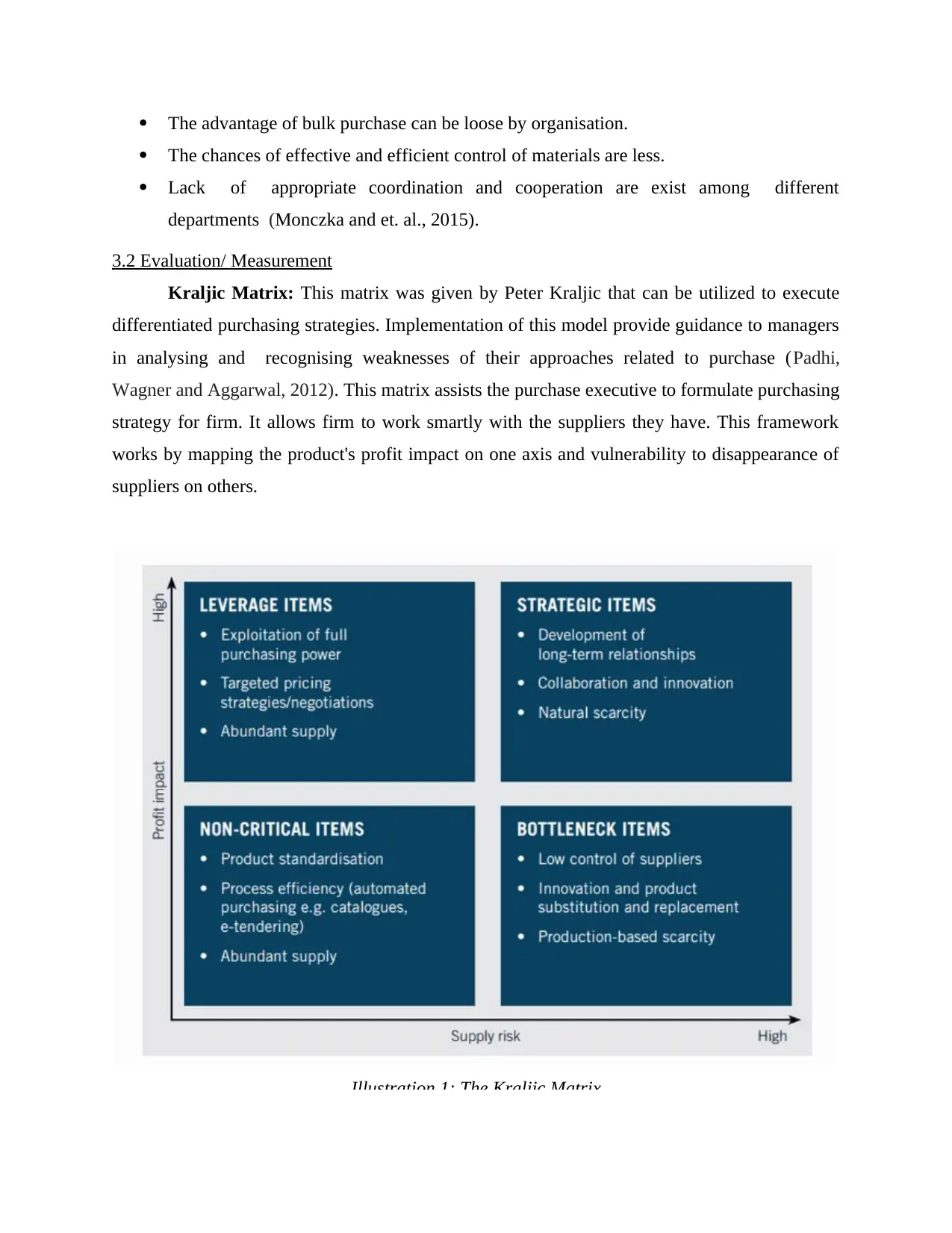
Kraljic Matrix: This matrix was given by Peter Kraljic that can be utilized to execute
differentiated purchasing strategies. Implementation of this model provide guidance to managers
in analysing and recognising weaknesses of their approaches related to purchase (Padhi,
Wagner and Aggarwal, 2012). This matrix assists the purchase executive to formulate purchasing
strategy for firm. It allows firm to work smartly with the suppliers they have. This framework
works by mapping the product's profit impact on one axis and vulnerability to disappearance of
suppliers on others.
Illustration 1: The Kraljic Matrix
The chances of effective and efficient control of materials are less.
Lack of appropriate coordination and cooperation are exist among different
departments (Monczka and et. al., 2015).
3.2 Evaluation/ Measurement
Kraljic Matrix: This matrix was given by Peter Kraljic that can be utilized to execute
differentiated purchasing strategies. Implementation of this model provide guidance to managers
in analysing and recognising weaknesses of their approaches related to purchase (Padhi,
Wagner and Aggarwal, 2012). This matrix assists the purchase executive to formulate purchasing
strategy for firm. It allows firm to work smartly with the suppliers they have. This framework
works by mapping the product's profit impact on one axis and vulnerability to disappearance of
suppliers on others.
Illustration 1: The Kraljic Matrix
(Source: The Kraljic Matrix, 2017)
The matrix has four 4 dimensions which are mentioned below:
Strategic items: High financial impact and high risk of supplier covers these items.
Strategic products represents only few suppliers, but ensures predictable and effective supplier
relationship which is a key to future of purchasing company. Strategic partnership and
collaboration can be used by purchasing executive of Devillier Group for these items. They can
also create long term supply relationship, plan for contingencies and manage risks constantly.
Leverage items: When the items have low risk factor and high profitability, the balance
of power is possess by the buyers in relationship and for getting high returns, they leverage this
strength (Narsimhan and Prasad, 2016). Competitive bidding and tendering are the strategies
that can be used by purchase executives of Devillier Group for leverage items.
Non-critical items: These items have low risk and the impact is also lower on
profitability of organisation. The purchasing strategies for these items emphasize on logistical
complexity and reducing administrative costs. The purchasing approaches of Non-critical items
for Devillier Group can be optimizing inventory levels, using standardized product and
optimizing or monitoring order volume.
Bottleneck items: In these items, the risk is high and profitability is low. In order to
force the prices upward, suppliers behave oligopolistically as they are few in market. For these
items, the purchasing strategy of Devillier Group may need to ensure supply continuity and they
can develop plan for reducing their dependence on suppliers (Monczka and et. al., 2015).
3.3 Suggestion
It is suggested to the firm to use combination of both, centralized and de-centralized
purchasing structures as per the requirement as this helps the firm in balancing purchasing
decisions. This will be effective for company at leveraging indirect spend than a decentralized
structure which fails to leverage effective practices and the suppliers across firm or a high cost
centralized framework. The coordinated structure takes the advantages of centralized and
decentralized structures of purchase while eliminating the disadvantages found in each
framework.
The matrix has four 4 dimensions which are mentioned below:
Strategic items: High financial impact and high risk of supplier covers these items.
Strategic products represents only few suppliers, but ensures predictable and effective supplier
relationship which is a key to future of purchasing company. Strategic partnership and
collaboration can be used by purchasing executive of Devillier Group for these items. They can
also create long term supply relationship, plan for contingencies and manage risks constantly.
Leverage items: When the items have low risk factor and high profitability, the balance
of power is possess by the buyers in relationship and for getting high returns, they leverage this
strength (Narsimhan and Prasad, 2016). Competitive bidding and tendering are the strategies
that can be used by purchase executives of Devillier Group for leverage items.
Non-critical items: These items have low risk and the impact is also lower on
profitability of organisation. The purchasing strategies for these items emphasize on logistical
complexity and reducing administrative costs. The purchasing approaches of Non-critical items
for Devillier Group can be optimizing inventory levels, using standardized product and
optimizing or monitoring order volume.
Bottleneck items: In these items, the risk is high and profitability is low. In order to
force the prices upward, suppliers behave oligopolistically as they are few in market. For these
items, the purchasing strategy of Devillier Group may need to ensure supply continuity and they
can develop plan for reducing their dependence on suppliers (Monczka and et. al., 2015).
3.3 Suggestion
It is suggested to the firm to use combination of both, centralized and de-centralized
purchasing structures as per the requirement as this helps the firm in balancing purchasing
decisions. This will be effective for company at leveraging indirect spend than a decentralized
structure which fails to leverage effective practices and the suppliers across firm or a high cost
centralized framework. The coordinated structure takes the advantages of centralized and
decentralized structures of purchase while eliminating the disadvantages found in each
framework.
⊘ This is a preview!⊘
Do you want full access?
Subscribe today to unlock all pages.
Trusted by 1+ million students worldwide
4. PERSONAL REFLECTION
By analysing and presenting the given case, me and my group have learned many things.
The study helped in gaining knowledge and deep understanding regarding the topic. This
analysis also helped us in knowing about pros and cons of different purchasing structures that
further assist in advising appropriate purchasing structure to company. By this case study
analysis, me and my group learned about the core concept of topic and the literature review part
helps in gaining deep understanding of topic from the perspectives of different authors.
5. CONCLUSION
As per the above mentioned report, it has been concluded that purchasing structure is a
very important aspect of operations management. Various factors needs to be considered by
purchasing managers while making purchase structure decisions like size of firm, its location, the
industry in which it deals etc. All this will help firm in adopting appropriate purchase structure
for making purchase. There are various advantages and disadvantages of each type of purchasing
structure which needs to be consider by manager while making purchase decisions.
By analysing and presenting the given case, me and my group have learned many things.
The study helped in gaining knowledge and deep understanding regarding the topic. This
analysis also helped us in knowing about pros and cons of different purchasing structures that
further assist in advising appropriate purchasing structure to company. By this case study
analysis, me and my group learned about the core concept of topic and the literature review part
helps in gaining deep understanding of topic from the perspectives of different authors.
5. CONCLUSION
As per the above mentioned report, it has been concluded that purchasing structure is a
very important aspect of operations management. Various factors needs to be considered by
purchasing managers while making purchase structure decisions like size of firm, its location, the
industry in which it deals etc. All this will help firm in adopting appropriate purchase structure
for making purchase. There are various advantages and disadvantages of each type of purchasing
structure which needs to be consider by manager while making purchase decisions.
Paraphrase This Document
Need a fresh take? Get an instant paraphrase of this document with our AI Paraphraser
REFERENCES
Books and Journals
Chiu, W. Y., Tzeng, G. H. and Li, H. L., 2013. A new hybrid MCDM model combining DANP
with VIKOR to improve e-store business. Knowledge-Based Systems. 37. pp.48-61.
Forsgren, M. and Johanson, J., 2014. Managing networks in international business. Routledge.
Ha, H. Y. and Janda, S., 2012. Predicting consumer intentions to purchase energy-efficient
products. Journal of Consumer Marketing. 29(7). pp.461-469.
Hesping, F. H. and Schiele, H., 2015. Purchasing strategy development: A multi-level
review. Journal of purchasing and supply management. 21(2). pp.138-150.
Monczka, R. M., Handfield, R. B., Giunipero, L. C. and Patterson, J. L., 2015. Purchasing and
supply chain management. Cengage Learning.
Narsimhan, S. and Prasad, D., 2016. Competitive negotiation tactics and Kraljic portfolio
category in SCM. Journal of Supply Chain Management System. 5(3).
Padhi, S. S., Wagner, S. M. and Aggarwal, V., 2012. Positioning of commodities using the
Kraljic Portfolio Matrix. Journal of Purchasing and Supply Management. 18(1). pp.1-8.
Savrul, M., Incekara, A. and Sener, S., 2014. The potential of e-commerce for SMEs in a
globalizing business environment. Procedia-Social and Behavioral Sciences. 150.
pp.35-45.
Scheer, A.W., 2012. ARIS—business process modeling. Springer Science & Business Media.
Seyedghorban, Z., Matanda, M. J. and LaPlaca, P., 2016. Advancing theory and knowledge in
the business-to-business branding literature. Journal of Business Research. 69(8).
pp.2664-2677.
Wang, C. L., Li, D., Barnes, B. R. and Ahn, J., 2012. Country image, product image and
consumer purchase intention: Evidence from an emerging economy. International
Business Review. 21(6). pp.1041-1051.
Weske, M., 2012. Business process management architectures. In Business Process
Management (pp. 333-371). Springer, Berlin, Heidelberg.
Online
Organizational Structure of the Purchasing Department, 2019. [Online]. Available through:
<https://smallbusiness.chron.com/organizational-structure-purchasing-department-
12820.html>
Structure of Procurement in an Organization, 2019. [Online]. Available through:
<https://bizfluent.com/facts-7294395-structure-procurement-organization.html>
Purchasing Organization Structure - Supply Chain Optimization, 2018. [Online]. Available
through: <https://www.thebalancesmb.com/purchasing-organization-structure-
2221222>
Purchasing Organization and Design, 2011. [Online]. Available through:
<https://link.springer.com/article/10.1007/BF03342754>
Centralized, Decentralized or Hybrid Sourcing Structure, 2017. [Online]. Available through:
<http://spendmatters.com/2017/08/01/centralized-decentralized-hybrid-sourcing-
structure-decide/>
Centralized, Decentralized or Hybrid: Which Procurement System Is Best for You?, 2017.
[Online]. Available through: <https://blog.gppcpa.com/blog/2017/06/22/centralized-
decentralized-hybrid-procurement-system-best>
Books and Journals
Chiu, W. Y., Tzeng, G. H. and Li, H. L., 2013. A new hybrid MCDM model combining DANP
with VIKOR to improve e-store business. Knowledge-Based Systems. 37. pp.48-61.
Forsgren, M. and Johanson, J., 2014. Managing networks in international business. Routledge.
Ha, H. Y. and Janda, S., 2012. Predicting consumer intentions to purchase energy-efficient
products. Journal of Consumer Marketing. 29(7). pp.461-469.
Hesping, F. H. and Schiele, H., 2015. Purchasing strategy development: A multi-level
review. Journal of purchasing and supply management. 21(2). pp.138-150.
Monczka, R. M., Handfield, R. B., Giunipero, L. C. and Patterson, J. L., 2015. Purchasing and
supply chain management. Cengage Learning.
Narsimhan, S. and Prasad, D., 2016. Competitive negotiation tactics and Kraljic portfolio
category in SCM. Journal of Supply Chain Management System. 5(3).
Padhi, S. S., Wagner, S. M. and Aggarwal, V., 2012. Positioning of commodities using the
Kraljic Portfolio Matrix. Journal of Purchasing and Supply Management. 18(1). pp.1-8.
Savrul, M., Incekara, A. and Sener, S., 2014. The potential of e-commerce for SMEs in a
globalizing business environment. Procedia-Social and Behavioral Sciences. 150.
pp.35-45.
Scheer, A.W., 2012. ARIS—business process modeling. Springer Science & Business Media.
Seyedghorban, Z., Matanda, M. J. and LaPlaca, P., 2016. Advancing theory and knowledge in
the business-to-business branding literature. Journal of Business Research. 69(8).
pp.2664-2677.
Wang, C. L., Li, D., Barnes, B. R. and Ahn, J., 2012. Country image, product image and
consumer purchase intention: Evidence from an emerging economy. International
Business Review. 21(6). pp.1041-1051.
Weske, M., 2012. Business process management architectures. In Business Process
Management (pp. 333-371). Springer, Berlin, Heidelberg.
Online
Organizational Structure of the Purchasing Department, 2019. [Online]. Available through:
<https://smallbusiness.chron.com/organizational-structure-purchasing-department-
12820.html>
Structure of Procurement in an Organization, 2019. [Online]. Available through:
<https://bizfluent.com/facts-7294395-structure-procurement-organization.html>
Purchasing Organization Structure - Supply Chain Optimization, 2018. [Online]. Available
through: <https://www.thebalancesmb.com/purchasing-organization-structure-
2221222>
Purchasing Organization and Design, 2011. [Online]. Available through:
<https://link.springer.com/article/10.1007/BF03342754>
Centralized, Decentralized or Hybrid Sourcing Structure, 2017. [Online]. Available through:
<http://spendmatters.com/2017/08/01/centralized-decentralized-hybrid-sourcing-
structure-decide/>
Centralized, Decentralized or Hybrid: Which Procurement System Is Best for You?, 2017.
[Online]. Available through: <https://blog.gppcpa.com/blog/2017/06/22/centralized-
decentralized-hybrid-procurement-system-best>
Is Hybrid Best? The Centralised Vs Decentralised Debate, 2016. [Online]. Available through:
<https://www.procurious.com/procurement-news/hybrid-centralised-decentralised-
debate>
"Centralized, decentralized, and hybrid purchasing organizations: What lies beyond?", 2017.
[Online]. Available through:
<https://journals.aom.org/doi/10.5465/ambpp.2015.13488abstract>
Importance of Centralized Purchasing, 2019. [Online]. Available through:
<https://smallbusiness.chron.com/importance-centralized-purchasing-80496.html>
Centralised vs. Decentralized Procurement, 2014. [Online]. Available through:
<http://spendmatters.com/2014/09/23/centralized-vs-decentralized-procurement-seeing-
the-benefits-and-challenges-of-centralization/>
<https://www.procurious.com/procurement-news/hybrid-centralised-decentralised-
debate>
"Centralized, decentralized, and hybrid purchasing organizations: What lies beyond?", 2017.
[Online]. Available through:
<https://journals.aom.org/doi/10.5465/ambpp.2015.13488abstract>
Importance of Centralized Purchasing, 2019. [Online]. Available through:
<https://smallbusiness.chron.com/importance-centralized-purchasing-80496.html>
Centralised vs. Decentralized Procurement, 2014. [Online]. Available through:
<http://spendmatters.com/2014/09/23/centralized-vs-decentralized-procurement-seeing-
the-benefits-and-challenges-of-centralization/>
⊘ This is a preview!⊘
Do you want full access?
Subscribe today to unlock all pages.
Trusted by 1+ million students worldwide

1 out of 12


Related Documents


Your All-in-One AI-Powered Toolkit for Academic Success.
+13062052269
info@desklib.com
Available 24*7 on WhatsApp / Email
![[object Object]](/_next/static/media/star-bottom.7253800d.svg)
Unlock your academic potential
Copyright © 2020–2026 A2Z Services. All Rights Reserved. Developed and managed by ZUCOL.