Public Health Principle: Diabetes Management in Australia and Africa
VerifiedAdded on 2021/06/15
|14
|3158
|61
Report
AI Summary
This report provides a comparative analysis of health promotion strategies for diabetes management, focusing on Australia and Africa. It begins with an introduction to the public health principle and health promotion, defining key concepts and principles. The report then explores the effectiveness of health promotion in diabetes, highlighting the importance of public awareness and self-management skills. A detailed comparison of diabetes health promotion strategies in Australia and Africa follows, examining the different approaches, target populations, and challenges faced in each region. The analysis includes the use of social media in Australia and community-based campaigns in Africa, along with the emphasis on healthy eating versus physical activity. The report concludes with a discussion of the outcomes of these health promotion strategies, noting the increasing prevalence of diabetes and the need for modified interventions. The report references relevant literature to support its findings and provides a comprehensive overview of the topic.
Running head: PUBLIC HEALTH PRINCIPLE
Public Health Principle
Name of the Student
Name of the University
Author Note
Public Health Principle
Name of the Student
Name of the University
Author Note

Paraphrase This Document
Need a fresh take? Get an instant paraphrase of this document with our AI Paraphraser
1
PUBLIC HEALTH PRINCIPLE
Table of Contents
Introduction................................................................................................................................3
Health Promotion.......................................................................................................................3
Effectiveness of health promotion in diabetes...........................................................................4
Diabetes in Australia and health promotion...............................................................................5
Diabetes in Africa and health promotion...................................................................................6
Outcome of health promotion....................................................................................................8
Conclusion..................................................................................................................................9
References................................................................................................................................11
PUBLIC HEALTH PRINCIPLE
Table of Contents
Introduction................................................................................................................................3
Health Promotion.......................................................................................................................3
Effectiveness of health promotion in diabetes...........................................................................4
Diabetes in Australia and health promotion...............................................................................5
Diabetes in Africa and health promotion...................................................................................6
Outcome of health promotion....................................................................................................8
Conclusion..................................................................................................................................9
References................................................................................................................................11

2
PUBLIC HEALTH PRINCIPLE
PUBLIC HEALTH PRINCIPLE
⊘ This is a preview!⊘
Do you want full access?
Subscribe today to unlock all pages.

Trusted by 1+ million students worldwide
3
PUBLIC HEALTH PRINCIPLE
Introduction
According to World Health Organisation (WHO), the public health principle points
the health status of the individual and communities (WHO, 2017). It also signifies that the
health of individuals of the communities cannot be separated from the overall health and the
diversity of the surrounding ecosystem. There are numerous public health principles like
monitoring and surveillance, health promotion and health policy, planning and management.
The current report aims at analysing the application of the health promotion in the domain of
effective management of diabetes mellitus. In analysing the health promotion, the report will
mainly follow a compare and contrast mode of data representation in diabetes. The two main
countries which will be selected for this compare and contrast are Australia and Africa. The
report will initiates via providing a detailed description of health promotion and public health
principle followed by a comparative analysis of the diabetes health promotion in Australia
and Africa.
Health Promotion
According to the description provided in the website of WHO, health promotion is
defined as a process of enabling individuals towards a subsequent increase in control over
their health and thereby providing subsequent improvement in the health status (WHO,
2017). WHO is of the opinion that the concept of health promotion is the major public health
principle. It moves beyond the focus over the behaviour of the individual towards a diverse
range of environmental and social interventions. As per the gradation of the WHO, the health
promotion strategy has five key principles. The first principle is promotion of health in a
context driven manner. This principle mainly focus over health and its underlying economic
and social determinants for analysing gender, socio-economic and ethnic gaps in disease
pattern and health in population groups. The second principle is, health promotion integrates
PUBLIC HEALTH PRINCIPLE
Introduction
According to World Health Organisation (WHO), the public health principle points
the health status of the individual and communities (WHO, 2017). It also signifies that the
health of individuals of the communities cannot be separated from the overall health and the
diversity of the surrounding ecosystem. There are numerous public health principles like
monitoring and surveillance, health promotion and health policy, planning and management.
The current report aims at analysing the application of the health promotion in the domain of
effective management of diabetes mellitus. In analysing the health promotion, the report will
mainly follow a compare and contrast mode of data representation in diabetes. The two main
countries which will be selected for this compare and contrast are Australia and Africa. The
report will initiates via providing a detailed description of health promotion and public health
principle followed by a comparative analysis of the diabetes health promotion in Australia
and Africa.
Health Promotion
According to the description provided in the website of WHO, health promotion is
defined as a process of enabling individuals towards a subsequent increase in control over
their health and thereby providing subsequent improvement in the health status (WHO,
2017). WHO is of the opinion that the concept of health promotion is the major public health
principle. It moves beyond the focus over the behaviour of the individual towards a diverse
range of environmental and social interventions. As per the gradation of the WHO, the health
promotion strategy has five key principles. The first principle is promotion of health in a
context driven manner. This principle mainly focus over health and its underlying economic
and social determinants for analysing gender, socio-economic and ethnic gaps in disease
pattern and health in population groups. The second principle is, health promotion integrates
Paraphrase This Document
Need a fresh take? Get an instant paraphrase of this document with our AI Paraphraser
4
PUBLIC HEALTH PRINCIPLE
three distinct dimensions of the WHO definition of health. Here the three distinct definition
of health includes promoting health via means of addressing the multi-dimensional pattern of
health along with its social, physical and mental dimensions (often highlighted in the spiritual
domain). The third principle promotes health promotion as a champion for good health as
public good. According to this, good health is important in the society in a comprehensive
manner as it supports economic and social development. The fifth and the last principle is
participation. WHO is of the opinion that participation is the core principle towards proper
promotion in health. This participation signifies participation of the people across the
communities towards controlling and improving the overall conditions in health and thereby
promoting health in mass (Australian Health Promotion Association, 2017).
However, this public health principle in the domain of health promotion experiences
certain level of challenges towards comprehensive implementation. The main challenge
includes changing burden in health along with complex determinants in health. After this
comes the inequality and health, problems with communication resolution, increase in
democratization of the countries around the globe and globalization. However, the severity of
these challenges varies from countries to countries. WHO has clearly stated that this
challenges varies in severity among the developed and developing countries as the ratio of the
increase in the elderly population and increase in the rate of occurrence of the chronic, non-
communicable and infectious disease varies significantly. This variance leads to change in
the health burden and thereby leading to a change in the overall scenario of the health
promotion – public health principle (WHO, 2017).
Effectiveness of health promotion in diabetes
Type 2 diabetes mellitus is a serious progressive condition, which is increasing its
prevalence globally. It causes long term health complications like cardiovascular disease,
PUBLIC HEALTH PRINCIPLE
three distinct dimensions of the WHO definition of health. Here the three distinct definition
of health includes promoting health via means of addressing the multi-dimensional pattern of
health along with its social, physical and mental dimensions (often highlighted in the spiritual
domain). The third principle promotes health promotion as a champion for good health as
public good. According to this, good health is important in the society in a comprehensive
manner as it supports economic and social development. The fifth and the last principle is
participation. WHO is of the opinion that participation is the core principle towards proper
promotion in health. This participation signifies participation of the people across the
communities towards controlling and improving the overall conditions in health and thereby
promoting health in mass (Australian Health Promotion Association, 2017).
However, this public health principle in the domain of health promotion experiences
certain level of challenges towards comprehensive implementation. The main challenge
includes changing burden in health along with complex determinants in health. After this
comes the inequality and health, problems with communication resolution, increase in
democratization of the countries around the globe and globalization. However, the severity of
these challenges varies from countries to countries. WHO has clearly stated that this
challenges varies in severity among the developed and developing countries as the ratio of the
increase in the elderly population and increase in the rate of occurrence of the chronic, non-
communicable and infectious disease varies significantly. This variance leads to change in
the health burden and thereby leading to a change in the overall scenario of the health
promotion – public health principle (WHO, 2017).
Effectiveness of health promotion in diabetes
Type 2 diabetes mellitus is a serious progressive condition, which is increasing its
prevalence globally. It causes long term health complications like cardiovascular disease,
5
PUBLIC HEALTH PRINCIPLE
renal failure and blindness. People suffering from diabetes are required to make multiple
daily choices about managing their health conditions, dietary intake, and physical activity
along with adherence to drugs. Effective health promotion helps to increase public awareness
about the disease and thereby helping the people suffering from diabetes to generate
necessary skills for self-management strategies (Khunti et al., 2012).
Diabetes in Australia and health promotion
According to the Australian National Diabetes Strategy (2016-2020), it is complex to
ascertain the total number of people suffering from diabetes in Australia however; the
approximate number is likely to be more than 1.1 million of Australians. Among this, 1.1
million people, 85% suffers from type 2 diabetes mellitus, 12 % suffers from type 2 diabetes
mellitus and rest 12 to 15 % suffers from gastro-intestinal diabetes mellitus. The majority of
the diabetes cases among the Australian population are diagnosed however, in case of Torres
Strait Islanders or other Australian aboriginals; they are few undiagnosed cases of diabetes
(Australian Government Department of Health, 2016).
According to Australian National Diabetes Strategy (2016-2020), the primary goal
towards the health promotion is prevention in developing type 2 diabetes (since it is highest
rescored cases among other types of diabetes in Australia). This prevention strategy is mostly
aimed towards the promotion of physical activity along with healthy eating (Australian
Government Department of Health, 2016). The education about healthy eating and healthy
lifestyle at work places is circulated mainly through social media and workplace campaign.
Here social media is selected as the main medium of population education because 70% of
the Australians used Facebook and at least 68% of Australians use YouTube (Office of the
Australian Information Commissioner, 2017; Diabetes Australia, 2017). Keeping this high
exposure of social media among the Australian population, Australian government has
PUBLIC HEALTH PRINCIPLE
renal failure and blindness. People suffering from diabetes are required to make multiple
daily choices about managing their health conditions, dietary intake, and physical activity
along with adherence to drugs. Effective health promotion helps to increase public awareness
about the disease and thereby helping the people suffering from diabetes to generate
necessary skills for self-management strategies (Khunti et al., 2012).
Diabetes in Australia and health promotion
According to the Australian National Diabetes Strategy (2016-2020), it is complex to
ascertain the total number of people suffering from diabetes in Australia however; the
approximate number is likely to be more than 1.1 million of Australians. Among this, 1.1
million people, 85% suffers from type 2 diabetes mellitus, 12 % suffers from type 2 diabetes
mellitus and rest 12 to 15 % suffers from gastro-intestinal diabetes mellitus. The majority of
the diabetes cases among the Australian population are diagnosed however, in case of Torres
Strait Islanders or other Australian aboriginals; they are few undiagnosed cases of diabetes
(Australian Government Department of Health, 2016).
According to Australian National Diabetes Strategy (2016-2020), the primary goal
towards the health promotion is prevention in developing type 2 diabetes (since it is highest
rescored cases among other types of diabetes in Australia). This prevention strategy is mostly
aimed towards the promotion of physical activity along with healthy eating (Australian
Government Department of Health, 2016). The education about healthy eating and healthy
lifestyle at work places is circulated mainly through social media and workplace campaign.
Here social media is selected as the main medium of population education because 70% of
the Australians used Facebook and at least 68% of Australians use YouTube (Office of the
Australian Information Commissioner, 2017; Diabetes Australia, 2017). Keeping this high
exposure of social media among the Australian population, Australian government has
⊘ This is a preview!⊘
Do you want full access?
Subscribe today to unlock all pages.
Trusted by 1+ million students worldwide
6
PUBLIC HEALTH PRINCIPLE
selected social media as the main medium for health promotion. Moreover, social media is
cost-effective and easily accessible means for health promotion (Neiger et al., 2012).
Furthermore, it can be seen that physical exercise and healthy eating (less consumption of
oily and fat containing food) was major highlight because according to reports, the majority
of the Australians lead a sedentary life and are more inclined towards the high calorific fats
foods (ABC News, 2017).
Another goal in the health promotion strategy in diabetes prevention in Australia is
reduce the rate of occurrence of complications associated with diabetes along with the
overall improvement of the quality of life among the group of population suffering from
diabetes. The potential areas for action in this domain include development of the nationally
agreed clinical guidelines along with other local care pathways and complications prevention
campaigns, increase in self-management of the disease, development and implement of
quality improvement process (use of My Health Records among the healthcare providers as
an online accessible management toll for treatment, medicines and condition). This goal also
targets development of proper diabetes workforce for up skilling aboriginals and Torres Strait
Islanders (Australian Government Department of Health, 2016).
Diabetes in Africa and health promotion
According to the reports, there are 14 million Africans suffering from diabetes
mellitus and among these 81% of cases are undiagnosed (vs 50% of reported cases in
worldwide) thus making Africa a continent of highest proportion of people residing with
undiagnosed diabetes (Ovbiagele, 2015; Africa International Diabetes Federation, 2017). The
main gaol towards health promotion in Africa is the increases in the number of the diagnosed
cases of diabetes in Africa (Pastakia et al., 2017). This can be achieved via generation of the
disease awareness which can be further achieved via increase in recognition of the early signs
PUBLIC HEALTH PRINCIPLE
selected social media as the main medium for health promotion. Moreover, social media is
cost-effective and easily accessible means for health promotion (Neiger et al., 2012).
Furthermore, it can be seen that physical exercise and healthy eating (less consumption of
oily and fat containing food) was major highlight because according to reports, the majority
of the Australians lead a sedentary life and are more inclined towards the high calorific fats
foods (ABC News, 2017).
Another goal in the health promotion strategy in diabetes prevention in Australia is
reduce the rate of occurrence of complications associated with diabetes along with the
overall improvement of the quality of life among the group of population suffering from
diabetes. The potential areas for action in this domain include development of the nationally
agreed clinical guidelines along with other local care pathways and complications prevention
campaigns, increase in self-management of the disease, development and implement of
quality improvement process (use of My Health Records among the healthcare providers as
an online accessible management toll for treatment, medicines and condition). This goal also
targets development of proper diabetes workforce for up skilling aboriginals and Torres Strait
Islanders (Australian Government Department of Health, 2016).
Diabetes in Africa and health promotion
According to the reports, there are 14 million Africans suffering from diabetes
mellitus and among these 81% of cases are undiagnosed (vs 50% of reported cases in
worldwide) thus making Africa a continent of highest proportion of people residing with
undiagnosed diabetes (Ovbiagele, 2015; Africa International Diabetes Federation, 2017). The
main gaol towards health promotion in Africa is the increases in the number of the diagnosed
cases of diabetes in Africa (Pastakia et al., 2017). This can be achieved via generation of the
disease awareness which can be further achieved via increase in recognition of the early signs
Paraphrase This Document
Need a fresh take? Get an instant paraphrase of this document with our AI Paraphraser
7
PUBLIC HEALTH PRINCIPLE
and symptoms of diabetes along with increased use of risk screening tools among the
community level (Australian Institute of Health and Welfare, 2017). Educational program
increases the increase in self-management and thereby decreasing the fatal outcome of
diabetes (Jalilian et al., 2014). This awareness and recognition of the early symptoms of
diabetes mostly type 2 diabetes is mostly directed towards the overall African population
(Pastakia et al., 2017). 2/3 rd. of the adult population in Africa is residing is currently living
with diabetes while remaining unaware about the conditions and this percentage is extremely
significant both in urban and rural areas (International Diabetes Federation Africa, 2016).
This is in sharp difference with the scenario in Australia as the increase in the disease
awareness and the recognition of the early signs and symptoms of diabetes is mostly centred
on the Australian aboriginals group of population and not over the comprehensive group of
population (Diabetes Australia, 2017). Moreover, the education and awareness in the domain
of diabetes is mainly done via community based campaign as opposed to the social media
campaigns in Australia. According to reports, though the total number of internet users has
increased by 20% in African, but the total internet users or social media access is extremely
poor in comparison to the comprehensive population in Australia (Africa News, 2018). In the
domain of towards the health promotion is prevention in developing diabetes, the African
government is mostly targeting towards increase in the consumption of the nutritious food in
comparison to the increase in the physical activity in Australia. There is urgent need to
introduce new policy designed to encourage the consumption of nutritious food while
avoidance of indulgence towards emerging food environments like diabetogenic/obesogenic
foods (Pastakia et al., 2017). This emphasis over the nutritious food intake in comparison to
physical activity as highlighted by the Australian government towards effective measures of
diabetes promotion is lifestyle transition in South African or sub-Saharan African settings
PUBLIC HEALTH PRINCIPLE
and symptoms of diabetes along with increased use of risk screening tools among the
community level (Australian Institute of Health and Welfare, 2017). Educational program
increases the increase in self-management and thereby decreasing the fatal outcome of
diabetes (Jalilian et al., 2014). This awareness and recognition of the early symptoms of
diabetes mostly type 2 diabetes is mostly directed towards the overall African population
(Pastakia et al., 2017). 2/3 rd. of the adult population in Africa is residing is currently living
with diabetes while remaining unaware about the conditions and this percentage is extremely
significant both in urban and rural areas (International Diabetes Federation Africa, 2016).
This is in sharp difference with the scenario in Australia as the increase in the disease
awareness and the recognition of the early signs and symptoms of diabetes is mostly centred
on the Australian aboriginals group of population and not over the comprehensive group of
population (Diabetes Australia, 2017). Moreover, the education and awareness in the domain
of diabetes is mainly done via community based campaign as opposed to the social media
campaigns in Australia. According to reports, though the total number of internet users has
increased by 20% in African, but the total internet users or social media access is extremely
poor in comparison to the comprehensive population in Australia (Africa News, 2018). In the
domain of towards the health promotion is prevention in developing diabetes, the African
government is mostly targeting towards increase in the consumption of the nutritious food in
comparison to the increase in the physical activity in Australia. There is urgent need to
introduce new policy designed to encourage the consumption of nutritious food while
avoidance of indulgence towards emerging food environments like diabetogenic/obesogenic
foods (Pastakia et al., 2017). This emphasis over the nutritious food intake in comparison to
physical activity as highlighted by the Australian government towards effective measures of
diabetes promotion is lifestyle transition in South African or sub-Saharan African settings
8
PUBLIC HEALTH PRINCIPLE
does not seem to matched with the lifestyle traits prevalent in the western culture like
sedentary mode of life (Pastakia et al., 2017).
In Africa, reduction in the occurrence of the diabetes related complications is mainly
centred over the comprehensive availability of the diabetes control medicines. According to
the reports published by WHO in the year 2015, only 51% of African population has
availability of metformin and 40% has availability of insulin. The availability of aspirin is
although higher with the percentage amounting to 71% (Atun et al., 2017). Increase
availability along with easy access of the medicines helps in the reduction of the disease
complications associated with the development of diabetes and thereby improving the quality
of life (Rojas & Gomes, 2013).
In Africa, the funding towards the domain of the health promotion in diabetes is
mostly emphasized over community campaigns, educational campaigns and accessibility of
proper treatments and medicines. This is in sharp construct with the Australian nature of
funding. According to Australian National Diabetes Strategy 2016-2020, the funding
towards diabetes promotion is concentrated towards the framing of the more innovative
strategies for diabetes work force and higher utilization of health care services among the
aboriginals (Australian Government Department of Health, 2016). However, in Africa there
is a lack of global commitment and this is further complicated via comparatively restricted in-
country financial funding that sub-Saharan African countries devote to health in comparison
with the rest of the world (Africa News, 2018).
Outcome of health promotion
The difference in the basic approach of the health promotion strategy in Australia and
Africa has resulted is also reflected in the difference in the diabetes related outcomes. For
example, in spite of the comprehensive health promotion, the prevalence of diabetes has
PUBLIC HEALTH PRINCIPLE
does not seem to matched with the lifestyle traits prevalent in the western culture like
sedentary mode of life (Pastakia et al., 2017).
In Africa, reduction in the occurrence of the diabetes related complications is mainly
centred over the comprehensive availability of the diabetes control medicines. According to
the reports published by WHO in the year 2015, only 51% of African population has
availability of metformin and 40% has availability of insulin. The availability of aspirin is
although higher with the percentage amounting to 71% (Atun et al., 2017). Increase
availability along with easy access of the medicines helps in the reduction of the disease
complications associated with the development of diabetes and thereby improving the quality
of life (Rojas & Gomes, 2013).
In Africa, the funding towards the domain of the health promotion in diabetes is
mostly emphasized over community campaigns, educational campaigns and accessibility of
proper treatments and medicines. This is in sharp construct with the Australian nature of
funding. According to Australian National Diabetes Strategy 2016-2020, the funding
towards diabetes promotion is concentrated towards the framing of the more innovative
strategies for diabetes work force and higher utilization of health care services among the
aboriginals (Australian Government Department of Health, 2016). However, in Africa there
is a lack of global commitment and this is further complicated via comparatively restricted in-
country financial funding that sub-Saharan African countries devote to health in comparison
with the rest of the world (Africa News, 2018).
Outcome of health promotion
The difference in the basic approach of the health promotion strategy in Australia and
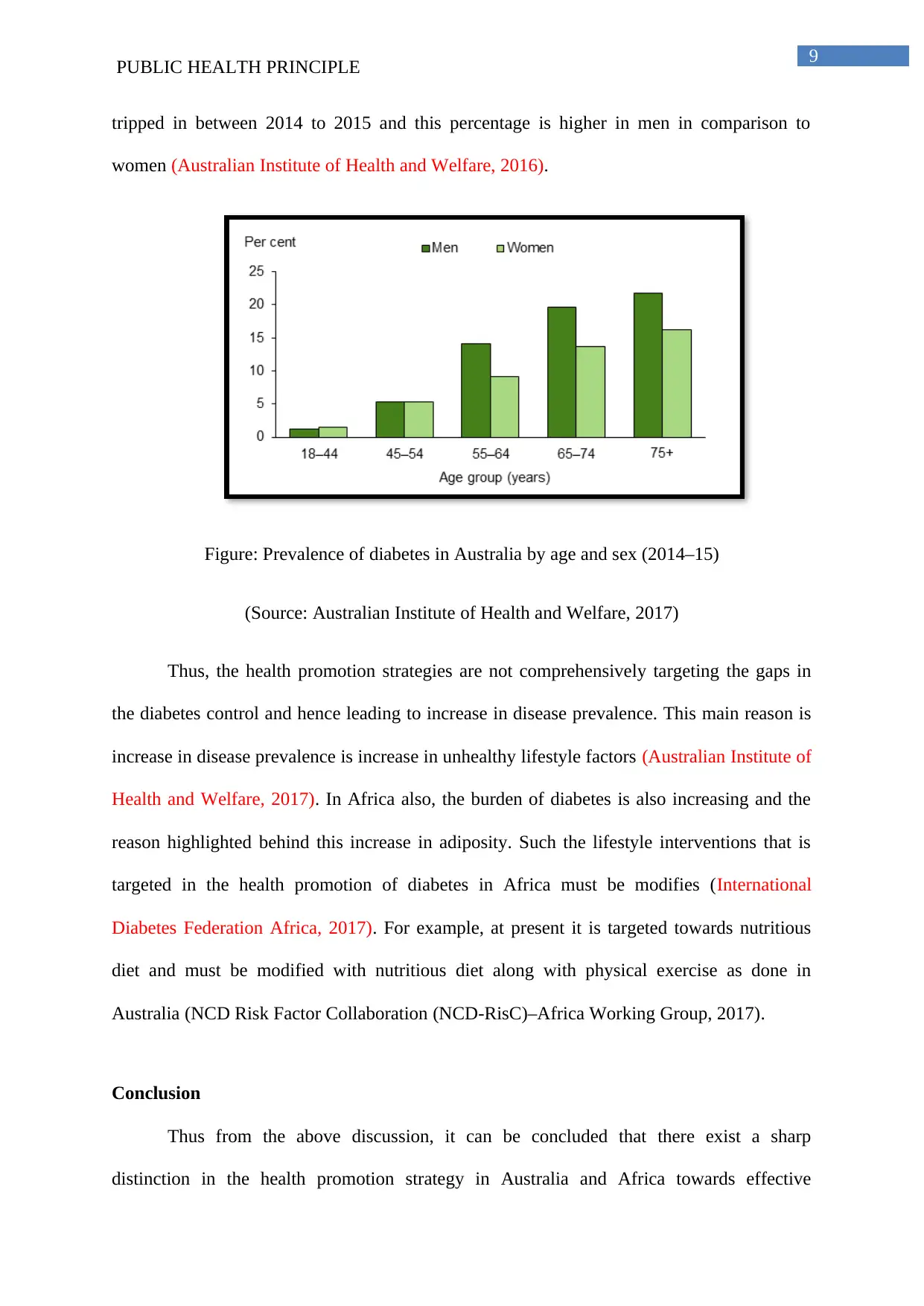
Africa has resulted is also reflected in the difference in the diabetes related outcomes. For
example, in spite of the comprehensive health promotion, the prevalence of diabetes has
⊘ This is a preview!⊘
Do you want full access?
Subscribe today to unlock all pages.
Trusted by 1+ million students worldwide
9
PUBLIC HEALTH PRINCIPLE
tripped in between 2014 to 2015 and this percentage is higher in men in comparison to
women (Australian Institute of Health and Welfare, 2016).
Figure: Prevalence of diabetes in Australia by age and sex (2014–15)
(Source: Australian Institute of Health and Welfare, 2017)
Thus, the health promotion strategies are not comprehensively targeting the gaps in
the diabetes control and hence leading to increase in disease prevalence. This main reason is
increase in disease prevalence is increase in unhealthy lifestyle factors (Australian Institute of
Health and Welfare, 2017). In Africa also, the burden of diabetes is also increasing and the
reason highlighted behind this increase in adiposity. Such the lifestyle interventions that is
targeted in the health promotion of diabetes in Africa must be modifies (International
Diabetes Federation Africa, 2017). For example, at present it is targeted towards nutritious
diet and must be modified with nutritious diet along with physical exercise as done in
Australia (NCD Risk Factor Collaboration (NCD-RisC)–Africa Working Group, 2017).
Conclusion
Thus from the above discussion, it can be concluded that there exist a sharp
distinction in the health promotion strategy in Australia and Africa towards effective
PUBLIC HEALTH PRINCIPLE
tripped in between 2014 to 2015 and this percentage is higher in men in comparison to
women (Australian Institute of Health and Welfare, 2016).
Figure: Prevalence of diabetes in Australia by age and sex (2014–15)
(Source: Australian Institute of Health and Welfare, 2017)
Thus, the health promotion strategies are not comprehensively targeting the gaps in
the diabetes control and hence leading to increase in disease prevalence. This main reason is
increase in disease prevalence is increase in unhealthy lifestyle factors (Australian Institute of
Health and Welfare, 2017). In Africa also, the burden of diabetes is also increasing and the
reason highlighted behind this increase in adiposity. Such the lifestyle interventions that is
targeted in the health promotion of diabetes in Africa must be modifies (International
Diabetes Federation Africa, 2017). For example, at present it is targeted towards nutritious
diet and must be modified with nutritious diet along with physical exercise as done in
Australia (NCD Risk Factor Collaboration (NCD-RisC)–Africa Working Group, 2017).
Conclusion
Thus from the above discussion, it can be concluded that there exist a sharp
distinction in the health promotion strategy in Australia and Africa towards effective
Paraphrase This Document
Need a fresh take? Get an instant paraphrase of this document with our AI Paraphraser
10
PUBLIC HEALTH PRINCIPLE
management of diabetes mellitus. This difference is mainly highlighted in the domain of
selection of the mode of disease awareness, funding for health promotion and factors
considered under the healthy life style. This above report further provided a clear insight that
the health promotion strategies differ in developed, developing and under developed
countries along with the difference in outcome.
PUBLIC HEALTH PRINCIPLE
management of diabetes mellitus. This difference is mainly highlighted in the domain of
selection of the mode of disease awareness, funding for health promotion and factors
considered under the healthy life style. This above report further provided a clear insight that
the health promotion strategies differ in developed, developing and under developed
countries along with the difference in outcome.
11
PUBLIC HEALTH PRINCIPLE
References
ABC News. (2017). What the changing food habits of Australians tell us. Access date: 2nd
May. Retrieved from: http://www.abc.net.au/news/2017-04-05/australians-are-
changing-their-eating-habits/8415526
Africa International Diabetes Federation (2017). EADSG Congress and Scientific Session on
Prevention of Diabetes and its Complications. Access date: 2nd May. Retrieved from:
https://www.idf.org/our-network/regions-members/africa/africa-news/97-eadsg-
congress-and-scientific-session-on-prevention-of-diabetes-and-its-complications.html
Africa News. (2018). Digital in 2018: Africa's internet users increase by 20%. Access date:
2nd May. Retrieved from: http://www.africanews.com/2018/02/06/digital-in-2018-
africa-s-internet-users-increase-by-20-percent//
Atun, R., Davies, J. I., Gale, E. A., Bärnighausen, T., Beran, D., Kengne, A. P., ... &
Ramaiya, K. (2017). Diabetes in sub-Saharan Africa: from clinical care to health
policy. The lancet Diabetes & endocrinology, 5(8), 622-667.
Australian Government – Department of Health (2016). Australian National Diabetes
Strategy 2016-2020. Access date: 2nd May. Retrieved from:
http://www.health.gov.au/internet/main/publishing.nsf/content/3AF935DA210DA043
CA257EFB000D0C03/$File/Australian%20National%20Diabetes%20Strategy
%202016-2020.pdf
Australian Health Promotion Association. (2017). The Australian Health Promotion
Association (AHPA®) seeks to advance the health of all people in Australia. Access
date: 2nd May. Retrieved from: https://www.healthpromotion.org.au/
PUBLIC HEALTH PRINCIPLE
References
ABC News. (2017). What the changing food habits of Australians tell us. Access date: 2nd
May. Retrieved from: http://www.abc.net.au/news/2017-04-05/australians-are-
changing-their-eating-habits/8415526
Africa International Diabetes Federation (2017). EADSG Congress and Scientific Session on
Prevention of Diabetes and its Complications. Access date: 2nd May. Retrieved from:
https://www.idf.org/our-network/regions-members/africa/africa-news/97-eadsg-
congress-and-scientific-session-on-prevention-of-diabetes-and-its-complications.html
Africa News. (2018). Digital in 2018: Africa's internet users increase by 20%. Access date:
2nd May. Retrieved from: http://www.africanews.com/2018/02/06/digital-in-2018-
africa-s-internet-users-increase-by-20-percent//
Atun, R., Davies, J. I., Gale, E. A., Bärnighausen, T., Beran, D., Kengne, A. P., ... &
Ramaiya, K. (2017). Diabetes in sub-Saharan Africa: from clinical care to health
policy. The lancet Diabetes & endocrinology, 5(8), 622-667.
Australian Government – Department of Health (2016). Australian National Diabetes
Strategy 2016-2020. Access date: 2nd May. Retrieved from:
http://www.health.gov.au/internet/main/publishing.nsf/content/3AF935DA210DA043
CA257EFB000D0C03/$File/Australian%20National%20Diabetes%20Strategy
%202016-2020.pdf
Australian Health Promotion Association. (2017). The Australian Health Promotion
Association (AHPA®) seeks to advance the health of all people in Australia. Access
date: 2nd May. Retrieved from: https://www.healthpromotion.org.au/
⊘ This is a preview!⊘
Do you want full access?
Subscribe today to unlock all pages.
Trusted by 1+ million students worldwide

1 out of 14


Related Documents


Your All-in-One AI-Powered Toolkit for Academic Success.
+13062052269
info@desklib.com
Available 24*7 on WhatsApp / Email
![[object Object]](/_next/static/media/star-bottom.7253800d.svg)
Unlock your academic potential
Copyright © 2020–2026 A2Z Services. All Rights Reserved. Developed and managed by ZUCOL.