Diabetes, Cardiac & Renal Conditions: Management & Education

Verified

Added on  2023/06/18

|3
|697
|147
AI Summary
This assignment solution is a poster presentation focusing on the critical management and client education related to diabetes, cardiac disease, and acute renal conditions, with a specific emphasis on non-English speaking clients. The poster highlights the interconnected risks of these conditions, emphasizing that mismanagement of diabetes can lead to cardiac complications and subsequent renal issues. It addresses the challenges faced by non-English speaking patients in communicating their healthcare needs and proposes solutions such as enhanced training for nurses and the use of translators to overcome language barriers. Key areas covered include the identification and management of diabetes through tests like Fasting Blood Sugar and Glucose Tolerance Tests, assessment of urinary retention risks, and ethical considerations in patient care. The poster aims to improve understanding among healthcare professionals about the complexities of managing these conditions in diverse patient populations, ultimately improving patient outcomes.

Document Page
POSTER
tabler-icon-diamond-filled.svg

Paraphrase This Document

Need a fresh take? Get an instant paraphrase of this document with our AI Paraphraser
Document Page
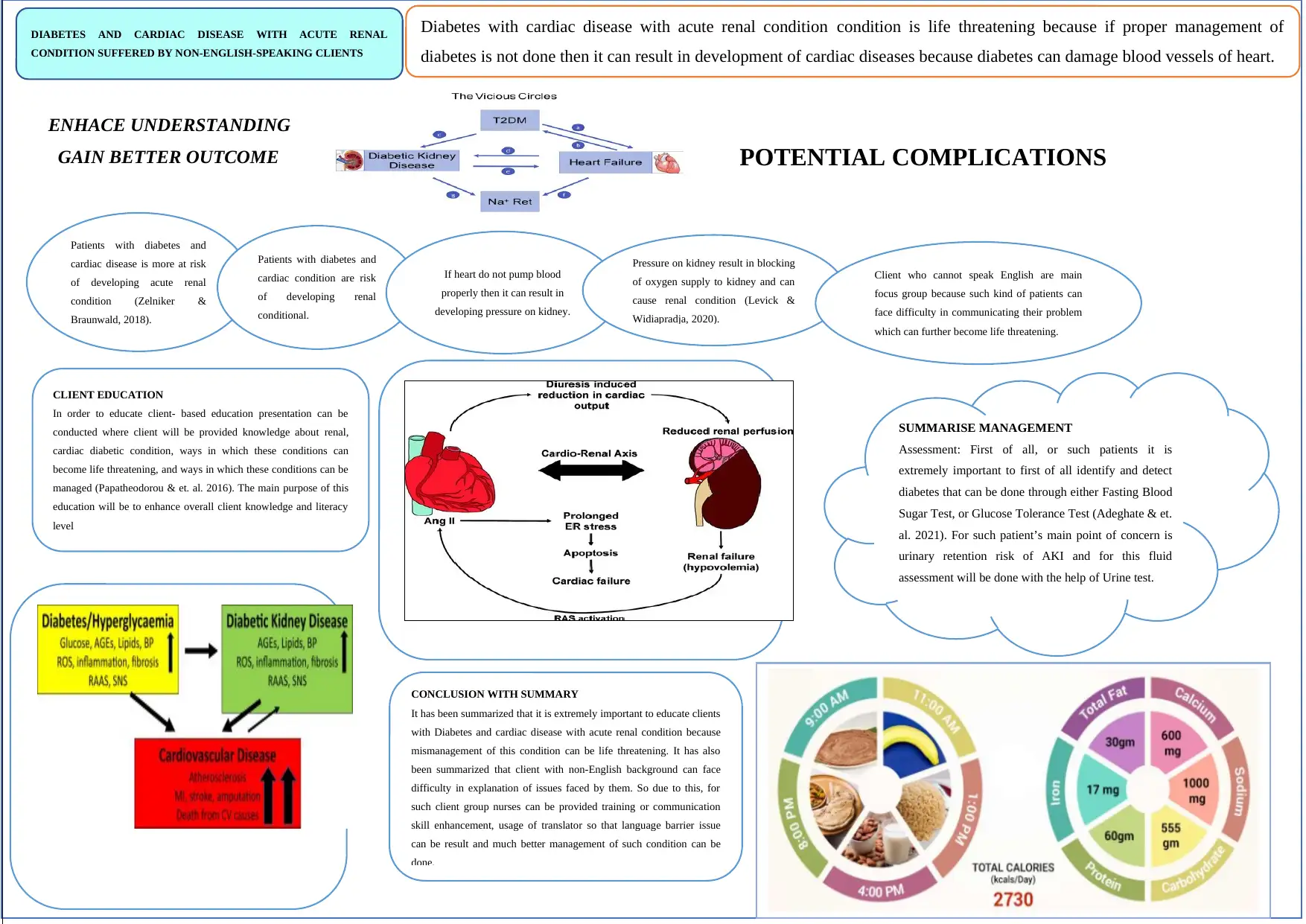
DIABETES AND CARDIAC DISEASE WITH ACUTE RENAL
CONDITION SUFFERED BY NON-ENGLISH-SPEAKING CLIENTS
Diabetes with cardiac disease with acute renal condition condition is life threatening because if proper management of
diabetes is not done then it can result in development of cardiac diseases because diabetes can damage blood vessels of heart.
Patients with diabetes and
cardiac disease is more at risk
of developing acute renal
condition (Zelniker &
Braunwald, 2018).
Patients with diabetes and
cardiac condition are risk
of developing renal
conditional.
If heart do not pump blood
properly then it can result in
developing pressure on kidney.
Pressure on kidney result in blocking
of oxygen supply to kidney and can
cause renal condition (Levick &
Widiapradja, 2020).
Client who cannot speak English are main
focus group because such kind of patients can
face difficulty in communicating their problem
which can further become life threatening.
ENHACE UNDERSTANDING
GAIN BETTER OUTCOME POTENTIAL COMPLICATIONS
CLIENT EDUCATION
In order to educate client- based education presentation can be
conducted where client will be provided knowledge about renal,
cardiac diabetic condition, ways in which these conditions can
become life threatening, and ways in which these conditions can be
managed (Papatheodorou & et. al. 2016). The main purpose of this
education will be to enhance overall client knowledge and literacy
level
CONCLUSION WITH SUMMARY
It has been summarized that it is extremely important to educate clients
with Diabetes and cardiac disease with acute renal condition because
mismanagement of this condition can be life threatening. It has also
been summarized that client with non-English background can face
difficulty in explanation of issues faced by them. So due to this, for
such client group nurses can be provided training or communication
skill enhancement, usage of translator so that language barrier issue
can be result and much better management of such condition can be
done.
SUMMARISE MANAGEMENT
Assessment: First of all, or such patients it is
extremely important to first of all identify and detect
diabetes that can be done through either Fasting Blood
Sugar Test, or Glucose Tolerance Test (Adeghate & et.
al. 2021). For such patient’s main point of concern is
urinary retention risk of AKI and for this fluid
assessment will be done with the help of Urine test.
Ethical and legal assessment: it is extremely important
Document Page
REFERENCES
Books and Journals
Alves, B. E., & et. al. (2019). Reduction of cardiac and renal dysfunction by new inhibitor of
DPP4 in diabetic rats. Pharmacological Reports, 71(6), 1190-1200.
Adeghate, E. A., & et. al. (2021). Tackling type 2 diabetes-associated cardiovascular and
renal comorbidities: a key challenge for drug development.
Alves, B. E., & et. al. (2019). Reduction of cardiac and renal dysfunction by new inhibitor of
DPP4 in diabetic rats. Pharmacological Reports, 71(6), 1190-1200.
Braunwald, E. (2019). Diabetes, heart failure, and renal dysfunction: the vicious
circles. Progress in Cardiovascular Diseases, 62(4), 298-302.
Fouli, G. E., & Gnudi, L. (2019). The future: experimental therapies for renal disease in
diabetes. Nephron, 143(1), 3-7.
Levick, S. P., & Widiapradja, A. (2020). The diabetic cardiac fibroblast: mechanisms
underlying phenotype and function. International journal of molecular
sciences, 21(3), 970.
Papatheodorou, K., & et. al. (2016). Complications of diabetes 2016.
Zelniker, T. A., & Braunwald, E. (2018). Cardiac and renal effects of sodium-glucose co-
transporter 2 inhibitors in diabetes: JACC state-of-the-art review. Journal of the
American College of Cardiology, 72(15), 1845-1855.
1
chevron_up_icon
1 out of 3
circle_padding
hide_on_mobile
zoom_out_icon
[object Object]