Health Management 2: Critical Review on Diabetes Mellitus Report

Verified

Added on  2022/09/25

|4
|885
|19
Report
AI Summary
This report provides a critical review of diabetes mellitus, a significant and contemporary public health issue. The report begins by defining diabetes mellitus as a metabolic disease characterized by high blood sugar levels, and it highlights the global impact of the disease, including its prevalence in Australia. It differentiates between type 1 and type 2 diabetes, outlining their causes, symptoms (such as increased hunger and thirst), and the major targets affected, which include individuals aged 45-64, but also increasingly younger populations. The report discusses various healthcare programs implemented by the Australian government to raise awareness and control the disease, including the use of insulin (rapid-acting and short-acting) for type 1 diabetes and diet and exercise for type 2 diabetes management. The report references several studies and research papers that support the findings, emphasizing the importance of early detection and comprehensive management strategies to address this pressing public health concern.

Document Page
Health Management 1
Introduction to Public Health
tabler-icon-diamond-filled.svg

Paraphrase This Document

Need a fresh take? Get an instant paraphrase of this document with our AI Paraphraser
Document Page
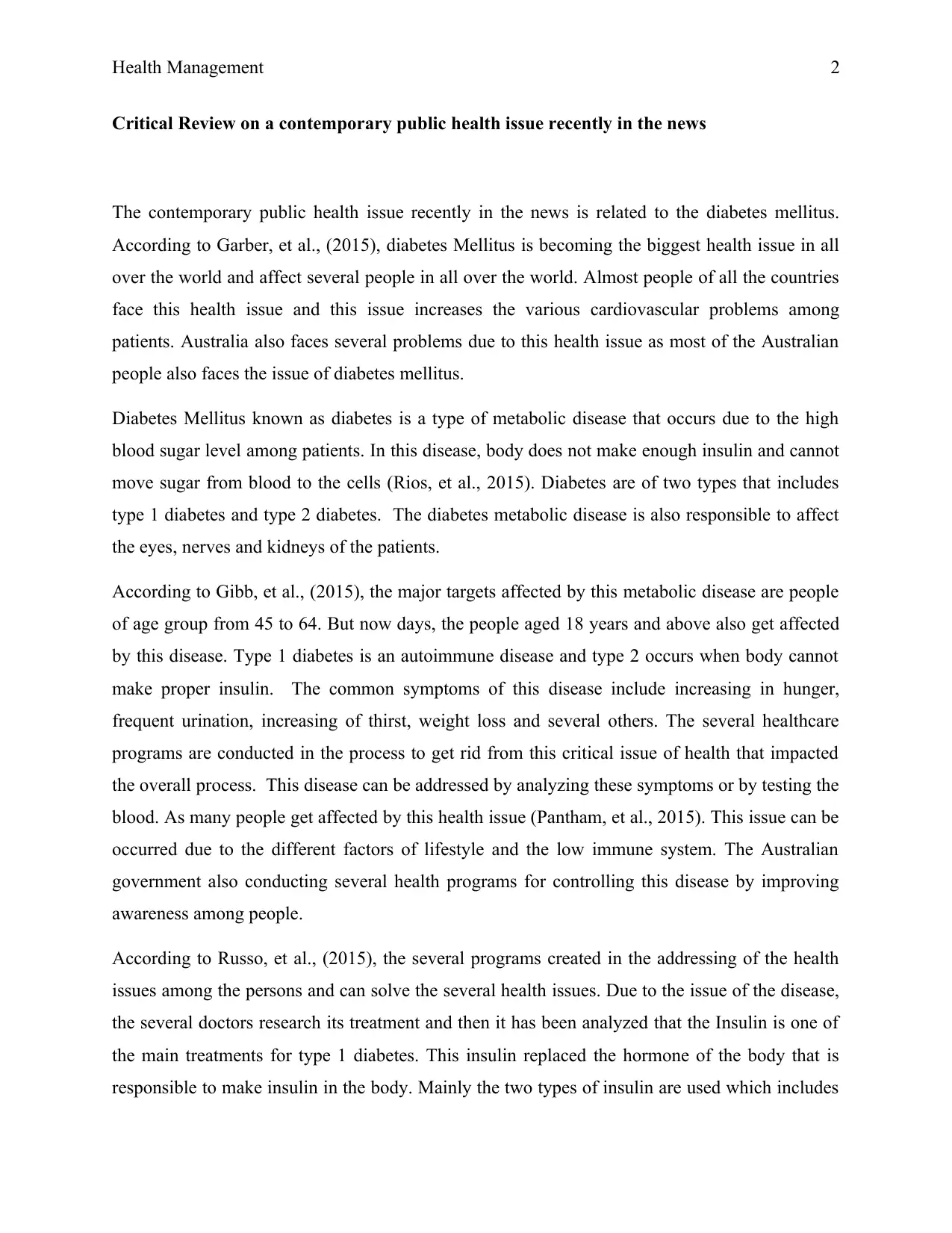
Health Management 2
Critical Review on a contemporary public health issue recently in the news
The contemporary public health issue recently in the news is related to the diabetes mellitus.
According to Garber, et al., (2015), diabetes Mellitus is becoming the biggest health issue in all
over the world and affect several people in all over the world. Almost people of all the countries
face this health issue and this issue increases the various cardiovascular problems among
patients. Australia also faces several problems due to this health issue as most of the Australian
people also faces the issue of diabetes mellitus.
Diabetes Mellitus known as diabetes is a type of metabolic disease that occurs due to the high
blood sugar level among patients. In this disease, body does not make enough insulin and cannot
move sugar from blood to the cells (Rios, et al., 2015). Diabetes are of two types that includes
type 1 diabetes and type 2 diabetes. The diabetes metabolic disease is also responsible to affect
the eyes, nerves and kidneys of the patients.
According to Gibb, et al., (2015), the major targets affected by this metabolic disease are people
of age group from 45 to 64. But now days, the people aged 18 years and above also get affected
by this disease. Type 1 diabetes is an autoimmune disease and type 2 occurs when body cannot
make proper insulin. The common symptoms of this disease include increasing in hunger,
frequent urination, increasing of thirst, weight loss and several others. The several healthcare
programs are conducted in the process to get rid from this critical issue of health that impacted
the overall process. This disease can be addressed by analyzing these symptoms or by testing the
blood. As many people get affected by this health issue (Pantham, et al., 2015). This issue can be
occurred due to the different factors of lifestyle and the low immune system. The Australian
government also conducting several health programs for controlling this disease by improving
awareness among people.
According to Russo, et al., (2015), the several programs created in the addressing of the health
issues among the persons and can solve the several health issues. Due to the issue of the disease,
the several doctors research its treatment and then it has been analyzed that the Insulin is one of
the main treatments for type 1 diabetes. This insulin replaced the hormone of the body that is
responsible to make insulin in the body. Mainly the two types of insulin are used which includes
Document Page
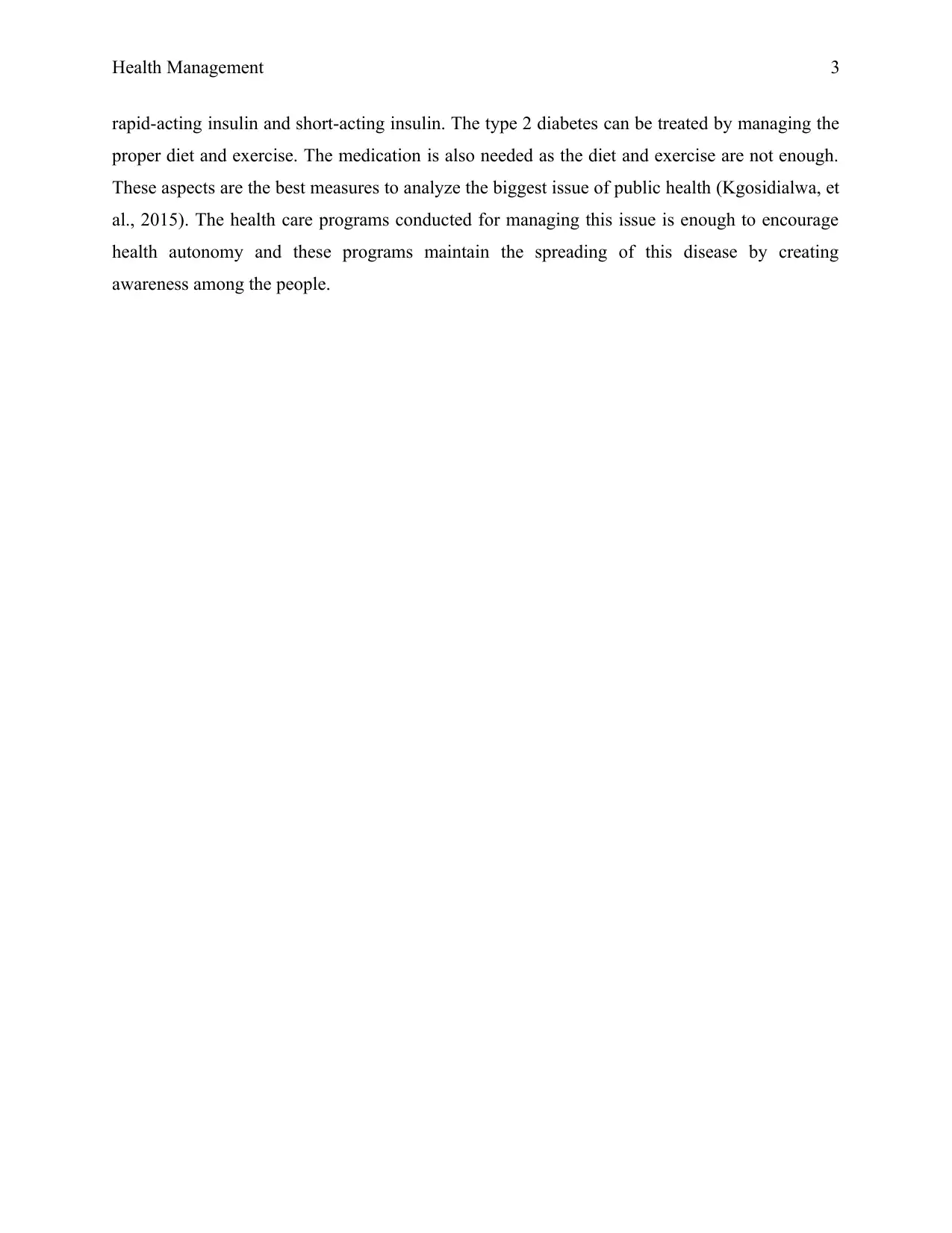
Health Management 3
rapid-acting insulin and short-acting insulin. The type 2 diabetes can be treated by managing the
proper diet and exercise. The medication is also needed as the diet and exercise are not enough.
These aspects are the best measures to analyze the biggest issue of public health (Kgosidialwa, et
al., 2015). The health care programs conducted for managing this issue is enough to encourage
health autonomy and these programs maintain the spreading of this disease by creating
awareness among the people.
Document Page
Health Management 4
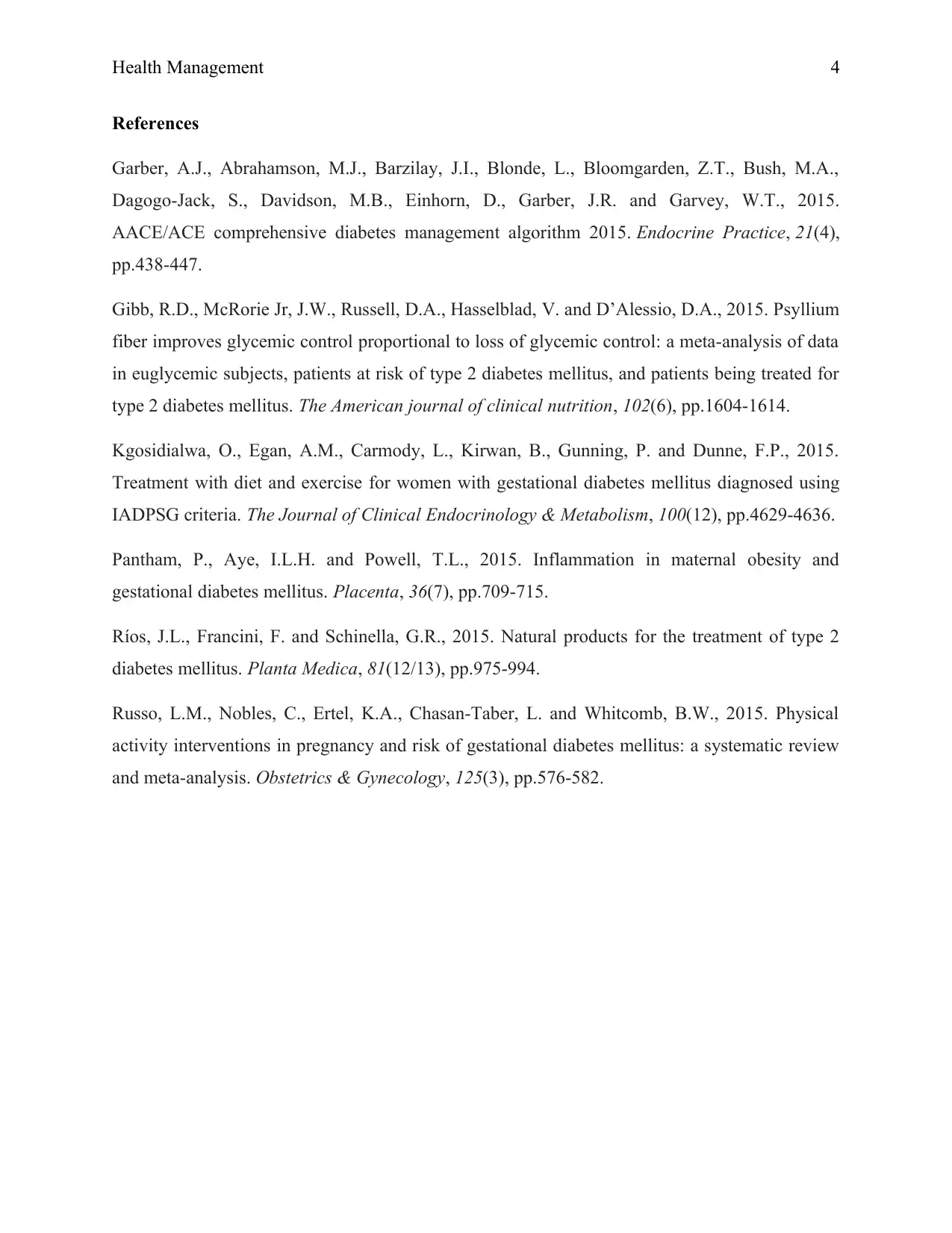
References
Garber, A.J., Abrahamson, M.J., Barzilay, J.I., Blonde, L., Bloomgarden, Z.T., Bush, M.A.,
Dagogo-Jack, S., Davidson, M.B., Einhorn, D., Garber, J.R. and Garvey, W.T., 2015.
AACE/ACE comprehensive diabetes management algorithm 2015. Endocrine Practice, 21(4),
pp.438-447.
Gibb, R.D., McRorie Jr, J.W., Russell, D.A., Hasselblad, V. and D’Alessio, D.A., 2015. Psyllium
fiber improves glycemic control proportional to loss of glycemic control: a meta-analysis of data
in euglycemic subjects, patients at risk of type 2 diabetes mellitus, and patients being treated for
type 2 diabetes mellitus. The American journal of clinical nutrition, 102(6), pp.1604-1614.
Kgosidialwa, O., Egan, A.M., Carmody, L., Kirwan, B., Gunning, P. and Dunne, F.P., 2015.
Treatment with diet and exercise for women with gestational diabetes mellitus diagnosed using
IADPSG criteria. The Journal of Clinical Endocrinology & Metabolism, 100(12), pp.4629-4636.
Pantham, P., Aye, I.L.H. and Powell, T.L., 2015. Inflammation in maternal obesity and
gestational diabetes mellitus. Placenta, 36(7), pp.709-715.
Ríos, J.L., Francini, F. and Schinella, G.R., 2015. Natural products for the treatment of type 2
diabetes mellitus. Planta Medica, 81(12/13), pp.975-994.
Russo, L.M., Nobles, C., Ertel, K.A., Chasan-Taber, L. and Whitcomb, B.W., 2015. Physical
activity interventions in pregnancy and risk of gestational diabetes mellitus: a systematic review
and meta-analysis. Obstetrics & Gynecology, 125(3), pp.576-582.
chevron_up_icon
1 out of 4
circle_padding
hide_on_mobile
zoom_out_icon
[object Object]