CNA613 Project Plan: Induction Training for Dialysis Nurses
VerifiedAdded on 2023/04/23
|27
|6157
|332
Project
AI Summary
This project plan outlines the development and implementation of an induction training program for novice dialysis nurses, focusing on basic needle cannulation to improve the lifespan of dialysis access. The plan addresses the critical need for proper cannulation techniques to minimize complications such as stenosis, infections, and thrombosis associated with arteriovenous fistula (AVF) hemodialysis. The project includes an executive summary, project overview with background, problem statement, goals, objectives, and deliverables. It further details scope, time management, communications, stakeholder management, organizational structure, human resources, budget, risk, and quality management plans. The project aims to refine the knowledge and skills of novice nurses through supervised training, ultimately improving patient outcomes by reducing pain and infection risks. The plan also includes a detailed risk register identifying potential challenges and mitigation strategies, as well as a quality plan to ensure project success. The total funding cost is estimated at $60,275 over one financial year. This project plan is designed to provide a framework for the successful implementation and management of the nurse training program.

Project Management Plan
Template & Guide
This guide is intended to be read in conjunction with the following template to assist with the
development of a Project Plan (PP) for Assessment 2 of Unit CNA613.
Remove the Guide from the front of your final document.
The project for this Assessment 2is hypothetical, i.e. it will not be executed. This has been developed
specifically for the submissionof the Project Planfor this assessment 2.
It is assumed that a hypothetical approval to develop thishypothetical Project Plan has come from
steering committee/senior management via the project sponsor after the acceptance of a preceding
Project Proposal.
Your Project Name Project Plan v 1.0 Page 1 of 27
Template & Guide
This guide is intended to be read in conjunction with the following template to assist with the
development of a Project Plan (PP) for Assessment 2 of Unit CNA613.
Remove the Guide from the front of your final document.
The project for this Assessment 2is hypothetical, i.e. it will not be executed. This has been developed
specifically for the submissionof the Project Planfor this assessment 2.
It is assumed that a hypothetical approval to develop thishypothetical Project Plan has come from
steering committee/senior management via the project sponsor after the acceptance of a preceding
Project Proposal.
Your Project Name Project Plan v 1.0 Page 1 of 27

Paraphrase This Document
Need a fresh take? Get an instant paraphrase of this document with our AI Paraphraser
What is a Project Plan?
A Project Plan is the management document for the project. It is owned, maintained and utilised by the Steering
Committee to ensure the delivery of project outputs/deliverables and for the realisation of project outcomes.
Why would you develop a Project Plan?
A Project Plan is developed to provide:
an overview of all the project components; how you intend to produce the outputs/deliverables
and abrief description of the roles and responsibilities of each of the stakeholders;
the project’s sponsor/steering committee/senior management with a documented framework
for the delivery of defined project objectives and the effective monitoring of the project from
start to finish; and
a formalised agreement between the Project Sponsor/Steering Committee/Senior Management
and the Project Manager of what needs to be delivered and when.
When would you develop a Project Plan?
Approval to develop a ProjectPlan for a small project may come from senior management or be obtained
from the acceptance or approval of a preceding stage such as a Project Proposal, or Project Business
Case.
What you need before you start:
Agreement to proceed with the development of the Project Plan from the Project Sponsor.
(Assume this has already been received.)
Knowledge and understanding of project planning, scope definition, stakeholder identification,
risk identification and the development of work breakdown structures.
Awareness of the organisation’s corporate strategies&/or goals.
What you will have when you are finished:
A complete Project Plan for a project that is ready for acceptance by the Project Sponsor or Project
Steering Committee.
How to use this template?
The template contains sections which may be developed at many levels of detail depending upon the
individual project.
What is the meaning of the different text styles
Several different text styles have been used within the template, as follows:
Text in italics and in green is intended to provide a guide as to the kind of information that can be
included in a section and to what types of projects it may be applicable. Please ensure all italics and
examples are removed beforesubmitting your completed Project plan for Assessment 2.Text in normal
font is intended as examples.
Your Project Name Project Plan v 1.0 Page 2 of 27
A Project Plan is the management document for the project. It is owned, maintained and utilised by the Steering
Committee to ensure the delivery of project outputs/deliverables and for the realisation of project outcomes.
Why would you develop a Project Plan?
A Project Plan is developed to provide:
an overview of all the project components; how you intend to produce the outputs/deliverables
and abrief description of the roles and responsibilities of each of the stakeholders;
the project’s sponsor/steering committee/senior management with a documented framework
for the delivery of defined project objectives and the effective monitoring of the project from
start to finish; and
a formalised agreement between the Project Sponsor/Steering Committee/Senior Management
and the Project Manager of what needs to be delivered and when.
When would you develop a Project Plan?
Approval to develop a ProjectPlan for a small project may come from senior management or be obtained
from the acceptance or approval of a preceding stage such as a Project Proposal, or Project Business
Case.
What you need before you start:
Agreement to proceed with the development of the Project Plan from the Project Sponsor.
(Assume this has already been received.)
Knowledge and understanding of project planning, scope definition, stakeholder identification,
risk identification and the development of work breakdown structures.
Awareness of the organisation’s corporate strategies&/or goals.
What you will have when you are finished:
A complete Project Plan for a project that is ready for acceptance by the Project Sponsor or Project
Steering Committee.
How to use this template?
The template contains sections which may be developed at many levels of detail depending upon the
individual project.
What is the meaning of the different text styles
Several different text styles have been used within the template, as follows:
Text in italics and in green is intended to provide a guide as to the kind of information that can be
included in a section and to what types of projects it may be applicable. Please ensure all italics and
examples are removed beforesubmitting your completed Project plan for Assessment 2.Text in normal
font is intended as examples.
Your Project Name Project Plan v 1.0 Page 2 of 27

Text in Blue italics is the Assessment task content required. Remove all Blue italics prior to submitting
your assessment.
Table of Contents
NB: The Table of Contents (TOC) uses the MS Word headings Styles H1 & H2 to identify the headings to
be used within the TOC.
Each section is separated with a section break. This allows the use of smart headers and changing from
portrait to Landscape page layouts. Use the show/hide switch “¶” (or Ctrl+* (Microsoft users)) to toggle
the formatting information on/off. It is strongly recommended to maintain the template’s headings as
they are.
Word Count:
Provide a word count for each section where a word count is stipulated. This should be with [Square
brackets] located at the end of each section i.e. [Word count = NNN].
This will not be included in the word count.
Word counts won’t include Headings and subheadings, Tables, andAppendices.
Your Project Name
Project Plan
Your Organisation
(including Department if applicable)
Version as at 30 August 2024
Your Project Name Project Plan v 1.0 Page 3 of 27
your assessment.
Table of Contents
NB: The Table of Contents (TOC) uses the MS Word headings Styles H1 & H2 to identify the headings to
be used within the TOC.
Each section is separated with a section break. This allows the use of smart headers and changing from
portrait to Landscape page layouts. Use the show/hide switch “¶” (or Ctrl+* (Microsoft users)) to toggle
the formatting information on/off. It is strongly recommended to maintain the template’s headings as
they are.
Word Count:
Provide a word count for each section where a word count is stipulated. This should be with [Square
brackets] located at the end of each section i.e. [Word count = NNN].
This will not be included in the word count.
Word counts won’t include Headings and subheadings, Tables, andAppendices.
Your Project Name
Project Plan
Your Organisation
(including Department if applicable)
Version as at 30 August 2024
Your Project Name Project Plan v 1.0 Page 3 of 27
⊘ This is a preview!⊘
Do you want full access?
Subscribe today to unlock all pages.

Trusted by 1+ million students worldwide
Version Date By whom
v 1.0
Complete the table above
Acknowledgements
The contribution of the following individuals in preparing this document is gratefully
acknowledged:
List all contributors/reviewers/developers who may have assisted you in the development of this
project plan. NB: Don’t acknowledge yourself.
Your Project Name Project Plan v 1.0 Page 4 of 27
v 1.0
Complete the table above
Acknowledgements
The contribution of the following individuals in preparing this document is gratefully
acknowledged:
List all contributors/reviewers/developers who may have assisted you in the development of this
project plan. NB: Don’t acknowledge yourself.
Your Project Name Project Plan v 1.0 Page 4 of 27
Paraphrase This Document
Need a fresh take? Get an instant paraphrase of this document with our AI Paraphraser

DOCUMENT ACCEPTANCE and RELEASE NOTICE
This is release is versionv 1.0 of the Your Project Name Project Management Plan.
The ProjectPlan is a managed document. For identification of amendments, each page contains
a release number and a page number. Changes will only be issued as a complete replacement
document. Recipients should remove superseded versions from circulation. This document is
authorised for release once all signatures have been obtained.
Complete the version control below
PREPARED: DATE:___/___/___
(for acceptance) (Your Name, Your Project Name Project Manager)
ACCEPTED: DATE:___/___/___
(for release) (Project Sponsor,name, title)
Your Project Name Project Plan v 1.0 Page 5 of 27
This is release is versionv 1.0 of the Your Project Name Project Management Plan.
The ProjectPlan is a managed document. For identification of amendments, each page contains
a release number and a page number. Changes will only be issued as a complete replacement
document. Recipients should remove superseded versions from circulation. This document is
authorised for release once all signatures have been obtained.
Complete the version control below
PREPARED: DATE:___/___/___
(for acceptance) (Your Name, Your Project Name Project Manager)
ACCEPTED: DATE:___/___/___
(for release) (Project Sponsor,name, title)
Your Project Name Project Plan v 1.0 Page 5 of 27
Executive Summary
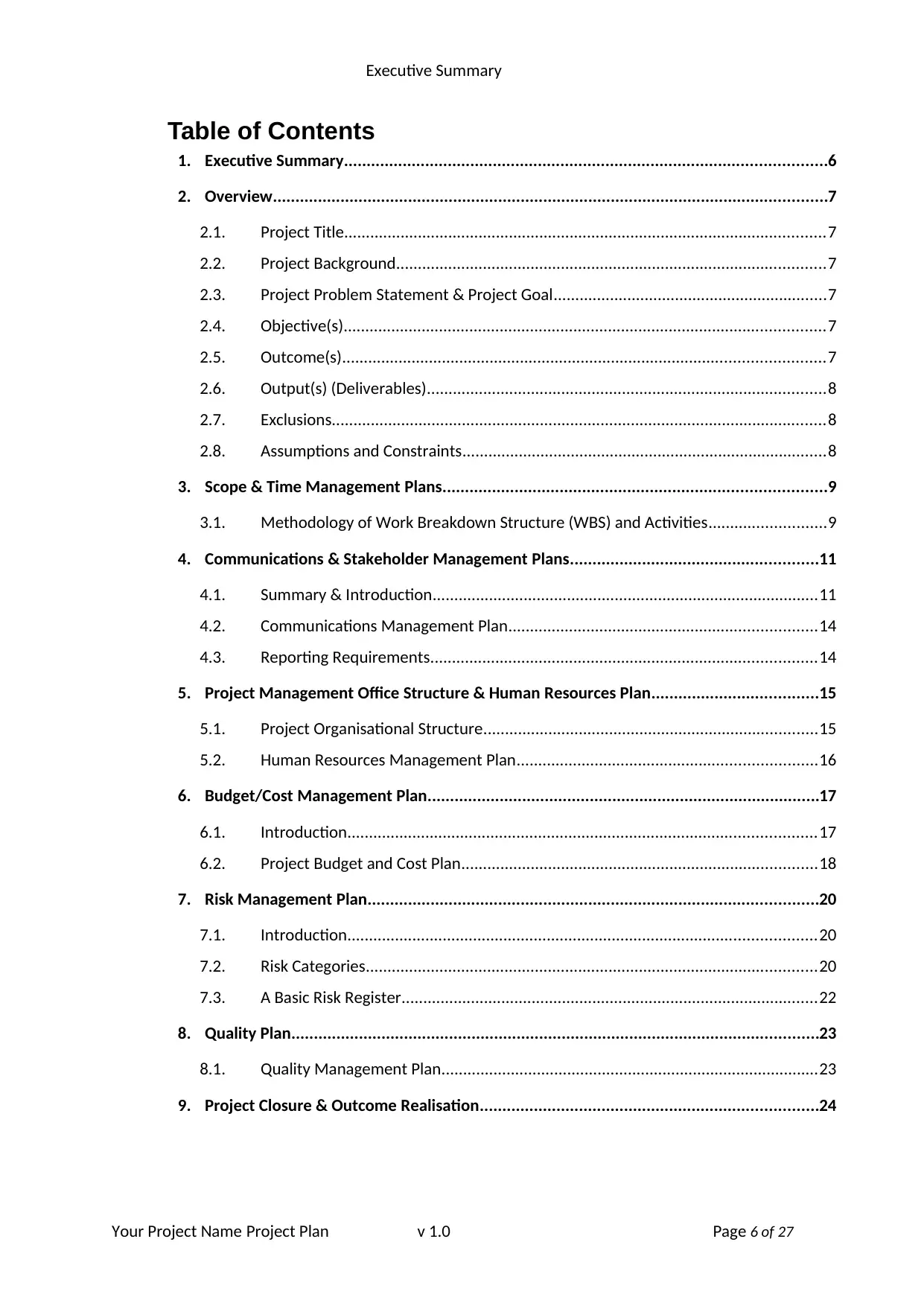
Table of Contents
1. Executive Summary...........................................................................................................6
2. Overview...........................................................................................................................7
2.1. Project Title...............................................................................................................7
2.2. Project Background...................................................................................................7
2.3. Project Problem Statement & Project Goal...............................................................7
2.4. Objective(s)...............................................................................................................7
2.5. Outcome(s)...............................................................................................................7
2.6. Output(s) (Deliverables)............................................................................................8
2.7. Exclusions..................................................................................................................8
2.8. Assumptions and Constraints....................................................................................8
3. Scope & Time Management Plans.....................................................................................9
3.1. Methodology of Work Breakdown Structure (WBS) and Activities...........................9
4. Communications & Stakeholder Management Plans.......................................................11
4.1. Summary & Introduction.........................................................................................11
4.2. Communications Management Plan.......................................................................14
4.3. Reporting Requirements.........................................................................................14
5. Project Management Office Structure & Human Resources Plan.....................................15
5.1. Project Organisational Structure.............................................................................15
5.2. Human Resources Management Plan.....................................................................16
6. Budget/Cost Management Plan.......................................................................................17
6.1. Introduction............................................................................................................17
6.2. Project Budget and Cost Plan..................................................................................18
7. Risk Management Plan....................................................................................................20
7.1. Introduction............................................................................................................20
7.2. Risk Categories........................................................................................................20
7.3. A Basic Risk Register................................................................................................22
8. Quality Plan.....................................................................................................................23
8.1. Quality Management Plan.......................................................................................23
9. Project Closure & Outcome Realisation...........................................................................24
Your Project Name Project Plan v 1.0 Page 6 of 27
Table of Contents
1. Executive Summary...........................................................................................................6
2. Overview...........................................................................................................................7
2.1. Project Title...............................................................................................................7
2.2. Project Background...................................................................................................7
2.3. Project Problem Statement & Project Goal...............................................................7
2.4. Objective(s)...............................................................................................................7
2.5. Outcome(s)...............................................................................................................7
2.6. Output(s) (Deliverables)............................................................................................8
2.7. Exclusions..................................................................................................................8
2.8. Assumptions and Constraints....................................................................................8
3. Scope & Time Management Plans.....................................................................................9
3.1. Methodology of Work Breakdown Structure (WBS) and Activities...........................9
4. Communications & Stakeholder Management Plans.......................................................11
4.1. Summary & Introduction.........................................................................................11
4.2. Communications Management Plan.......................................................................14
4.3. Reporting Requirements.........................................................................................14
5. Project Management Office Structure & Human Resources Plan.....................................15
5.1. Project Organisational Structure.............................................................................15
5.2. Human Resources Management Plan.....................................................................16
6. Budget/Cost Management Plan.......................................................................................17
6.1. Introduction............................................................................................................17
6.2. Project Budget and Cost Plan..................................................................................18
7. Risk Management Plan....................................................................................................20
7.1. Introduction............................................................................................................20
7.2. Risk Categories........................................................................................................20
7.3. A Basic Risk Register................................................................................................22
8. Quality Plan.....................................................................................................................23
8.1. Quality Management Plan.......................................................................................23
9. Project Closure & Outcome Realisation...........................................................................24
Your Project Name Project Plan v 1.0 Page 6 of 27
⊘ This is a preview!⊘
Do you want full access?
Subscribe today to unlock all pages.
Trusted by 1+ million students worldwide

Executive Summary
1. Executive Summary
Project statement: Increase in the threat of the patients in the domain of bacterial
contamination and pain due to improper cannulation of the needle during kidney
dialysis by untrained nurses.
Project goal: Improving the patient outcome by giving nursing professionals training
Project will deliver the novice nurses training and the success criteria is high as
training will be conducted under the controlled supervision of the registered yet
trained nurses
The total funding cost will be: $ 60,275 and the duration of the funding term will be
2019 to 2020, one financial year
The steering committee or the corporate body which the project sponsor will be
reporting will be the hospital board
The project sponsor is the main trustee of the hospital administrative board
The significant identified risk of the project implementation include increased in the
risk of the patients’ health during hands-on training of the novice nurses, decrease in
the footfall of the experienced nurses and the junior doctors in the duty wards as
they are engaged in the training process, increase in the overall budget and high
level of stress among the trainee nurses. The risks will be mitigated by effective
monitoring and planning of the risk mitigation risks
The significant project management activities that will be undertaken include proper
evaluation of the success of the project by successful monitoring of the project
progress on a weekly basis. Other project management activities include effective
communication among all the stakeholder of the projects like face-to-face
communication, arranging seminars, conference and channelizing mails in order to
keep them updated about the progress of the project
Your Project Name Project Plan v 1.0 Page 7 of 27
1. Executive Summary
Project statement: Increase in the threat of the patients in the domain of bacterial
contamination and pain due to improper cannulation of the needle during kidney
dialysis by untrained nurses.
Project goal: Improving the patient outcome by giving nursing professionals training
Project will deliver the novice nurses training and the success criteria is high as
training will be conducted under the controlled supervision of the registered yet
trained nurses
The total funding cost will be: $ 60,275 and the duration of the funding term will be
2019 to 2020, one financial year
The steering committee or the corporate body which the project sponsor will be
reporting will be the hospital board
The project sponsor is the main trustee of the hospital administrative board
The significant identified risk of the project implementation include increased in the
risk of the patients’ health during hands-on training of the novice nurses, decrease in
the footfall of the experienced nurses and the junior doctors in the duty wards as
they are engaged in the training process, increase in the overall budget and high
level of stress among the trainee nurses. The risks will be mitigated by effective
monitoring and planning of the risk mitigation risks
The significant project management activities that will be undertaken include proper
evaluation of the success of the project by successful monitoring of the project
progress on a weekly basis. Other project management activities include effective
communication among all the stakeholder of the projects like face-to-face
communication, arranging seminars, conference and channelizing mails in order to
keep them updated about the progress of the project
Your Project Name Project Plan v 1.0 Page 7 of 27
Paraphrase This Document
Need a fresh take? Get an instant paraphrase of this document with our AI Paraphraser
Executive Summary
2. Overview
2.1. Project Title
Basic (dialysis) needle cannulation training session in the induction package for novice
dialysis nurses to improve the lifespan of dialysis access
2.2. Project Background
Vascular access (VA) is the lifeline and Achilles’s heel of gemodialysis therapy,
enabling the process of blood purification possible while simultaneously often constituting a
rate limiting factor in the process of treatment adequacy. The ultimate indicator of quality is
the effect of the overall access on the mortality of the patient and rate of morbidity. In the
domain of patient survival, there lies a preponderance of evidence for the overall superiority
of the arteriovenous fistulas or arteriovenous grafts. Arterio-venous fistula (AVF) is widely
used to undergoing dialysis among the End Stage Renal Disease (ESRD) patients (Parisotto et
al., 2014). Vale, Lopez-Vargas and Polkinghorne (2012) are of the opinion that the fistula
must be in good working condition and sterile in order to obtain optimal clearance through
kidney dialysis. AVF/graft is mainly accommodate two needs and requires basic cannulation
3 times per week. Complications associated with the VA mainly constitute the most common
cause behind the hospitalization of the patients and risk of which is directly proportional to
the type of the VA. Thus in addition to selecting the best access type, prevention of access
complication falls under the highest priority in the dialysis and numerous official
recommendations aimed towards maintaining access patency for long-term use. The
guidelines devised mainly focus on various aspects of VA management in the domain of
choice of type of VA, timing of the surgery, methods use for monitoring of the access
function and observance of the aseptic techniques. The overall recommendation procedure
for the for cannulation are less and mainly focus on the size of the needle, angel of insertion
of the needle, the angle at which at needle is required to planted and calculative rotation of
the needle after insertion (Parisotto et al., 2014).
There is limited evidence in the domain of the effective methods and the guidelines
for the AVF cannulation. Moreover, the guidelines seem to vary from clinic to clinic because
of historical training approaches under the individualised settings. Repeated cannulation and
improper needle infiltration AVF put patients at the risk for developing bacterial
contamination. Proper cannulation technique and assessment of the graft or fistula and
optimal implementation of the infection control practices are important in order to increase
Your Project Name Project Plan v 1.0 Page 8 of 27
2. Overview
2.1. Project Title
Basic (dialysis) needle cannulation training session in the induction package for novice
dialysis nurses to improve the lifespan of dialysis access
2.2. Project Background
Vascular access (VA) is the lifeline and Achilles’s heel of gemodialysis therapy,
enabling the process of blood purification possible while simultaneously often constituting a
rate limiting factor in the process of treatment adequacy. The ultimate indicator of quality is
the effect of the overall access on the mortality of the patient and rate of morbidity. In the
domain of patient survival, there lies a preponderance of evidence for the overall superiority
of the arteriovenous fistulas or arteriovenous grafts. Arterio-venous fistula (AVF) is widely
used to undergoing dialysis among the End Stage Renal Disease (ESRD) patients (Parisotto et
al., 2014). Vale, Lopez-Vargas and Polkinghorne (2012) are of the opinion that the fistula
must be in good working condition and sterile in order to obtain optimal clearance through
kidney dialysis. AVF/graft is mainly accommodate two needs and requires basic cannulation
3 times per week. Complications associated with the VA mainly constitute the most common
cause behind the hospitalization of the patients and risk of which is directly proportional to
the type of the VA. Thus in addition to selecting the best access type, prevention of access
complication falls under the highest priority in the dialysis and numerous official
recommendations aimed towards maintaining access patency for long-term use. The
guidelines devised mainly focus on various aspects of VA management in the domain of
choice of type of VA, timing of the surgery, methods use for monitoring of the access
function and observance of the aseptic techniques. The overall recommendation procedure
for the for cannulation are less and mainly focus on the size of the needle, angel of insertion
of the needle, the angle at which at needle is required to planted and calculative rotation of
the needle after insertion (Parisotto et al., 2014).
There is limited evidence in the domain of the effective methods and the guidelines
for the AVF cannulation. Moreover, the guidelines seem to vary from clinic to clinic because
of historical training approaches under the individualised settings. Repeated cannulation and
improper needle infiltration AVF put patients at the risk for developing bacterial
contamination. Proper cannulation technique and assessment of the graft or fistula and
optimal implementation of the infection control practices are important in order to increase
Your Project Name Project Plan v 1.0 Page 8 of 27

Executive Summary
the overall efficiency of the vascular access (Vale, Lopez-Vargas & Polkinghorne, 2012).
Moreover, the in the dialysis field, rotation of the needle have a significant influence over
the degree of endothelia trauma and the over size of the puncture of the orifice. The
improper puncture at the orifice also increases the chance of getting infected with the
bacterial pathogens while increasing the overall clotting time and bleeding time. The
direction and the percentage of the orientation of the bowel also influence the level of pain.
In this project the training process will be devised by the trained registered nurses in the
dialysis unit of hospital X in Sydney Australia in English and the main funding agency will be
the hospital administration under which the novice nurses are registered (Parisotto et al.,
2014).
2.3. Project Problem Statement & Project Goal
Thus numerous aspects of the AVF cannulation techniques and the guidelines are
not comprehensively addressed and this hampers the overall training process of the nursing
professionals in the process of AVF cannulation. Stenosis, infections and thrombosis are the
three major complications associated with AVF haemodialysis. About 50% of the mortality
and morbidity rate is reduced upon proper cannulation procedure under sterile conditions.
This concern justifies the importance of the proper nursing training and importance of skill
development through training as per the professional standards in AVF cannulation.
The project goal is to enforce the nursing professionals and the healthcare
professionals, working in the dialysis unit with the skills and knowledge of the AVF
cannulation. The knowledge is intended to train dialysis nurses and to enable them with
increased level of skills and confidence in the cannulation process. Increase in the provision
of training of the nursing and the healthcare professionals in AVF cannulation will help to
improve the overall process of care in the dialysis unit by decreases the level of pain and the
chances of the bacterial infection.
2.4. Objective(s)
To refine the knowledge of the novice nurses and medical care professionals in the
domain of AVF cannulation procedures and protocols during one month of training
at their induction under the supervision of experienced registered nurses.
To reduce needle induced vessel injuries and related complications such as
thrombosis and aneurysm in AVF cannulation imposed kidney dialysis after one
month of training among novice nurses in dialysis unit.
Your Project Name Project Plan v 1.0 Page 9 of 27
the overall efficiency of the vascular access (Vale, Lopez-Vargas & Polkinghorne, 2012).
Moreover, the in the dialysis field, rotation of the needle have a significant influence over
the degree of endothelia trauma and the over size of the puncture of the orifice. The
improper puncture at the orifice also increases the chance of getting infected with the
bacterial pathogens while increasing the overall clotting time and bleeding time. The
direction and the percentage of the orientation of the bowel also influence the level of pain.
In this project the training process will be devised by the trained registered nurses in the
dialysis unit of hospital X in Sydney Australia in English and the main funding agency will be
the hospital administration under which the novice nurses are registered (Parisotto et al.,
2014).
2.3. Project Problem Statement & Project Goal
Thus numerous aspects of the AVF cannulation techniques and the guidelines are
not comprehensively addressed and this hampers the overall training process of the nursing
professionals in the process of AVF cannulation. Stenosis, infections and thrombosis are the
three major complications associated with AVF haemodialysis. About 50% of the mortality
and morbidity rate is reduced upon proper cannulation procedure under sterile conditions.
This concern justifies the importance of the proper nursing training and importance of skill
development through training as per the professional standards in AVF cannulation.
The project goal is to enforce the nursing professionals and the healthcare
professionals, working in the dialysis unit with the skills and knowledge of the AVF
cannulation. The knowledge is intended to train dialysis nurses and to enable them with
increased level of skills and confidence in the cannulation process. Increase in the provision
of training of the nursing and the healthcare professionals in AVF cannulation will help to
improve the overall process of care in the dialysis unit by decreases the level of pain and the
chances of the bacterial infection.
2.4. Objective(s)
To refine the knowledge of the novice nurses and medical care professionals in the
domain of AVF cannulation procedures and protocols during one month of training
at their induction under the supervision of experienced registered nurses.
To reduce needle induced vessel injuries and related complications such as
thrombosis and aneurysm in AVF cannulation imposed kidney dialysis after one
month of training among novice nurses in dialysis unit.
Your Project Name Project Plan v 1.0 Page 9 of 27
⊘ This is a preview!⊘
Do you want full access?
Subscribe today to unlock all pages.
Trusted by 1+ million students worldwide

Executive Summary
To eliminate and minimize AVF related infections through the use of proper
cannulation procedure, reduce chances of frequent cannulation, and by ensuring
safety precaution and asceptic techniques are always observed.
2.5. Outcome(s)
Improvement in the nursing practice in the dialysis unit and increase in the overall
career development of the newly recruited nursing professionals as highlighted by
increased in their level of performance and skill development
Reduced level of pain of the dialysis patients as measured by the pain score and
decrease in psychological complications of the patients as highlighted by the mental
health professionals
Decreased rate of hospital admission or increased in the stay at the hospital due to
hospital acquired infection during the process of care. It will be measured through
improved overall health outcome of the patients
2.6. Output(s)(Deliverables)
New or different things will we need to realise beneficial change: Increase in the patient’s
overall health outcome
Product: (i) Over-head projector for training of novice nurses
(ii) adequate sterile needles for conduction of training
Services: (i) Hands on training of the novice nurses in cannulation procedure under the
active supervision of the experienced trained nurse
(ii)Proper monitoring of the novice nurses when they join the duty and proper monitoring of
the spread of infection among the dialysis patients and their mental health
Management practices: One month of training of the novice nurses before they can handle
the patients directly for AVF cannulation in the dialysis ward.
Outputs/deliverables: An education package: For improving the hands on skills and
knowledge of the novice nurses in the domain of AVF needle cannulation in the dialysis ward
2.7. Exclusions
The opinion of the family of care givers about the dialysis outcome is excluded from the
project planning
Your Project Name Project Plan v 1.0 Page 10 of 27
To eliminate and minimize AVF related infections through the use of proper
cannulation procedure, reduce chances of frequent cannulation, and by ensuring
safety precaution and asceptic techniques are always observed.
2.5. Outcome(s)
Improvement in the nursing practice in the dialysis unit and increase in the overall
career development of the newly recruited nursing professionals as highlighted by
increased in their level of performance and skill development
Reduced level of pain of the dialysis patients as measured by the pain score and
decrease in psychological complications of the patients as highlighted by the mental
health professionals
Decreased rate of hospital admission or increased in the stay at the hospital due to
hospital acquired infection during the process of care. It will be measured through
improved overall health outcome of the patients
2.6. Output(s)(Deliverables)
New or different things will we need to realise beneficial change: Increase in the patient’s
overall health outcome
Product: (i) Over-head projector for training of novice nurses
(ii) adequate sterile needles for conduction of training
Services: (i) Hands on training of the novice nurses in cannulation procedure under the
active supervision of the experienced trained nurse
(ii)Proper monitoring of the novice nurses when they join the duty and proper monitoring of
the spread of infection among the dialysis patients and their mental health
Management practices: One month of training of the novice nurses before they can handle
the patients directly for AVF cannulation in the dialysis ward.
Outputs/deliverables: An education package: For improving the hands on skills and
knowledge of the novice nurses in the domain of AVF needle cannulation in the dialysis ward
2.7. Exclusions
The opinion of the family of care givers about the dialysis outcome is excluded from the
project planning
Your Project Name Project Plan v 1.0 Page 10 of 27
Paraphrase This Document
Need a fresh take? Get an instant paraphrase of this document with our AI Paraphraser

Executive Summary
2.8. Assumptions and Constraints
2.8.1. Assumptions
The main assumptions include the resources which will be used for the training process
might increase the overall budget of the plan. However, the increase in the patient health
outcome after the successful completion of the project might pay-off in the long run.
The deadline for the training will 1 month minimum. If some of the nurses are found to be
weak in their skills even after the cessation of the training session, he or she will be again
enrolled for a 15-day training
2.8.2. Constraints
The main constraint is the training of the nurses while on job will increase the CTC (cost-to-
company) of the hospital. This will further increase the overall budget. The schedule for one
month of training is not sufficient for the comprehensive improvement of skills of all the
nurses. The scope of success of the project depends on how the nurses diligently take part in
the training session
3. Scope & Time Management Plans
3.1. Methodology of Work Breakdown Structure (WBS) and Activities
WBS has been developed based on the Plan, Impending Outcomes and Actions required to
be taken in order to achieve those outcomes. The scope of the project is to increase the
knowledge and skills of the nurses in needle cannulation in order to improve the health
outcomes of the patients. The time limit of the project is training session for one month
among the novice nurses in the dialysis ward. The management plans include detailed
training under the control supervision of the experienced nursing professionals.
Time line
1st week: arrangement of the resources and the guideline planning
2nd week and 3rd week: Educating the novice nurses through power-point presentation: 10
nurses in each session
4th and 5th week: hands on training under control supervision of registered yet experienced
nurses
6th week to 8th week: monitoring the performance of nurses who have attended training and
monitoring of patient’s outcome
1st Milestone: Successful completion of the interactive training session: 2nd week and 3rd week
Your Project Name Project Plan v 1.0 Page 11 of 27
2.8. Assumptions and Constraints
2.8.1. Assumptions
The main assumptions include the resources which will be used for the training process
might increase the overall budget of the plan. However, the increase in the patient health
outcome after the successful completion of the project might pay-off in the long run.
The deadline for the training will 1 month minimum. If some of the nurses are found to be
weak in their skills even after the cessation of the training session, he or she will be again
enrolled for a 15-day training
2.8.2. Constraints
The main constraint is the training of the nurses while on job will increase the CTC (cost-to-
company) of the hospital. This will further increase the overall budget. The schedule for one
month of training is not sufficient for the comprehensive improvement of skills of all the
nurses. The scope of success of the project depends on how the nurses diligently take part in
the training session
3. Scope & Time Management Plans
3.1. Methodology of Work Breakdown Structure (WBS) and Activities
WBS has been developed based on the Plan, Impending Outcomes and Actions required to
be taken in order to achieve those outcomes. The scope of the project is to increase the
knowledge and skills of the nurses in needle cannulation in order to improve the health
outcomes of the patients. The time limit of the project is training session for one month
among the novice nurses in the dialysis ward. The management plans include detailed
training under the control supervision of the experienced nursing professionals.
Time line
1st week: arrangement of the resources and the guideline planning
2nd week and 3rd week: Educating the novice nurses through power-point presentation: 10
nurses in each session
4th and 5th week: hands on training under control supervision of registered yet experienced
nurses
6th week to 8th week: monitoring the performance of nurses who have attended training and
monitoring of patient’s outcome
1st Milestone: Successful completion of the interactive training session: 2nd week and 3rd week
Your Project Name Project Plan v 1.0 Page 11 of 27

Executive Summary
2nd Milestone: Successful completion of the hands-on training: 4th and 5th week
3rd Milestone: Improvement performance in the dialysis unit: 6th week to 8th week
3.1.1. High-Level Project Work Breakdown Structure (WBS) Schedule
WBS# Description Duration
(weeks)
Start Date Finish Date
1.0 Successful completion of the
interactive training session
01 2/02/2019 16/02/201
9
2.0 Successful completion of the
hands-on training
01 17/02/2019 04/03/201
9
3.0 Improvement performance in the
dialysis unit
01 10/03/2019 24/03/201
9
4.0 Commissioning & Evaluation
completed
9th week 25/09/2019 31/03/201
9
5.0 Handover 1/04/2014 1/04/2014
6.0 Project Finish 5/04/2019
3.1.2. High-Level Milestones Schedule
WBS# Milestones and Project Planning Due Date
1.0 Starting the project planning based on budget and the
requirement
01/02/2019
2.0 Successful completion of the interactive training session 16/02/2019
3.0 Successful completion of the hands-on training 04/03/2019
4.0 Improvement performance in the dialysis unit 24/03/2019
5.0 Commissioning & Evaluation completed 31/03/2019
6.0 Handover 1/04/2014
7.0 Project Finish 5/04/2019
Your Project Name Project Plan v 1.0 Page 12 of 27
2nd Milestone: Successful completion of the hands-on training: 4th and 5th week
3rd Milestone: Improvement performance in the dialysis unit: 6th week to 8th week
3.1.1. High-Level Project Work Breakdown Structure (WBS) Schedule
WBS# Description Duration
(weeks)
Start Date Finish Date
1.0 Successful completion of the
interactive training session
01 2/02/2019 16/02/201
9
2.0 Successful completion of the
hands-on training
01 17/02/2019 04/03/201
9
3.0 Improvement performance in the
dialysis unit
01 10/03/2019 24/03/201
9
4.0 Commissioning & Evaluation
completed
9th week 25/09/2019 31/03/201
9
5.0 Handover 1/04/2014 1/04/2014
6.0 Project Finish 5/04/2019
3.1.2. High-Level Milestones Schedule
WBS# Milestones and Project Planning Due Date
1.0 Starting the project planning based on budget and the
requirement
01/02/2019
2.0 Successful completion of the interactive training session 16/02/2019
3.0 Successful completion of the hands-on training 04/03/2019
4.0 Improvement performance in the dialysis unit 24/03/2019
5.0 Commissioning & Evaluation completed 31/03/2019
6.0 Handover 1/04/2014
7.0 Project Finish 5/04/2019
Your Project Name Project Plan v 1.0 Page 12 of 27
⊘ This is a preview!⊘
Do you want full access?
Subscribe today to unlock all pages.
Trusted by 1+ million students worldwide

1 out of 27


Related Documents


Your All-in-One AI-Powered Toolkit for Academic Success.
+13062052269
info@desklib.com
Available 24*7 on WhatsApp / Email
![[object Object]](/_next/static/media/star-bottom.7253800d.svg)
Unlock your academic potential
Copyright © 2020–2026 A2Z Services. All Rights Reserved. Developed and managed by ZUCOL.