Cohort Study Proposal: Diarrhoea Determinants in Ipswich, Queensland
VerifiedAdded on 2022/10/15
|11
|3439
|23
Report
AI Summary
This report presents a detailed proposal for a cohort study investigating the determinants and magnitude of diarrhoea among children aged 0 to 5 years residing in the City of Ipswich, Queensland, Australia. The study aims to measure the incidence of diarrhoea and its relationship to socio-economic determinants of health. The research employs a 6-month cohort study design, utilizing purposive sampling to select participants from both urban and rural areas within the City of Ipswich. Data collection involves baseline interviews with mothers, followed by regular follow-up inquiries and anthropometric measurements to assess diarrhoea occurrence, health-seeking behaviors, and living conditions. The study's SMART goals include quantifying diarrhoea incidence and examining the correlation between socio-economic factors and the disease. Data analysis will focus on calculating cumulative incidence, rate of occurrence, and risk ratios to understand the disease burden and risk factors. The proposal also addresses ethical considerations, study limitations, and the potential impact of the research on public health interventions. The proposal's project management section outlines the study's timeline and resource allocation.
Running head: PROPOSAL
Public Health and Epidemiology/ M1267
Name of the Student
Name of the University
Author Note
Public Health and Epidemiology/ M1267
Name of the Student
Name of the University
Author Note

Paraphrase This Document
Need a fresh take? Get an instant paraphrase of this document with our AI Paraphraser
1PROPOSAL
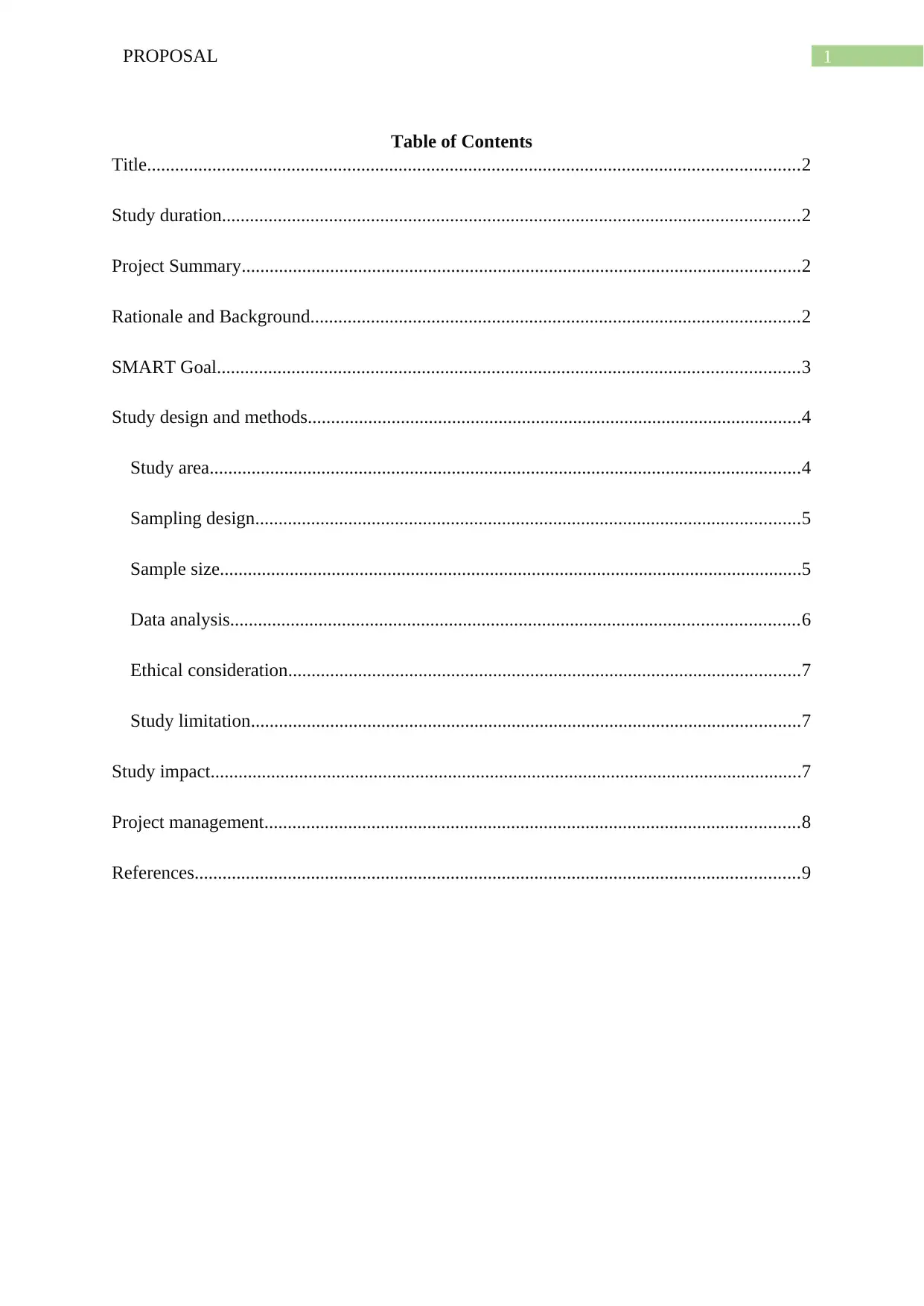
Table of Contents
Title............................................................................................................................................2
Study duration............................................................................................................................2
Project Summary........................................................................................................................2
Rationale and Background.........................................................................................................2
SMART Goal.............................................................................................................................3
Study design and methods..........................................................................................................4
Study area...............................................................................................................................4
Sampling design.....................................................................................................................5
Sample size.............................................................................................................................5
Data analysis..........................................................................................................................6
Ethical consideration..............................................................................................................7
Study limitation......................................................................................................................7
Study impact...............................................................................................................................7
Project management...................................................................................................................8
References..................................................................................................................................9
Table of Contents
Title............................................................................................................................................2
Study duration............................................................................................................................2
Project Summary........................................................................................................................2
Rationale and Background.........................................................................................................2
SMART Goal.............................................................................................................................3
Study design and methods..........................................................................................................4
Study area...............................................................................................................................4
Sampling design.....................................................................................................................5
Sample size.............................................................................................................................5
Data analysis..........................................................................................................................6
Ethical consideration..............................................................................................................7
Study limitation......................................................................................................................7
Study impact...............................................................................................................................7
Project management...................................................................................................................8
References..................................................................................................................................9
2PROPOSAL
Title
Determinants and magnitude of developing diarrhoea among 0 to 5 years old children
residing in the City of Ipswich, Queensland Australia: A cohort study
Study duration
The entire duration of the study will be 6 months and the study will be conducted
private and the public hospitals located in the City of Ipswich. Diarrhoea is an infectious
disease with a colonization time about 1 to 2 weeks. However, in order to study the overall
incidence and the magnitude of the disease in detail over the children, duration of 6 months is
being taken. The duration of the cohort study mainly depends on the number of cases that the
authors want to do a follow-up or the total sample size. Increase in the Sample Size and the
follow-up sessions help to increase the generalization of the research results (1).
Project Summary
The research will be structured as per the guidelines of the cohort study with a follow-
up period of 6 months. The study will be conducted among the children between the age
group of 0 to 5 years residing in the City of Ipswich. The conduction of the study will help in
identifying the person-centred interventions for the prevention of the disease while framing
proper awareness and educational plan for reducing the risk factors of the disease occurrence.
The follow up study will be done over the selected group of the children population. The
selection of the sample size will be done based on the heterogeneous purposive sampling
among the children who are aged between 0 to 5 years. The aim of the study will be to
measure the incidence and the risks factors of diarrhoea. Diarrhoea will be defined as more
than 3 stools per day that were in the liquid form. After every 3 weeks, follow-up enquiry
will be done and this will help to ascertain the occurrence of diarrhoea, the health seeking,
diarrhoea history and the infant feeding practices. In addition, the living conditions of the
children will also be assessed by monitoring the source of drinking water, use of toilet, water
purification, and kitchen garden presence in the house, at regular intervals of one month. This
will help in establishing correlation between diarrhoea and its determinants. The cumulative
incidence, the rate of occurrence and the risk ratio will be used for the estimation of the
disease burden and risk of diarrhoea.
Title
Determinants and magnitude of developing diarrhoea among 0 to 5 years old children
residing in the City of Ipswich, Queensland Australia: A cohort study
Study duration
The entire duration of the study will be 6 months and the study will be conducted
private and the public hospitals located in the City of Ipswich. Diarrhoea is an infectious
disease with a colonization time about 1 to 2 weeks. However, in order to study the overall
incidence and the magnitude of the disease in detail over the children, duration of 6 months is
being taken. The duration of the cohort study mainly depends on the number of cases that the
authors want to do a follow-up or the total sample size. Increase in the Sample Size and the
follow-up sessions help to increase the generalization of the research results (1).
Project Summary
The research will be structured as per the guidelines of the cohort study with a follow-
up period of 6 months. The study will be conducted among the children between the age
group of 0 to 5 years residing in the City of Ipswich. The conduction of the study will help in
identifying the person-centred interventions for the prevention of the disease while framing
proper awareness and educational plan for reducing the risk factors of the disease occurrence.
The follow up study will be done over the selected group of the children population. The
selection of the sample size will be done based on the heterogeneous purposive sampling
among the children who are aged between 0 to 5 years. The aim of the study will be to
measure the incidence and the risks factors of diarrhoea. Diarrhoea will be defined as more
than 3 stools per day that were in the liquid form. After every 3 weeks, follow-up enquiry
will be done and this will help to ascertain the occurrence of diarrhoea, the health seeking,
diarrhoea history and the infant feeding practices. In addition, the living conditions of the
children will also be assessed by monitoring the source of drinking water, use of toilet, water
purification, and kitchen garden presence in the house, at regular intervals of one month. This
will help in establishing correlation between diarrhoea and its determinants. The cumulative
incidence, the rate of occurrence and the risk ratio will be used for the estimation of the
disease burden and risk of diarrhoea.
⊘ This is a preview!⊘
Do you want full access?
Subscribe today to unlock all pages.

Trusted by 1+ million students worldwide
3PROPOSAL
Rationale and Background
According to the reports published by the National Institute of Diabetes and Digestive
and Kidney Diseases (NIH) UK, diarrhoea is defined as a condition where the person
excretes watery stools for more than three times a day. It can be acute, persistent as well as
chronic. Acute diarrhoea is common in comparison to the persistent or chronic diarrhoea. The
main complications associated with diarrhoea include dehydration and mal-absorption along
with developmental delays among the children. The main reasons behind the occurrence of
diarrhoea include infections, food allergies, side-effects of medications and other
complications in the gastro-intestinal tract (2). Diarrheal is the second leading cause of death
after pneumonia among the children who are 0 to 5 years old. It amounts to 1300 children
death per year throughout the world (3). Under Australian community, diarrhoea is a
common illness among the children in comparison to males (4). Diarrhoea is a preventable
disease and the cause of the death along with continued efforts to improve the access of the
safe water, sanitization techniques along with proper childhood nutrition is important for
decreasing the global burden of diarrhoea. The information published by the Queensland
Government highlighted that children in Australia are prone towards developing diarrhoea.
Illness developed due to viral and bacterial infections mainly surfaces post 1 to 3 days after
exposure while illness caused by parasitic infection develops after 5 to 15 days post exposure
to the micro-organism. The duration of the illness mainly depends on causative agent and
under any condition it is life threatening. Close monitoring of the children is important and
the disease mainly spreads by the faeces of the infected children (5). So far no significant
research has been conducted in order to access the rate of occurrence and the characteristics
of the diarrheal outbreak among the children residing in Australia or to be more specific, in
the Queensland Australia. Thus, indicating gap in the research practice about the diarrhoeal
incidence in Australia.
Despite a significant reduction in the mortality and morbidity rate associated with
diarrhoea in many developing or developed countries, the overall burden of these preventable
diseases remains concentrated among the children, mainly the children who reside under the
poor socio-economic status (6). A proper understanding of the contribution of the each of the
causes leading to the development of the diarrhoea and how this varies among the patients
who are admitted in the privately funded and government subsidized hospitals will help in the
generation of the targeted interventions (7). Identifications of the disease burden and other
epidemiological correlates of diarrhoea might help in proper planning of person centred
Rationale and Background
According to the reports published by the National Institute of Diabetes and Digestive
and Kidney Diseases (NIH) UK, diarrhoea is defined as a condition where the person
excretes watery stools for more than three times a day. It can be acute, persistent as well as
chronic. Acute diarrhoea is common in comparison to the persistent or chronic diarrhoea. The
main complications associated with diarrhoea include dehydration and mal-absorption along
with developmental delays among the children. The main reasons behind the occurrence of
diarrhoea include infections, food allergies, side-effects of medications and other
complications in the gastro-intestinal tract (2). Diarrheal is the second leading cause of death
after pneumonia among the children who are 0 to 5 years old. It amounts to 1300 children
death per year throughout the world (3). Under Australian community, diarrhoea is a
common illness among the children in comparison to males (4). Diarrhoea is a preventable
disease and the cause of the death along with continued efforts to improve the access of the
safe water, sanitization techniques along with proper childhood nutrition is important for
decreasing the global burden of diarrhoea. The information published by the Queensland
Government highlighted that children in Australia are prone towards developing diarrhoea.
Illness developed due to viral and bacterial infections mainly surfaces post 1 to 3 days after
exposure while illness caused by parasitic infection develops after 5 to 15 days post exposure
to the micro-organism. The duration of the illness mainly depends on causative agent and
under any condition it is life threatening. Close monitoring of the children is important and
the disease mainly spreads by the faeces of the infected children (5). So far no significant
research has been conducted in order to access the rate of occurrence and the characteristics
of the diarrheal outbreak among the children residing in Australia or to be more specific, in
the Queensland Australia. Thus, indicating gap in the research practice about the diarrhoeal
incidence in Australia.
Despite a significant reduction in the mortality and morbidity rate associated with
diarrhoea in many developing or developed countries, the overall burden of these preventable
diseases remains concentrated among the children, mainly the children who reside under the
poor socio-economic status (6). A proper understanding of the contribution of the each of the
causes leading to the development of the diarrhoea and how this varies among the patients
who are admitted in the privately funded and government subsidized hospitals will help in the
generation of the targeted interventions (7). Identifications of the disease burden and other
epidemiological correlates of diarrhoea might help in proper planning of person centred
Paraphrase This Document
Need a fresh take? Get an instant paraphrase of this document with our AI Paraphraser
4PROPOSAL
interventions in order to effectively prevent and control the diarrhoea disease (8). Thus this
cohort study will aim to analyse the magnitude of diarrhoea and the associated
epidemiological correlates in the children between the age group of 0 to 5 years.
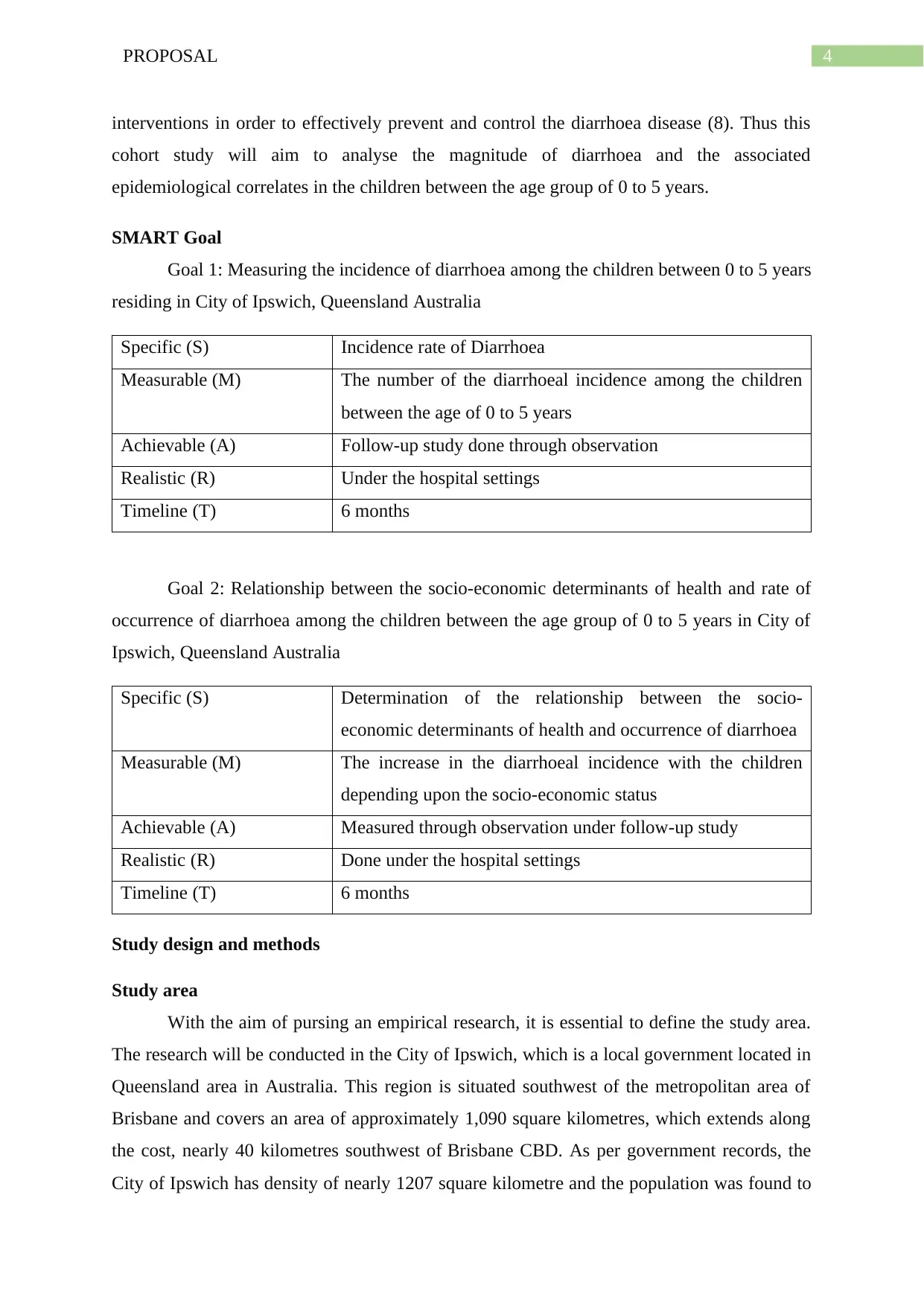
SMART Goal
Goal 1: Measuring the incidence of diarrhoea among the children between 0 to 5 years
residing in City of Ipswich, Queensland Australia
Specific (S) Incidence rate of Diarrhoea
Measurable (M) The number of the diarrhoeal incidence among the children
between the age of 0 to 5 years
Achievable (A) Follow-up study done through observation
Realistic (R) Under the hospital settings
Timeline (T) 6 months
Goal 2: Relationship between the socio-economic determinants of health and rate of
occurrence of diarrhoea among the children between the age group of 0 to 5 years in City of
Ipswich, Queensland Australia
Specific (S) Determination of the relationship between the socio-
economic determinants of health and occurrence of diarrhoea
Measurable (M) The increase in the diarrhoeal incidence with the children
depending upon the socio-economic status
Achievable (A) Measured through observation under follow-up study
Realistic (R) Done under the hospital settings
Timeline (T) 6 months
Study design and methods
Study area
With the aim of pursing an empirical research, it is essential to define the study area.
The research will be conducted in the City of Ipswich, which is a local government located in
Queensland area in Australia. This region is situated southwest of the metropolitan area of
Brisbane and covers an area of approximately 1,090 square kilometres, which extends along
the cost, nearly 40 kilometres southwest of Brisbane CBD. As per government records, the
City of Ipswich has density of nearly 1207 square kilometre and the population was found to
interventions in order to effectively prevent and control the diarrhoea disease (8). Thus this
cohort study will aim to analyse the magnitude of diarrhoea and the associated
epidemiological correlates in the children between the age group of 0 to 5 years.
SMART Goal
Goal 1: Measuring the incidence of diarrhoea among the children between 0 to 5 years
residing in City of Ipswich, Queensland Australia
Specific (S) Incidence rate of Diarrhoea
Measurable (M) The number of the diarrhoeal incidence among the children
between the age of 0 to 5 years
Achievable (A) Follow-up study done through observation
Realistic (R) Under the hospital settings
Timeline (T) 6 months
Goal 2: Relationship between the socio-economic determinants of health and rate of
occurrence of diarrhoea among the children between the age group of 0 to 5 years in City of
Ipswich, Queensland Australia
Specific (S) Determination of the relationship between the socio-
economic determinants of health and occurrence of diarrhoea
Measurable (M) The increase in the diarrhoeal incidence with the children
depending upon the socio-economic status
Achievable (A) Measured through observation under follow-up study
Realistic (R) Done under the hospital settings
Timeline (T) 6 months
Study design and methods
Study area
With the aim of pursing an empirical research, it is essential to define the study area.
The research will be conducted in the City of Ipswich, which is a local government located in
Queensland area in Australia. This region is situated southwest of the metropolitan area of
Brisbane and covers an area of approximately 1,090 square kilometres, which extends along
the cost, nearly 40 kilometres southwest of Brisbane CBD. As per government records, the
City of Ipswich has density of nearly 1207 square kilometre and the population was found to
5PROPOSAL
be 200,000 in the year 2017 (9) (10). Some of the urban suburbs from which children aged
less than five years will be selected for conducting this cohort study are namely, Carole Park,
Booval, Newtown, Rosewood, and Silkstone. However, the research will merely not be
restricted to the urban regions and will also involve assessing the children living in rural areas
namely, Amberley, Mount Marrow, Haigslea, and Thagoona. Therefore, the study area will
encompass several regions of Queensland.
Sampling design
The process of sampling encompass the steps that are generally followed for the
selection of people from a target population of interest, in order to generalise the research
findings to the larger population from where the sample had been selected. Purposive
sampling process will be selected for this research. This sampling design refers to a non-
probability sample that is generally selected based on the definite features and characteristics
of the target population, taking into consideration the aims and objectives of the study (11).
Owing to the fact that the research aims to determine the magnitude of diarrhoea among
children aged less than 5 years, and also intends to explore the determinants, the sample will
be a heterogeneous purposive one. Selection of a heterogeneous purposive sample will ensure
that there exists maximum variation between the selected participants and will also help in
confirming that every child recruited for the research has diverse value for the characteristic
(diarrhoea magnitude) that is being investigated (12). The primary reason behind adopting a
purposive sampling technique can be accredited to the fact that it will provide justification for
making generalisation about the presence of diarrhoea in the target population. Not only will
the sampling technique comprise of different phases, but will also have the phases built upon
information obtained from the previous stage, thus offering greater non-probability sampling
chances. Another major advantage of this sampling technique is the fact that the flexibility of
the procedure will help in saving money and time, at the time of data collection (13). Multiple
interests and needs can be met, while still upholding the basis of an outstanding focal point.
Hence, it will facilitate the production of a concluding logical result that is illustrative and
characteristic of the specific population.
Sample size
Sample size generally refers to the total number of individuals who have been
measured or evaluated for an experiment (14). It has often been postulated by researchers that
the sample size required for incident cohort study is as much as thrice higher than that
required for prevalent cohort study (taking into consideration that the participants have been
be 200,000 in the year 2017 (9) (10). Some of the urban suburbs from which children aged
less than five years will be selected for conducting this cohort study are namely, Carole Park,
Booval, Newtown, Rosewood, and Silkstone. However, the research will merely not be
restricted to the urban regions and will also involve assessing the children living in rural areas
namely, Amberley, Mount Marrow, Haigslea, and Thagoona. Therefore, the study area will
encompass several regions of Queensland.
Sampling design
The process of sampling encompass the steps that are generally followed for the
selection of people from a target population of interest, in order to generalise the research
findings to the larger population from where the sample had been selected. Purposive
sampling process will be selected for this research. This sampling design refers to a non-
probability sample that is generally selected based on the definite features and characteristics
of the target population, taking into consideration the aims and objectives of the study (11).
Owing to the fact that the research aims to determine the magnitude of diarrhoea among
children aged less than 5 years, and also intends to explore the determinants, the sample will
be a heterogeneous purposive one. Selection of a heterogeneous purposive sample will ensure
that there exists maximum variation between the selected participants and will also help in
confirming that every child recruited for the research has diverse value for the characteristic
(diarrhoea magnitude) that is being investigated (12). The primary reason behind adopting a
purposive sampling technique can be accredited to the fact that it will provide justification for
making generalisation about the presence of diarrhoea in the target population. Not only will
the sampling technique comprise of different phases, but will also have the phases built upon
information obtained from the previous stage, thus offering greater non-probability sampling
chances. Another major advantage of this sampling technique is the fact that the flexibility of
the procedure will help in saving money and time, at the time of data collection (13). Multiple
interests and needs can be met, while still upholding the basis of an outstanding focal point.
Hence, it will facilitate the production of a concluding logical result that is illustrative and
characteristic of the specific population.
Sample size
Sample size generally refers to the total number of individuals who have been
measured or evaluated for an experiment (14). It has often been postulated by researchers that
the sample size required for incident cohort study is as much as thrice higher than that
required for prevalent cohort study (taking into consideration that the participants have been
⊘ This is a preview!⊘
Do you want full access?
Subscribe today to unlock all pages.
Trusted by 1+ million students worldwide
6PROPOSAL
enlisted at time 0) (15). In order to determine the total number of study participants who will
be recruited for this cohort study from the City of Ipswich, the PASS software will be used.
PASS has been identified as a computer generated program that facilitates estimation of
sample size, and also assists in the determination of confidence interval and/or power of a
statistical procedure. Owing to the fact that the PASS comprises of more than 920 confidence
interval and statistical test scenario, it will help in evaluating the total number of children
who need to be recruited for the cohort study.
Data analysis
Data collection forms an essential part of research since it encompasses the procedure
of collecting and measuring information, related to particular targeted variables, in an already
established system. This in turn facilitates the process of drawing conclusions to relevant
research questions, followed by evaluation of outcomes. The data collection process will
encompass collecting baseline information from the mother of all recruited children,
regarding specific variables such as, birth history, socio-demographic profile, child feeding
practices, history of immunization, dietary history, morbidity profile, and use of primary
healthcare service for the children. Collection of baseline data will form an essential
component of the research owing to the fact that it will provide exhaustive information
against which the children will be monitored and assessed for the presence and magnitude of
diarrhoea, and will also help in identification of the determinants that increase the risk of
diarrhoea amid the children. Collection of baseline information will be done based on a pre-
formulated and pre-tested interview plan. Interview has been selected as the data collection
procedure since it will provide a detailed overview of the perception and opinion of mothers
about the baseline variables and will also help in attaining a high response rate (16).
Following this interview, the children enrolled for the study will be followed for a duration of
six months. After every three weeks, an enquiry will be held about the sudden onset of
diarrhoea, in addition to investigating any change in child feeding practice, dietary pattern,
and health seeking behaviour. These information will be compared to responses obtained
during the previous interval. The children will also be subjected to different anthropometric
measurements after each month such as, height, body weight and mid upper arm
circumference (MUAC). Occurrence of diarrhoea will be measured as event of three or more
stools in a day, in liquid form. In addition, the mothers will also be asked questions on
drinking water source, water purification, use of toilet, and kitchen garden presence in the
house, at regular intervals of one month. The data obtained will be analysed using the SPSS
enlisted at time 0) (15). In order to determine the total number of study participants who will
be recruited for this cohort study from the City of Ipswich, the PASS software will be used.
PASS has been identified as a computer generated program that facilitates estimation of
sample size, and also assists in the determination of confidence interval and/or power of a
statistical procedure. Owing to the fact that the PASS comprises of more than 920 confidence
interval and statistical test scenario, it will help in evaluating the total number of children
who need to be recruited for the cohort study.
Data analysis
Data collection forms an essential part of research since it encompasses the procedure
of collecting and measuring information, related to particular targeted variables, in an already
established system. This in turn facilitates the process of drawing conclusions to relevant
research questions, followed by evaluation of outcomes. The data collection process will
encompass collecting baseline information from the mother of all recruited children,
regarding specific variables such as, birth history, socio-demographic profile, child feeding
practices, history of immunization, dietary history, morbidity profile, and use of primary
healthcare service for the children. Collection of baseline data will form an essential
component of the research owing to the fact that it will provide exhaustive information
against which the children will be monitored and assessed for the presence and magnitude of
diarrhoea, and will also help in identification of the determinants that increase the risk of
diarrhoea amid the children. Collection of baseline information will be done based on a pre-
formulated and pre-tested interview plan. Interview has been selected as the data collection
procedure since it will provide a detailed overview of the perception and opinion of mothers
about the baseline variables and will also help in attaining a high response rate (16).
Following this interview, the children enrolled for the study will be followed for a duration of
six months. After every three weeks, an enquiry will be held about the sudden onset of
diarrhoea, in addition to investigating any change in child feeding practice, dietary pattern,
and health seeking behaviour. These information will be compared to responses obtained
during the previous interval. The children will also be subjected to different anthropometric
measurements after each month such as, height, body weight and mid upper arm
circumference (MUAC). Occurrence of diarrhoea will be measured as event of three or more
stools in a day, in liquid form. In addition, the mothers will also be asked questions on
drinking water source, water purification, use of toilet, and kitchen garden presence in the
house, at regular intervals of one month. The data obtained will be analysed using the SPSS
Paraphrase This Document
Need a fresh take? Get an instant paraphrase of this document with our AI Paraphraser
7PROPOSAL
21.0 software and the magnitude of diarrhoea will be represented in the form of attack rates,
cumulative incidence, and average number of episodes. Diarrhoea incidence will be measured
by using the following formula:
Total children having at least one diarrhoea episode * 1000/Total children showing risk of
diarrhoea
Risk ratio will be used to determine the association between the research variables
and a confidence interval of 95% will be premeditated for the relative risk.
Ethical consideration
Prior to conduction of this cohort study, the institutional review board will be
approached for obtaining ethical clearance. The parents of prospective children will be
initially contacted over mail and will be provided with a sealed envelope that contains
detailed information about the purpose, potential advantage and drawback of the research (if
any). After obtaining informed consent from the parents, the children will be recruited (17).
The parents will be provided the opportunity to withdraw from the study at any point of time
and might even refuse participation.
Study limitation
There might be some disadvantages associated with the sampling technique. While
using heterogeneous purposive sampling for the collection of information about diarrhoea in
children aged less than five years, there might arise a vast plethora of inferential statistical
processes that might seem invalid. In addition, the sampling procedure is also prone to
researcher bias, regardless of the method that will be adopted for data collection. The basic
idea that the sample has been created in the first place will be highly dependent on the
decision of the researcher, in addition to their personal explanation of the data. In addition,
the high subjectivity level might cast an unavoidable shadow of uncertainty on the outcomes
in almost every condition. Moreover, loss of participants to follow up bias is another major
concern that might arise in this research. Recall bias might also affect the study results when
the mothers will be inquired about the health of their children.
Study impact
Measurement of the magnitude of diarrhoea episodes among the children between the
age group of the 0 to 5 years and the measurement of the cumulative incidence of the
diarrhoea per year will help in understanding of the overall disease burden over the children.
21.0 software and the magnitude of diarrhoea will be represented in the form of attack rates,
cumulative incidence, and average number of episodes. Diarrhoea incidence will be measured
by using the following formula:
Total children having at least one diarrhoea episode * 1000/Total children showing risk of
diarrhoea
Risk ratio will be used to determine the association between the research variables
and a confidence interval of 95% will be premeditated for the relative risk.
Ethical consideration
Prior to conduction of this cohort study, the institutional review board will be
approached for obtaining ethical clearance. The parents of prospective children will be
initially contacted over mail and will be provided with a sealed envelope that contains
detailed information about the purpose, potential advantage and drawback of the research (if
any). After obtaining informed consent from the parents, the children will be recruited (17).
The parents will be provided the opportunity to withdraw from the study at any point of time
and might even refuse participation.
Study limitation
There might be some disadvantages associated with the sampling technique. While
using heterogeneous purposive sampling for the collection of information about diarrhoea in
children aged less than five years, there might arise a vast plethora of inferential statistical
processes that might seem invalid. In addition, the sampling procedure is also prone to
researcher bias, regardless of the method that will be adopted for data collection. The basic
idea that the sample has been created in the first place will be highly dependent on the
decision of the researcher, in addition to their personal explanation of the data. In addition,
the high subjectivity level might cast an unavoidable shadow of uncertainty on the outcomes
in almost every condition. Moreover, loss of participants to follow up bias is another major
concern that might arise in this research. Recall bias might also affect the study results when
the mothers will be inquired about the health of their children.
Study impact
Measurement of the magnitude of diarrhoea episodes among the children between the
age group of the 0 to 5 years and the measurement of the cumulative incidence of the
diarrhoea per year will help in understanding of the overall disease burden over the children.
8PROPOSAL
The study of the magnitude of diarrhoea among the children will help to understand the risk
factors that increase the rate of occurrence of the diarrhoea among the children. The analysis
of the risk factors associated with the development of the diarrhoea will help in framing of
the proper awareness program for the parents among the community-based healthcare
settings and thereby helping to reduce the vulnerability of developing the disease. The
analysis of the rate of incidence of diarrhoea will help to frame person-centred interventions
for the disease management (7).
Project management
The project will involve participation of parents having children aged less than five
years, primary health care centres located across the City of Ipswich, healthcare
professionals, and local government authorities. Moreover, administrative officials of
playhouse and kindergarten will also be form an important part of the research since they will
also help in recruitment of prospective research candidates.
The study of the magnitude of diarrhoea among the children will help to understand the risk
factors that increase the rate of occurrence of the diarrhoea among the children. The analysis
of the risk factors associated with the development of the diarrhoea will help in framing of
the proper awareness program for the parents among the community-based healthcare
settings and thereby helping to reduce the vulnerability of developing the disease. The
analysis of the rate of incidence of diarrhoea will help to frame person-centred interventions
for the disease management (7).
Project management
The project will involve participation of parents having children aged less than five
years, primary health care centres located across the City of Ipswich, healthcare
professionals, and local government authorities. Moreover, administrative officials of
playhouse and kindergarten will also be form an important part of the research since they will
also help in recruitment of prospective research candidates.
⊘ This is a preview!⊘
Do you want full access?
Subscribe today to unlock all pages.
Trusted by 1+ million students worldwide
9PROPOSAL
References
1. Smith GD, Gelling L, Haigh C, Barnason S, Allan HT, Jackson D. The position of
reporting guidelines in qualitative nursing research. Journal of clinical nursing. 2018
Mar 25;27(5-6):889-91.
2. National Institute of Diabetes and Digestive and Kidney Diseases (NIH) UK.
Diarrhea. [Internet]. U.S. Department of Health and Human Services. 2019. [cited
2019 September 23]. Available from:
https://www.niddk.nih.gov/health-information/digestive-diseases/diarrhea
3. UNICEF. Diarrhoeal disease. [Internet]. UNICEF. 2019. [cited 2019 September
23]. Available from: https://data.unicef.org/topic/child-health/diarrhoeal-disease/
4. Wong MY, Ansari S, Shin JS, Koorey D, Gibson J. Diarrhea in an immunosuppressed
patient—The accordion sign. International Journal of Infectious Diseases. 2019 Jun
1;83:46-8.
5. Queensland Government. Diarrhoea in Young Children. [Internet]. The State of
Queensland 1995–2019. 2019. [cited 2019 September 23]. Available from:
http://conditions.health.qld.gov.au/HealthCondition/condition/14/217/39/Diarrhoea-
in-Young-Children
6. Kumar R, Borkar R. Magnitude and determinants of diarrhea among 0-6 year’s
children: a cohort study from central India. International Journal Of Community
Medicine And Public Health. 2018 Nov 24;5(12):5246-52.
7. Schilling KA, Omore R, Derado G, Ayers T, Ochieng JB, Farag TH, Nasrin D,
Panchalingam S, Nataro JP, Kotloff KL, Levine MM. Factors associated with the
duration of moderate-to-severe diarrhea among children in rural western Kenya
enrolled in the global enteric multicenter study, 2008–2012. The American journal of
tropical medicine and hygiene. 2017 Jul 12;97(1):248-58.
8. World Health Organization. WHO estimates of the global burden of foodborne
diseases: foodborne disease burden epidemiology reference group 2007-2015. World
Health Organization; 2015.
9. Centre for the Government of Queensland. Ipswich. [Internet]. Queensland
Places. 2018 [cited 2019 September 23]. Available from:
https://queenslandplaces.com.au/ipswich
10. City of Ipswich. Ipswich Population Modeller identifies 200,000th resident.
[Internet]. Ipswich City Council. 2017 [cited 2019 September 23]. Available from:
References
1. Smith GD, Gelling L, Haigh C, Barnason S, Allan HT, Jackson D. The position of
reporting guidelines in qualitative nursing research. Journal of clinical nursing. 2018
Mar 25;27(5-6):889-91.
2. National Institute of Diabetes and Digestive and Kidney Diseases (NIH) UK.
Diarrhea. [Internet]. U.S. Department of Health and Human Services. 2019. [cited
2019 September 23]. Available from:
https://www.niddk.nih.gov/health-information/digestive-diseases/diarrhea
3. UNICEF. Diarrhoeal disease. [Internet]. UNICEF. 2019. [cited 2019 September
23]. Available from: https://data.unicef.org/topic/child-health/diarrhoeal-disease/
4. Wong MY, Ansari S, Shin JS, Koorey D, Gibson J. Diarrhea in an immunosuppressed
patient—The accordion sign. International Journal of Infectious Diseases. 2019 Jun
1;83:46-8.
5. Queensland Government. Diarrhoea in Young Children. [Internet]. The State of
Queensland 1995–2019. 2019. [cited 2019 September 23]. Available from:
http://conditions.health.qld.gov.au/HealthCondition/condition/14/217/39/Diarrhoea-
in-Young-Children
6. Kumar R, Borkar R. Magnitude and determinants of diarrhea among 0-6 year’s
children: a cohort study from central India. International Journal Of Community
Medicine And Public Health. 2018 Nov 24;5(12):5246-52.
7. Schilling KA, Omore R, Derado G, Ayers T, Ochieng JB, Farag TH, Nasrin D,
Panchalingam S, Nataro JP, Kotloff KL, Levine MM. Factors associated with the
duration of moderate-to-severe diarrhea among children in rural western Kenya
enrolled in the global enteric multicenter study, 2008–2012. The American journal of
tropical medicine and hygiene. 2017 Jul 12;97(1):248-58.
8. World Health Organization. WHO estimates of the global burden of foodborne
diseases: foodborne disease burden epidemiology reference group 2007-2015. World
Health Organization; 2015.
9. Centre for the Government of Queensland. Ipswich. [Internet]. Queensland
Places. 2018 [cited 2019 September 23]. Available from:
https://queenslandplaces.com.au/ipswich
10. City of Ipswich. Ipswich Population Modeller identifies 200,000th resident.
[Internet]. Ipswich City Council. 2017 [cited 2019 September 23]. Available from:
Paraphrase This Document
Need a fresh take? Get an instant paraphrase of this document with our AI Paraphraser
10PROPOSAL
https://www.ipswich.qld.gov.au/about_council/media/articles/2017/ipswich-
population-modeller-identifies-200,000th-resident
11. Robertson A, Sibley CG. Research sampling: a pragmatic approach. InAdvanced
Research Methods for Applied Psychology 2018 Aug 14 (pp. 27-48). Routledge.
12. Etikan I, Bala K. Sampling and sampling methods. Biometrics & Biostatistics
International Journal. 2017;5(6):00149.
13. Etikan I, Musa SA, Alkassim RS. Comparison of convenience sampling and
purposive sampling. American journal of theoretical and applied statistics. 2016
Jan;5(1):1-4.
14. Chow SC, Shao J, Wang H, Lokhnygina Y. Sample size calculations in clinical
research. Chapman and Hall/CRC; 2017 Aug 15.
15. Liu H, Shen Y, Ning J, Qin J. Sample size calculations for prevalent cohort designs.
Statistical methods in medical research. 2017 Feb;26(1):280-91.
16. Kallio H, Pietilä AM, Johnson M, Kangasniemi M. Systematic methodological
review: developing a framework for a qualitative semi‐structured interview guide.
Journal of advanced nursing. 2016 Dec;72(12):2954-65.
17. Grady C. Enduring and emerging challenges of informed consent. New England
Journal of Medicine. 2015 Feb 26;372(9):855-62.
https://www.ipswich.qld.gov.au/about_council/media/articles/2017/ipswich-
population-modeller-identifies-200,000th-resident
11. Robertson A, Sibley CG. Research sampling: a pragmatic approach. InAdvanced
Research Methods for Applied Psychology 2018 Aug 14 (pp. 27-48). Routledge.
12. Etikan I, Bala K. Sampling and sampling methods. Biometrics & Biostatistics
International Journal. 2017;5(6):00149.
13. Etikan I, Musa SA, Alkassim RS. Comparison of convenience sampling and
purposive sampling. American journal of theoretical and applied statistics. 2016
Jan;5(1):1-4.
14. Chow SC, Shao J, Wang H, Lokhnygina Y. Sample size calculations in clinical
research. Chapman and Hall/CRC; 2017 Aug 15.
15. Liu H, Shen Y, Ning J, Qin J. Sample size calculations for prevalent cohort designs.
Statistical methods in medical research. 2017 Feb;26(1):280-91.
16. Kallio H, Pietilä AM, Johnson M, Kangasniemi M. Systematic methodological
review: developing a framework for a qualitative semi‐structured interview guide.
Journal of advanced nursing. 2016 Dec;72(12):2954-65.
17. Grady C. Enduring and emerging challenges of informed consent. New England
Journal of Medicine. 2015 Feb 26;372(9):855-62.

1 out of 11


Related Documents


Your All-in-One AI-Powered Toolkit for Academic Success.
+13062052269
info@desklib.com
Available 24*7 on WhatsApp / Email
![[object Object]](/_next/static/media/star-bottom.7253800d.svg)
Unlock your academic potential
Copyright © 2020–2026 A2Z Services. All Rights Reserved. Developed and managed by ZUCOL.