An Exploration of Death and Journey in Emily Dickinson's Poem

Verified

Added on  2023/06/15

|5
|1224
|240
Essay
AI Summary
This essay provides a literary analysis of Emily Dickinson's poem "Because I could not stop for Death," exploring the themes of death, immortality, and the journey to the afterlife. The analysis highlights Dickinson's unique portrayal of death as a kind and chivalrous figure, contrasting with traditional grim depictions. The essay examines the use of natural surroundings and symbolism in the poem, drawing connections to other literary works like Dante's "The Divina Commedia" and Shakespeare's Hamlet. It argues that Dickinson's poem reflects her American roots, mystical inclinations, and association with the Pre-Raphaelite Movement, ultimately presenting death as a smooth and even enjoyable transition to eternity.
Document Page
Running head: ENGLISH ASSIGNMENT
English Assignment
Name of the Student:
Name of the University:
Author Note:
tabler-icon-diamond-filled.svg

Paraphrase This Document

Need a fresh take? Get an instant paraphrase of this document with our AI Paraphraser
Document Page
1ENGLISH ASSIGNMENT
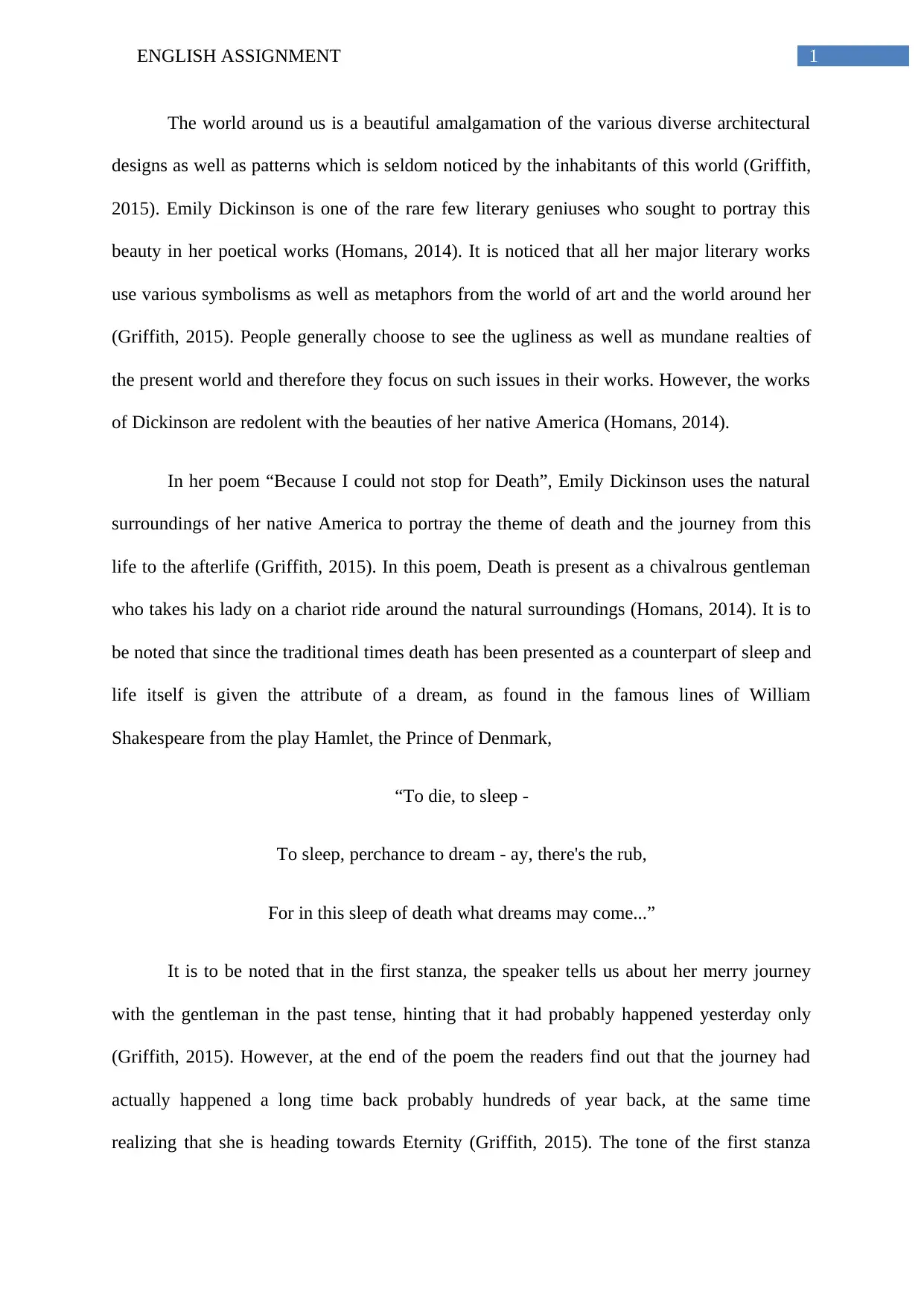
The world around us is a beautiful amalgamation of the various diverse architectural
designs as well as patterns which is seldom noticed by the inhabitants of this world (Griffith,
2015). Emily Dickinson is one of the rare few literary geniuses who sought to portray this
beauty in her poetical works (Homans, 2014). It is noticed that all her major literary works
use various symbolisms as well as metaphors from the world of art and the world around her
(Griffith, 2015). People generally choose to see the ugliness as well as mundane realties of
the present world and therefore they focus on such issues in their works. However, the works
of Dickinson are redolent with the beauties of her native America (Homans, 2014).
In her poem “Because I could not stop for Death”, Emily Dickinson uses the natural
surroundings of her native America to portray the theme of death and the journey from this
life to the afterlife (Griffith, 2015). In this poem, Death is present as a chivalrous gentleman
who takes his lady on a chariot ride around the natural surroundings (Homans, 2014). It is to
be noted that since the traditional times death has been presented as a counterpart of sleep and
life itself is given the attribute of a dream, as found in the famous lines of William
Shakespeare from the play Hamlet, the Prince of Denmark,
“To die, to sleep -
To sleep, perchance to dream - ay, there's the rub,
For in this sleep of death what dreams may come...”
It is to be noted that in the first stanza, the speaker tells us about her merry journey
with the gentleman in the past tense, hinting that it had probably happened yesterday only
(Griffith, 2015). However, at the end of the poem the readers find out that the journey had
actually happened a long time back probably hundreds of year back, at the same time
realizing that she is heading towards Eternity (Griffith, 2015). The tone of the first stanza
Document Page
2ENGLISH ASSIGNMENT
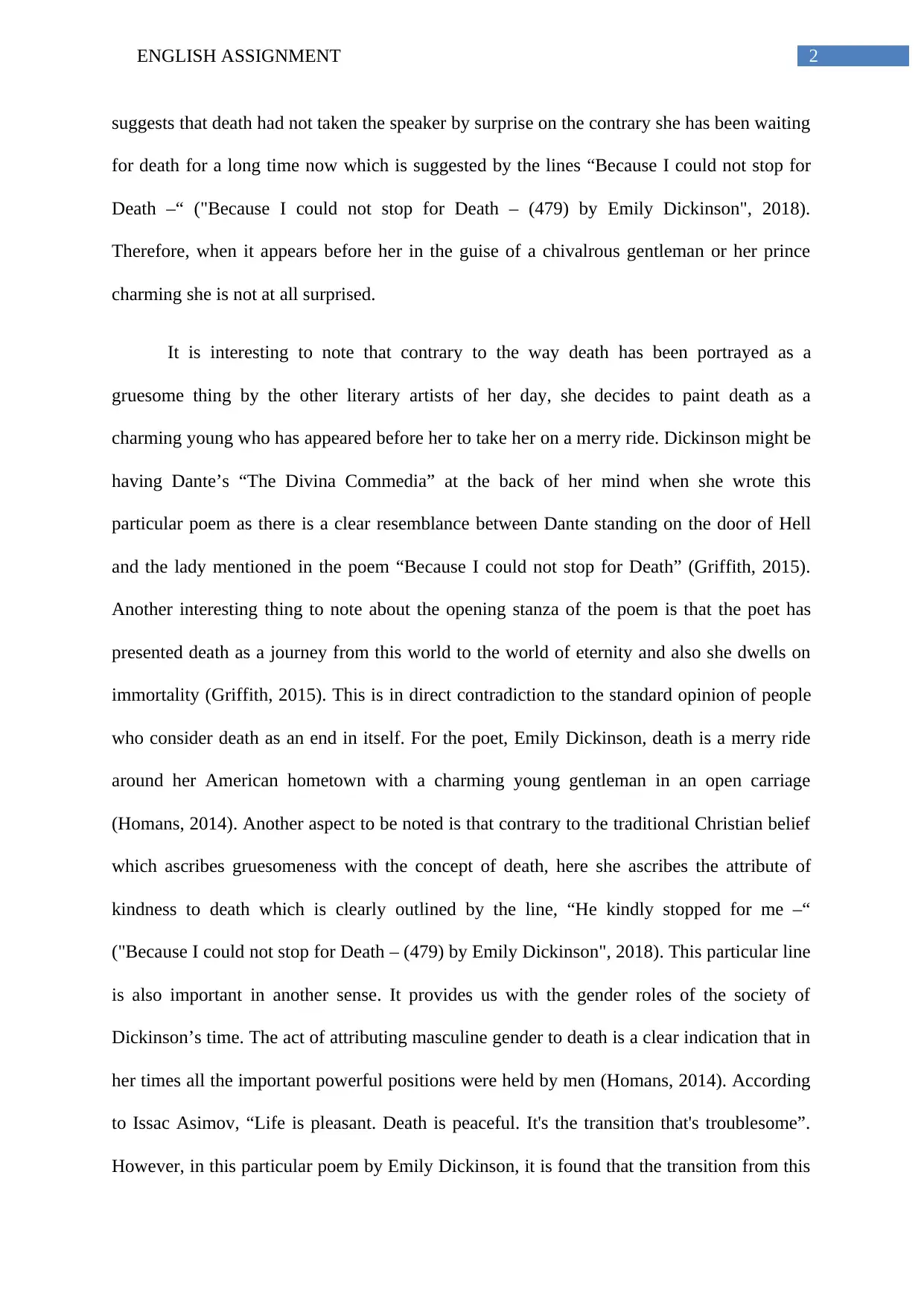
suggests that death had not taken the speaker by surprise on the contrary she has been waiting
for death for a long time now which is suggested by the lines “Because I could not stop for
Death –“ ("Because I could not stop for Death – (479) by Emily Dickinson", 2018).
Therefore, when it appears before her in the guise of a chivalrous gentleman or her prince
charming she is not at all surprised.
It is interesting to note that contrary to the way death has been portrayed as a
gruesome thing by the other literary artists of her day, she decides to paint death as a
charming young who has appeared before her to take her on a merry ride. Dickinson might be
having Dante’s “The Divina Commedia” at the back of her mind when she wrote this
particular poem as there is a clear resemblance between Dante standing on the door of Hell
and the lady mentioned in the poem “Because I could not stop for Death” (Griffith, 2015).
Another interesting thing to note about the opening stanza of the poem is that the poet has
presented death as a journey from this world to the world of eternity and also she dwells on
immortality (Griffith, 2015). This is in direct contradiction to the standard opinion of people
who consider death as an end in itself. For the poet, Emily Dickinson, death is a merry ride
around her American hometown with a charming young gentleman in an open carriage
(Homans, 2014). Another aspect to be noted is that contrary to the traditional Christian belief
which ascribes gruesomeness with the concept of death, here she ascribes the attribute of
kindness to death which is clearly outlined by the line, “He kindly stopped for me –“
("Because I could not stop for Death – (479) by Emily Dickinson", 2018). This particular line
is also important in another sense. It provides us with the gender roles of the society of
Dickinson’s time. The act of attributing masculine gender to death is a clear indication that in
her times all the important powerful positions were held by men (Homans, 2014). According
to Issac Asimov, “Life is pleasant. Death is peaceful. It's the transition that's troublesome”.
However, in this particular poem by Emily Dickinson, it is found that the transition from this
Document Page
3ENGLISH ASSIGNMENT
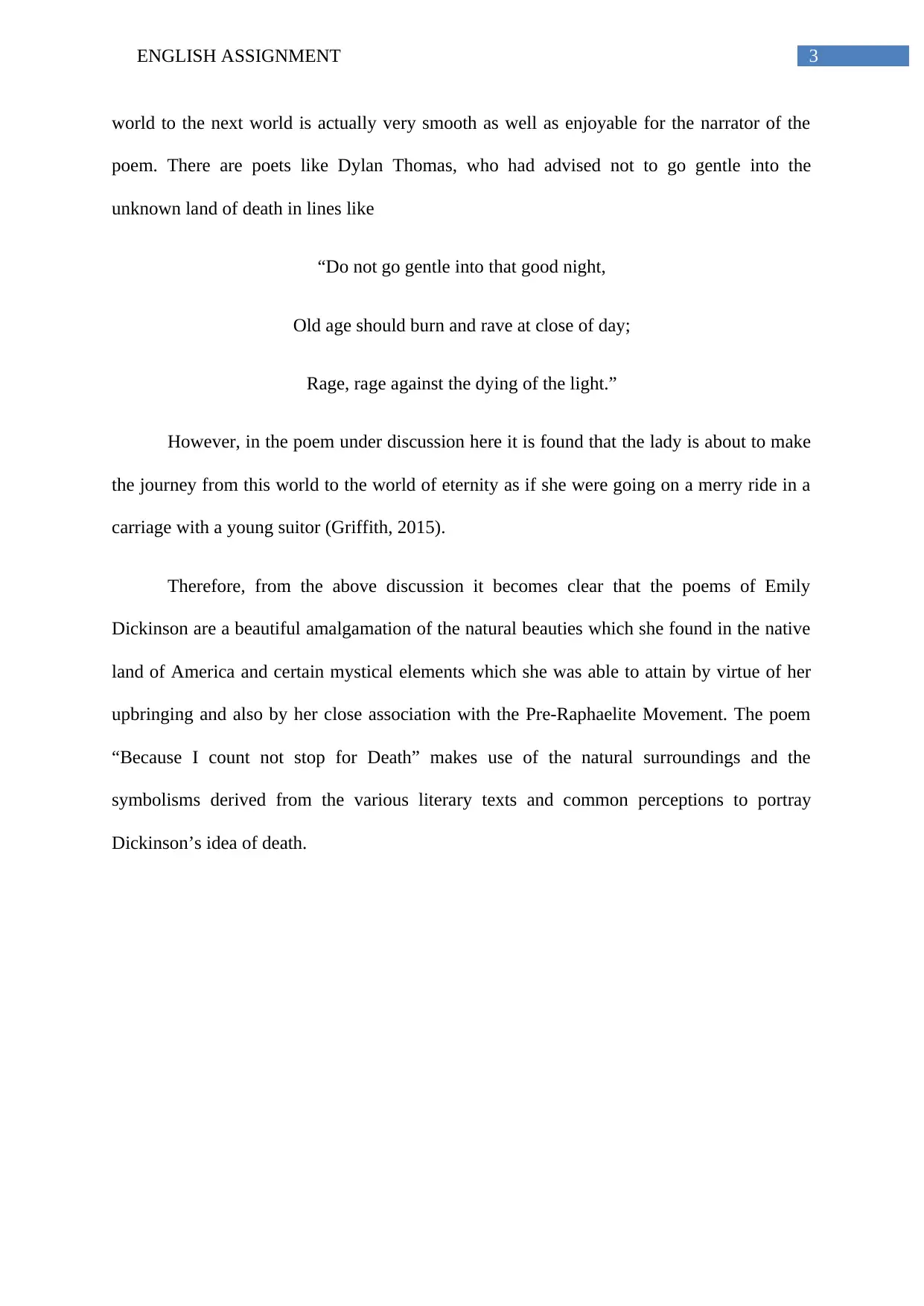
world to the next world is actually very smooth as well as enjoyable for the narrator of the
poem. There are poets like Dylan Thomas, who had advised not to go gentle into the
unknown land of death in lines like
“Do not go gentle into that good night,
Old age should burn and rave at close of day;
Rage, rage against the dying of the light.”
However, in the poem under discussion here it is found that the lady is about to make
the journey from this world to the world of eternity as if she were going on a merry ride in a
carriage with a young suitor (Griffith, 2015).
Therefore, from the above discussion it becomes clear that the poems of Emily
Dickinson are a beautiful amalgamation of the natural beauties which she found in the native
land of America and certain mystical elements which she was able to attain by virtue of her
upbringing and also by her close association with the Pre-Raphaelite Movement. The poem
“Because I count not stop for Death” makes use of the natural surroundings and the
symbolisms derived from the various literary texts and common perceptions to portray
Dickinson’s idea of death.
tabler-icon-diamond-filled.svg

Paraphrase This Document

Need a fresh take? Get an instant paraphrase of this document with our AI Paraphraser
Document Page
4ENGLISH ASSIGNMENT
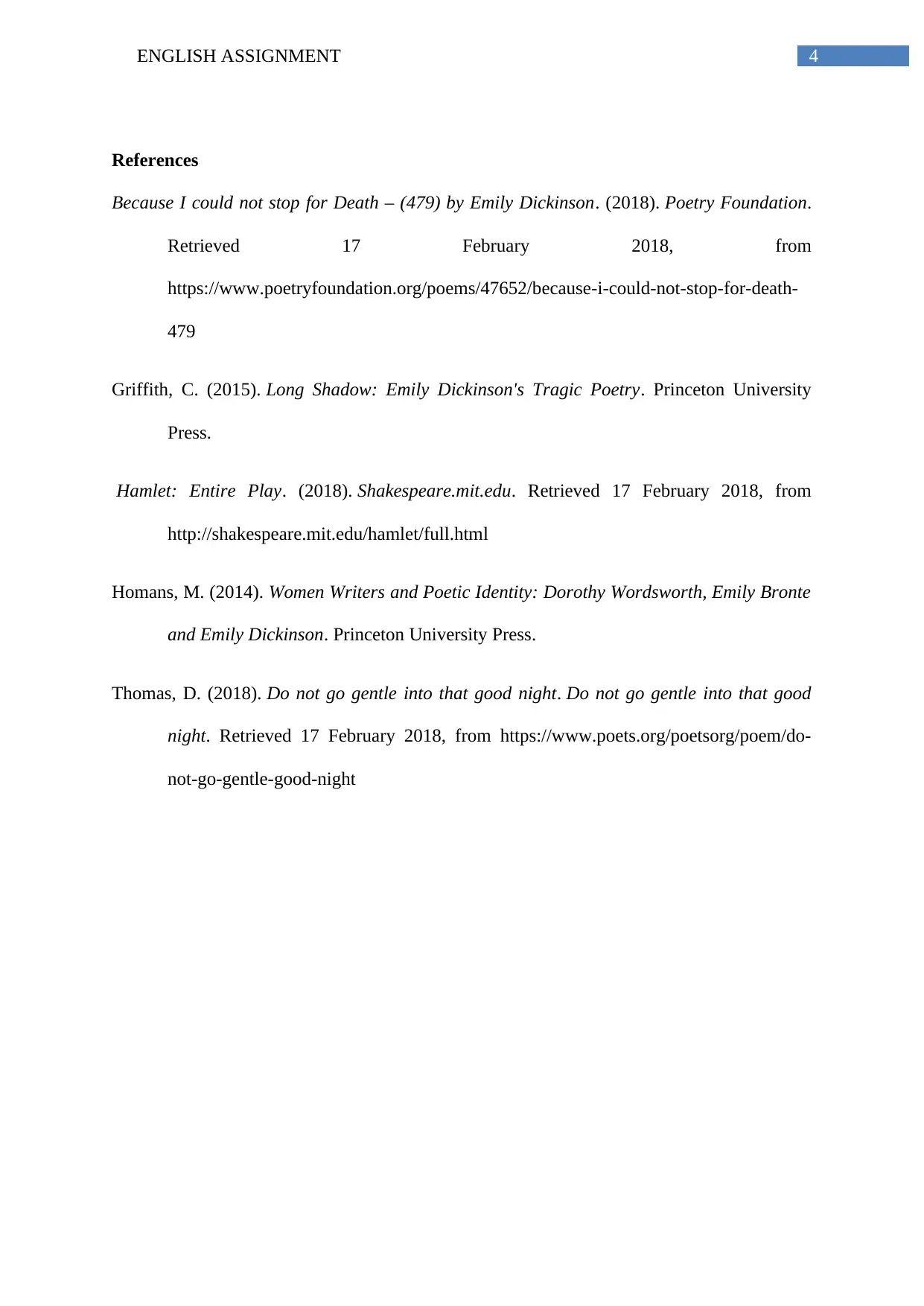
References
Because I could not stop for Death – (479) by Emily Dickinson. (2018). Poetry Foundation.
Retrieved 17 February 2018, from
https://www.poetryfoundation.org/poems/47652/because-i-could-not-stop-for-death-
479
Griffith, C. (2015). Long Shadow: Emily Dickinson's Tragic Poetry. Princeton University
Press.
Hamlet: Entire Play. (2018). Shakespeare.mit.edu. Retrieved 17 February 2018, from
http://shakespeare.mit.edu/hamlet/full.html
Homans, M. (2014). Women Writers and Poetic Identity: Dorothy Wordsworth, Emily Bronte
and Emily Dickinson. Princeton University Press.
Thomas, D. (2018). Do not go gentle into that good night. Do not go gentle into that good
night. Retrieved 17 February 2018, from https://www.poets.org/poetsorg/poem/do-
not-go-gentle-good-night
chevron_up_icon
1 out of 5
circle_padding
hide_on_mobile
zoom_out_icon
[object Object]