Research Project: Importance of Diet and Exercise for UK Youth Health
VerifiedAdded on 2021/01/01
|28
|9339
|447
Homework Assignment
AI Summary
This research project explores the critical role of diet and exercise in the health of young people in the UK, focusing on the age range of 13-21. The project aims to assess the importance of physical activity and healthy eating, promoting these habits among adolescents. It addresses ethical considerations like voluntary participation, confidentiality, and non-harm, while examining the aims and objectives to understand service improvements. The literature review synthesizes findings from various sources, emphasizing the benefits of physical activity, healthy diets, and their impact on long-term health. The research highlights the importance of proper nutrition, the consequences of unhealthy eating habits, and the need for promoting healthy lifestyles to prevent chronic diseases. The project also considers the changing lifestyles of young people in the UK and the impact of these changes on their health, aligning with broader public health concerns. The project incorporates research methodologies like literature review and analysis of existing studies to understand the relationship between diet, exercise and youth health.
Undertake a research project within Services for Health and
Social Care or Children and Young People
(Unit reference number: J/602/3499)
Unit Aims
The purpose of this unit is to enable you to demonstrate that you have the knowledge, skills
and understanding to undertake a research project in Services for Health and Social Care or
Children and Young People.
This guidance will help you to set out and develop your project so that you cover all the steps
required to achieve the unit.
Learning Outcomes
Be able to justify a topic for research within services for health and social care or
children and young people
Understand how the components of research are used
Be able to conduct a research project within services for health and social care or
children and young people
Be able to analyse research findings
Sources of information
Here are some sources of information which you may find useful:
Books
G. Wisker - The Postgraduate Research Handbook ISBN 9780230521308
C. Robson - How to do a research project: A guide for undergraduates ISBN
9781405114905
Websites
www.angelfire.com/biz/rumsby/ARES.html- how to do research
www.enquirylearning.net/ELU/Issues/Research/Res1Cont.html - an introduction to
qualitative research
www2.chass.ncsu.edu/garson/pa765/survey.htm - a guide to survey research
www.enquirylearning.net/ELU/Issues/Research/Res1Ch4.html - an introduction to action
research
www.nova.edu/ssss/QR/QR3-2/tellis1.html - a guide to case study research
you may complete this workbook and present it in total as your
evidence or you can submit the tasks as completed to your
assessor for assessment and feedback as you progress.
Your assessor may request which approach they wish you to use
for them
Social Care or Children and Young People
(Unit reference number: J/602/3499)
Unit Aims
The purpose of this unit is to enable you to demonstrate that you have the knowledge, skills
and understanding to undertake a research project in Services for Health and Social Care or
Children and Young People.
This guidance will help you to set out and develop your project so that you cover all the steps
required to achieve the unit.
Learning Outcomes
Be able to justify a topic for research within services for health and social care or
children and young people
Understand how the components of research are used
Be able to conduct a research project within services for health and social care or
children and young people
Be able to analyse research findings
Sources of information
Here are some sources of information which you may find useful:
Books
G. Wisker - The Postgraduate Research Handbook ISBN 9780230521308
C. Robson - How to do a research project: A guide for undergraduates ISBN
9781405114905
Websites
www.angelfire.com/biz/rumsby/ARES.html- how to do research
www.enquirylearning.net/ELU/Issues/Research/Res1Cont.html - an introduction to
qualitative research
www2.chass.ncsu.edu/garson/pa765/survey.htm - a guide to survey research
www.enquirylearning.net/ELU/Issues/Research/Res1Ch4.html - an introduction to action
research
www.nova.edu/ssss/QR/QR3-2/tellis1.html - a guide to case study research
you may complete this workbook and present it in total as your
evidence or you can submit the tasks as completed to your
assessor for assessment and feedback as you progress.
Your assessor may request which approach they wish you to use
for them

Paraphrase This Document
Need a fresh take? Get an instant paraphrase of this document with our AI Paraphraser
Undertake a research project
Let's start with some fundamentals.
Firstly, you need to consider what is to be the focus of your research project and to develop
its aims and objectives relating to health and social care or children and young people. This
may be something which has interested you for some time, or it may be an issue which is
topical.
For example, you might want to try and establish to what extent your service is delivering
personalised experiences to individuals and their families. By doing this you will try to prove
that delivering high quality services to vulnerable individuals combines safe, effective, caring,
responsiveness and well led attributes that meet the inspection criteria.
Research projects usually fit into one of four categories of research:
positivist/post positivist (mainly quantitative)
social constructivist (mainly qualitative)
pragmatic
participatory
Researchers have different world views or belief systems which guide them in their research,
influencing the decisions they make about how to conduct their studies, what counts as valid
knowledge, what is the right way to obtain that knowledge, how it should be analysed (e.g.
using quantitative or qualitative-based methods) and what their own role in the process is.
The post-positivist tradition emerged in the 19th century. They challenged the positivist
attempts to seek “absolute truth” arguing that this was not appropriate when studying the
behaviour and actions of people. This led to an acceptance that absolute truth can never be
found and that research evidence is not infallible or perfect.
According to the social constructivist paradigm, people try to make sense of the world they
live in. Through interaction with other people, they develop subjective understandings and
meanings of their experience and they do this within a specific social, political, cultural and
historical context. Social constructivists believe that there is not one reality but rather varied
and multiple realities. Based on this theory of reality, researchers are interested in trying to
understand the way people experience and make sense of the world.
Compatibility theory acknowledged the different philosophical assumptions but stated that
each approach had its strengths and weaknesses, that neither was right or wrong and that
methods typically used by each could even be mixed in the same study. This is known as the
pragmatic paradigm and is generally accepted nowadays as being a valid approach to
research.
Let's start with some fundamentals.
Firstly, you need to consider what is to be the focus of your research project and to develop
its aims and objectives relating to health and social care or children and young people. This
may be something which has interested you for some time, or it may be an issue which is
topical.
For example, you might want to try and establish to what extent your service is delivering
personalised experiences to individuals and their families. By doing this you will try to prove
that delivering high quality services to vulnerable individuals combines safe, effective, caring,
responsiveness and well led attributes that meet the inspection criteria.
Research projects usually fit into one of four categories of research:
positivist/post positivist (mainly quantitative)
social constructivist (mainly qualitative)
pragmatic
participatory
Researchers have different world views or belief systems which guide them in their research,
influencing the decisions they make about how to conduct their studies, what counts as valid
knowledge, what is the right way to obtain that knowledge, how it should be analysed (e.g.
using quantitative or qualitative-based methods) and what their own role in the process is.
The post-positivist tradition emerged in the 19th century. They challenged the positivist
attempts to seek “absolute truth” arguing that this was not appropriate when studying the
behaviour and actions of people. This led to an acceptance that absolute truth can never be
found and that research evidence is not infallible or perfect.
According to the social constructivist paradigm, people try to make sense of the world they
live in. Through interaction with other people, they develop subjective understandings and
meanings of their experience and they do this within a specific social, political, cultural and
historical context. Social constructivists believe that there is not one reality but rather varied
and multiple realities. Based on this theory of reality, researchers are interested in trying to
understand the way people experience and make sense of the world.
Compatibility theory acknowledged the different philosophical assumptions but stated that
each approach had its strengths and weaknesses, that neither was right or wrong and that
methods typically used by each could even be mixed in the same study. This is known as the
pragmatic paradigm and is generally accepted nowadays as being a valid approach to
research.

⊘ This is a preview!⊘
Do you want full access?
Subscribe today to unlock all pages.

Trusted by 1+ million students worldwide
Once you have decided upon a possible area for research, you will need to consider a number
of constraints or influences which might impact on this. For example:
Are there any ethical considerations to take into account?
What research methodologies will be most appropriate and effective for this project?
What time or budgetary constraints are there which could impact on the research?
Undertaking research, particularly in health and social care or children and young people,
carries with it significant responsibilities both in terms of how the research is carried out and
how the findings are used/published. Much, if not all, of the data you will use will be
confidential and it is imperative that the rights of all individuals involved in the project are
respected. As such you need to take into account any legal restrictions, for example
confidentiality of information or sensitivity of protecting identity of participants that could
impact on your research.
You also need to be clear about the aims and objectives of the project:
What is the purpose of the research?
What do you hope to achieve?
Taking the example of scrutinising your own service it is one of the best ways to learn about
what things your team and you do right and what needs adjusting. In developing the aims and
objectives of the research it should help you to understand your service better but also to
understand the needs of the individuals, their families, friends, advocates etc. The project
should help you to put things more into practice and be more reflective of your actions. The
research should help you to put things into perspective and find out different approaches,
ideas from others, and how you can adapt those to your service if applicable.
Finally, you will need a title for your research project!
The title of my research project is:
of constraints or influences which might impact on this. For example:
Are there any ethical considerations to take into account?
What research methodologies will be most appropriate and effective for this project?
What time or budgetary constraints are there which could impact on the research?
Undertaking research, particularly in health and social care or children and young people,
carries with it significant responsibilities both in terms of how the research is carried out and
how the findings are used/published. Much, if not all, of the data you will use will be
confidential and it is imperative that the rights of all individuals involved in the project are
respected. As such you need to take into account any legal restrictions, for example
confidentiality of information or sensitivity of protecting identity of participants that could
impact on your research.
You also need to be clear about the aims and objectives of the project:
What is the purpose of the research?
What do you hope to achieve?
Taking the example of scrutinising your own service it is one of the best ways to learn about
what things your team and you do right and what needs adjusting. In developing the aims and
objectives of the research it should help you to understand your service better but also to
understand the needs of the individuals, their families, friends, advocates etc. The project
should help you to put things more into practice and be more reflective of your actions. The
research should help you to put things into perspective and find out different approaches,
ideas from others, and how you can adapt those to your service if applicable.
Finally, you will need a title for your research project!
The title of my research project is:
Paraphrase This Document
Need a fresh take? Get an instant paraphrase of this document with our AI Paraphraser
Task 1
Define and explain your research area, state what the aims and objectives of the project are
and identify any ethical or other considerations inherent in the topic and the research
methods to be used.
My research area is: Diet and Exercise with young people, as nowadays nutrition and physical
fitness plays a key role in the health of adolescents. Physical activity and healthy diet has a direct
impact on health of people from age of 13 to 21. The purpose of this research is to know the
importance of healthy diet and exercise among young people and promote physical activity across
UK.
The aims and objectives of the project are: The aim of this research proposal is to assess the
importance of exercise and healthy diet among young people of UK.
Objectives
To assess the importance of exercise among youth.
To know the relevance of healthy diet among adolescents across UK.
To promote healthy diet and physical activity among teens.
Ethical considerations: ethics are considered as norms or standards for conduct that differentiate
between right and wrong. Some ethical considerations that need to be followed while preparing for
research proposal are; Voluntary participation, in which people are free to withdraw their
participation; do not harm, states that the evaluation process does not harm anyone; confidentiality,
means does not allow access to information to anyone except coordinator.
Your next step is to track down and examine the sources of information which will help with
your research topic. These may be:
web sites
journals
text books
films/videos/documentaries
presentations
other research papers
Think about research looking across a wide range of literature relating to health and social
care or children and young people. Perhaps you might include the findings of media and
general public perception about the changes and progress through the years within the
sector, if this is applicable, and perhaps consider some of the information and findings from
fellow managers and their experiences, as well as attending service provider’s forums and
relative seminars.
Define and explain your research area, state what the aims and objectives of the project are
and identify any ethical or other considerations inherent in the topic and the research
methods to be used.
My research area is: Diet and Exercise with young people, as nowadays nutrition and physical
fitness plays a key role in the health of adolescents. Physical activity and healthy diet has a direct
impact on health of people from age of 13 to 21. The purpose of this research is to know the
importance of healthy diet and exercise among young people and promote physical activity across
UK.
The aims and objectives of the project are: The aim of this research proposal is to assess the
importance of exercise and healthy diet among young people of UK.
Objectives
To assess the importance of exercise among youth.
To know the relevance of healthy diet among adolescents across UK.
To promote healthy diet and physical activity among teens.
Ethical considerations: ethics are considered as norms or standards for conduct that differentiate
between right and wrong. Some ethical considerations that need to be followed while preparing for
research proposal are; Voluntary participation, in which people are free to withdraw their
participation; do not harm, states that the evaluation process does not harm anyone; confidentiality,
means does not allow access to information to anyone except coordinator.
Your next step is to track down and examine the sources of information which will help with
your research topic. These may be:
web sites
journals
text books
films/videos/documentaries
presentations
other research papers
Think about research looking across a wide range of literature relating to health and social
care or children and young people. Perhaps you might include the findings of media and
general public perception about the changes and progress through the years within the
sector, if this is applicable, and perhaps consider some of the information and findings from
fellow managers and their experiences, as well as attending service provider’s forums and
relative seminars.

⊘ This is a preview!⊘
Do you want full access?
Subscribe today to unlock all pages.
Trusted by 1+ million students worldwide
Task 2
Provide a summary of your literature review findings. As you find potential sources of
information and opinion, make a note of the source, when it was published or originated and
the author(s). Enter these in the space below or keep a spreadsheet with the details on.
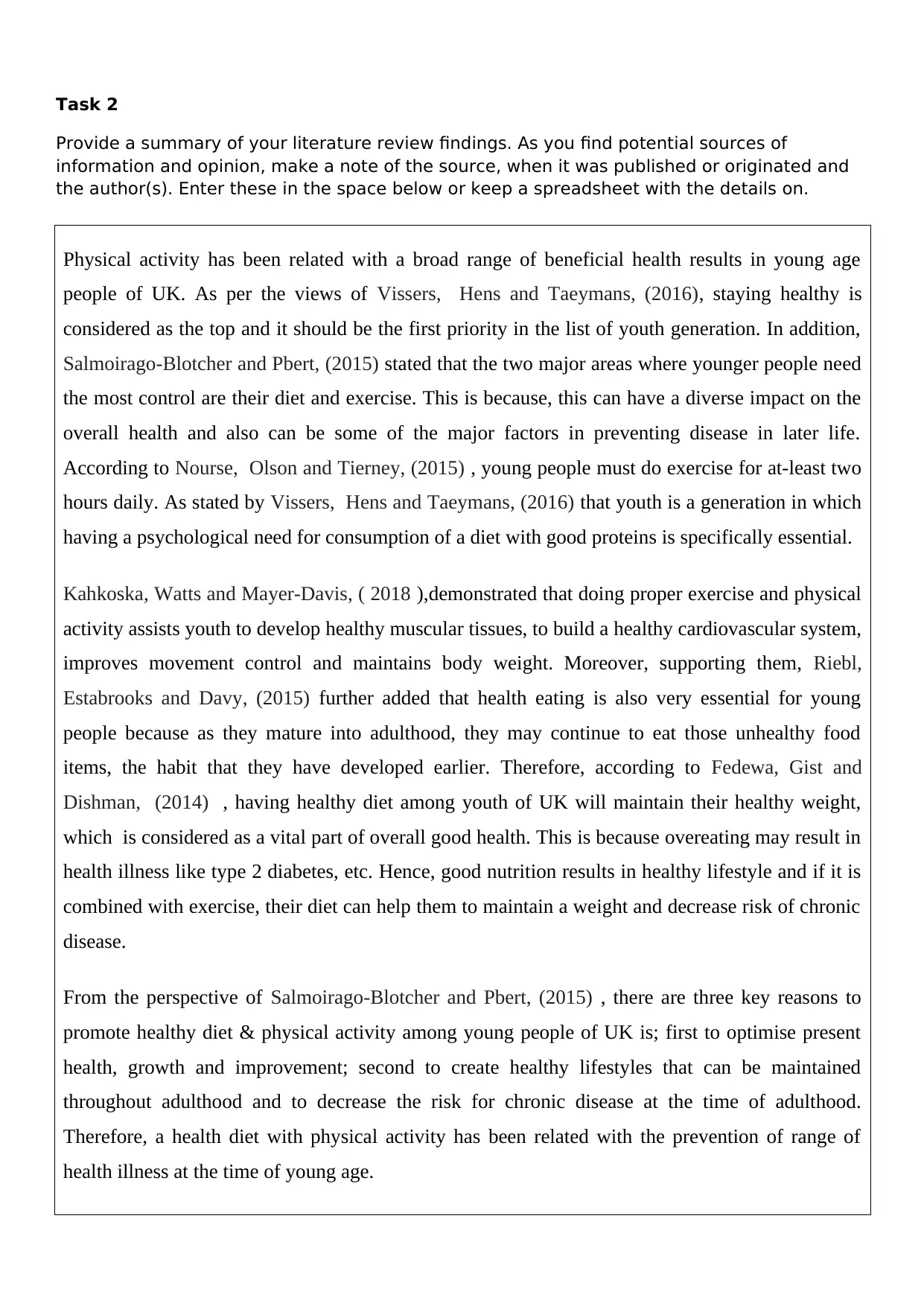
Physical activity has been related with a broad range of beneficial health results in young age
people of UK. As per the views of Vissers, Hens and Taeymans, (2016), staying healthy is
considered as the top and it should be the first priority in the list of youth generation. In addition,
Salmoirago-Blotcher and Pbert, (2015) stated that the two major areas where younger people need
the most control are their diet and exercise. This is because, this can have a diverse impact on the
overall health and also can be some of the major factors in preventing disease in later life.
According to Nourse, Olson and Tierney, (2015) , young people must do exercise for at-least two
hours daily. As stated by Vissers, Hens and Taeymans, (2016) that youth is a generation in which
having a psychological need for consumption of a diet with good proteins is specifically essential.
Kahkoska, Watts and Mayer-Davis, ( 2018 ),demonstrated that doing proper exercise and physical
activity assists youth to develop healthy muscular tissues, to build a healthy cardiovascular system,
improves movement control and maintains body weight. Moreover, supporting them, Riebl,
Estabrooks and Davy, (2015) further added that health eating is also very essential for young
people because as they mature into adulthood, they may continue to eat those unhealthy food
items, the habit that they have developed earlier. Therefore, according to Fedewa, Gist and
Dishman, (2014) , having healthy diet among youth of UK will maintain their healthy weight,
which is considered as a vital part of overall good health. This is because overeating may result in
health illness like type 2 diabetes, etc. Hence, good nutrition results in healthy lifestyle and if it is
combined with exercise, their diet can help them to maintain a weight and decrease risk of chronic
disease.
From the perspective of Salmoirago-Blotcher and Pbert, (2015) , there are three key reasons to
promote healthy diet & physical activity among young people of UK is; first to optimise present
health, growth and improvement; second to create healthy lifestyles that can be maintained
throughout adulthood and to decrease the risk for chronic disease at the time of adulthood.
Therefore, a health diet with physical activity has been related with the prevention of range of
health illness at the time of young age.
Provide a summary of your literature review findings. As you find potential sources of
information and opinion, make a note of the source, when it was published or originated and
the author(s). Enter these in the space below or keep a spreadsheet with the details on.
Physical activity has been related with a broad range of beneficial health results in young age
people of UK. As per the views of Vissers, Hens and Taeymans, (2016), staying healthy is
considered as the top and it should be the first priority in the list of youth generation. In addition,
Salmoirago-Blotcher and Pbert, (2015) stated that the two major areas where younger people need
the most control are their diet and exercise. This is because, this can have a diverse impact on the
overall health and also can be some of the major factors in preventing disease in later life.
According to Nourse, Olson and Tierney, (2015) , young people must do exercise for at-least two
hours daily. As stated by Vissers, Hens and Taeymans, (2016) that youth is a generation in which
having a psychological need for consumption of a diet with good proteins is specifically essential.
Kahkoska, Watts and Mayer-Davis, ( 2018 ),demonstrated that doing proper exercise and physical
activity assists youth to develop healthy muscular tissues, to build a healthy cardiovascular system,
improves movement control and maintains body weight. Moreover, supporting them, Riebl,
Estabrooks and Davy, (2015) further added that health eating is also very essential for young
people because as they mature into adulthood, they may continue to eat those unhealthy food
items, the habit that they have developed earlier. Therefore, according to Fedewa, Gist and
Dishman, (2014) , having healthy diet among youth of UK will maintain their healthy weight,
which is considered as a vital part of overall good health. This is because overeating may result in
health illness like type 2 diabetes, etc. Hence, good nutrition results in healthy lifestyle and if it is
combined with exercise, their diet can help them to maintain a weight and decrease risk of chronic
disease.
From the perspective of Salmoirago-Blotcher and Pbert, (2015) , there are three key reasons to
promote healthy diet & physical activity among young people of UK is; first to optimise present
health, growth and improvement; second to create healthy lifestyles that can be maintained
throughout adulthood and to decrease the risk for chronic disease at the time of adulthood.
Therefore, a health diet with physical activity has been related with the prevention of range of
health illness at the time of young age.
Paraphrase This Document
Need a fresh take? Get an instant paraphrase of this document with our AI Paraphraser
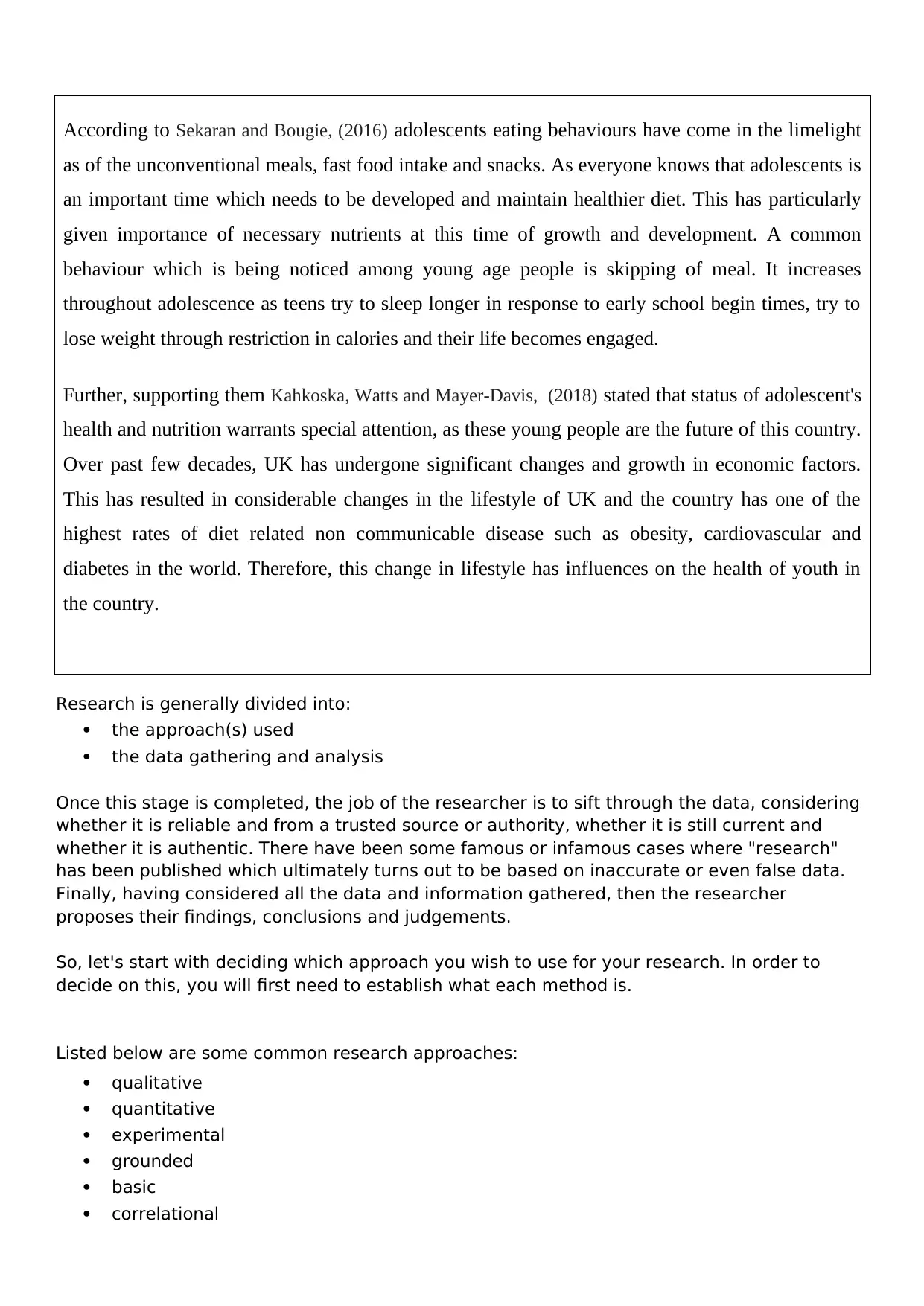
According to Sekaran and Bougie, (2016) adolescents eating behaviours have come in the limelight
as of the unconventional meals, fast food intake and snacks. As everyone knows that adolescents is
an important time which needs to be developed and maintain healthier diet. This has particularly
given importance of necessary nutrients at this time of growth and development. A common
behaviour which is being noticed among young age people is skipping of meal. It increases
throughout adolescence as teens try to sleep longer in response to early school begin times, try to
lose weight through restriction in calories and their life becomes engaged.
Further, supporting them Kahkoska, Watts and Mayer-Davis, (2018) stated that status of adolescent's
health and nutrition warrants special attention, as these young people are the future of this country.
Over past few decades, UK has undergone significant changes and growth in economic factors.
This has resulted in considerable changes in the lifestyle of UK and the country has one of the
highest rates of diet related non communicable disease such as obesity, cardiovascular and
diabetes in the world. Therefore, this change in lifestyle has influences on the health of youth in
the country.
Research is generally divided into:
the approach(s) used
the data gathering and analysis
Once this stage is completed, the job of the researcher is to sift through the data, considering
whether it is reliable and from a trusted source or authority, whether it is still current and
whether it is authentic. There have been some famous or infamous cases where "research"
has been published which ultimately turns out to be based on inaccurate or even false data.
Finally, having considered all the data and information gathered, then the researcher
proposes their findings, conclusions and judgements.
So, let's start with deciding which approach you wish to use for your research. In order to
decide on this, you will first need to establish what each method is.
Listed below are some common research approaches:
qualitative
quantitative
experimental
grounded
basic
correlational
as of the unconventional meals, fast food intake and snacks. As everyone knows that adolescents is
an important time which needs to be developed and maintain healthier diet. This has particularly
given importance of necessary nutrients at this time of growth and development. A common
behaviour which is being noticed among young age people is skipping of meal. It increases
throughout adolescence as teens try to sleep longer in response to early school begin times, try to
lose weight through restriction in calories and their life becomes engaged.
Further, supporting them Kahkoska, Watts and Mayer-Davis, (2018) stated that status of adolescent's
health and nutrition warrants special attention, as these young people are the future of this country.
Over past few decades, UK has undergone significant changes and growth in economic factors.
This has resulted in considerable changes in the lifestyle of UK and the country has one of the
highest rates of diet related non communicable disease such as obesity, cardiovascular and
diabetes in the world. Therefore, this change in lifestyle has influences on the health of youth in
the country.
Research is generally divided into:
the approach(s) used
the data gathering and analysis
Once this stage is completed, the job of the researcher is to sift through the data, considering
whether it is reliable and from a trusted source or authority, whether it is still current and
whether it is authentic. There have been some famous or infamous cases where "research"
has been published which ultimately turns out to be based on inaccurate or even false data.
Finally, having considered all the data and information gathered, then the researcher
proposes their findings, conclusions and judgements.
So, let's start with deciding which approach you wish to use for your research. In order to
decide on this, you will first need to establish what each method is.
Listed below are some common research approaches:
qualitative
quantitative
experimental
grounded
basic
correlational

descriptive
ethnographic
historical
You may not use more than one of these approaches, but then you may use several -
depending on the type of research and the way in which you need or want to collect data.
In order to do so it is important that you understand what they are.
In order to carry out a critical comparison of different types of research you need to review a
wide range of methods and come to justified conclusions of your method(s) choice.
ethnographic
historical
You may not use more than one of these approaches, but then you may use several -
depending on the type of research and the way in which you need or want to collect data.
In order to do so it is important that you understand what they are.
In order to carry out a critical comparison of different types of research you need to review a
wide range of methods and come to justified conclusions of your method(s) choice.
⊘ This is a preview!⊘
Do you want full access?
Subscribe today to unlock all pages.
Trusted by 1+ million students worldwide
Task 3
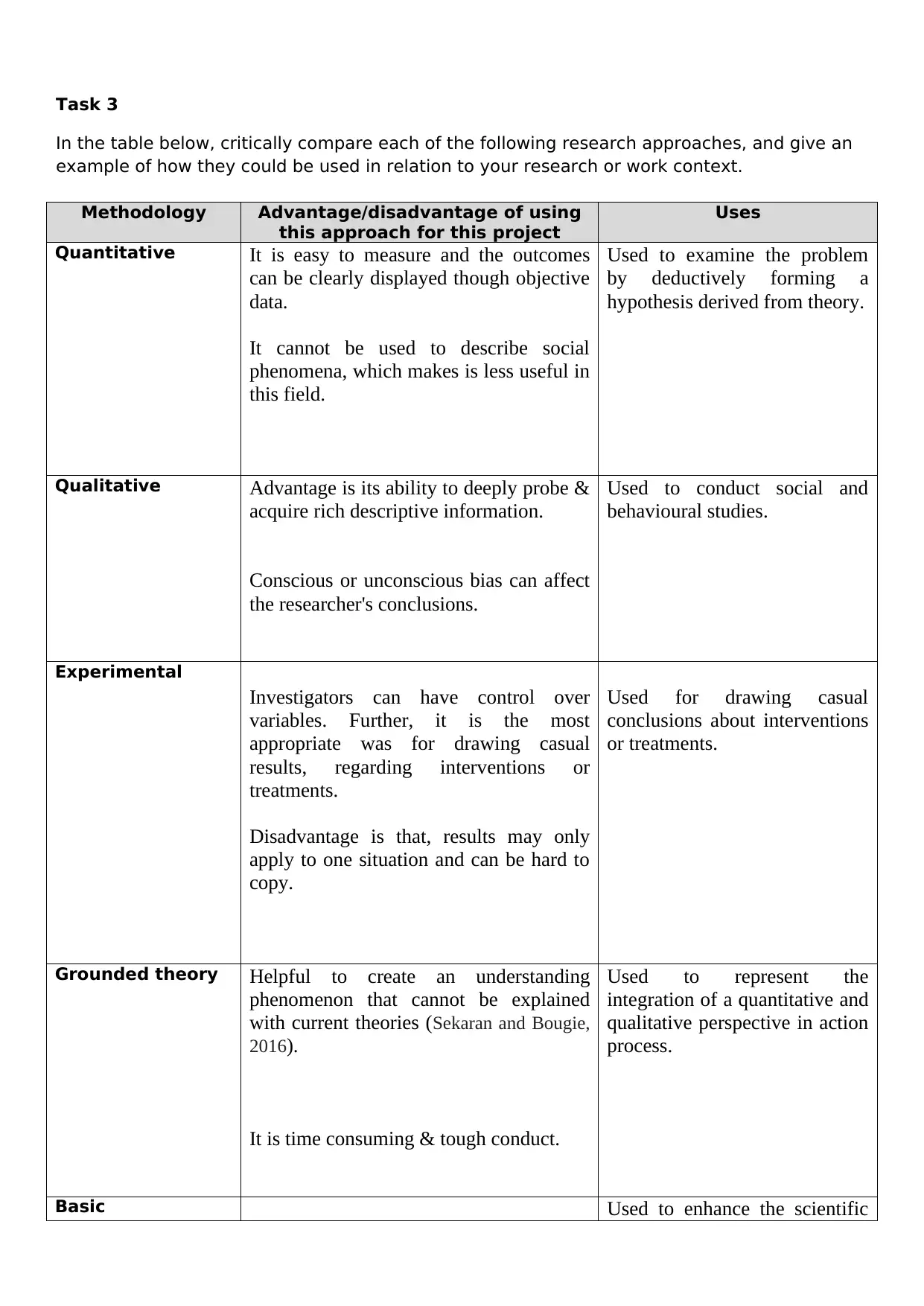
In the table below, critically compare each of the following research approaches, and give an
example of how they could be used in relation to your research or work context.
Methodology Advantage/disadvantage of using
this approach for this project
Uses
Quantitative It is easy to measure and the outcomes
can be clearly displayed though objective
data.
It cannot be used to describe social
phenomena, which makes is less useful in
this field.
Used to examine the problem
by deductively forming a
hypothesis derived from theory.
Qualitative Advantage is its ability to deeply probe &
acquire rich descriptive information.
Conscious or unconscious bias can affect
the researcher's conclusions.
Used to conduct social and
behavioural studies.
Experimental
Investigators can have control over
variables. Further, it is the most
appropriate was for drawing casual
results, regarding interventions or
treatments.
Disadvantage is that, results may only
apply to one situation and can be hard to
copy.
Used for drawing casual
conclusions about interventions
or treatments.
Grounded theory Helpful to create an understanding
phenomenon that cannot be explained
with current theories (Sekaran and Bougie,
2016).
It is time consuming & tough conduct.
Used to represent the
integration of a quantitative and
qualitative perspective in action
process.
Basic Used to enhance the scientific
In the table below, critically compare each of the following research approaches, and give an
example of how they could be used in relation to your research or work context.
Methodology Advantage/disadvantage of using
this approach for this project
Uses
Quantitative It is easy to measure and the outcomes
can be clearly displayed though objective
data.
It cannot be used to describe social
phenomena, which makes is less useful in
this field.
Used to examine the problem
by deductively forming a
hypothesis derived from theory.
Qualitative Advantage is its ability to deeply probe &
acquire rich descriptive information.
Conscious or unconscious bias can affect
the researcher's conclusions.
Used to conduct social and
behavioural studies.
Experimental
Investigators can have control over
variables. Further, it is the most
appropriate was for drawing casual
results, regarding interventions or
treatments.
Disadvantage is that, results may only
apply to one situation and can be hard to
copy.
Used for drawing casual
conclusions about interventions
or treatments.
Grounded theory Helpful to create an understanding
phenomenon that cannot be explained
with current theories (Sekaran and Bougie,
2016).
It is time consuming & tough conduct.
Used to represent the
integration of a quantitative and
qualitative perspective in action
process.
Basic Used to enhance the scientific
Paraphrase This Document
Need a fresh take? Get an instant paraphrase of this document with our AI Paraphraser
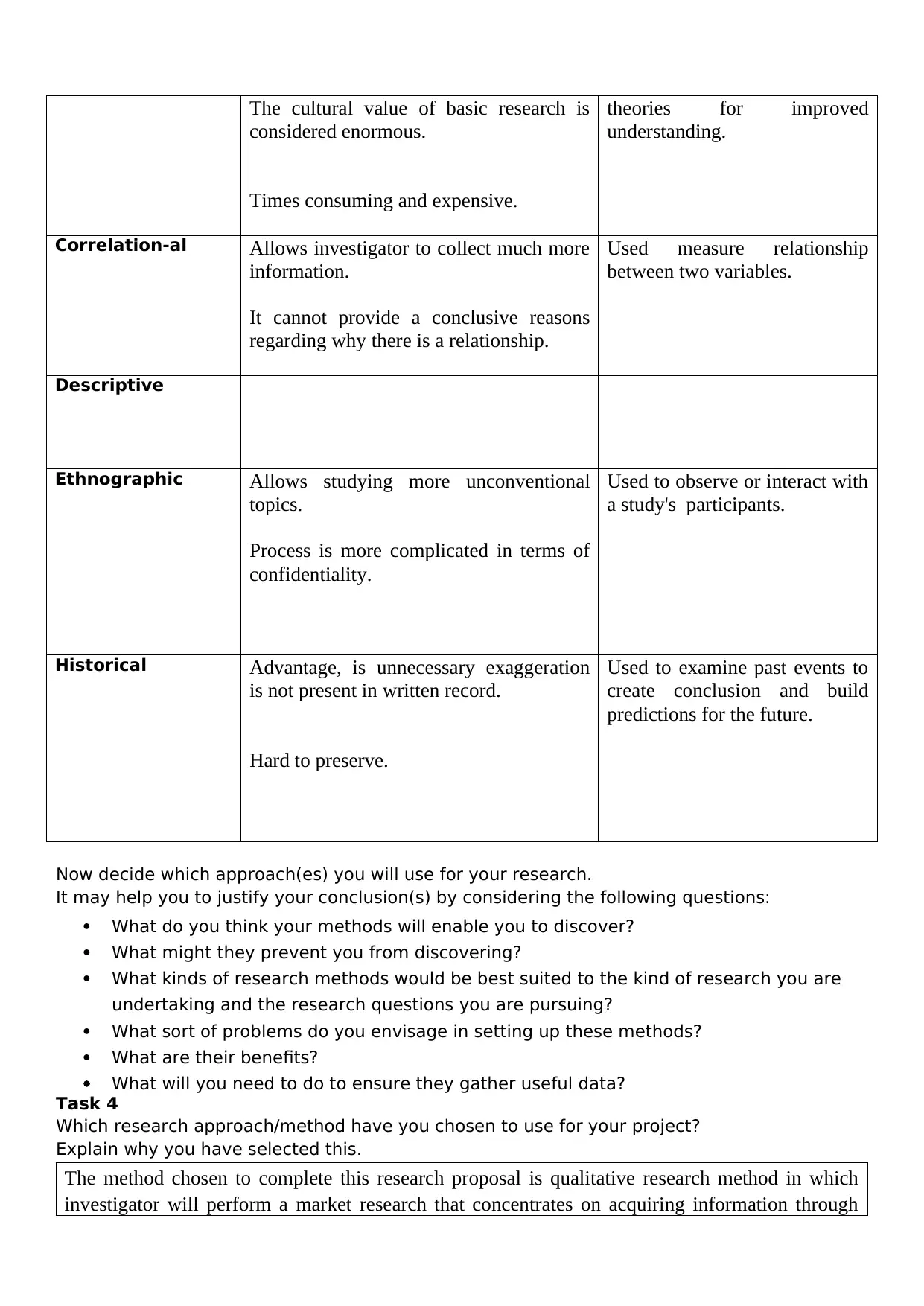
The cultural value of basic research is
considered enormous.
Times consuming and expensive.
theories for improved
understanding.
Correlation-al Allows investigator to collect much more
information.
It cannot provide a conclusive reasons
regarding why there is a relationship.
Used measure relationship
between two variables.
Descriptive
Ethnographic Allows studying more unconventional
topics.
Process is more complicated in terms of
confidentiality.
Used to observe or interact with
a study's participants.
Historical Advantage, is unnecessary exaggeration
is not present in written record.
Hard to preserve.
Used to examine past events to
create conclusion and build
predictions for the future.
Now decide which approach(es) you will use for your research.
It may help you to justify your conclusion(s) by considering the following questions:
What do you think your methods will enable you to discover?
What might they prevent you from discovering?
What kinds of research methods would be best suited to the kind of research you are
undertaking and the research questions you are pursuing?
What sort of problems do you envisage in setting up these methods?
What are their benefits?
What will you need to do to ensure they gather useful data?
Task 4
Which research approach/method have you chosen to use for your project?
Explain why you have selected this.
The method chosen to complete this research proposal is qualitative research method in which
investigator will perform a market research that concentrates on acquiring information through
considered enormous.
Times consuming and expensive.
theories for improved
understanding.
Correlation-al Allows investigator to collect much more
information.
It cannot provide a conclusive reasons
regarding why there is a relationship.
Used measure relationship
between two variables.
Descriptive
Ethnographic Allows studying more unconventional
topics.
Process is more complicated in terms of
confidentiality.
Used to observe or interact with
a study's participants.
Historical Advantage, is unnecessary exaggeration
is not present in written record.
Hard to preserve.
Used to examine past events to
create conclusion and build
predictions for the future.
Now decide which approach(es) you will use for your research.
It may help you to justify your conclusion(s) by considering the following questions:
What do you think your methods will enable you to discover?
What might they prevent you from discovering?
What kinds of research methods would be best suited to the kind of research you are
undertaking and the research questions you are pursuing?
What sort of problems do you envisage in setting up these methods?
What are their benefits?
What will you need to do to ensure they gather useful data?
Task 4
Which research approach/method have you chosen to use for your project?
Explain why you have selected this.
The method chosen to complete this research proposal is qualitative research method in which
investigator will perform a market research that concentrates on acquiring information through
open ended and conversational communication. This research method is chosen because this not
only tells about what people think, but also why they think so. Therefore, this method will allow
investigator to obtain in-depth information.
Under this research, simple random sampling will be used to acquire the importance of exercise
and health among UK's youth generation. In this technique every item in the population has an
even chance of being selected in the sample. The sample will basically focus on young people
who are of 13 to 21 age. It is the basic sampling approach where a large group of population will
be selected and each of the individual is selected entirely by chance and they all have even chance
of being included in the sample process. Benefits of this type of sampling is that it is free of
classification of error, it needs minimal advanced knowledge of the population. However, the list
of population which needs to be obtain is a difficult task.
Here the first step will be making list of all college going as well as all youngsters who are more
prone to unhealthy diet in UK. Then comes the sampling frame where young people and children
will be divided in age groups such as 1st group will cover 13 to 17 age then second group will
cover 18 to 21 age. Then random number generator will be used to choose sample by utilising
sampling frame.
Having considered the various research approaches, now you need to decide how you will
gather the data or information and what tools you will use to analyse it. Your project might
lend itself to case study formulation, or you may need to use observations. Or you may need
to collate data that has already been gathered and analyse this.
Examples of the range of methods that can assist researchers when collecting the data are:
experiments with completion of various tests measuring different abilities normally
linking performance and other factors
surveys where collecting data usually comes from large groups using questionnaires or
interviews – set time/event point or “before and after”
questionnaires that obtain information from large number of people (more private and
honest with no time pressure). Questionnaires can contain multiple choice questions,
attitude scales, closed questions and open-ended questions. Questionnaires can be
administered in a number of different ways (e.g. sent by post or as email attachments,
posted on Internet sites, handed out personally or administered to audience (such as
people attending conferences)
interviews which are usually carried out in person i.e. face-to-face but can also be
completed by telephone or using more advance computer technology such as Skype.
The approach can be formal or informal depending on the structure agreed with the
individual (check list, form, and questionnaire)
case studies that involve a detailed study of a particular case (a person or small group).
Various methods can be used (mainly observation and interviews)
participant / non participant observation which involves observing people and being
part of the observed group or “distance observations”
only tells about what people think, but also why they think so. Therefore, this method will allow
investigator to obtain in-depth information.
Under this research, simple random sampling will be used to acquire the importance of exercise
and health among UK's youth generation. In this technique every item in the population has an
even chance of being selected in the sample. The sample will basically focus on young people
who are of 13 to 21 age. It is the basic sampling approach where a large group of population will
be selected and each of the individual is selected entirely by chance and they all have even chance
of being included in the sample process. Benefits of this type of sampling is that it is free of
classification of error, it needs minimal advanced knowledge of the population. However, the list
of population which needs to be obtain is a difficult task.
Here the first step will be making list of all college going as well as all youngsters who are more
prone to unhealthy diet in UK. Then comes the sampling frame where young people and children
will be divided in age groups such as 1st group will cover 13 to 17 age then second group will
cover 18 to 21 age. Then random number generator will be used to choose sample by utilising
sampling frame.
Having considered the various research approaches, now you need to decide how you will
gather the data or information and what tools you will use to analyse it. Your project might
lend itself to case study formulation, or you may need to use observations. Or you may need
to collate data that has already been gathered and analyse this.
Examples of the range of methods that can assist researchers when collecting the data are:
experiments with completion of various tests measuring different abilities normally
linking performance and other factors
surveys where collecting data usually comes from large groups using questionnaires or
interviews – set time/event point or “before and after”
questionnaires that obtain information from large number of people (more private and
honest with no time pressure). Questionnaires can contain multiple choice questions,
attitude scales, closed questions and open-ended questions. Questionnaires can be
administered in a number of different ways (e.g. sent by post or as email attachments,
posted on Internet sites, handed out personally or administered to audience (such as
people attending conferences)
interviews which are usually carried out in person i.e. face-to-face but can also be
completed by telephone or using more advance computer technology such as Skype.
The approach can be formal or informal depending on the structure agreed with the
individual (check list, form, and questionnaire)
case studies that involve a detailed study of a particular case (a person or small group).
Various methods can be used (mainly observation and interviews)
participant / non participant observation which involves observing people and being
part of the observed group or “distance observations”
⊘ This is a preview!⊘
Do you want full access?
Subscribe today to unlock all pages.
Trusted by 1+ million students worldwide

1 out of 28


Related Documents


Your All-in-One AI-Powered Toolkit for Academic Success.
+13062052269
info@desklib.com
Available 24*7 on WhatsApp / Email
![[object Object]](/_next/static/media/star-bottom.7253800d.svg)
Unlock your academic potential
Copyright © 2020–2026 A2Z Services. All Rights Reserved. Developed and managed by ZUCOL.