Discussion Assignment 3: Anxiety and Related Disorders in Psychology

Verified

Added on  2022/11/14

|5
|1109
|78
Discussion Board Post
AI Summary
This discussion post analyzes a case study involving a patient experiencing symptoms of anxiety and potential PTSD. The student initially considers a heart attack, then a panic attack, before diagnosing the patient with PTSD based on the DSM-5 criteria. The student discusses the importance of gathering comprehensive information, including medical and family history, to arrive at an accurate differential diagnosis, considering other potential disorders like Generalized Anxiety Disorder, depression, and sleep disorders. The post recommends Cognitive Behavioral Therapy (CBT) as a suitable treatment approach for PTSD and emphasizes the value of understanding the nuances of different mental health conditions. The student reflects on the learning experience, highlighting the significance of gathering thorough client information and utilizing differential diagnostic processes. The assignment includes a reference list from a textbook on abnormal psychology.

Document Page
1
DISCUSSION ASSESSMENT 3
tabler-icon-diamond-filled.svg

Paraphrase This Document

Need a fresh take? Get an instant paraphrase of this document with our AI Paraphraser
Document Page
2
1.
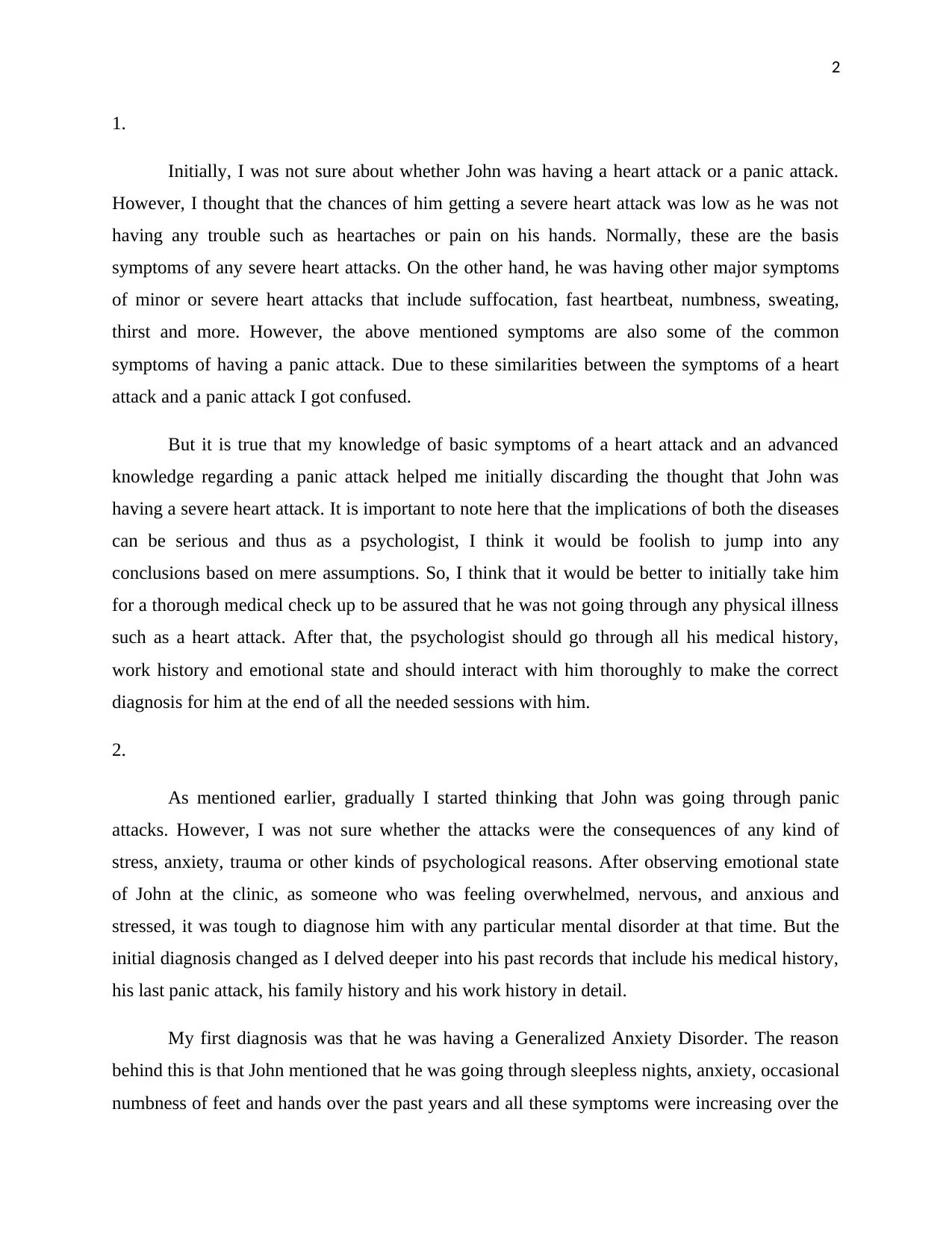
Initially, I was not sure about whether John was having a heart attack or a panic attack.
However, I thought that the chances of him getting a severe heart attack was low as he was not
having any trouble such as heartaches or pain on his hands. Normally, these are the basis
symptoms of any severe heart attacks. On the other hand, he was having other major symptoms
of minor or severe heart attacks that include suffocation, fast heartbeat, numbness, sweating,
thirst and more. However, the above mentioned symptoms are also some of the common
symptoms of having a panic attack. Due to these similarities between the symptoms of a heart
attack and a panic attack I got confused.
But it is true that my knowledge of basic symptoms of a heart attack and an advanced
knowledge regarding a panic attack helped me initially discarding the thought that John was
having a severe heart attack. It is important to note here that the implications of both the diseases
can be serious and thus as a psychologist, I think it would be foolish to jump into any
conclusions based on mere assumptions. So, I think that it would be better to initially take him
for a thorough medical check up to be assured that he was not going through any physical illness
such as a heart attack. After that, the psychologist should go through all his medical history,
work history and emotional state and should interact with him thoroughly to make the correct
diagnosis for him at the end of all the needed sessions with him.
2.
As mentioned earlier, gradually I started thinking that John was going through panic
attacks. However, I was not sure whether the attacks were the consequences of any kind of
stress, anxiety, trauma or other kinds of psychological reasons. After observing emotional state
of John at the clinic, as someone who was feeling overwhelmed, nervous, and anxious and
stressed, it was tough to diagnose him with any particular mental disorder at that time. But the
initial diagnosis changed as I delved deeper into his past records that include his medical history,
his last panic attack, his family history and his work history in detail.
My first diagnosis was that he was having a Generalized Anxiety Disorder. The reason
behind this is that John mentioned that he was going through sleepless nights, anxiety, occasional
numbness of feet and hands over the past years and all these symptoms were increasing over the
Document Page
3
years. However, I discarded this diagnosis when I analyzed his past records. My diagnosis
changed when I asked him about whether he had a partner in his office and he revealed all his
repressed feelings for witnessing the death of his colleague few years ago. He also mentioned
that he was having nightmares of that day when the tragic and trauma inducing incident
happened. I realized that he was under a lot of guilt for not being able to save that person. As a
result, he started avoiding the road where the incident happened and that was the reason behind
his reluctance to skip his work. These are the reasons that convinced me to change my initial
diagnosis of John.
3.
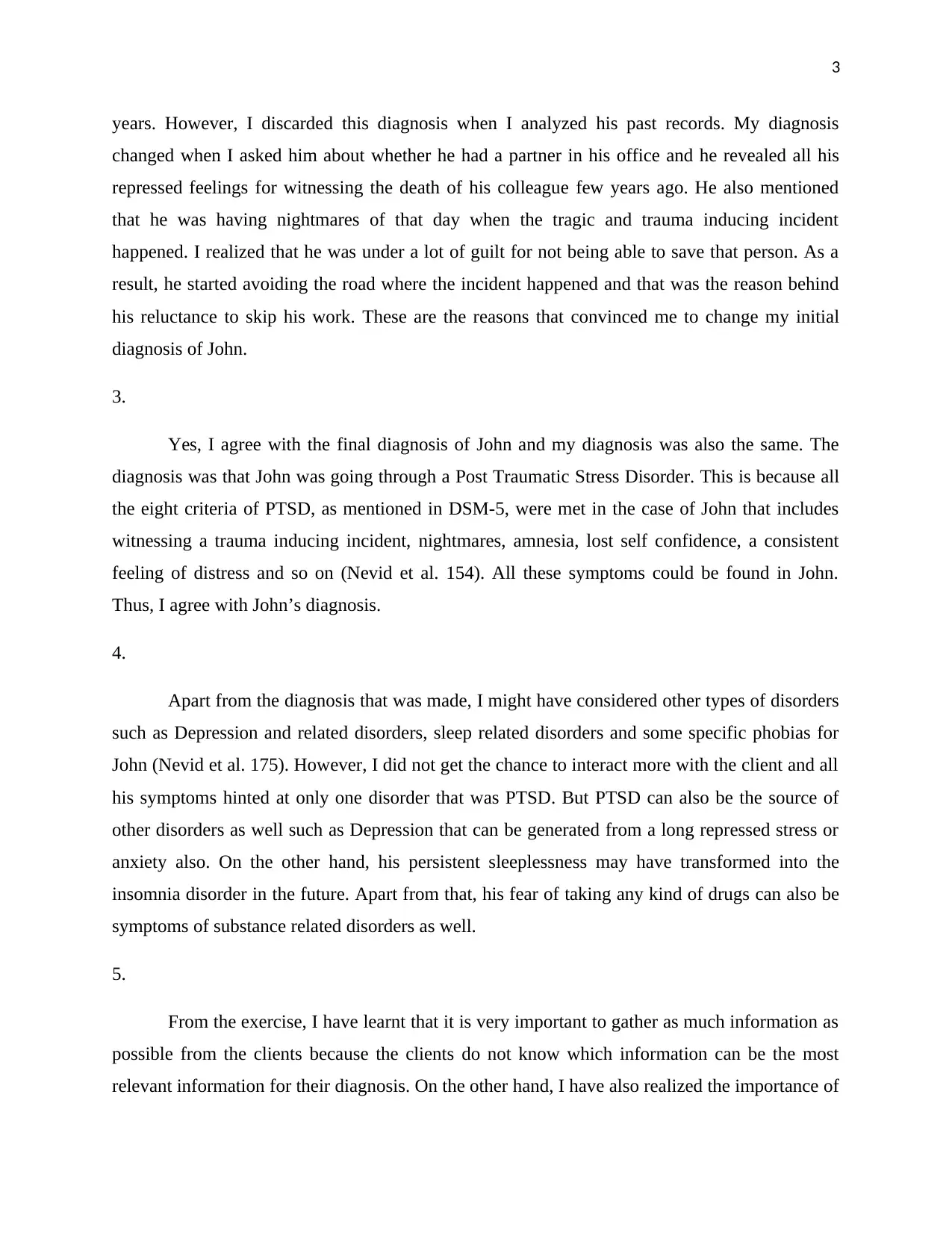
Yes, I agree with the final diagnosis of John and my diagnosis was also the same. The
diagnosis was that John was going through a Post Traumatic Stress Disorder. This is because all
the eight criteria of PTSD, as mentioned in DSM-5, were met in the case of John that includes
witnessing a trauma inducing incident, nightmares, amnesia, lost self confidence, a consistent
feeling of distress and so on (Nevid et al. 154). All these symptoms could be found in John.
Thus, I agree with John’s diagnosis.
4.
Apart from the diagnosis that was made, I might have considered other types of disorders
such as Depression and related disorders, sleep related disorders and some specific phobias for
John (Nevid et al. 175). However, I did not get the chance to interact more with the client and all
his symptoms hinted at only one disorder that was PTSD. But PTSD can also be the source of
other disorders as well such as Depression that can be generated from a long repressed stress or
anxiety also. On the other hand, his persistent sleeplessness may have transformed into the
insomnia disorder in the future. Apart from that, his fear of taking any kind of drugs can also be
symptoms of substance related disorders as well.
5.
From the exercise, I have learnt that it is very important to gather as much information as
possible from the clients because the clients do not know which information can be the most
relevant information for their diagnosis. On the other hand, I have also realized the importance of
Document Page
4
differential diagnosis that includes consideration of each and every category of mental disorders.
This is important because many mental disorders have a high level of similarities but have
certain uniqueness that makes them different from each other. Thus all the categories of mental
disorders need to be considered while dealing with any client in order to give the correct
diagnosis.
6.
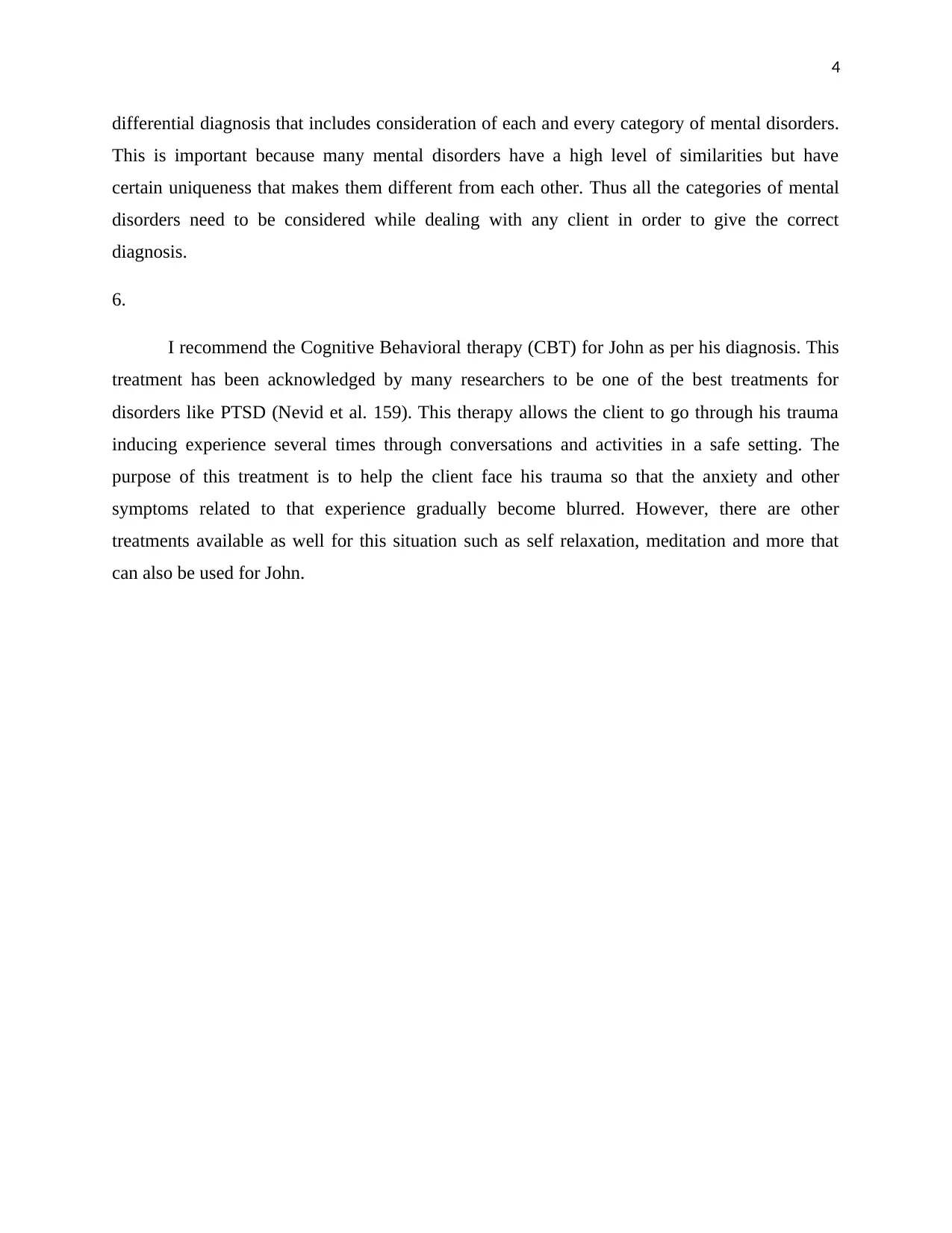
I recommend the Cognitive Behavioral therapy (CBT) for John as per his diagnosis. This
treatment has been acknowledged by many researchers to be one of the best treatments for
disorders like PTSD (Nevid et al. 159). This therapy allows the client to go through his trauma
inducing experience several times through conversations and activities in a safe setting. The
purpose of this treatment is to help the client face his trauma so that the anxiety and other
symptoms related to that experience gradually become blurred. However, there are other
treatments available as well for this situation such as self relaxation, meditation and more that
can also be used for John.
tabler-icon-diamond-filled.svg

Paraphrase This Document

Need a fresh take? Get an instant paraphrase of this document with our AI Paraphraser
Document Page
5
Reference list
Nevid, Jeffrey S., Spencer A. Rathus, and Beverly Greene. Abnormal psychology in a changing
world. Upper Saddle River: Prentice Hall, 2003.
chevron_up_icon
1 out of 5
circle_padding
hide_on_mobile
zoom_out_icon
[object Object]