University Calculus: Differential Equations Homework and Solutions

Verified

Added on  2022/08/27

|8
|2910
|37
Homework Assignment
AI Summary
This document presents solutions to a series of differential equation problems, covering various aspects of the subject. The solutions begin with solving specific differential equations using techniques such as rearranging, comparing with Bernoulli equations, and finding integrating factors. Subsequent problems involve solving first-order ODEs, determining equilibrium solutions, analyzing their stability using phase lines, and discussing the long-term behavior of the system. The solutions also include detailed explanations of the steps taken to solve the problems, making use of concepts like autonomous equations, and the application of stability analysis. Finally, the document addresses bifurcation diagrams and provides a step-by-step solution for constructing a bifurcation diagram for a given ODE, including stability analysis of equilibrium points.
Document Page
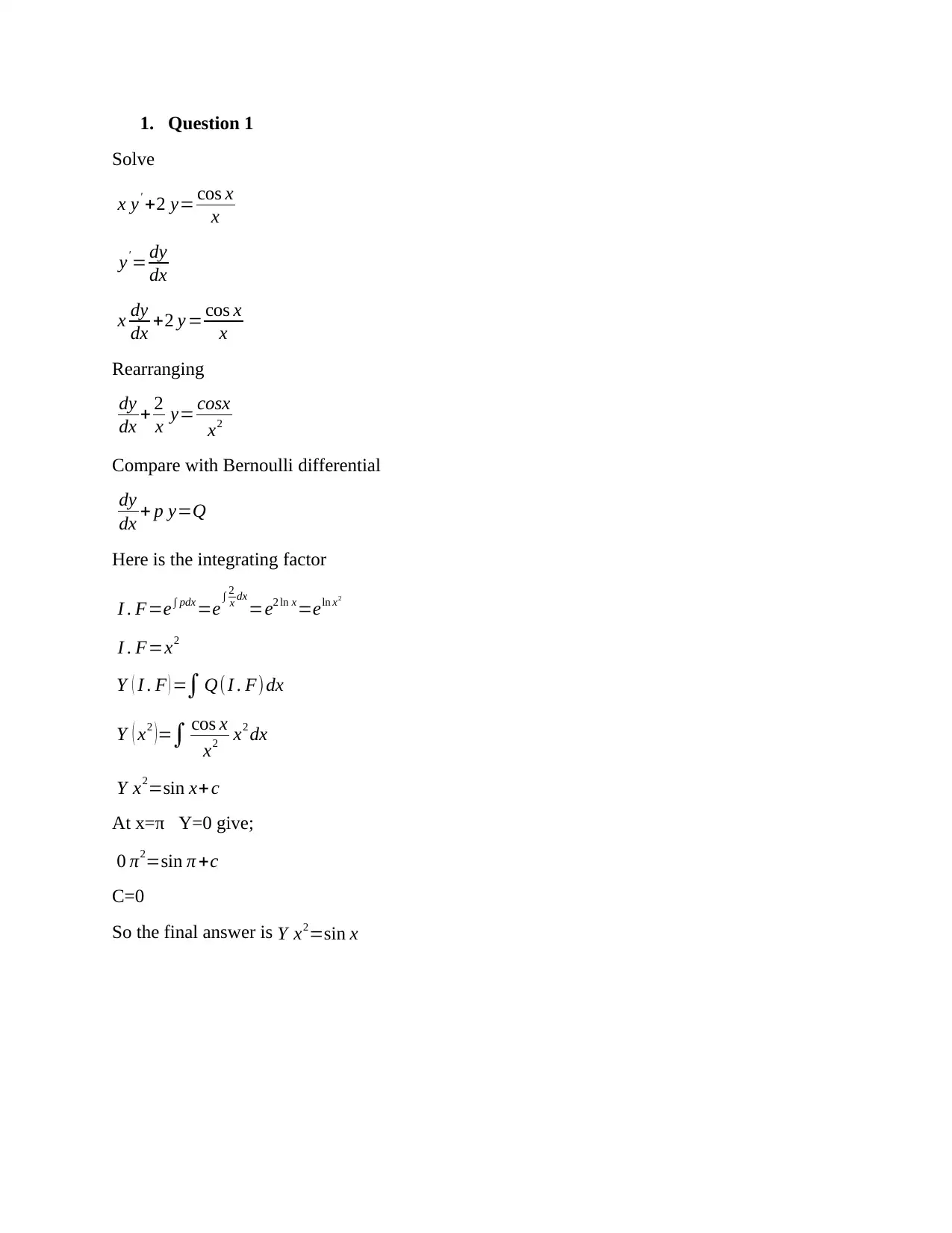
1. Question 1
Solve
x y' +2 y= cos x
x
y' = dy
dx
x dy
dx +2 y = cos x
x
Rearranging
dy
dx + 2
x y= cosx
x2
Compare with Bernoulli differential
dy
dx + p y=Q
Here is the integrating factor
I . F=e pdx =e 2
x dx
=e2 ln x=eln x2
I . F=x2
Y ( I . F ) = Q(I . F)dx
Y ( x2 ) = cos x
x2 x2 dx
Y x2=sin x+ c
At x=π Y=0 give;
0 π2=sin π +c
C=0
So the final answer is Y x2=sin x
tabler-icon-diamond-filled.svg

Paraphrase This Document

Need a fresh take? Get an instant paraphrase of this document with our AI Paraphraser
Document Page
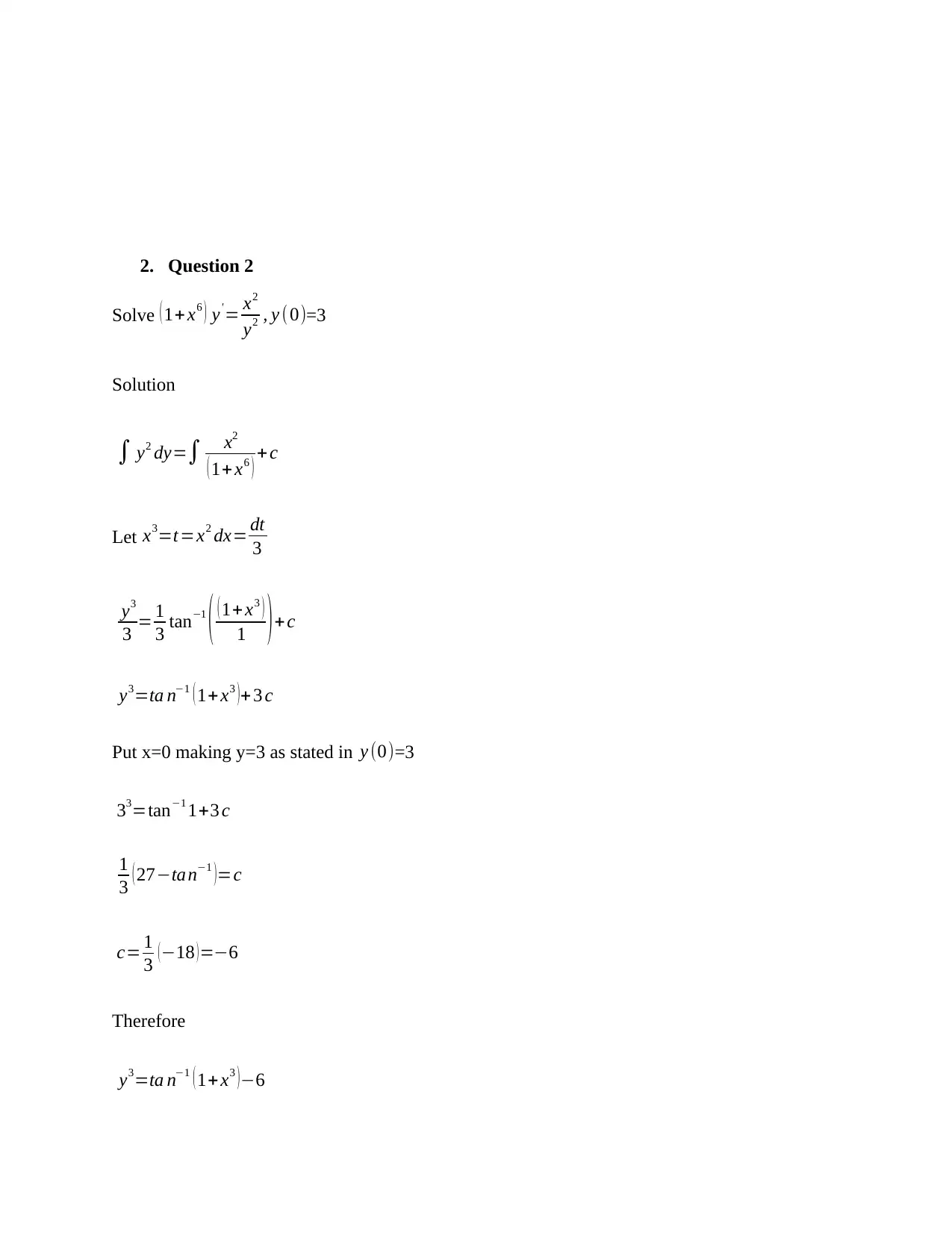
2. Question 2
Solve ( 1+ x6 ) y' = x2
y2 , y (0)=3
Solution
y2 dy= x2
( 1+ x6 ) +c
Let x3=t=x2 dx= dt
3
y3
3 = 1
3 tan1
( ( 1+ x3 )
1 ) + c
y3=ta n1 ( 1+ x3 )+ 3 c
Put x=0 making y=3 as stated in y (0)=3
33=tan1 1+3 c
1
3 ( 27ta n1 )=c
c= 1
3 (18 )=6
Therefore
y3=ta n1 ( 1+ x3 )6
Document Page
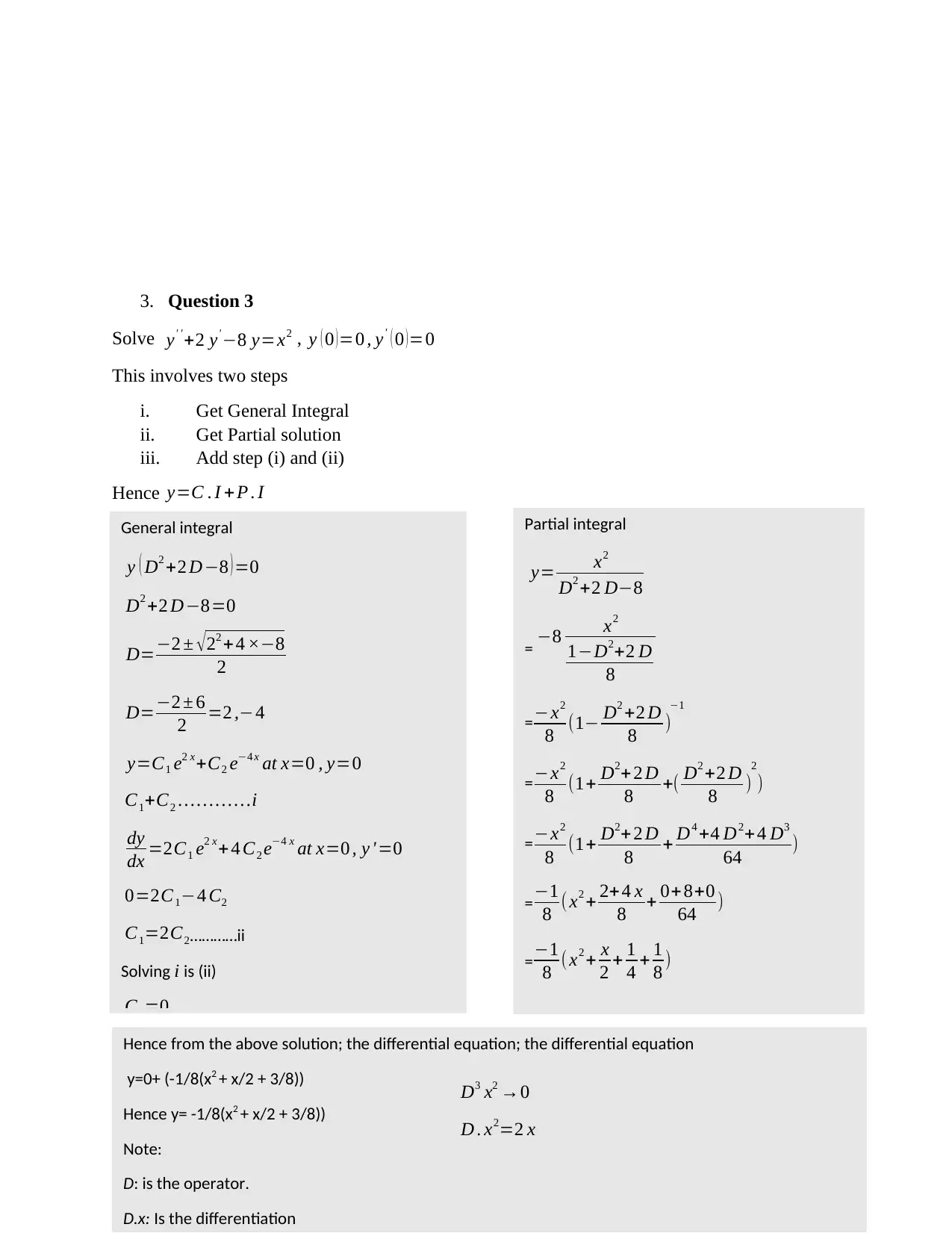
3. Question 3
Solve y' '+2 y' 8 y=x2 , y ( 0 )=0 , y' ( 0 )=0
This involves two steps
i. Get General Integral
ii. Get Partial solution
iii. Add step (i) and (ii)
Hence y=C . I + P . I
4.
General integral
y ( D2 +2 D8 ) =0
D2 +2 D8=0
D=2 ± 22 +4 ×8
2
D=2 ± 6
2 =2 ,4
y=C1 e2 x+C2 e4 x at x=0 , y=0
C1+C2 i
dy
dx =2C1 e2 x+ 4 C2 e4 x at x=0 , y '=0
0=2C14 C2
C1=2C2…………ii
Solving i is (ii)
C2=0
Partial integral
y= x2
D2 +2 D8
= 8 x2
1D2+2 D
8
= x2
8 (1 D2 +2 D
8 )
1
=x2
8 (1+ D2+ 2 D
8 +( D2 +2 D
8 )
2
)
=x2
8 (1+ D2+ 2 D
8 + D4 +4 D2+ 4 D3
64 )
=1
8 ( x2 + 2+ 4 x
8 + 0+ 8+0
64 )
= 1
8 ( x2 + x
2 + 1
4 + 1
8 )
Hence from the above solution; the differential equation; the differential equation
y=0+ (-1/8(x2 + x/2 + 3/8))
Hence y= -1/8(x2 + x/2 + 3/8))
Note:
D: is the operator.
D.x: Is the differentiation
D3 x2 0
D . x2=2 x
Document Page
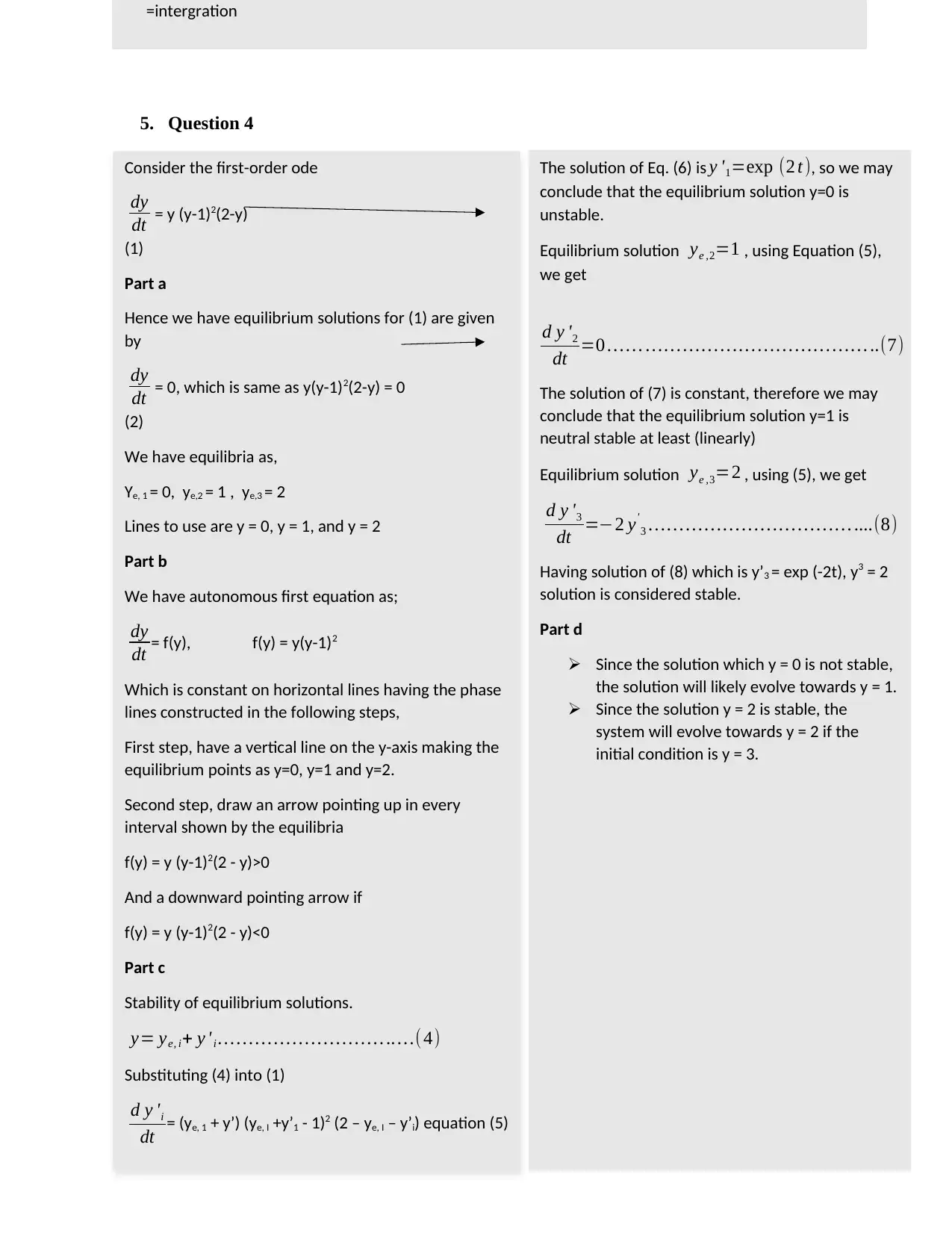
5. Question 4
=intergration
Consider the first-order ode
dy
dt = y (y-1)2(2-y)
(1)
Part a
Hence we have equilibrium solutions for (1) are given
by
dy
dt = 0, which is same as y(y-1)2(2-y) = 0
(2)
We have equilibria as,
Ye, 1 = 0, ye,2 = 1 , ye,3 = 2
Lines to use are y = 0, y = 1, and y = 2
Part b
We have autonomous first equation as;
dy
dt = f(y), f(y) = y(y-1)2
Which is constant on horizontal lines having the phase
lines constructed in the following steps,
First step, have a vertical line on the y-axis making the
equilibrium points as y=0, y=1 and y=2.
Second step, draw an arrow pointing up in every
interval shown by the equilibria
f(y) = y (y-1)2(2 - y)>0
And a downward pointing arrow if
f(y) = y (y-1)2(2 - y)<0
Part c
Stability of equilibrium solutions.
y= ye, i+ y 'i .. (4)
Substituting (4) into (1)
d y 'i
dt = (ye, 1 + y’) (ye, I +y’1 - 1)2 (2 – ye, I – y’i) equation (5)
Neglecting quadratic terms in y 'i , for the equilibrium
The solution of Eq. (6) is y '1=exp (2 t), so we may
conclude that the equilibrium solution y=0 is
unstable.
Equilibrium solution ye ,2=1 , using Equation (5),
we get
d y '2
dt =0 ..(7)
The solution of (7) is constant, therefore we may
conclude that the equilibrium solution y=1 is
neutral stable at least (linearly)
Equilibrium solution ye ,3=2 , using (5), we get
d y '3
dt =2 y'
3 ....(8)
Having solution of (8) which is y’3 = exp (-2t), y3 = 2
solution is considered stable.
Part d
Since the solution which y = 0 is not stable,
the solution will likely evolve towards y = 1.
Since the solution y = 2 is stable, the
system will evolve towards y = 2 if the
initial condition is y = 3.
tabler-icon-diamond-filled.svg

Paraphrase This Document

Need a fresh take? Get an instant paraphrase of this document with our AI Paraphraser
Document Page
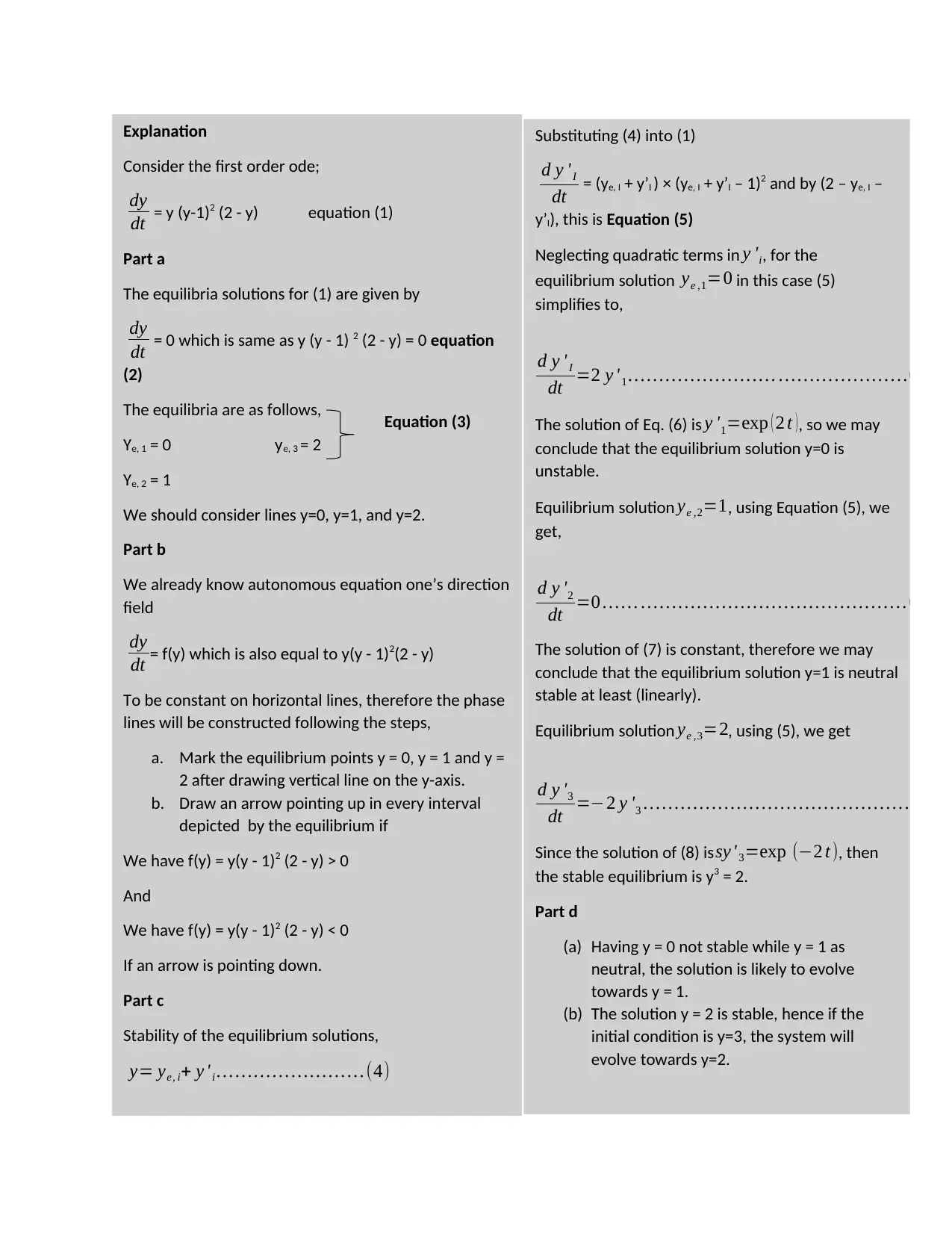
Explanation
Consider the first order ode;
dy
dt = y (y-1)2 (2 - y) equation (1)
Part a
The equilibria solutions for (1) are given by
dy
dt = 0 which is same as y (y - 1) 2 (2 - y) = 0 equation
(2)
The equilibria are as follows,
Ye, 1 = 0 ye, 3 = 2
Ye, 2 = 1
We should consider lines y=0, y=1, and y=2.
Part b
We already know autonomous equation one’s direction
field
dy
dt = f(y) which is also equal to y(y - 1)2(2 - y)
To be constant on horizontal lines, therefore the phase
lines will be constructed following the steps,
a. Mark the equilibrium points y = 0, y = 1 and y =
2 after drawing vertical line on the y-axis.
b. Draw an arrow pointing up in every interval
depicted by the equilibrium if
We have f(y) = y(y - 1)2 (2 - y) > 0
And
We have f(y) = y(y - 1)2 (2 - y) < 0
If an arrow is pointing down.
Part c
Stability of the equilibrium solutions,
y= ye, i+ y 'i (4)
Substituting (4) into (1)
d y 'I
dt = (ye, I + y’I ) × (ye, I + y’I – 1)2 and by (2 – ye, I
y’I), this is Equation (5)
Neglecting quadratic terms in y 'i, for the
equilibrium solution ye ,1=0 in this case (5)
simplifies to,
d y ' I
dt =2 y '1 (6)
The solution of Eq. (6) is y '1=exp ( 2 t ), so we may
conclude that the equilibrium solution y=0 is
unstable.
Equilibrium solution ye ,2=1, using Equation (5), we
get,
d y '2
dt =0 .(7)
The solution of (7) is constant, therefore we may
conclude that the equilibrium solution y=1 is neutral
stable at least (linearly).
Equilibrium solution ye ,3=2, using (5), we get
d y '3
dt =2 y '3 .(7)
Since the solution of (8) is sy '3=exp (2 t), then
the stable equilibrium is y3 = 2.
Part d
(a) Having y = 0 not stable while y = 1 as
neutral, the solution is likely to evolve
towards y = 1.
(b) The solution y = 2 is stable, hence if the
initial condition is y=3, the system will
evolve towards y=2.
Equation (3)
Document Page
6. Question 5
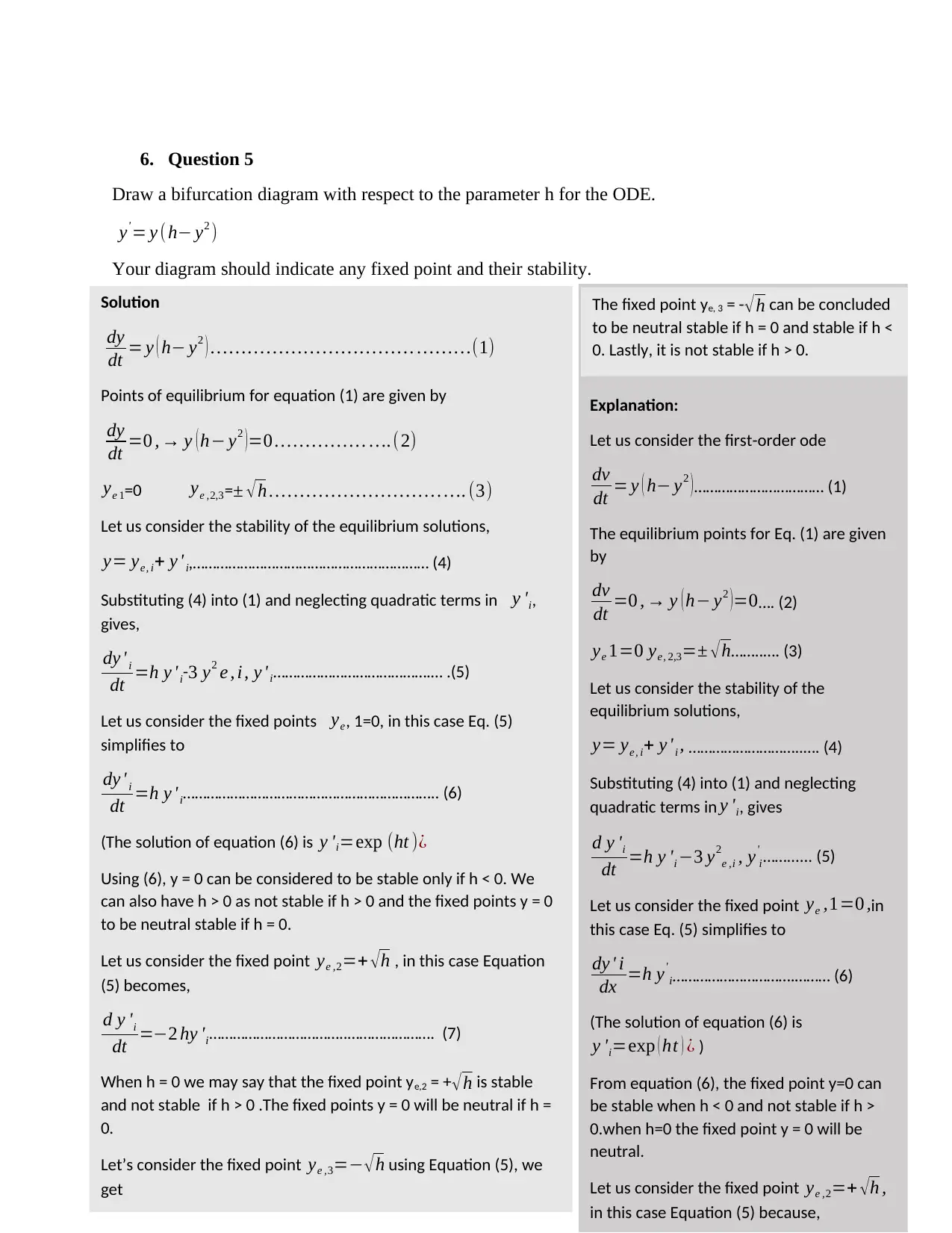
Draw a bifurcation diagram with respect to the parameter h for the ODE.
y' = y (h y2 )
Your diagram should indicate any fixed point and their stability.
Solution
dy
dt = y ( h y2 ) (1)
Points of equilibrium for equation (1) are given by
dy
dt =0 , y ( h y2 )=0 .(2)
ye 1=0 ye ,2,3=± h . . (3)
Let us consider the stability of the equilibrium solutions,
y= ye, i+ y ' i,…………………………………………………… (4)
Substituting (4) into (1) and neglecting quadratic terms in y 'i,
gives,
dy ' i
dt =h y 'i-3 y2 e , i, y 'i………………………………….… .(5)
Let us consider the fixed points ye, 1=0, in this case Eq. (5)
simplifies to
dy ' i
dt =h y 'i……………………………………………………….. (6)
(The solution of equation (6) is y 'i=exp (ht )¿
Using (6), y = 0 can be considered to be stable only if h < 0. We
can also have h > 0 as not stable if h > 0 and the fixed points y = 0
to be neutral stable if h = 0.
Let us consider the fixed point ye ,2=+ h , in this case Equation
(5) becomes,
d y 'i
dt =2 hy 'i……………………………..…………………. (7)
When h = 0 we may say that the fixed point ye,2 = +h is stable
and not stable if h > 0 .The fixed points y = 0 will be neutral if h =
0.
Let’s consider the fixed point ye ,3= h using Equation (5), we
get
Explanation:
Let us consider the first-order ode
dv
dt = y ( h y2 )…………………………… (1)
The equilibrium points for Eq. (1) are given
by
dv
dt =0 , y ( h y2 )=0…. (2)
ye 1=0 ye, 2,3=± h……..…. (3)
Let us consider the stability of the
equilibrium solutions,
y= ye, i+ y 'i , ………………………..…. (4)
Substituting (4) into (1) and neglecting
quadratic terms in y 'i, gives
d y 'i
dt =h y 'i 3 y2
e ,i , y'
i……...... (5)
Let us consider the fixed point ye ,1=0 ,in
this case Eq. (5) simplifies to
dy ' i
dx =h y'
i………………………….……… (6)
(The solution of equation (6) is
y 'i=exp ( ht ) ¿ )
From equation (6), the fixed point y=0 can
be stable when h < 0 and not stable if h >
0.when h=0 the fixed point y = 0 will be
neutral.
Let us consider the fixed point ye ,2=+ h ,
in this case Equation (5) because,
The fixed point ye, 3 = -h can be concluded
to be neutral stable if h = 0 and stable if h <
0. Lastly, it is not stable if h > 0.
Document Page
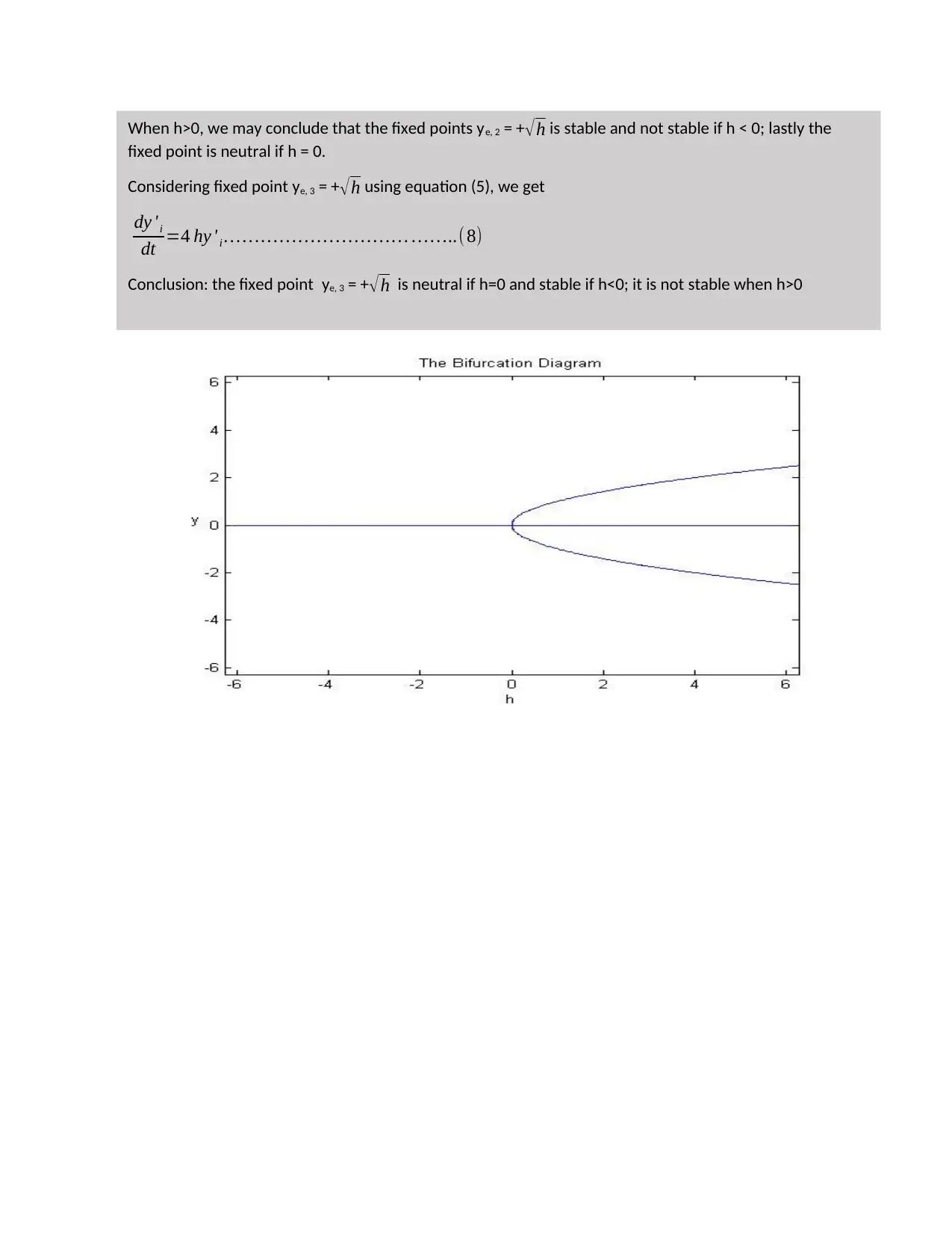
When h>0, we may conclude that the fixed points ye, 2 = +h is stable and not stable if h < 0; lastly the
fixed point is neutral if h = 0.
Considering fixed point ye, 3 = +h using equation (5), we get
dy 'i
dt =4 hy ' i ..( 8)
Conclusion: the fixed point ye, 3 = +h is neutral if h=0 and stable if h<0; it is not stable when h>0
tabler-icon-diamond-filled.svg

Paraphrase This Document

Need a fresh take? Get an instant paraphrase of this document with our AI Paraphraser
Document Page
chevron_up_icon
1 out of 8
circle_padding
hide_on_mobile
zoom_out_icon
[object Object]