BUSI 601: Digby's Crucial Strategy and Marketing Analysis

Verified

Added on  2022/08/14

|8
|1070
|11
Report
AI Summary
This report provides an analysis of Digby's company, focusing on its functional strategy, particularly within the marketing department. The analysis begins with an introduction to strategy, defining its importance and outlining different strategy types, with a specific emphasis on functional-level strategies. The report delves into the internal system factors relevant to a business's strategy, highlighting the importance of the marketing department in revenue generation and brand recognition. The company's financial performance, as revealed by simulation data, including ROS, ROA, ROE, and sales figures, is reviewed to assess the company's position. The report emphasizes the significance of aligning internal factors with the marketing department's strategy to achieve a competitive advantage. The analysis includes a discussion of the marketing department's functions, relevant internal factors such as resource allocation, human resources, and KPIs. The conclusion summarizes the findings, suggesting a business-level strategy to effectively address market competition and internal factors within the marketing department for long-term organizational benefits. The report is based on the BUSI 601 course at University Canada West and includes financial data from the provided annual report.
Document Page
Running Head: DIGBY’S CRUCIAL STRATEGY 1
DIGBY’S CRUCIAL STRATEGY
tabler-icon-diamond-filled.svg

Paraphrase This Document

Need a fresh take? Get an instant paraphrase of this document with our AI Paraphraser
Document Page
DIGBY’S CRUCIAL STRATEGY 2
Table of Contents
Introduction................................................................................................................................3
Internal system factors relevant to a specific business’ strategy................................................3
Conclusion..................................................................................................................................6
Reference....................................................................................................................................7
Document Page
DIGBY’S CRUCIAL STRATEGY 3
Introduction
Every business has various different departments that contributes to its productivity and
the primary source of revenue is dependent upon its sales and marketing activities. In this
current discussion Digby’s company’s key functional department have been analysed. The
company has four areas of core functionalities including production and planning, research
and development, finance and marketing and sales. Marketing department constitutes and
conducts various functions and is considered most crucial in making specific business
strategy.
Internal system factors relevant to a specific business’
strategy
Strategy is the course of action that managers of the business undertake for achieving one
or more organisation goal. Strategy sets course for varied organisational activities by
utilisation of various available scarce resource to attain a desirable state in the future.
Encompassing a strategic course of action is essential for the business as it is nearly
impossible to foresee the future hence strategy deals with long term developments (Teece,
2010). There are four main types of strategy such as the corporate level strategy, business
level strategy, functional strategy and operating level strategy. The current strategy adopted
will be a functional level strategy suitable for dealing with competition and the internal
system it will be applied to is marketing department.
A corporate strategy is a type which may be developed by the corporate management for
pursuing stability, growth, retrenchment and combination of types of strategies. These are
broader types of strategy that might be adopted for the entire organisation. Business level
strategies is fundamentally concerned with competition. Michael Porter’s three generic
strategies include cost-leadership, differentiation and focus strategy. These are the types of
Document Page
DIGBY’S CRUCIAL STRATEGY 4
strategy that enables a business to succeed in the market. The current business will be
implementing this type of strategy for excelling in the market. Functional strategy might be
an operational, marketing, finance or human resource strategy. By conducting a SWOT
(Strength, weakness, opportunity and threat) analysis an organisation might be able to
determine the area of functionality that it is lagging behind and then determine suitable
strategic course of action.
Analysing the business of the company from simulation data, reveals that the company’s
ROS is at 16.3% with asset turnover being at 1.25. The company have been steadily
generating ROA at 20.3% with leveraging at 1.2. The ROE of the company is at 24.5% and
sales is $ 52,280, 466. It has quite high EBIT and profits in comparison with other
organisations for which the simulation had also been undertaken. The Contributory Margin of
the company is at 35.5%. Further the cash flow and share prices reveals stable position of the
company. With a stable profit history of the company, in case it takes further marketing
endeavours then the company can become more competitive and gain greater share of the
market. With well-aligned internal production functions, the company can apply strategic
directions for its marketing department for success of the company. A functional strategy for
the marketing department can yield valuable suggestion for the department allow aligning of
internal factors to cope up to external competitive forces.
The marketing department of the business is the core department possessing capability to
generate tremendous revenue for the business by enhancing its brand name and brand
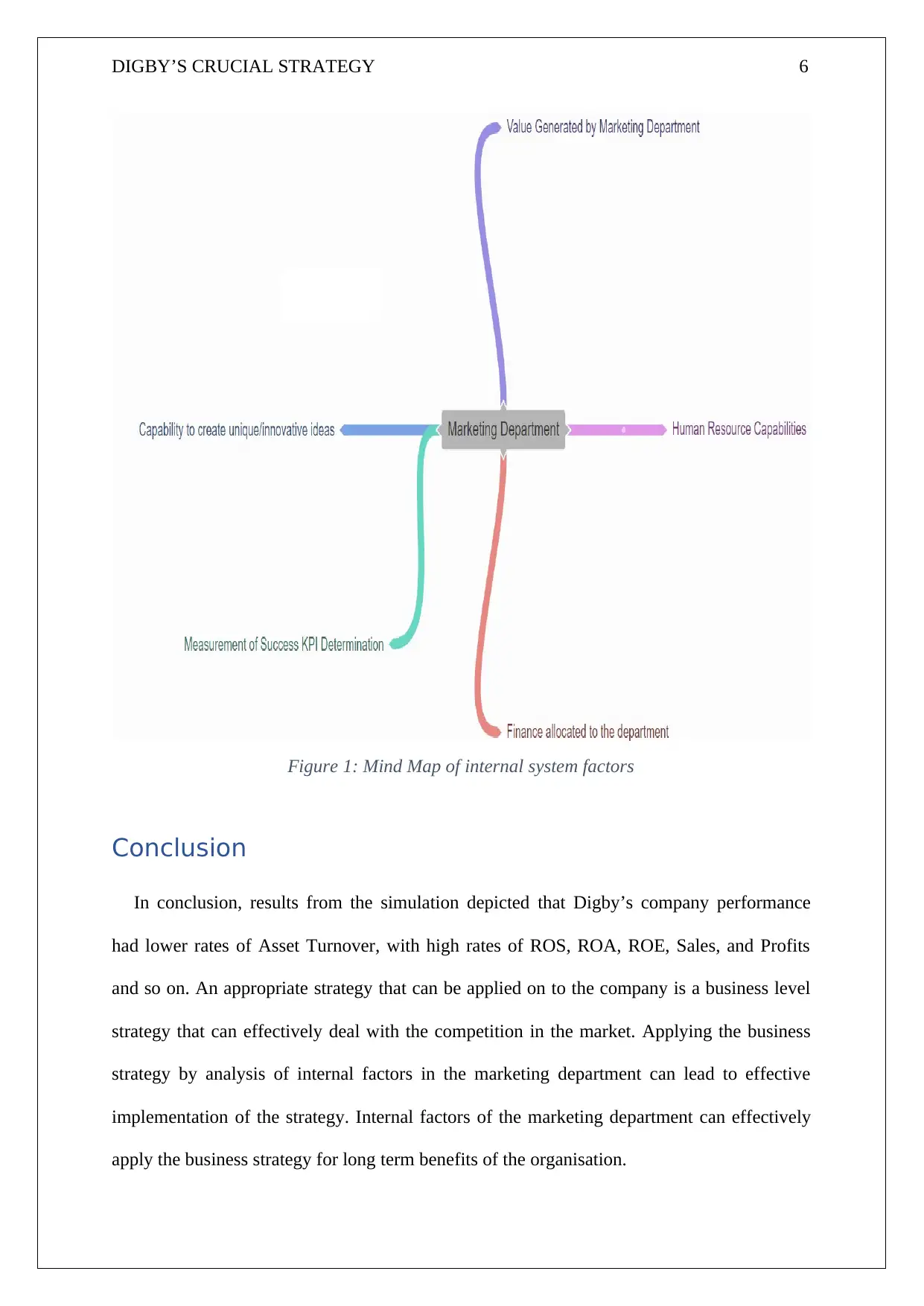
recognition (Hsieh, & Chen, 2011). The marketing internal system factors that are relevant to
this business level strategy includes resource allocated to this department, human resource
and other capabilities that can suitably apply strategic course in action and KPI (key
performance indicator) measuring success of the business strategy.
tabler-icon-diamond-filled.svg

Paraphrase This Document

Need a fresh take? Get an instant paraphrase of this document with our AI Paraphraser
Document Page
DIGBY’S CRUCIAL STRATEGY 5
The marketing department of the organisation has various functions such as strategy
making, advertising for sales and promotions, conducting marketing research, understanding
marketing position, its customers, company’s focus, sales promotions and so on. This
department is affected by a number of internal factors that in turn impacts the success or
failure of a particular strategy (Parnell, 2010). Ascertaining a strategy for the marketing
department and understanding its internal factors can allow effectively implementing a
strategy.
In the previous discussion the marketing strategy that was found suitable as the functional
strategy in gaining competitive advantage included price skimming method for products of
the company where high prices was charged for higher performance of the products of the
company.
Document Page
DIGBY’S CRUCIAL STRATEGY 6
Figure 1: Mind Map of internal system factors
Conclusion
In conclusion, results from the simulation depicted that Digby’s company performance
had lower rates of Asset Turnover, with high rates of ROS, ROA, ROE, Sales, and Profits
and so on. An appropriate strategy that can be applied on to the company is a business level
strategy that can effectively deal with the competition in the market. Applying the business
strategy by analysis of internal factors in the marketing department can lead to effective
implementation of the strategy. Internal factors of the marketing department can effectively
apply the business strategy for long term benefits of the organisation.
Document Page
DIGBY’S CRUCIAL STRATEGY 7
Reference
Hsieh, Y. H., & Chen, H. M. (2011). Strategic fit among Business Competitive Strategy,
Human Resource Strategy, and Reward System. Academy of Strategic Management
Journal, 10(2). Retrieved from
<https://s3.amazonaws.com/academia.edu.documents/52754887/Tugas_Review_Jurnal.pd
f?response-content-disposition=inline%3B%20filename
%3DSTRATEGIC_FIT_AMONG_BUSINESS_COMPETITIVE.pdf&X-Amz-
Algorithm=AWS4-HMAC-SHA256&X-Amz-
Credential=AKIAIWOWYYGZ2Y53UL3A%2F20200214%2Fus-east-
tabler-icon-diamond-filled.svg

Paraphrase This Document

Need a fresh take? Get an instant paraphrase of this document with our AI Paraphraser
Document Page
DIGBY’S CRUCIAL STRATEGY 8
1%2Fs3%2Faws4_request&X-Amz-Date=20200214T115252Z&X-Amz-
Expires=3600&X-Amz-SignedHeaders=host&X-Amz-
Signature=19abf88dd26bbb746e34507bac0dd24206daa509f408765a3e4ae9443268595e>
Parnell, J. A. (2010). Strategic clarity, business strategy and performance. Journal of Strategy
and Management. DOI: 10.1108/17554251011092683
Teece, D. J. (2010). Business models, business strategy and innovation. Long range
planning, 43(2-3), 172-194. DOI: 10.1016/j.lrp.2009.07.003
chevron_up_icon
1 out of 8
circle_padding
hide_on_mobile
zoom_out_icon
[object Object]