Canterbury Christ Church University: Digit Ratio & Mental Rotation
VerifiedAdded on 2021/04/21
|13
|3068
|98
Report
AI Summary
This report investigates the relationship between digit ratio (2D:4D), a proxy for prenatal testosterone exposure, and mental rotation ability. Conducted at Canterbury Christ Church University, the study involved 91 participants who measured their digit ratios and completed a mental rotation test. The research aimed to determine if a correlation exists between digit ratio and spatial ability, without considering gender or age. The results, analyzed using an independent sample t-test, revealed no statistically significant relationship between the two variables. The study's findings contradict the initial hypothesis and suggest that, within the confines of this research, digit ratio does not predict mental rotation performance. The report includes methodology, results, and a discussion of the implications of the findings, including the limitations of the research and its implications for understanding cognitive abilities and hormonal influences.
P a g e | 1
An investigation of relationship between
Digit ratio and Mental Rotational Score
Student Name: Student ID:
Unit Name: Unit ID:
Date Due: Professor Name:
Word count: 2030
An investigation of relationship between
Digit ratio and Mental Rotational Score
Student Name: Student ID:
Unit Name: Unit ID:
Date Due: Professor Name:
Word count: 2030

Paraphrase This Document
Need a fresh take? Get an instant paraphrase of this document with our AI Paraphraser
P a g e | 2
Abstract
Humans are differentiated by means of their spatial and cognitive ability. The effect of
testosterone hormone on the cognitive and spatial ability gets decided from pre natal age. The
ratio of the second and fourth finger lengths (2d4d) is affected by the sexual hormones of
humans. Some of the researchers have found positive relation between the 2d4d (digit) ratio
and cognitive ability, whereas in some of the studies no correlation was established between
these variables. In some studies researches have indicated correlation based on gender basis.
The current study seeks to correlate digit ratio with spatial ability without considering gender
and age of the subjects of study. Independent sample t-test was used to analyse the data set.
Results indicated that there was no significant relation between digit ratio and spatial ability
which was measured as a mental score in this research work.
Abstract
Humans are differentiated by means of their spatial and cognitive ability. The effect of
testosterone hormone on the cognitive and spatial ability gets decided from pre natal age. The
ratio of the second and fourth finger lengths (2d4d) is affected by the sexual hormones of
humans. Some of the researchers have found positive relation between the 2d4d (digit) ratio
and cognitive ability, whereas in some of the studies no correlation was established between
these variables. In some studies researches have indicated correlation based on gender basis.
The current study seeks to correlate digit ratio with spatial ability without considering gender
and age of the subjects of study. Independent sample t-test was used to analyse the data set.
Results indicated that there was no significant relation between digit ratio and spatial ability
which was measured as a mental score in this research work.
P a g e | 3
1.0 Introduction
Communication shapes human society and the gender based dimorphic traits of the society
makes it diversified (Barel, 2017). The cognitive perceptive capacity defines social intelligence
and according to recent studies this ability is more in females than males. The difference in
cognitive capacity for two genders occurs in early stages of gestation (Malas, 2006). The
permanence of cognitive ability (McIntyre, Cohn, Ellison, 2006; McIntyre, Ellison, Lieberman,
Demerath, & Towne, 2005; Trivers, Manning, & Jacobson, 2006) and its morphed relation with
human hormones testosterones and estrogen has triggered precise interest (Vora-cek & Loibl,
2009) in scientific study. The ratio between the lengths of the index finger with the ring finger
(digit ratio) indicates the level of exposure to pre-natal testosterone hormone, though relation
with cognitive ability is not well established (Austin, 2002). Previous research works of relation
between digit ratio (2d4d) and human nature or physical health were highly inconsistent in
nature (Manning et al., 2007; Puts, McDaniel, Jordan, & Breedlove, 2008).
Social structure and surroundings of human race induces ability of behavioral prediction to
gather adaptive ability and cognitive mechanism. These abilities enable the human race to fight
with daily challenges of society and nature. Cognitive ability of pattern recognition helps to
assess the emotional changes due to delicate bodily indications especially the eye movements
and facial look. Females generally do better than males in situation of applying cognitive skills
(Manning, Churchill, & Peters, 2007). The differences in quality of pattern recognition between
the two genders occur due to diversity of personality traits and sexual hormone levels. In a recent
1.0 Introduction
Communication shapes human society and the gender based dimorphic traits of the society
makes it diversified (Barel, 2017). The cognitive perceptive capacity defines social intelligence
and according to recent studies this ability is more in females than males. The difference in
cognitive capacity for two genders occurs in early stages of gestation (Malas, 2006). The
permanence of cognitive ability (McIntyre, Cohn, Ellison, 2006; McIntyre, Ellison, Lieberman,
Demerath, & Towne, 2005; Trivers, Manning, & Jacobson, 2006) and its morphed relation with
human hormones testosterones and estrogen has triggered precise interest (Vora-cek & Loibl,
2009) in scientific study. The ratio between the lengths of the index finger with the ring finger
(digit ratio) indicates the level of exposure to pre-natal testosterone hormone, though relation
with cognitive ability is not well established (Austin, 2002). Previous research works of relation
between digit ratio (2d4d) and human nature or physical health were highly inconsistent in
nature (Manning et al., 2007; Puts, McDaniel, Jordan, & Breedlove, 2008).
Social structure and surroundings of human race induces ability of behavioral prediction to
gather adaptive ability and cognitive mechanism. These abilities enable the human race to fight
with daily challenges of society and nature. Cognitive ability of pattern recognition helps to
assess the emotional changes due to delicate bodily indications especially the eye movements
and facial look. Females generally do better than males in situation of applying cognitive skills
(Manning, Churchill, & Peters, 2007). The differences in quality of pattern recognition between
the two genders occur due to diversity of personality traits and sexual hormone levels. In a recent
⊘ This is a preview!⊘
Do you want full access?
Subscribe today to unlock all pages.

Trusted by 1+ million students worldwide
P a g e | 4
study of cognitive ability, males out-performed females and a positive relation was observed
between prenatal 2d4d ratio and mental rotational tasks of the participants irrespective of their
sexual orientations (Barel, E. & Tzischinsky, O., 2017). The research work also studied the inter
gender and intra gender analysis based on organizational effects of testosterone and estrogen.
The results revealed a significant relation between sex and digit ratio of the right hand for
various kind of recollection tasks.
The digit ratio of the right hand is considered more effective than the left hand 2d4d ratio (e.g.
Coates, Gurnell, & Rustichini, 2009; Manning, 2002; Manning et al., 2007; Williams et al.,
2000) for males and for the females the left hand digit ratio is considered to reflect the
personality traits. Researchers investigating the phenomenon though choose the right hand ratio
than the left hand ratio for consistency of their study (e.g. Austin, Manning, McInroy, &
Mathews, 2002; Coates et al., 2009). Researchers have constantly tried to establish a relationship
of digit score with human behavioral and morphological pattern but the results have been
inconsistent in nature (Manning et al., 2007; Puts, McDaniel, Jordan, & Breedlove, 2008).
From the above arguments and findings it was hypothesized that human sex hormones have
significant relation with cognitive ability and individuality of males and females. The sex
hormones affect the pre and post natal physical conditions of both the sex from which the digit
ratio gets formed (Longman, 2011). The correlation between the 2d4d ratio and pattern
recognition was hypothesized to be positive. The participant number, the digit ratio 2d4d and
digit_Ratio2d4d_Group were taken as independent variables and the mental rotation score was
taken as dependent variable. The mental scores of the subjects were supposed to be high for the
high digit ratio group and low for the lesser digit ratio group (Zhao, 2012). The division of the
study of cognitive ability, males out-performed females and a positive relation was observed
between prenatal 2d4d ratio and mental rotational tasks of the participants irrespective of their
sexual orientations (Barel, E. & Tzischinsky, O., 2017). The research work also studied the inter
gender and intra gender analysis based on organizational effects of testosterone and estrogen.
The results revealed a significant relation between sex and digit ratio of the right hand for
various kind of recollection tasks.
The digit ratio of the right hand is considered more effective than the left hand 2d4d ratio (e.g.
Coates, Gurnell, & Rustichini, 2009; Manning, 2002; Manning et al., 2007; Williams et al.,
2000) for males and for the females the left hand digit ratio is considered to reflect the
personality traits. Researchers investigating the phenomenon though choose the right hand ratio
than the left hand ratio for consistency of their study (e.g. Austin, Manning, McInroy, &
Mathews, 2002; Coates et al., 2009). Researchers have constantly tried to establish a relationship
of digit score with human behavioral and morphological pattern but the results have been
inconsistent in nature (Manning et al., 2007; Puts, McDaniel, Jordan, & Breedlove, 2008).
From the above arguments and findings it was hypothesized that human sex hormones have
significant relation with cognitive ability and individuality of males and females. The sex
hormones affect the pre and post natal physical conditions of both the sex from which the digit
ratio gets formed (Longman, 2011). The correlation between the 2d4d ratio and pattern
recognition was hypothesized to be positive. The participant number, the digit ratio 2d4d and
digit_Ratio2d4d_Group were taken as independent variables and the mental rotation score was
taken as dependent variable. The mental scores of the subjects were supposed to be high for the
high digit ratio group and low for the lesser digit ratio group (Zhao, 2012). The division of the
Paraphrase This Document
Need a fresh take? Get an instant paraphrase of this document with our AI Paraphraser
P a g e | 5
groups was based on the median score of the digit ratios of the subjects. Few of the statistical
measures were same for both the variables and an independent sample t-test was performed for
the analysis. Two groups were constructed based on the digit ratio score, subjects with a digit
ratio score more than 0.9875 were placed in high digit ratio group and those with a digit ratio
score less than 0.9875 were placed in low digit ratio score (Malas, 2006).
2.0 Methodology
2.1 Participants
The subjects of the study were chosen by opportunity sampling. A workshop was
conducted at Canterbury Christ Church University (CCCU) and all the students in the vicinity
were invited to participate in the research study. All the participants were informed about the aim
of the research work and detailed information was given about the digit ratio and mental oriented
tasks. A diagram was displayed explaining how to measure the 2d4d ratio of their right hand.
The terms and conditions were clearly stated to all the participants and their queries were
answered by the scholar (Puts, 2008). Participants were then provided with the option to
withdraw themselves from the workshop and time was provided for the same. The participants
were also informed that the study is ethically approved by the Canterbury Christ Church
University Research Ethics Committee. The scholar informed them that the collected data will be
preserved in agreement with the Data Protection Act, 1998 and the Canterbury
Christ Church University’s Data Protection Principles (Hone, 2012). The study went ahead with
remaining ninety one subjects where seventy eight were females and thirteen were males. They
groups was based on the median score of the digit ratios of the subjects. Few of the statistical
measures were same for both the variables and an independent sample t-test was performed for
the analysis. Two groups were constructed based on the digit ratio score, subjects with a digit
ratio score more than 0.9875 were placed in high digit ratio group and those with a digit ratio
score less than 0.9875 were placed in low digit ratio score (Malas, 2006).
2.0 Methodology
2.1 Participants
The subjects of the study were chosen by opportunity sampling. A workshop was
conducted at Canterbury Christ Church University (CCCU) and all the students in the vicinity
were invited to participate in the research study. All the participants were informed about the aim
of the research work and detailed information was given about the digit ratio and mental oriented
tasks. A diagram was displayed explaining how to measure the 2d4d ratio of their right hand.
The terms and conditions were clearly stated to all the participants and their queries were
answered by the scholar (Puts, 2008). Participants were then provided with the option to
withdraw themselves from the workshop and time was provided for the same. The participants
were also informed that the study is ethically approved by the Canterbury Christ Church
University Research Ethics Committee. The scholar informed them that the collected data will be
preserved in agreement with the Data Protection Act, 1998 and the Canterbury
Christ Church University’s Data Protection Principles (Hone, 2012). The study went ahead with
remaining ninety one subjects where seventy eight were females and thirteen were males. They
P a g e | 6
were all provided consent forms and were asked to sign it. Participants were all aged between 18
and 50 years with mean age of 19.92 years and standard deviation of 4.09 years.
2.2 Materials and Procedure
Participants were asked not to mention their sex and age on the sheet provided to them.
This ensured that personal identity of the participating subjects was not revealed. For the first
task the participants were divided into thirteen groups with seven participants in each group
(Hönekopp J. &., 2011). They were asked to measure the length of their index finger and ring
finger with measuring tape by holding the palm upside placed on a table. The lengths were noted
by the participants on a paper given to them in the workshop. The participants were asked to
repeat the procedure thrice and note the lengths separately. The digit ratio was found for each of
the participants by dividing their length of the index finger by length of the ring finger (Manning,
2007). The ratio was written on the paper provided by the participants. After a break of twenty
minutes the participants were asked to join the workshop again for the second task. For the
mental rotational task the participants were initially showed twenty five objects from different
angles of rotation and were provided an hour of time to observe them. After stipulated time
objects were removed from the display and a three page questionnaire (Peters, Laeng, Latham,
Jackson, Zaiyouna, & Richardson, 1995) was given to the students. A total of twenty five
questions (Vandenberg and Kuse Mental Rotations Test) were set where in each question a
single object from twenty five objects was drawn in four possible ways. Two of the options were
correct and for each correct option chosen one mark was awarded for each answer where no
marks were awarded for wrong answer choice. Participants were asked to follow the given
instructions in the questionnaire and were allowed one hour of time to answer all the questions.
were all provided consent forms and were asked to sign it. Participants were all aged between 18
and 50 years with mean age of 19.92 years and standard deviation of 4.09 years.
2.2 Materials and Procedure
Participants were asked not to mention their sex and age on the sheet provided to them.
This ensured that personal identity of the participating subjects was not revealed. For the first
task the participants were divided into thirteen groups with seven participants in each group
(Hönekopp J. &., 2011). They were asked to measure the length of their index finger and ring
finger with measuring tape by holding the palm upside placed on a table. The lengths were noted
by the participants on a paper given to them in the workshop. The participants were asked to
repeat the procedure thrice and note the lengths separately. The digit ratio was found for each of
the participants by dividing their length of the index finger by length of the ring finger (Manning,
2007). The ratio was written on the paper provided by the participants. After a break of twenty
minutes the participants were asked to join the workshop again for the second task. For the
mental rotational task the participants were initially showed twenty five objects from different
angles of rotation and were provided an hour of time to observe them. After stipulated time
objects were removed from the display and a three page questionnaire (Peters, Laeng, Latham,
Jackson, Zaiyouna, & Richardson, 1995) was given to the students. A total of twenty five
questions (Vandenberg and Kuse Mental Rotations Test) were set where in each question a
single object from twenty five objects was drawn in four possible ways. Two of the options were
correct and for each correct option chosen one mark was awarded for each answer where no
marks were awarded for wrong answer choice. Participants were asked to follow the given
instructions in the questionnaire and were allowed one hour of time to answer all the questions.
⊘ This is a preview!⊘
Do you want full access?
Subscribe today to unlock all pages.
Trusted by 1+ million students worldwide
P a g e | 7
The total mental score of individual participant was calculated by adding the individual scores of
each question and recorded separately.
3.0 Results
The primary data of digit ratio score and metal orientation score were analyzed by the
help of measure of central tendency and dispersion data. The entire data was divided into two
groups. Participants with digit ratio more than 0.9875 (45 participants) were considered as
high digit ratio group (HDR) and less than 0.9875 (46 participants) were labeled as low digit
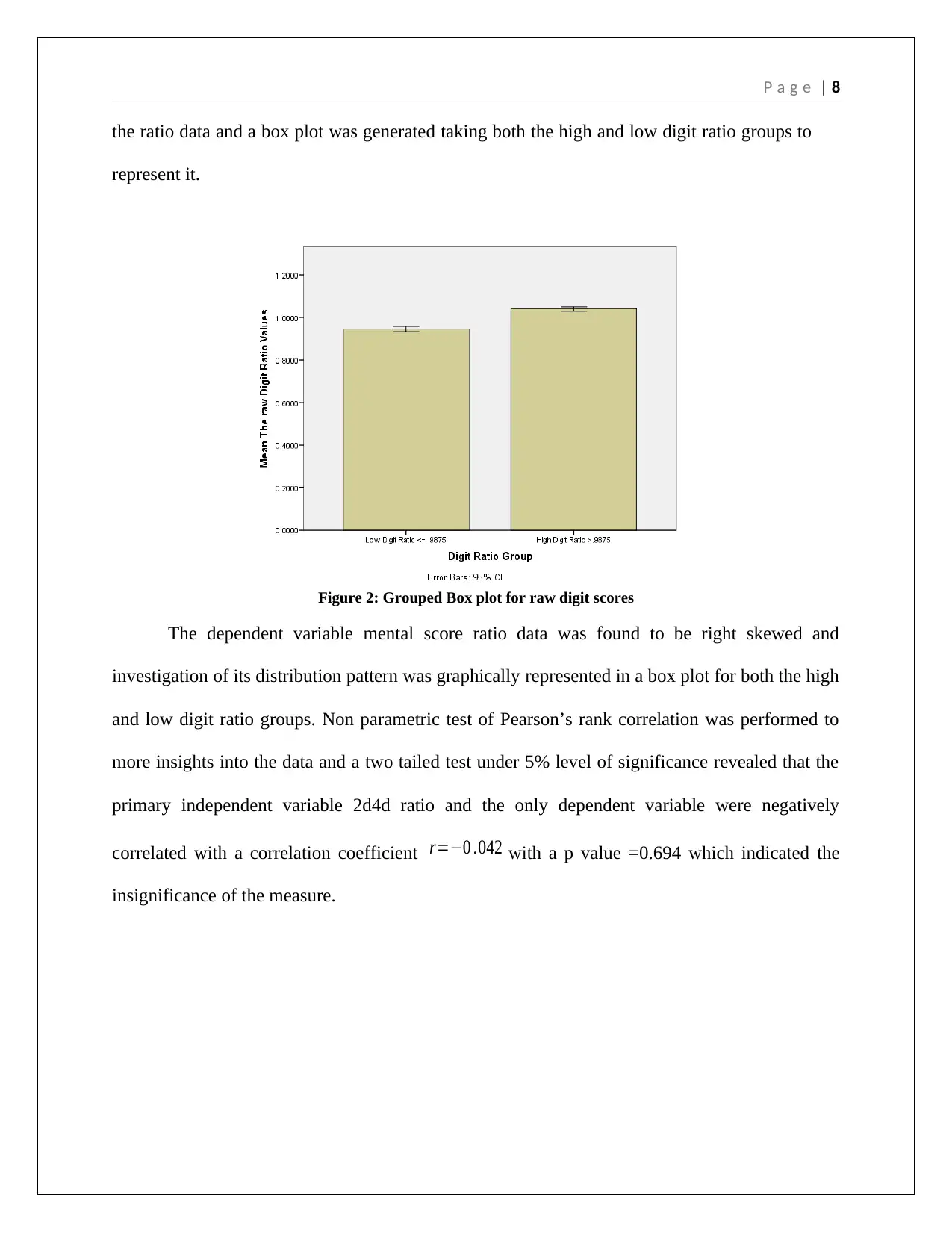
ratio group (LDR). The mean and standard deviation for 2d4d ratio was calculated as 0.9448
and 0.0392 for LDR group whereas the descriptive values were 1.0398 and 0.0373 for HDR
group. The mean and standard deviation for the mental score for HDR group was 8.38 and
4.519; for LDR group the same descriptive were 9.26 and 5.5568. The primary independent
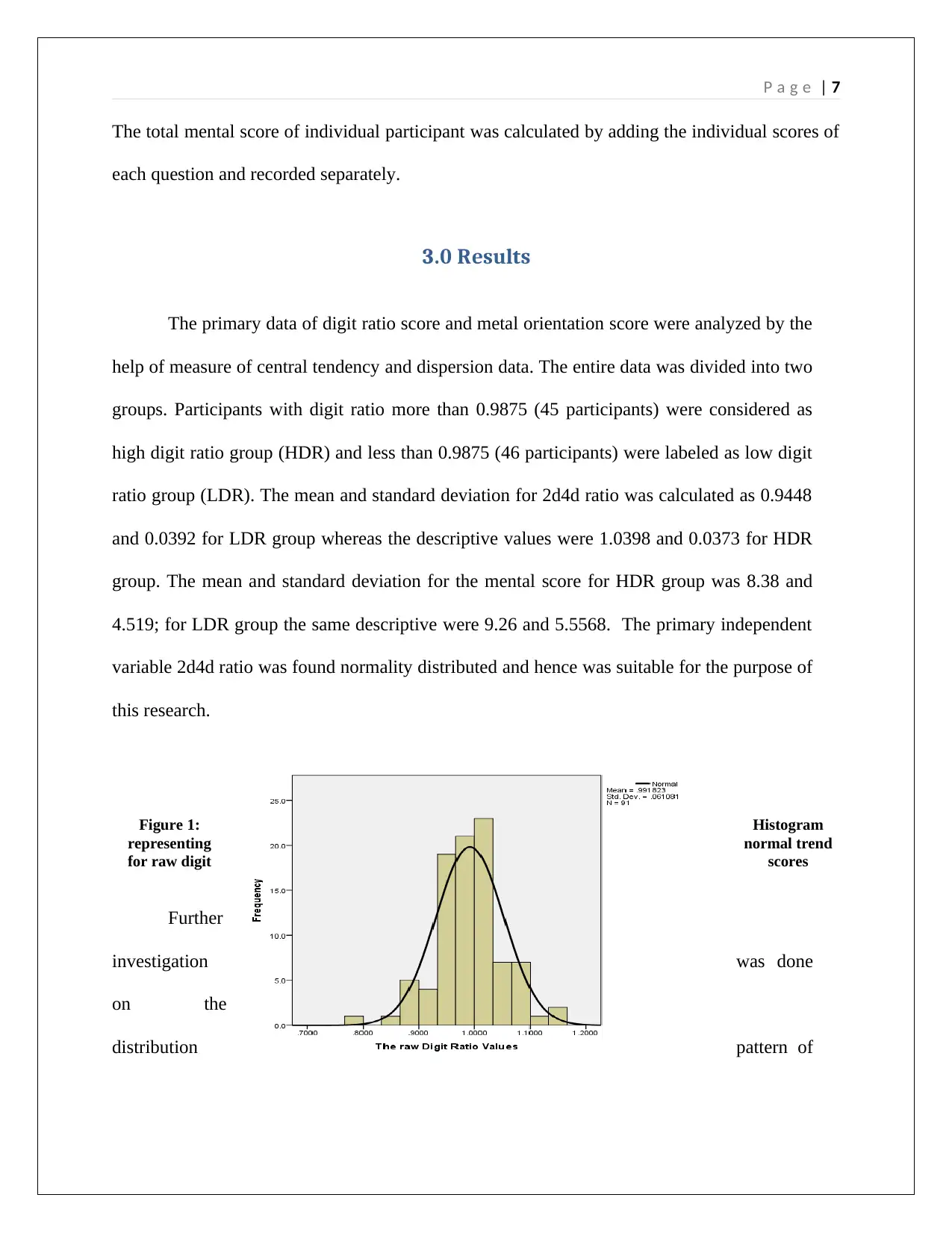
variable 2d4d ratio was found normality distributed and hence was suitable for the purpose of
this research.
Figure 1: Histogram
representing normal trend
for raw digit scores
Further
investigation was done
on the
distribution pattern of
The total mental score of individual participant was calculated by adding the individual scores of
each question and recorded separately.
3.0 Results
The primary data of digit ratio score and metal orientation score were analyzed by the
help of measure of central tendency and dispersion data. The entire data was divided into two
groups. Participants with digit ratio more than 0.9875 (45 participants) were considered as
high digit ratio group (HDR) and less than 0.9875 (46 participants) were labeled as low digit
ratio group (LDR). The mean and standard deviation for 2d4d ratio was calculated as 0.9448
and 0.0392 for LDR group whereas the descriptive values were 1.0398 and 0.0373 for HDR
group. The mean and standard deviation for the mental score for HDR group was 8.38 and
4.519; for LDR group the same descriptive were 9.26 and 5.5568. The primary independent
variable 2d4d ratio was found normality distributed and hence was suitable for the purpose of
this research.
Figure 1: Histogram
representing normal trend
for raw digit scores
Further
investigation was done
on the
distribution pattern of
Paraphrase This Document
Need a fresh take? Get an instant paraphrase of this document with our AI Paraphraser
P a g e | 8
the ratio data and a box plot was generated taking both the high and low digit ratio groups to
represent it.
Figure 2: Grouped Box plot for raw digit scores
The dependent variable mental score ratio data was found to be right skewed and
investigation of its distribution pattern was graphically represented in a box plot for both the high
and low digit ratio groups. Non parametric test of Pearson’s rank correlation was performed to
more insights into the data and a two tailed test under 5% level of significance revealed that the
primary independent variable 2d4d ratio and the only dependent variable were negatively
correlated with a correlation coefficient r=−0 .042 with a p value =0.694 which indicated the
insignificance of the measure.
the ratio data and a box plot was generated taking both the high and low digit ratio groups to
represent it.
Figure 2: Grouped Box plot for raw digit scores
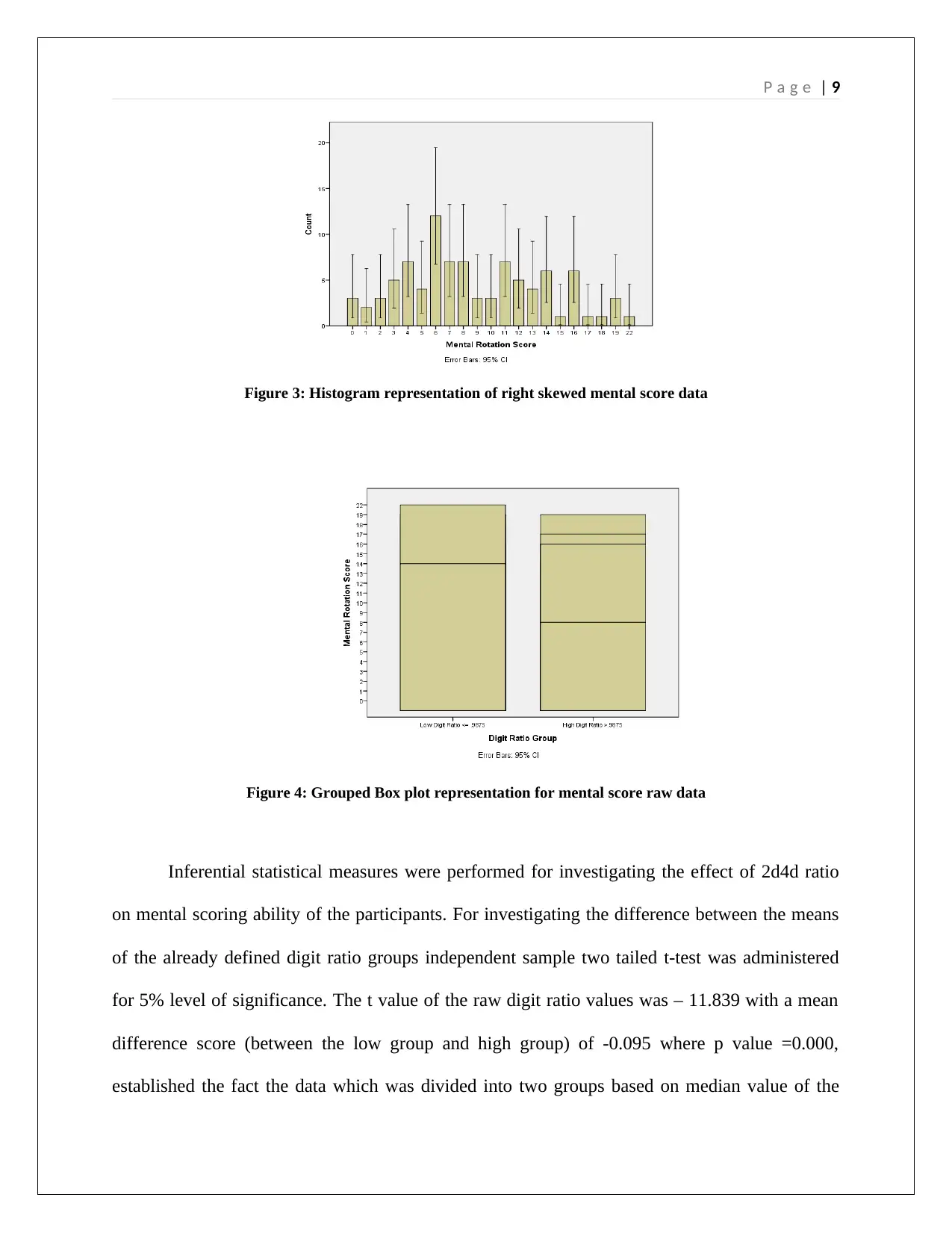
The dependent variable mental score ratio data was found to be right skewed and
investigation of its distribution pattern was graphically represented in a box plot for both the high
and low digit ratio groups. Non parametric test of Pearson’s rank correlation was performed to
more insights into the data and a two tailed test under 5% level of significance revealed that the
primary independent variable 2d4d ratio and the only dependent variable were negatively
correlated with a correlation coefficient r=−0 .042 with a p value =0.694 which indicated the
insignificance of the measure.
P a g e | 9
Figure 3: Histogram representation of right skewed mental score data
Figure 4: Grouped Box plot representation for mental score raw data
Inferential statistical measures were performed for investigating the effect of 2d4d ratio
on mental scoring ability of the participants. For investigating the difference between the means
of the already defined digit ratio groups independent sample two tailed t-test was administered
for 5% level of significance. The t value of the raw digit ratio values was – 11.839 with a mean
difference score (between the low group and high group) of -0.095 where p value =0.000,
established the fact the data which was divided into two groups based on median value of the
Figure 3: Histogram representation of right skewed mental score data
Figure 4: Grouped Box plot representation for mental score raw data
Inferential statistical measures were performed for investigating the effect of 2d4d ratio
on mental scoring ability of the participants. For investigating the difference between the means
of the already defined digit ratio groups independent sample two tailed t-test was administered
for 5% level of significance. The t value of the raw digit ratio values was – 11.839 with a mean
difference score (between the low group and high group) of -0.095 where p value =0.000,
established the fact the data which was divided into two groups based on median value of the
⊘ This is a preview!⊘
Do you want full access?
Subscribe today to unlock all pages.
Trusted by 1+ million students worldwide
P a g e | 10
raw 2d4d digit ratio was statistically significant. The confidence interval for the difference in
mean was [−0 .1110 ,−0 . 0791] for 5% level of significance. The difference in mean scores for the
dependent variable mental rotational score was 0.883 with a t value of 0.830. The most
significant value was p value=0.409 which was greater than 0.025 (for two tailed test). The
confidence interval was [−1. 232 , 2. 998 ] for 5% level of significance. Hence it was evident from
the p value that the difference in mental orientation scores for low and high digit ratio groups
was highly insignificant. This result was consistent with the non parametric result of Pearson’s
correlation where a very low negative correlation was obtained. Equality of variances for two
groups was assumed. The independent sample t-test also provided data for un-equal variance
assumption and with different set of values the similar statistical inference was visible. The p
value=0.408 for un-equal variance assumption was obtained.
4.0 Discussion
The findings of the current study were carefully interpreted as no significant correlation
whatsoever was obtained between digit ratio and cognitive or spatial ability. The hypothesis
assumed initially for this study was rejected and within the limitations of this research work it
was concluded that there was no significant relation between 2d4d (digit) ratio and mental
scoring ability.
The obtained data was not containing information on sex and age of the participants.
Gender of the participating subjects was a matter of interest as previous research works (Jack van
Honk, Dennis J. Schutter, Peter A. Bos, Anne-Wil Kruijt, Eef G. Lentjes, and Simon Baron-
raw 2d4d digit ratio was statistically significant. The confidence interval for the difference in
mean was [−0 .1110 ,−0 . 0791] for 5% level of significance. The difference in mean scores for the
dependent variable mental rotational score was 0.883 with a t value of 0.830. The most
significant value was p value=0.409 which was greater than 0.025 (for two tailed test). The
confidence interval was [−1. 232 , 2. 998 ] for 5% level of significance. Hence it was evident from
the p value that the difference in mental orientation scores for low and high digit ratio groups
was highly insignificant. This result was consistent with the non parametric result of Pearson’s
correlation where a very low negative correlation was obtained. Equality of variances for two
groups was assumed. The independent sample t-test also provided data for un-equal variance
assumption and with different set of values the similar statistical inference was visible. The p
value=0.408 for un-equal variance assumption was obtained.
4.0 Discussion
The findings of the current study were carefully interpreted as no significant correlation
whatsoever was obtained between digit ratio and cognitive or spatial ability. The hypothesis
assumed initially for this study was rejected and within the limitations of this research work it
was concluded that there was no significant relation between 2d4d (digit) ratio and mental
scoring ability.
The obtained data was not containing information on sex and age of the participants.
Gender of the participating subjects was a matter of interest as previous research works (Jack van
Honk, Dennis J. Schutter, Peter A. Bos, Anne-Wil Kruijt, Eef G. Lentjes, and Simon Baron-
Paraphrase This Document
Need a fresh take? Get an instant paraphrase of this document with our AI Paraphraser
P a g e | 11
Cohen, 2010) revealed the effect of sexual hormones on both the sexes. Earlier in 2005 a positive
correlation was also found between the 2d4d ratio and testosterone level with spatial ability
(Kempel, P., Gohlke, B., Kelmpau, J., Zinsberger, P., Reuter, M., & Hennig, J. (2005).
Testosterone hormone levels of the participants were not measured and hence a major factor of
earlier research works was also excluded. Inter and intra sex relation (Höne-kopp, Rudolph,
Beier, Liebert, & Müller, 2007; Sell et al., 2009) was also a matter considering the physical
ability as dependent variable.
The preliminary outcomes of the study due to lack of several independent variables
possibly generated the probability of type-I error and a true hypothesis was rejected based on the
experiment results. No association was observed between digit ratio and mental scoring ability as
predicted. To facilitate the study of scenario and effects in details different personality traits of
human race such as ethnicity, verbal fluency could also be considered as dependent variables.
However with the current results of the research work further study can be conducted with
variation in parameters and variables of the current study.
Cohen, 2010) revealed the effect of sexual hormones on both the sexes. Earlier in 2005 a positive
correlation was also found between the 2d4d ratio and testosterone level with spatial ability
(Kempel, P., Gohlke, B., Kelmpau, J., Zinsberger, P., Reuter, M., & Hennig, J. (2005).
Testosterone hormone levels of the participants were not measured and hence a major factor of
earlier research works was also excluded. Inter and intra sex relation (Höne-kopp, Rudolph,
Beier, Liebert, & Müller, 2007; Sell et al., 2009) was also a matter considering the physical
ability as dependent variable.
The preliminary outcomes of the study due to lack of several independent variables
possibly generated the probability of type-I error and a true hypothesis was rejected based on the
experiment results. No association was observed between digit ratio and mental scoring ability as
predicted. To facilitate the study of scenario and effects in details different personality traits of
human race such as ethnicity, verbal fluency could also be considered as dependent variables.
However with the current results of the research work further study can be conducted with
variation in parameters and variables of the current study.
P a g e | 12
5.0 References
Austin, E. J., Manning, J. T., McInroy, K., & Mathews, E. (2002). A preliminary investigation
of the associations between personality, cognitive ability and digit ratio. Personality and
Individual Differences, 33, 1115–1124. https://doi.org/10.1016/S0191-8869(02)00002-8
Bennett, M., Manning, J. T., Cook, C. J., & Kilduff, L. P. (2010). Digit ratio (2D: 4D) and
performance in elite rugby players. Journal of sports sciences, 28(13), 1415-1421.
Hone, L. S., & McCullough, M. E. (2012). 2D: 4D ratios predict hand grip strength (but not hand
grip endurance) in men (but not in women). Evolution and Human Behavior, 33(6), 780-
789.
Hönekopp, J., & Watson, S. (2011). Meta-analysis of the relationship between digit-ratio 2D: 4D
and aggression. Personality and Individual Differences, 51(4), 381-386.
Hönekopp, J., & Schuster, M. (2010). A meta-analysis on 2D: 4D and athletic prowess:
Substantial relationships but neither hand out-predicts the other. Personality and Individual
Differences, 48(1), 4-10.
Kempel, P., Gohlke, B., Kelmpau, J., Zinsberger, P., Reuter, M., & Hennig, J. (2005). Second-
to-fourth digit length, testosterone and spatial ability. Intelligence, 33, 215–
230. https://doi.org/10.1016/j.intell.2004.11.004
Longman, D., Stock, J. T., & Wells, J. C. K. (2011). Digit ratio (2D: 4D) and rowing ergo meter
performance in males and females. American journal of physical anthropology, 144(3),
337-341.
Malas, M. A., Dogan, S., Evcil, E. H., & Desdicioglu, K. (2006). Fetal development of the hand,
digits and digit ratio (2D: 4D). Early human development, 82(7), 469-475.
Manning, J. T., Churchill, A. J., & Peters, M. (2007). The effects of sex, ethnicity, and sexual
orientation on self-measured digit ratio (2D: 4D). Archives of sexual behavior, 36(2), 223-
233.
5.0 References
Austin, E. J., Manning, J. T., McInroy, K., & Mathews, E. (2002). A preliminary investigation
of the associations between personality, cognitive ability and digit ratio. Personality and
Individual Differences, 33, 1115–1124. https://doi.org/10.1016/S0191-8869(02)00002-8
Bennett, M., Manning, J. T., Cook, C. J., & Kilduff, L. P. (2010). Digit ratio (2D: 4D) and
performance in elite rugby players. Journal of sports sciences, 28(13), 1415-1421.
Hone, L. S., & McCullough, M. E. (2012). 2D: 4D ratios predict hand grip strength (but not hand
grip endurance) in men (but not in women). Evolution and Human Behavior, 33(6), 780-
789.
Hönekopp, J., & Watson, S. (2011). Meta-analysis of the relationship between digit-ratio 2D: 4D
and aggression. Personality and Individual Differences, 51(4), 381-386.
Hönekopp, J., & Schuster, M. (2010). A meta-analysis on 2D: 4D and athletic prowess:
Substantial relationships but neither hand out-predicts the other. Personality and Individual
Differences, 48(1), 4-10.
Kempel, P., Gohlke, B., Kelmpau, J., Zinsberger, P., Reuter, M., & Hennig, J. (2005). Second-
to-fourth digit length, testosterone and spatial ability. Intelligence, 33, 215–
230. https://doi.org/10.1016/j.intell.2004.11.004
Longman, D., Stock, J. T., & Wells, J. C. K. (2011). Digit ratio (2D: 4D) and rowing ergo meter
performance in males and females. American journal of physical anthropology, 144(3),
337-341.
Malas, M. A., Dogan, S., Evcil, E. H., & Desdicioglu, K. (2006). Fetal development of the hand,
digits and digit ratio (2D: 4D). Early human development, 82(7), 469-475.
Manning, J. T., Churchill, A. J., & Peters, M. (2007). The effects of sex, ethnicity, and sexual
orientation on self-measured digit ratio (2D: 4D). Archives of sexual behavior, 36(2), 223-
233.
⊘ This is a preview!⊘
Do you want full access?
Subscribe today to unlock all pages.
Trusted by 1+ million students worldwide

1 out of 13


Your All-in-One AI-Powered Toolkit for Academic Success.
+13062052269
info@desklib.com
Available 24*7 on WhatsApp / Email
![[object Object]](/_next/static/media/star-bottom.7253800d.svg)
Unlock your academic potential
Copyright © 2020–2026 A2Z Services. All Rights Reserved. Developed and managed by ZUCOL.