Detailed Report: Digital Art Styles, Stages, and Comparison in Games
VerifiedAdded on 2023/01/05
|7
|959
|76
Report
AI Summary
This report delves into the various digital art forms used in game development, differentiating between 2D and 3D art styles. It examines specific techniques like pixel art, vector art, cel shading, and 3D cartoon graphics, highlighting their characteristics and applications. The report outlines the stages of game development, including preliminary development, unwrapping, texturing, 3D modeling, and animation. Furthermore, it compares digital art forms with traditional methods, emphasizing the advantages of digital content such as portability and productivity, while also acknowledging the importance of traditional techniques in fostering creativity and problem-solving skills. The report also analyzes the popularity of 3D cartoon art styles, their suitability for diverse audiences, and the impact of interactivity and simulations on user experience, with references to relevant literature on the subject.

REPORTS
Paraphrase This Document
Need a fresh take? Get an instant paraphrase of this document with our AI Paraphraser

Table of Contents
REPORT : ASSIGNMENT 1..........................................................................................................3
Artwork Styles........................................................................................................................3
Stages......................................................................................................................................3
Comparison.............................................................................................................................4
REPORT : ASSIGNMENT 2..........................................................................................................5
References........................................................................................................................................6
REPORT : ASSIGNMENT 1..........................................................................................................3
Artwork Styles........................................................................................................................3
Stages......................................................................................................................................3
Comparison.............................................................................................................................4
REPORT : ASSIGNMENT 2..........................................................................................................5
References........................................................................................................................................6

REPORT : ASSIGNMENT 1
Artwork Styles
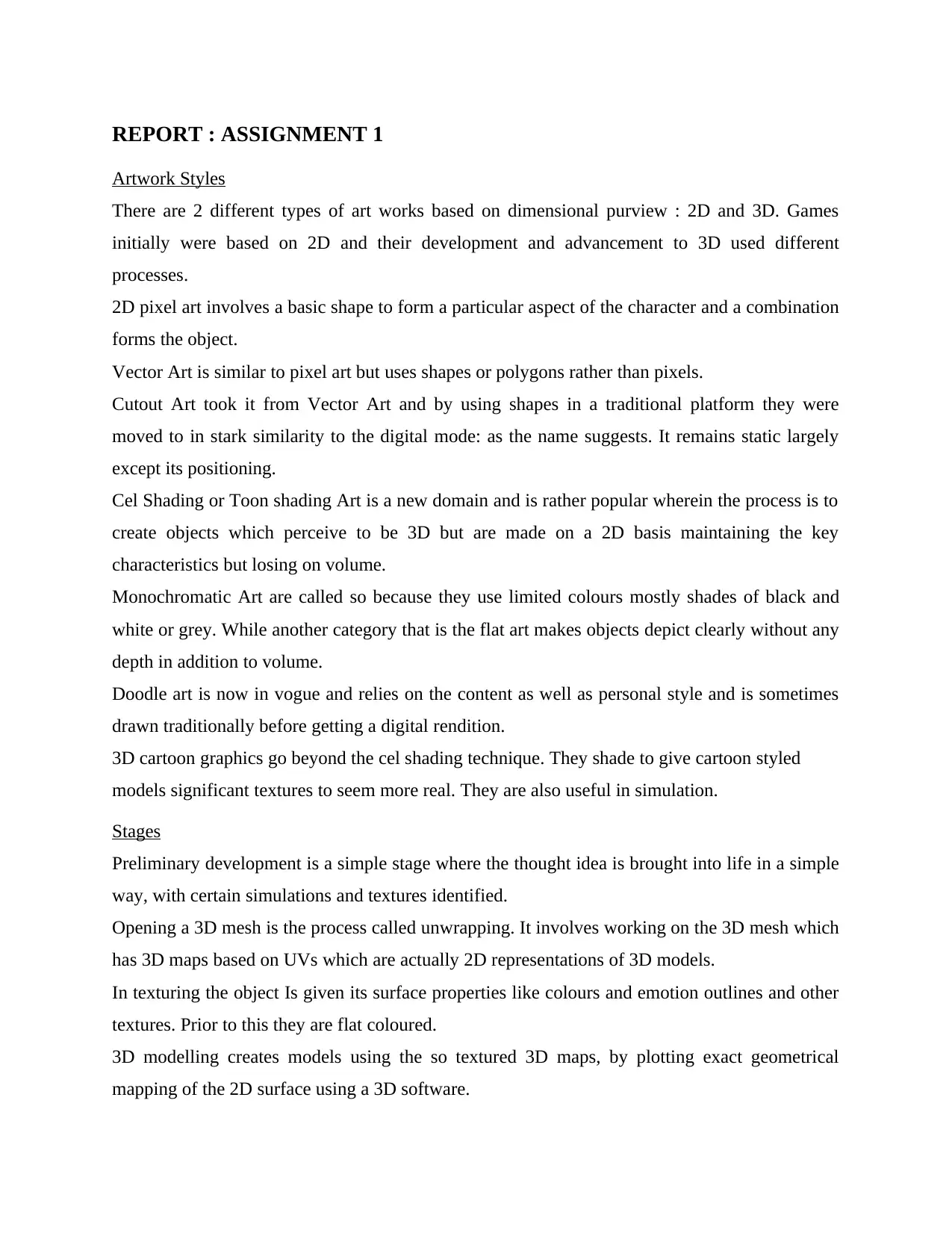
There are 2 different types of art works based on dimensional purview : 2D and 3D. Games
initially were based on 2D and their development and advancement to 3D used different
processes.
2D pixel art involves a basic shape to form a particular aspect of the character and a combination
forms the object.
Vector Art is similar to pixel art but uses shapes or polygons rather than pixels.
Cutout Art took it from Vector Art and by using shapes in a traditional platform they were
moved to in stark similarity to the digital mode: as the name suggests. It remains static largely
except its positioning.
Cel Shading or Toon shading Art is a new domain and is rather popular wherein the process is to
create objects which perceive to be 3D but are made on a 2D basis maintaining the key
characteristics but losing on volume.
Monochromatic Art are called so because they use limited colours mostly shades of black and
white or grey. While another category that is the flat art makes objects depict clearly without any
depth in addition to volume.
Doodle art is now in vogue and relies on the content as well as personal style and is sometimes
drawn traditionally before getting a digital rendition.
3D cartoon graphics go beyond the cel shading technique. They shade to give cartoon styled
models significant textures to seem more real. They are also useful in simulation.
Stages
Preliminary development is a simple stage where the thought idea is brought into life in a simple
way, with certain simulations and textures identified.
Opening a 3D mesh is the process called unwrapping. It involves working on the 3D mesh which
has 3D maps based on UVs which are actually 2D representations of 3D models.
In texturing the object Is given its surface properties like colours and emotion outlines and other
textures. Prior to this they are flat coloured.
3D modelling creates models using the so textured 3D maps, by plotting exact geometrical
mapping of the 2D surface using a 3D software.
Artwork Styles
There are 2 different types of art works based on dimensional purview : 2D and 3D. Games
initially were based on 2D and their development and advancement to 3D used different
processes.
2D pixel art involves a basic shape to form a particular aspect of the character and a combination
forms the object.
Vector Art is similar to pixel art but uses shapes or polygons rather than pixels.
Cutout Art took it from Vector Art and by using shapes in a traditional platform they were
moved to in stark similarity to the digital mode: as the name suggests. It remains static largely
except its positioning.
Cel Shading or Toon shading Art is a new domain and is rather popular wherein the process is to
create objects which perceive to be 3D but are made on a 2D basis maintaining the key
characteristics but losing on volume.
Monochromatic Art are called so because they use limited colours mostly shades of black and
white or grey. While another category that is the flat art makes objects depict clearly without any
depth in addition to volume.
Doodle art is now in vogue and relies on the content as well as personal style and is sometimes
drawn traditionally before getting a digital rendition.
3D cartoon graphics go beyond the cel shading technique. They shade to give cartoon styled
models significant textures to seem more real. They are also useful in simulation.
Stages
Preliminary development is a simple stage where the thought idea is brought into life in a simple
way, with certain simulations and textures identified.
Opening a 3D mesh is the process called unwrapping. It involves working on the 3D mesh which
has 3D maps based on UVs which are actually 2D representations of 3D models.
In texturing the object Is given its surface properties like colours and emotion outlines and other
textures. Prior to this they are flat coloured.
3D modelling creates models using the so textured 3D maps, by plotting exact geometrical
mapping of the 2D surface using a 3D software.
⊘ This is a preview!⊘
Do you want full access?
Subscribe today to unlock all pages.

Trusted by 1+ million students worldwide

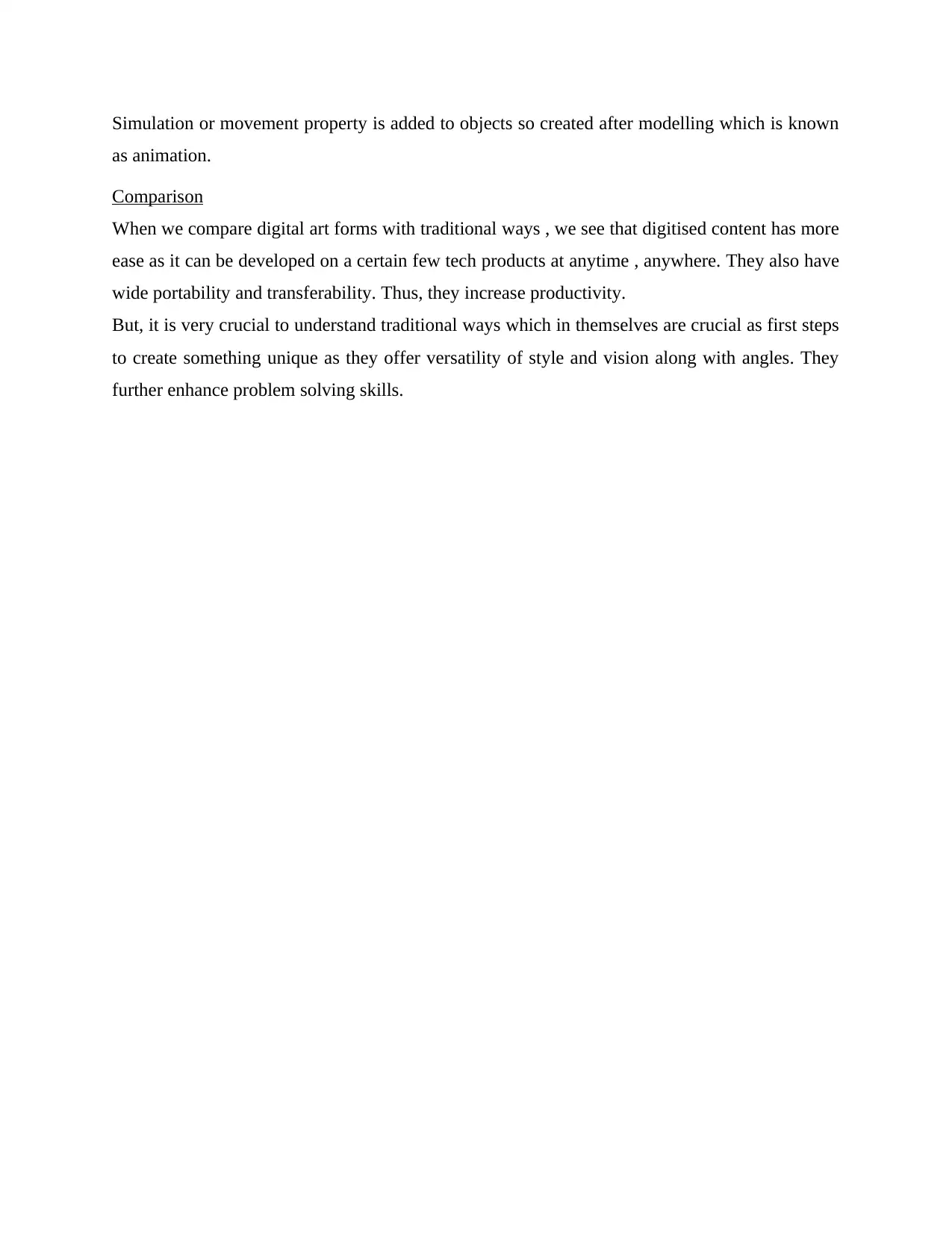
Simulation or movement property is added to objects so created after modelling which is known
as animation.
Comparison
When we compare digital art forms with traditional ways , we see that digitised content has more
ease as it can be developed on a certain few tech products at anytime , anywhere. They also have
wide portability and transferability. Thus, they increase productivity.
But, it is very crucial to understand traditional ways which in themselves are crucial as first steps
to create something unique as they offer versatility of style and vision along with angles. They
further enhance problem solving skills.
as animation.
Comparison
When we compare digital art forms with traditional ways , we see that digitised content has more
ease as it can be developed on a certain few tech products at anytime , anywhere. They also have
wide portability and transferability. Thus, they increase productivity.
But, it is very crucial to understand traditional ways which in themselves are crucial as first steps
to create something unique as they offer versatility of style and vision along with angles. They
further enhance problem solving skills.
Paraphrase This Document
Need a fresh take? Get an instant paraphrase of this document with our AI Paraphraser

REPORT : ASSIGNMENT 2
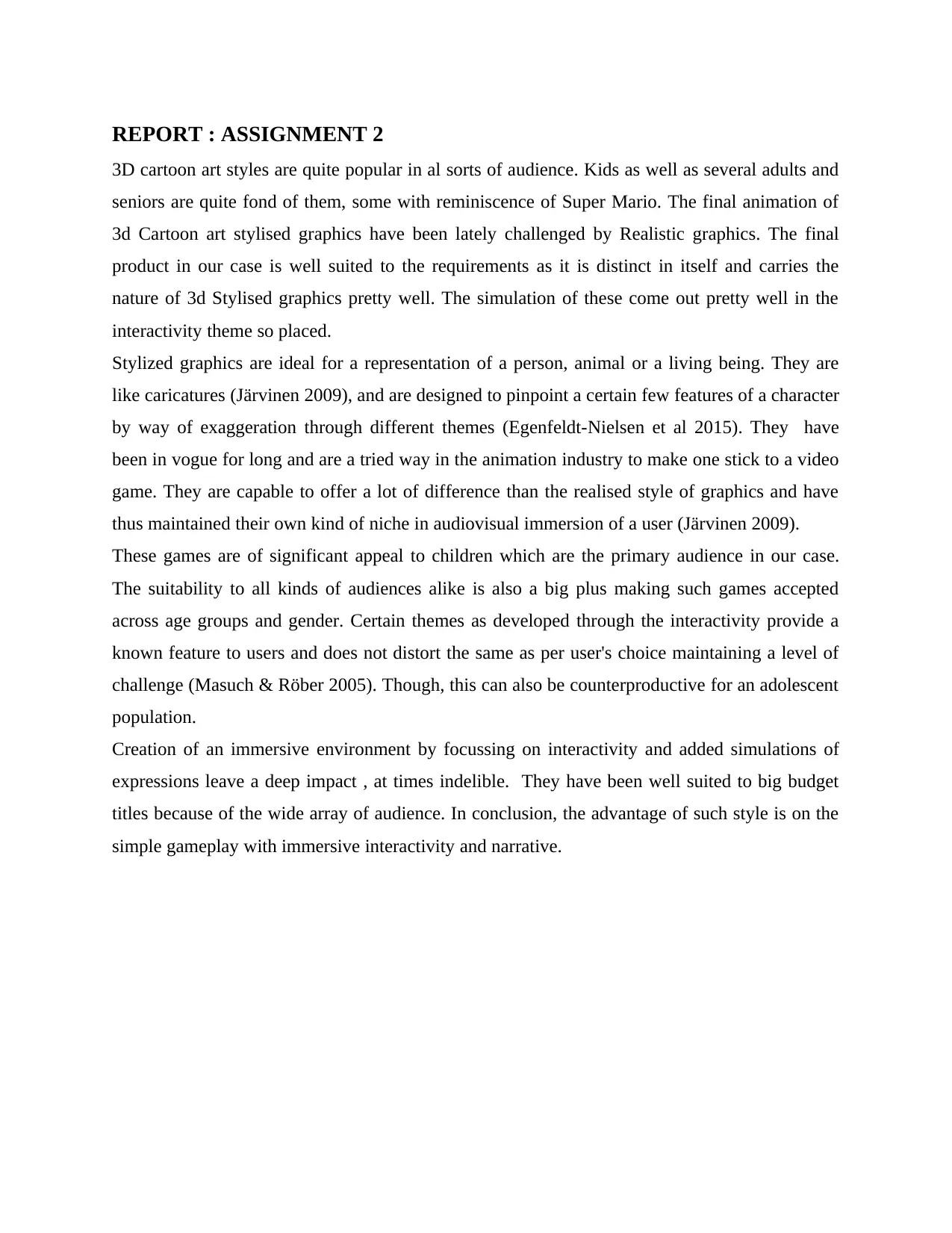
3D cartoon art styles are quite popular in al sorts of audience. Kids as well as several adults and
seniors are quite fond of them, some with reminiscence of Super Mario. The final animation of
3d Cartoon art stylised graphics have been lately challenged by Realistic graphics. The final
product in our case is well suited to the requirements as it is distinct in itself and carries the
nature of 3d Stylised graphics pretty well. The simulation of these come out pretty well in the
interactivity theme so placed.
Stylized graphics are ideal for a representation of a person, animal or a living being. They are
like caricatures (Järvinen 2009), and are designed to pinpoint a certain few features of a character
by way of exaggeration through different themes (Egenfeldt-Nielsen et al 2015). They have
been in vogue for long and are a tried way in the animation industry to make one stick to a video
game. They are capable to offer a lot of difference than the realised style of graphics and have
thus maintained their own kind of niche in audiovisual immersion of a user (Järvinen 2009).
These games are of significant appeal to children which are the primary audience in our case.
The suitability to all kinds of audiences alike is also a big plus making such games accepted
across age groups and gender. Certain themes as developed through the interactivity provide a
known feature to users and does not distort the same as per user's choice maintaining a level of
challenge (Masuch & Röber 2005). Though, this can also be counterproductive for an adolescent
population.
Creation of an immersive environment by focussing on interactivity and added simulations of
expressions leave a deep impact , at times indelible. They have been well suited to big budget
titles because of the wide array of audience. In conclusion, the advantage of such style is on the
simple gameplay with immersive interactivity and narrative.
3D cartoon art styles are quite popular in al sorts of audience. Kids as well as several adults and
seniors are quite fond of them, some with reminiscence of Super Mario. The final animation of
3d Cartoon art stylised graphics have been lately challenged by Realistic graphics. The final
product in our case is well suited to the requirements as it is distinct in itself and carries the
nature of 3d Stylised graphics pretty well. The simulation of these come out pretty well in the
interactivity theme so placed.
Stylized graphics are ideal for a representation of a person, animal or a living being. They are
like caricatures (Järvinen 2009), and are designed to pinpoint a certain few features of a character
by way of exaggeration through different themes (Egenfeldt-Nielsen et al 2015). They have
been in vogue for long and are a tried way in the animation industry to make one stick to a video
game. They are capable to offer a lot of difference than the realised style of graphics and have
thus maintained their own kind of niche in audiovisual immersion of a user (Järvinen 2009).
These games are of significant appeal to children which are the primary audience in our case.
The suitability to all kinds of audiences alike is also a big plus making such games accepted
across age groups and gender. Certain themes as developed through the interactivity provide a
known feature to users and does not distort the same as per user's choice maintaining a level of
challenge (Masuch & Röber 2005). Though, this can also be counterproductive for an adolescent
population.
Creation of an immersive environment by focussing on interactivity and added simulations of
expressions leave a deep impact , at times indelible. They have been well suited to big budget
titles because of the wide array of audience. In conclusion, the advantage of such style is on the
simple gameplay with immersive interactivity and narrative.

References
Books and Web Content
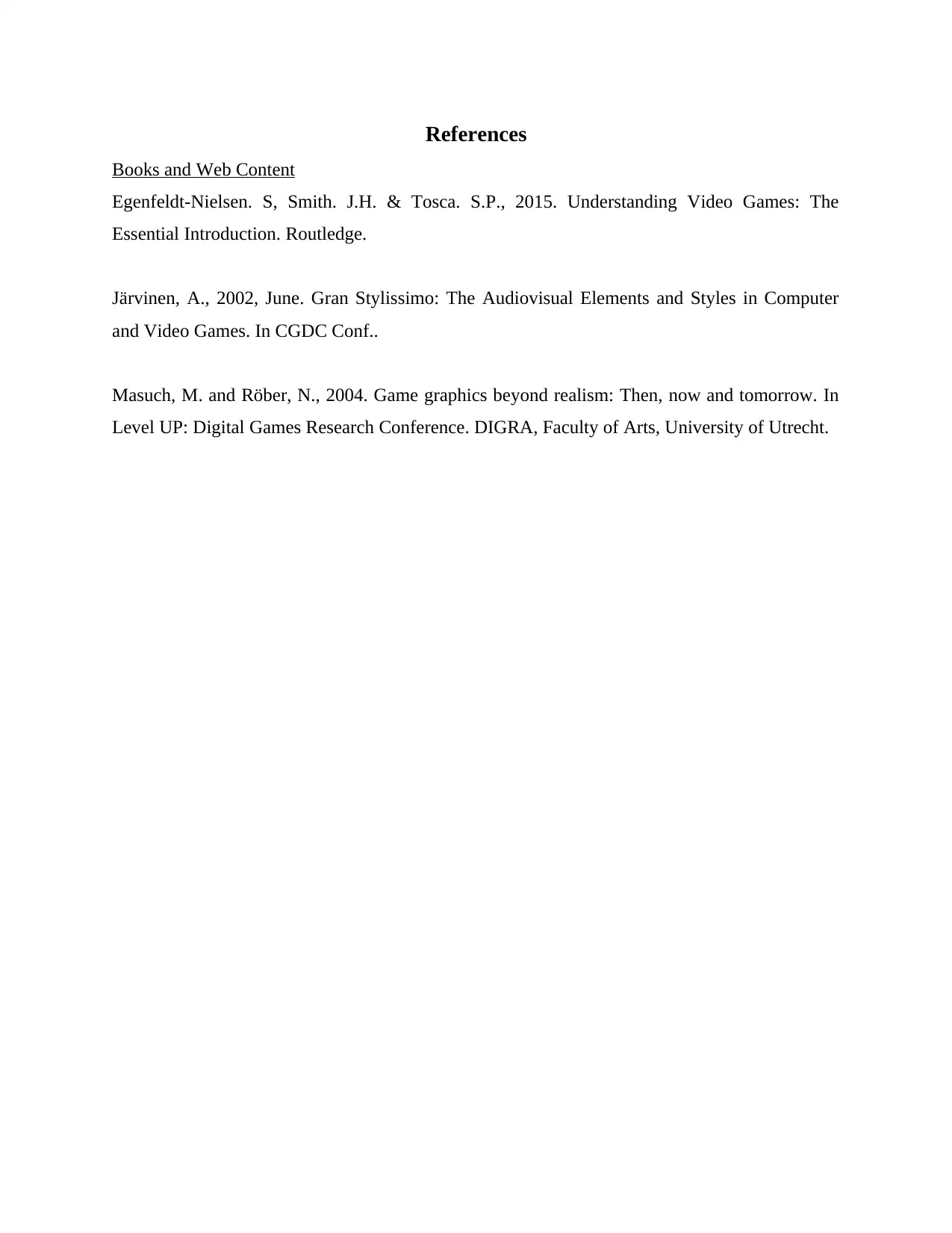
Egenfeldt-Nielsen. S, Smith. J.H. & Tosca. S.P., 2015. Understanding Video Games: The
Essential Introduction. Routledge.
Järvinen, A., 2002, June. Gran Stylissimo: The Audiovisual Elements and Styles in Computer
and Video Games. In CGDC Conf..
Masuch, M. and Röber, N., 2004. Game graphics beyond realism: Then, now and tomorrow. In
Level UP: Digital Games Research Conference. DIGRA, Faculty of Arts, University of Utrecht.
Books and Web Content
Egenfeldt-Nielsen. S, Smith. J.H. & Tosca. S.P., 2015. Understanding Video Games: The
Essential Introduction. Routledge.
Järvinen, A., 2002, June. Gran Stylissimo: The Audiovisual Elements and Styles in Computer
and Video Games. In CGDC Conf..
Masuch, M. and Röber, N., 2004. Game graphics beyond realism: Then, now and tomorrow. In
Level UP: Digital Games Research Conference. DIGRA, Faculty of Arts, University of Utrecht.
⊘ This is a preview!⊘
Do you want full access?
Subscribe today to unlock all pages.

Trusted by 1+ million students worldwide

1 out of 7
Your All-in-One AI-Powered Toolkit for Academic Success.
+13062052269
info@desklib.com
Available 24*7 on WhatsApp / Email
Unlock your academic potential
Copyright © 2020–2025 A2Z Services. All Rights Reserved. Developed and managed by ZUCOL.