BM565 Report: AI and Technological Advancements in Supply Chains
VerifiedAdded on 2023/06/08
|10
|2452
|196
Report
AI Summary
This report examines the role of artificial intelligence and new technologies in modern digital business, focusing primarily on supply chain management. It highlights the importance of supply chain operations, discussing recent trends like digitalization and customization, as well as the evolution of supply chains through risk management and agile methodologies. The report details how AI is used for inventory management, cost reduction, and warehouse efficiency, further exploring technological platforms like Google AI, Amazon Web Services, and Microsoft Azure. It also identifies different types of businesses utilizing AI and assesses its effectiveness as a business tool, emphasizing its ability to enhance decision-making, improve efficiency, and provide competitive advantages. The conclusion recommends the adoption of AI for optimizing resource utilization and driving sustainability in business operations.
BM565
Digital business and
new technologies
Digital business and
new technologies

Paraphrase This Document
Need a fresh take? Get an instant paraphrase of this document with our AI Paraphraser
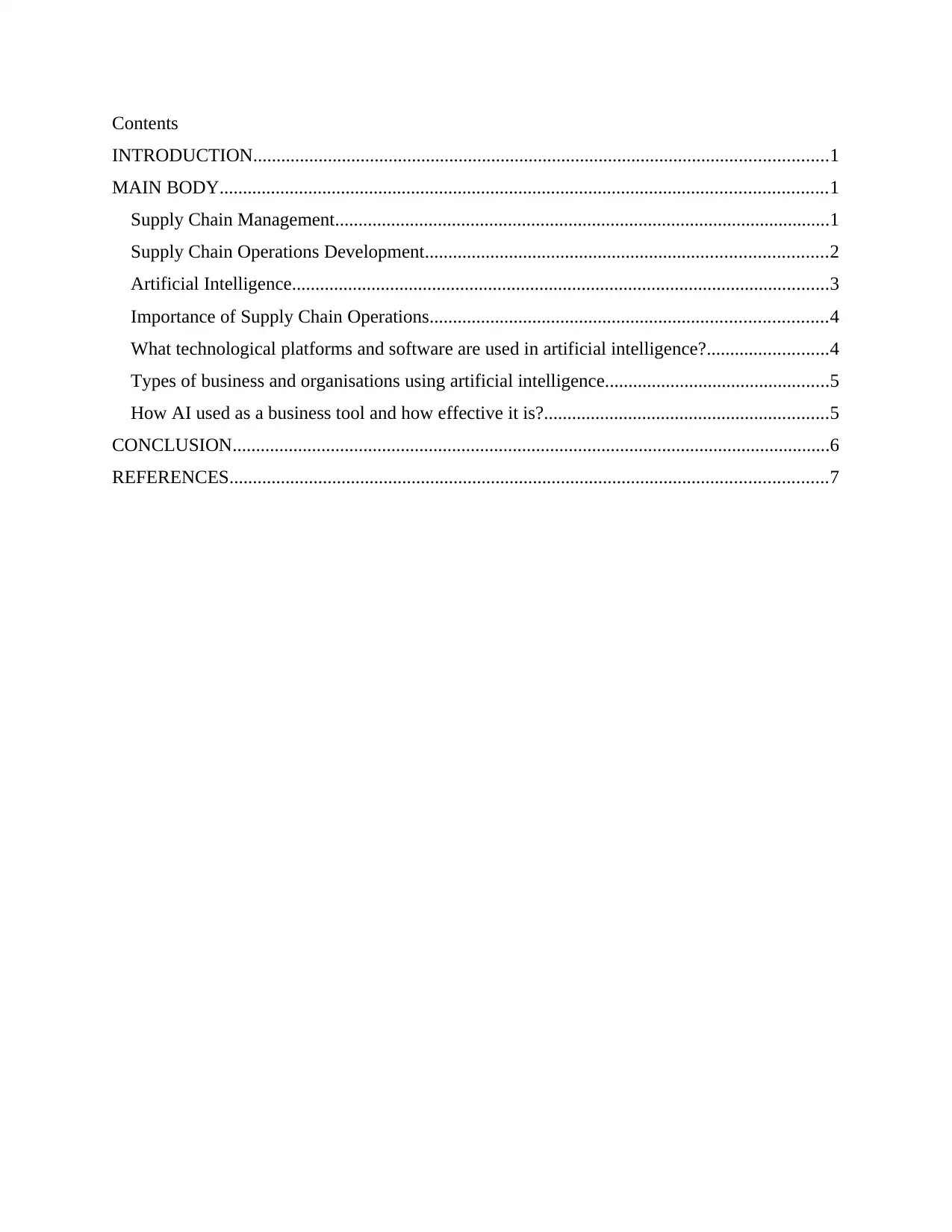
Contents
INTRODUCTION...........................................................................................................................1
MAIN BODY..................................................................................................................................1
Supply Chain Management..........................................................................................................1
Supply Chain Operations Development......................................................................................2
Artificial Intelligence...................................................................................................................3
Importance of Supply Chain Operations.....................................................................................4
What technological platforms and software are used in artificial intelligence?..........................4
Types of business and organisations using artificial intelligence................................................5
How AI used as a business tool and how effective it is?.............................................................5
CONCLUSION................................................................................................................................6
REFERENCES................................................................................................................................7
INTRODUCTION...........................................................................................................................1
MAIN BODY..................................................................................................................................1
Supply Chain Management..........................................................................................................1
Supply Chain Operations Development......................................................................................2
Artificial Intelligence...................................................................................................................3
Importance of Supply Chain Operations.....................................................................................4
What technological platforms and software are used in artificial intelligence?..........................4
Types of business and organisations using artificial intelligence................................................5
How AI used as a business tool and how effective it is?.............................................................5
CONCLUSION................................................................................................................................6
REFERENCES................................................................................................................................7

⊘ This is a preview!⊘
Do you want full access?
Subscribe today to unlock all pages.

Trusted by 1+ million students worldwide
INTRODUCTION
Supply chain refers to the framework which consists of buyer, seller, organisation, raw
materials, resources, technology etc involved in formation and trade of a product. Supply chain
operations consists of structures, system and procedures to create a framework to build a plan
and implement it during the movement of goods and services from seller to the consumer.
Supply chain operation is essential in an organisation for smooth functioning of the operations,
and for maximization of profits. It also helps in enhancing efficiency and effectiveness in the
organisation and to do so internal and external operations and supply chain must be evaluated in
a frequent time span (Olson, 2010). This file will include discussion on supply chain, supply
chain operations and its developments, supply chain management and artificial intelligence.
MAIN BODY
Supply Chain Management
Supply chain management refers to the processes required in the movement of goods and
services from supplier to the consumer and it also includes the procedure of converting raw
material into final goods (Akbariand Kok,2022). The importance of Supply chain management
has been highlighted below-
Improved Customer Service- Efficient management of supply chain helps in enhancing
customer satisfaction as customer expect premium quality product at affordable price at
right place and at right time and it is only possible if the company selling the goods have
effective supply chain. For example – Supply chain of Morrison's supermarket helps the
company to improve its customer service and satisfaction.
Minimise Operating Costs - Efficient management of supply chain also helps in
reducing operating cost such as cost of purchasing and production. Both retailers and
manufactures depend on supply chain to deliver goods and raw material to the consumer
at minimum time. If goods reach to the end consumer in short span of time, then carrying
cost can be reduced.
Boost Financial Position - Efficient management of supply chain helps in increasing
profit leverages and cash flow. Every organisation requires effective supply chain
managers because they reduce supply chain costs and which leads to increase in
1
Supply chain refers to the framework which consists of buyer, seller, organisation, raw
materials, resources, technology etc involved in formation and trade of a product. Supply chain
operations consists of structures, system and procedures to create a framework to build a plan
and implement it during the movement of goods and services from seller to the consumer.
Supply chain operation is essential in an organisation for smooth functioning of the operations,
and for maximization of profits. It also helps in enhancing efficiency and effectiveness in the
organisation and to do so internal and external operations and supply chain must be evaluated in
a frequent time span (Olson, 2010). This file will include discussion on supply chain, supply
chain operations and its developments, supply chain management and artificial intelligence.
MAIN BODY
Supply Chain Management
Supply chain management refers to the processes required in the movement of goods and
services from supplier to the consumer and it also includes the procedure of converting raw
material into final goods (Akbariand Kok,2022). The importance of Supply chain management
has been highlighted below-
Improved Customer Service- Efficient management of supply chain helps in enhancing
customer satisfaction as customer expect premium quality product at affordable price at
right place and at right time and it is only possible if the company selling the goods have
effective supply chain. For example – Supply chain of Morrison's supermarket helps the
company to improve its customer service and satisfaction.
Minimise Operating Costs - Efficient management of supply chain also helps in
reducing operating cost such as cost of purchasing and production. Both retailers and
manufactures depend on supply chain to deliver goods and raw material to the consumer
at minimum time. If goods reach to the end consumer in short span of time, then carrying
cost can be reduced.
Boost Financial Position - Efficient management of supply chain helps in increasing
profit leverages and cash flow. Every organisation requires effective supply chain
managers because they reduce supply chain costs and which leads to increase in
1
Paraphrase This Document
Need a fresh take? Get an instant paraphrase of this document with our AI Paraphraser
company’s profit and these managers also tries to reduce the time required in movement
of goods which also results in increment of organisational profits.
Better Quality of Life – Effective management of supply can create some opportunities
for humans which can improve their quality of life and standard of living. Supply chain
which has developed infrastructure are able to exchange goods easily with the consumers
which also helps in customer retention and it helps in generation of profit in the
organisation.
Supply Chain Operations Development
This topic of supply chain has been developed after a careful study of its recent trends which
have need highlighted here in -
1. Supply Chain Trends - Supply chain trends is an important tool for development and
advancement of supply chain (Akbari andDo2021). Some of these trends are-
Digitalisation - Digitalisation refers to process of formatting things into digital form.
Digitalisation of supply chain is a process where new and advanced technologies are used
to build the effective supply chain. Digitalisation of supply chain is a complex process
and it requires both internal and external interferences.
Customization - Customization refers to the process of designing the product according
to the customer preferences, choices, expectations and needs. If the operating supply
chain will be customised according to the customer preferences, it will reduce the
operating as well as fixed expenses and will fulfil the exact need of the consumer.
2. Supply Chain Evolution - Supply chain has been gone through several evolutions in
recent trends. Some of these evolution is -
Risk management – Management of Risk is very important factor for growth of every
supply chain. As there are many unpredictable, uncertain and undetermined events that
need to be taken care of to minimise the risk. Companies should try to determine these
risks factors beforehand so that strategies could be formulated to reduce the effect of
these factors on supply chain.
Agile supply chain – Flexible supply chain is required to reduce complexity of the
supply chain and to fulfil dynamic customer needs (LiHsub and Liuc, 2022). The agile
2
of goods which also results in increment of organisational profits.
Better Quality of Life – Effective management of supply can create some opportunities
for humans which can improve their quality of life and standard of living. Supply chain
which has developed infrastructure are able to exchange goods easily with the consumers
which also helps in customer retention and it helps in generation of profit in the
organisation.
Supply Chain Operations Development
This topic of supply chain has been developed after a careful study of its recent trends which
have need highlighted here in -
1. Supply Chain Trends - Supply chain trends is an important tool for development and
advancement of supply chain (Akbari andDo2021). Some of these trends are-
Digitalisation - Digitalisation refers to process of formatting things into digital form.
Digitalisation of supply chain is a process where new and advanced technologies are used
to build the effective supply chain. Digitalisation of supply chain is a complex process
and it requires both internal and external interferences.
Customization - Customization refers to the process of designing the product according
to the customer preferences, choices, expectations and needs. If the operating supply
chain will be customised according to the customer preferences, it will reduce the
operating as well as fixed expenses and will fulfil the exact need of the consumer.
2. Supply Chain Evolution - Supply chain has been gone through several evolutions in
recent trends. Some of these evolution is -
Risk management – Management of Risk is very important factor for growth of every
supply chain. As there are many unpredictable, uncertain and undetermined events that
need to be taken care of to minimise the risk. Companies should try to determine these
risks factors beforehand so that strategies could be formulated to reduce the effect of
these factors on supply chain.
Agile supply chain – Flexible supply chain is required to reduce complexity of the
supply chain and to fulfil dynamic customer needs (LiHsub and Liuc, 2022). The agile
2
supply chain will help the supply chain managers to deal easily with changes and
unexpected events such as climate changes, natural calamities, pandemic etc to compete
with competitors and to fulfil customer demands
3. Technology's role in Supply Chain – Technology plays a very vital role in supply
chain. Some of these roles are -
Better Control Over Production – Efficient use of technology in supply chain provide
great in sight for production processes. Companies should have clear sight of current
stages of production process which helps in building transparency in the organisation.
This helps the company in enhancing their control over the product line.
Order Tracking and Delivery – These days after placing an order it can be tracked and its
location can be identified easily and its time of delivery is also known once order is
placed and this is possible through advanced technological development. Tracking and
timely delivery of goods leads to customer satisfaction and higher customer satisfaction
helps in retaining the customers.
Artificial Intelligence
Artificial Intelligence was developed by an American computer scientist John McCarthy also
known as Father of Artificial Intelligence. It refers to the process of duplication of human
intelligence in any tool or a machinery to minimise human efforts. This intelligence has already
been used in computers from many years but now it has evolved itself in many other products
such as Supply chain management. This intelligence plays a vital role in development of efficient
supply chain.
Uses of Artificial Intelligence in supply chain has been discussed below -
Exact Inventory Management – Artificial intelligence helps in maintaining accurate
inventory. These tool can help in effective management of inventory as AI helps in
analysing database and helps in anticipation of demand and supply. These AI can also
forecast future taste and preferences, demands of the consumers and can maintain the
stock beforehand at lower costs.
Reduction in Costs - Artificial Intelligence helps in reducing both operating or non-
operating cost. These intelligence helps in replacing human manpower with artificial
3
unexpected events such as climate changes, natural calamities, pandemic etc to compete
with competitors and to fulfil customer demands
3. Technology's role in Supply Chain – Technology plays a very vital role in supply
chain. Some of these roles are -
Better Control Over Production – Efficient use of technology in supply chain provide
great in sight for production processes. Companies should have clear sight of current
stages of production process which helps in building transparency in the organisation.
This helps the company in enhancing their control over the product line.
Order Tracking and Delivery – These days after placing an order it can be tracked and its
location can be identified easily and its time of delivery is also known once order is
placed and this is possible through advanced technological development. Tracking and
timely delivery of goods leads to customer satisfaction and higher customer satisfaction
helps in retaining the customers.
Artificial Intelligence
Artificial Intelligence was developed by an American computer scientist John McCarthy also
known as Father of Artificial Intelligence. It refers to the process of duplication of human
intelligence in any tool or a machinery to minimise human efforts. This intelligence has already
been used in computers from many years but now it has evolved itself in many other products
such as Supply chain management. This intelligence plays a vital role in development of efficient
supply chain.
Uses of Artificial Intelligence in supply chain has been discussed below -
Exact Inventory Management – Artificial intelligence helps in maintaining accurate
inventory. These tool can help in effective management of inventory as AI helps in
analysing database and helps in anticipation of demand and supply. These AI can also
forecast future taste and preferences, demands of the consumers and can maintain the
stock beforehand at lower costs.
Reduction in Costs - Artificial Intelligence helps in reducing both operating or non-
operating cost. These intelligence helps in replacing human manpower with artificial
3
⊘ This is a preview!⊘
Do you want full access?
Subscribe today to unlock all pages.
Trusted by 1+ million students worldwide
intelligence and as human manpower is reduced chances of error is also reduced.
Working with these intelligence helps in achieving accuracy, speed, productivity and
high profits.
Warehouse Efficiency – Artificial intelligence system helps in maintaining goods stored
in warehouses and it also helps in solving warehouse issues very quickly in an accurate
manner. This AI also helps in solving warehouse complexities.
Importance of Supply Chain Operations
Supply chain operations plays a vital importance in effective and efficient management of supply
chain. It also helps in enhancing efficiency and quality with generation of higher profits with
high quality and lower costs, it also satisfies the customer easily by improving its distribution
channel which also helps in maintaining coordination among the suppliers and the customers and
also helps in customer retention and organisational growth (Sharma and et.el 2022).
What technological platforms and software are used in artificial intelligence?
Big tech companies such Google, Microsoft and Amazon offer cloud service and platforms.
These platforms allow user to train models using a broad range of different customisation
options. These platforms offer wide range of AI services all functioning in an system which
provide synergy and stability.
1. Google AI :- It emerged as the market leader in the industry with its variety of AI
solutions. This platform provides services for picture processing, translation and data
organising.
2. Amazon web services: - This platform offers services that serve to consumer facing
apps that automate and optimise customer management. This platform mainly focusses
on enriching customer experience by applications and software.
3. Microsoft Azure: - This platform mainly focuses on generating and deploying solutions
that utilizes predictive analytics. This platform offers custom AI development, intelligent
search services and conversational AI.
4. Receptivity: - It is a unique AI solution that uses psychology to obtain insight through
company's employees with integration into services like Gmail and Ms office. This
platform derives insights from a company's workforce.
4
Working with these intelligence helps in achieving accuracy, speed, productivity and
high profits.
Warehouse Efficiency – Artificial intelligence system helps in maintaining goods stored
in warehouses and it also helps in solving warehouse issues very quickly in an accurate
manner. This AI also helps in solving warehouse complexities.
Importance of Supply Chain Operations
Supply chain operations plays a vital importance in effective and efficient management of supply
chain. It also helps in enhancing efficiency and quality with generation of higher profits with
high quality and lower costs, it also satisfies the customer easily by improving its distribution
channel which also helps in maintaining coordination among the suppliers and the customers and
also helps in customer retention and organisational growth (Sharma and et.el 2022).
What technological platforms and software are used in artificial intelligence?
Big tech companies such Google, Microsoft and Amazon offer cloud service and platforms.
These platforms allow user to train models using a broad range of different customisation
options. These platforms offer wide range of AI services all functioning in an system which
provide synergy and stability.
1. Google AI :- It emerged as the market leader in the industry with its variety of AI
solutions. This platform provides services for picture processing, translation and data
organising.
2. Amazon web services: - This platform offers services that serve to consumer facing
apps that automate and optimise customer management. This platform mainly focusses
on enriching customer experience by applications and software.
3. Microsoft Azure: - This platform mainly focuses on generating and deploying solutions
that utilizes predictive analytics. This platform offers custom AI development, intelligent
search services and conversational AI.
4. Receptivity: - It is a unique AI solution that uses psychology to obtain insight through
company's employees with integration into services like Gmail and Ms office. This
platform derives insights from a company's workforce.
4
Paraphrase This Document
Need a fresh take? Get an instant paraphrase of this document with our AI Paraphraser
Types of business and organisations using artificial intelligence.
In today's world different businesses are embracing artificial intelligence and by developing right
AI technology a business can gain the ability to save time and money by automating their
operations. AI can help any business to increase their productivity and efficiency.
Some examples of businesses that uses artificial intelligence are as follows: -
Smart assistants:- It is the most popular category in artificial intelligence, many companies are
using smart assistants in their products to enhance user experience. Some popular smart
assistants like Alexa and Siri offer so many services which you can use by only a voice
command.
Smart products: - Every electronic product from lightbulb to fridges are now equipped with
artificial intelligence, these products are made to make consumers life easier. Electronic industry
is using artificial intelligence to making products more user friendly.
Facial recognition: - These technology capture users face in a photo and a AI software than
reads the geometry of the face. This technology is used by many government organisations and
law enforcement agencies. Use of this technology for security purpose is increasing day by day.
How AI used as a business tool and how effective it is?
AI can be used as a business tool in almost every business and it can be very effective, as AI
have the capabilities to compare so many conditions that's why an AI software can easily help a
business to choose the best options. Use of AI in business operations can reduce the time and can
minimise the chance of any errors. This technology can also help businesses to make a better
marketing plan because it can help track customer behaviour and can automate marketing plans.
AI can help companies to interpret data efficiently and provide meaningful insight into their
assets, brand, staff and customers. Use of this technology can in production line by integrating
robots and teaching them to perform labour intensive task can increase manufacturing output and
efficiency. Virtual assistant programs can provide real time support to customers which can
increase customer satisfaction. Most of the top companies around the world have adopted the use
of artificial intelligence.
5
In today's world different businesses are embracing artificial intelligence and by developing right
AI technology a business can gain the ability to save time and money by automating their
operations. AI can help any business to increase their productivity and efficiency.
Some examples of businesses that uses artificial intelligence are as follows: -
Smart assistants:- It is the most popular category in artificial intelligence, many companies are
using smart assistants in their products to enhance user experience. Some popular smart
assistants like Alexa and Siri offer so many services which you can use by only a voice
command.
Smart products: - Every electronic product from lightbulb to fridges are now equipped with
artificial intelligence, these products are made to make consumers life easier. Electronic industry
is using artificial intelligence to making products more user friendly.
Facial recognition: - These technology capture users face in a photo and a AI software than
reads the geometry of the face. This technology is used by many government organisations and
law enforcement agencies. Use of this technology for security purpose is increasing day by day.
How AI used as a business tool and how effective it is?
AI can be used as a business tool in almost every business and it can be very effective, as AI
have the capabilities to compare so many conditions that's why an AI software can easily help a
business to choose the best options. Use of AI in business operations can reduce the time and can
minimise the chance of any errors. This technology can also help businesses to make a better
marketing plan because it can help track customer behaviour and can automate marketing plans.
AI can help companies to interpret data efficiently and provide meaningful insight into their
assets, brand, staff and customers. Use of this technology can in production line by integrating
robots and teaching them to perform labour intensive task can increase manufacturing output and
efficiency. Virtual assistant programs can provide real time support to customers which can
increase customer satisfaction. Most of the top companies around the world have adopted the use
of artificial intelligence.
5
Every business needs to apply AI in their business to perform at their best, AI allows
companies to make optimum utilisation of resources. This technology always found effective
because it reduces chances of error. AI perform tasks with an accuracy that humans cannot
match. Another reason of AI being effective is its speed robots and computers work with an
astonishing speed. Some dangerous tasks which cannot be done by humans can be easily done
with the help of robots and AI. Customers can be so impatient and they want instant response of
their query. Artificial intelligence provide solution of this problem with AI chatbots. These bots
can handle user queries on their own and using these bots also save companies money that they
will pay for hiring people 24 hours a day.
CONCLUSION
From the above discussion it is concluded that artificial intelligence is an important
technology which can help companies to take better decisions. In increases the speed and
precision of company’s decision making process. Further in this report we discussed about
various platforms which can help various business organisations to make optimum utilisation of
resources. Also we discuss about various businesses using artificial technologies to take full
advantage of market opportunities. Use of AI is recommended for a organisation because it drive
sustainability into a business and it can provide businesses a competitive advantage.
REFERENCES
Books and Journals:
6
companies to make optimum utilisation of resources. This technology always found effective
because it reduces chances of error. AI perform tasks with an accuracy that humans cannot
match. Another reason of AI being effective is its speed robots and computers work with an
astonishing speed. Some dangerous tasks which cannot be done by humans can be easily done
with the help of robots and AI. Customers can be so impatient and they want instant response of
their query. Artificial intelligence provide solution of this problem with AI chatbots. These bots
can handle user queries on their own and using these bots also save companies money that they
will pay for hiring people 24 hours a day.
CONCLUSION
From the above discussion it is concluded that artificial intelligence is an important
technology which can help companies to take better decisions. In increases the speed and
precision of company’s decision making process. Further in this report we discussed about
various platforms which can help various business organisations to make optimum utilisation of
resources. Also we discuss about various businesses using artificial technologies to take full
advantage of market opportunities. Use of AI is recommended for a organisation because it drive
sustainability into a business and it can provide businesses a competitive advantage.
REFERENCES
Books and Journals:
6
⊘ This is a preview!⊘
Do you want full access?
Subscribe today to unlock all pages.
Trusted by 1+ million students worldwide
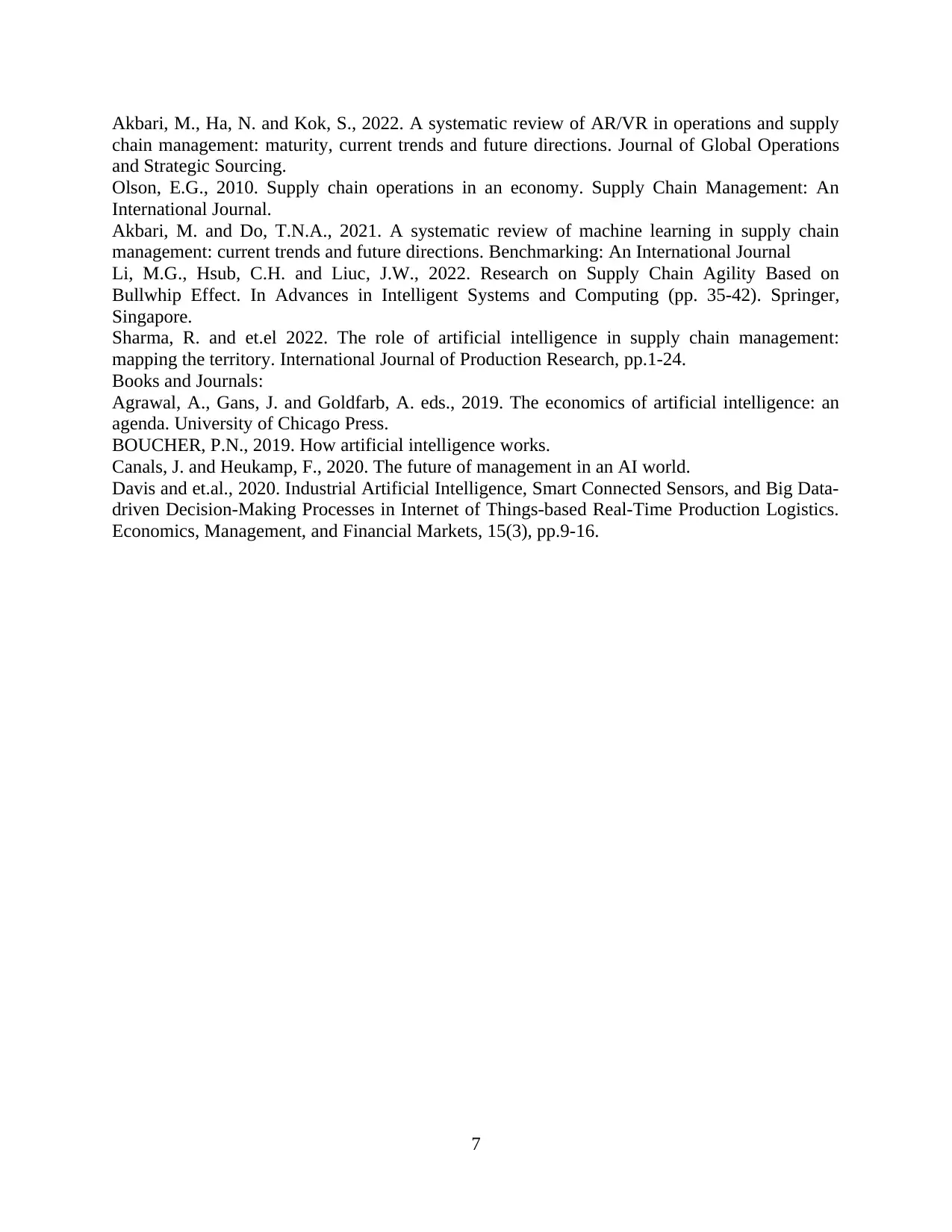
Akbari, M., Ha, N. and Kok, S., 2022. A systematic review of AR/VR in operations and supply
chain management: maturity, current trends and future directions. Journal of Global Operations
and Strategic Sourcing.
Olson, E.G., 2010. Supply chain operations in an economy. Supply Chain Management: An
International Journal.
Akbari, M. and Do, T.N.A., 2021. A systematic review of machine learning in supply chain
management: current trends and future directions. Benchmarking: An International Journal
Li, M.G., Hsub, C.H. and Liuc, J.W., 2022. Research on Supply Chain Agility Based on
Bullwhip Effect. In Advances in Intelligent Systems and Computing (pp. 35-42). Springer,
Singapore.
Sharma, R. and et.el 2022. The role of artificial intelligence in supply chain management:
mapping the territory. International Journal of Production Research, pp.1-24.
Books and Journals:
Agrawal, A., Gans, J. and Goldfarb, A. eds., 2019. The economics of artificial intelligence: an
agenda. University of Chicago Press.
BOUCHER, P.N., 2019. How artificial intelligence works.
Canals, J. and Heukamp, F., 2020. The future of management in an AI world.
Davis and et.al., 2020. Industrial Artificial Intelligence, Smart Connected Sensors, and Big Data-
driven Decision-Making Processes in Internet of Things-based Real-Time Production Logistics.
Economics, Management, and Financial Markets, 15(3), pp.9-16.
7
chain management: maturity, current trends and future directions. Journal of Global Operations
and Strategic Sourcing.
Olson, E.G., 2010. Supply chain operations in an economy. Supply Chain Management: An
International Journal.
Akbari, M. and Do, T.N.A., 2021. A systematic review of machine learning in supply chain
management: current trends and future directions. Benchmarking: An International Journal
Li, M.G., Hsub, C.H. and Liuc, J.W., 2022. Research on Supply Chain Agility Based on
Bullwhip Effect. In Advances in Intelligent Systems and Computing (pp. 35-42). Springer,
Singapore.
Sharma, R. and et.el 2022. The role of artificial intelligence in supply chain management:
mapping the territory. International Journal of Production Research, pp.1-24.
Books and Journals:
Agrawal, A., Gans, J. and Goldfarb, A. eds., 2019. The economics of artificial intelligence: an
agenda. University of Chicago Press.
BOUCHER, P.N., 2019. How artificial intelligence works.
Canals, J. and Heukamp, F., 2020. The future of management in an AI world.
Davis and et.al., 2020. Industrial Artificial Intelligence, Smart Connected Sensors, and Big Data-
driven Decision-Making Processes in Internet of Things-based Real-Time Production Logistics.
Economics, Management, and Financial Markets, 15(3), pp.9-16.
7

1 out of 10


Related Documents


Your All-in-One AI-Powered Toolkit for Academic Success.
+13062052269
info@desklib.com
Available 24*7 on WhatsApp / Email
![[object Object]](/_next/static/media/star-bottom.7253800d.svg)
Unlock your academic potential
Copyright © 2020–2026 A2Z Services. All Rights Reserved. Developed and managed by ZUCOL.