Report on Digital Business & New Technologies: E-commerce Platforms
VerifiedAdded on 2023/06/04
|11
|2581
|388
Report
AI Summary
This report provides an in-depth analysis of e-commerce platforms within the context of digital business and new technologies. It explores the significance of e-commerce, its historical development, and practical applications, including how various businesses utilize it. The report details the technological platforms, software, and apps used in e-commerce, examines different business models such as B2C, B2B, and C2C, and discusses their effectiveness. Furthermore, the report critically examines the relationship between digital and traditional technologies, along with emerging business and management theories, such as decision-making, quantitative, system, and contingency theories. The chosen case study is Amazon. The report concludes with a summary of key findings and insights into the future of e-commerce.
Digital Business &
New Technologies
New Technologies

Paraphrase This Document
Need a fresh take? Get an instant paraphrase of this document with our AI Paraphraser

EXECUTIVE SUMMARY
In this report, E- commerce platforms which is being a part of digital technology and is
growing rapidly. The importance, development, use and which types of businesses uses this
platforms. Further, effectiveness of E- commerce, its theories and models are also discussed.
In this report, E- commerce platforms which is being a part of digital technology and is
growing rapidly. The importance, development, use and which types of businesses uses this
platforms. Further, effectiveness of E- commerce, its theories and models are also discussed.

Table of Contents
EXECUTIVE SUMMARY.............................................................................................................2
INTRODUCTION...........................................................................................................................3
TASK – 1.........................................................................................................................................4
Importance of E- commerce.........................................................................................................4
Development of E- commerce.....................................................................................................4
Detailed description of E- commerce and its use.........................................................................5
What technological platforms, software and apps are used in E- commerce..............................5
What type of business uses E- commerce technology?...............................................................5
How E- commerce is used as a business tool and it is effective?................................................6
TASK - 2..........................................................................................................................................6
Critically discuss the nature of relationship between digital technologies modern as well as
traditional. Also discuss the emerging theories on business and management structures and
practices?......................................................................................................................................6
Types of E- commerce models....................................................................................................7
CONCLUSION ...............................................................................................................................9
REFERENCES..............................................................................................................................10
Books and Journals....................................................................................................................10
EXECUTIVE SUMMARY.............................................................................................................2
INTRODUCTION...........................................................................................................................3
TASK – 1.........................................................................................................................................4
Importance of E- commerce.........................................................................................................4
Development of E- commerce.....................................................................................................4
Detailed description of E- commerce and its use.........................................................................5
What technological platforms, software and apps are used in E- commerce..............................5
What type of business uses E- commerce technology?...............................................................5
How E- commerce is used as a business tool and it is effective?................................................6
TASK - 2..........................................................................................................................................6
Critically discuss the nature of relationship between digital technologies modern as well as
traditional. Also discuss the emerging theories on business and management structures and
practices?......................................................................................................................................6
Types of E- commerce models....................................................................................................7
CONCLUSION ...............................................................................................................................9
REFERENCES..............................................................................................................................10
Books and Journals....................................................................................................................10
⊘ This is a preview!⊘
Do you want full access?
Subscribe today to unlock all pages.

Trusted by 1+ million students worldwide

INTRODUCTION
With increasing innovation and development in technology the businesses are engaged in
using these technology within its business operations (Chaffey, Edmundson-Bird and Hemphill,
2019). The involvement of digital technologies for performing business operations are
considered as digital business. The organisations are able to achieve its set targets such as
enhancement in customer base, increasing profit and so on with the help of digital tools. The
chosen organisation for preparing this report is Amazon, which have started its operations in
1994 in US. The purpose behind preparing this reports is to evaluate the importance of E-
commerce its past, present and development. The businesses which uses such E- commerce
technology within its businesses. Further, new as well as old emerging theories of businesses will
be discussed. Lastly, it included the types of E- commerce model.
TASK – 1
Importance of E- commerce
The sell or purchase of goods through online platforms is considered as E- commerce. It
is the new or modern mode of making purchase (Gupta, Mejia and Kajikawa, 2019). With the
use of this online platforms certain businesses organisations are getting benefit. Its importance is
as follows -
Convenience – With use of E- commerce platforms customers are able to make easy
purchase and make the products get delivered to their doorsteps. By use of one click
purchase facility Amazon is able to provide facility to its customers to make online
purchase.
Availability – The physical stores use to open for a particular time period, but the
customers can make purchase from Amazon 24*7, which helps in enhances experience of
its customers.
Wide options – The customers get wide range of options through E- commerce platforms
this is because national as well as global businesses are easily available on such
platforms. This helps Amazon in fulfilling requirements of customers. Cost saving – The resellers are able to sell its products or services directly without
involvement of any mediator, thus Amazon is able to make sales of its products at low
prices and are able to increase its customer base.
With increasing innovation and development in technology the businesses are engaged in
using these technology within its business operations (Chaffey, Edmundson-Bird and Hemphill,
2019). The involvement of digital technologies for performing business operations are
considered as digital business. The organisations are able to achieve its set targets such as
enhancement in customer base, increasing profit and so on with the help of digital tools. The
chosen organisation for preparing this report is Amazon, which have started its operations in
1994 in US. The purpose behind preparing this reports is to evaluate the importance of E-
commerce its past, present and development. The businesses which uses such E- commerce
technology within its businesses. Further, new as well as old emerging theories of businesses will
be discussed. Lastly, it included the types of E- commerce model.
TASK – 1
Importance of E- commerce
The sell or purchase of goods through online platforms is considered as E- commerce. It
is the new or modern mode of making purchase (Gupta, Mejia and Kajikawa, 2019). With the
use of this online platforms certain businesses organisations are getting benefit. Its importance is
as follows -
Convenience – With use of E- commerce platforms customers are able to make easy
purchase and make the products get delivered to their doorsteps. By use of one click
purchase facility Amazon is able to provide facility to its customers to make online
purchase.
Availability – The physical stores use to open for a particular time period, but the
customers can make purchase from Amazon 24*7, which helps in enhances experience of
its customers.
Wide options – The customers get wide range of options through E- commerce platforms
this is because national as well as global businesses are easily available on such
platforms. This helps Amazon in fulfilling requirements of customers. Cost saving – The resellers are able to sell its products or services directly without
involvement of any mediator, thus Amazon is able to make sales of its products at low
prices and are able to increase its customer base.
Paraphrase This Document
Need a fresh take? Get an instant paraphrase of this document with our AI Paraphraser

Development of E- commerce
In 1991 the internet was opened to use of commercial purpose then only the use of E-
commerce has started (Haddud, McAllen and DeSouza, 2018). In 1995, Amazon was the one and
largest digital retailer in the world who was involved in selling books. The Dotcom Boom was
the first E- commerce website which are developed in 1992. The revenue of E- commerce
websites reached out to 160 billion Euros in 1991, which is a huge amount at that time. With the
development of Smart phones the use of internet started growing rapidly. The customers finds it
easy for making use of E- commerce platforms and hence continued to make shopping. Further,
with the launch of online payment system customers find it more easy and continent for making
purchase. As Amazon have provided certain attractive offers for the customers are made online
payment. This is how Amazon is able to grab attention of customers. The businesses are able to
make sales of its product and services conveniently this is enhancing customer experiences. The
customers does not get sufficient time for make purchase through physical stores which is why
they will make use of E- commerce websites for making purchase in future. Amazon is able to
generate a huge revenue with the use of E- commerce platforms and are making enhancement in
its brand value. E- commerce platforms will be able to capture 70% market by the end of 2025.
Detailed description of E- commerce and its use
E- commerce is platform or network where the business owner can sell its products
online (Heavin and Power, 2018). The mediators are being eliminated through out the process
which make the goods available at low rates. The customers are able to get wide range of options
as number of retailers are available on a single platform. The use of E- commerce are as follows
-
Online sales – The E- commerce platforms provides a medium though which retailers are
able to make its products sell online. After the easy process of registration the retailers
are able to upload its products on Amazon platforms and from their customer can make
purchase. Affiliate program – The affiliate programs helps other person for earning money. The
person who want to earn make use of affiliate link of Amazon. If can consumer make
purchase of any goods using the link the person is will be paid commission on its.
In 1991 the internet was opened to use of commercial purpose then only the use of E-
commerce has started (Haddud, McAllen and DeSouza, 2018). In 1995, Amazon was the one and
largest digital retailer in the world who was involved in selling books. The Dotcom Boom was
the first E- commerce website which are developed in 1992. The revenue of E- commerce
websites reached out to 160 billion Euros in 1991, which is a huge amount at that time. With the
development of Smart phones the use of internet started growing rapidly. The customers finds it
easy for making use of E- commerce platforms and hence continued to make shopping. Further,
with the launch of online payment system customers find it more easy and continent for making
purchase. As Amazon have provided certain attractive offers for the customers are made online
payment. This is how Amazon is able to grab attention of customers. The businesses are able to
make sales of its product and services conveniently this is enhancing customer experiences. The
customers does not get sufficient time for make purchase through physical stores which is why
they will make use of E- commerce websites for making purchase in future. Amazon is able to
generate a huge revenue with the use of E- commerce platforms and are making enhancement in
its brand value. E- commerce platforms will be able to capture 70% market by the end of 2025.
Detailed description of E- commerce and its use
E- commerce is platform or network where the business owner can sell its products
online (Heavin and Power, 2018). The mediators are being eliminated through out the process
which make the goods available at low rates. The customers are able to get wide range of options
as number of retailers are available on a single platform. The use of E- commerce are as follows
-
Online sales – The E- commerce platforms provides a medium though which retailers are
able to make its products sell online. After the easy process of registration the retailers
are able to upload its products on Amazon platforms and from their customer can make
purchase. Affiliate program – The affiliate programs helps other person for earning money. The
person who want to earn make use of affiliate link of Amazon. If can consumer make
purchase of any goods using the link the person is will be paid commission on its.

What technological platforms, software and apps are used in E- commerce
The use of digital E- commerce platforms are incomplete without the use of Artificial
intelligence (Kotarba, 2018). The needs and wants of customers can be easily evaluated with the
help of use of artificial intelligence technology. After analysing demand of customer, products
are being pitched and then they customers are influenced for buying. The Chatbots technology
leads customers to get timely answers of the problem faced by them. While using E- commerce
platforms when ever customers faces any difficulty they can make use of these technological
platforms. There are number of E- commerce platforms such as Amazon, Asos, E- bay, Shopify,
PrestaShop and so on, out of which Amazon was the first and leading E- commerce platform.
What type of business uses E- commerce technology?
The large as well small business organisations are involved in using E- commerce
platforms now a days (Sahut, Iandoli and Teulon, 2021). The small organisations uses E-
commerce platforms because they are cost effective and does not required any physical stores
through which they are able to save cost. A large customer base is easily available on E-
commerce platform thus large organisations wants to make enhancement in its customer base so
its easy to grab them from here. As per current market trend now most of the industrial sectors
such as healthcare, retailers, fashion, banking, hospitality and so on are involved in making use
of E- commerce platform for selling its products. Amazon is able to generate a sales of 65% by
the use of E- commerce within its operations. Thus, market capitalisation of Amazon keeps on
growing with the use of E- commerce platform for performing its business operations.
How E- commerce is used as a business tool and it is effective?
The operations of businesses are operated smoothly with the use of E- commerce
platforms (Sepashvili, 2019). The unnecessary of cost of businesses keeps on declining with this
it is not necessary to spend lot of amount on its infrastructure. The customers are able to make
enhancement in its satisfaction level with the use of E- commerce websites. The organisations
are able to reach out its potential as well as targeted customers with the use of E- commerce
platforms. The rapid growth of around 50 to 60 % has to be seen by the use of E- commerce
platforms. So, it is a effective tool for organisations as they are able to generate desired profits
along with enhancement in its brand value.
The use of digital E- commerce platforms are incomplete without the use of Artificial
intelligence (Kotarba, 2018). The needs and wants of customers can be easily evaluated with the
help of use of artificial intelligence technology. After analysing demand of customer, products
are being pitched and then they customers are influenced for buying. The Chatbots technology
leads customers to get timely answers of the problem faced by them. While using E- commerce
platforms when ever customers faces any difficulty they can make use of these technological
platforms. There are number of E- commerce platforms such as Amazon, Asos, E- bay, Shopify,
PrestaShop and so on, out of which Amazon was the first and leading E- commerce platform.
What type of business uses E- commerce technology?
The large as well small business organisations are involved in using E- commerce
platforms now a days (Sahut, Iandoli and Teulon, 2021). The small organisations uses E-
commerce platforms because they are cost effective and does not required any physical stores
through which they are able to save cost. A large customer base is easily available on E-
commerce platform thus large organisations wants to make enhancement in its customer base so
its easy to grab them from here. As per current market trend now most of the industrial sectors
such as healthcare, retailers, fashion, banking, hospitality and so on are involved in making use
of E- commerce platform for selling its products. Amazon is able to generate a sales of 65% by
the use of E- commerce within its operations. Thus, market capitalisation of Amazon keeps on
growing with the use of E- commerce platform for performing its business operations.
How E- commerce is used as a business tool and it is effective?
The operations of businesses are operated smoothly with the use of E- commerce
platforms (Sepashvili, 2019). The unnecessary of cost of businesses keeps on declining with this
it is not necessary to spend lot of amount on its infrastructure. The customers are able to make
enhancement in its satisfaction level with the use of E- commerce websites. The organisations
are able to reach out its potential as well as targeted customers with the use of E- commerce
platforms. The rapid growth of around 50 to 60 % has to be seen by the use of E- commerce
platforms. So, it is a effective tool for organisations as they are able to generate desired profits
along with enhancement in its brand value.
⊘ This is a preview!⊘
Do you want full access?
Subscribe today to unlock all pages.
Trusted by 1+ million students worldwide

TASK - 2
Critically discuss the nature of relationship between digital technologies modern as well as
traditional. Also discuss the emerging theories on business and management structures
and practices?
The quick or rapid changes which are arising rapidly within the technology makes the
businesses able to grow and expand its operations at global level (Wiesböck and Hess, 2020).
The organisations aims make expansions in its business operations this is why they makes
optimum utilisation of technological tools. The certain business theories in context to E-
commerce technology is as follows - Decision Making Theory - Decision making theory states the behaviour of an individual
at the time of situation when risk and uncertainty arises. The individuals are able to make
effective decision with the use of Decision making theory. The business are able to
evaluate which kind of products should be taken to E- commerce platforms with the help
of Decision making theory. Quantitative theory – The complex as well as difficult problems can be easily sorted with
the help of Quantitative theory. This theory shows a path or direction which can be
followed by organisations in order to solve business problem. The retailers finds it
difficult to grow its business over E- commerce, thus Amazon is able to find out effective
solutions through which retailers feels convenient to sells its products online. System theory – The system theory states that organisations are able to achieve its
objectives when they make use its several business operations collectively. E- commerce
provides a platform at which business are able to grow among large customer base. It is
also a cost effective solution which can be used by both large as well as small
organisations. Contingency theory - Contingency theory states that there is not any perfect way for
operating business operations. Each organisations uses different ways for performing its
operations and achieving its goals. With the help of E- commerce platforms the
organisation are able to generate huge revenue.
Critically discuss the nature of relationship between digital technologies modern as well as
traditional. Also discuss the emerging theories on business and management structures
and practices?
The quick or rapid changes which are arising rapidly within the technology makes the
businesses able to grow and expand its operations at global level (Wiesböck and Hess, 2020).
The organisations aims make expansions in its business operations this is why they makes
optimum utilisation of technological tools. The certain business theories in context to E-
commerce technology is as follows - Decision Making Theory - Decision making theory states the behaviour of an individual
at the time of situation when risk and uncertainty arises. The individuals are able to make
effective decision with the use of Decision making theory. The business are able to
evaluate which kind of products should be taken to E- commerce platforms with the help
of Decision making theory. Quantitative theory – The complex as well as difficult problems can be easily sorted with
the help of Quantitative theory. This theory shows a path or direction which can be
followed by organisations in order to solve business problem. The retailers finds it
difficult to grow its business over E- commerce, thus Amazon is able to find out effective
solutions through which retailers feels convenient to sells its products online. System theory – The system theory states that organisations are able to achieve its
objectives when they make use its several business operations collectively. E- commerce
provides a platform at which business are able to grow among large customer base. It is
also a cost effective solution which can be used by both large as well as small
organisations. Contingency theory - Contingency theory states that there is not any perfect way for
operating business operations. Each organisations uses different ways for performing its
operations and achieving its goals. With the help of E- commerce platforms the
organisation are able to generate huge revenue.
Paraphrase This Document
Need a fresh take? Get an instant paraphrase of this document with our AI Paraphraser
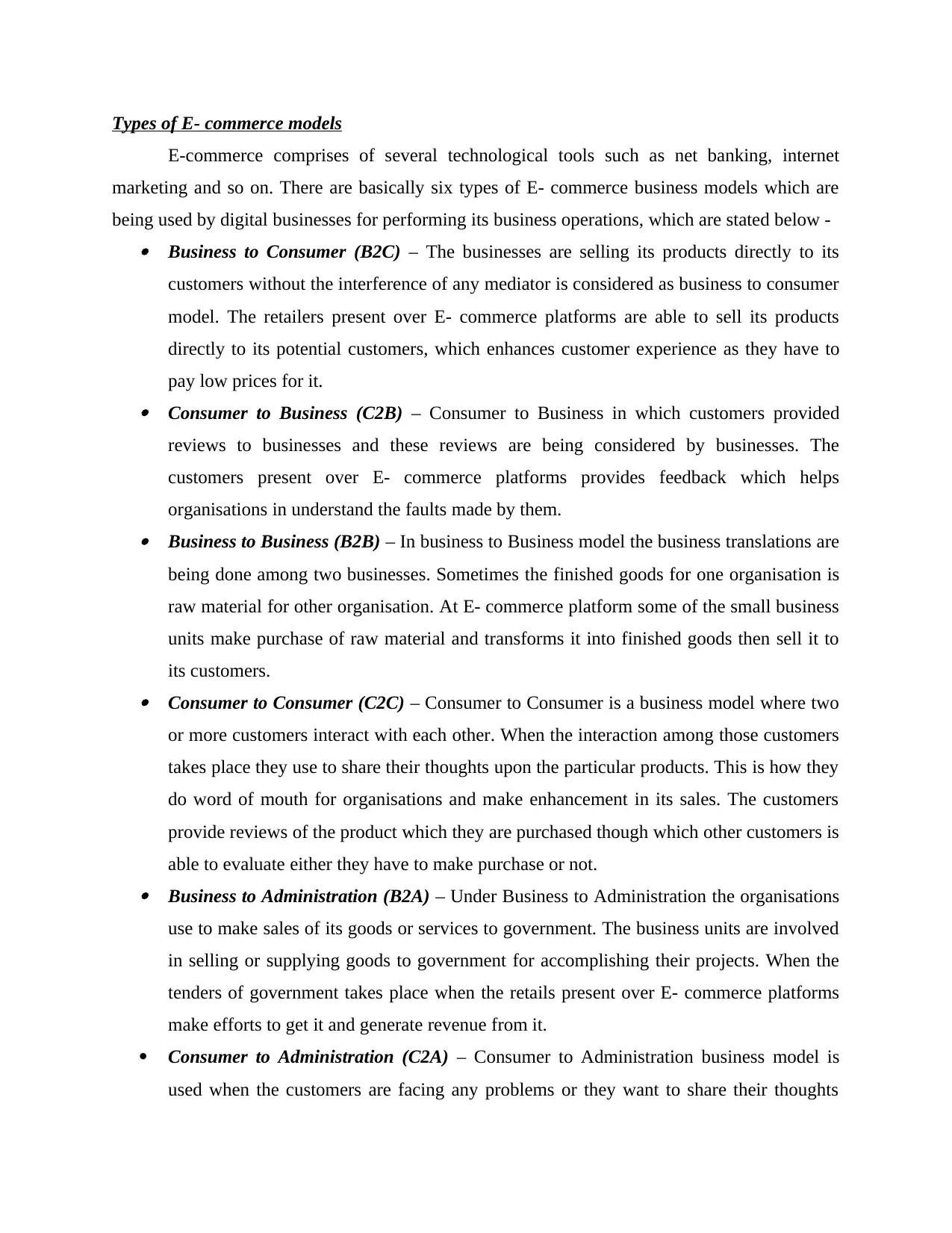
Types of E- commerce models
E-commerce comprises of several technological tools such as net banking, internet
marketing and so on. There are basically six types of E- commerce business models which are
being used by digital businesses for performing its business operations, which are stated below - Business to Consumer (B2C) – The businesses are selling its products directly to its
customers without the interference of any mediator is considered as business to consumer
model. The retailers present over E- commerce platforms are able to sell its products
directly to its potential customers, which enhances customer experience as they have to
pay low prices for it. Consumer to Business (C2B) – Consumer to Business in which customers provided
reviews to businesses and these reviews are being considered by businesses. The
customers present over E- commerce platforms provides feedback which helps
organisations in understand the faults made by them. Business to Business (B2B) – In business to Business model the business translations are
being done among two businesses. Sometimes the finished goods for one organisation is
raw material for other organisation. At E- commerce platform some of the small business
units make purchase of raw material and transforms it into finished goods then sell it to
its customers. Consumer to Consumer (C2C) – Consumer to Consumer is a business model where two
or more customers interact with each other. When the interaction among those customers
takes place they use to share their thoughts upon the particular products. This is how they
do word of mouth for organisations and make enhancement in its sales. The customers
provide reviews of the product which they are purchased though which other customers is
able to evaluate either they have to make purchase or not. Business to Administration (B2A) – Under Business to Administration the organisations
use to make sales of its goods or services to government. The business units are involved
in selling or supplying goods to government for accomplishing their projects. When the
tenders of government takes place when the retails present over E- commerce platforms
make efforts to get it and generate revenue from it.
Consumer to Administration (C2A) – Consumer to Administration business model is
used when the customers are facing any problems or they want to share their thoughts
E-commerce comprises of several technological tools such as net banking, internet
marketing and so on. There are basically six types of E- commerce business models which are
being used by digital businesses for performing its business operations, which are stated below - Business to Consumer (B2C) – The businesses are selling its products directly to its
customers without the interference of any mediator is considered as business to consumer
model. The retailers present over E- commerce platforms are able to sell its products
directly to its potential customers, which enhances customer experience as they have to
pay low prices for it. Consumer to Business (C2B) – Consumer to Business in which customers provided
reviews to businesses and these reviews are being considered by businesses. The
customers present over E- commerce platforms provides feedback which helps
organisations in understand the faults made by them. Business to Business (B2B) – In business to Business model the business translations are
being done among two businesses. Sometimes the finished goods for one organisation is
raw material for other organisation. At E- commerce platform some of the small business
units make purchase of raw material and transforms it into finished goods then sell it to
its customers. Consumer to Consumer (C2C) – Consumer to Consumer is a business model where two
or more customers interact with each other. When the interaction among those customers
takes place they use to share their thoughts upon the particular products. This is how they
do word of mouth for organisations and make enhancement in its sales. The customers
provide reviews of the product which they are purchased though which other customers is
able to evaluate either they have to make purchase or not. Business to Administration (B2A) – Under Business to Administration the organisations
use to make sales of its goods or services to government. The business units are involved
in selling or supplying goods to government for accomplishing their projects. When the
tenders of government takes place when the retails present over E- commerce platforms
make efforts to get it and generate revenue from it.
Consumer to Administration (C2A) – Consumer to Administration business model is
used when the customers are facing any problems or they want to share their thoughts

and opinions to government. The government focuses on the queries faced by citizens of
native countries.
native countries.
⊘ This is a preview!⊘
Do you want full access?
Subscribe today to unlock all pages.
Trusted by 1+ million students worldwide

CONCLUSION
From the above report, it has been concluded that E- commerce is a platform where
retails are able to make sell of its products easily. The businesses are able to save lot of cost
occurred on infrastructure of organisation. The customers can avail products at low prices
because mediators are not present over this platforms. The business theories helps in expansion
and taking crucial decisions of businesses. The business model used within E- commerce helps
gathering customer base though different medium. E- commerce platforms are able to get rapid
growth within it.
From the above report, it has been concluded that E- commerce is a platform where
retails are able to make sell of its products easily. The businesses are able to save lot of cost
occurred on infrastructure of organisation. The customers can avail products at low prices
because mediators are not present over this platforms. The business theories helps in expansion
and taking crucial decisions of businesses. The business model used within E- commerce helps
gathering customer base though different medium. E- commerce platforms are able to get rapid
growth within it.
Paraphrase This Document
Need a fresh take? Get an instant paraphrase of this document with our AI Paraphraser

REFERENCES
Books and Journals
Chaffey, D., Edmundson-Bird, D. and Hemphill, T., 2019. Digital business and e-commerce
management. Pearson UK.
Gupta, R., Mejia, C. and Kajikawa, Y., 2019. Business, innovation and digital ecosystems
landscape survey and knowledge cross sharing. Technological Forecasting and Social
Change, 147, pp.100-109.
Haddud, A., McAllen, D.K. and DeSouza, A.R., 2018. Managing Technological Innovation in
Digital Business Environments. In Marktorientiertes Produkt-und
Produktionsmanagement in digitalen Umwelten (pp. 47-60). Springer Gabler,
Wiesbaden.
Heavin, C. and Power, D.J., 2018. Challenges for digital transformation–towards a conceptual
decision support guide for managers. Journal of Decision Systems, 27(sup1), pp.38-45.
Kotarba, M., 2018. Digital transformation of business models. Foundations of
management, 10(1), pp.123-142.
Sahut, J.M., Iandoli, L. and Teulon, F., 2021. The age of digital entrepreneurship. Small
Business Economics, 56(3), pp.1159-1169.
Sepashvili, E., 2019. Digital technologies and e-banking: the future of global economy.
Wiesböck, F. and Hess, T., 2020. Digital innovations. Electronic Markets, 30(1), pp.75-86.
Books and Journals
Chaffey, D., Edmundson-Bird, D. and Hemphill, T., 2019. Digital business and e-commerce
management. Pearson UK.
Gupta, R., Mejia, C. and Kajikawa, Y., 2019. Business, innovation and digital ecosystems
landscape survey and knowledge cross sharing. Technological Forecasting and Social
Change, 147, pp.100-109.
Haddud, A., McAllen, D.K. and DeSouza, A.R., 2018. Managing Technological Innovation in
Digital Business Environments. In Marktorientiertes Produkt-und
Produktionsmanagement in digitalen Umwelten (pp. 47-60). Springer Gabler,
Wiesbaden.
Heavin, C. and Power, D.J., 2018. Challenges for digital transformation–towards a conceptual
decision support guide for managers. Journal of Decision Systems, 27(sup1), pp.38-45.
Kotarba, M., 2018. Digital transformation of business models. Foundations of
management, 10(1), pp.123-142.
Sahut, J.M., Iandoli, L. and Teulon, F., 2021. The age of digital entrepreneurship. Small
Business Economics, 56(3), pp.1159-1169.
Sepashvili, E., 2019. Digital technologies and e-banking: the future of global economy.
Wiesböck, F. and Hess, T., 2020. Digital innovations. Electronic Markets, 30(1), pp.75-86.

1 out of 11


Related Documents


Your All-in-One AI-Powered Toolkit for Academic Success.
+13062052269
info@desklib.com
Available 24*7 on WhatsApp / Email
![[object Object]](/_next/static/media/star-bottom.7253800d.svg)
Unlock your academic potential
Copyright © 2020–2026 A2Z Services. All Rights Reserved. Developed and managed by ZUCOL.