Analyzing M&S's Digital Disruption and Transformation Strategies
VerifiedAdded on 2021/01/01
|28
|4159
|156
Project
AI Summary
This project undertakes an in-depth analysis of Marks & Spencer (M&S) to evaluate the strategies employed by the business to navigate the challenges of digital disruption and transformation. The project begins with an introduction outlining the project's aim, objectives, and research questions, focusing on understanding digital disruption's impact on businesses. It then details the project management plan, covering scope, background, literature review, project costs, communication strategies, resource allocation, and risk assessment. The core of the project includes a work breakdown structure, Gantt chart, and a discussion of research methodologies, including qualitative and quantitative approaches. Findings are analyzed, leading to conclusions and recommendations for M&S to effectively manage digital transformation. The project concludes with a reflection on the research's value and its contribution to the student's learning and performance, supported by references and appendices. The project's aim is to explore ways for businesses to cope with major challenges of digital disruption and transformation in the context of Marks and Spencer. It also analyzes the concept of digital disruption and transformation for business, ascertains the challenges of digital disruption and transformation for M&S, identifies the ways for M&S to cope with challenges of digital disruption and transformation, and recommends and suggests strategies for application of ways to cope up with the challenges for M&S.
Managing a Successful
Businesses Project
Businesses Project

Paraphrase This Document
Need a fresh take? Get an instant paraphrase of this document with our AI Paraphraser
TABLE OF CONTENTS
INTRODUCTION...........................................................................................................................1
P1 Project aim and objectives for chosen scenario................................................................1
Research Questions................................................................................................................1
Aim.........................................................................................................................................1
Objectives...............................................................................................................................1
Research Rationale ................................................................................................................2
P2 Project Management Plan ................................................................................................2
Project Scope.........................................................................................................................2
Background of the study.........................................................................................................3
Literature Review...................................................................................................................3
Project cost ............................................................................................................................4
Project communication...........................................................................................................5
Resources................................................................................................................................6
Project risk..............................................................................................................................6
P3 Work break down structure and Gantt chart ....................................................................7
LO2..................................................................................................................................................7
P4 Small scale research by qualitative and quantitative research methods...........................7
Research methodology ..........................................................................................................7
LO3..................................................................................................................................................9
P5 Analysis and findings .......................................................................................................9
P6 Conclusion and Recommendation .................................................................................11
LO4................................................................................................................................................12
P7 Reflection on the values of undertaking research to meet the stated objectives and own
learning and performance.....................................................................................................12
REFERENCES..............................................................................................................................13
Appendix 1.....................................................................................................................................15
INTRODUCTION...........................................................................................................................1
P1 Project aim and objectives for chosen scenario................................................................1
Research Questions................................................................................................................1
Aim.........................................................................................................................................1
Objectives...............................................................................................................................1
Research Rationale ................................................................................................................2
P2 Project Management Plan ................................................................................................2
Project Scope.........................................................................................................................2
Background of the study.........................................................................................................3
Literature Review...................................................................................................................3
Project cost ............................................................................................................................4
Project communication...........................................................................................................5
Resources................................................................................................................................6
Project risk..............................................................................................................................6
P3 Work break down structure and Gantt chart ....................................................................7
LO2..................................................................................................................................................7
P4 Small scale research by qualitative and quantitative research methods...........................7
Research methodology ..........................................................................................................7
LO3..................................................................................................................................................9
P5 Analysis and findings .......................................................................................................9
P6 Conclusion and Recommendation .................................................................................11
LO4................................................................................................................................................12
P7 Reflection on the values of undertaking research to meet the stated objectives and own
learning and performance.....................................................................................................12
REFERENCES..............................................................................................................................13
Appendix 1.....................................................................................................................................15
PROJECT TITLE
To evaluate strategies that used by the businesses for coping up with the major challenges of
digital disruption and transformation: A study on Marks & Spencer (M&S)
INTRODUCTION
With the continuous rise in implementation of digital technology, there are some
challenges that need to be faced by any organisation. Digital disruption are analysed as changes
that occurs when new digital technologies and businesses models affect the value preposition of
existing goods and services . The continuous rise in the use of mobile devices for personal use
and work. Digital transformation sometimes considered as consumerism of information
technology which has increased the potential of digital disruption across various industries.
In retail industry, there are various business enterprises which are facing challenges after
making implementation of new digital technologies at workplace. Transformation of business
models due to application of technologies has also affected the value preposition of existing
products and service of organisation in market.
Present research has been carried out with an aim of analysing various ways for
businesses to cope up with major challenges of digital disruption and transformation. For this
research, Marks and Spencer is taken in to consideration which is an international retail
enterprise. Company has its various stores across various countries but they decided to
transform their clothing business online platform.
P1 Project aim and objectives for chosen scenario
Research Questions
What is the concept of digital disruption and transformation for business?
What are challenges of digital disruption and transformation for M&S?
How business has coped up with challenges of digital disruption and transformation?
Aim
To explore the ways for coping up with major challenges of digital disruption and
transformation in the context of Marks and Spencer.
Objectives
To analyse concept of digital disruption and transformation for business
To evaluate strategies that used by the businesses for coping up with the major challenges of
digital disruption and transformation: A study on Marks & Spencer (M&S)
INTRODUCTION
With the continuous rise in implementation of digital technology, there are some
challenges that need to be faced by any organisation. Digital disruption are analysed as changes
that occurs when new digital technologies and businesses models affect the value preposition of
existing goods and services . The continuous rise in the use of mobile devices for personal use
and work. Digital transformation sometimes considered as consumerism of information
technology which has increased the potential of digital disruption across various industries.
In retail industry, there are various business enterprises which are facing challenges after
making implementation of new digital technologies at workplace. Transformation of business
models due to application of technologies has also affected the value preposition of existing
products and service of organisation in market.
Present research has been carried out with an aim of analysing various ways for
businesses to cope up with major challenges of digital disruption and transformation. For this
research, Marks and Spencer is taken in to consideration which is an international retail
enterprise. Company has its various stores across various countries but they decided to
transform their clothing business online platform.
P1 Project aim and objectives for chosen scenario
Research Questions
What is the concept of digital disruption and transformation for business?
What are challenges of digital disruption and transformation for M&S?
How business has coped up with challenges of digital disruption and transformation?
Aim
To explore the ways for coping up with major challenges of digital disruption and
transformation in the context of Marks and Spencer.
Objectives
To analyse concept of digital disruption and transformation for business
⊘ This is a preview!⊘
Do you want full access?
Subscribe today to unlock all pages.

Trusted by 1+ million students worldwide
To ascertain the challenges of digital disruption and transformation for M&S
To identify the ways for M&S to cope with challenges of digital disruption and
transformation
To recommend and suggest strategies for application of ways to cope up with the
challenges for M&S
Research Rationale
Rationale behind conducting this research was to gain knowledge and understanding
about various challenges of digital disruption and transformation. Multiple research strategies
have been applied which helps in improving the performance level. There are various important
aspects that have been covered in research which helps in development of conceptual knowledge
about current issues faced by organisation due to digital disruption and transformation.
Collection of data from secondary resources will help in conducting critical analysis of argument
of different researchers. Thus, researcher will get to know about the ways through which
businesses will cope up with challenges of digital disruption.
P2 Project Management Plan
Project Management Plan is analysed as an essential part of investigation which helps the
scholar in identification of sequence as per different activities and tasks to be accomplished
during research process. Development of project plan is considered as important as it aids
scholar in preventing overlapping of activities and ensuring appropriate utilization of resources.
There are various important elements of project management plan such as cost, quality, time,
scope, communication and resources.
Project Scope
It is a part of project planning that includes determination and documentation of list of
specific goals, deliverable, characteristics, important functions, activities, deadlines and cost.
This business research has been conducted with the scope of analysing various important ways or
methods for businesses to cope up with challenges of digital disruption and transformation.
Project deliverables are the outcomes achieved by scholar after completion of research. In this
research, deliverable will be the ways used by company to cope up with challenges of digital
disruption and transformation.
2
To identify the ways for M&S to cope with challenges of digital disruption and
transformation
To recommend and suggest strategies for application of ways to cope up with the
challenges for M&S
Research Rationale
Rationale behind conducting this research was to gain knowledge and understanding
about various challenges of digital disruption and transformation. Multiple research strategies
have been applied which helps in improving the performance level. There are various important
aspects that have been covered in research which helps in development of conceptual knowledge
about current issues faced by organisation due to digital disruption and transformation.
Collection of data from secondary resources will help in conducting critical analysis of argument
of different researchers. Thus, researcher will get to know about the ways through which
businesses will cope up with challenges of digital disruption.
P2 Project Management Plan
Project Management Plan is analysed as an essential part of investigation which helps the
scholar in identification of sequence as per different activities and tasks to be accomplished
during research process. Development of project plan is considered as important as it aids
scholar in preventing overlapping of activities and ensuring appropriate utilization of resources.
There are various important elements of project management plan such as cost, quality, time,
scope, communication and resources.
Project Scope
It is a part of project planning that includes determination and documentation of list of
specific goals, deliverable, characteristics, important functions, activities, deadlines and cost.
This business research has been conducted with the scope of analysing various important ways or
methods for businesses to cope up with challenges of digital disruption and transformation.
Project deliverables are the outcomes achieved by scholar after completion of research. In this
research, deliverable will be the ways used by company to cope up with challenges of digital
disruption and transformation.
2
Paraphrase This Document
Need a fresh take? Get an instant paraphrase of this document with our AI Paraphraser
Background of the study
In this competitive environment, digital technology is widely adopted by organisation in
their business models and processes to attain competitive advantages in market. These
technologies have incurred various changes in business and provided recognition to products and
services in market.
Digital transformation is considered as the profound transformation of business and
various organisational activities, competencies, processes and models to fully leverage changes
and opportunities of a mix of digital technologies (Rotman, 2013). In retail industry, company
has provided major focus on application of various new technologies in their business because it
is beneficial for them to attain objectives.
Main objective of business is to maximize profits and they must implement digital
technologies to transform their business (Pardo, 2013). However, digital disruption and
transformation have created major challenges for these enterprises to operate with new business
models. In this research, Scholar has carried out an analysis on M&S which is a retail business
enterprise. There are some issues and ways to cope up with these challenges for cited
organisation will be identified by scholar in this research.
Literature Review
According to Buguin and et.al, (2013), digital disruptions are usually analysed as issues
which occurs after involvement of technologies in any business model. Organizations
undergoing digital transformation have achieved increased market share, customers’
engagement, and increase in employee morale and rise in customer revenue. Participants in the
study reported that their companies have faced various challenges after this transformation.
Hirt and Willmott, (2014) stated that, employees pushback is the major challenge which
has created issues for enterprise after implementation of digital technologies for completion of
different business activities. This digital transformation has provided a feeling of threat of lay off
to employees because technologies have continuously reduced requirement of employees.
Further, lack of expertise to lead the digitalization initiatives is another challenges for enterprise
because organisation also needs qualified employees at workplace who are capable of
implementing and adopting new technologies (Piercy, 2016). In retail sector, companies having
more than 5000 employees are also facing this issue as they do not have expertise who can lead
and implement initiatives of digitalization of business process and initiatives. Actions of
3
In this competitive environment, digital technology is widely adopted by organisation in
their business models and processes to attain competitive advantages in market. These
technologies have incurred various changes in business and provided recognition to products and
services in market.
Digital transformation is considered as the profound transformation of business and
various organisational activities, competencies, processes and models to fully leverage changes
and opportunities of a mix of digital technologies (Rotman, 2013). In retail industry, company
has provided major focus on application of various new technologies in their business because it
is beneficial for them to attain objectives.
Main objective of business is to maximize profits and they must implement digital
technologies to transform their business (Pardo, 2013). However, digital disruption and
transformation have created major challenges for these enterprises to operate with new business
models. In this research, Scholar has carried out an analysis on M&S which is a retail business
enterprise. There are some issues and ways to cope up with these challenges for cited
organisation will be identified by scholar in this research.
Literature Review
According to Buguin and et.al, (2013), digital disruptions are usually analysed as issues
which occurs after involvement of technologies in any business model. Organizations
undergoing digital transformation have achieved increased market share, customers’
engagement, and increase in employee morale and rise in customer revenue. Participants in the
study reported that their companies have faced various challenges after this transformation.
Hirt and Willmott, (2014) stated that, employees pushback is the major challenge which
has created issues for enterprise after implementation of digital technologies for completion of
different business activities. This digital transformation has provided a feeling of threat of lay off
to employees because technologies have continuously reduced requirement of employees.
Further, lack of expertise to lead the digitalization initiatives is another challenges for enterprise
because organisation also needs qualified employees at workplace who are capable of
implementing and adopting new technologies (Piercy, 2016). In retail sector, companies having
more than 5000 employees are also facing this issue as they do not have expertise who can lead
and implement initiatives of digitalization of business process and initiatives. Actions of
3
organisation to resolve these challenges provide threat of retrenchment and lay off to existing
employees at workplace.
According to Bharadwaj and et.al, (2013), Digital transformation is considered as substantial
initiative and usually require changes in more than the employees daily routine. This can be
interpreted as transformation of roles, departments and overall organisation structure. Changes
in overall structure is very critical for organisation as it creates conflicts between management
and employees at workplace.
Huge requirement of budget and resources is also considered challenge of digital disruption and
transformation for businesses. Implementation of new technologies requires wide technical
resources and expertise which needs to arranged by organisation.
According to Brynjolfsson and McAfee, (2012), in order to cope with the challenge of
employee pushback, it is essential for company to completely resolve doubts and uncertainty
from employee's mind and they can also certainly alleviate them. Being consistent and
transparent in front of employees is the key to face this challenge. Company should keep their
employees informed and involved through whole process of digital transformation (Westerman,
Bonnet and McAfee, 2014). By providing training for developing experience and competencies
have provide support to retail business enterprise to achieve employee satisfaction.
According to Loebbecke and Picot, (2015), it is important to develop a company wide
digital transformation strategy in which company need to clarified a vision, set goals to reach
that vision and providing a purpose to whole team. This aid the management to resolve
redundancies and increase the involvement of employees to attain the business goals and vision
effectively. Further, company should hire expertise who able to operate technology and provide
support to organisation by attracting more customers (Buguin and et.al, 2013). It is also essential
that organisation structure will be fluid because the new frontier of technology and customer
experience will require it to be like this. Further, when company build strategies of digital
transformation, it should use budget as reality check to consider how much they can handle and
create a plan for appropriate utilization of resources.
Project cost
There are various important expenditure have been considered which needs to be
incurred by scholar for execution of research. Some important expenditures are travelling,
4
employees at workplace.
According to Bharadwaj and et.al, (2013), Digital transformation is considered as substantial
initiative and usually require changes in more than the employees daily routine. This can be
interpreted as transformation of roles, departments and overall organisation structure. Changes
in overall structure is very critical for organisation as it creates conflicts between management
and employees at workplace.
Huge requirement of budget and resources is also considered challenge of digital disruption and
transformation for businesses. Implementation of new technologies requires wide technical
resources and expertise which needs to arranged by organisation.
According to Brynjolfsson and McAfee, (2012), in order to cope with the challenge of
employee pushback, it is essential for company to completely resolve doubts and uncertainty
from employee's mind and they can also certainly alleviate them. Being consistent and
transparent in front of employees is the key to face this challenge. Company should keep their
employees informed and involved through whole process of digital transformation (Westerman,
Bonnet and McAfee, 2014). By providing training for developing experience and competencies
have provide support to retail business enterprise to achieve employee satisfaction.
According to Loebbecke and Picot, (2015), it is important to develop a company wide
digital transformation strategy in which company need to clarified a vision, set goals to reach
that vision and providing a purpose to whole team. This aid the management to resolve
redundancies and increase the involvement of employees to attain the business goals and vision
effectively. Further, company should hire expertise who able to operate technology and provide
support to organisation by attracting more customers (Buguin and et.al, 2013). It is also essential
that organisation structure will be fluid because the new frontier of technology and customer
experience will require it to be like this. Further, when company build strategies of digital
transformation, it should use budget as reality check to consider how much they can handle and
create a plan for appropriate utilization of resources.
Project cost
There are various important expenditure have been considered which needs to be
incurred by scholar for execution of research. Some important expenditures are travelling,
4
⊘ This is a preview!⊘
Do you want full access?
Subscribe today to unlock all pages.
Trusted by 1+ million students worldwide
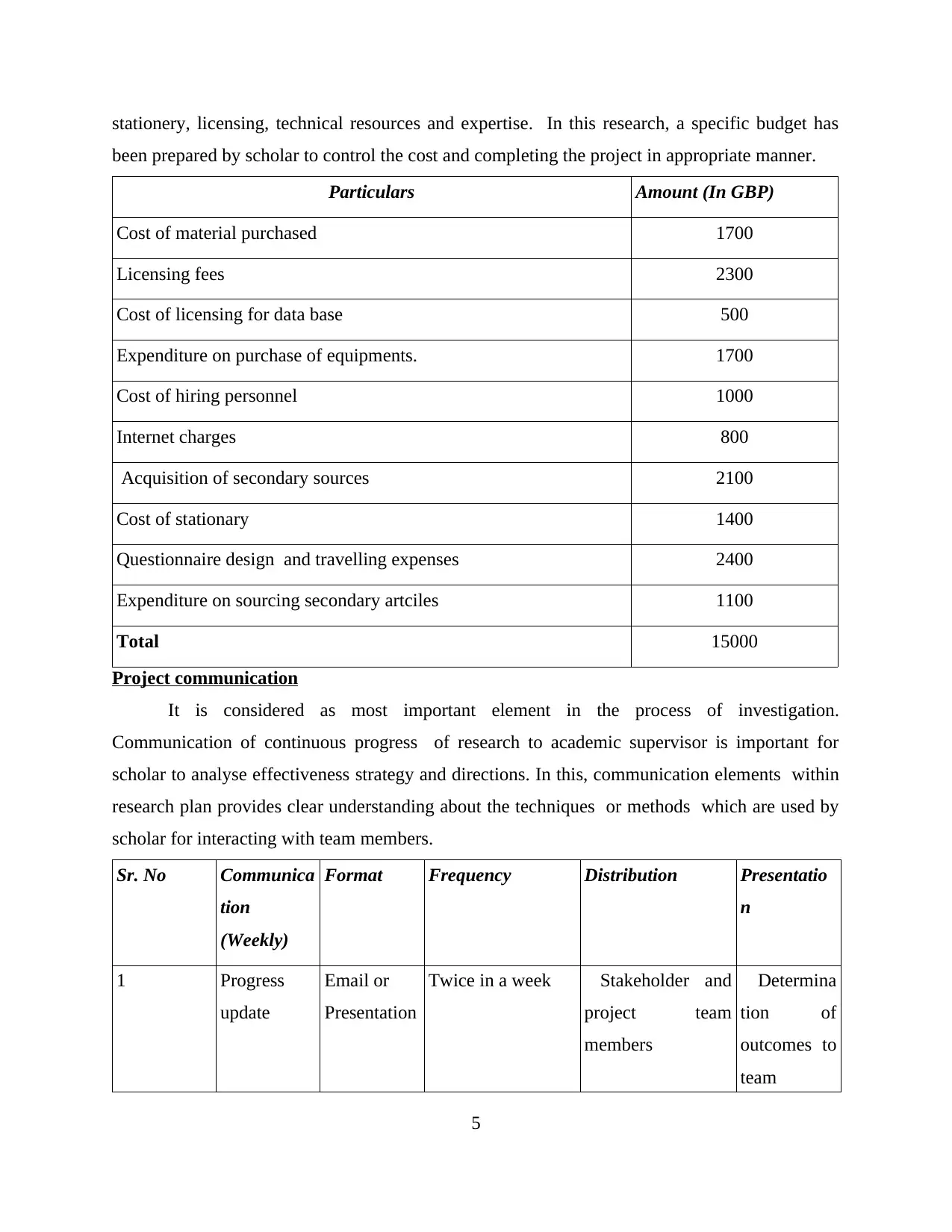
stationery, licensing, technical resources and expertise. In this research, a specific budget has
been prepared by scholar to control the cost and completing the project in appropriate manner.
Particulars Amount (In GBP)
Cost of material purchased 1700
Licensing fees 2300
Cost of licensing for data base 500
Expenditure on purchase of equipments. 1700
Cost of hiring personnel 1000
Internet charges 800
Acquisition of secondary sources 2100
Cost of stationary 1400
Questionnaire design and travelling expenses 2400
Expenditure on sourcing secondary artciles 1100
Total 15000
Project communication
It is considered as most important element in the process of investigation.
Communication of continuous progress of research to academic supervisor is important for
scholar to analyse effectiveness strategy and directions. In this, communication elements within
research plan provides clear understanding about the techniques or methods which are used by
scholar for interacting with team members.
Sr. No Communica
tion
(Weekly)
Format Frequency Distribution Presentatio
n
1 Progress
update
Email or
Presentation
Twice in a week Stakeholder and
project team
members
Determina
tion of
outcomes to
team
5
been prepared by scholar to control the cost and completing the project in appropriate manner.
Particulars Amount (In GBP)
Cost of material purchased 1700
Licensing fees 2300
Cost of licensing for data base 500
Expenditure on purchase of equipments. 1700
Cost of hiring personnel 1000
Internet charges 800
Acquisition of secondary sources 2100
Cost of stationary 1400
Questionnaire design and travelling expenses 2400
Expenditure on sourcing secondary artciles 1100
Total 15000
Project communication
It is considered as most important element in the process of investigation.
Communication of continuous progress of research to academic supervisor is important for
scholar to analyse effectiveness strategy and directions. In this, communication elements within
research plan provides clear understanding about the techniques or methods which are used by
scholar for interacting with team members.
Sr. No Communica
tion
(Weekly)
Format Frequency Distribution Presentatio
n
1 Progress
update
Email or
Presentation
Twice in a week Stakeholder and
project team
members
Determina
tion of
outcomes to
team
5
Paraphrase This Document
Need a fresh take? Get an instant paraphrase of this document with our AI Paraphraser
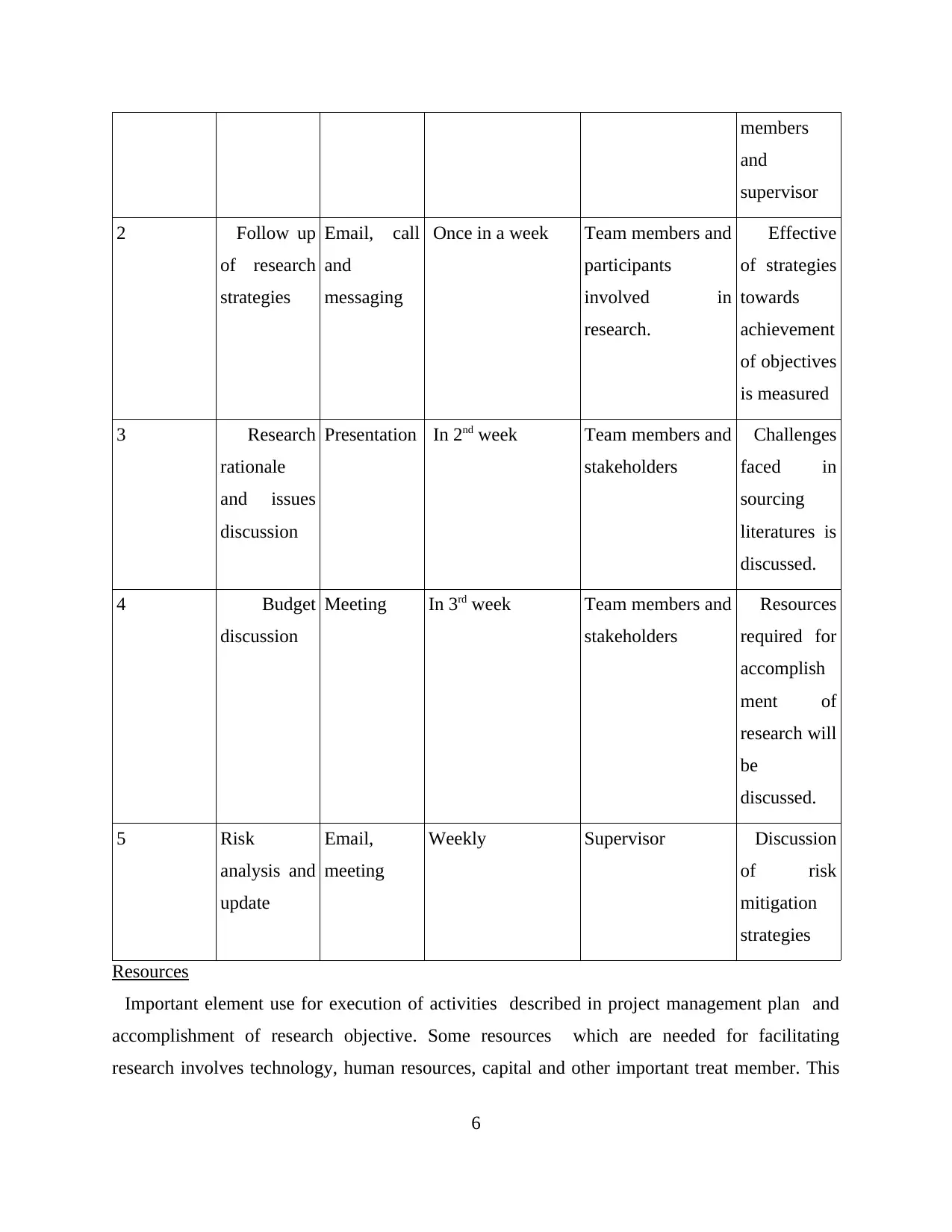
members
and
supervisor
2 Follow up
of research
strategies
Email, call
and
messaging
Once in a week Team members and
participants
involved in
research.
Effective
of strategies
towards
achievement
of objectives
is measured
3 Research
rationale
and issues
discussion
Presentation In 2nd week Team members and
stakeholders
Challenges
faced in
sourcing
literatures is
discussed.
4 Budget
discussion
Meeting In 3rd week Team members and
stakeholders
Resources
required for
accomplish
ment of
research will
be
discussed.
5 Risk
analysis and
update
Email,
meeting
Weekly Supervisor Discussion
of risk
mitigation
strategies
Resources
Important element use for execution of activities described in project management plan and
accomplishment of research objective. Some resources which are needed for facilitating
research involves technology, human resources, capital and other important treat member. This
6
and
supervisor
2 Follow up
of research
strategies
Email, call
and
messaging
Once in a week Team members and
participants
involved in
research.
Effective
of strategies
towards
achievement
of objectives
is measured
3 Research
rationale
and issues
discussion
Presentation In 2nd week Team members and
stakeholders
Challenges
faced in
sourcing
literatures is
discussed.
4 Budget
discussion
Meeting In 3rd week Team members and
stakeholders
Resources
required for
accomplish
ment of
research will
be
discussed.
5 Risk
analysis and
update
Email,
meeting
Weekly Supervisor Discussion
of risk
mitigation
strategies
Resources
Important element use for execution of activities described in project management plan and
accomplishment of research objective. Some resources which are needed for facilitating
research involves technology, human resources, capital and other important treat member. This
6
element in research plan help scholar in ensuring data appropriate utilisation of resources during
the process of investigation.
Project risk
Various kinds risk have been occurred while execution of investigation such as
inappropriate response from respondents, less reliability of data, Lack of understanding bout data
analysis and risk of wastage of useful resources and other redundancies etc. Various important
strategies have been implemented and all these issues have been resolve d appropriately.
M1
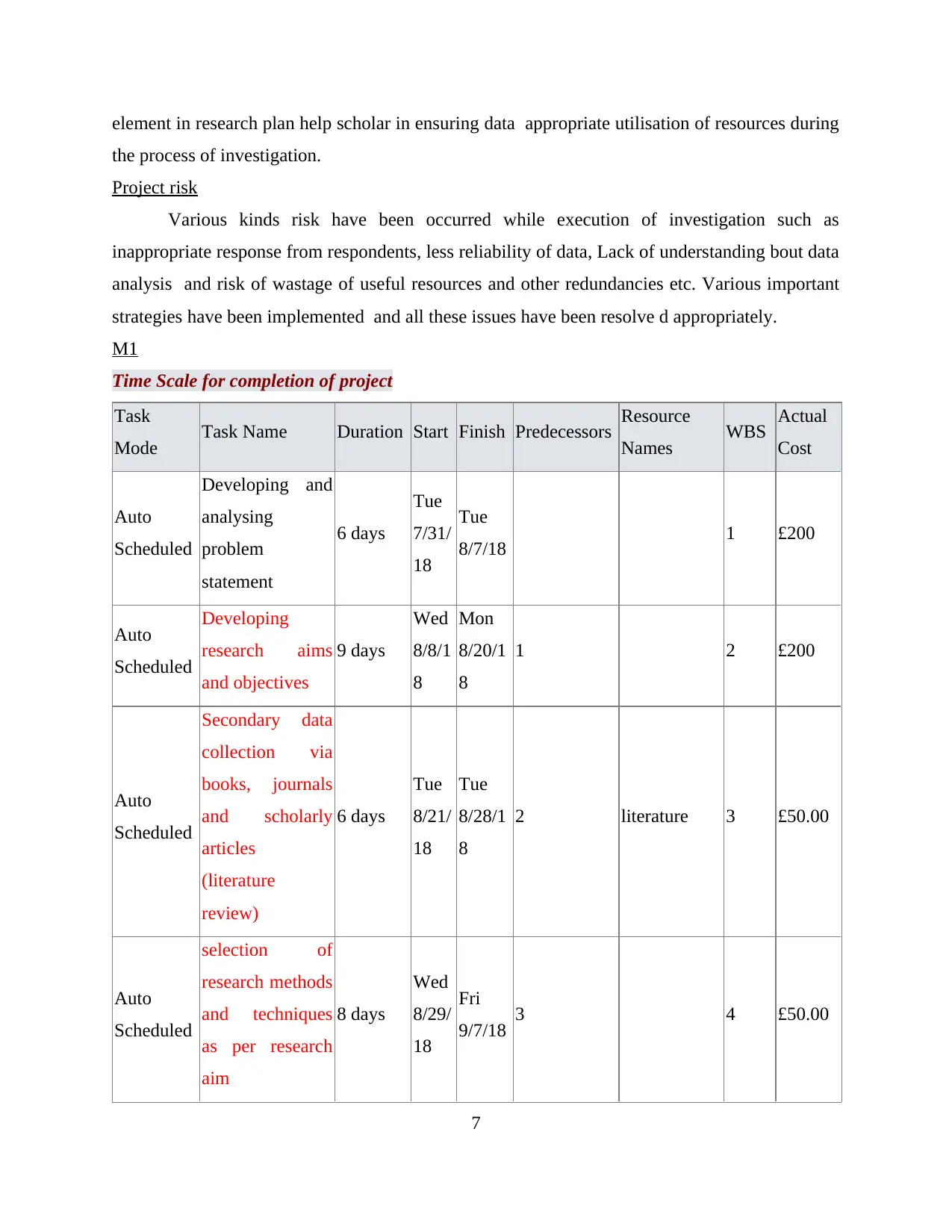
Time Scale for completion of project
Task
Mode Task Name Duration Start Finish Predecessors Resource
Names WBS Actual
Cost
Auto
Scheduled
Developing and
analysing
problem
statement
6 days
Tue
7/31/
18
Tue
8/7/18 1 £200
Auto
Scheduled
Developing
research aims
and objectives
9 days
Wed
8/8/1
8
Mon
8/20/1
8
1 2 £200
Auto
Scheduled
Secondary data
collection via
books, journals
and scholarly
articles
(literature
review)
6 days
Tue
8/21/
18
Tue
8/28/1
8
2 literature 3 £50.00
Auto
Scheduled
selection of
research methods
and techniques
as per research
aim
8 days
Wed
8/29/
18
Fri
9/7/18 3 4 £50.00
7
the process of investigation.
Project risk
Various kinds risk have been occurred while execution of investigation such as
inappropriate response from respondents, less reliability of data, Lack of understanding bout data
analysis and risk of wastage of useful resources and other redundancies etc. Various important
strategies have been implemented and all these issues have been resolve d appropriately.
M1
Time Scale for completion of project
Task
Mode Task Name Duration Start Finish Predecessors Resource
Names WBS Actual
Cost
Auto
Scheduled
Developing and
analysing
problem
statement
6 days
Tue
7/31/
18
Tue
8/7/18 1 £200
Auto
Scheduled
Developing
research aims
and objectives
9 days
Wed
8/8/1
8
Mon
8/20/1
8
1 2 £200
Auto
Scheduled
Secondary data
collection via
books, journals
and scholarly
articles
(literature
review)
6 days
Tue
8/21/
18
Tue
8/28/1
8
2 literature 3 £50.00
Auto
Scheduled
selection of
research methods
and techniques
as per research
aim
8 days
Wed
8/29/
18
Fri
9/7/18 3 4 £50.00
7
⊘ This is a preview!⊘
Do you want full access?
Subscribe today to unlock all pages.
Trusted by 1+ million students worldwide
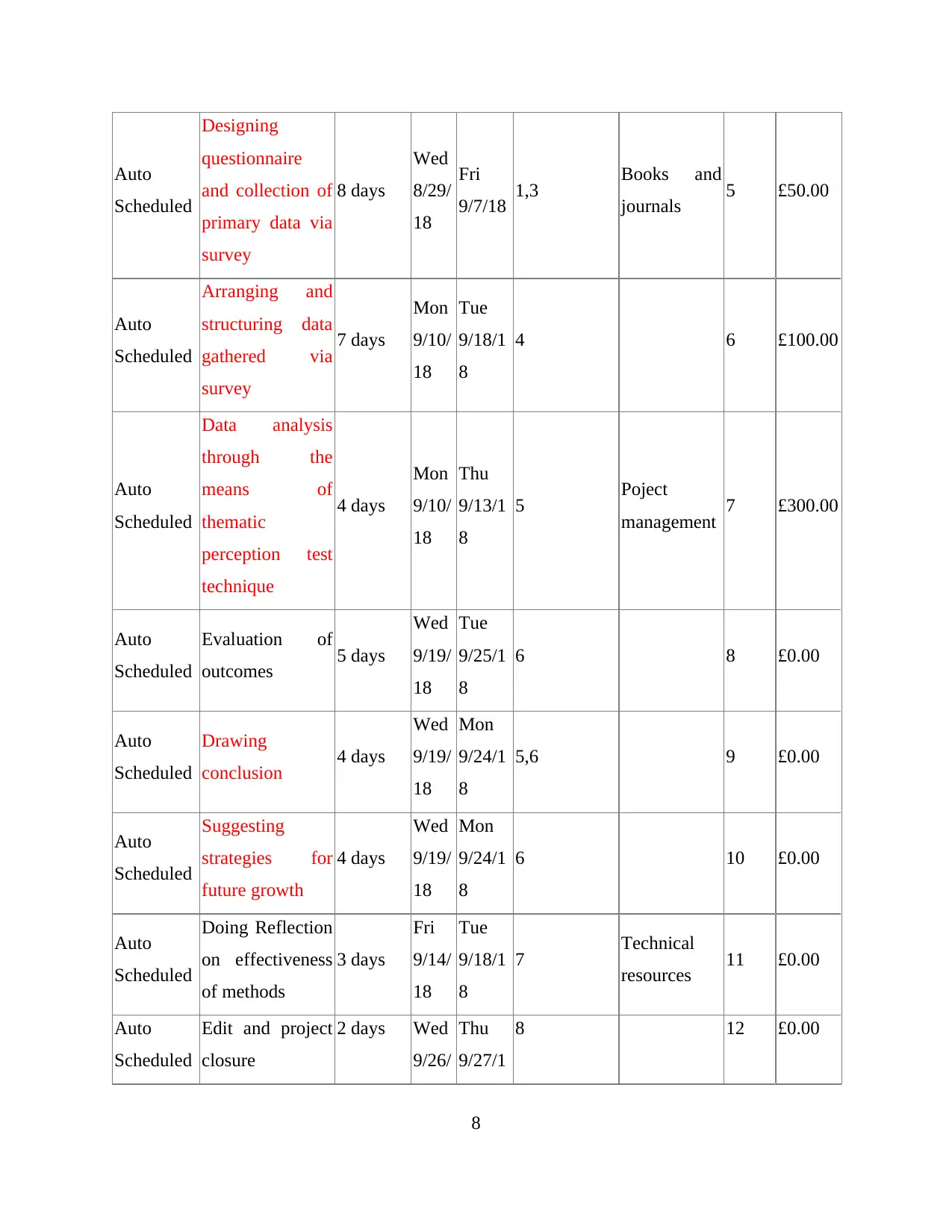
Auto
Scheduled
Designing
questionnaire
and collection of
primary data via
survey
8 days
Wed
8/29/
18
Fri
9/7/18 1,3 Books and
journals 5 £50.00
Auto
Scheduled
Arranging and
structuring data
gathered via
survey
7 days
Mon
9/10/
18
Tue
9/18/1
8
4 6 £100.00
Auto
Scheduled
Data analysis
through the
means of
thematic
perception test
technique
4 days
Mon
9/10/
18
Thu
9/13/1
8
5 Poject
management 7 £300.00
Auto
Scheduled
Evaluation of
outcomes 5 days
Wed
9/19/
18
Tue
9/25/1
8
6 8 £0.00
Auto
Scheduled
Drawing
conclusion 4 days
Wed
9/19/
18
Mon
9/24/1
8
5,6 9 £0.00
Auto
Scheduled
Suggesting
strategies for
future growth
4 days
Wed
9/19/
18
Mon
9/24/1
8
6 10 £0.00
Auto
Scheduled
Doing Reflection
on effectiveness
of methods
3 days
Fri
9/14/
18
Tue
9/18/1
8
7 Technical
resources 11 £0.00
Auto
Scheduled
Edit and project
closure
2 days Wed
9/26/
Thu
9/27/1
8 12 £0.00
8
Scheduled
Designing
questionnaire
and collection of
primary data via
survey
8 days
Wed
8/29/
18
Fri
9/7/18 1,3 Books and
journals 5 £50.00
Auto
Scheduled
Arranging and
structuring data
gathered via
survey
7 days
Mon
9/10/
18
Tue
9/18/1
8
4 6 £100.00
Auto
Scheduled
Data analysis
through the
means of
thematic
perception test
technique
4 days
Mon
9/10/
18
Thu
9/13/1
8
5 Poject
management 7 £300.00
Auto
Scheduled
Evaluation of
outcomes 5 days
Wed
9/19/
18
Tue
9/25/1
8
6 8 £0.00
Auto
Scheduled
Drawing
conclusion 4 days
Wed
9/19/
18
Mon
9/24/1
8
5,6 9 £0.00
Auto
Scheduled
Suggesting
strategies for
future growth
4 days
Wed
9/19/
18
Mon
9/24/1
8
6 10 £0.00
Auto
Scheduled
Doing Reflection
on effectiveness
of methods
3 days
Fri
9/14/
18
Tue
9/18/1
8
7 Technical
resources 11 £0.00
Auto
Scheduled
Edit and project
closure
2 days Wed
9/26/
Thu
9/27/1
8 12 £0.00
8
Paraphrase This Document
Need a fresh take? Get an instant paraphrase of this document with our AI Paraphraser

18 8
Auto
Scheduled Final Submission 1 day
Wed
9/26/
18
Wed
9/26/1
8
8,7 13 £0.00
P3 Work break down structure and Gantt chart
Project Gantt Chart
Network Diagram
9
Illustration 1: Project Gantt Chart
Auto
Scheduled Final Submission 1 day
Wed
9/26/
18
Wed
9/26/1
8
8,7 13 £0.00
P3 Work break down structure and Gantt chart
Project Gantt Chart
Network Diagram
9
Illustration 1: Project Gantt Chart
LO2
P4 Small scale research by qualitative and quantitative research methods
Research methodology
These are analysed as specific procedure or techniques which are used by scholar to
identify, selection, processing and analysis of information about research. It allows scholar to
critically evaluate overall validity and reliability of research in appropriate manner (Taylor,
Bogdan and DeVault, 2015). In this research, Scholar has utilized various research
methodologies to explore the ways for M&S to cope up the challenged of digital disruption and
transformation. It involves both qualitative and qualitative research which are mentioned below:
Research philosophy
It is considered as belief of scholar about the direction and method through which data
related to the phenomenon will be collected. These research philosophy usually deals with the
source, nature and development of knowledge (Mackey and Gass, 2015). Mainly there are two
kinds of research philosophy which is mostly used for conducting research such as Positivism
and interpretivism. In this research, interpretivism philosophy is used by scholar for
accomplishment of research in appropriate manner. It is also considered as appropriate research
philosophy which helps the scholar in accomplishment of research objectives (Iordanova and
Cunningham, 2012).
10
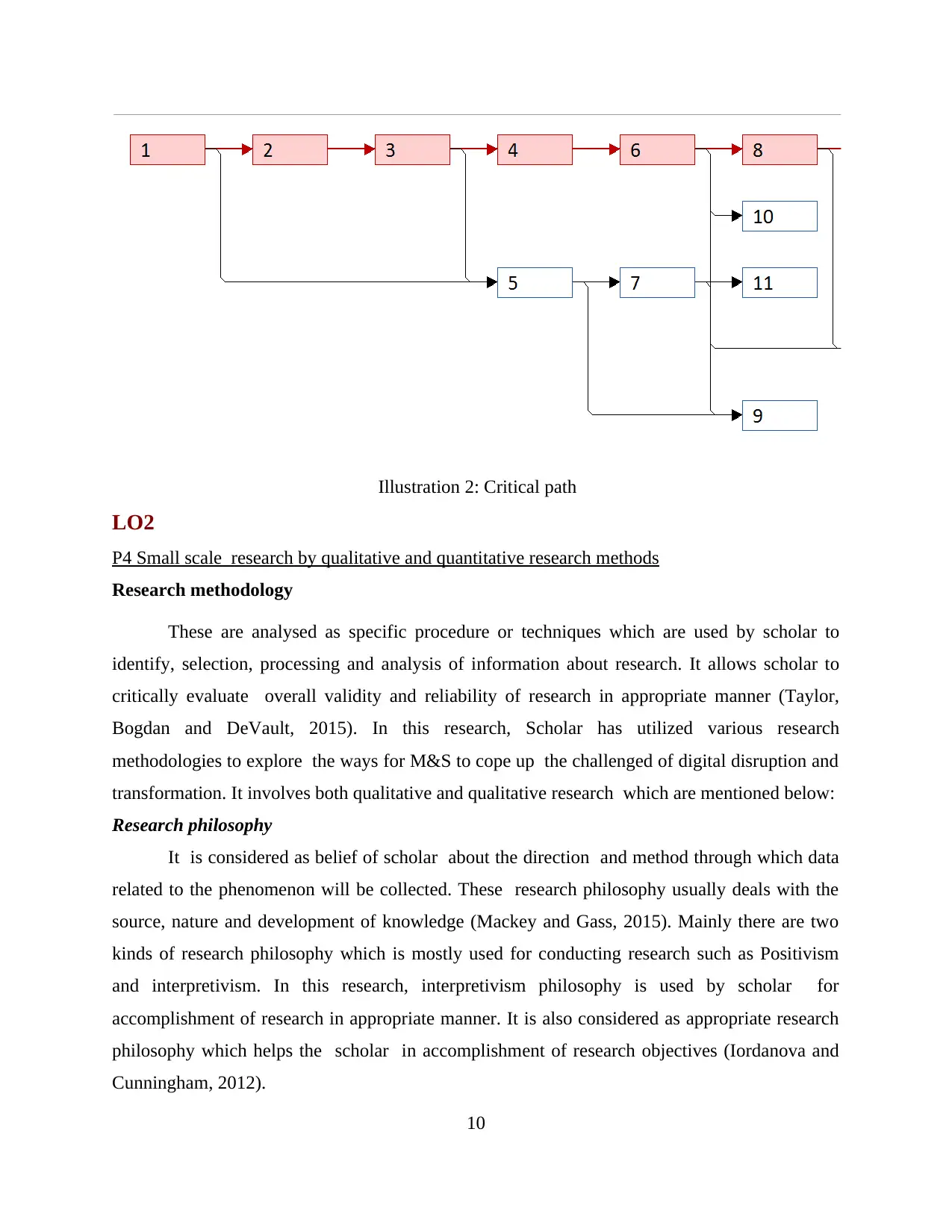
Illustration 2: Critical path
P4 Small scale research by qualitative and quantitative research methods
Research methodology
These are analysed as specific procedure or techniques which are used by scholar to
identify, selection, processing and analysis of information about research. It allows scholar to
critically evaluate overall validity and reliability of research in appropriate manner (Taylor,
Bogdan and DeVault, 2015). In this research, Scholar has utilized various research
methodologies to explore the ways for M&S to cope up the challenged of digital disruption and
transformation. It involves both qualitative and qualitative research which are mentioned below:
Research philosophy
It is considered as belief of scholar about the direction and method through which data
related to the phenomenon will be collected. These research philosophy usually deals with the
source, nature and development of knowledge (Mackey and Gass, 2015). Mainly there are two
kinds of research philosophy which is mostly used for conducting research such as Positivism
and interpretivism. In this research, interpretivism philosophy is used by scholar for
accomplishment of research in appropriate manner. It is also considered as appropriate research
philosophy which helps the scholar in accomplishment of research objectives (Iordanova and
Cunningham, 2012).
10
Illustration 2: Critical path
⊘ This is a preview!⊘
Do you want full access?
Subscribe today to unlock all pages.
Trusted by 1+ million students worldwide

1 out of 28


Related Documents


Your All-in-One AI-Powered Toolkit for Academic Success.
+13062052269
info@desklib.com
Available 24*7 on WhatsApp / Email
![[object Object]](/_next/static/media/star-bottom.7253800d.svg)
Unlock your academic potential
Copyright © 2020–2026 A2Z Services. All Rights Reserved. Developed and managed by ZUCOL.