Effects of Digitalisation on Health and Social Care Development
VerifiedAdded on 2023/01/13
|17
|5810
|35
Report
AI Summary
This report investigates the effects of digitalisation on the development of the health and social care sector, focusing on the National Health Service (NHS). The study begins with an introduction to digitalisation and its impact on healthcare, followed by a background analysis of the subject. The rationale, research questions, and aims and objectives are clearly defined. The research methodology includes the research philosophy, approach, type of investigation, data collection sources, and research strategy. The literature review explores the benefits of implementing digital technology within the NHS, the importance of digitalisation in improving health and social care, challenges faced during implementation, and suggestions for improving services. The findings and analysis section presents data analysis, focusing on the benefits, importance, challenges, and potential improvements. The report concludes with an evaluation, recommendations, and references. The report utilizes secondary data collected from online sources such as books, journals, and articles to provide a comprehensive analysis. The report also includes a table of contents and an appendix for additional information.

Unit-06: Research
Project
Project

Paraphrase This Document
Need a fresh take? Get an instant paraphrase of this document with our AI Paraphraser
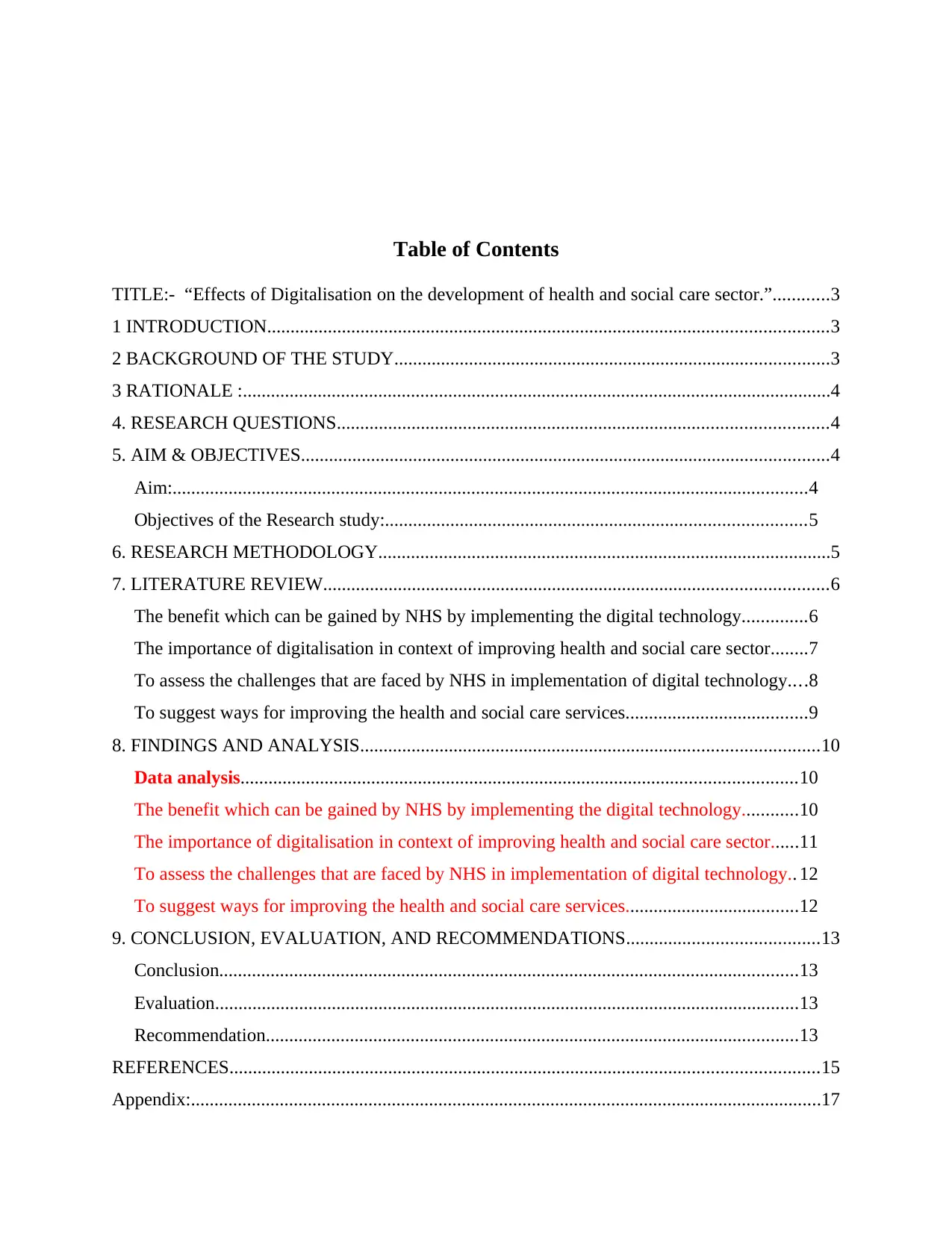
Table of Contents
TITLE:- “Effects of Digitalisation on the development of health and social care sector.”............3
1 INTRODUCTION........................................................................................................................3
2 BACKGROUND OF THE STUDY.............................................................................................3
3 RATIONALE :..............................................................................................................................4
4. RESEARCH QUESTIONS.........................................................................................................4
5. AIM & OBJECTIVES.................................................................................................................4
Aim:........................................................................................................................................4
Objectives of the Research study:..........................................................................................5
6. RESEARCH METHODOLOGY.................................................................................................5
7. LITERATURE REVIEW............................................................................................................6
The benefit which can be gained by NHS by implementing the digital technology..............6
The importance of digitalisation in context of improving health and social care sector........7
To assess the challenges that are faced by NHS in implementation of digital technology....8
To suggest ways for improving the health and social care services.......................................9
8. FINDINGS AND ANALYSIS..................................................................................................10
Data analysis.......................................................................................................................10
The benefit which can be gained by NHS by implementing the digital technology............10
The importance of digitalisation in context of improving health and social care sector......11
To assess the challenges that are faced by NHS in implementation of digital technology.. 12
To suggest ways for improving the health and social care services.....................................12
9. CONCLUSION, EVALUATION, AND RECOMMENDATIONS.........................................13
Conclusion............................................................................................................................13
Evaluation.............................................................................................................................13
Recommendation..................................................................................................................13
REFERENCES..............................................................................................................................15
Appendix:.......................................................................................................................................17
TITLE:- “Effects of Digitalisation on the development of health and social care sector.”............3
1 INTRODUCTION........................................................................................................................3
2 BACKGROUND OF THE STUDY.............................................................................................3
3 RATIONALE :..............................................................................................................................4
4. RESEARCH QUESTIONS.........................................................................................................4
5. AIM & OBJECTIVES.................................................................................................................4
Aim:........................................................................................................................................4
Objectives of the Research study:..........................................................................................5
6. RESEARCH METHODOLOGY.................................................................................................5
7. LITERATURE REVIEW............................................................................................................6
The benefit which can be gained by NHS by implementing the digital technology..............6
The importance of digitalisation in context of improving health and social care sector........7
To assess the challenges that are faced by NHS in implementation of digital technology....8
To suggest ways for improving the health and social care services.......................................9
8. FINDINGS AND ANALYSIS..................................................................................................10
Data analysis.......................................................................................................................10
The benefit which can be gained by NHS by implementing the digital technology............10
The importance of digitalisation in context of improving health and social care sector......11
To assess the challenges that are faced by NHS in implementation of digital technology.. 12
To suggest ways for improving the health and social care services.....................................12
9. CONCLUSION, EVALUATION, AND RECOMMENDATIONS.........................................13
Conclusion............................................................................................................................13
Evaluation.............................................................................................................................13
Recommendation..................................................................................................................13
REFERENCES..............................................................................................................................15
Appendix:.......................................................................................................................................17

⊘ This is a preview!⊘
Do you want full access?
Subscribe today to unlock all pages.

Trusted by 1+ million students worldwide
TITLE:- “Effects of Digitalisation on the development of health and social
care sector.”
1 INTRODUCTION
Digitalisation is a process through which information is provided to digital platform. It is a
conversion from physical market to digital platform that takes place to attains the attention of a
large number of people. Health and social care sector provides the treatment to the ill people and
provide adequate medication to them. Health sector manages the wellness of people whereas,
wealth sector provide accurate care to the ill people to overcome from their issues. NHS is the
national health care services of UK that performs their work with public fund (Degryse, 2016).
The major purpose of this research is to determine the importance and effects of digitalisation on
the health and social care sector on NHS. Digitalisation in health and social care provides the
relevancy to the patients as with that they get the help to know about the best services about the
illness that reduce the irrespective issues of the patients.
2 BACKGROUND OF THE STUDY
Digitalisation provides the wider platform for all to share the views or either distribute
the services it collects a large number of gathering with minimum time. It is a vast services that
can be served for the customers to resolve the different issues that has been raised on random
basis. NHS provides the services to the customers that is suffering from different diseases and
they advanced their services by using digital platform (Kagermann, 2015). That provides
easiness for both as people get to know about the best services as per their health issues on the
other hand NHS also get an help as they directly maintains the contact with the people and help
them to overcome from their illness. It saves the lot of time with that improvise the quality of the
services with that provides the services on wider level that has positive effect on the health of
maximum population.
Digitalisation has positive impact on the growth and development of health and social
care sector of NHS as it imparts the large change and reduce the complexity with that manage
the records of all the patients and then provides the services as per the requirement (Fernández-
Macías, 2018). Patients faces a lot of problem regarding the solution of their health issues for
that they find different doctor and clinics but they didn't find the real problem as what they are
facing. With that it normally induces a lot of time and many of the patients died as they didn't get
care sector.”
1 INTRODUCTION
Digitalisation is a process through which information is provided to digital platform. It is a
conversion from physical market to digital platform that takes place to attains the attention of a
large number of people. Health and social care sector provides the treatment to the ill people and
provide adequate medication to them. Health sector manages the wellness of people whereas,
wealth sector provide accurate care to the ill people to overcome from their issues. NHS is the
national health care services of UK that performs their work with public fund (Degryse, 2016).
The major purpose of this research is to determine the importance and effects of digitalisation on
the health and social care sector on NHS. Digitalisation in health and social care provides the
relevancy to the patients as with that they get the help to know about the best services about the
illness that reduce the irrespective issues of the patients.
2 BACKGROUND OF THE STUDY
Digitalisation provides the wider platform for all to share the views or either distribute
the services it collects a large number of gathering with minimum time. It is a vast services that
can be served for the customers to resolve the different issues that has been raised on random
basis. NHS provides the services to the customers that is suffering from different diseases and
they advanced their services by using digital platform (Kagermann, 2015). That provides
easiness for both as people get to know about the best services as per their health issues on the
other hand NHS also get an help as they directly maintains the contact with the people and help
them to overcome from their illness. It saves the lot of time with that improvise the quality of the
services with that provides the services on wider level that has positive effect on the health of
maximum population.
Digitalisation has positive impact on the growth and development of health and social
care sector of NHS as it imparts the large change and reduce the complexity with that manage
the records of all the patients and then provides the services as per the requirement (Fernández-
Macías, 2018). Patients faces a lot of problem regarding the solution of their health issues for
that they find different doctor and clinics but they didn't find the real problem as what they are
facing. With that it normally induces a lot of time and many of the patients died as they didn't get
Paraphrase This Document
Need a fresh take? Get an instant paraphrase of this document with our AI Paraphraser
the best treatment. Thus digitalisation somehow helps to reduce there issues and provides better
services and patients also choose the doctor as per their convenience.
Thus digitalisation also reduces the demographic pressures as those people who lives in
backward areas or those who didn't have that much amount to invest that in recovering. They all
gets the belief and proper treatment with the reasonable prices and with that it also saves the time
and provides the integrated services to the patients (Calvino and Criscuolo, 2019). It also
maintains the record of all the vaccine that is used by the patient that helps the NHS in fast
recovery and build the strong and balanced relationship.
3 RATIONALE :
The main aim behind conducting this study is to develop an understanding regarding
manner in which digitalisation is implementing its influence over the development of health and
social care sector. This will also help in determining the changes that digitalising bring to health
and social factor which contribute toward improving health care services. Additionally, current
research also focuses over identifying different key elements that are involved in brining key
changes in NHS while implementing digital technology. This will support NHS in determining
the factors that it must consider in order to perform digitalisation of its business practices more
effectively which in turn also support other businesses to use this information as a support to
become successful in digitalising their business.
4. RESEARCH QUESTIONS
What are the benefits and advantages of digital technology for the NHS?
How digitalisation can improve the health and social care sector?
What are the challenges associated with implementation of digital technology?
What are the ways or methods for improving the services of health and social care?
5. AIM & OBJECTIVES
Aim:
“To analyse the effects of digitalisation on the development of health and social care
sector.” - A study on NHS.
services and patients also choose the doctor as per their convenience.
Thus digitalisation also reduces the demographic pressures as those people who lives in
backward areas or those who didn't have that much amount to invest that in recovering. They all
gets the belief and proper treatment with the reasonable prices and with that it also saves the time
and provides the integrated services to the patients (Calvino and Criscuolo, 2019). It also
maintains the record of all the vaccine that is used by the patient that helps the NHS in fast
recovery and build the strong and balanced relationship.
3 RATIONALE :
The main aim behind conducting this study is to develop an understanding regarding
manner in which digitalisation is implementing its influence over the development of health and
social care sector. This will also help in determining the changes that digitalising bring to health
and social factor which contribute toward improving health care services. Additionally, current
research also focuses over identifying different key elements that are involved in brining key
changes in NHS while implementing digital technology. This will support NHS in determining
the factors that it must consider in order to perform digitalisation of its business practices more
effectively which in turn also support other businesses to use this information as a support to
become successful in digitalising their business.
4. RESEARCH QUESTIONS
What are the benefits and advantages of digital technology for the NHS?
How digitalisation can improve the health and social care sector?
What are the challenges associated with implementation of digital technology?
What are the ways or methods for improving the services of health and social care?
5. AIM & OBJECTIVES
Aim:
“To analyse the effects of digitalisation on the development of health and social care
sector.” - A study on NHS.
Objectives of the Research study:
To determine the benefit which can be gained by NHS by implementing the digital
technology.
To identify the importance of digitalisation in context of improving health and social care
sector.
To assess the challenges that are faced by NHS in implementation of digital technology.
To suggest ways for improving the health and social care services.
6. RESEARCH METHODOLOGY
Research methodology is a crucial part of an investigation which contains a detail
description regarding the set of tools and techniques used for gathering the information regarding
the study and support in evaluating and interpreting the data effectively so that most appropriate
outcome can be extracted (Green, Camilli and Elmore, 2012). The research methodology support
the investigator in directing the actions of investigator by suggesting appropriate tools that help
in achieving research objectives effectively. The tools and techniques used for this investigation
are mentioned below:
Research philosophy:- It is a tool that help in determining the pattern that an
investigator is following to conduct a research. The research philosophy are interpretivism and
positivism. Among them interpretivism philosophy will be used as it help in studying the view
point of people related with particular study effectively. This philosophy will support in
presenting the secondary information with the view point of several different authors or
researcher in order to critically evaluate the information and then use it present information
effectively.
Research approach:- This section support in determining a particular tool to be used for
analysing the data effectively. There are two kind of research approach such as inductive and
deductive (Kumar, 2019). From these inductive approaches will be used as it support in
evaluating the qualitative data gathered for investigation effectively which help in getting most
positive outcome. Additionally, it also support in presenting the outcome of study in more
effective manner by performing deep analyse of larger amount of data and concise it into finding
to bring more understanding in study.
Type of investigation:- A research is mainly performed by using a particular method of
data collection such as qualitative or quantitative. In order to perform this investigation,
To determine the benefit which can be gained by NHS by implementing the digital
technology.
To identify the importance of digitalisation in context of improving health and social care
sector.
To assess the challenges that are faced by NHS in implementation of digital technology.
To suggest ways for improving the health and social care services.
6. RESEARCH METHODOLOGY
Research methodology is a crucial part of an investigation which contains a detail
description regarding the set of tools and techniques used for gathering the information regarding
the study and support in evaluating and interpreting the data effectively so that most appropriate
outcome can be extracted (Green, Camilli and Elmore, 2012). The research methodology support
the investigator in directing the actions of investigator by suggesting appropriate tools that help
in achieving research objectives effectively. The tools and techniques used for this investigation
are mentioned below:
Research philosophy:- It is a tool that help in determining the pattern that an
investigator is following to conduct a research. The research philosophy are interpretivism and
positivism. Among them interpretivism philosophy will be used as it help in studying the view
point of people related with particular study effectively. This philosophy will support in
presenting the secondary information with the view point of several different authors or
researcher in order to critically evaluate the information and then use it present information
effectively.
Research approach:- This section support in determining a particular tool to be used for
analysing the data effectively. There are two kind of research approach such as inductive and
deductive (Kumar, 2019). From these inductive approaches will be used as it support in
evaluating the qualitative data gathered for investigation effectively which help in getting most
positive outcome. Additionally, it also support in presenting the outcome of study in more
effective manner by performing deep analyse of larger amount of data and concise it into finding
to bring more understanding in study.
Type of investigation:- A research is mainly performed by using a particular method of
data collection such as qualitative or quantitative. In order to perform this investigation,
⊘ This is a preview!⊘
Do you want full access?
Subscribe today to unlock all pages.
Trusted by 1+ million students worldwide
researcher is using qualitative method of data collection as it help in gathering the information
related with unquantifiable or non-numeric elements that support in gaining an understanding
and insights over the motivations and reasons (Quinlan and et. al., 2019). The main reason
behind selecting quantified data is that it will support in making effective use of theoretical
framework where a concept will be explained in detailed manner to create better understanding
about it and help in providing proper evidence and arguments regarding the impact that digital
technology bring to health care sector.
Data collection sources:- The sources that are used for gathering information plays a
crucial role within the outcome of study. For gathering information two sources are used i.e.
primary and secondary (Mackenzie and et. al., 2012). The primary information is gathered with
the help of questionnaire, interview, survey, focus group etc. while secondary information is
gathered using books, journal, article etc. Among them for conducting this study the secondary
data collection method will be used where information will be collected through online sources
such as books, journals, articles etc. which is already investigated and published by some other
people previously. The main reason behind conducting secondary investigation is that it will
support in gathering information which is more accurate and reliable that already being
published after went through a deep investigation and test. So, secondary data will support in
presenting most accurate information regarding the effect that digital platform bring within
health care sector.
Research strategy:- It refers to a particular tactic that is used for collecting the
information regarding the particular area of study. There are several methods used for this such
as interview, focus group, brain storming, questionnaire, observation, internet survey etc. Among
them internet survey will be used to gather secondary information by accessing and evaluating
the several books, journals, articles, etc. that contains a detailed information about eth concept of
digitalisation within health and care sector as well as changes it bring to the health care sector so
that appropriate evaluation can be performed for prese ting valid outcome.
7. LITERATURE REVIEW
The benefit which can be gained by NHS by implementing the digital technology.
As per the review of Jonathan Bloor. 2019, if country wants to resolve the issues related
to health then digital infrastructure in needed. It provides end to end digital workflows as to
related with unquantifiable or non-numeric elements that support in gaining an understanding
and insights over the motivations and reasons (Quinlan and et. al., 2019). The main reason
behind selecting quantified data is that it will support in making effective use of theoretical
framework where a concept will be explained in detailed manner to create better understanding
about it and help in providing proper evidence and arguments regarding the impact that digital
technology bring to health care sector.
Data collection sources:- The sources that are used for gathering information plays a
crucial role within the outcome of study. For gathering information two sources are used i.e.
primary and secondary (Mackenzie and et. al., 2012). The primary information is gathered with
the help of questionnaire, interview, survey, focus group etc. while secondary information is
gathered using books, journal, article etc. Among them for conducting this study the secondary
data collection method will be used where information will be collected through online sources
such as books, journals, articles etc. which is already investigated and published by some other
people previously. The main reason behind conducting secondary investigation is that it will
support in gathering information which is more accurate and reliable that already being
published after went through a deep investigation and test. So, secondary data will support in
presenting most accurate information regarding the effect that digital platform bring within
health care sector.
Research strategy:- It refers to a particular tactic that is used for collecting the
information regarding the particular area of study. There are several methods used for this such
as interview, focus group, brain storming, questionnaire, observation, internet survey etc. Among
them internet survey will be used to gather secondary information by accessing and evaluating
the several books, journals, articles, etc. that contains a detailed information about eth concept of
digitalisation within health and care sector as well as changes it bring to the health care sector so
that appropriate evaluation can be performed for prese ting valid outcome.
7. LITERATURE REVIEW
The benefit which can be gained by NHS by implementing the digital technology.
As per the review of Jonathan Bloor. 2019, if country wants to resolve the issues related
to health then digital infrastructure in needed. It provides end to end digital workflows as to
Paraphrase This Document
Need a fresh take? Get an instant paraphrase of this document with our AI Paraphraser
maintains the relationship between the social care and hospitals they need to fill the admission
form, discharge and withdrawal process as well and that is recorded on paper, emails, printing
and scanning etc. That helps the doctor to get to know about the on-time health issues and
provides the previous information as well that impart in fastest recovery. The lack of people
interaction sometimes affect the quality of health related services, due to lack or inappropriate
communication system. But the digitalisation in healthcare process will allow to create new
structure, roles and teams that have the capability to cope up with the complexity of people’s
interaction with services by maintaining proper flow of data between setting with the help of fax,
email, scanning. At the basic level of a hospital, doctors as well as nurses need to know that
whether the patients have any social worker, who are they, whether those individuals have safety
issue. On the other side the social worker is required to have someone’s diagnosis or conditions,
their medication along with place where they get admitted. The digitalisation of operations in
health care support in connecting the health and social care workers with the help of secure and
instant flow of information which ensures that treatment of an individual get performed after
having adequate knowledge about his/her condition, so that most effective service can be
provided to them.
As per the review of Tony Pickering. 2016, digitalisation helps to resolve the challenges
of a large population. NHS believe to maintain the record of every individual patient that takes
the care and manages that for a longer period of time that ultimately helps the staff and patient at
the time of treatment. With that also provides the training to the staff as if they didn't know about
how to use that then technological advancement is wastage. Thus NHS provides particular
training to the staff as well about how to manages the collective data off all the patients and also
prevents precautions of data security. With that NHS has clear vision and with that each and
every trust of NHS works with different targets, process and policy to provide the treatments to
all the patients.
The importance of digitalisation in context of improving health and social care sector.
As per the viewpoint of Jenny Harrison. 2018, health care gets the benefits of
digitalisation as it supports to provides more efficiency and accuracy. Whenever technological
advancement has been induced in imparts some threat in the business but that is not happens with
the health care sector. It provides easiness in the health and social care sector in terms of
handling of staff, nurses, medication department, clinical department, research and developments
form, discharge and withdrawal process as well and that is recorded on paper, emails, printing
and scanning etc. That helps the doctor to get to know about the on-time health issues and
provides the previous information as well that impart in fastest recovery. The lack of people
interaction sometimes affect the quality of health related services, due to lack or inappropriate
communication system. But the digitalisation in healthcare process will allow to create new
structure, roles and teams that have the capability to cope up with the complexity of people’s
interaction with services by maintaining proper flow of data between setting with the help of fax,
email, scanning. At the basic level of a hospital, doctors as well as nurses need to know that
whether the patients have any social worker, who are they, whether those individuals have safety
issue. On the other side the social worker is required to have someone’s diagnosis or conditions,
their medication along with place where they get admitted. The digitalisation of operations in
health care support in connecting the health and social care workers with the help of secure and
instant flow of information which ensures that treatment of an individual get performed after
having adequate knowledge about his/her condition, so that most effective service can be
provided to them.
As per the review of Tony Pickering. 2016, digitalisation helps to resolve the challenges
of a large population. NHS believe to maintain the record of every individual patient that takes
the care and manages that for a longer period of time that ultimately helps the staff and patient at
the time of treatment. With that also provides the training to the staff as if they didn't know about
how to use that then technological advancement is wastage. Thus NHS provides particular
training to the staff as well about how to manages the collective data off all the patients and also
prevents precautions of data security. With that NHS has clear vision and with that each and
every trust of NHS works with different targets, process and policy to provide the treatments to
all the patients.
The importance of digitalisation in context of improving health and social care sector.
As per the viewpoint of Jenny Harrison. 2018, health care gets the benefits of
digitalisation as it supports to provides more efficiency and accuracy. Whenever technological
advancement has been induced in imparts some threat in the business but that is not happens with
the health care sector. It provides easiness in the health and social care sector in terms of
handling of staff, nurses, medication department, clinical department, research and developments
etc. It inserts better coordination in between patients and professionals of healthcare as there is
no need to maintains the record of all the medical appointments. As at the time of emergency
complete profile of patients has been shown in the records that is managed in digital platforms
that provides the mercifulness. There is a time when healthcare is a single way services in that
patients only follows the recommendation of doctors. But with digitalisation in imparts a two-
way service in which both patient and doctors understand the nuances and then comes with better
solutions.
As per the viewpoint of Rohan Kulkarni. 2017, digital world changes the life of all the
individuals as everyone is using smartphones and uses search engines to find everything as per
the need, email, text messaging etc. As technology is form that connect various health-care and
manages a system that handles health insurers, pharmaceuticals, providers. The major goal
behind digitalisation is to provide services on wider level and solve the traditional issues of all in
with digital solutions. It also improves the engagement and performance of NHS as they provide
the integrated services to the patients. This is done by brining an integration between the
technology as well as service platform which contribute toward aggregating the clinical,
demographic data and claims in order to profile the clinical trial candidates. It includes a tool of
diogital technology named as data mining which support in enhancing the technique of hot
spotting i.e. determining a particular region where there remains a high concentration of the
eligibility population for both the patients as well as investigators. This capability help in
minimising the cost and time of enrolling the correct study population. This in turn also help in
improving the communication practices by using new channels like social media support for
recruitment as well as onboarding of patients and investigator so that through study can be
perform to gather data effetely and at the same time spreading to ensure that people get with
most adequate and true information which support in improving the well being of patients.
To assess the challenges that are faced by NHS in implementation of digital technology.
As per the viewpoint of Nick Ismail. 2017, digital technologies brings the rapid change
in the health care landscape. With that it also brings various challenge to implement that
advancement in the sector as it change the behaviour of human, by using the technologies it is
important to get the training. For that NHS provide training to the staff to use the digital platform
but with that somehow physical indulgence in enhanced. Thus human must knows that
technology helps to increase the work efficiency but with human also has that much knowledge
no need to maintains the record of all the medical appointments. As at the time of emergency
complete profile of patients has been shown in the records that is managed in digital platforms
that provides the mercifulness. There is a time when healthcare is a single way services in that
patients only follows the recommendation of doctors. But with digitalisation in imparts a two-
way service in which both patient and doctors understand the nuances and then comes with better
solutions.
As per the viewpoint of Rohan Kulkarni. 2017, digital world changes the life of all the
individuals as everyone is using smartphones and uses search engines to find everything as per
the need, email, text messaging etc. As technology is form that connect various health-care and
manages a system that handles health insurers, pharmaceuticals, providers. The major goal
behind digitalisation is to provide services on wider level and solve the traditional issues of all in
with digital solutions. It also improves the engagement and performance of NHS as they provide
the integrated services to the patients. This is done by brining an integration between the
technology as well as service platform which contribute toward aggregating the clinical,
demographic data and claims in order to profile the clinical trial candidates. It includes a tool of
diogital technology named as data mining which support in enhancing the technique of hot
spotting i.e. determining a particular region where there remains a high concentration of the
eligibility population for both the patients as well as investigators. This capability help in
minimising the cost and time of enrolling the correct study population. This in turn also help in
improving the communication practices by using new channels like social media support for
recruitment as well as onboarding of patients and investigator so that through study can be
perform to gather data effetely and at the same time spreading to ensure that people get with
most adequate and true information which support in improving the well being of patients.
To assess the challenges that are faced by NHS in implementation of digital technology.
As per the viewpoint of Nick Ismail. 2017, digital technologies brings the rapid change
in the health care landscape. With that it also brings various challenge to implement that
advancement in the sector as it change the behaviour of human, by using the technologies it is
important to get the training. For that NHS provide training to the staff to use the digital platform
but with that somehow physical indulgence in enhanced. Thus human must knows that
technology helps to increase the work efficiency but with human also has that much knowledge
⊘ This is a preview!⊘
Do you want full access?
Subscribe today to unlock all pages.
Trusted by 1+ million students worldwide
to manage every situations with the logics. The lack of interoperability about the healthcare that
creates more uncertainty to connect with the patients. It also brings the ransomware attacks as it
is a malware that is the biggest operation of cyber that disburse the management of NHS. As to
find the staff that is well skilled and experienced that handles all the record safely and doesn't
misuse the data of patients and it is a biggest challenge of NHS towards digitalisation.
As per the viewpoint of Sophie Castle-Clarke. 2018, technological advancement brings
the new challenges but with that brings the pressure on management structure of NHS. And it
takes longer time to recognised the potential of digitalisation with that it is a biggest challenge to
implement the technology in wider scale as it needs a lot of economy. Some of the patients never
use digital platform and they are also not aware about the different services that is offered by the
health-care sector. To attain the trust of patients about there data serving and medication process
is the biggest challenge as patients suffers depression due to their continuous health issues. The
major challenges that is found with this is that the new technology could fundamentally change
the manner in which the working pattern of NHS staff totally get changes and they required to
perform new role while getting integrated with the technology which remain difficult as it take
time to learn new procedure of working. Another change found to gain public trust in term of
managing their data. Therefore, it must be ensure that the health and social care practitioner must
maintain a balance between the benefit of sharing data with the concern about the security as
well as confidentiality, as these may become barrier to the progress of NHS in term if
digitalisation if not being focused.
To suggest ways for improving the health and social care services.
As per the viewpoint of Christopher Cheney. 2018, to access the services in the rural
areas inserts the quality in the healthcare sector. It is difficult for rural area to get connect with
the healthcare services as they didn't have that much resources thus if healthcare services is
provided in those areas that creates more quality and value. Be available for the patients at every
time as emergency never comes with invitation, it happens altogether thus if health care provide
the services on daily basis that provide more opportunities to improve the relationship with the
patients. It will also improves if they are assess in rural areas as and have the staff that known the
language of that areas that prevents more convenience.
As per the viewpoint of Simon Bottery. 2019, people often have problems related to the
availability of health-care service. Thus to improve the services of health and care sector they
creates more uncertainty to connect with the patients. It also brings the ransomware attacks as it
is a malware that is the biggest operation of cyber that disburse the management of NHS. As to
find the staff that is well skilled and experienced that handles all the record safely and doesn't
misuse the data of patients and it is a biggest challenge of NHS towards digitalisation.
As per the viewpoint of Sophie Castle-Clarke. 2018, technological advancement brings
the new challenges but with that brings the pressure on management structure of NHS. And it
takes longer time to recognised the potential of digitalisation with that it is a biggest challenge to
implement the technology in wider scale as it needs a lot of economy. Some of the patients never
use digital platform and they are also not aware about the different services that is offered by the
health-care sector. To attain the trust of patients about there data serving and medication process
is the biggest challenge as patients suffers depression due to their continuous health issues. The
major challenges that is found with this is that the new technology could fundamentally change
the manner in which the working pattern of NHS staff totally get changes and they required to
perform new role while getting integrated with the technology which remain difficult as it take
time to learn new procedure of working. Another change found to gain public trust in term of
managing their data. Therefore, it must be ensure that the health and social care practitioner must
maintain a balance between the benefit of sharing data with the concern about the security as
well as confidentiality, as these may become barrier to the progress of NHS in term if
digitalisation if not being focused.
To suggest ways for improving the health and social care services.
As per the viewpoint of Christopher Cheney. 2018, to access the services in the rural
areas inserts the quality in the healthcare sector. It is difficult for rural area to get connect with
the healthcare services as they didn't have that much resources thus if healthcare services is
provided in those areas that creates more quality and value. Be available for the patients at every
time as emergency never comes with invitation, it happens altogether thus if health care provide
the services on daily basis that provide more opportunities to improve the relationship with the
patients. It will also improves if they are assess in rural areas as and have the staff that known the
language of that areas that prevents more convenience.
As per the viewpoint of Simon Bottery. 2019, people often have problems related to the
availability of health-care service. Thus to improve the services of health and care sector they
Paraphrase This Document
Need a fresh take? Get an instant paraphrase of this document with our AI Paraphraser
always remain available of the public that provides easiness for the patients to get resolve their
health issues. With that publish the policies annually by which people get the favoured
behaviours that provides helps to them to recover even more faster. Provides the best quality
services to the patients by which they get satisfaction and also integrates there services. The
digital technology can be used in a best possible manner to improve the quality of services as
with the help of internet reach the doctors, nurses and health care practitioners can reach to the
patients virtually and provide them with adequate knowledge and understanding about the issues
they are having as well as actions they can undertake in order to deal with their health issues.
Other than this the health and social care practitioner can also spread information to people about
the best practices they can perform in order to stay healthier so that heath issues in future can be
avoided. For this they can give information by having live interaction for two-way
communication where the patients or other people who are concern can clear their doubts and
adopt healthy practices for their life to improve quality of living and health.
8. FINDINGS AND ANALYSIS
There are number of analytical tools available for performing analysis of data in term of
qualitative and quantitative data such as typologies, thematic analysis, trend analysis, content
analysis etc. Hence, in order to analyse the qualitative information, thematic analysis will be
used which support in forming up the themes related with each questions which provide a
summary regarding the discussion to be made forth as per the information gathered for particular
research question and systematically evaluating the information regarding the current study
(Miller and et. al., 2012).
Data analysis
The benefit which can be gained by NHS by implementing the digital technology.
From the analysis of information mentioned above it has been fund that digitalisation of
health and social care sector is a crucial step which support in improving the quality of services
by adding an approach of easy access to data. This is so become by improving infrastructure and
installing or using several digital devices the health care institutes would be able to aid in
providing better services where a accuracy in report and flow of information through machines
make the task easier and at the same time also reduce the time taken by each activities
performed. This will provide an end to end flow of work in each and every work performed
health issues. With that publish the policies annually by which people get the favoured
behaviours that provides helps to them to recover even more faster. Provides the best quality
services to the patients by which they get satisfaction and also integrates there services. The
digital technology can be used in a best possible manner to improve the quality of services as
with the help of internet reach the doctors, nurses and health care practitioners can reach to the
patients virtually and provide them with adequate knowledge and understanding about the issues
they are having as well as actions they can undertake in order to deal with their health issues.
Other than this the health and social care practitioner can also spread information to people about
the best practices they can perform in order to stay healthier so that heath issues in future can be
avoided. For this they can give information by having live interaction for two-way
communication where the patients or other people who are concern can clear their doubts and
adopt healthy practices for their life to improve quality of living and health.
8. FINDINGS AND ANALYSIS
There are number of analytical tools available for performing analysis of data in term of
qualitative and quantitative data such as typologies, thematic analysis, trend analysis, content
analysis etc. Hence, in order to analyse the qualitative information, thematic analysis will be
used which support in forming up the themes related with each questions which provide a
summary regarding the discussion to be made forth as per the information gathered for particular
research question and systematically evaluating the information regarding the current study
(Miller and et. al., 2012).
Data analysis
The benefit which can be gained by NHS by implementing the digital technology.
From the analysis of information mentioned above it has been fund that digitalisation of
health and social care sector is a crucial step which support in improving the quality of services
by adding an approach of easy access to data. This is so become by improving infrastructure and
installing or using several digital devices the health care institutes would be able to aid in
providing better services where a accuracy in report and flow of information through machines
make the task easier and at the same time also reduce the time taken by each activities
performed. This will provide an end to end flow of work in each and every work performed
within eth health and social care institute and also bring more accountability by managing nad
controlling the accuracy in work from filling up the admission form by patients to their
diagnosis, treatment and discharge. This in turn involve recording and managing of overall data
of patients digitally that aid doctor in getting better understanding about the issues which creates
an environment to have evidence-based practices, where the doctors regularly information about
the patients as well as such treatments performed earlier along with their bad or good things.
Despite of this it has been also determined that the digitalisation also supported in resolving the
challenges that was faced by larger number of people. As with eth manual work the maintenance
of data of patients remains quite difficult which sometimes also affected the work performed
with eth institute but as soon as the digitalisation platform has been adopted the training is
exerted to the staff members and all the information get stored in a systematic manner which in
turn ensures that right kind of treatment must be presented to staff. Hence the digitalisation
support in improving eth services offered by health care sector.
The importance of digitalisation in context of improving health and social care sector.
According to the analysed data it has been found that the digitalisation is becoming a
common concept in health and social care sector which provide a more effective integration of
people to enhance their quality of interaction for positive outcome of each effort. As a result of
this it provides a huge support to health care practices that contribute toward enhancing the
efficiency as well accuracy of actions conducted by reducing chances of human error. The
digitalisation holds a huge importance within health care sector in term of providing integrated
care system where it connect the different departments or parts of health care institute within
single network and help in managing and controlling the actions performed by staff, nurses,
clinical department, medication department, research and development department. When all
these departments work co-ordinately then it provide a good structure of delivering services with
maintaining proper interaction with staff members and departments so that proper information or
suggestion of experience staff flow to ensure better delivery of services. Addition to this it is also
essential for maintaining record and using it when needed in appropriate manner like, at the time
of emergency the complete profile of patients can be shown in record which is maintained at
digital platform which make it easier to access the past history and then provide treatment
accordingly. This can be done using digital technology like big data management that help in
managing the large amount of data that make it easier to get access when required in few
controlling the accuracy in work from filling up the admission form by patients to their
diagnosis, treatment and discharge. This in turn involve recording and managing of overall data
of patients digitally that aid doctor in getting better understanding about the issues which creates
an environment to have evidence-based practices, where the doctors regularly information about
the patients as well as such treatments performed earlier along with their bad or good things.
Despite of this it has been also determined that the digitalisation also supported in resolving the
challenges that was faced by larger number of people. As with eth manual work the maintenance
of data of patients remains quite difficult which sometimes also affected the work performed
with eth institute but as soon as the digitalisation platform has been adopted the training is
exerted to the staff members and all the information get stored in a systematic manner which in
turn ensures that right kind of treatment must be presented to staff. Hence the digitalisation
support in improving eth services offered by health care sector.
The importance of digitalisation in context of improving health and social care sector.
According to the analysed data it has been found that the digitalisation is becoming a
common concept in health and social care sector which provide a more effective integration of
people to enhance their quality of interaction for positive outcome of each effort. As a result of
this it provides a huge support to health care practices that contribute toward enhancing the
efficiency as well accuracy of actions conducted by reducing chances of human error. The
digitalisation holds a huge importance within health care sector in term of providing integrated
care system where it connect the different departments or parts of health care institute within
single network and help in managing and controlling the actions performed by staff, nurses,
clinical department, medication department, research and development department. When all
these departments work co-ordinately then it provide a good structure of delivering services with
maintaining proper interaction with staff members and departments so that proper information or
suggestion of experience staff flow to ensure better delivery of services. Addition to this it is also
essential for maintaining record and using it when needed in appropriate manner like, at the time
of emergency the complete profile of patients can be shown in record which is maintained at
digital platform which make it easier to access the past history and then provide treatment
accordingly. This can be done using digital technology like big data management that help in
managing the large amount of data that make it easier to get access when required in few
⊘ This is a preview!⊘
Do you want full access?
Subscribe today to unlock all pages.
Trusted by 1+ million students worldwide

1 out of 17


Related Documents


Your All-in-One AI-Powered Toolkit for Academic Success.
+13062052269
info@desklib.com
Available 24*7 on WhatsApp / Email
![[object Object]](/_next/static/media/star-bottom.7253800d.svg)
Unlock your academic potential
Copyright © 2020–2026 A2Z Services. All Rights Reserved. Developed and managed by ZUCOL.