Unit 5: Leadership & Management - Digital Technology's Impact
VerifiedAdded on  2023/04/24
|6
|1476
|282
Report
AI Summary
This report analyzes the impact of digital technology on leadership and management styles within the service industry, specifically focusing on three UK-based restaurant chains: Hazev, Haz, and Tas. It reviews classical management theories such as Frederick Taylor's scientific management, Henri Fayol's principles of administrative management, and Max Weber's bureaucratic management. The report also explains the role of a leader and various leadership styles, including democratic, strategic, and situational leadership. It examines how managers in Hazev, Haz, and Tas adopt different management theories and leadership styles, and how digital technology has influenced their internal and external management practices, affecting factors like organizational policies, employee motivation, customer relations, and competitive strategies. The conclusion emphasizes the importance of digital technology in modern organizations and its impact on data management and transmission.
Running head: IMPACT OF DIGITAL TECHNOLOGY ON LEADERSHIP
Digital Technology’s Impact on Management and Leadership
Name of the Student
Name of the University
Author’s Note:
Digital Technology’s Impact on Management and Leadership
Name of the Student
Name of the University
Author’s Note:
Paraphrase This Document
Need a fresh take? Get an instant paraphrase of this document with our AI Paraphraser

1
IMPACT OF DIGITAL TECHNOLOGY ON LEADERSHIP
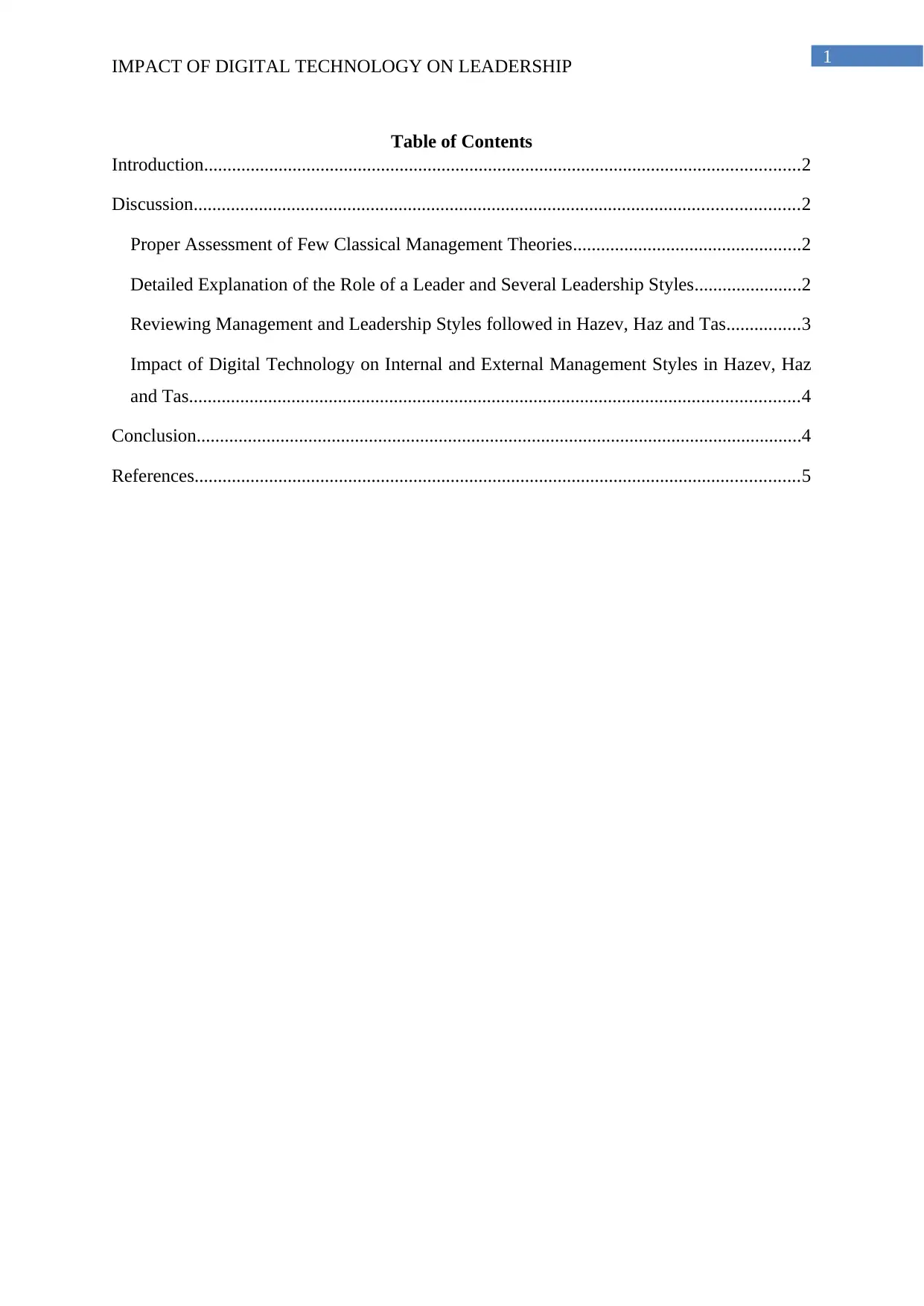
Table of Contents
Introduction................................................................................................................................2
Discussion..................................................................................................................................2
Proper Assessment of Few Classical Management Theories.................................................2
Detailed Explanation of the Role of a Leader and Several Leadership Styles.......................2
Reviewing Management and Leadership Styles followed in Hazev, Haz and Tas................3
Impact of Digital Technology on Internal and External Management Styles in Hazev, Haz
and Tas...................................................................................................................................4
Conclusion..................................................................................................................................4
References..................................................................................................................................5
IMPACT OF DIGITAL TECHNOLOGY ON LEADERSHIP
Table of Contents
Introduction................................................................................................................................2
Discussion..................................................................................................................................2
Proper Assessment of Few Classical Management Theories.................................................2
Detailed Explanation of the Role of a Leader and Several Leadership Styles.......................2
Reviewing Management and Leadership Styles followed in Hazev, Haz and Tas................3
Impact of Digital Technology on Internal and External Management Styles in Hazev, Haz
and Tas...................................................................................................................................4
Conclusion..................................................................................................................................4
References..................................................................................................................................5

2
IMPACT OF DIGITAL TECHNOLOGY ON LEADERSHIP
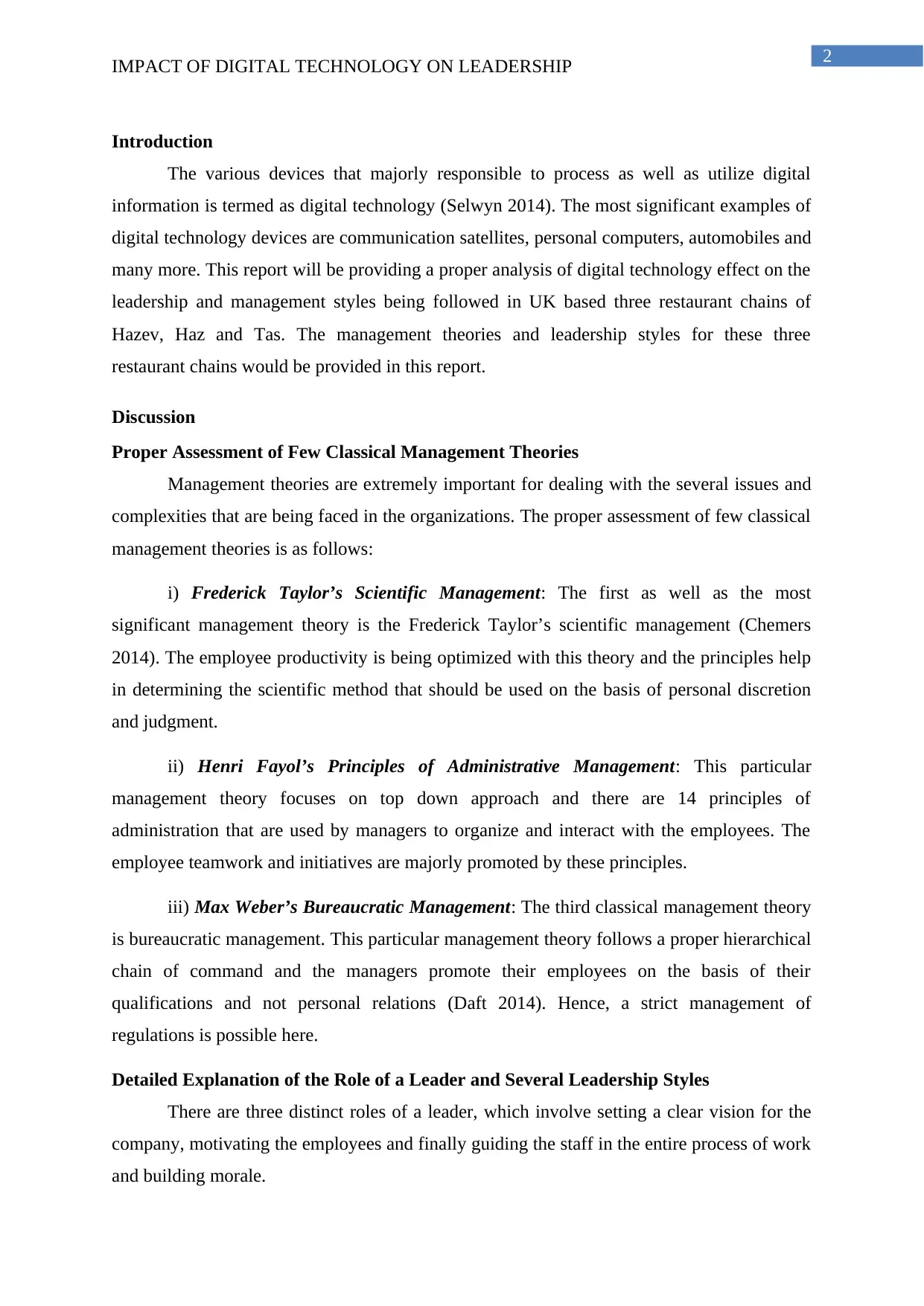
Introduction
The various devices that majorly responsible to process as well as utilize digital
information is termed as digital technology (Selwyn 2014). The most significant examples of
digital technology devices are communication satellites, personal computers, automobiles and
many more. This report will be providing a proper analysis of digital technology effect on the
leadership and management styles being followed in UK based three restaurant chains of
Hazev, Haz and Tas. The management theories and leadership styles for these three
restaurant chains would be provided in this report.
Discussion
Proper Assessment of Few Classical Management Theories
Management theories are extremely important for dealing with the several issues and
complexities that are being faced in the organizations. The proper assessment of few classical
management theories is as follows:
i) Frederick Taylor’s Scientific Management: The first as well as the most
significant management theory is the Frederick Taylor’s scientific management (Chemers
2014). The employee productivity is being optimized with this theory and the principles help
in determining the scientific method that should be used on the basis of personal discretion
and judgment.
ii) Henri Fayol’s Principles of Administrative Management: This particular
management theory focuses on top down approach and there are 14 principles of
administration that are used by managers to organize and interact with the employees. The
employee teamwork and initiatives are majorly promoted by these principles.
iii) Max Weber’s Bureaucratic Management: The third classical management theory
is bureaucratic management. This particular management theory follows a proper hierarchical
chain of command and the managers promote their employees on the basis of their
qualifications and not personal relations (Daft 2014). Hence, a strict management of
regulations is possible here.
Detailed Explanation of the Role of a Leader and Several Leadership Styles
There are three distinct roles of a leader, which involve setting a clear vision for the
company, motivating the employees and finally guiding the staff in the entire process of work
and building morale.
IMPACT OF DIGITAL TECHNOLOGY ON LEADERSHIP
Introduction
The various devices that majorly responsible to process as well as utilize digital
information is termed as digital technology (Selwyn 2014). The most significant examples of
digital technology devices are communication satellites, personal computers, automobiles and
many more. This report will be providing a proper analysis of digital technology effect on the
leadership and management styles being followed in UK based three restaurant chains of
Hazev, Haz and Tas. The management theories and leadership styles for these three
restaurant chains would be provided in this report.
Discussion
Proper Assessment of Few Classical Management Theories
Management theories are extremely important for dealing with the several issues and
complexities that are being faced in the organizations. The proper assessment of few classical
management theories is as follows:
i) Frederick Taylor’s Scientific Management: The first as well as the most
significant management theory is the Frederick Taylor’s scientific management (Chemers
2014). The employee productivity is being optimized with this theory and the principles help
in determining the scientific method that should be used on the basis of personal discretion
and judgment.
ii) Henri Fayol’s Principles of Administrative Management: This particular
management theory focuses on top down approach and there are 14 principles of
administration that are used by managers to organize and interact with the employees. The
employee teamwork and initiatives are majorly promoted by these principles.
iii) Max Weber’s Bureaucratic Management: The third classical management theory
is bureaucratic management. This particular management theory follows a proper hierarchical
chain of command and the managers promote their employees on the basis of their
qualifications and not personal relations (Daft 2014). Hence, a strict management of
regulations is possible here.
Detailed Explanation of the Role of a Leader and Several Leadership Styles
There are three distinct roles of a leader, which involve setting a clear vision for the
company, motivating the employees and finally guiding the staff in the entire process of work
and building morale.
⊘ This is a preview!⊘
Do you want full access?
Subscribe today to unlock all pages.

Trusted by 1+ million students worldwide

3
IMPACT OF DIGITAL TECHNOLOGY ON LEADERSHIP
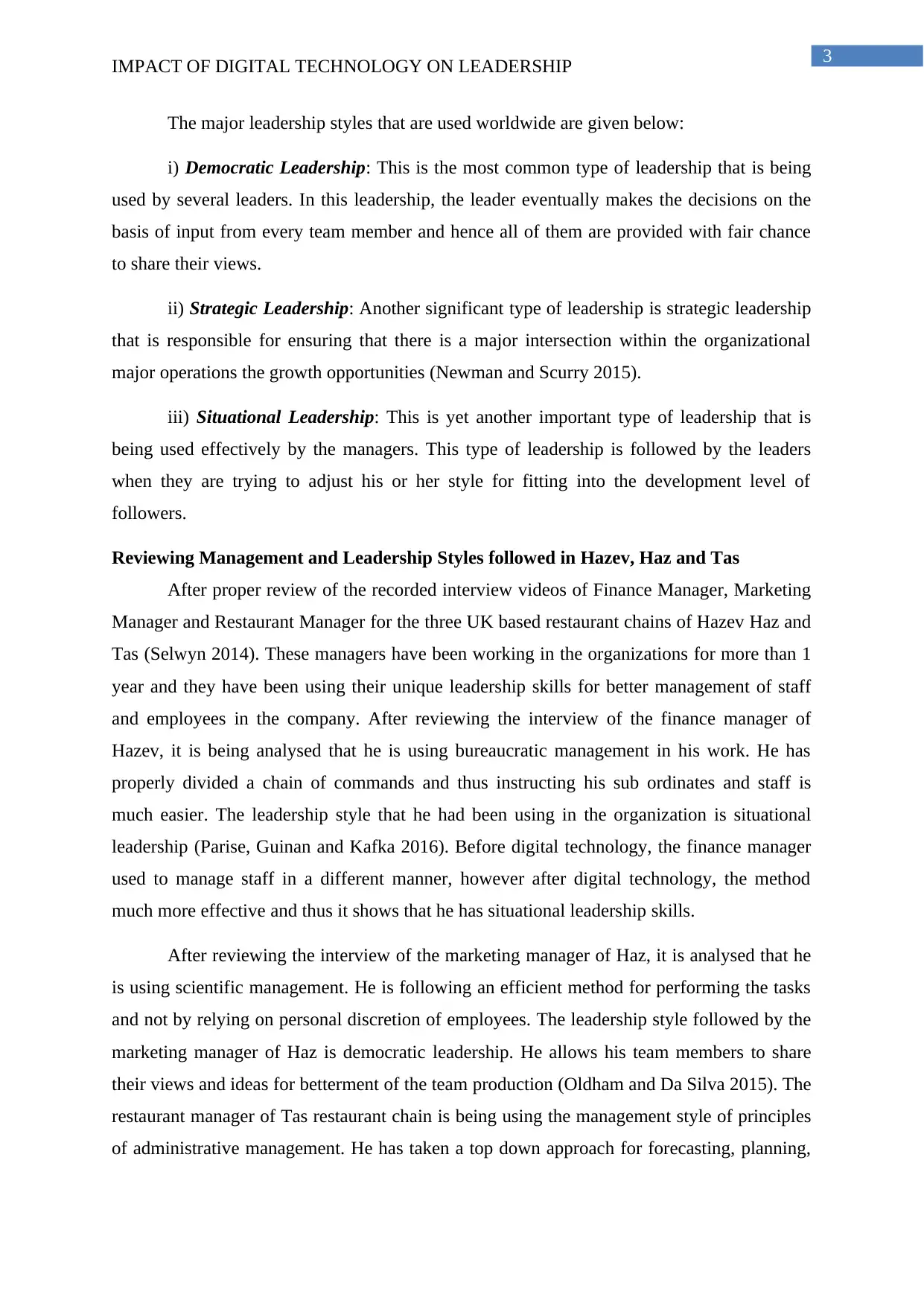
The major leadership styles that are used worldwide are given below:
i) Democratic Leadership: This is the most common type of leadership that is being
used by several leaders. In this leadership, the leader eventually makes the decisions on the
basis of input from every team member and hence all of them are provided with fair chance
to share their views.
ii) Strategic Leadership: Another significant type of leadership is strategic leadership
that is responsible for ensuring that there is a major intersection within the organizational
major operations the growth opportunities (Newman and Scurry 2015).
iii) Situational Leadership: This is yet another important type of leadership that is
being used effectively by the managers. This type of leadership is followed by the leaders
when they are trying to adjust his or her style for fitting into the development level of
followers.
Reviewing Management and Leadership Styles followed in Hazev, Haz and Tas
After proper review of the recorded interview videos of Finance Manager, Marketing
Manager and Restaurant Manager for the three UK based restaurant chains of Hazev Haz and
Tas (Selwyn 2014). These managers have been working in the organizations for more than 1
year and they have been using their unique leadership skills for better management of staff
and employees in the company. After reviewing the interview of the finance manager of
Hazev, it is being analysed that he is using bureaucratic management in his work. He has
properly divided a chain of commands and thus instructing his sub ordinates and staff is
much easier. The leadership style that he had been using in the organization is situational
leadership (Parise, Guinan and Kafka 2016). Before digital technology, the finance manager
used to manage staff in a different manner, however after digital technology, the method
much more effective and thus it shows that he has situational leadership skills.
After reviewing the interview of the marketing manager of Haz, it is analysed that he
is using scientific management. He is following an efficient method for performing the tasks
and not by relying on personal discretion of employees. The leadership style followed by the
marketing manager of Haz is democratic leadership. He allows his team members to share
their views and ideas for betterment of the team production (Oldham and Da Silva 2015). The
restaurant manager of Tas restaurant chain is being using the management style of principles
of administrative management. He has taken a top down approach for forecasting, planning,
IMPACT OF DIGITAL TECHNOLOGY ON LEADERSHIP
The major leadership styles that are used worldwide are given below:
i) Democratic Leadership: This is the most common type of leadership that is being
used by several leaders. In this leadership, the leader eventually makes the decisions on the
basis of input from every team member and hence all of them are provided with fair chance
to share their views.
ii) Strategic Leadership: Another significant type of leadership is strategic leadership
that is responsible for ensuring that there is a major intersection within the organizational
major operations the growth opportunities (Newman and Scurry 2015).
iii) Situational Leadership: This is yet another important type of leadership that is
being used effectively by the managers. This type of leadership is followed by the leaders
when they are trying to adjust his or her style for fitting into the development level of
followers.
Reviewing Management and Leadership Styles followed in Hazev, Haz and Tas
After proper review of the recorded interview videos of Finance Manager, Marketing
Manager and Restaurant Manager for the three UK based restaurant chains of Hazev Haz and
Tas (Selwyn 2014). These managers have been working in the organizations for more than 1
year and they have been using their unique leadership skills for better management of staff
and employees in the company. After reviewing the interview of the finance manager of
Hazev, it is being analysed that he is using bureaucratic management in his work. He has
properly divided a chain of commands and thus instructing his sub ordinates and staff is
much easier. The leadership style that he had been using in the organization is situational
leadership (Parise, Guinan and Kafka 2016). Before digital technology, the finance manager
used to manage staff in a different manner, however after digital technology, the method
much more effective and thus it shows that he has situational leadership skills.
After reviewing the interview of the marketing manager of Haz, it is analysed that he
is using scientific management. He is following an efficient method for performing the tasks
and not by relying on personal discretion of employees. The leadership style followed by the
marketing manager of Haz is democratic leadership. He allows his team members to share
their views and ideas for betterment of the team production (Oldham and Da Silva 2015). The
restaurant manager of Tas restaurant chain is being using the management style of principles
of administrative management. He has taken a top down approach for forecasting, planning,
Paraphrase This Document
Need a fresh take? Get an instant paraphrase of this document with our AI Paraphraser

4
IMPACT OF DIGITAL TECHNOLOGY ON LEADERSHIP
organizing, commanding, coordinating and controlling. He is following strategic leadership
and hence he provides strategies for solving the issues.
Impact of Digital Technology on Internal and External Management Styles in Hazev,
Haz and Tas
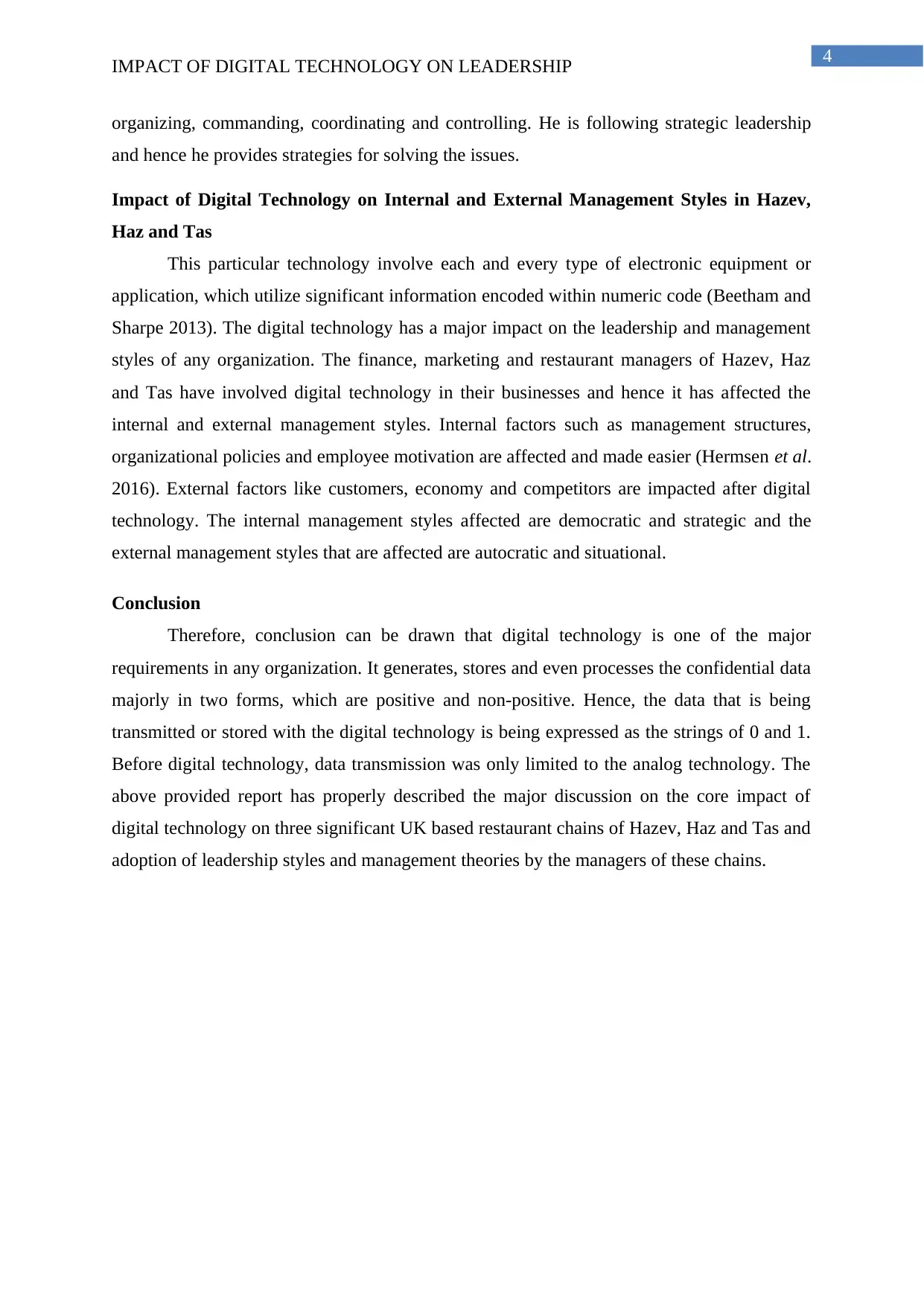
This particular technology involve each and every type of electronic equipment or
application, which utilize significant information encoded within numeric code (Beetham and
Sharpe 2013). The digital technology has a major impact on the leadership and management
styles of any organization. The finance, marketing and restaurant managers of Hazev, Haz
and Tas have involved digital technology in their businesses and hence it has affected the
internal and external management styles. Internal factors such as management structures,
organizational policies and employee motivation are affected and made easier (Hermsen et al.
2016). External factors like customers, economy and competitors are impacted after digital
technology. The internal management styles affected are democratic and strategic and the
external management styles that are affected are autocratic and situational.
Conclusion
Therefore, conclusion can be drawn that digital technology is one of the major
requirements in any organization. It generates, stores and even processes the confidential data
majorly in two forms, which are positive and non-positive. Hence, the data that is being
transmitted or stored with the digital technology is being expressed as the strings of 0 and 1.
Before digital technology, data transmission was only limited to the analog technology. The
above provided report has properly described the major discussion on the core impact of
digital technology on three significant UK based restaurant chains of Hazev, Haz and Tas and
adoption of leadership styles and management theories by the managers of these chains.
IMPACT OF DIGITAL TECHNOLOGY ON LEADERSHIP
organizing, commanding, coordinating and controlling. He is following strategic leadership
and hence he provides strategies for solving the issues.
Impact of Digital Technology on Internal and External Management Styles in Hazev,
Haz and Tas
This particular technology involve each and every type of electronic equipment or
application, which utilize significant information encoded within numeric code (Beetham and
Sharpe 2013). The digital technology has a major impact on the leadership and management
styles of any organization. The finance, marketing and restaurant managers of Hazev, Haz
and Tas have involved digital technology in their businesses and hence it has affected the
internal and external management styles. Internal factors such as management structures,
organizational policies and employee motivation are affected and made easier (Hermsen et al.
2016). External factors like customers, economy and competitors are impacted after digital
technology. The internal management styles affected are democratic and strategic and the
external management styles that are affected are autocratic and situational.
Conclusion
Therefore, conclusion can be drawn that digital technology is one of the major
requirements in any organization. It generates, stores and even processes the confidential data
majorly in two forms, which are positive and non-positive. Hence, the data that is being
transmitted or stored with the digital technology is being expressed as the strings of 0 and 1.
Before digital technology, data transmission was only limited to the analog technology. The
above provided report has properly described the major discussion on the core impact of
digital technology on three significant UK based restaurant chains of Hazev, Haz and Tas and
adoption of leadership styles and management theories by the managers of these chains.

5
IMPACT OF DIGITAL TECHNOLOGY ON LEADERSHIP
References
Beetham, H. and Sharpe, R. eds., 2013. Rethinking pedagogy for a digital age: Designing for
21st century learning. routledge.
Chemers, M., 2014. An integrative theory of leadership. Psychology Press.
Daft, R.L., 2014. The leadership experience. Cengage Learning.
Hermsen, S., Frost, J., Renes, R.J. and Kerkhof, P., 2016. Using feedback through digital
technology to disrupt and change habitual behavior: A critical review of current
literature. Computers in Human Behavior, 57, pp.61-74.
Newman, F. and Scurry, J.E., 2015. Higher education and the digital Rapids. International
Higher Education, (26).
Oldham, G.R. and Da Silva, N., 2015. The impact of digital technology on the generation and
implementation of creative ideas in the workplace. Computers in Human Behavior, 42, pp.5-
11.
Parise, S., Guinan, P.J. and Kafka, R., 2016. Solving the crisis of immediacy: How digital
technology can transform the customer experience. Business Horizons, 59(4), pp.411-420.
Selwyn, N., 2014. Digital technology and the contemporary university: Degrees of
digitization. Routledge.
IMPACT OF DIGITAL TECHNOLOGY ON LEADERSHIP
References
Beetham, H. and Sharpe, R. eds., 2013. Rethinking pedagogy for a digital age: Designing for
21st century learning. routledge.
Chemers, M., 2014. An integrative theory of leadership. Psychology Press.
Daft, R.L., 2014. The leadership experience. Cengage Learning.
Hermsen, S., Frost, J., Renes, R.J. and Kerkhof, P., 2016. Using feedback through digital
technology to disrupt and change habitual behavior: A critical review of current
literature. Computers in Human Behavior, 57, pp.61-74.
Newman, F. and Scurry, J.E., 2015. Higher education and the digital Rapids. International
Higher Education, (26).
Oldham, G.R. and Da Silva, N., 2015. The impact of digital technology on the generation and
implementation of creative ideas in the workplace. Computers in Human Behavior, 42, pp.5-
11.
Parise, S., Guinan, P.J. and Kafka, R., 2016. Solving the crisis of immediacy: How digital
technology can transform the customer experience. Business Horizons, 59(4), pp.411-420.
Selwyn, N., 2014. Digital technology and the contemporary university: Degrees of
digitization. Routledge.
⊘ This is a preview!⊘
Do you want full access?
Subscribe today to unlock all pages.

Trusted by 1+ million students worldwide
1 out of 6
Related Documents
Your All-in-One AI-Powered Toolkit for Academic Success.
 +13062052269
info@desklib.com
Available 24*7 on WhatsApp / Email
Unlock your academic potential
Copyright © 2020–2025 A2Z Services. All Rights Reserved. Developed and managed by ZUCOL.