Digital Literacy as a Social Equity Issue: ISY10212 Forum 2

Verified

Added on  2022/10/02

|3
|690
|461
Discussion Board Post
AI Summary
This discussion post explores digital literacy as a critical aspect of social equity, arguing that it is no longer a mere skill but a necessity in the modern world. The author presents a reasoned argument, supported by examples and references, including an interview with a mother and daughter highlighting generational differences in technology adoption. The post emphasizes the shift from a time when computers were unfamiliar to a current environment where digital literacy is fundamental. It concludes that digital literacy impacts various aspects of life, from education and business to communication and social amenities, and the lack thereof can lead to significant disadvantages. The author's argument underlines the need for universal access to computer knowledge and the importance of addressing the digital divide to ensure social equity.
Document Page
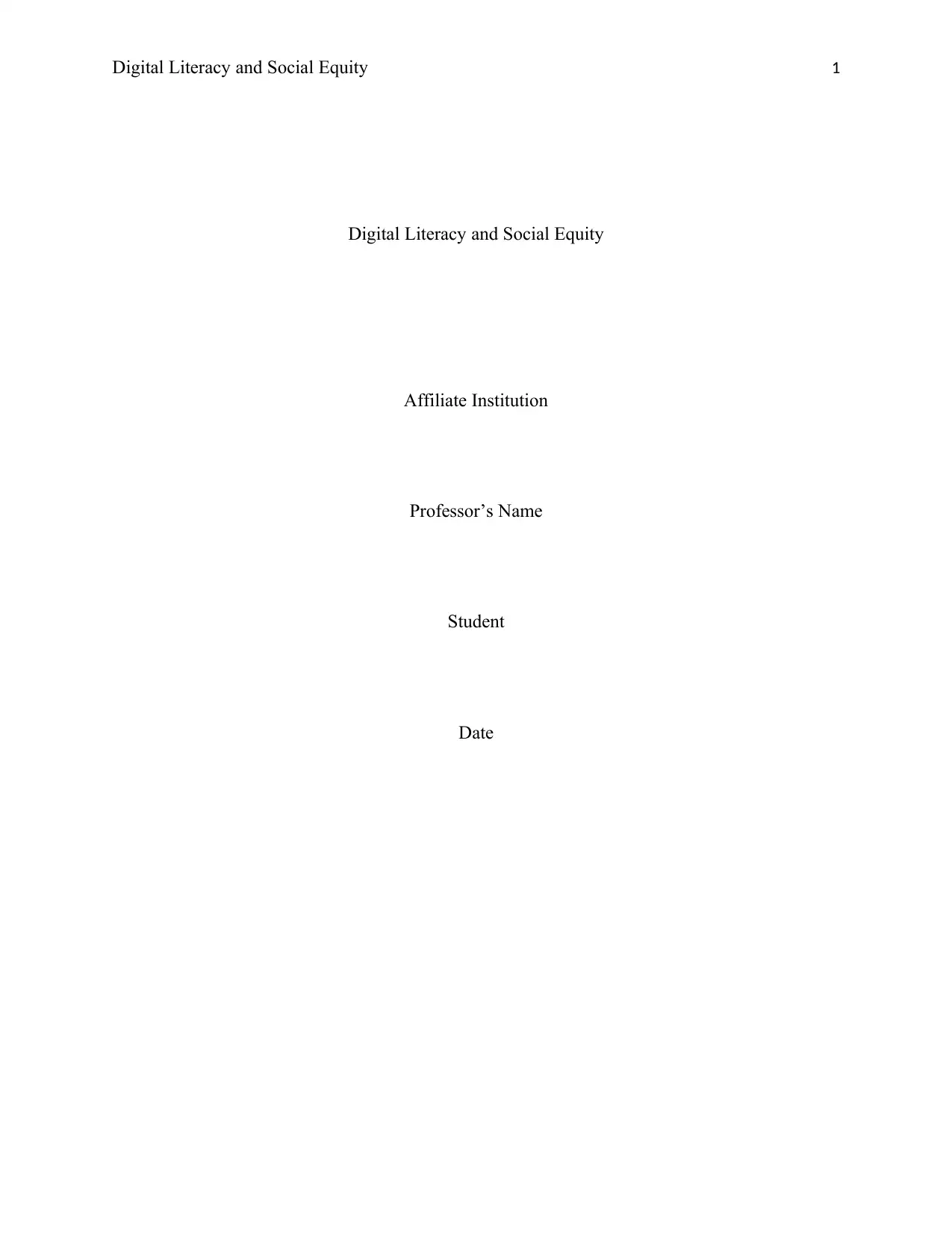
Digital Literacy and Social Equity 1
Digital Literacy and Social Equity
Affiliate Institution
Professor’s Name
Student
Date
tabler-icon-diamond-filled.svg

Paraphrase This Document

Need a fresh take? Get an instant paraphrase of this document with our AI Paraphraser
Document Page
Digital Literacy and Social Equity 2
Why can digital literacy be considered to be an issue of social equity?
Digital literacy is the ability of someone to critically understand and learn new technology. As
soon as the technology started in the 1980s, very few people knew how to operate computers.
Because of the ignorance which was there during that time, people took it as something which
was very hard to learn and understand. As the time goes by people get to understand that the new
technology was becoming a necessity because of the introduction of the World Wide Web into
the arena of the new technology. (Fantin, 2010)
To find a clear message concerning digital literacy, I happened to interview two people, a 65
year old mum and her daughter who is 21 years old. The mother explain to me that in the 1980s
when the technology started, she finds it difficult to learn about computers. She even at some
point ignore it because she lacks interest about it. But in the event of time at around late 1990s,
she started to feel that it is becoming a necessity. (Fantin, 2010)This because of the introduction
of the internet into the system. She started to regret why she should not learn computers at her
tender age. However, I also interviewed her 21 year old daughter and the difference is that at the
moment we are in the world where we grow with computers. Everything is online and you don’t
have even to struggle learning about computers but it is just a matter of interest and positive
attitude. (Carillo, n.d.)
Therefore, digital literacy is at the moment a necessity such that if you cannot possess then you
look useless. Children finds themselves growing in an environment surrounded by computers at
their tender age. It is a major factor which has contributed to the most of the population being
digitally literate. Also the technology has change such that if you want to learn something new,
you just open your browser and go online to search from Google. It is today a necessity and most
nations are ensuring that every citizen must be provided with computer knowledge. This is an
Document Page
Digital Literacy and Social Equity 3
evidence as from the current trainings and awareness from most government institutions. It is
easy to learn how to operate computers today. People are becoming more literate than before and
has made possible for almost everyone to be a computer expert. (Book Review: Exploring
Critical Digital Literacy Practices: Everyday Video in a Dual Language Context, 2018)
In conclusion, digital literacy important in the modern world as is considered the age of
computers. Today everywhere you can go you will find computers or mobile phones being used.
Even in our industries. These computers do help us in our day to day activities like social
amenities, health, business, education, industries and communication. Without the knowledge of
computer deemed to be awkward. Even today to find someone without a computing device is a
rare thing. The world has change and people can interact together as if they are in a single
village. Even the money nowadays can be paid through online platforms. Which implies that
people can run businesses wherever they are.
References
Fantin, M. (2010). Perspectives on Media Literacy, Digital Literacy and Information Literacy.
International Journal of Digital Literacy and Digital Competence, 1(4), pp.10-15.
Book Review: Exploring Critical Digital Literacy Practices: Everyday Video in a Dual Language
Context. (2018). Journal of Media Literacy Education, 10(3).
Carillo, E. (n.d.). MLA guide to digital literacy.
chevron_up_icon
1 out of 3
circle_padding
hide_on_mobile
zoom_out_icon
[object Object]