Report: Digital Marketing's Impact and Customer Journey Analysis
VerifiedAdded on 2020/10/23
|8
|1780
|132
Report
AI Summary
This report provides a comprehensive comparison between traditional and digital marketing strategies, highlighting the significant shift brought about by technological advancements. It explores the differences in cost, reach, and analytical capabilities, emphasizing the advantages of digital marketing in terms of measurable results and data-driven decision-making. The report delves into the evolving customer experience, focusing on omnichannel journeys and the impact of digital touchpoints on consumer behavior. Furthermore, it underscores the crucial role of data analytics in understanding customer interactions, improving marketing strategies, and personalizing customer experiences. The report concludes by summarizing the key differences between the two marketing approaches and emphasizing the importance of data analysis in driving effective marketing campaigns.
Digital Marketing
Paraphrase This Document
Need a fresh take? Get an instant paraphrase of this document with our AI Paraphraser

Table of Contents
INTRODUCTION...........................................................................................................................1
MAIN BODY..................................................................................................................................1
CONCLUSION................................................................................................................................3
REFERENCES................................................................................................................................4
INTRODUCTION...........................................................................................................................1
MAIN BODY..................................................................................................................................1
CONCLUSION................................................................................................................................3
REFERENCES................................................................................................................................4

INTRODUCTION
In today’s digitalization world, the advancement in technology has made created a
platform for business to expand in different counties. Due to this the condition of market has
completely changed. It has resulted in creating era of digital marketing. Moreover, it has led to
change in customer perception and their buying behavior (Leeflang and et.al., 2014). It has
connected business and people at one platform. In addition, digital marketing has improved the
efficiency of business. Besides this, it has improved experience of customer in buying process.
This report will describe difference between traditional and digital marketing. It will also show
customer touch points and omnichannel journey of customer. Furthermore, it will discuss the
role of data and analytic in digital marketing and how it helps in improving customer experience.
MAIN BODY
In earlier times organizations have to spend a lot of cost and time to advertise their
products and services. It was done through several sources such as TV, newspaper, magazines,
etc. for marketing a proper and effective strategy was developed to select authentic source. But
in present time the way of marketing have completely transformed (Tiago and Veríssimo, 2014).
The digital marketing industry is growing rapidly. This is because of large number of business
using digital way of marketing. It is a concept in which products and services of a business are
promoted and advertised with the help of digital technology primarily internet. Digital marketing
is a platform where advertising can be done in wide area. Also, it helps in connecting large
number of people.
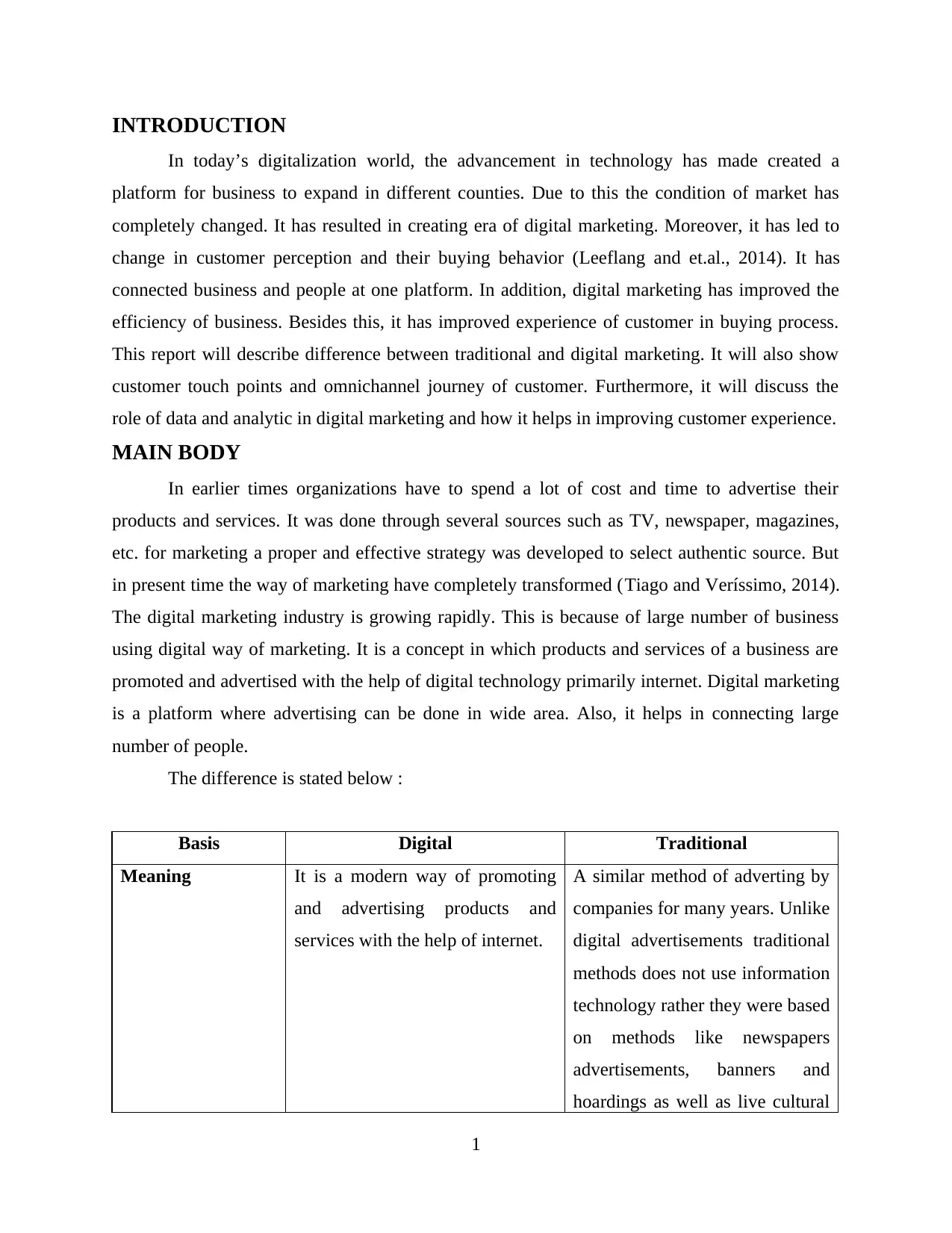
The difference is stated below :
Basis Digital Traditional
Meaning It is a modern way of promoting
and advertising products and
services with the help of internet.
A similar method of adverting by
companies for many years. Unlike
digital advertisements traditional
methods does not use information
technology rather they were based
on methods like newspapers
advertisements, banners and
hoardings as well as live cultural
1
In today’s digitalization world, the advancement in technology has made created a
platform for business to expand in different counties. Due to this the condition of market has
completely changed. It has resulted in creating era of digital marketing. Moreover, it has led to
change in customer perception and their buying behavior (Leeflang and et.al., 2014). It has
connected business and people at one platform. In addition, digital marketing has improved the
efficiency of business. Besides this, it has improved experience of customer in buying process.
This report will describe difference between traditional and digital marketing. It will also show
customer touch points and omnichannel journey of customer. Furthermore, it will discuss the
role of data and analytic in digital marketing and how it helps in improving customer experience.
MAIN BODY
In earlier times organizations have to spend a lot of cost and time to advertise their
products and services. It was done through several sources such as TV, newspaper, magazines,
etc. for marketing a proper and effective strategy was developed to select authentic source. But
in present time the way of marketing have completely transformed (Tiago and Veríssimo, 2014).
The digital marketing industry is growing rapidly. This is because of large number of business
using digital way of marketing. It is a concept in which products and services of a business are
promoted and advertised with the help of digital technology primarily internet. Digital marketing
is a platform where advertising can be done in wide area. Also, it helps in connecting large
number of people.
The difference is stated below :
Basis Digital Traditional
Meaning It is a modern way of promoting
and advertising products and
services with the help of internet.
A similar method of adverting by
companies for many years. Unlike
digital advertisements traditional
methods does not use information
technology rather they were based
on methods like newspapers
advertisements, banners and
hoardings as well as live cultural
1
⊘ This is a preview!⊘
Do you want full access?
Subscribe today to unlock all pages.

Trusted by 1+ million students worldwide

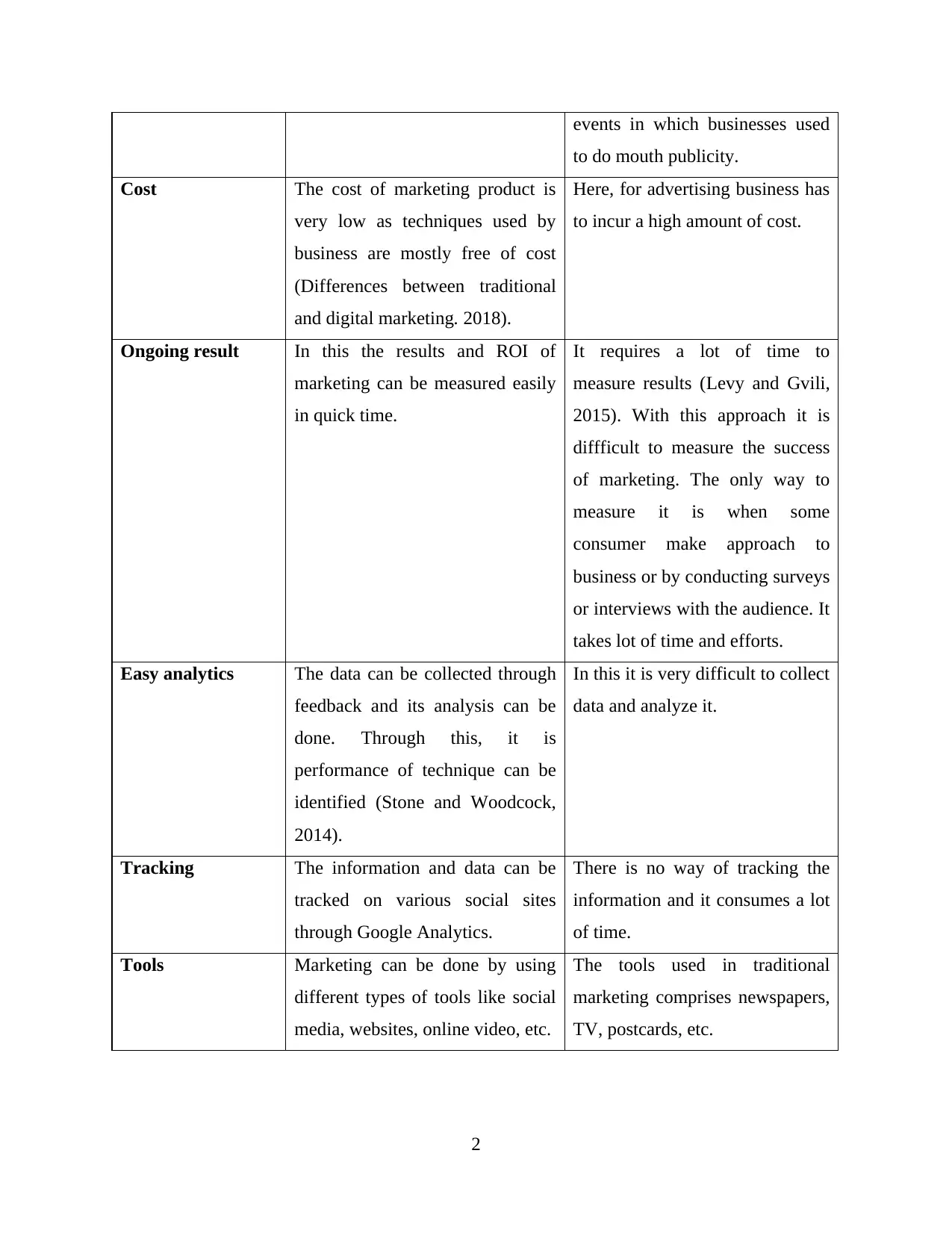
events in which businesses used
to do mouth publicity.
Cost The cost of marketing product is
very low as techniques used by
business are mostly free of cost
(Differences between traditional
and digital marketing. 2018).
Here, for advertising business has
to incur a high amount of cost.
Ongoing result In this the results and ROI of
marketing can be measured easily
in quick time.
It requires a lot of time to
measure results (Levy and Gvili,
2015). With this approach it is
diffficult to measure the success
of marketing. The only way to
measure it is when some
consumer make approach to
business or by conducting surveys
or interviews with the audience. It
takes lot of time and efforts.
Easy analytics The data can be collected through
feedback and its analysis can be
done. Through this, it is
performance of technique can be
identified (Stone and Woodcock,
2014).
In this it is very difficult to collect
data and analyze it.
Tracking The information and data can be
tracked on various social sites
through Google Analytics.
There is no way of tracking the
information and it consumes a lot
of time.
Tools Marketing can be done by using
different types of tools like social
media, websites, online video, etc.
The tools used in traditional
marketing comprises newspapers,
TV, postcards, etc.
2
to do mouth publicity.
Cost The cost of marketing product is
very low as techniques used by
business are mostly free of cost
(Differences between traditional
and digital marketing. 2018).
Here, for advertising business has
to incur a high amount of cost.
Ongoing result In this the results and ROI of
marketing can be measured easily
in quick time.
It requires a lot of time to
measure results (Levy and Gvili,
2015). With this approach it is
diffficult to measure the success
of marketing. The only way to
measure it is when some
consumer make approach to
business or by conducting surveys
or interviews with the audience. It
takes lot of time and efforts.
Easy analytics The data can be collected through
feedback and its analysis can be
done. Through this, it is
performance of technique can be
identified (Stone and Woodcock,
2014).
In this it is very difficult to collect
data and analyze it.
Tracking The information and data can be
tracked on various social sites
through Google Analytics.
There is no way of tracking the
information and it consumes a lot
of time.
Tools Marketing can be done by using
different types of tools like social
media, websites, online video, etc.
The tools used in traditional
marketing comprises newspapers,
TV, postcards, etc.
2
Paraphrase This Document
Need a fresh take? Get an instant paraphrase of this document with our AI Paraphraser

Digital marketing has influenced consumer buying decision to a great extent. It has
allowed them to search, collect and analyze lot of information from different sources
collectively. The nature and touch points of customers have changed. People are experiencing a
new way of shopping. They are able to choose products from wide range of available options.
They share product review with other that helps in attracting more people. (Stephen, 2016). An
omnichannel customer journey means individual touch points where different channels are
connected together. It enables customer to continue experience from where they are left. In these
companies engage customer through various channels like video, web, etc. it helps them to
develop loyal customer base and keeping them engaged. For example the omnichannel concept
allow customers to determine price of same product at various stores on just a single click. Thus,
without physically moving to different stores customers are able to compare the price and
product specifications provided by different vendors or brands. This platform benefits in
providing competitive advantage, streamlined customer service, personalized interaction, etc.
Digital marketing is now integrated with data analytic. It has played a significant role in
providing accurate and effective data. With the help of it, quick decisions can be taken and
executed properly. By analyzing data user interaction with tools is identified. Data analytic has
supported business in improving their decision making process. They are able to take smart
decisions quickly. Also, goals and objectives are developed for short time. The data is used to
increase rate at which customer purchase or to engage with some online or offline action. The
data analysis has played key role in improving the experience of consumers. It is possible for the
customers to compare data of different brands and then to make purchasing decisions. The
consumers no longer need to physically move to stores for analyzing different brands. In context
to it, KPI are formed and metrics are developed to take accurate and precise decision. Company
are using certain analytics tools like Big data and Google analytic (Kannan, 2017). It has been
useful for them to track user activity and their response time. In digital marketing many types of
concepts have emerged like PPC, SEO, etc. these services are provided by third parties. Now,
business do not have to organize marketing campaigns. This has saved their time as well as cost.
In digital marketing the data collected plays a vital role in getting results. There are
certain tools through which data analytics is done. Here, data tracking is done to develop
strategies. The business is able to measure performance of tools and strategies used by them. For
example if organisation has used video message to promote their services then they can find its
3
allowed them to search, collect and analyze lot of information from different sources
collectively. The nature and touch points of customers have changed. People are experiencing a
new way of shopping. They are able to choose products from wide range of available options.
They share product review with other that helps in attracting more people. (Stephen, 2016). An
omnichannel customer journey means individual touch points where different channels are
connected together. It enables customer to continue experience from where they are left. In these
companies engage customer through various channels like video, web, etc. it helps them to
develop loyal customer base and keeping them engaged. For example the omnichannel concept
allow customers to determine price of same product at various stores on just a single click. Thus,
without physically moving to different stores customers are able to compare the price and
product specifications provided by different vendors or brands. This platform benefits in
providing competitive advantage, streamlined customer service, personalized interaction, etc.
Digital marketing is now integrated with data analytic. It has played a significant role in
providing accurate and effective data. With the help of it, quick decisions can be taken and
executed properly. By analyzing data user interaction with tools is identified. Data analytic has
supported business in improving their decision making process. They are able to take smart
decisions quickly. Also, goals and objectives are developed for short time. The data is used to
increase rate at which customer purchase or to engage with some online or offline action. The
data analysis has played key role in improving the experience of consumers. It is possible for the
customers to compare data of different brands and then to make purchasing decisions. The
consumers no longer need to physically move to stores for analyzing different brands. In context
to it, KPI are formed and metrics are developed to take accurate and precise decision. Company
are using certain analytics tools like Big data and Google analytic (Kannan, 2017). It has been
useful for them to track user activity and their response time. In digital marketing many types of
concepts have emerged like PPC, SEO, etc. these services are provided by third parties. Now,
business do not have to organize marketing campaigns. This has saved their time as well as cost.
In digital marketing the data collected plays a vital role in getting results. There are
certain tools through which data analytics is done. Here, data tracking is done to develop
strategies. The business is able to measure performance of tools and strategies used by them. For
example if organisation has used video message to promote their services then they can find its
3

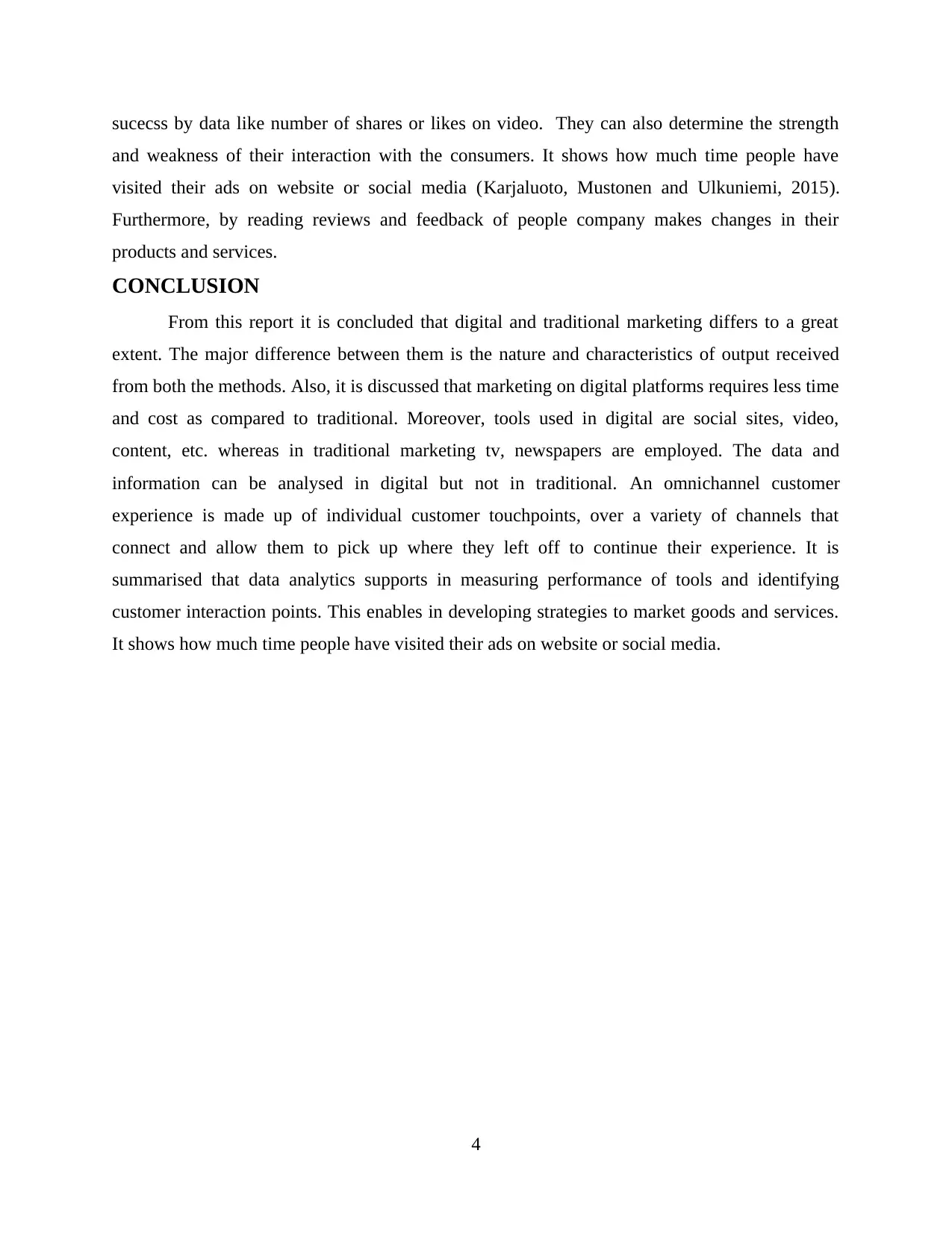
sucecss by data like number of shares or likes on video. They can also determine the strength
and weakness of their interaction with the consumers. It shows how much time people have
visited their ads on website or social media (Karjaluoto, Mustonen and Ulkuniemi, 2015).
Furthermore, by reading reviews and feedback of people company makes changes in their
products and services.
CONCLUSION
From this report it is concluded that digital and traditional marketing differs to a great
extent. The major difference between them is the nature and characteristics of output received
from both the methods. Also, it is discussed that marketing on digital platforms requires less time
and cost as compared to traditional. Moreover, tools used in digital are social sites, video,
content, etc. whereas in traditional marketing tv, newspapers are employed. The data and
information can be analysed in digital but not in traditional. An omnichannel customer
experience is made up of individual customer touchpoints, over a variety of channels that
connect and allow them to pick up where they left off to continue their experience. It is
summarised that data analytics supports in measuring performance of tools and identifying
customer interaction points. This enables in developing strategies to market goods and services.
It shows how much time people have visited their ads on website or social media.
4
and weakness of their interaction with the consumers. It shows how much time people have
visited their ads on website or social media (Karjaluoto, Mustonen and Ulkuniemi, 2015).
Furthermore, by reading reviews and feedback of people company makes changes in their
products and services.
CONCLUSION
From this report it is concluded that digital and traditional marketing differs to a great
extent. The major difference between them is the nature and characteristics of output received
from both the methods. Also, it is discussed that marketing on digital platforms requires less time
and cost as compared to traditional. Moreover, tools used in digital are social sites, video,
content, etc. whereas in traditional marketing tv, newspapers are employed. The data and
information can be analysed in digital but not in traditional. An omnichannel customer
experience is made up of individual customer touchpoints, over a variety of channels that
connect and allow them to pick up where they left off to continue their experience. It is
summarised that data analytics supports in measuring performance of tools and identifying
customer interaction points. This enables in developing strategies to market goods and services.
It shows how much time people have visited their ads on website or social media.
4
⊘ This is a preview!⊘
Do you want full access?
Subscribe today to unlock all pages.

Trusted by 1+ million students worldwide

REFERENCES
Books and journals
Kannan, P. K., 2017. Digital marketing: A framework, review and research
agenda. International Journal of Research in Marketing, 34(1), pp.22-45.
Karjaluoto, H., Mustonen, N. and Ulkuniemi, P., 2015. The role of digital channels in
industrial marketing communications. Journal of Business & Industrial Marketing, 30(6),
pp.703-710.
Leeflang, P. S. and et. al., 2014. Challenges and solutions for marketing in a digital
era. European management journal, 32(1), pp.1-12.
Levy, S. and Gvili, Y., 2015. How Credible is E-Word of Mouth Across Digital-
Marketing Channels?: The Roles of Social Capital, Information Richness, and
Interactivity. Journal of Advertising Research, 55(1), pp.95-109.
Stephen, A. T., 2016. The role of digital and social media marketing in consumer
behavior. Current Opinion in Psychology, 10, pp.17-21.
Stone, M. D. and Woodcock, N. D., 2014. Interactive, direct and digital marketing: A
future that depends on better use of business intelligence. Journal of Research in Interactive
Marketing, 8(1), pp.4-17.
Tiago, M. T. P. M. B. and Veríssimo, J. M. C., 2014. Digital marketing and social
media: Why bother?. Business Horizons, 57(6), pp.703-708.
Online
Differences between traditional and digital marketing. 2018. [Online] Available through: <
https://www.digitaldoughnut.com/articles/2018/july/traditional-marketing-vs-digital >
5
Books and journals
Kannan, P. K., 2017. Digital marketing: A framework, review and research
agenda. International Journal of Research in Marketing, 34(1), pp.22-45.
Karjaluoto, H., Mustonen, N. and Ulkuniemi, P., 2015. The role of digital channels in
industrial marketing communications. Journal of Business & Industrial Marketing, 30(6),
pp.703-710.
Leeflang, P. S. and et. al., 2014. Challenges and solutions for marketing in a digital
era. European management journal, 32(1), pp.1-12.
Levy, S. and Gvili, Y., 2015. How Credible is E-Word of Mouth Across Digital-
Marketing Channels?: The Roles of Social Capital, Information Richness, and
Interactivity. Journal of Advertising Research, 55(1), pp.95-109.
Stephen, A. T., 2016. The role of digital and social media marketing in consumer
behavior. Current Opinion in Psychology, 10, pp.17-21.
Stone, M. D. and Woodcock, N. D., 2014. Interactive, direct and digital marketing: A
future that depends on better use of business intelligence. Journal of Research in Interactive
Marketing, 8(1), pp.4-17.
Tiago, M. T. P. M. B. and Veríssimo, J. M. C., 2014. Digital marketing and social
media: Why bother?. Business Horizons, 57(6), pp.703-708.
Online
Differences between traditional and digital marketing. 2018. [Online] Available through: <
https://www.digitaldoughnut.com/articles/2018/july/traditional-marketing-vs-digital >
5
Paraphrase This Document
Need a fresh take? Get an instant paraphrase of this document with our AI Paraphraser

6
1 out of 8
Related Documents
Your All-in-One AI-Powered Toolkit for Academic Success.
+13062052269
info@desklib.com
Available 24*7 on WhatsApp / Email
Unlock your academic potential
Copyright © 2020–2025 A2Z Services. All Rights Reserved. Developed and managed by ZUCOL.