Digital Marketing Strategy Report for British Council Myanmar Project
VerifiedAdded on 2023/04/21
|25
|8107
|479
Report
AI Summary
This report provides a detailed digital marketing plan tailored for the British Council in Myanmar. It begins with an executive summary outlining the report's objectives: to improve digital personalization strategies. The report is structured into three key tasks. Task 1 analyzes the organization's background, customer personas, customer journeys, and touchpoints, and identifies crucial analytics for personalization. Task 2 evaluates current personalization practices and explores best practices in the market to develop a refined digital strategy. Task 3 focuses on planning improvements to personalization, exploring wider implications, and ensuring compliance with privacy legislation. The report covers customer acquisition, retention, and engagement stages, analyzing the effectiveness of various touchpoints and providing recommendations for improvement. It also addresses the limitations of analytics and suggests strategies to overcome them, ensuring effective and privacy-compliant marketing practices.
Running head: DIGITAL MARKETING PLAN FOR BRITISH COUNCIL MYANAMAR
DIGITAL MARKETING PLAN FOR BRITISH COUNCIL MYANMAR
Name of the Student:
Name of the University:
Author Note:
DIGITAL MARKETING PLAN FOR BRITISH COUNCIL MYANMAR
Name of the Student:
Name of the University:
Author Note:

Paraphrase This Document
Need a fresh take? Get an instant paraphrase of this document with our AI Paraphraser
1DIGITAL MARKETING PLAN FOR BRITISH COUNCIL MYANMAR
Executive Summary
The purpose of this report is to come up with an effective digital marketing solution in
terms of digital personalization, for the British Council of Burma (Myanmar). It is divided in
three parts, which address specific problems in the digital marketing strategies of the
organization, and in the end, comes up with an effective solution by which proper
personalization can be incorporated in the organization’s consumer journey. The report
outlines the budget and timeline to implement the plan, and also states the limitations that
need to be avoided in terms of privacy.
Executive Summary
The purpose of this report is to come up with an effective digital marketing solution in
terms of digital personalization, for the British Council of Burma (Myanmar). It is divided in
three parts, which address specific problems in the digital marketing strategies of the
organization, and in the end, comes up with an effective solution by which proper
personalization can be incorporated in the organization’s consumer journey. The report
outlines the budget and timeline to implement the plan, and also states the limitations that
need to be avoided in terms of privacy.
2DIGITAL MARKETING PLAN FOR BRITISH COUNCIL MYANMAR
Table of Contents
TASK 1: BRIEFING PAPER....................................................................................................3
ORGANIZATION NAME: BRITISH COUNCIL, BURMA...............................................3
ORGANIZATION INFORMATION:...................................................................................3
SPECIFIC BACKGROUND:................................................................................................3
1.b CUSTOMER PERSONA, JOURNEY AND TOUCHPOINTS......................................4
1.b.1 CUSTOMER PERSONA..............................................................................................4
1.b.2 CUSTOMER JOURNEY AND TOUCHPOINTS.......................................................4
1.c ANALYTICS TO DETERMINE PERSONALIZATION...............................................6
IDENTIFYING THE ANALYTICS......................................................................................6
USING THE ANALYTICS TO DETERMINE PERSONALIZATION...............................7
LIMITATIONS OF THE ANALYTICS...............................................................................7
RECOMMENDATIONS TO OVERCOME THE ANALYTICS.........................................7
TASK 2......................................................................................................................................8
2.a EVALUATING PERSONALISATION..........................................................................8
2.b THE BEST PERSONALIZATION PRACTICES IN THE MARKET...........................9
2.c DEVELOPING A DIGITAL STRATEGY....................................................................11
TASK 3....................................................................................................................................13
3.a PLANNING TO IMPROVE PERSONALIZATION....................................................13
3.b WIDER IMPLICATIONS.............................................................................................16
3.c COMPLYING WITH PRIVACY LEGISLATION.......................................................17
Table of Contents
TASK 1: BRIEFING PAPER....................................................................................................3
ORGANIZATION NAME: BRITISH COUNCIL, BURMA...............................................3
ORGANIZATION INFORMATION:...................................................................................3
SPECIFIC BACKGROUND:................................................................................................3
1.b CUSTOMER PERSONA, JOURNEY AND TOUCHPOINTS......................................4
1.b.1 CUSTOMER PERSONA..............................................................................................4
1.b.2 CUSTOMER JOURNEY AND TOUCHPOINTS.......................................................4
1.c ANALYTICS TO DETERMINE PERSONALIZATION...............................................6
IDENTIFYING THE ANALYTICS......................................................................................6
USING THE ANALYTICS TO DETERMINE PERSONALIZATION...............................7
LIMITATIONS OF THE ANALYTICS...............................................................................7
RECOMMENDATIONS TO OVERCOME THE ANALYTICS.........................................7
TASK 2......................................................................................................................................8
2.a EVALUATING PERSONALISATION..........................................................................8
2.b THE BEST PERSONALIZATION PRACTICES IN THE MARKET...........................9
2.c DEVELOPING A DIGITAL STRATEGY....................................................................11
TASK 3....................................................................................................................................13
3.a PLANNING TO IMPROVE PERSONALIZATION....................................................13
3.b WIDER IMPLICATIONS.............................................................................................16
3.c COMPLYING WITH PRIVACY LEGISLATION.......................................................17
⊘ This is a preview!⊘
Do you want full access?
Subscribe today to unlock all pages.

Trusted by 1+ million students worldwide
3DIGITAL MARKETING PLAN FOR BRITISH COUNCIL MYANMAR
TASK 1: BRIEFING PAPER
ORGANIZATION NAME: BRITISH COUNCIL, BURMA.
ORGANIZATION INFORMATION:
The BRITISH COUNCIL, BURMA in Myanmar is a UK charity, under Royal
Charter and a public body of the UK, devoted towards cultural relations and education. Based
in the United Kingdom, the organization is based in more than 100 countries across the globe,
to improve knowledge and understanding between the UK and the other countries. The
deliverables of this organization include arts and culture, the language of English, civil
society and education (Reddy et al. 2018). The customer base of the organization includes
around 758 million people online, as of last year (Britishcouncil.org.mm, n.d.). The main
competitors of this organization are BLUE HORIZONS and WALLSTREET HORIZON
worldwide, but does not have any significant competitor specifically in Myanmar. Therefore,
the organization has had a fair amount of market share in the charity that it does, and has also
made significant impacts in the cultural and educational societies across the globe.
SPECIFIC BACKGROUND:
British Council, Burma has been operating in the country of Myanmar since 1944,
improving cultural relations, developing educational platforms, and making contributions in
arts and society (Britishcouncil.org, n.d.). Its main consumer segment is aged between 15 to
40 years of age, having interest in literature and arts, inclined towards cultural diversities and
looking for higher education. Hence it is clear, that the list of deliverables of the organization
is pretty vast, and considering the number of audiences it caters to, it needs an advanced level
personalization that requires little to no human input, and can personalize its services
automatically, pertaining to the records of the customer journey.
The company has been serving its members based on the records that it has collected
over the course of the customer acquisition and journey stages, which caters to the
personalization which it is able to provide at the present. However, there have been a lot of
discrepancies in the content with which it reaches out to its audiences, indicating that the
personalization which the company provides, is mature but not effective in all cases. It is
therefore undergoing a transition in the way it operates with its digital marketing strategies.
TASK 1: BRIEFING PAPER
ORGANIZATION NAME: BRITISH COUNCIL, BURMA.
ORGANIZATION INFORMATION:
The BRITISH COUNCIL, BURMA in Myanmar is a UK charity, under Royal
Charter and a public body of the UK, devoted towards cultural relations and education. Based
in the United Kingdom, the organization is based in more than 100 countries across the globe,
to improve knowledge and understanding between the UK and the other countries. The
deliverables of this organization include arts and culture, the language of English, civil
society and education (Reddy et al. 2018). The customer base of the organization includes
around 758 million people online, as of last year (Britishcouncil.org.mm, n.d.). The main
competitors of this organization are BLUE HORIZONS and WALLSTREET HORIZON
worldwide, but does not have any significant competitor specifically in Myanmar. Therefore,
the organization has had a fair amount of market share in the charity that it does, and has also
made significant impacts in the cultural and educational societies across the globe.
SPECIFIC BACKGROUND:
British Council, Burma has been operating in the country of Myanmar since 1944,
improving cultural relations, developing educational platforms, and making contributions in
arts and society (Britishcouncil.org, n.d.). Its main consumer segment is aged between 15 to
40 years of age, having interest in literature and arts, inclined towards cultural diversities and
looking for higher education. Hence it is clear, that the list of deliverables of the organization
is pretty vast, and considering the number of audiences it caters to, it needs an advanced level
personalization that requires little to no human input, and can personalize its services
automatically, pertaining to the records of the customer journey.
The company has been serving its members based on the records that it has collected
over the course of the customer acquisition and journey stages, which caters to the
personalization which it is able to provide at the present. However, there have been a lot of
discrepancies in the content with which it reaches out to its audiences, indicating that the
personalization which the company provides, is mature but not effective in all cases. It is
therefore undergoing a transition in the way it operates with its digital marketing strategies.
Paraphrase This Document
Need a fresh take? Get an instant paraphrase of this document with our AI Paraphraser
4DIGITAL MARKETING PLAN FOR BRITISH COUNCIL MYANMAR
1.b CUSTOMER PERSONA, JOURNEY AND TOUCHPOINTS
From the key customer segment of the British Council in Burma, the customer
persona can be identified and described by using research methods on the same.
1.b.1 CUSTOMER PERSONA
Firstly, the people of Myanmar aged between 15 and 40 years are more dynamic in
nature than the rest of the age groups in the country (Elizabeth and Banks 2018). By dynamic,
it is meant that these people exhibit a high openness to experiences, and are usually energetic
in nature. Those having interest in literature and arts, tend to be intellectual and creative in
nature, showing interests in creative processes of learning such as debates and riddles, and
tend to contribute to the society in their respective fields as well.
Secondly, people of Myanmar who show an inclination towards cultural diversities,
have been observed to be more conscientious and open to experiences, while being highly
accepting of the multiculturalism in the country at the same time (Rich and Frank 2016).
Since the majority of this segment of the consumer base is older than the rest of the
population in the key consumer segment, these consumers often tend to be exploratory than
being indoors, having more free time than the busy young population of the country.
Thirdly, people looking for higher education in the country tend to move abroad
(Harcourt 2018). These people are highly keen on learning concepts related to their fields,
and are willing to grab on to attractive educational opportunities that they get at a reasonable
price.
Therefore, from the above research done on the key consumer segment of the
organization, it can be inferred that the customer persona of the customer base of British
Council, Burma, is that of an energetic and exploratory nature, tolerant towards
multiculturalism, inclined to learning and are highly open to experiences.
1.b.2 CUSTOMER JOURNEY AND TOUCHPOINTS
Customer journey on the other hand is the customer’s entire experience of interacting with
the organization throughout his or her engagement with the brand (Lemon and Verhoef
2016). The points of interactions of the customer with the brand are called customer
touchpoints (Bascur, Rusu and Quiñones 2018).
1.b CUSTOMER PERSONA, JOURNEY AND TOUCHPOINTS
From the key customer segment of the British Council in Burma, the customer
persona can be identified and described by using research methods on the same.
1.b.1 CUSTOMER PERSONA
Firstly, the people of Myanmar aged between 15 and 40 years are more dynamic in
nature than the rest of the age groups in the country (Elizabeth and Banks 2018). By dynamic,
it is meant that these people exhibit a high openness to experiences, and are usually energetic
in nature. Those having interest in literature and arts, tend to be intellectual and creative in
nature, showing interests in creative processes of learning such as debates and riddles, and
tend to contribute to the society in their respective fields as well.
Secondly, people of Myanmar who show an inclination towards cultural diversities,
have been observed to be more conscientious and open to experiences, while being highly
accepting of the multiculturalism in the country at the same time (Rich and Frank 2016).
Since the majority of this segment of the consumer base is older than the rest of the
population in the key consumer segment, these consumers often tend to be exploratory than
being indoors, having more free time than the busy young population of the country.
Thirdly, people looking for higher education in the country tend to move abroad
(Harcourt 2018). These people are highly keen on learning concepts related to their fields,
and are willing to grab on to attractive educational opportunities that they get at a reasonable
price.
Therefore, from the above research done on the key consumer segment of the
organization, it can be inferred that the customer persona of the customer base of British
Council, Burma, is that of an energetic and exploratory nature, tolerant towards
multiculturalism, inclined to learning and are highly open to experiences.
1.b.2 CUSTOMER JOURNEY AND TOUCHPOINTS
Customer journey on the other hand is the customer’s entire experience of interacting with
the organization throughout his or her engagement with the brand (Lemon and Verhoef
2016). The points of interactions of the customer with the brand are called customer
touchpoints (Bascur, Rusu and Quiñones 2018).
5DIGITAL MARKETING PLAN FOR BRITISH COUNCIL MYANMAR
In the case of British Council, Burma, the first touch point in order to acquire new
customers is to organize events in selective locations, where the theme of the event would
perfectly reflect the customer persona that the organization targets. British Council of
Myanmar does organize events such as art and literary fairs and debates. These events must
be organized targeting the most popular universities of the country, like University of Yangon
and Mandalay University, to attract the potential customers.
Another touchpoint during the acquisition stage of the consumer journey, is social
media interaction. Sponsored posts informing the public about the latest developments taking
place regarding the organization is a great way to spread brand awareness and acquire new
customers.
For the retention stage, the organization tries emails and phone calls as an effective
way to maintain customer relations, and host webinars in order to reach out to the younger
population. These webinars take place via the organization’s official website.
For the engagement stage, the organization often use digital tools like online forms to
collect data about the experiences of a consumer from availing a particular service or product
from the organization. Online messages can also be sent to them, thanking them for their
engagement with the brand, sending out special invitations to the loyal and old customers,
about offers and special events.
For analyzing the nature of the discussed touchpoints, predictions have to be made
about how a particular attempt to interact with the customer could be viewed by the customer
at that point of time. Hosting events to spread brand awareness can usually not be taken in a
negative manner by the audience, and if hosted in specific places where the theme of the
event reflects the consumer persona, positive perceptions about the organization are bound to
take place (Deng, Li and Shen 2015). Hence, this is a tool which can be effective in
developing brand image of the organization, and increase trust.
Sponsored posts during this stage however, might not prove to be as effective in
achieving the same however. Social media is a huge platform and a sponsored post can reach
out to anyone in the world, who might not have any fascination towards the offerings of the
organization. For example, promoting a cultural fest online via online ads, could prove to be
intruding for someone who is interested in watching an interesting Youtube video when the
In the case of British Council, Burma, the first touch point in order to acquire new
customers is to organize events in selective locations, where the theme of the event would
perfectly reflect the customer persona that the organization targets. British Council of
Myanmar does organize events such as art and literary fairs and debates. These events must
be organized targeting the most popular universities of the country, like University of Yangon
and Mandalay University, to attract the potential customers.
Another touchpoint during the acquisition stage of the consumer journey, is social
media interaction. Sponsored posts informing the public about the latest developments taking
place regarding the organization is a great way to spread brand awareness and acquire new
customers.
For the retention stage, the organization tries emails and phone calls as an effective
way to maintain customer relations, and host webinars in order to reach out to the younger
population. These webinars take place via the organization’s official website.
For the engagement stage, the organization often use digital tools like online forms to
collect data about the experiences of a consumer from availing a particular service or product
from the organization. Online messages can also be sent to them, thanking them for their
engagement with the brand, sending out special invitations to the loyal and old customers,
about offers and special events.
For analyzing the nature of the discussed touchpoints, predictions have to be made
about how a particular attempt to interact with the customer could be viewed by the customer
at that point of time. Hosting events to spread brand awareness can usually not be taken in a
negative manner by the audience, and if hosted in specific places where the theme of the
event reflects the consumer persona, positive perceptions about the organization are bound to
take place (Deng, Li and Shen 2015). Hence, this is a tool which can be effective in
developing brand image of the organization, and increase trust.
Sponsored posts during this stage however, might not prove to be as effective in
achieving the same however. Social media is a huge platform and a sponsored post can reach
out to anyone in the world, who might not have any fascination towards the offerings of the
organization. For example, promoting a cultural fest online via online ads, could prove to be
intruding for someone who is interested in watching an interesting Youtube video when the
⊘ This is a preview!⊘
Do you want full access?
Subscribe today to unlock all pages.
Trusted by 1+ million students worldwide
6DIGITAL MARKETING PLAN FOR BRITISH COUNCIL MYANMAR
ad keeps him waiting for a while until it ends. In such cases, the viewer could get frustrated
and this particular touchpoint could prove to be a negative experience or a pain touchpoint.
In the next sage however, emails can be a very effective way of retaining a customer,
by staying in touch with him or her in an attempt to make the customer feel special about
choosing to purchase from the organization. It can also help the customer in staying updated
about the important information and developments regarding the organization. Hence, it can
enhance the trust between the two entities. For example, a book lover getting an update about
a nearby book fair taking place in the upcoming week.
Phone calls however, could be intruding for the customer. One may not like the
intrusive nature of a sudden phone call that he or she gets, during an important or busy time.
Hence, it can create an irritating experience for the customer.
Webinars are a selective way of engaging the audience as specific webinars will be
attracting audiences of specific interests. Hence, if managed and delivered effectively, a
webinar can prove to be a positive experience for a target consumer. Through to the retention
stage, online forms asking for a customer’s feedback are optional for any customer. Those
who want to provide a feedback would welcome it, and those uninterested would be ignoring
it. But, knowing that the organization cares about a customer’s experience, can only create a
positive image of the organization in the minds of the customers. This is often effective in
creating and/or enhancing trust in the organization.
Hence, from the predicting and analyzing how the various touchpoints could be
affecting the customer throughout the customer journey from acquisition to engagement, the
touchpoints could be classified in the following manner:
Trust touchpoints: online events, emails, webinars and online feedback forms.
Pain touchpoints: sponsored posts and ads, and phone calls.
1.c ANALYTICS TO DETERMINE PERSONALIZATION
To analyze the level of personalization through the stages of customer journey,
following is how analytics can be used:
IDENTIFYING THE ANALYTICS
The analytics that can be used to determine the level of personalization are polls and
surveys, and focus groups. Polls are questions which are sent out to target respondents with
ad keeps him waiting for a while until it ends. In such cases, the viewer could get frustrated
and this particular touchpoint could prove to be a negative experience or a pain touchpoint.
In the next sage however, emails can be a very effective way of retaining a customer,
by staying in touch with him or her in an attempt to make the customer feel special about
choosing to purchase from the organization. It can also help the customer in staying updated
about the important information and developments regarding the organization. Hence, it can
enhance the trust between the two entities. For example, a book lover getting an update about
a nearby book fair taking place in the upcoming week.
Phone calls however, could be intruding for the customer. One may not like the
intrusive nature of a sudden phone call that he or she gets, during an important or busy time.
Hence, it can create an irritating experience for the customer.
Webinars are a selective way of engaging the audience as specific webinars will be
attracting audiences of specific interests. Hence, if managed and delivered effectively, a
webinar can prove to be a positive experience for a target consumer. Through to the retention
stage, online forms asking for a customer’s feedback are optional for any customer. Those
who want to provide a feedback would welcome it, and those uninterested would be ignoring
it. But, knowing that the organization cares about a customer’s experience, can only create a
positive image of the organization in the minds of the customers. This is often effective in
creating and/or enhancing trust in the organization.
Hence, from the predicting and analyzing how the various touchpoints could be
affecting the customer throughout the customer journey from acquisition to engagement, the
touchpoints could be classified in the following manner:
Trust touchpoints: online events, emails, webinars and online feedback forms.
Pain touchpoints: sponsored posts and ads, and phone calls.
1.c ANALYTICS TO DETERMINE PERSONALIZATION
To analyze the level of personalization through the stages of customer journey,
following is how analytics can be used:
IDENTIFYING THE ANALYTICS
The analytics that can be used to determine the level of personalization are polls and
surveys, and focus groups. Polls are questions which are sent out to target respondents with
Paraphrase This Document
Need a fresh take? Get an instant paraphrase of this document with our AI Paraphraser
7DIGITAL MARKETING PLAN FOR BRITISH COUNCIL MYANMAR
specific options which the respondent can choose from as his or her reply to the question
(Sajuria and Fábrega 2016). Surveys can contain tools like that of a questionnaire, designed
to collect information from a group of people or from an area, which can be further analyzed
to quantify or qualify the data.
USING THE ANALYTICS TO DETERMINE PERSONALIZATION
Polls and survey questions, including focus group interviews could be designed in a
way that asks about a person’s interest, whether cultural, arts and literature, or educational,
and questions the respondent whether he has received mails, or phone calls pertaining to the
information related to the organization that coincides with his interest (Morgan and Hoffman
2018). This data can be then analyzed on the basis of how many people did not actually
receive information relating to his or her areas of interests, and possibly also on how many
kept receiving mails that had nothing to do with his interests. This can indicate the level of
personalization that exists in the customer experience. The most important thing to note here
is the fact that the purpose of the analytics is to measure the personalization level. Therefore,
they should be designed in a way in which the qualitative data which would be gathered from
the analytics would be perfectly reflective of the quantitative level of personalization upon
evaluation. Questions should be very much objective regarding the interests of the customers,
and the choices in the questionnaires should only include the services which the organization
provides to its customers. The responses should be measured in degrees; for example, on a
scale of one to six, based on the level of the agreeableness of the customer.
LIMITATIONS OF THE ANALYTICS
However, this could eventually prove to be a futile analysis, since respondents can
very well ignore the questionnaires and polls altogether (Keeter et al. 2017). On top of that,
the polls might not be representative, and customers of one domain could be much more
responsive than the customers of any other domain in the process. Hence, the entire process
of the analysis could become very unrepresentative in nature. This is because it would lead to
more data pertaining to a specific segment of the services which the company provides, and
not encompass the entirety of its services. Therefore, it would not be able to effectively aid in
measuring the personalization level of the organization’s services.
RECOMMENDATIONS TO OVERCOME THE ANALYTICS
To make the analysis and data collection more effective and useful, stress should be
given on pre-determining the areas of interests of the customers form the records, and then
specific options which the respondent can choose from as his or her reply to the question
(Sajuria and Fábrega 2016). Surveys can contain tools like that of a questionnaire, designed
to collect information from a group of people or from an area, which can be further analyzed
to quantify or qualify the data.
USING THE ANALYTICS TO DETERMINE PERSONALIZATION
Polls and survey questions, including focus group interviews could be designed in a
way that asks about a person’s interest, whether cultural, arts and literature, or educational,
and questions the respondent whether he has received mails, or phone calls pertaining to the
information related to the organization that coincides with his interest (Morgan and Hoffman
2018). This data can be then analyzed on the basis of how many people did not actually
receive information relating to his or her areas of interests, and possibly also on how many
kept receiving mails that had nothing to do with his interests. This can indicate the level of
personalization that exists in the customer experience. The most important thing to note here
is the fact that the purpose of the analytics is to measure the personalization level. Therefore,
they should be designed in a way in which the qualitative data which would be gathered from
the analytics would be perfectly reflective of the quantitative level of personalization upon
evaluation. Questions should be very much objective regarding the interests of the customers,
and the choices in the questionnaires should only include the services which the organization
provides to its customers. The responses should be measured in degrees; for example, on a
scale of one to six, based on the level of the agreeableness of the customer.
LIMITATIONS OF THE ANALYTICS
However, this could eventually prove to be a futile analysis, since respondents can
very well ignore the questionnaires and polls altogether (Keeter et al. 2017). On top of that,
the polls might not be representative, and customers of one domain could be much more
responsive than the customers of any other domain in the process. Hence, the entire process
of the analysis could become very unrepresentative in nature. This is because it would lead to
more data pertaining to a specific segment of the services which the company provides, and
not encompass the entirety of its services. Therefore, it would not be able to effectively aid in
measuring the personalization level of the organization’s services.
RECOMMENDATIONS TO OVERCOME THE ANALYTICS
To make the analysis and data collection more effective and useful, stress should be
given on pre-determining the areas of interests of the customers form the records, and then
8DIGITAL MARKETING PLAN FOR BRITISH COUNCIL MYANMAR
polls and questionnaires to them proportionately, such that equal chances of receiving a
response from each type of customer remains.
TASK 2
2.a EVALUATING PERSONALISATION
Based on the touchpoints identified in 1(b), they need to be evaluated on the basis of
how effective they are personalized for the customers, to get an overall evaluation of the
existing personalization.
As a trust touchpoint, online events do play a very effective role in acquiring new
customers (Harmeling et al. 2017). However, these cannot be termed as highly personalized
since these events can reach out to people from various domains. Hence, there is no guarantee
that a person interested in a specific domain will be exclusively a part of that special event.
Mails are mostly personalized by the organization, targeting customers interested in
each domain, specifically and separately. These mails are generally sent out to customers on
the basis of the interests that they tend to show in the records of the organization. Therefore,
specific mails concerning specific fields of interests can be effectively sent out for a better
consumer experience and response. These mails can either be promotional or relational,
which anyway prove to be useful for the recipient because of the personalized nature of these
mails.
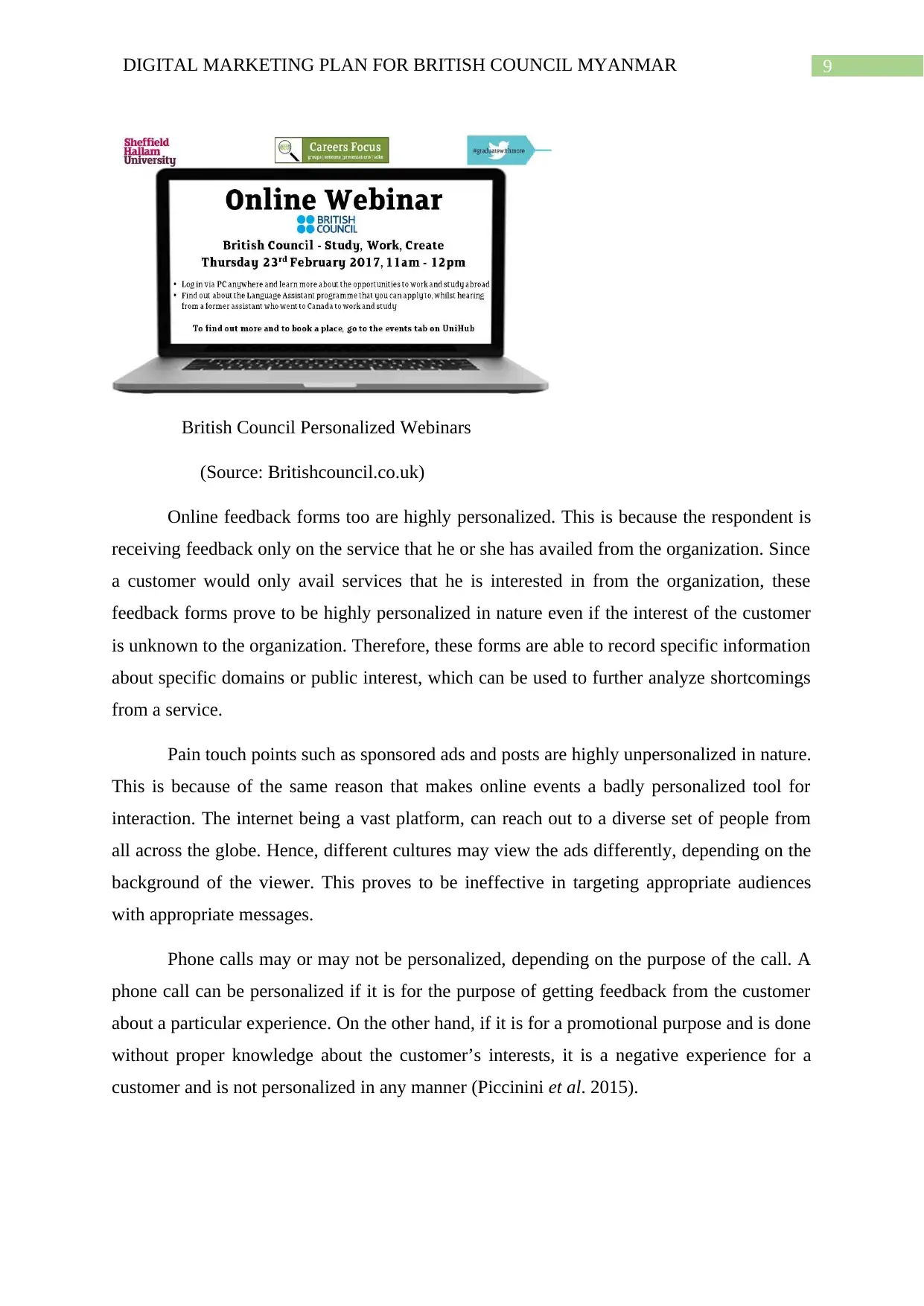
Webinars too, are highly personalized. These webinars are only based on specific
domains, and people interested in those specific domains can watch it on demand (Semingson
et al. 2016). Therefore, these are catering to the people who are interested in the topics. By
far, the British Council of Myanmar has conducted over 500 webinars, and has attracted
viewers not only from Myanmar, but from all over the world, thereby proving its
effectiveness.
polls and questionnaires to them proportionately, such that equal chances of receiving a
response from each type of customer remains.
TASK 2
2.a EVALUATING PERSONALISATION
Based on the touchpoints identified in 1(b), they need to be evaluated on the basis of
how effective they are personalized for the customers, to get an overall evaluation of the
existing personalization.
As a trust touchpoint, online events do play a very effective role in acquiring new
customers (Harmeling et al. 2017). However, these cannot be termed as highly personalized
since these events can reach out to people from various domains. Hence, there is no guarantee
that a person interested in a specific domain will be exclusively a part of that special event.
Mails are mostly personalized by the organization, targeting customers interested in
each domain, specifically and separately. These mails are generally sent out to customers on
the basis of the interests that they tend to show in the records of the organization. Therefore,
specific mails concerning specific fields of interests can be effectively sent out for a better
consumer experience and response. These mails can either be promotional or relational,
which anyway prove to be useful for the recipient because of the personalized nature of these
mails.
Webinars too, are highly personalized. These webinars are only based on specific
domains, and people interested in those specific domains can watch it on demand (Semingson
et al. 2016). Therefore, these are catering to the people who are interested in the topics. By
far, the British Council of Myanmar has conducted over 500 webinars, and has attracted
viewers not only from Myanmar, but from all over the world, thereby proving its
effectiveness.
⊘ This is a preview!⊘
Do you want full access?
Subscribe today to unlock all pages.
Trusted by 1+ million students worldwide
9DIGITAL MARKETING PLAN FOR BRITISH COUNCIL MYANMAR
British Council Personalized Webinars
(Source: Britishcouncil.co.uk)
Online feedback forms too are highly personalized. This is because the respondent is
receiving feedback only on the service that he or she has availed from the organization. Since
a customer would only avail services that he is interested in from the organization, these
feedback forms prove to be highly personalized in nature even if the interest of the customer
is unknown to the organization. Therefore, these forms are able to record specific information
about specific domains or public interest, which can be used to further analyze shortcomings
from a service.
Pain touch points such as sponsored ads and posts are highly unpersonalized in nature.
This is because of the same reason that makes online events a badly personalized tool for
interaction. The internet being a vast platform, can reach out to a diverse set of people from
all across the globe. Hence, different cultures may view the ads differently, depending on the
background of the viewer. This proves to be ineffective in targeting appropriate audiences
with appropriate messages.
Phone calls may or may not be personalized, depending on the purpose of the call. A
phone call can be personalized if it is for the purpose of getting feedback from the customer
about a particular experience. On the other hand, if it is for a promotional purpose and is done
without proper knowledge about the customer’s interests, it is a negative experience for a
customer and is not personalized in any manner (Piccinini et al. 2015).
British Council Personalized Webinars
(Source: Britishcouncil.co.uk)
Online feedback forms too are highly personalized. This is because the respondent is
receiving feedback only on the service that he or she has availed from the organization. Since
a customer would only avail services that he is interested in from the organization, these
feedback forms prove to be highly personalized in nature even if the interest of the customer
is unknown to the organization. Therefore, these forms are able to record specific information
about specific domains or public interest, which can be used to further analyze shortcomings
from a service.
Pain touch points such as sponsored ads and posts are highly unpersonalized in nature.
This is because of the same reason that makes online events a badly personalized tool for
interaction. The internet being a vast platform, can reach out to a diverse set of people from
all across the globe. Hence, different cultures may view the ads differently, depending on the
background of the viewer. This proves to be ineffective in targeting appropriate audiences
with appropriate messages.
Phone calls may or may not be personalized, depending on the purpose of the call. A
phone call can be personalized if it is for the purpose of getting feedback from the customer
about a particular experience. On the other hand, if it is for a promotional purpose and is done
without proper knowledge about the customer’s interests, it is a negative experience for a
customer and is not personalized in any manner (Piccinini et al. 2015).
Paraphrase This Document
Need a fresh take? Get an instant paraphrase of this document with our AI Paraphraser
10DIGITAL MARKETING PLAN FOR BRITISH COUNCIL MYANMAR
2.b THE BEST PERSONALIZATION PRACTICES IN THE MARKET
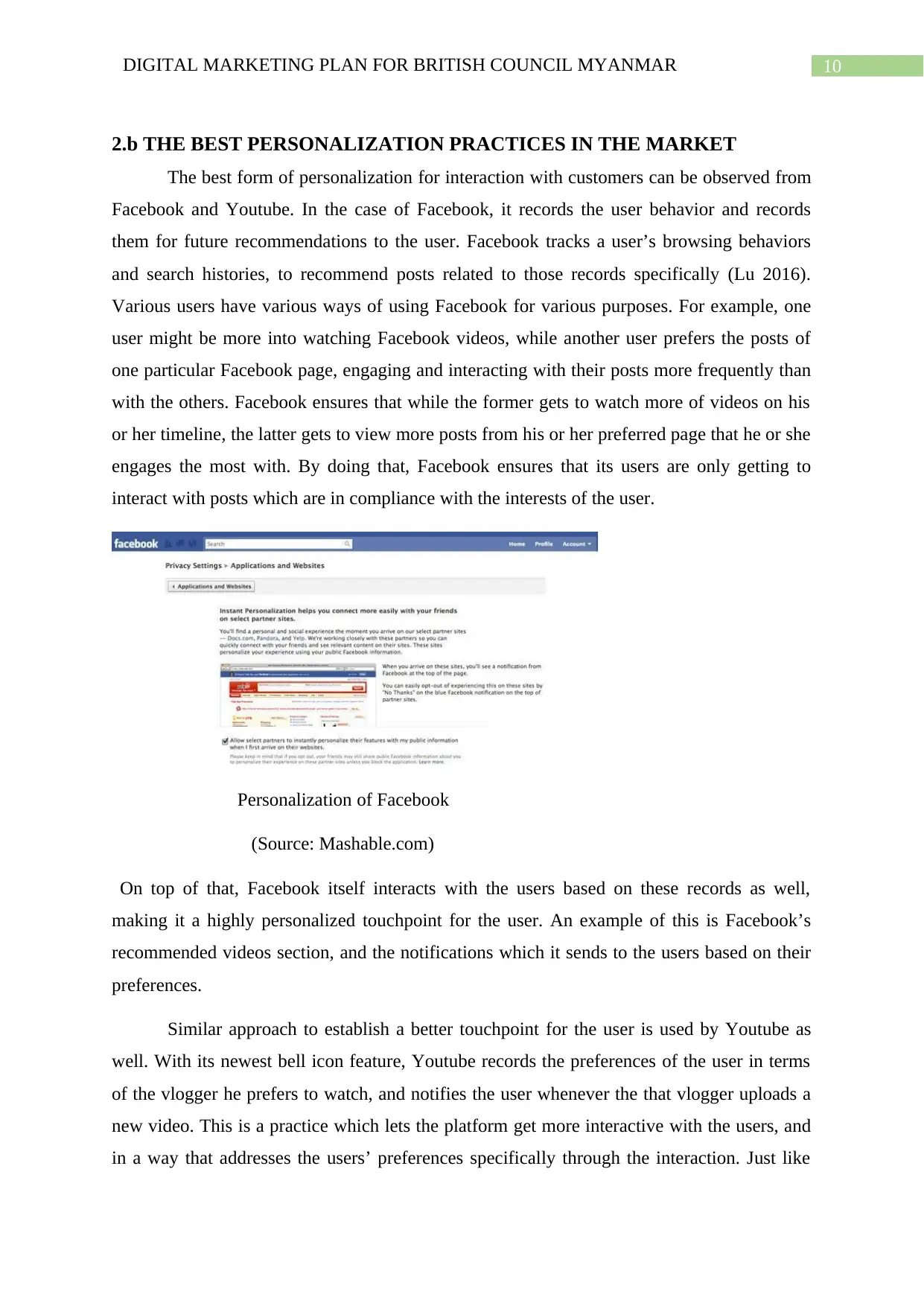
The best form of personalization for interaction with customers can be observed from
Facebook and Youtube. In the case of Facebook, it records the user behavior and records
them for future recommendations to the user. Facebook tracks a user’s browsing behaviors
and search histories, to recommend posts related to those records specifically (Lu 2016).
Various users have various ways of using Facebook for various purposes. For example, one
user might be more into watching Facebook videos, while another user prefers the posts of
one particular Facebook page, engaging and interacting with their posts more frequently than
with the others. Facebook ensures that while the former gets to watch more of videos on his
or her timeline, the latter gets to view more posts from his or her preferred page that he or she
engages the most with. By doing that, Facebook ensures that its users are only getting to
interact with posts which are in compliance with the interests of the user.
Personalization of Facebook
(Source: Mashable.com)
On top of that, Facebook itself interacts with the users based on these records as well,
making it a highly personalized touchpoint for the user. An example of this is Facebook’s
recommended videos section, and the notifications which it sends to the users based on their
preferences.
Similar approach to establish a better touchpoint for the user is used by Youtube as
well. With its newest bell icon feature, Youtube records the preferences of the user in terms
of the vlogger he prefers to watch, and notifies the user whenever the that vlogger uploads a
new video. This is a practice which lets the platform get more interactive with the users, and
in a way that addresses the users’ preferences specifically through the interaction. Just like
2.b THE BEST PERSONALIZATION PRACTICES IN THE MARKET
The best form of personalization for interaction with customers can be observed from
Facebook and Youtube. In the case of Facebook, it records the user behavior and records
them for future recommendations to the user. Facebook tracks a user’s browsing behaviors
and search histories, to recommend posts related to those records specifically (Lu 2016).
Various users have various ways of using Facebook for various purposes. For example, one
user might be more into watching Facebook videos, while another user prefers the posts of
one particular Facebook page, engaging and interacting with their posts more frequently than
with the others. Facebook ensures that while the former gets to watch more of videos on his
or her timeline, the latter gets to view more posts from his or her preferred page that he or she
engages the most with. By doing that, Facebook ensures that its users are only getting to
interact with posts which are in compliance with the interests of the user.
Personalization of Facebook
(Source: Mashable.com)
On top of that, Facebook itself interacts with the users based on these records as well,
making it a highly personalized touchpoint for the user. An example of this is Facebook’s
recommended videos section, and the notifications which it sends to the users based on their
preferences.
Similar approach to establish a better touchpoint for the user is used by Youtube as
well. With its newest bell icon feature, Youtube records the preferences of the user in terms
of the vlogger he prefers to watch, and notifies the user whenever the that vlogger uploads a
new video. This is a practice which lets the platform get more interactive with the users, and
in a way that addresses the users’ preferences specifically through the interaction. Just like
11DIGITAL MARKETING PLAN FOR BRITISH COUNCIL MYANMAR
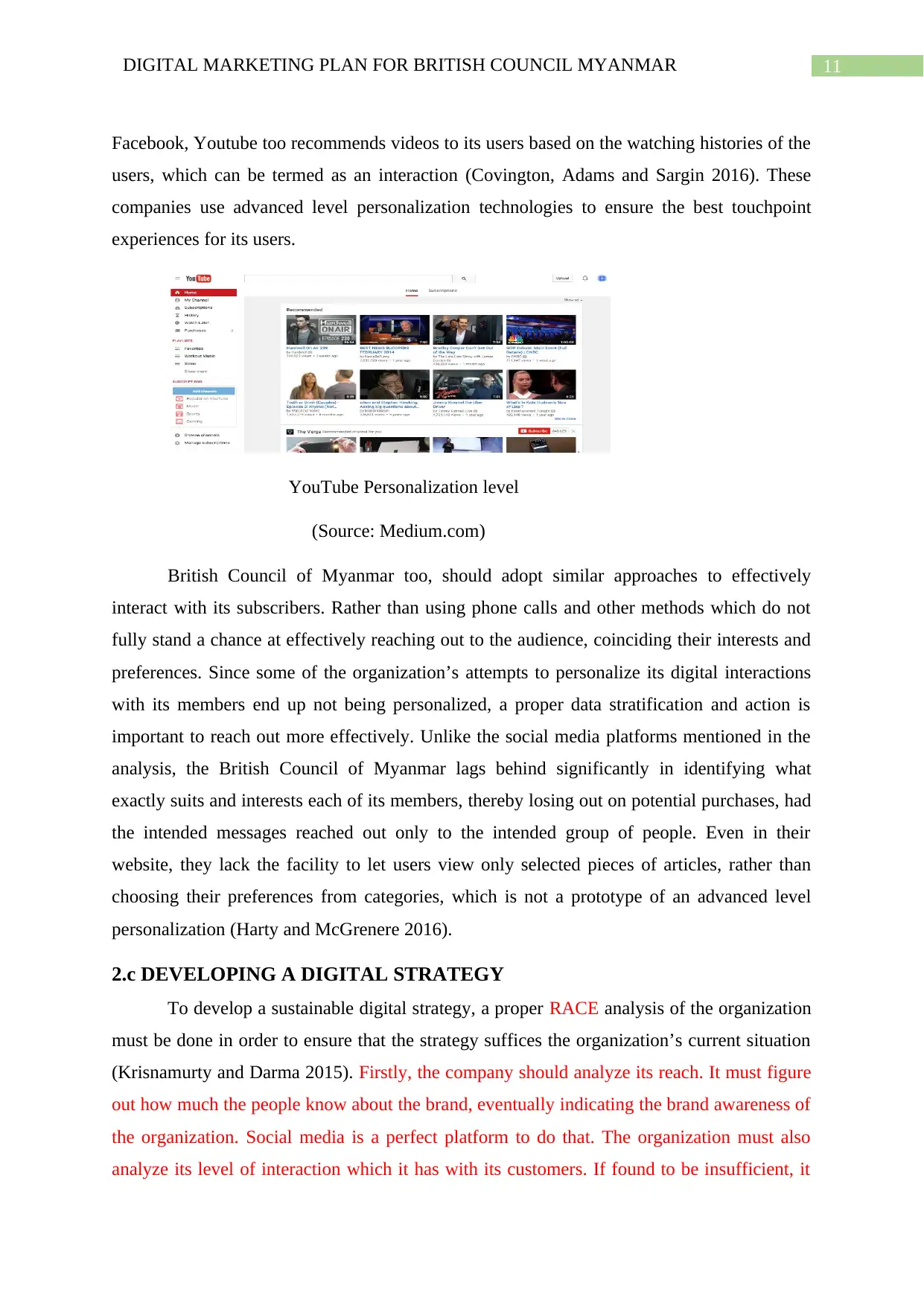
Facebook, Youtube too recommends videos to its users based on the watching histories of the
users, which can be termed as an interaction (Covington, Adams and Sargin 2016). These
companies use advanced level personalization technologies to ensure the best touchpoint
experiences for its users.
YouTube Personalization level
(Source: Medium.com)
British Council of Myanmar too, should adopt similar approaches to effectively
interact with its subscribers. Rather than using phone calls and other methods which do not
fully stand a chance at effectively reaching out to the audience, coinciding their interests and
preferences. Since some of the organization’s attempts to personalize its digital interactions
with its members end up not being personalized, a proper data stratification and action is
important to reach out more effectively. Unlike the social media platforms mentioned in the
analysis, the British Council of Myanmar lags behind significantly in identifying what
exactly suits and interests each of its members, thereby losing out on potential purchases, had
the intended messages reached out only to the intended group of people. Even in their
website, they lack the facility to let users view only selected pieces of articles, rather than
choosing their preferences from categories, which is not a prototype of an advanced level
personalization (Harty and McGrenere 2016).
2.c DEVELOPING A DIGITAL STRATEGY
To develop a sustainable digital strategy, a proper RACE analysis of the organization
must be done in order to ensure that the strategy suffices the organization’s current situation
(Krisnamurty and Darma 2015). Firstly, the company should analyze its reach. It must figure
out how much the people know about the brand, eventually indicating the brand awareness of
the organization. Social media is a perfect platform to do that. The organization must also
analyze its level of interaction which it has with its customers. If found to be insufficient, it
Facebook, Youtube too recommends videos to its users based on the watching histories of the
users, which can be termed as an interaction (Covington, Adams and Sargin 2016). These
companies use advanced level personalization technologies to ensure the best touchpoint
experiences for its users.
YouTube Personalization level
(Source: Medium.com)
British Council of Myanmar too, should adopt similar approaches to effectively
interact with its subscribers. Rather than using phone calls and other methods which do not
fully stand a chance at effectively reaching out to the audience, coinciding their interests and
preferences. Since some of the organization’s attempts to personalize its digital interactions
with its members end up not being personalized, a proper data stratification and action is
important to reach out more effectively. Unlike the social media platforms mentioned in the
analysis, the British Council of Myanmar lags behind significantly in identifying what
exactly suits and interests each of its members, thereby losing out on potential purchases, had
the intended messages reached out only to the intended group of people. Even in their
website, they lack the facility to let users view only selected pieces of articles, rather than
choosing their preferences from categories, which is not a prototype of an advanced level
personalization (Harty and McGrenere 2016).
2.c DEVELOPING A DIGITAL STRATEGY
To develop a sustainable digital strategy, a proper RACE analysis of the organization
must be done in order to ensure that the strategy suffices the organization’s current situation
(Krisnamurty and Darma 2015). Firstly, the company should analyze its reach. It must figure
out how much the people know about the brand, eventually indicating the brand awareness of
the organization. Social media is a perfect platform to do that. The organization must also
analyze its level of interaction which it has with its customers. If found to be insufficient, it
⊘ This is a preview!⊘
Do you want full access?
Subscribe today to unlock all pages.
Trusted by 1+ million students worldwide

1 out of 25


Your All-in-One AI-Powered Toolkit for Academic Success.
+13062052269
info@desklib.com
Available 24*7 on WhatsApp / Email
![[object Object]](/_next/static/media/star-bottom.7253800d.svg)
Unlock your academic potential
Copyright © 2020–2026 A2Z Services. All Rights Reserved. Developed and managed by ZUCOL.