Critical Reflections on Ethical Issues in Digital Marketing Report

Verified

Added on  2023/06/10

|7
|1628
|313
Report
AI Summary
This report examines the role of digital marketing in enhancing a company's brand image, focusing on Amazon as a case study. It outlines the research aim, objectives, and questions, employing the Saunders research onion framework for data collection and analysis. The methodology includes a deductive approach, positivism philosophy, surveys, and both primary (questionnaires distributed to 40 Amazon managers) and secondary data collection methods. Ethical considerations are thoroughly addressed, emphasizing respect for autonomy, scientific integrity, social responsibility, and maximizing benefit while minimizing harm to respondents. The report adheres to ethical principles by ensuring voluntary participation, protecting privacy, maintaining transparency, and avoiding misleading practices, ultimately contributing to a better understanding of ethical digital marketing strategies and their societal impact. Desklib provides access to similar solved assignments for students.

Document Page
Critical reflections on ethical issues &
Ethics checklist submission
tabler-icon-diamond-filled.svg

Paraphrase This Document

Need a fresh take? Get an instant paraphrase of this document with our AI Paraphraser
Document Page
EXECUTIVE SUMMARY
In the current study, information is carried out about the role of digital marketing within
an organisation. This report has covered research aim, objectives and questions. It has also
included research methods used for the accumulation of information in a precise way. It also
includes each ethical principle followed by investigator to maintain the accuracy and relevancy
of the study.
Document Page
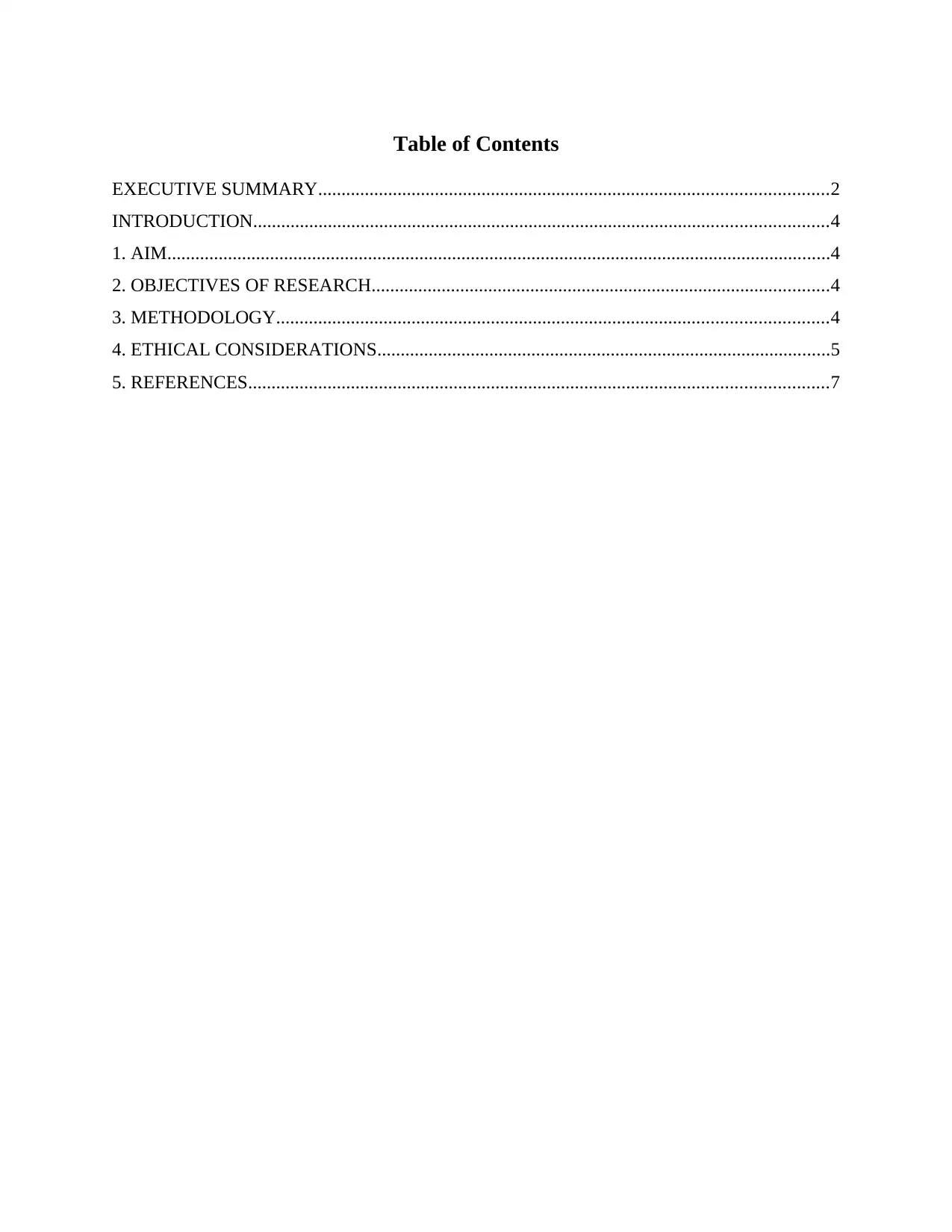
Table of Contents
EXECUTIVE SUMMARY.............................................................................................................2
INTRODUCTION...........................................................................................................................4
1. AIM..............................................................................................................................................4
2. OBJECTIVES OF RESEARCH..................................................................................................4
3. METHODOLOGY......................................................................................................................4
4. ETHICAL CONSIDERATIONS.................................................................................................5
5. REFERENCES............................................................................................................................7
Document Page
INTRODUCTION
Digital marketing is the concept which is mostly used by companies to promote products
and different offerings of the brand (Dastane, 2020). It is one of the simplest forms to promote
companies to connect with current and potential consumers through internet and several other
forms of digital marketing. It includes web-based advertising, e-mail, multimedia messages,
social media and many more (Eze and et. al., 2020). Therefore, the current study focuses over
carrying out information about the role of digital marketing in enhancing the brand image of a
company along with challenges faced by organisation while implementing digital marketing
strategies.
1. AIM
“To analyse the role of digital marketing in improving brand image of an organisation.”A
study on Amazon
2. OBJECTIVES OF RESEARCH
To identify the concept and the importance of digital marketing within an organisation
To examine the digital marketing strategies used by the company, Amazon, to improve
the brand image
To determine the challenges facing Amazon as it implements certain digital marketing
strategies to improve its brand image
Questions of the research
Explain the concept and how important is digital marketing within the company?
What digital marketing strategies does Amazon use to improve its brand image?
What challenges do Amazon face as it implements digital marketing strategies to improve
its brand image?
3. METHODOLOGY
It is the research method that helps in the collection and analysis of information in a
significant manner (Mohajan, 2018). Thus, it has followed Saunders research onion framework
so that information can be collected and evaluated in a proper manner. Some of the used methods
for accumulating information are given below in a brief manner.
tabler-icon-diamond-filled.svg

Paraphrase This Document

Need a fresh take? Get an instant paraphrase of this document with our AI Paraphraser
Document Page
Research Design: In the current investigation, there are several research methods which
are used by researcher to collect and analyse apt and relevant information (Basias and Pollalis,
2018). In this study, certain methods and stages are followed mentioned in the Saunders research
onion framework. Researcher has used deductive approach, positivism philosophy, survey,
primary and secondary data collection method. Primary method has helped in collecting raw and
first-hand information in a systematic manner (Rutberg and Bouikidis, 2018). Questionnaire is
also developed in the study to collect data directly by approaching selected each representative.
On the other hand, secondary method has assisted in collecting second-hand information in a
systematic manner. Some of the secondary sources used in the study are: books, articles,
journals, publications, newspapers etc.
Research Approach: In the current study, quantitative method is used by investigator to
collect numerable and statistical piece of information in a systematic manner. The main reason
behind using quantitative method is that it helps in carrying out measurable and comparable
results and outcomes (Solihatin and et. al., 2020). Thus, the major benefit experienced by
investigator through quantitative research approach is that it helps in collecting, interpreting and
analysing numerical piece of information.
Sampling: It is the research method that assists in selecting right number of respondents.
Probability sampling is used to collect information by directly approaching right number of
participants (Ryder and et. al., 2020). 40 managers are selected by researcher from Amazon.
These managers are from the age group of 30-40 years. These managers are chosen because they
have great knowledge about the importance of digital marketing to improve the brand image.
4. ETHICAL CONSIDERATIONS
Respect for the autonomy, privacy and dignity of individuals and communities: Every
respondent in an investigation takes part voluntarily, free from any pressure or influence etc.
Autonomy & dignity and right of each respondent is appropriately protected and respected while
conducting investigation in a systematic way (Hanlon, 2021). For respecting autonomy of each
respondent, researcher gives importance to choices and opinions in relation to the proposed
research topic. On the other hand, if research respondents lack in the capacity of making
autonomous decisions then this is protected during the study. This mainly focuses over not
revealing the caste, name or any other data about the selected respondents that may reveal their
identity (Wilmer and et. al., 2021).
Document Page
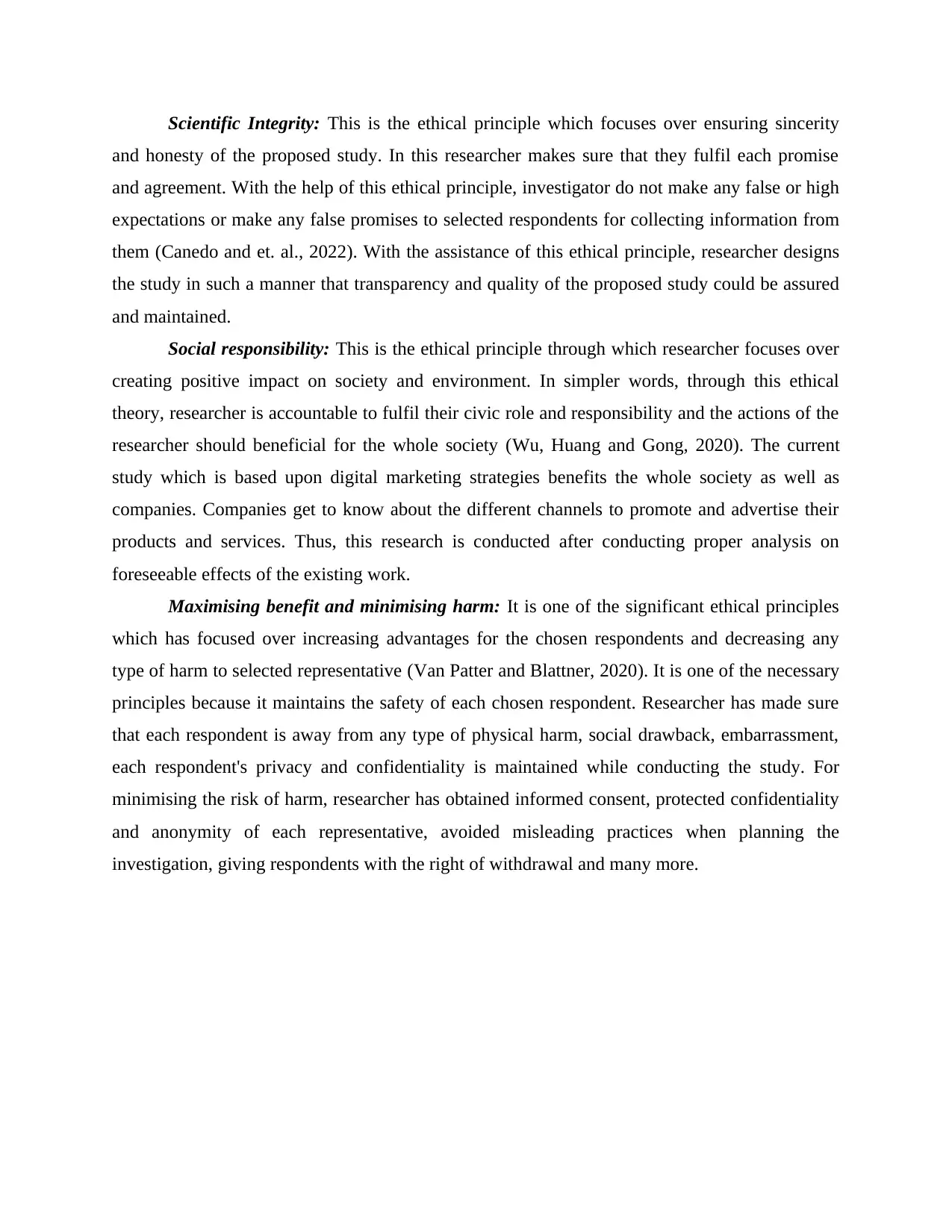
Scientific Integrity: This is the ethical principle which focuses over ensuring sincerity
and honesty of the proposed study. In this researcher makes sure that they fulfil each promise
and agreement. With the help of this ethical principle, investigator do not make any false or high
expectations or make any false promises to selected respondents for collecting information from
them (Canedo and et. al., 2022). With the assistance of this ethical principle, researcher designs
the study in such a manner that transparency and quality of the proposed study could be assured
and maintained.
Social responsibility: This is the ethical principle through which researcher focuses over
creating positive impact on society and environment. In simpler words, through this ethical
theory, researcher is accountable to fulfil their civic role and responsibility and the actions of the
researcher should beneficial for the whole society (Wu, Huang and Gong, 2020). The current
study which is based upon digital marketing strategies benefits the whole society as well as
companies. Companies get to know about the different channels to promote and advertise their
products and services. Thus, this research is conducted after conducting proper analysis on
foreseeable effects of the existing work.
Maximising benefit and minimising harm: It is one of the significant ethical principles
which has focused over increasing advantages for the chosen respondents and decreasing any
type of harm to selected representative (Van Patter and Blattner, 2020). It is one of the necessary
principles because it maintains the safety of each chosen respondent. Researcher has made sure
that each respondent is away from any type of physical harm, social drawback, embarrassment,
each respondent's privacy and confidentiality is maintained while conducting the study. For
minimising the risk of harm, researcher has obtained informed consent, protected confidentiality
and anonymity of each representative, avoided misleading practices when planning the
investigation, giving respondents with the right of withdrawal and many more.
Document Page
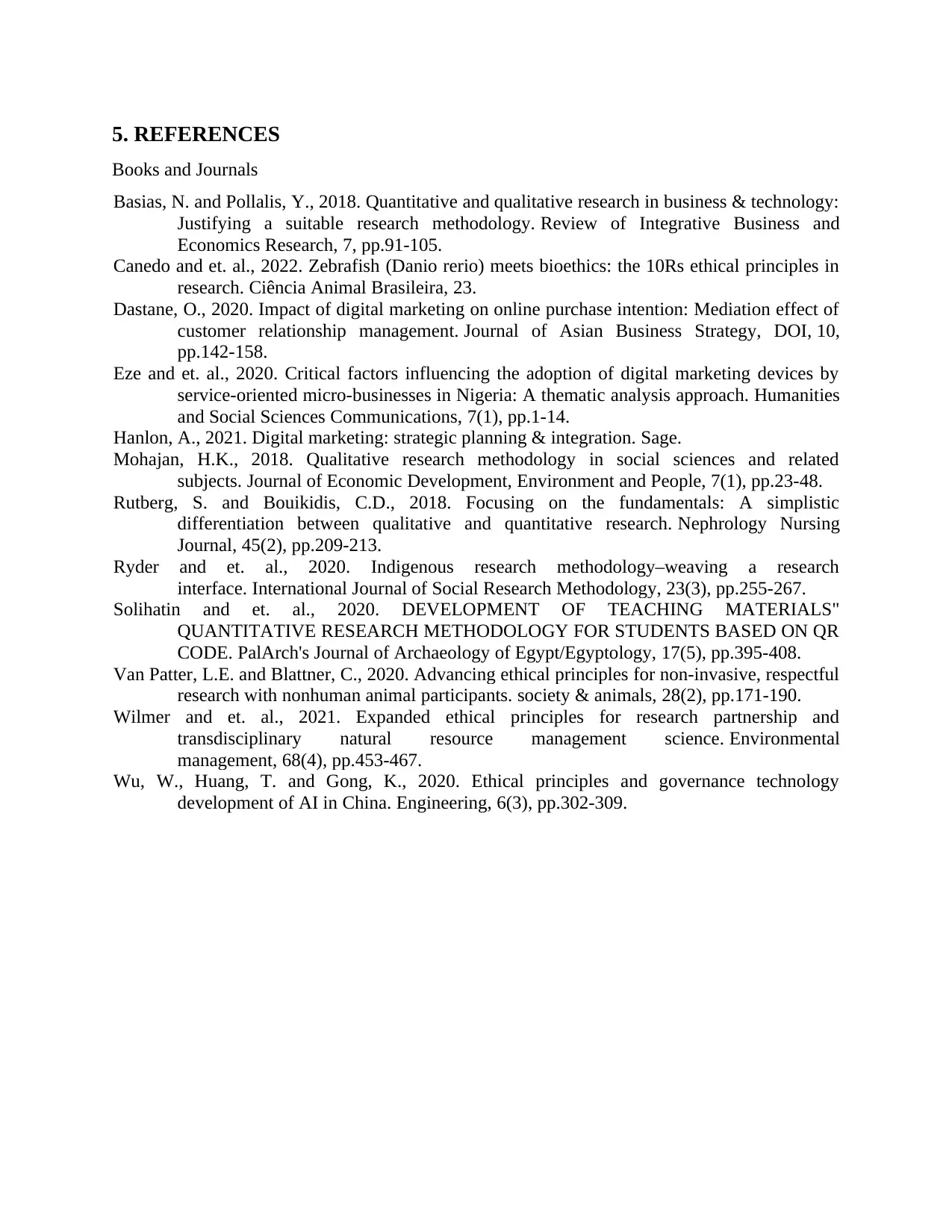
5. REFERENCES
Books and Journals
Basias, N. and Pollalis, Y., 2018. Quantitative and qualitative research in business & technology:
Justifying a suitable research methodology. Review of Integrative Business and
Economics Research, 7, pp.91-105.
Canedo and et. al., 2022. Zebrafish (Danio rerio) meets bioethics: the 10Rs ethical principles in
research. Ciência Animal Brasileira, 23.
Dastane, O., 2020. Impact of digital marketing on online purchase intention: Mediation effect of
customer relationship management. Journal of Asian Business Strategy, DOI, 10,
pp.142-158.
Eze and et. al., 2020. Critical factors influencing the adoption of digital marketing devices by
service-oriented micro-businesses in Nigeria: A thematic analysis approach. Humanities
and Social Sciences Communications, 7(1), pp.1-14.
Hanlon, A., 2021. Digital marketing: strategic planning & integration. Sage.
Mohajan, H.K., 2018. Qualitative research methodology in social sciences and related
subjects. Journal of Economic Development, Environment and People, 7(1), pp.23-48.
Rutberg, S. and Bouikidis, C.D., 2018. Focusing on the fundamentals: A simplistic
differentiation between qualitative and quantitative research. Nephrology Nursing
Journal, 45(2), pp.209-213.
Ryder and et. al., 2020. Indigenous research methodology–weaving a research
interface. International Journal of Social Research Methodology, 23(3), pp.255-267.
Solihatin and et. al., 2020. DEVELOPMENT OF TEACHING MATERIALS"
QUANTITATIVE RESEARCH METHODOLOGY FOR STUDENTS BASED ON QR
CODE. PalArch's Journal of Archaeology of Egypt/Egyptology, 17(5), pp.395-408.
Van Patter, L.E. and Blattner, C., 2020. Advancing ethical principles for non-invasive, respectful
research with nonhuman animal participants. society & animals, 28(2), pp.171-190.
Wilmer and et. al., 2021. Expanded ethical principles for research partnership and
transdisciplinary natural resource management science. Environmental
management, 68(4), pp.453-467.
Wu, W., Huang, T. and Gong, K., 2020. Ethical principles and governance technology
development of AI in China. Engineering, 6(3), pp.302-309.
chevron_up_icon
1 out of 7
circle_padding
hide_on_mobile
zoom_out_icon
[object Object]