Customer Retention in Hospitality: Digital Marketing Strategies
VerifiedAdded on 2020/01/28
|22
|9468
|46
Report
AI Summary
This report critically evaluates the role of digital marketing in enhancing customer retention within the hospitality and tourism industries, with a specific focus on the Red Carnation Hotel in the UK. The investigation explores the relationship between digital marketing strategies and customer loyalty, examining various factors influencing customer retention, such as online marketing and customer service. The research employs a systematic process, including literature reviews, and the selection of appropriate data collection methods, including both primary and secondary data. The report also assesses research philosophies, specifically positivism, and discusses the application of various digital marketing techniques to improve customer retention rates. The report further addresses issues of reliability and validity in data collection, offering solutions and proposes a research project suitable for this level of study. The findings provide valuable insights into the effectiveness of digital marketing in fostering long-term customer relationships and driving business success in the competitive hospitality sector.
Advance research methods for tourism and
hospitality
1
hospitality
1

Paraphrase This Document
Need a fresh take? Get an instant paraphrase of this document with our AI Paraphraser
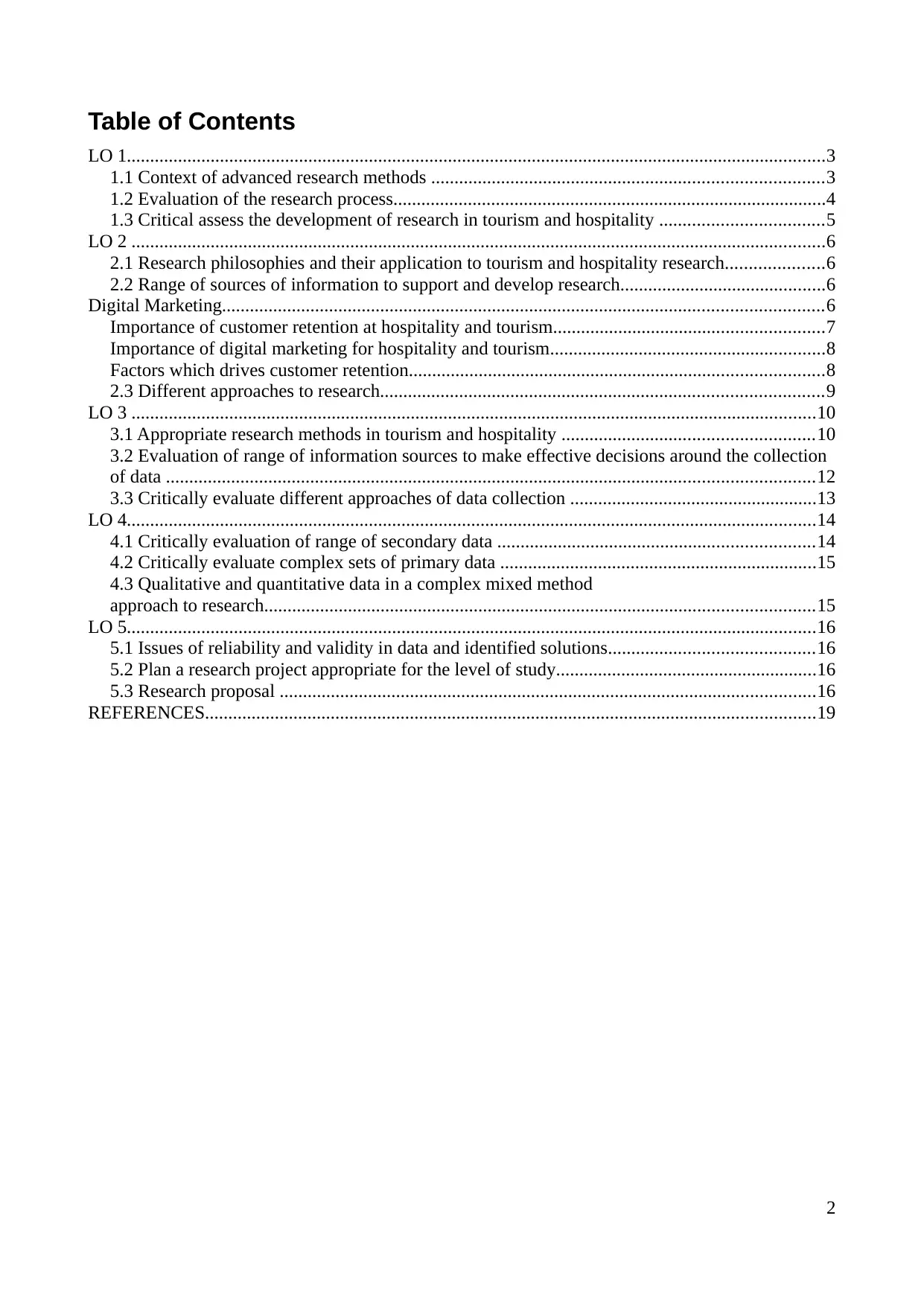
Table of Contents
LO 1......................................................................................................................................................3
1.1 Context of advanced research methods ....................................................................................3
1.2 Evaluation of the research process.............................................................................................4
1.3 Critical assess the development of research in tourism and hospitality ...................................5
LO 2 .....................................................................................................................................................6
2.1 Research philosophies and their application to tourism and hospitality research.....................6
2.2 Range of sources of information to support and develop research............................................6
Digital Marketing.................................................................................................................................6
Importance of customer retention at hospitality and tourism..........................................................7
Importance of digital marketing for hospitality and tourism...........................................................8
Factors which drives customer retention.........................................................................................8
2.3 Different approaches to research...............................................................................................9
LO 3 ...................................................................................................................................................10
3.1 Appropriate research methods in tourism and hospitality ......................................................10
3.2 Evaluation of range of information sources to make effective decisions around the collection
of data ...........................................................................................................................................12
3.3 Critically evaluate different approaches of data collection .....................................................13
LO 4....................................................................................................................................................14
4.1 Critically evaluation of range of secondary data ....................................................................14
4.2 Critically evaluate complex sets of primary data ....................................................................15
4.3 Qualitative and quantitative data in a complex mixed method
approach to research......................................................................................................................15
LO 5....................................................................................................................................................16
5.1 Issues of reliability and validity in data and identified solutions............................................16
5.2 Plan a research project appropriate for the level of study........................................................16
5.3 Research proposal ...................................................................................................................16
REFERENCES...................................................................................................................................19
2
LO 1......................................................................................................................................................3
1.1 Context of advanced research methods ....................................................................................3
1.2 Evaluation of the research process.............................................................................................4
1.3 Critical assess the development of research in tourism and hospitality ...................................5
LO 2 .....................................................................................................................................................6
2.1 Research philosophies and their application to tourism and hospitality research.....................6
2.2 Range of sources of information to support and develop research............................................6
Digital Marketing.................................................................................................................................6
Importance of customer retention at hospitality and tourism..........................................................7
Importance of digital marketing for hospitality and tourism...........................................................8
Factors which drives customer retention.........................................................................................8
2.3 Different approaches to research...............................................................................................9
LO 3 ...................................................................................................................................................10
3.1 Appropriate research methods in tourism and hospitality ......................................................10
3.2 Evaluation of range of information sources to make effective decisions around the collection
of data ...........................................................................................................................................12
3.3 Critically evaluate different approaches of data collection .....................................................13
LO 4....................................................................................................................................................14
4.1 Critically evaluation of range of secondary data ....................................................................14
4.2 Critically evaluate complex sets of primary data ....................................................................15
4.3 Qualitative and quantitative data in a complex mixed method
approach to research......................................................................................................................15
LO 5....................................................................................................................................................16
5.1 Issues of reliability and validity in data and identified solutions............................................16
5.2 Plan a research project appropriate for the level of study........................................................16
5.3 Research proposal ...................................................................................................................16
REFERENCES...................................................................................................................................19
2
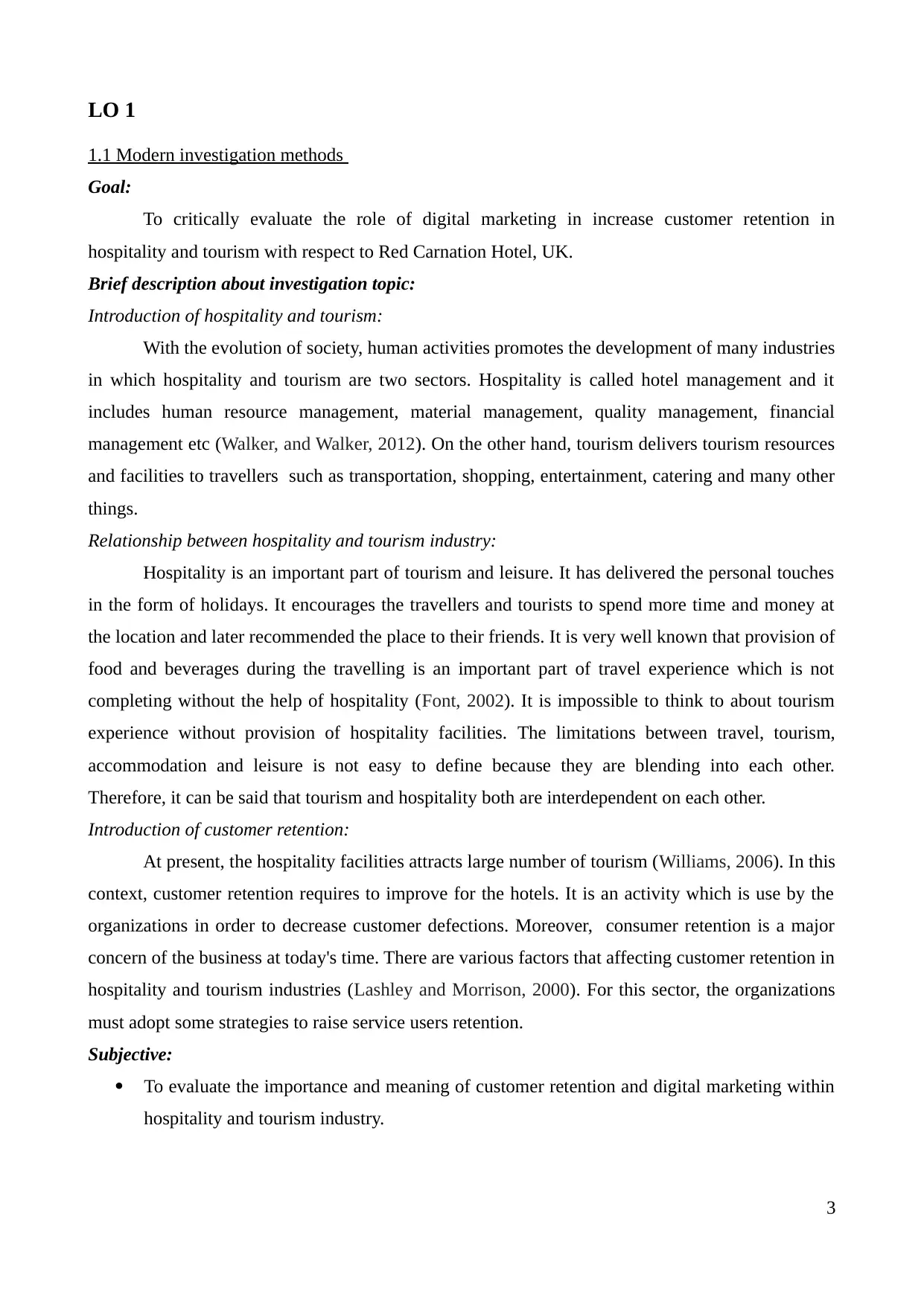
LO 1
1.1 Modern investigation methods
Goal:
To critically evaluate the role of digital marketing in increase customer retention in
hospitality and tourism with respect to Red Carnation Hotel, UK.
Brief description about investigation topic:
Introduction of hospitality and tourism:
With the evolution of society, human activities promotes the development of many industries
in which hospitality and tourism are two sectors. Hospitality is called hotel management and it
includes human resource management, material management, quality management, financial
management etc (Walker, and Walker, 2012). On the other hand, tourism delivers tourism resources
and facilities to travellers such as transportation, shopping, entertainment, catering and many other
things.
Relationship between hospitality and tourism industry:
Hospitality is an important part of tourism and leisure. It has delivered the personal touches
in the form of holidays. It encourages the travellers and tourists to spend more time and money at
the location and later recommended the place to their friends. It is very well known that provision of
food and beverages during the travelling is an important part of travel experience which is not
completing without the help of hospitality (Font, 2002). It is impossible to think to about tourism
experience without provision of hospitality facilities. The limitations between travel, tourism,
accommodation and leisure is not easy to define because they are blending into each other.
Therefore, it can be said that tourism and hospitality both are interdependent on each other.
Introduction of customer retention:
At present, the hospitality facilities attracts large number of tourism (Williams, 2006). In this
context, customer retention requires to improve for the hotels. It is an activity which is use by the
organizations in order to decrease customer defections. Moreover, consumer retention is a major
concern of the business at today's time. There are various factors that affecting customer retention in
hospitality and tourism industries (Lashley and Morrison, 2000). For this sector, the organizations
must adopt some strategies to raise service users retention.
Subjective:
To evaluate the importance and meaning of customer retention and digital marketing within
hospitality and tourism industry.
3
1.1 Modern investigation methods
Goal:
To critically evaluate the role of digital marketing in increase customer retention in
hospitality and tourism with respect to Red Carnation Hotel, UK.
Brief description about investigation topic:
Introduction of hospitality and tourism:
With the evolution of society, human activities promotes the development of many industries
in which hospitality and tourism are two sectors. Hospitality is called hotel management and it
includes human resource management, material management, quality management, financial
management etc (Walker, and Walker, 2012). On the other hand, tourism delivers tourism resources
and facilities to travellers such as transportation, shopping, entertainment, catering and many other
things.
Relationship between hospitality and tourism industry:
Hospitality is an important part of tourism and leisure. It has delivered the personal touches
in the form of holidays. It encourages the travellers and tourists to spend more time and money at
the location and later recommended the place to their friends. It is very well known that provision of
food and beverages during the travelling is an important part of travel experience which is not
completing without the help of hospitality (Font, 2002). It is impossible to think to about tourism
experience without provision of hospitality facilities. The limitations between travel, tourism,
accommodation and leisure is not easy to define because they are blending into each other.
Therefore, it can be said that tourism and hospitality both are interdependent on each other.
Introduction of customer retention:
At present, the hospitality facilities attracts large number of tourism (Williams, 2006). In this
context, customer retention requires to improve for the hotels. It is an activity which is use by the
organizations in order to decrease customer defections. Moreover, consumer retention is a major
concern of the business at today's time. There are various factors that affecting customer retention in
hospitality and tourism industries (Lashley and Morrison, 2000). For this sector, the organizations
must adopt some strategies to raise service users retention.
Subjective:
To evaluate the importance and meaning of customer retention and digital marketing within
hospitality and tourism industry.
3
⊘ This is a preview!⊘
Do you want full access?
Subscribe today to unlock all pages.

Trusted by 1+ million students worldwide
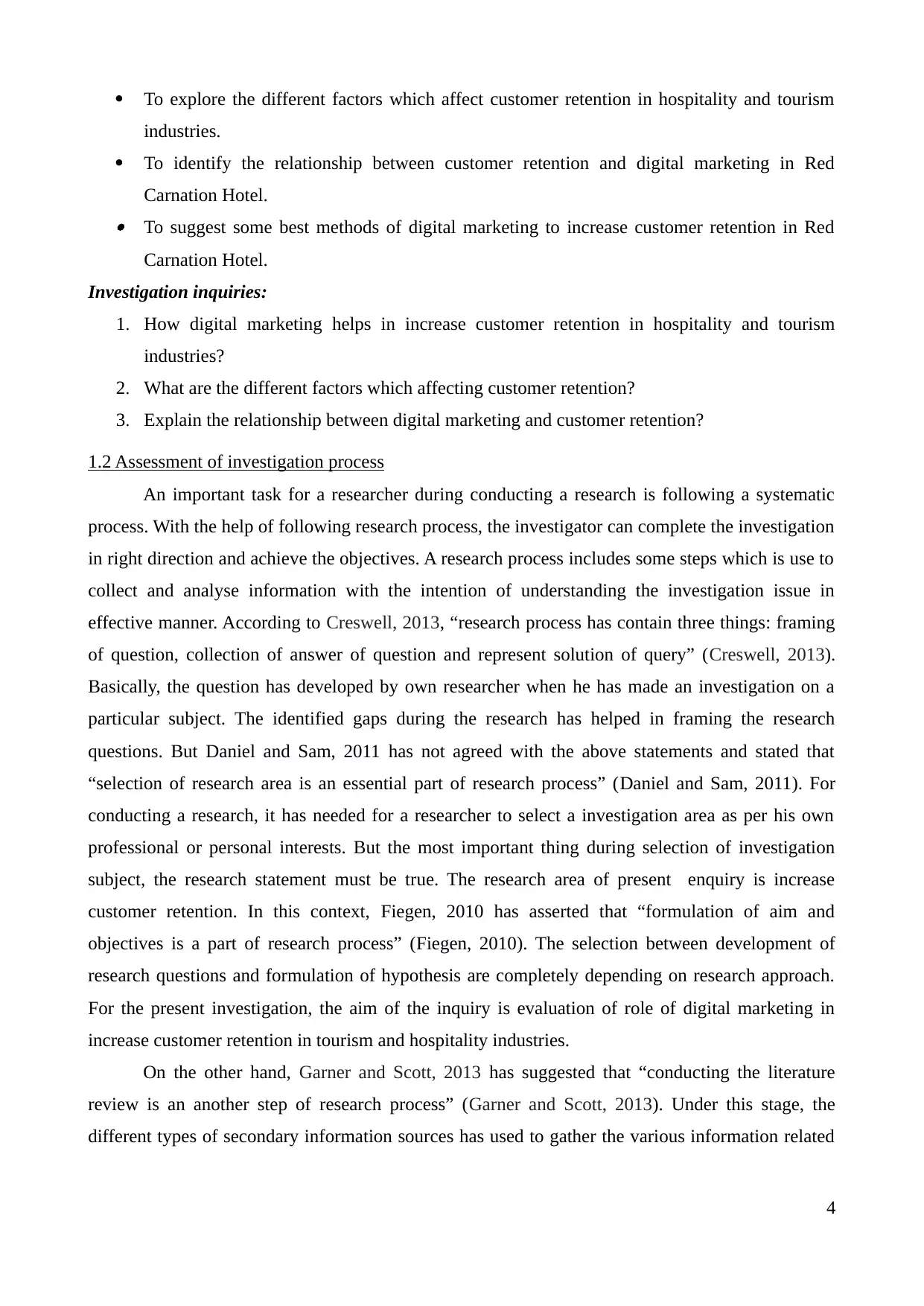
To explore the different factors which affect customer retention in hospitality and tourism
industries.
To identify the relationship between customer retention and digital marketing in Red
Carnation Hotel. To suggest some best methods of digital marketing to increase customer retention in Red
Carnation Hotel.
Investigation inquiries:
1. How digital marketing helps in increase customer retention in hospitality and tourism
industries?
2. What are the different factors which affecting customer retention?
3. Explain the relationship between digital marketing and customer retention?
1.2 Assessment of investigation process
An important task for a researcher during conducting a research is following a systematic
process. With the help of following research process, the investigator can complete the investigation
in right direction and achieve the objectives. A research process includes some steps which is use to
collect and analyse information with the intention of understanding the investigation issue in
effective manner. According to Creswell, 2013, “research process has contain three things: framing
of question, collection of answer of question and represent solution of query” (Creswell, 2013).
Basically, the question has developed by own researcher when he has made an investigation on a
particular subject. The identified gaps during the research has helped in framing the research
questions. But Daniel and Sam, 2011 has not agreed with the above statements and stated that
“selection of research area is an essential part of research process” (Daniel and Sam, 2011). For
conducting a research, it has needed for a researcher to select a investigation area as per his own
professional or personal interests. But the most important thing during selection of investigation
subject, the research statement must be true. The research area of present enquiry is increase
customer retention. In this context, Fiegen, 2010 has asserted that “formulation of aim and
objectives is a part of research process” (Fiegen, 2010). The selection between development of
research questions and formulation of hypothesis are completely depending on research approach.
For the present investigation, the aim of the inquiry is evaluation of role of digital marketing in
increase customer retention in tourism and hospitality industries.
On the other hand, Garner and Scott, 2013 has suggested that “conducting the literature
review is an another step of research process” (Garner and Scott, 2013). Under this stage, the
different types of secondary information sources has used to gather the various information related
4
industries.
To identify the relationship between customer retention and digital marketing in Red
Carnation Hotel. To suggest some best methods of digital marketing to increase customer retention in Red
Carnation Hotel.
Investigation inquiries:
1. How digital marketing helps in increase customer retention in hospitality and tourism
industries?
2. What are the different factors which affecting customer retention?
3. Explain the relationship between digital marketing and customer retention?
1.2 Assessment of investigation process
An important task for a researcher during conducting a research is following a systematic
process. With the help of following research process, the investigator can complete the investigation
in right direction and achieve the objectives. A research process includes some steps which is use to
collect and analyse information with the intention of understanding the investigation issue in
effective manner. According to Creswell, 2013, “research process has contain three things: framing
of question, collection of answer of question and represent solution of query” (Creswell, 2013).
Basically, the question has developed by own researcher when he has made an investigation on a
particular subject. The identified gaps during the research has helped in framing the research
questions. But Daniel and Sam, 2011 has not agreed with the above statements and stated that
“selection of research area is an essential part of research process” (Daniel and Sam, 2011). For
conducting a research, it has needed for a researcher to select a investigation area as per his own
professional or personal interests. But the most important thing during selection of investigation
subject, the research statement must be true. The research area of present enquiry is increase
customer retention. In this context, Fiegen, 2010 has asserted that “formulation of aim and
objectives is a part of research process” (Fiegen, 2010). The selection between development of
research questions and formulation of hypothesis are completely depending on research approach.
For the present investigation, the aim of the inquiry is evaluation of role of digital marketing in
increase customer retention in tourism and hospitality industries.
On the other hand, Garner and Scott, 2013 has suggested that “conducting the literature
review is an another step of research process” (Garner and Scott, 2013). Under this stage, the
different types of secondary information sources has used to gather the various information related
4
Paraphrase This Document
Need a fresh take? Get an instant paraphrase of this document with our AI Paraphraser
to the investigation topic. In the context of the present research, the researcher has selected wide
range of secondary sources of information such as newspapers, online books, articles, previous
researches, magazines etc. As per the research of Goddard and Melville, 2004, it has found that
“selection of data collection method is having the similar importance as a literature review”
(Goddard and Melville, 2004). The choice of data collection methods has based on subject of the
investigation and pros and cons of other alternative data collection techniques. For the current
research, the researcher has selected both primary and secondary data collection methods because it
will help in gathering those information which will similar to investigation subject. In this context,
Kumar, 2014 has sated that “the methods of primary data collection method has required in
research process” (Kumar, 2014). The choice of technique of primary data collection has based on
aim and objectives of the investigation. The tool used by the researcher for present study has
questionnaire. The structure of questionnaire has formal and systematic which assist in achieve the
objectives of the investigation in appropriate manner. Similarly, McMillan and Schumacher, 2014
has stated that “data analysis is also a part of research process which play an important role in
meeting the aim and objectives of the research” (McMillan and Schumacher, 2014). Selection of
data analysis method has depended on the gather information and technique used for data
collection. Therefore, from the above discussion and studied of various authors or investigators, it
has found that all the steps of research process has equally important for conducting the study
related to evaluate the role of digital marketing in increase customer retention in hospitality and
tourism industries.
1.3 Critical assessment of evolution of investigation in tourism and hospitality
At present time, most of the people are now taking interest in various leisure activities. It
promotes both hospitality and tourism industries and these are now become a fastest growing
sectors in the world. It is needed for tourism and hospitality organizations to not only attract the
new customers or just meet their satisfaction level but also retain them for long time (Barrows and
Powers, 2008). In this concern, all types of hypothesis related to increase customers retention has
applied. For hospitality organizations, it has impossible to match all the expectations of the service
users all the time. This is the reason of decrease number or interest of consumers in a particular
hotel (Ottenbacher and Gnoth, 2005). Further, it is needed to carrying out the investigation to
determine various techniques of digital marketing with the intention of increase service users
retention.
On the other hand, the following research has also consist practical significance. At present,
most of the hospitality organizations are starting focusing on attracting the new customers by
5
range of secondary sources of information such as newspapers, online books, articles, previous
researches, magazines etc. As per the research of Goddard and Melville, 2004, it has found that
“selection of data collection method is having the similar importance as a literature review”
(Goddard and Melville, 2004). The choice of data collection methods has based on subject of the
investigation and pros and cons of other alternative data collection techniques. For the current
research, the researcher has selected both primary and secondary data collection methods because it
will help in gathering those information which will similar to investigation subject. In this context,
Kumar, 2014 has sated that “the methods of primary data collection method has required in
research process” (Kumar, 2014). The choice of technique of primary data collection has based on
aim and objectives of the investigation. The tool used by the researcher for present study has
questionnaire. The structure of questionnaire has formal and systematic which assist in achieve the
objectives of the investigation in appropriate manner. Similarly, McMillan and Schumacher, 2014
has stated that “data analysis is also a part of research process which play an important role in
meeting the aim and objectives of the research” (McMillan and Schumacher, 2014). Selection of
data analysis method has depended on the gather information and technique used for data
collection. Therefore, from the above discussion and studied of various authors or investigators, it
has found that all the steps of research process has equally important for conducting the study
related to evaluate the role of digital marketing in increase customer retention in hospitality and
tourism industries.
1.3 Critical assessment of evolution of investigation in tourism and hospitality
At present time, most of the people are now taking interest in various leisure activities. It
promotes both hospitality and tourism industries and these are now become a fastest growing
sectors in the world. It is needed for tourism and hospitality organizations to not only attract the
new customers or just meet their satisfaction level but also retain them for long time (Barrows and
Powers, 2008). In this concern, all types of hypothesis related to increase customers retention has
applied. For hospitality organizations, it has impossible to match all the expectations of the service
users all the time. This is the reason of decrease number or interest of consumers in a particular
hotel (Ottenbacher and Gnoth, 2005). Further, it is needed to carrying out the investigation to
determine various techniques of digital marketing with the intention of increase service users
retention.
On the other hand, the following research has also consist practical significance. At present,
most of the hospitality organizations are starting focusing on attracting the new customers by
5
offering wide range of services such as accommodation, food and beverages etc (Mehmetoglu,
2004). To retain them and getting their attention, firms are using different techniques of digital
marketing. Hence, the aim of following research is evaluate the role of digital marketing in increase
customers retention in hospitality and tourism industry.
LO 2
2.1 Research philosophies and their application to tourism and hospitality research
According to Sobh and Perry, 2006., “research philosophy is a method which help in
defining the steps of data collection and its analysis” (Sobh and Perry, 2006). It reflects the
important presumes which have been already taken by the researcher for the investigation.
Generally, research philosophy is based on the sets of various assumptions, concepts and values. In
a simple words, it can be said that it has define the thinking and knowledge of the scholar related to
the research subject. There are two types of research philosophies: interpretivism and positivism.
Bordens and Abbott, 2002 has stated that “positivism research philosophy is a structured
methodology that generalized and quantified the observations as well as evaluate outcomes with the
use of statistical methods” (Bordens and Abbott, 2002). Under this method, the researcher can
gather all information such as facts and figures which are related to the investigation issue.
But Cochran, 2007 has asserted in the contrast of the above statement that “the investigator
plays a role of objective analyst to assess the data collection and generate an appropriate outcomes
with the purpose of achieve the aims and objectives of the investigation” (Cochran, 2007).
Positivism research philosophy relates the opinions or viewpoints of the researcher which he wants
to focused during the investigation. On the other hand, from the research of Candè and Wakin,
2008, it has found that “interpretivism research philosophy has used subjective concept to address
the research in the right direction” (Candè and Wakin, 2008). It has played an essential role in order
to generate final outcomes from the collected information. At the time of using interpretivism
research philosophy, the investigator has considered various factors such as living standards,
culture, group or individual belief etc.
The present research is related to evaluate the role of digital marketing in increase customer
retention in hospitality and tourism. For this, the researcher has been selected positivism research
philosophy (Särndal, Swensson and Wretman, 2003). The reason behind selecting the following
research philosophy by the scholar is to determine the relationship between the digital marketing
and customer retention in hospitality and tourism industry with the respect of Red Carnation Hotel.
Another reason of using positivism research philosophy is for analysing the collected data,
quantitative research type has used (Csikszentmihalyi and Larson, 2014). With the help of this, the
6
2004). To retain them and getting their attention, firms are using different techniques of digital
marketing. Hence, the aim of following research is evaluate the role of digital marketing in increase
customers retention in hospitality and tourism industry.
LO 2
2.1 Research philosophies and their application to tourism and hospitality research
According to Sobh and Perry, 2006., “research philosophy is a method which help in
defining the steps of data collection and its analysis” (Sobh and Perry, 2006). It reflects the
important presumes which have been already taken by the researcher for the investigation.
Generally, research philosophy is based on the sets of various assumptions, concepts and values. In
a simple words, it can be said that it has define the thinking and knowledge of the scholar related to
the research subject. There are two types of research philosophies: interpretivism and positivism.
Bordens and Abbott, 2002 has stated that “positivism research philosophy is a structured
methodology that generalized and quantified the observations as well as evaluate outcomes with the
use of statistical methods” (Bordens and Abbott, 2002). Under this method, the researcher can
gather all information such as facts and figures which are related to the investigation issue.
But Cochran, 2007 has asserted in the contrast of the above statement that “the investigator
plays a role of objective analyst to assess the data collection and generate an appropriate outcomes
with the purpose of achieve the aims and objectives of the investigation” (Cochran, 2007).
Positivism research philosophy relates the opinions or viewpoints of the researcher which he wants
to focused during the investigation. On the other hand, from the research of Candè and Wakin,
2008, it has found that “interpretivism research philosophy has used subjective concept to address
the research in the right direction” (Candè and Wakin, 2008). It has played an essential role in order
to generate final outcomes from the collected information. At the time of using interpretivism
research philosophy, the investigator has considered various factors such as living standards,
culture, group or individual belief etc.
The present research is related to evaluate the role of digital marketing in increase customer
retention in hospitality and tourism. For this, the researcher has been selected positivism research
philosophy (Särndal, Swensson and Wretman, 2003). The reason behind selecting the following
research philosophy by the scholar is to determine the relationship between the digital marketing
and customer retention in hospitality and tourism industry with the respect of Red Carnation Hotel.
Another reason of using positivism research philosophy is for analysing the collected data,
quantitative research type has used (Csikszentmihalyi and Larson, 2014). With the help of this, the
6
⊘ This is a preview!⊘
Do you want full access?
Subscribe today to unlock all pages.
Trusted by 1+ million students worldwide
researcher has able to get objective information and meet the objectives of the investigation.
2.2 Literature Review
Digital Marketing
According to Chaffey, Smith and Smith, 2012 “digital marketing can be defined as a promotional
tool in which promotion is done through electronic media” (Chaffey, Smith and Smith, 2012). On
the other hand, Leeflang, Verhoef and Freundt, 2014 stated that “digital marketing is an umbrella
term which is used of targeting, measuring and in performing interactive marketing for goods and
services with the help of digital marketing” (Leeflang, Verhoef and Freundt, 2014). However, it is
the cheapest form of advertisement and one of the best way to convey information. In this context,
there are many social media like Facebook, Twitter, YouTube, etc. through which firm can be post
their advertisement and attract more and more customers (Tiago and Veríssimo, 2014). In addition
to this, there are many activities involved in digital marketing which are very helpful in e-commerce
marketing, content automation, etc. (Stone and Woodcock, 2014). Further, it is a wide topic which is
growing rapidly and helping customers and businesses to perform their operations effectively. It
does not have a vast history but do have strong influence over all users. As per Royle and Laing,
2014 “business develop digital marketing strategy in which they decide on the steps which will be
taken on order to promote their product or services” (Royle and Laing, 2014). Digital marketing is
used at all industries and has proved to be effective.
Importance of customer retention at hospitality and tourism
Järvinen and Karjaluoto, 2015 has stated that “Customer retention is an activity which is
conducted by the organisations for preventing customer defection for sustainable growth” (Järvinen
and Karjaluoto, 2015). Similarly, Khan and Siddiqui, 2013 has said that “It is a process ” (Khan and
Siddiqui, 2013). All the organization aim at gaining maximum profit and it is only possible when
firms focus on attracting more and more customers. In this context, it is very essential for the
organizations to understand the needs and wants of customers and in develop products or services
which would be helpful in satisfying customers (Taiminen and Karjaluoto, 2015). There are many
organizations which provides similar products and it is very essential for the firms to develop
strategies with the help of which they would be able to attract customers. In this context, firms
develop different strategies through which they achieve their desired goals and objectives.
According to Andreani, Rokka and Conchon, 2014 “retention of customer is better than attracting
new one” (Andreani, Rokka and Conchon, 2014). However, Levy and Gvili, 2015 stated that “firm
should put on their efforts to attract both new or old once” (Levy and Gvili, 2015). As per
JÄRVINEN, Tollinen and JAYAWARDHENA, 2012 “regular customers already know the services
7
2.2 Literature Review
Digital Marketing
According to Chaffey, Smith and Smith, 2012 “digital marketing can be defined as a promotional
tool in which promotion is done through electronic media” (Chaffey, Smith and Smith, 2012). On
the other hand, Leeflang, Verhoef and Freundt, 2014 stated that “digital marketing is an umbrella
term which is used of targeting, measuring and in performing interactive marketing for goods and
services with the help of digital marketing” (Leeflang, Verhoef and Freundt, 2014). However, it is
the cheapest form of advertisement and one of the best way to convey information. In this context,
there are many social media like Facebook, Twitter, YouTube, etc. through which firm can be post
their advertisement and attract more and more customers (Tiago and Veríssimo, 2014). In addition
to this, there are many activities involved in digital marketing which are very helpful in e-commerce
marketing, content automation, etc. (Stone and Woodcock, 2014). Further, it is a wide topic which is
growing rapidly and helping customers and businesses to perform their operations effectively. It
does not have a vast history but do have strong influence over all users. As per Royle and Laing,
2014 “business develop digital marketing strategy in which they decide on the steps which will be
taken on order to promote their product or services” (Royle and Laing, 2014). Digital marketing is
used at all industries and has proved to be effective.
Importance of customer retention at hospitality and tourism
Järvinen and Karjaluoto, 2015 has stated that “Customer retention is an activity which is
conducted by the organisations for preventing customer defection for sustainable growth” (Järvinen
and Karjaluoto, 2015). Similarly, Khan and Siddiqui, 2013 has said that “It is a process ” (Khan and
Siddiqui, 2013). All the organization aim at gaining maximum profit and it is only possible when
firms focus on attracting more and more customers. In this context, it is very essential for the
organizations to understand the needs and wants of customers and in develop products or services
which would be helpful in satisfying customers (Taiminen and Karjaluoto, 2015). There are many
organizations which provides similar products and it is very essential for the firms to develop
strategies with the help of which they would be able to attract customers. In this context, firms
develop different strategies through which they achieve their desired goals and objectives.
According to Andreani, Rokka and Conchon, 2014 “retention of customer is better than attracting
new one” (Andreani, Rokka and Conchon, 2014). However, Levy and Gvili, 2015 stated that “firm
should put on their efforts to attract both new or old once” (Levy and Gvili, 2015). As per
JÄRVINEN, Tollinen and JAYAWARDHENA, 2012 “regular customers already know the services
7
Paraphrase This Document
Need a fresh take? Get an instant paraphrase of this document with our AI Paraphraser
provided by a particular organization” (JÄRVINEN, Tollinen and JAYAWARDHENA, 2012).
However, there when the needs and wants of their regular customers are identified, then they will be
able to retain their customers. According to Yasmin, Tasneem and Fatema, 2015 stated that “use of
technology plays vital role in retaining customers as with the use of technology firm will be able to
understand their customers more clearly and will be able to provide fulfil their needs and wants
effectively” (Yasmin, Tasneem and Fatema, 2015). On the other hand, even in tourism there is high
competition and it is very essential for the firm to retain customers so as to compete effectively.
Importance of digital marketing for hospitality and tourism
As per Oliveira, Santos and Sousa, 2014 “it is very important for the management to use
digital marketing” (Oliveira, Santos and Sousa, 2014). Gershon, Robinson and Wilder, Zencolor
Corporation, 2013 stated that “use of internet has rapidly increasing and firms should focus on using
it effectively” (Gershon, Robinson and Wilder, Zencolor Corporation, 2013). There are many
hospitality and tourism firms which provide their customers with online services like booking
tickets, cancellation, different destination, etc. According to Chaffey, Smith and Smith, 2012
“mostly all the services which the customers expects can easily be booked through internet”
(Chaffey, Smith and Smith, 2012). However, Leeflang, Verhoef and Freundt, 2014 stated that “for
travel agency, when they plan any kind of tour package they have to look after all the other services
which are related to it like food, accommodation, travel, etc.” (Leeflang, Verhoef and Freundt,
2014). In this context, organizations have provided their services users with the facility to choose
their preferred services. Through internet customers can get all the information regarding the
services which will be provided to them (Tiago and Veríssimo, 2014). Moreover, they can also get
know the experience of the customers who used these type of services. As it was discussed above, it
is the cheapest tool through which organizations can provide information regarding their services
products easily. According to Stone and Woodcock, 2014 “customers may be having many doubts
regrading the services which would be provided to them it can be easily solved with the help of
internet” (Stone and Woodcock, 2014).
Factors which drives customer retention
According to Royle and Laing, 2014 “customer retention is the key driver for long term
profit and growth is through marketing” (Royle and Laing, 2014). However, there are firms which
focus on attracting new customers rather than retaining. There are many things which has to be kept
in mind so as to retain customers (Järvinen and Karjaluoto, 2015). Following are few of the things
which can be followed by organization in retaining service users:
Reducing attraction: As per Khan and Siddiqui, 2013 “it is very important of the firm to know the
8
However, there when the needs and wants of their regular customers are identified, then they will be
able to retain their customers. According to Yasmin, Tasneem and Fatema, 2015 stated that “use of
technology plays vital role in retaining customers as with the use of technology firm will be able to
understand their customers more clearly and will be able to provide fulfil their needs and wants
effectively” (Yasmin, Tasneem and Fatema, 2015). On the other hand, even in tourism there is high
competition and it is very essential for the firm to retain customers so as to compete effectively.
Importance of digital marketing for hospitality and tourism
As per Oliveira, Santos and Sousa, 2014 “it is very important for the management to use
digital marketing” (Oliveira, Santos and Sousa, 2014). Gershon, Robinson and Wilder, Zencolor
Corporation, 2013 stated that “use of internet has rapidly increasing and firms should focus on using
it effectively” (Gershon, Robinson and Wilder, Zencolor Corporation, 2013). There are many
hospitality and tourism firms which provide their customers with online services like booking
tickets, cancellation, different destination, etc. According to Chaffey, Smith and Smith, 2012
“mostly all the services which the customers expects can easily be booked through internet”
(Chaffey, Smith and Smith, 2012). However, Leeflang, Verhoef and Freundt, 2014 stated that “for
travel agency, when they plan any kind of tour package they have to look after all the other services
which are related to it like food, accommodation, travel, etc.” (Leeflang, Verhoef and Freundt,
2014). In this context, organizations have provided their services users with the facility to choose
their preferred services. Through internet customers can get all the information regarding the
services which will be provided to them (Tiago and Veríssimo, 2014). Moreover, they can also get
know the experience of the customers who used these type of services. As it was discussed above, it
is the cheapest tool through which organizations can provide information regarding their services
products easily. According to Stone and Woodcock, 2014 “customers may be having many doubts
regrading the services which would be provided to them it can be easily solved with the help of
internet” (Stone and Woodcock, 2014).
Factors which drives customer retention
According to Royle and Laing, 2014 “customer retention is the key driver for long term
profit and growth is through marketing” (Royle and Laing, 2014). However, there are firms which
focus on attracting new customers rather than retaining. There are many things which has to be kept
in mind so as to retain customers (Järvinen and Karjaluoto, 2015). Following are few of the things
which can be followed by organization in retaining service users:
Reducing attraction: As per Khan and Siddiqui, 2013 “it is very important of the firm to know the
8
areas in which customers dislike the product or services” (Khan and Siddiqui, 2013). The only
reason because of which customers bend towards other services would be because of additional or
better services provided to customers. Taiminen and Karjaluoto, 2015 stated that “when customers
are provided with the services which they expect, then they could be retained easily” (Taiminen and
Karjaluoto, 2015).
Additional services: According to Andreani, Rokka and Conchon, 2014 “customers should be
treated like kings of queens. However, when customers are provided with additional services, then
customers could be retained or regular customers could be changed to loyal” (Andreani, Rokka and
Conchon, 2014).
Getting customers feedback: Levy and Gvili, 2015 stated that “collecting feedback will help in
know the areas in which they lack or the areas which customers do not prefer” (Levy and Gvili,
2015). However, Yasmin, Tasneem and Fatema, 2015 stated that “improvements could be make on
their products or services” (Yasmin, Tasneem and Fatema, 2015). As customers use the product so
they know the drawbacks and expectation for the product.
2.3 Various approaches to investigation
Research approach is a method of developing a new hypothesis by clearly understand the
research problems (Research approach. 2015). The selection of appropriate approach affects the
final outcomes of the investigation. Deductive or inductive are two types of research approach. As
per the research of Creswell, 2013 “deductive method has utilized to tests the validity of the
assumptions which has been taken the researcher before conducting the investigation” (Creswell,
2013). It has defined the relationship between various variables which has required to explained
during the study by the investigator. In addition to this, Blackstone, 2016 has stated that
“quantitative research types has used to collect the information” (Blackstone, 2016). There are not
set rules and process for gathering the information. On the other hand, Daniel and Sam, 2011 has
asserted that “with the help of inductive research approach, the scholar can generate a new
hypothesis or theory from the gather information” (Daniel and Sam, 2011). Under this method, the
research has moved from specific discussion to the general discussion. Along with this, the research
questions usually use by the researcher to carry out the investigation. According to Fiegen, 2010,
“inductive research approach is having the flexible research structure which help in implement the
new changes during the study” (Fiegen, 2010). The findings of the investigation can not be
generalized and for this, the researcher has required to understand the research problem in deep
manner. There is not any kind of theories apply in inductive research approach and start the study
with detailed observations. As per the view points of Flick, 2011 “inductive approach has based on
9
reason because of which customers bend towards other services would be because of additional or
better services provided to customers. Taiminen and Karjaluoto, 2015 stated that “when customers
are provided with the services which they expect, then they could be retained easily” (Taiminen and
Karjaluoto, 2015).
Additional services: According to Andreani, Rokka and Conchon, 2014 “customers should be
treated like kings of queens. However, when customers are provided with additional services, then
customers could be retained or regular customers could be changed to loyal” (Andreani, Rokka and
Conchon, 2014).
Getting customers feedback: Levy and Gvili, 2015 stated that “collecting feedback will help in
know the areas in which they lack or the areas which customers do not prefer” (Levy and Gvili,
2015). However, Yasmin, Tasneem and Fatema, 2015 stated that “improvements could be make on
their products or services” (Yasmin, Tasneem and Fatema, 2015). As customers use the product so
they know the drawbacks and expectation for the product.
2.3 Various approaches to investigation
Research approach is a method of developing a new hypothesis by clearly understand the
research problems (Research approach. 2015). The selection of appropriate approach affects the
final outcomes of the investigation. Deductive or inductive are two types of research approach. As
per the research of Creswell, 2013 “deductive method has utilized to tests the validity of the
assumptions which has been taken the researcher before conducting the investigation” (Creswell,
2013). It has defined the relationship between various variables which has required to explained
during the study by the investigator. In addition to this, Blackstone, 2016 has stated that
“quantitative research types has used to collect the information” (Blackstone, 2016). There are not
set rules and process for gathering the information. On the other hand, Daniel and Sam, 2011 has
asserted that “with the help of inductive research approach, the scholar can generate a new
hypothesis or theory from the gather information” (Daniel and Sam, 2011). Under this method, the
research has moved from specific discussion to the general discussion. Along with this, the research
questions usually use by the researcher to carry out the investigation. According to Fiegen, 2010,
“inductive research approach is having the flexible research structure which help in implement the
new changes during the study” (Fiegen, 2010). The findings of the investigation can not be
generalized and for this, the researcher has required to understand the research problem in deep
manner. There is not any kind of theories apply in inductive research approach and start the study
with detailed observations. As per the view points of Flick, 2011 “inductive approach has based on
9
⊘ This is a preview!⊘
Do you want full access?
Subscribe today to unlock all pages.
Trusted by 1+ million students worldwide
learning from experience” (Flick, 2011). During applying the following framework, the researcher
looks for outcomes from the collected data.
The following research has based on to evaluate the role of digital marketing in increase
customer retention in hospitality and tourism. For this, the researcher has been selected inductive
research approach because it help in attaining the objectives of the study (Garner and Scott, 2013).
For this, the investigator has been collected data from both primary and secondary sources. After
this, a pattern of gathered information has prepared and analysed. The observation of the data has
helped in developed an appropriate conclusion which assisted in achieve the aim and objectives of
the study. Another reason of adopting inductive approach by the investigator during the research
has began the study with some specific observations and finally develop general conclusion
(Goddard and Melville, 2004). In addition to this, the reason of not using deductive research
approach by the researcher in the current investigation is there have no hypothesis has developed by
the scholar.
LO 3
3.1 Selection of right research methods in tourism and hospitality
To carry out the investigation in exact direction, it has important to select right research
methods. It has considered the essential part of the investigation to reach out the conclusion of the
study (Research Methodology. 2015). The following research has based on to evaluate the role of
digital marketing in increase customer retention in hospitality and tourism sectors. For this, the
different research methods can be used which are as follows.
Research design: According to Kumar, 2014, “research design refers to a strategy which is
selecting by the researcher to integrate the various aspects of the study in logical and rational
manner” (Kumar, 2014). With the help of this, it becomes easy to address the research questions,
collect and analysed the data. There are two types of research designs: descriptive and exploratory
research designs. As per the research of McMillan and Schumacher, 2014, it has been found that
“the aim of descriptive design is observe the research problem and describe in well manner”
(McMillan and Schumacher, 2014). It is a kind of study which is design to collect and evaluate the
data without making nay kind of manipulation. The quantitative research has utilized to assess the
information.
On the other, Sobh and Perry, 2006 has stated in the contrast of the above statement that
“exploratory research designed has conducted for that condition when research problem has bot
been clearly defined for the researcher” (Sobh and Perry, 2006). The aim of the following research
design is explore the study in deep manner. With the help if this, it can easy to explain the causes of
10
looks for outcomes from the collected data.
The following research has based on to evaluate the role of digital marketing in increase
customer retention in hospitality and tourism. For this, the researcher has been selected inductive
research approach because it help in attaining the objectives of the study (Garner and Scott, 2013).
For this, the investigator has been collected data from both primary and secondary sources. After
this, a pattern of gathered information has prepared and analysed. The observation of the data has
helped in developed an appropriate conclusion which assisted in achieve the aim and objectives of
the study. Another reason of adopting inductive approach by the investigator during the research
has began the study with some specific observations and finally develop general conclusion
(Goddard and Melville, 2004). In addition to this, the reason of not using deductive research
approach by the researcher in the current investigation is there have no hypothesis has developed by
the scholar.
LO 3
3.1 Selection of right research methods in tourism and hospitality
To carry out the investigation in exact direction, it has important to select right research
methods. It has considered the essential part of the investigation to reach out the conclusion of the
study (Research Methodology. 2015). The following research has based on to evaluate the role of
digital marketing in increase customer retention in hospitality and tourism sectors. For this, the
different research methods can be used which are as follows.
Research design: According to Kumar, 2014, “research design refers to a strategy which is
selecting by the researcher to integrate the various aspects of the study in logical and rational
manner” (Kumar, 2014). With the help of this, it becomes easy to address the research questions,
collect and analysed the data. There are two types of research designs: descriptive and exploratory
research designs. As per the research of McMillan and Schumacher, 2014, it has been found that
“the aim of descriptive design is observe the research problem and describe in well manner”
(McMillan and Schumacher, 2014). It is a kind of study which is design to collect and evaluate the
data without making nay kind of manipulation. The quantitative research has utilized to assess the
information.
On the other, Sobh and Perry, 2006 has stated in the contrast of the above statement that
“exploratory research designed has conducted for that condition when research problem has bot
been clearly defined for the researcher” (Sobh and Perry, 2006). The aim of the following research
design is explore the study in deep manner. With the help if this, it can easy to explain the causes of
10
Paraphrase This Document
Need a fresh take? Get an instant paraphrase of this document with our AI Paraphraser
research problems and alternative solutions of it. Similarly, Bordens and Abbott, 2002has stated that
“exploratory research design has simply explored the research questions of the study without
including the previous or past researches” (Bordens and Abbott, 2002).
The following research has related to evaluate the role of digital marketing in increase
customer retention in hospitality and tourism. For this, the descriptive research design has been
selected by the researcher because of determined the relationship between digital marketing and
customer retention with the respect of hospitality and tourism business (Choosing appropriate
research methodologies). Under this method, the research interacts with participants who has
involved in survey to gather the required information.
Research type: Quantitative and qualitative are two types of research. According to Wyse, 2011
“qualitative research has delivered a complete and detail description about the research” (Wyse,
2011). It is suitable for gaining a depth understanding for underlying reasons. At the same time, it
has assisted the researcher to developed new ideas and hypothesis for conduct the investigation to
next stage. But Cochran, 2007 has not supported the above stated statement and asserted that “the
purpose of using quantitative research type for the investigation is quantified the gather
information” (Cochran, 2007). The outcomes of the investigation has gained from measurement of
different opinions of the respondents. It has delivered a broad base of insight on research problem
which assist the researcher to recommend some course of actions to solve the issues.
The present research has related to evaluate the role of digital marketing in increase
customer retention in tourism and hospitality. For this, the researcher has been chosen quantitative
and qualitative research types because a systematic and structured questionnaire has prepared for
collect the information in numeric form (Candè and Wakin, 2008). The outcome of the investigation
become more generalized, valid and reliable. The reason of selecting qualitative research type for
the following study is it has focused on subjectivity of the investigation and the responses of the
participants has unstructured.
Sampling: According to Särndal, Swensson and Wretman, 2003, “sampling is technique to select
suitable sample for an experiment from a given size of population” (Särndal, Swensson and
Wretman, 2003). The group of people who are participating in survey are representing the target
population. For the researcher, it is important to select the right and suitable sample size for the
research because of accomplished the aim and objectives of the investigation. In this context,
Csikszentmihalyi and Larson, 2014 has stated that “there are various types of sampling methods
which can be used by the researcher in the research as per his convenience and type of the study”
(Csikszentmihalyi and Larson, 2014). Random, systematic, convenience, quota etc are the basic
form of sampling.
11
“exploratory research design has simply explored the research questions of the study without
including the previous or past researches” (Bordens and Abbott, 2002).
The following research has related to evaluate the role of digital marketing in increase
customer retention in hospitality and tourism. For this, the descriptive research design has been
selected by the researcher because of determined the relationship between digital marketing and
customer retention with the respect of hospitality and tourism business (Choosing appropriate
research methodologies). Under this method, the research interacts with participants who has
involved in survey to gather the required information.
Research type: Quantitative and qualitative are two types of research. According to Wyse, 2011
“qualitative research has delivered a complete and detail description about the research” (Wyse,
2011). It is suitable for gaining a depth understanding for underlying reasons. At the same time, it
has assisted the researcher to developed new ideas and hypothesis for conduct the investigation to
next stage. But Cochran, 2007 has not supported the above stated statement and asserted that “the
purpose of using quantitative research type for the investigation is quantified the gather
information” (Cochran, 2007). The outcomes of the investigation has gained from measurement of
different opinions of the respondents. It has delivered a broad base of insight on research problem
which assist the researcher to recommend some course of actions to solve the issues.
The present research has related to evaluate the role of digital marketing in increase
customer retention in tourism and hospitality. For this, the researcher has been chosen quantitative
and qualitative research types because a systematic and structured questionnaire has prepared for
collect the information in numeric form (Candè and Wakin, 2008). The outcome of the investigation
become more generalized, valid and reliable. The reason of selecting qualitative research type for
the following study is it has focused on subjectivity of the investigation and the responses of the
participants has unstructured.
Sampling: According to Särndal, Swensson and Wretman, 2003, “sampling is technique to select
suitable sample for an experiment from a given size of population” (Särndal, Swensson and
Wretman, 2003). The group of people who are participating in survey are representing the target
population. For the researcher, it is important to select the right and suitable sample size for the
research because of accomplished the aim and objectives of the investigation. In this context,
Csikszentmihalyi and Larson, 2014 has stated that “there are various types of sampling methods
which can be used by the researcher in the research as per his convenience and type of the study”
(Csikszentmihalyi and Larson, 2014). Random, systematic, convenience, quota etc are the basic
form of sampling.
11
To address the research to evaluate the role of digital marketing to increase customers
retention in tourism and hospitality, the scholar has been selected random sampling. The reason
behind selecting the following framework is it works on probability approach. The sample
population for conducting the research is management team of Red Carnation Hotel of UK
(Creswell, 2013). The sample size of the respondents has 20. During taking samples, the different
aspects of participants have considered by the investigator such as gender, age, profession etc.
3.2 Evaluation of range of information sources for collection of data
The researcher can take help of different information sources to collect the data. In this
context, there are two sources of information: primary and secondary. The selection of appropriate
source of information saves the time of the researcher and helps in get relevant information ( Daniel
and Sam, 2011). The evaluation of wide range of information sources to make effective decision
around the data collection are as follows.
Primary sources of information
Questionnaire: The purpose of this method is getting lot of information from the respondents easily
and quickly in a non threatening way. It is easy to compare and analyse the responses and opinions
of the respondents (Fiegen, 2010).
Interviews: It is applying in that condition when the researcher wants to completely understand
respondents experiences or gain more information on a particular topic. It has provided the
flexibility to the researcher to conclude the outcome of the investigation in different format.
Observation: For gathering the right information about research problem, the observation method
can be used. Here, the researcher has observed the things without making any kind of discussion
with the respondents (Flick, 2011).
Focus groups: With the help of the following primary source of information, the researcher can
explore the research subject in depth via group discussion such as understand the reactions,
experience etc.
Secondary source of information
There are various types of secondary sources of information which help in getting the
appropriate information about the particular research problem. Books is one of the secondary source
of information which deliver the complete overview of research topic to the investigator (Garner
and Scott, 2013). Basically, the included information in the books are well researches and enclosed
various references of other sources. On the other hand, journal is another secondary source of
information which is collection of different articles related to particular subject. With the help of
this, the scholar can easily get the latest information on specific research topic. It is considering the
12
retention in tourism and hospitality, the scholar has been selected random sampling. The reason
behind selecting the following framework is it works on probability approach. The sample
population for conducting the research is management team of Red Carnation Hotel of UK
(Creswell, 2013). The sample size of the respondents has 20. During taking samples, the different
aspects of participants have considered by the investigator such as gender, age, profession etc.
3.2 Evaluation of range of information sources for collection of data
The researcher can take help of different information sources to collect the data. In this
context, there are two sources of information: primary and secondary. The selection of appropriate
source of information saves the time of the researcher and helps in get relevant information ( Daniel
and Sam, 2011). The evaluation of wide range of information sources to make effective decision
around the data collection are as follows.
Primary sources of information
Questionnaire: The purpose of this method is getting lot of information from the respondents easily
and quickly in a non threatening way. It is easy to compare and analyse the responses and opinions
of the respondents (Fiegen, 2010).
Interviews: It is applying in that condition when the researcher wants to completely understand
respondents experiences or gain more information on a particular topic. It has provided the
flexibility to the researcher to conclude the outcome of the investigation in different format.
Observation: For gathering the right information about research problem, the observation method
can be used. Here, the researcher has observed the things without making any kind of discussion
with the respondents (Flick, 2011).
Focus groups: With the help of the following primary source of information, the researcher can
explore the research subject in depth via group discussion such as understand the reactions,
experience etc.
Secondary source of information
There are various types of secondary sources of information which help in getting the
appropriate information about the particular research problem. Books is one of the secondary source
of information which deliver the complete overview of research topic to the investigator (Garner
and Scott, 2013). Basically, the included information in the books are well researches and enclosed
various references of other sources. On the other hand, journal is another secondary source of
information which is collection of different articles related to particular subject. With the help of
this, the scholar can easily get the latest information on specific research topic. It is considering the
12
⊘ This is a preview!⊘
Do you want full access?
Subscribe today to unlock all pages.
Trusted by 1+ million students worldwide

1 out of 22


Related Documents


Your All-in-One AI-Powered Toolkit for Academic Success.
+13062052269
info@desklib.com
Available 24*7 on WhatsApp / Email
![[object Object]](/_next/static/media/star-bottom.7253800d.svg)
Unlock your academic potential
Copyright © 2020–2026 A2Z Services. All Rights Reserved. Developed and managed by ZUCOL.