Master Thesis: Digital Media for Socioeconomic Inclusion in India
VerifiedAdded on 2022/12/20
|14
|2890
|75
Thesis and Dissertation
AI Summary
This Master's Thesis examines the potential of digital media technologies to enhance the socioeconomic inclusion of individuals with hearing and speech disabilities in India. The research addresses the global prevalence of disability and the specific challenges faced by this demographic, particularly in a developing country context. It explores existing telecommunication systems and the importance of sign language while acknowledging the historical philanthropic nature of Indian society towards the disabled, while recognizing the mixed societal attitudes and systemic disadvantages. The study aims to propose a mechanism leveraging digital media to improve the quality of life for deaf and mute individuals by defining disability and quality of life, identifying barriers and enablers to digital solution uptake, and devising a framework for digital media application. The research questions guide the investigation of these areas, incorporating literature reviews, statistical data, and research methodologies. The thesis provides a comprehensive overview of the challenges, statistics, and potential solutions for promoting greater inclusion through technological advancements.
Running head: MASTER THESIS
Inclusion of deaf and dumb people by using digital media technologies
Name of the student
Name of the university
Author Note:
Inclusion of deaf and dumb people by using digital media technologies
Name of the student
Name of the university
Author Note:

Paraphrase This Document
Need a fresh take? Get an instant paraphrase of this document with our AI Paraphraser

2
MASTER THESIS
Table of Contents
MASTER THESIS
Table of Contents
3
MASTER THESIS
Chapter 1: Introduction
1.0 Introduction
The World Health Organization has estimated that more than a billion people generally bear
some kind or other of the disability globally. According to the survey taken bygovernment of
India, 2011 census data reported over 26.8 million people in India suffer from some formof the
disability out of which 18.9% people have speech, whereas, 7.5% people have hearing disability.
Even though telecommunication systems like decoder system for captioned TV programs, real
time captioning technology, access to email and many more have emerged as an effective and
efficient means of communication among and between deaf and hearing people, sign language is
the only affordable, available and accessible approach of communication for the people suffering
from hearing and speaking disability India. The Indian Society has been philanthropic in nature
from the ancient times. The people of the society in India have shown love, compassion as well
as sympathy for the poor and the needy. The outlook of the Indian society towards the disabled
persons has however been mixed and varied. Though there have been compassion for these
persons, there also has been a large scale regret among the other members towards having a
disabled member in the family.
The wide-scale poverty in India as well as the absence of proper facilities and lack of proper
and efficient technological efficiency has been the most important disadvantage for India. The
presence of most of the disabled population in the rural areas of India has also left the
Government with little options to provide the people with proper health care. The scenario has
however changed for the better since the last few years as the Rights with Disabilities Act of
2016 came into effect in the year 2016. The following right has been formulated in a much better
MASTER THESIS
Chapter 1: Introduction
1.0 Introduction
The World Health Organization has estimated that more than a billion people generally bear
some kind or other of the disability globally. According to the survey taken bygovernment of
India, 2011 census data reported over 26.8 million people in India suffer from some formof the
disability out of which 18.9% people have speech, whereas, 7.5% people have hearing disability.
Even though telecommunication systems like decoder system for captioned TV programs, real
time captioning technology, access to email and many more have emerged as an effective and
efficient means of communication among and between deaf and hearing people, sign language is
the only affordable, available and accessible approach of communication for the people suffering
from hearing and speaking disability India. The Indian Society has been philanthropic in nature
from the ancient times. The people of the society in India have shown love, compassion as well
as sympathy for the poor and the needy. The outlook of the Indian society towards the disabled
persons has however been mixed and varied. Though there have been compassion for these
persons, there also has been a large scale regret among the other members towards having a
disabled member in the family.
The wide-scale poverty in India as well as the absence of proper facilities and lack of proper
and efficient technological efficiency has been the most important disadvantage for India. The
presence of most of the disabled population in the rural areas of India has also left the
Government with little options to provide the people with proper health care. The scenario has
however changed for the better since the last few years as the Rights with Disabilities Act of
2016 came into effect in the year 2016. The following right has been formulated in a much better
⊘ This is a preview!⊘
Do you want full access?
Subscribe today to unlock all pages.

Trusted by 1+ million students worldwide
4
MASTER THESIS
and efficient manner and has been capable of addressing the gaps and limitations of the earlier
act. The research has been able to provide a clear and precise view of the disabled persons and
their change in life through the use of technology in a developing country like India. The focus
of the research has been basically on the deaf and dumb persons of the country and their
improvement and development in the coming years through the use of different forms of
technology.
1.2 Rationale of the Research
The research has identified the problems related to the deaf and dumb persons in India.
The problems here refer to the different issues and challenges they face in the country and the
technological changes that have been put into effect by the Government to help these persons
accordingly.
1.3 Research Aim
The research aims to propose a mechanism that will promote digital media technology to
foster the social and economic inclusion of the people with disability and help them improve
their lives.
1.4 Research Objectives
The objectives of the research are as follows;
1. To define disability and quality of life for deaf and mute in context of environmental
and personal factors in India.
2. To identify barriers and enablers to uptake of digital solutions for deaf and mute.
3. To identify current coping mechanism for deaf and mute to deal effectively with
environmental and personal contextual factors in India.
MASTER THESIS
and efficient manner and has been capable of addressing the gaps and limitations of the earlier
act. The research has been able to provide a clear and precise view of the disabled persons and
their change in life through the use of technology in a developing country like India. The focus
of the research has been basically on the deaf and dumb persons of the country and their
improvement and development in the coming years through the use of different forms of
technology.
1.2 Rationale of the Research
The research has identified the problems related to the deaf and dumb persons in India.
The problems here refer to the different issues and challenges they face in the country and the
technological changes that have been put into effect by the Government to help these persons
accordingly.
1.3 Research Aim
The research aims to propose a mechanism that will promote digital media technology to
foster the social and economic inclusion of the people with disability and help them improve
their lives.
1.4 Research Objectives
The objectives of the research are as follows;
1. To define disability and quality of life for deaf and mute in context of environmental
and personal factors in India.
2. To identify barriers and enablers to uptake of digital solutions for deaf and mute.
3. To identify current coping mechanism for deaf and mute to deal effectively with
environmental and personal contextual factors in India.
Paraphrase This Document
Need a fresh take? Get an instant paraphrase of this document with our AI Paraphraser
5
MASTER THESIS
4. To device a framework that guides digital media application to support quality of life
outcomes.
1.5 Research Questions
The research questions of the research have been helpful for the analysis of the literature
review. The question that has been selected by the research has helped the research to select the
most appropriate questions and also the most appropriate answers to them. The research
Questions are as follows;
a) How can we define disability and quality of life for deaf and mute in context of
environmental and personal factors in India?
b) What are the processes to identify barriers and enablers to uptake of digital solutions
for deaf and mute?
c) What are the ways to identify current coping mechanism for deaf and mute to deal
effectively with environmental and personal contextual factors in India?
d) What are the ways to device a framework that guides digital media application to
support quality of life outcomes?
1.6 Significance of the Research
1.7 Structure of the Dissertation
The structure of the dissertation generally consists of the different chapters namely
Introduction, literature review, research methodology, data analysis and findings and last but not
the least Conclusions and recommendations.
a) Chapter 1: Introduction
The first chapter emphasizes on the basic concepts of the research thereby, providing an
overview of the research topic. This makes the research topic easily understandable for
MASTER THESIS
4. To device a framework that guides digital media application to support quality of life
outcomes.
1.5 Research Questions
The research questions of the research have been helpful for the analysis of the literature
review. The question that has been selected by the research has helped the research to select the
most appropriate questions and also the most appropriate answers to them. The research
Questions are as follows;
a) How can we define disability and quality of life for deaf and mute in context of
environmental and personal factors in India?
b) What are the processes to identify barriers and enablers to uptake of digital solutions
for deaf and mute?
c) What are the ways to identify current coping mechanism for deaf and mute to deal
effectively with environmental and personal contextual factors in India?
d) What are the ways to device a framework that guides digital media application to
support quality of life outcomes?
1.6 Significance of the Research
1.7 Structure of the Dissertation
The structure of the dissertation generally consists of the different chapters namely
Introduction, literature review, research methodology, data analysis and findings and last but not
the least Conclusions and recommendations.
a) Chapter 1: Introduction
The first chapter emphasizes on the basic concepts of the research thereby, providing an
overview of the research topic. This makes the research topic easily understandable for
6
MASTER THESIS
the readers. This chapter also consists of the research aim, objectives and questions that
lay the overall foundation of the research.
b) Chapter 2: Literature Review
The literature review highlights the existing concepts and theories that provide in-depth
knowledge of the research topic. The literature review has provided the statistical based
qualitative data as well as different tables that has shown the number of the people who
suffers from disabilities and their segmentation by means of gender as well as percentage
based on the total number of people suffering from disability in India. The research has
provided extra stress to the calculation and analysis of the deaf and dumb to ensure about the
following study in a brief manner. The use of the different theories and frameworks related to
the problems faced by the deaf and dumb people in India has also been one of the major
focuses of the following study. The solution has also shown as to how the technology
solution is being used by the Government to ensure the changes in the life of the deaf and
dumb people in India.
c) Chapter 3: Research Methodology
This chapter emphasizes on the various research approaches used for this particular
research with the justification for using them. This helps in achieving the research aim and
objectives accurately.
d) Chapter 4: Research Data
This chapter consists of the various analysis and data that has been collected while
conducting the research. The quantitative data as well as qualitative data is being collected
from that of the deaf and the mute students who studies at Centurion University of India.
MASTER THESIS
the readers. This chapter also consists of the research aim, objectives and questions that
lay the overall foundation of the research.
b) Chapter 2: Literature Review
The literature review highlights the existing concepts and theories that provide in-depth
knowledge of the research topic. The literature review has provided the statistical based
qualitative data as well as different tables that has shown the number of the people who
suffers from disabilities and their segmentation by means of gender as well as percentage
based on the total number of people suffering from disability in India. The research has
provided extra stress to the calculation and analysis of the deaf and dumb to ensure about the
following study in a brief manner. The use of the different theories and frameworks related to
the problems faced by the deaf and dumb people in India has also been one of the major
focuses of the following study. The solution has also shown as to how the technology
solution is being used by the Government to ensure the changes in the life of the deaf and
dumb people in India.
c) Chapter 3: Research Methodology
This chapter emphasizes on the various research approaches used for this particular
research with the justification for using them. This helps in achieving the research aim and
objectives accurately.
d) Chapter 4: Research Data
This chapter consists of the various analysis and data that has been collected while
conducting the research. The quantitative data as well as qualitative data is being collected
from that of the deaf and the mute students who studies at Centurion University of India.
⊘ This is a preview!⊘
Do you want full access?
Subscribe today to unlock all pages.
Trusted by 1+ million students worldwide
7
MASTER THESIS
e) Chapter 5: Discussion
Based on the previous chapter, this chapter includes discussing the data obtained while
conducting the research.
f) Chapter 6: Conclusions
The last chapter is for summarizing and assessing the findings of this research and its
success by linking the objectives mentioned in the first chapter.
1.8 Summary
The
2.0 Literature Review
2.1 Introduction
The literature review chapter of a research study is one of the most important chapters
amongst all the chapters provided in a dissertation. The following chapter throws light on the
scholarly articles, different other research studies based on the same topic, views of other authors
on the topic, proceedings from literary conferences on the topic of the research and online
sources related to the subject. The literature review part of the dissertation thus provides a clear
and concise view of the secondary study to the subject of the research and provides the different
views of the authors who have discussed and analyzed about the subject in different manners and
through different approaches. However the most important feature of the literature review is the
capability of the review to ensure the success of the research to address the different research
questions of the study in an effective manner.
MASTER THESIS
e) Chapter 5: Discussion
Based on the previous chapter, this chapter includes discussing the data obtained while
conducting the research.
f) Chapter 6: Conclusions
The last chapter is for summarizing and assessing the findings of this research and its
success by linking the objectives mentioned in the first chapter.
1.8 Summary
The
2.0 Literature Review
2.1 Introduction
The literature review chapter of a research study is one of the most important chapters
amongst all the chapters provided in a dissertation. The following chapter throws light on the
scholarly articles, different other research studies based on the same topic, views of other authors
on the topic, proceedings from literary conferences on the topic of the research and online
sources related to the subject. The literature review part of the dissertation thus provides a clear
and concise view of the secondary study to the subject of the research and provides the different
views of the authors who have discussed and analyzed about the subject in different manners and
through different approaches. However the most important feature of the literature review is the
capability of the review to ensure the success of the research to address the different research
questions of the study in an effective manner.
Paraphrase This Document
Need a fresh take? Get an instant paraphrase of this document with our AI Paraphraser
8
MASTER THESIS
2.1 Disability and Quality of Life in India for the disabled
The persons suffering from disabilities generally face a vast number of different problems
as well as challenges. These challenges tend to cripple the disabled persons as most of the times
they fail to meet up with these challenges in the absence of proper amenities and support from
the part of the authority and administration. These people thus tends to become vulnerable as
because they suffer from a number of different problems including the likes of the physical,
financial and most importantly physical problems. As mentioned earlier, the administration has
to be supportive and careful towards these special peoples in order to help them out and provide
them with different kinds of facilities to make them feel safe and secure in the society. The
governments of the countries must ensure the implementation of a number of different kinds of
the plans that can ensure the required support for the development of these peoples. The different
kinds of the supportive activities from the part of the government includes rehabilitation, special
support in case of jobs, providing training for self-supportive activities, access to different kinds
of health care services and also provide access to higher education. The challenges faced by the
disabled are generally twice or sometimes more in the developing and underdeveloped countries
than that of the developed ones. The Governments of the underdeveloped and the developing
countries generally fails to formulate any strong policy that can help address the challenges of
the disabled. The absence of any policies and supportive activities from the Governments makes
the disabled community more vulnerable and leads them to face a hard and struggled life in the
coming days which is devoid of any security and basic facilities. The problems of disability
further increases in the future with the fact that disability is a non-communicable disease. The
changes in the lifestyle of the people and the development of the health structure ensures the
increase in the expectancy of life among the people.
MASTER THESIS
2.1 Disability and Quality of Life in India for the disabled
The persons suffering from disabilities generally face a vast number of different problems
as well as challenges. These challenges tend to cripple the disabled persons as most of the times
they fail to meet up with these challenges in the absence of proper amenities and support from
the part of the authority and administration. These people thus tends to become vulnerable as
because they suffer from a number of different problems including the likes of the physical,
financial and most importantly physical problems. As mentioned earlier, the administration has
to be supportive and careful towards these special peoples in order to help them out and provide
them with different kinds of facilities to make them feel safe and secure in the society. The
governments of the countries must ensure the implementation of a number of different kinds of
the plans that can ensure the required support for the development of these peoples. The different
kinds of the supportive activities from the part of the government includes rehabilitation, special
support in case of jobs, providing training for self-supportive activities, access to different kinds
of health care services and also provide access to higher education. The challenges faced by the
disabled are generally twice or sometimes more in the developing and underdeveloped countries
than that of the developed ones. The Governments of the underdeveloped and the developing
countries generally fails to formulate any strong policy that can help address the challenges of
the disabled. The absence of any policies and supportive activities from the Governments makes
the disabled community more vulnerable and leads them to face a hard and struggled life in the
coming days which is devoid of any security and basic facilities. The problems of disability
further increases in the future with the fact that disability is a non-communicable disease. The
changes in the lifestyle of the people and the development of the health structure ensures the
increase in the expectancy of life among the people.
9
MASTER THESIS
In developing countries like that of India disability has turned out to be one of the major
problems that has crippled the health structure and the social structure of the country. The
presence of the majority amount of disabled persons in the rural areas of the country makes the
task of the Government more challenging. The rural areas are often located at inaccessible points
where the authority is unable to provide the quality health services to help out the disabled
persons. Apart from the problems of inaccessibility, the problems of availability, absence of
proper resources as well as the high amount of cost involved in the treatment of the disabled
persons leads to the problems within the business organization. Leaving the providence of
services for the disabled, carrying out even any kind of research on the exact status of the
disability and its effects in India is also one of the most important challenges that tends to cripple
the health picture of the country. The types of the disability in the following case is the
consideration of the people with disability that includes hearing, speech and visual as well as
mental disability. These different types of disabilities incur a huge amount of cost that makes it
unaffordable for most of the rural population to afford. The absence of an effective and equal
distribution of the Government services makes the condition of India more problematic for the
Government. The absence of the basic services in India makes the tasks of the India more
challenging.
2.2 Statistics of disability in India
The census conducted by the Government of India revealed the number of disabled
persons in India. Amongst the 121 crore strong population of India more than 2.50 crore persons
of the country are supposed to be disabled in nature. This amount collectively stands for around
2.21% of the total population of the country. Though the amount seems to be very less, there are
a number of different kinds of factors that are responsible for the current situation in India. This
MASTER THESIS
In developing countries like that of India disability has turned out to be one of the major
problems that has crippled the health structure and the social structure of the country. The
presence of the majority amount of disabled persons in the rural areas of the country makes the
task of the Government more challenging. The rural areas are often located at inaccessible points
where the authority is unable to provide the quality health services to help out the disabled
persons. Apart from the problems of inaccessibility, the problems of availability, absence of
proper resources as well as the high amount of cost involved in the treatment of the disabled
persons leads to the problems within the business organization. Leaving the providence of
services for the disabled, carrying out even any kind of research on the exact status of the
disability and its effects in India is also one of the most important challenges that tends to cripple
the health picture of the country. The types of the disability in the following case is the
consideration of the people with disability that includes hearing, speech and visual as well as
mental disability. These different types of disabilities incur a huge amount of cost that makes it
unaffordable for most of the rural population to afford. The absence of an effective and equal
distribution of the Government services makes the condition of India more problematic for the
Government. The absence of the basic services in India makes the tasks of the India more
challenging.
2.2 Statistics of disability in India
The census conducted by the Government of India revealed the number of disabled
persons in India. Amongst the 121 crore strong population of India more than 2.50 crore persons
of the country are supposed to be disabled in nature. This amount collectively stands for around
2.21% of the total population of the country. Though the amount seems to be very less, there are
a number of different kinds of factors that are responsible for the current situation in India. This
⊘ This is a preview!⊘
Do you want full access?
Subscribe today to unlock all pages.
Trusted by 1+ million students worldwide
10
MASTER THESIS
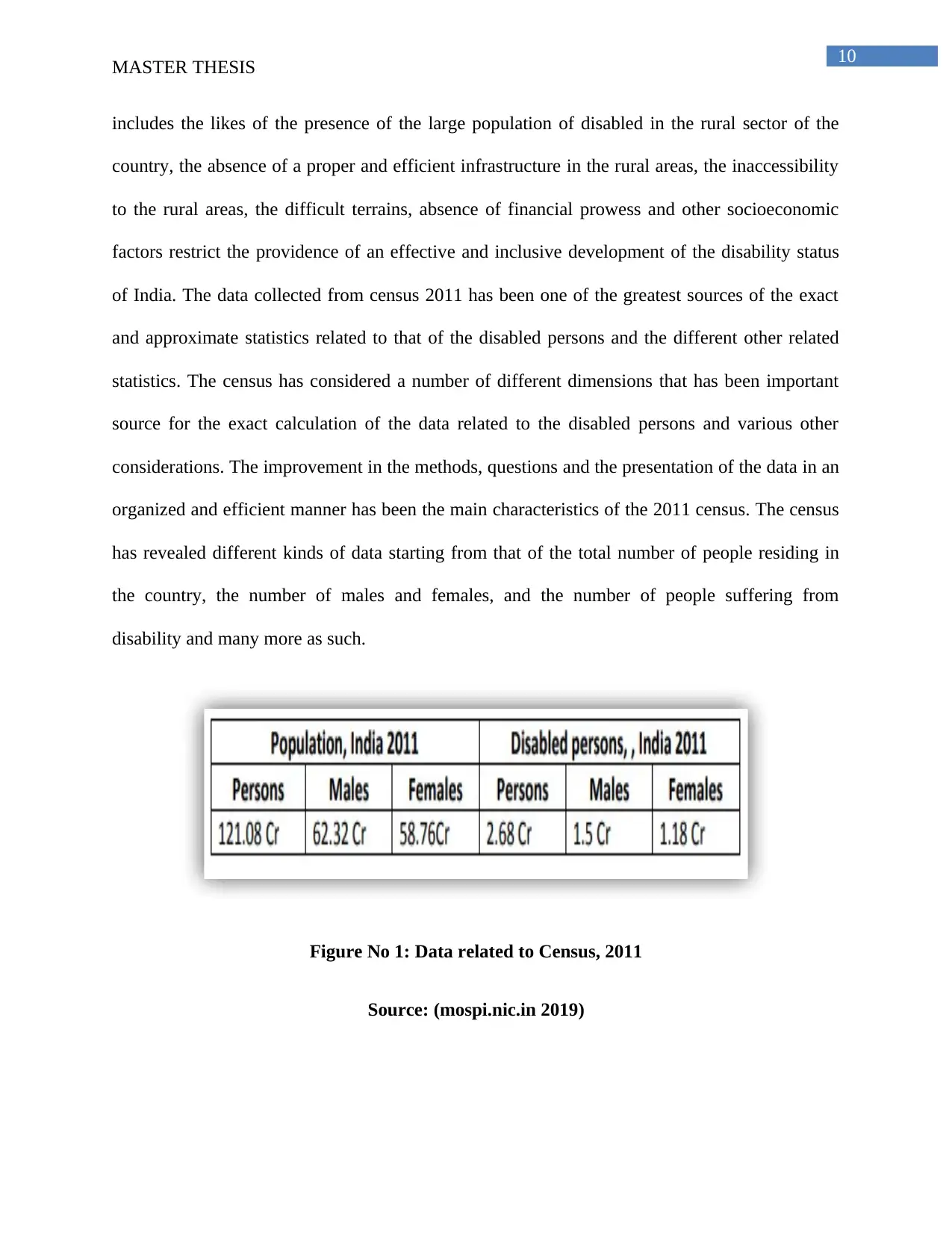
includes the likes of the presence of the large population of disabled in the rural sector of the
country, the absence of a proper and efficient infrastructure in the rural areas, the inaccessibility
to the rural areas, the difficult terrains, absence of financial prowess and other socioeconomic
factors restrict the providence of an effective and inclusive development of the disability status
of India. The data collected from census 2011 has been one of the greatest sources of the exact
and approximate statistics related to that of the disabled persons and the different other related
statistics. The census has considered a number of different dimensions that has been important
source for the exact calculation of the data related to the disabled persons and various other
considerations. The improvement in the methods, questions and the presentation of the data in an
organized and efficient manner has been the main characteristics of the 2011 census. The census
has revealed different kinds of data starting from that of the total number of people residing in
the country, the number of males and females, and the number of people suffering from
disability and many more as such.
Figure No 1: Data related to Census, 2011
Source: (mospi.nic.in 2019)
MASTER THESIS
includes the likes of the presence of the large population of disabled in the rural sector of the
country, the absence of a proper and efficient infrastructure in the rural areas, the inaccessibility
to the rural areas, the difficult terrains, absence of financial prowess and other socioeconomic
factors restrict the providence of an effective and inclusive development of the disability status
of India. The data collected from census 2011 has been one of the greatest sources of the exact
and approximate statistics related to that of the disabled persons and the different other related
statistics. The census has considered a number of different dimensions that has been important
source for the exact calculation of the data related to the disabled persons and various other
considerations. The improvement in the methods, questions and the presentation of the data in an
organized and efficient manner has been the main characteristics of the 2011 census. The census
has revealed different kinds of data starting from that of the total number of people residing in
the country, the number of males and females, and the number of people suffering from
disability and many more as such.
Figure No 1: Data related to Census, 2011
Source: (mospi.nic.in 2019)
Paraphrase This Document
Need a fresh take? Get an instant paraphrase of this document with our AI Paraphraser
11
MASTER THESIS
The table as shown in the above figure(figure 1) has highlighted the data collected during
the census of 2011. The table shows that the number of total persons residing in India during the
time as around 121 crore among which close to 63 crore males and the rest of them amounting to
another 60 crore being females. It is clearly seen that around 2.70 crore of the persons in the
country suffer from different kinds of disability. The disability percentage is also high among the
males as more than 1.50 crore of them suffering from such diseases while close to 1.20 crore of
the females suffering from disability in India. The percentage of males thus stood at around 56%
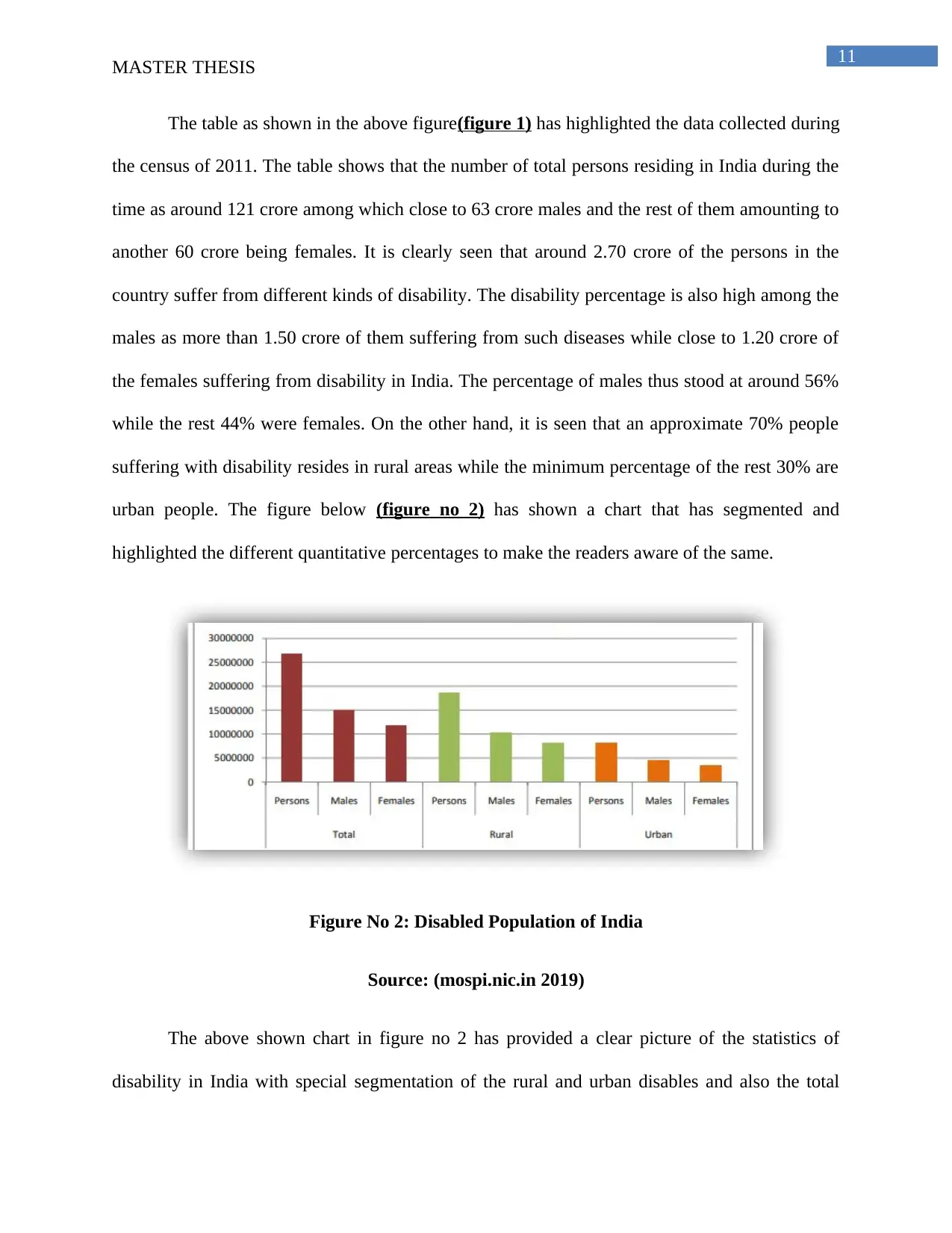
while the rest 44% were females. On the other hand, it is seen that an approximate 70% people
suffering with disability resides in rural areas while the minimum percentage of the rest 30% are
urban people. The figure below (figure no 2) has shown a chart that has segmented and
highlighted the different quantitative percentages to make the readers aware of the same.
Figure No 2: Disabled Population of India
Source: (mospi.nic.in 2019)
The above shown chart in figure no 2 has provided a clear picture of the statistics of
disability in India with special segmentation of the rural and urban disables and also the total
MASTER THESIS
The table as shown in the above figure(figure 1) has highlighted the data collected during
the census of 2011. The table shows that the number of total persons residing in India during the
time as around 121 crore among which close to 63 crore males and the rest of them amounting to
another 60 crore being females. It is clearly seen that around 2.70 crore of the persons in the
country suffer from different kinds of disability. The disability percentage is also high among the
males as more than 1.50 crore of them suffering from such diseases while close to 1.20 crore of
the females suffering from disability in India. The percentage of males thus stood at around 56%
while the rest 44% were females. On the other hand, it is seen that an approximate 70% people
suffering with disability resides in rural areas while the minimum percentage of the rest 30% are
urban people. The figure below (figure no 2) has shown a chart that has segmented and
highlighted the different quantitative percentages to make the readers aware of the same.
Figure No 2: Disabled Population of India
Source: (mospi.nic.in 2019)
The above shown chart in figure no 2 has provided a clear picture of the statistics of
disability in India with special segmentation of the rural and urban disables and also the total
12
MASTER THESIS
disabled persons of the country. The presentation of the following chart is important for the
presentation of the quantifiable data related to the percentage and exact number of disabled
persons in India. The census has also considered the various social groups distribution while
estimating the national disability register. The results of the census related to the number and the
percentage of the people suffering from disability has shown a steep increase in the last few
years. The number has increased both in rural as well as the urban areas and the increase in the
number has led to the increase in the number of challenges for the Government as they have been
struggling to address the difficulties of the people with disabilities. The increase in the number of
challenges have thus led to the Government of Indi opting out for special policies to address the
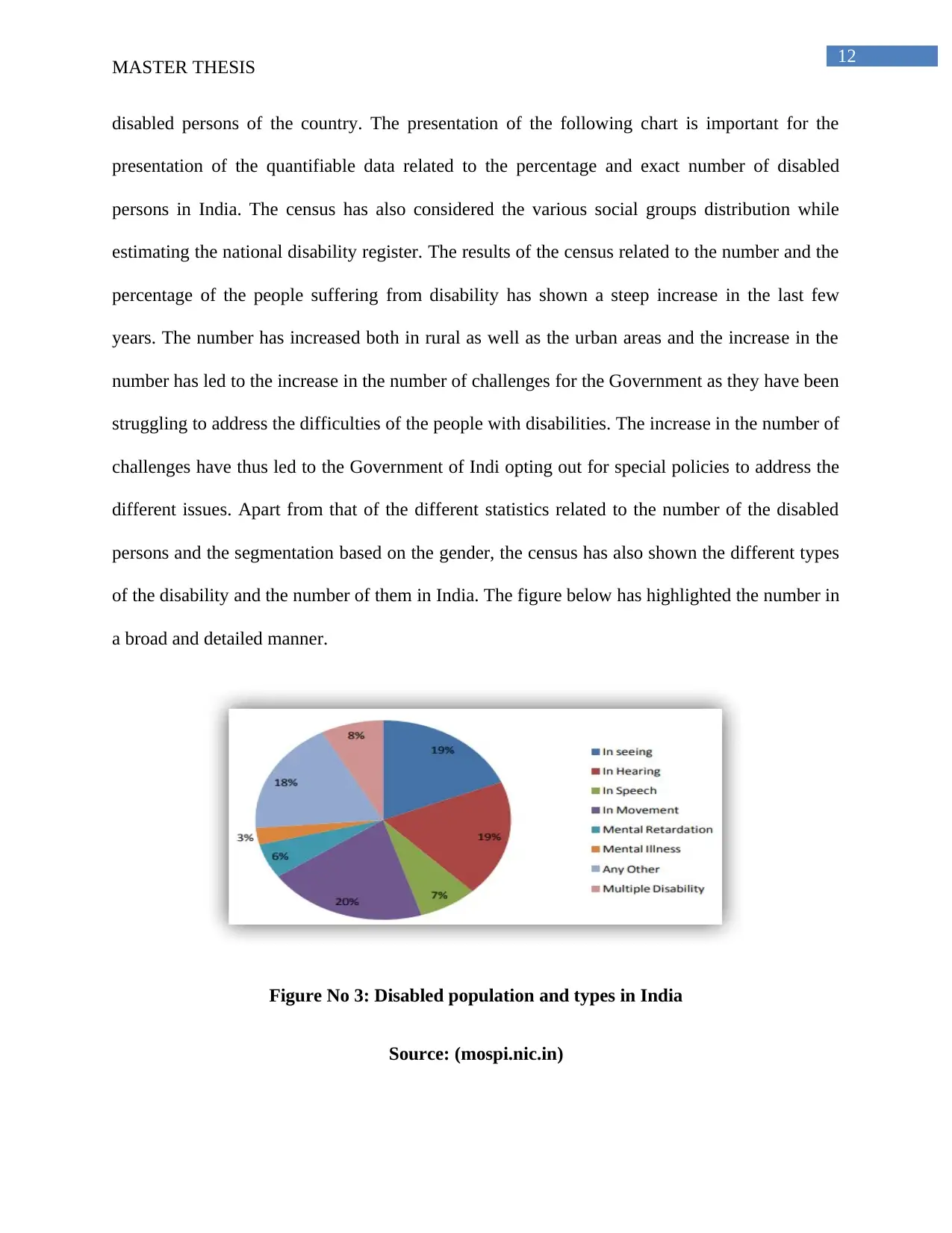
different issues. Apart from that of the different statistics related to the number of the disabled
persons and the segmentation based on the gender, the census has also shown the different types
of the disability and the number of them in India. The figure below has highlighted the number in
a broad and detailed manner.
Figure No 3: Disabled population and types in India
Source: (mospi.nic.in)
MASTER THESIS
disabled persons of the country. The presentation of the following chart is important for the
presentation of the quantifiable data related to the percentage and exact number of disabled
persons in India. The census has also considered the various social groups distribution while
estimating the national disability register. The results of the census related to the number and the
percentage of the people suffering from disability has shown a steep increase in the last few
years. The number has increased both in rural as well as the urban areas and the increase in the
number has led to the increase in the number of challenges for the Government as they have been
struggling to address the difficulties of the people with disabilities. The increase in the number of
challenges have thus led to the Government of Indi opting out for special policies to address the
different issues. Apart from that of the different statistics related to the number of the disabled
persons and the segmentation based on the gender, the census has also shown the different types
of the disability and the number of them in India. The figure below has highlighted the number in
a broad and detailed manner.
Figure No 3: Disabled population and types in India
Source: (mospi.nic.in)
⊘ This is a preview!⊘
Do you want full access?
Subscribe today to unlock all pages.
Trusted by 1+ million students worldwide

1 out of 14


Related Documents


Your All-in-One AI-Powered Toolkit for Academic Success.
+13062052269
info@desklib.com
Available 24*7 on WhatsApp / Email
![[object Object]](/_next/static/media/star-bottom.7253800d.svg)
Unlock your academic potential
Copyright © 2020–2026 A2Z Services. All Rights Reserved. Developed and managed by ZUCOL.