The Impacts of Robotics Technology in the Beer Industry: A Report
VerifiedAdded on 2023/03/30
|8
|1381
|414
Report
AI Summary
This report delves into the transformative effects of robotics technology on the beer industry. It examines how robots are changing various aspects, including predicting consumer preferences using big data and predictive algorithms, automating bottle capping and labeling processes, and streamlining customer feedback acquisition. The report also considers the regulatory and ethical implications of these technological advancements, including market constraints, legal mandates, ethical standards, and social norms. A disruption process description outlines how robotics impacts procurement, production, and market release. The report highlights the potential for cost reduction, increased efficiency, and reduced risks in the beer manufacturing process. A video transcript complements the report, emphasizing the shift from traditional methods like internet-based feedback to the use of biometric data for predicting product quality. Overall, the report underscores the capacity of robotics to revolutionize the beer industry, offering solutions for scaling up operations while maintaining product integrity.
Running head: DIGITAL REVOLUTION 1
The Impacts of Robotics Technology in Beer Industry
Student
Tutor
Institutional Affiliations
Date
The Impacts of Robotics Technology in Beer Industry
Student
Tutor
Institutional Affiliations
Date
Paraphrase This Document
Need a fresh take? Get an instant paraphrase of this document with our AI Paraphraser

DIGITAL REVOLUTION 2
The Impacts of Robotics Technology in Beer Industry
Part two: ways robotic technology may change beer industry
Since it got invented, robotic technology has demonstrated profound impacts in various
industries, especially in manufacturing industries. It has been used in these industries to perform
harmful tasks or operate in dangerous areas; this technology has created revolution in
manufacturing processes. Despite the impacts, it is essential to keep an eye on what is coming
next in the beer industry as the technology is becoming useful in many manufacturing industries.
Predicting likability of a beer by consumers: It has been a trend not only in beer
manufacturing industries but also in many other industries that a product is released to the
market after manufacturing process to seek for customers feedback. This has been time
consuming and costly and may even lead to a great loss on the off chance that consumers does
not like the product. The robotic technology can help to solve this problem in future. It can be
possible to utilize big data along with predictive algorithms in robotic technology to predict what
customers may think about the beer. This technology will help in saving a considerable cost and
time.
Bottle capping: various industries have adopted semi-automatic ways of handling this task.
However the issue with the semi-automatic involve wastage of time while loading data.
Companies have been spending a lot of time and resources in this activity. This task can be
perfectly done by robots in a cheaper and cost effective way. We can use robots in bottle capping
through dual gripper configurations. This technique is very cost effective and time consuming
because it does not need the presence of human employee and also robots can cap two or more
bottles at a time.
The Impacts of Robotics Technology in Beer Industry
Part two: ways robotic technology may change beer industry
Since it got invented, robotic technology has demonstrated profound impacts in various
industries, especially in manufacturing industries. It has been used in these industries to perform
harmful tasks or operate in dangerous areas; this technology has created revolution in
manufacturing processes. Despite the impacts, it is essential to keep an eye on what is coming
next in the beer industry as the technology is becoming useful in many manufacturing industries.
Predicting likability of a beer by consumers: It has been a trend not only in beer
manufacturing industries but also in many other industries that a product is released to the
market after manufacturing process to seek for customers feedback. This has been time
consuming and costly and may even lead to a great loss on the off chance that consumers does
not like the product. The robotic technology can help to solve this problem in future. It can be
possible to utilize big data along with predictive algorithms in robotic technology to predict what
customers may think about the beer. This technology will help in saving a considerable cost and
time.
Bottle capping: various industries have adopted semi-automatic ways of handling this task.
However the issue with the semi-automatic involve wastage of time while loading data.
Companies have been spending a lot of time and resources in this activity. This task can be
perfectly done by robots in a cheaper and cost effective way. We can use robots in bottle capping
through dual gripper configurations. This technique is very cost effective and time consuming
because it does not need the presence of human employee and also robots can cap two or more
bottles at a time.

DIGITAL REVOLUTION 3
Bottle labeling: like capping, bottle labelling is another task that have always been done in the
industry using automatic machines. However, these machines need the presence of human being
to perform certain physical operations. Robots can be programmed to perform the technical tasks
that have been initially done by human employees in bottle labelling.
Part three: Regulation and ethics
The market constraints involves the economic forces. The regulations regarding the
economic forces may require that the technology is used taking the price stability into
account; the price of the product should not be increased for any technical reason.
Concerning laws, certain mandates including legal acts concerning technical operations
enforced by legal authorities like government may limit the change.
Regarding architecture, ethics may require that the underlying system resulting to the
change conform to the defined ethical standard that ensure interoperability for
applications, data as well as technology (Contissa, 2017).
Lastly, in norms there are social conventions such as issues regarding privacy that may
restrict the implementation of the change, this is due to the reason that the technology
will use big data to ensure this change and there are social norms regarding personal
information.
Part four: Disruption
Process description
Beer manufacturing industry involve various process; some of these processes include
procurement which involve the process of acquiring raw materials, production process involving
beer manufacturing among others. The production process involve many operations including the
Bottle labeling: like capping, bottle labelling is another task that have always been done in the
industry using automatic machines. However, these machines need the presence of human being
to perform certain physical operations. Robots can be programmed to perform the technical tasks
that have been initially done by human employees in bottle labelling.
Part three: Regulation and ethics
The market constraints involves the economic forces. The regulations regarding the
economic forces may require that the technology is used taking the price stability into
account; the price of the product should not be increased for any technical reason.
Concerning laws, certain mandates including legal acts concerning technical operations
enforced by legal authorities like government may limit the change.
Regarding architecture, ethics may require that the underlying system resulting to the
change conform to the defined ethical standard that ensure interoperability for
applications, data as well as technology (Contissa, 2017).
Lastly, in norms there are social conventions such as issues regarding privacy that may
restrict the implementation of the change, this is due to the reason that the technology
will use big data to ensure this change and there are social norms regarding personal
information.
Part four: Disruption
Process description
Beer manufacturing industry involve various process; some of these processes include
procurement which involve the process of acquiring raw materials, production process involving
beer manufacturing among others. The production process involve many operations including the
⊘ This is a preview!⊘
Do you want full access?
Subscribe today to unlock all pages.

Trusted by 1+ million students worldwide

DIGITAL REVOLUTION 4
manufacture of packages, canning, labelling, bottling and packing to mention a few. After
bottling and packing, the product is released to the market. After then, customer feedback is
collected for further improvement on the product.
Considering a case where a new beer is produced, the procurement team will identify the
best raw materials for the product including ingredients, the raw materials for manufacturing
packages, cans, bottle tops and so on. The raw products are then submitted to manufacturing
sector where the product will be processed. This stage involves processes like brewing, canning,
bottling and packing. Since this is a new product, the consumer feedback is required for testing,
this can either be done the manual way or using the internet technology i.e. social media where
consumers provide their experience with the product (Liu & Alexander, 2017). This process is
very essential as it enable the industry to adjust the product in order to meet its consumers’
needs. However, the process may be quite hectic, technological innovation is yet to come up with
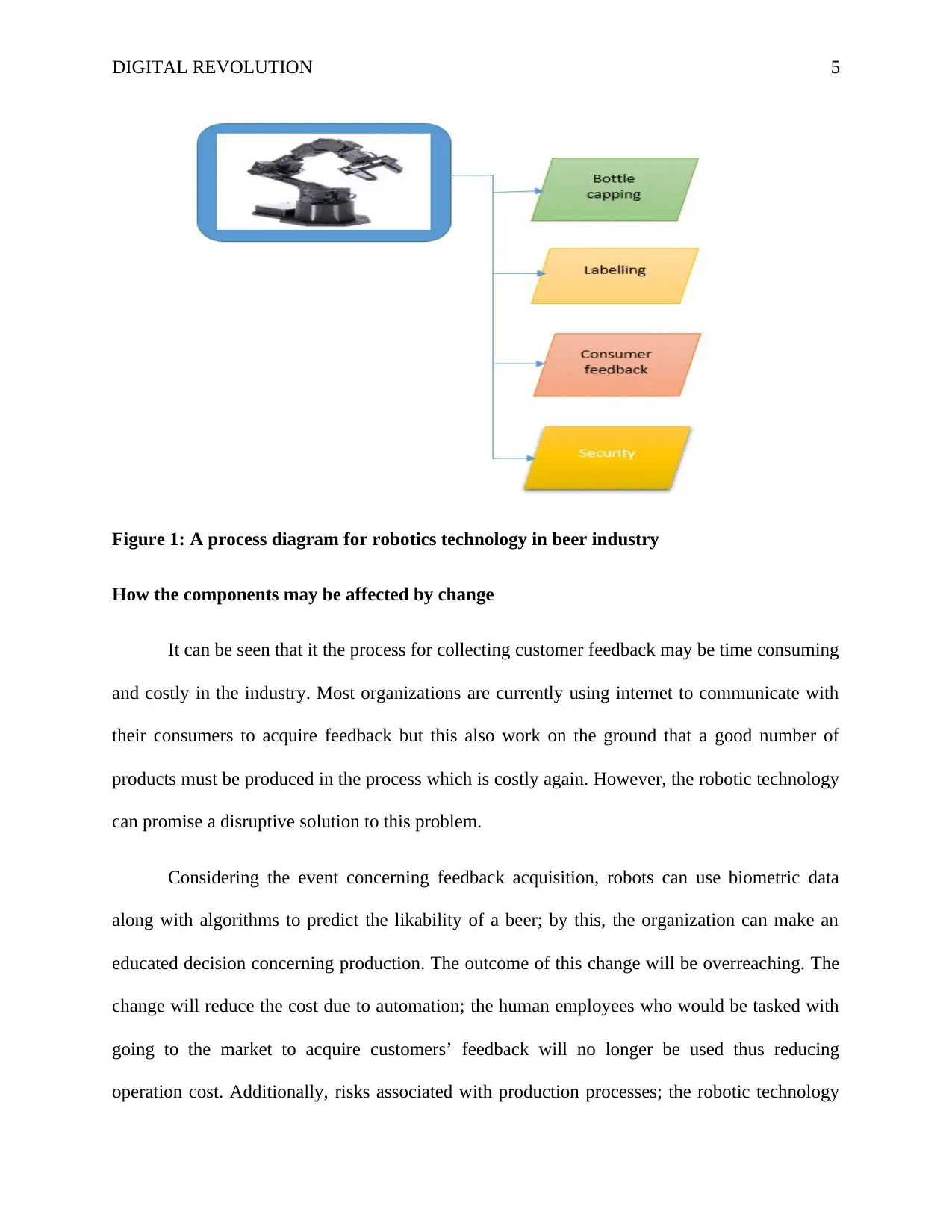
a new solution to the problem, the following shows the technological disruptive change for the
process. The following figure show a simple process diagram showing the change.
manufacture of packages, canning, labelling, bottling and packing to mention a few. After
bottling and packing, the product is released to the market. After then, customer feedback is
collected for further improvement on the product.
Considering a case where a new beer is produced, the procurement team will identify the
best raw materials for the product including ingredients, the raw materials for manufacturing
packages, cans, bottle tops and so on. The raw products are then submitted to manufacturing
sector where the product will be processed. This stage involves processes like brewing, canning,
bottling and packing. Since this is a new product, the consumer feedback is required for testing,
this can either be done the manual way or using the internet technology i.e. social media where
consumers provide their experience with the product (Liu & Alexander, 2017). This process is
very essential as it enable the industry to adjust the product in order to meet its consumers’
needs. However, the process may be quite hectic, technological innovation is yet to come up with
a new solution to the problem, the following shows the technological disruptive change for the
process. The following figure show a simple process diagram showing the change.
Paraphrase This Document
Need a fresh take? Get an instant paraphrase of this document with our AI Paraphraser

DIGITAL REVOLUTION 5
Figure 1: A process diagram for robotics technology in beer industry
How the components may be affected by change
It can be seen that it the process for collecting customer feedback may be time consuming
and costly in the industry. Most organizations are currently using internet to communicate with
their consumers to acquire feedback but this also work on the ground that a good number of
products must be produced in the process which is costly again. However, the robotic technology
can promise a disruptive solution to this problem.
Considering the event concerning feedback acquisition, robots can use biometric data
along with algorithms to predict the likability of a beer; by this, the organization can make an
educated decision concerning production. The outcome of this change will be overreaching. The
change will reduce the cost due to automation; the human employees who would be tasked with
going to the market to acquire customers’ feedback will no longer be used thus reducing
operation cost. Additionally, risks associated with production processes; the robotic technology
Figure 1: A process diagram for robotics technology in beer industry
How the components may be affected by change
It can be seen that it the process for collecting customer feedback may be time consuming
and costly in the industry. Most organizations are currently using internet to communicate with
their consumers to acquire feedback but this also work on the ground that a good number of
products must be produced in the process which is costly again. However, the robotic technology
can promise a disruptive solution to this problem.
Considering the event concerning feedback acquisition, robots can use biometric data
along with algorithms to predict the likability of a beer; by this, the organization can make an
educated decision concerning production. The outcome of this change will be overreaching. The
change will reduce the cost due to automation; the human employees who would be tasked with
going to the market to acquire customers’ feedback will no longer be used thus reducing
operation cost. Additionally, risks associated with production processes; the robotic technology

DIGITAL REVOLUTION 6
will only use a sample product for test thus reducing the risk of producing many products which
may fail to meet consumer needs (Brattin & Sexton, 2018). Along with that it will save a
considerable amount of time involving going to the market and communicating with consumers
to obtain feedback. This is due to the reason that the robots test and provide the result instantly.
Part five: Video transcript
The impacts of robotics technology has already been felt on many industries and now the
latest industry to experience the disruption is beer manufacturing industry. Initially, the industry
have been using internet like Facebook, whatsapp, and messengers for trials and now the
industry can use biometric data along with algorithms to predict the quality of the product.
Robotic technology has proven to be capable of transforming the beer manufacturing industry. In
this video, we look at a few ways this technology may change beer industry.
Customer feedback acquisition has been a trend in many industries including beer
manufacturing sector. This activity has been time consuming and quite expensive since it may
require human employees. The robotic technology has proven to be having a potential that can be
leveraged to solve this issue. By using simple algorithms which are based on biometric data, a
consumer feedback can be tailored. This process does not involve human employee, it therefore
reduces the cost of operation. This is in the sense that the funds that would be allocated for
employees are no longer allocated with this technology.
In addition to this, beer industries use bottles for serving beers, however, making these
items have been an arduous task. In the past, many organizations were using bench capper, but
making a hundreds of bottles alone can make one tired. As a solution to this, semi-automatic
machine were invented which are currently used by many organizations. However, this
will only use a sample product for test thus reducing the risk of producing many products which
may fail to meet consumer needs (Brattin & Sexton, 2018). Along with that it will save a
considerable amount of time involving going to the market and communicating with consumers
to obtain feedback. This is due to the reason that the robots test and provide the result instantly.
Part five: Video transcript
The impacts of robotics technology has already been felt on many industries and now the
latest industry to experience the disruption is beer manufacturing industry. Initially, the industry
have been using internet like Facebook, whatsapp, and messengers for trials and now the
industry can use biometric data along with algorithms to predict the quality of the product.
Robotic technology has proven to be capable of transforming the beer manufacturing industry. In
this video, we look at a few ways this technology may change beer industry.
Customer feedback acquisition has been a trend in many industries including beer
manufacturing sector. This activity has been time consuming and quite expensive since it may
require human employees. The robotic technology has proven to be having a potential that can be
leveraged to solve this issue. By using simple algorithms which are based on biometric data, a
consumer feedback can be tailored. This process does not involve human employee, it therefore
reduces the cost of operation. This is in the sense that the funds that would be allocated for
employees are no longer allocated with this technology.
In addition to this, beer industries use bottles for serving beers, however, making these
items have been an arduous task. In the past, many organizations were using bench capper, but
making a hundreds of bottles alone can make one tired. As a solution to this, semi-automatic
machine were invented which are currently used by many organizations. However, this
⊘ This is a preview!⊘
Do you want full access?
Subscribe today to unlock all pages.

Trusted by 1+ million students worldwide

DIGITAL REVOLUTION 7
technology also require human beings to perform tasks regarding operating machines which may
be costly. Robotic technology can be programmed to operate machine, thus performing the tasks
that would be done by human employees. As a consequence, the operation efficiency will be
increased as the operation cost is reduced. Thus it is worth noting that this technology has
potential to overcome the challenge of scaling up beer industry without any compromise on the
product’s integrity.
References
Brattin, R., & Sexton, R. (2018). PREDICTING BREWERY CUSTOMER SATISFACTION
USING AN ARTIFICIAL NEURAL NETWORK. Business and Management, 10(4).
Contissa, G. (2017). Information technology for the law (Vol. 6). G Giappichelli Editore.
Liu, H., & Alexander, P. (2017). Analysis of the impact of advertising and the use of social
media regarding product sales.
technology also require human beings to perform tasks regarding operating machines which may
be costly. Robotic technology can be programmed to operate machine, thus performing the tasks
that would be done by human employees. As a consequence, the operation efficiency will be
increased as the operation cost is reduced. Thus it is worth noting that this technology has
potential to overcome the challenge of scaling up beer industry without any compromise on the
product’s integrity.
References
Brattin, R., & Sexton, R. (2018). PREDICTING BREWERY CUSTOMER SATISFACTION
USING AN ARTIFICIAL NEURAL NETWORK. Business and Management, 10(4).
Contissa, G. (2017). Information technology for the law (Vol. 6). G Giappichelli Editore.
Liu, H., & Alexander, P. (2017). Analysis of the impact of advertising and the use of social
media regarding product sales.
Paraphrase This Document
Need a fresh take? Get an instant paraphrase of this document with our AI Paraphraser

DIGITAL REVOLUTION 8
1 out of 8
Related Documents
Your All-in-One AI-Powered Toolkit for Academic Success.
+13062052269
info@desklib.com
Available 24*7 on WhatsApp / Email
Unlock your academic potential
Copyright © 2020–2025 A2Z Services. All Rights Reserved. Developed and managed by ZUCOL.