Research Proposal: Impact of Digital Technologies on Higher Education
VerifiedAdded on 2024/06/07
|11
|3245
|254
Report
AI Summary
This research proposal investigates the impact of digital technologies on student learning in higher education. It outlines the rationale, background, aims, and objectives of the research, focusing on how digital technologies influence student performance, motivation, and transitions into employment. The proposal includes a literature review, examining various perspectives on the advantages and disadvantages of digital technology in education, highlighting its role in improving access to information, enhancing learning experiences, and facilitating skill development. The research aims to evaluate the effectiveness of digital tools in supporting student learning and identify the extent to which these technologies contribute to improved educational outcomes and career prospects.
RESEARCH PROPOSAL
Research Project Title: Impact of digital technologies on students learning in higher
education.
Research Project Background:
Introduction
The research proposal is presented in the following aspects of determining the impact
of digital technologies on the students in higher education. The research is based on
the digital technologies and learning of the students in higher education. This research
provides the knowledge about the deep information of digital technologies. The
improved digital technology and its impact on the students learning and coming
opportunities for employment are considered as the matter of discussion in this
research report (Sargent, 2018). The research is based on the collection of information
or data on the impact and influence of digital technologies. The research is completed
with the help of proper use of research methodologies which were used to collect and
analyze the data. The information is analyzed with the use of different methodologies.
The research form and develops the perception of the people on the use of digital
technologies and its advantages and disadvantages (Sargent, 2018). The research
project is developed under the specified time frame. The time for each activity is
decided and planned. This research report will explain the reasons and rationale for
1
Research Project Title: Impact of digital technologies on students learning in higher
education.
Research Project Background:
Introduction
The research proposal is presented in the following aspects of determining the impact
of digital technologies on the students in higher education. The research is based on
the digital technologies and learning of the students in higher education. This research
provides the knowledge about the deep information of digital technologies. The
improved digital technology and its impact on the students learning and coming
opportunities for employment are considered as the matter of discussion in this
research report (Sargent, 2018). The research is based on the collection of information
or data on the impact and influence of digital technologies. The research is completed
with the help of proper use of research methodologies which were used to collect and
analyze the data. The information is analyzed with the use of different methodologies.
The research form and develops the perception of the people on the use of digital
technologies and its advantages and disadvantages (Sargent, 2018). The research
project is developed under the specified time frame. The time for each activity is
decided and planned. This research report will explain the reasons and rationale for
1

Paraphrase This Document
Need a fresh take? Get an instant paraphrase of this document with our AI Paraphraser
selecting this topic and developed it in the high productivity manner. The research
aims and objectives are discussed under the provided research proposal which
determines the basis of the report and the information which this research will provide
(Sargent, 2018). Research questions are framed to answer in the research and
literature review or conceptual framework of different authors and researchers on the
topic are understood for studying the topic deeply. Methodologies are provided which
will explain and help in conducting the research. These of mixed methodology for this
type of research are important as the conceptual framework and the survey of people
helps in getting and collecting the information properly.
Rationale
The reason for conducting the research is the part of the rationale. The rationale
describes the reason for conducting research on the above-provided topic. This
research has been selected for determining the research on the impact of digital
technologies on the higher education and learning of students (Ang, et. al., 2018). The
importance of latest and digital technologies in improvising the results of students and
making the learning more interesting and easy is discussed in this research. The study
n this research is based on identifying the research problems and impact of various
effective digital technologies in the use of learning and providing education to the
students in higher studies. The research topic which is elected as a high scope as new
and latest technologies are promoting the education system and interest in the student
regarding learning. The digital technology in studies and higher education has
basically covered the developed countries and still covering the developing countries
(Ang, et. al., 2018). This research is conducted with a reason of proving the
advantages and disadvantages of the digital technologies on learning and higher
education of students in developing countries to changes the perception of people.
The effective rationale for the research topic is to develop the information on
advantages and disadvantages of digital technology in learning. The level of higher
performance in the education and role of digital technologies in the same is the reason
for selecting to conduct this research (Ang, et. al., 2018). The improved transitions
into the employment with the help of digital technology are also provided under this
research. The research is conducted to identify to what extent digital technologies
2
aims and objectives are discussed under the provided research proposal which
determines the basis of the report and the information which this research will provide
(Sargent, 2018). Research questions are framed to answer in the research and
literature review or conceptual framework of different authors and researchers on the
topic are understood for studying the topic deeply. Methodologies are provided which
will explain and help in conducting the research. These of mixed methodology for this
type of research are important as the conceptual framework and the survey of people
helps in getting and collecting the information properly.
Rationale
The reason for conducting the research is the part of the rationale. The rationale
describes the reason for conducting research on the above-provided topic. This
research has been selected for determining the research on the impact of digital
technologies on the higher education and learning of students (Ang, et. al., 2018). The
importance of latest and digital technologies in improvising the results of students and
making the learning more interesting and easy is discussed in this research. The study
n this research is based on identifying the research problems and impact of various
effective digital technologies in the use of learning and providing education to the
students in higher studies. The research topic which is elected as a high scope as new
and latest technologies are promoting the education system and interest in the student
regarding learning. The digital technology in studies and higher education has
basically covered the developed countries and still covering the developing countries
(Ang, et. al., 2018). This research is conducted with a reason of proving the
advantages and disadvantages of the digital technologies on learning and higher
education of students in developing countries to changes the perception of people.
The effective rationale for the research topic is to develop the information on
advantages and disadvantages of digital technology in learning. The level of higher
performance in the education and role of digital technologies in the same is the reason
for selecting to conduct this research (Ang, et. al., 2018). The improved transitions
into the employment with the help of digital technology are also provided under this
research. The research is conducted to identify to what extent digital technologies
2
facilitates students learning and education. The impact of digital technology on the
motivation of the students in learning is also the reason for the same. It becomes the
motivational factor as it provided the interesting concept of learning (Ang, et. al.,
2018).
Background
The digital technologies have improved the various learning and educational systems.
The digital technologies have improved the process of teaching and made the studies
easier for higher education. The people in the various countries and at various places
identify the proper learning methods which are effective as well as provide the
knowledge as soon as possible (Bauer, 2018). With the use of digital technologies, the
studies could be made easy in learning and understanding. The knowledge is
important as it helps in developing the personality of a person. The digital
technological use has various importance as well as advantages. The digital
technology improves the learning system and the effective attempt of the latest
technology also initiate the step in making the educational institutes digitalized. The
modern education system is very advanced as it is proving its services online and
education has become easy access to the people. With this, the security of education
institution on proving the learning materials and examination attempts is also very
important which is ensured in the digital technology (Bauer, 2018). The impact of
digital technology has observed positive in learning and higher education. The digital
technology has framed the different level of education and has an effective working of
it. The research project is developed under the specified time frame. The time for each
activity is decided and planned. This research report will explain the reasons and
rationale for selecting this topic and developed it in the high productivity manner
(Bauer, 2018). The research aims and objectives are discussed under the provided
research proposal which determines the basis of the report and the information which
this research will provide. Research questions are framed to answer in the research
and literature review or conceptual framework of different authors and researchers on
the topic are understood for studying the topic deeply. Methodologies are provided
which will explain and help in conducting the research (Bauer, 2018).
3
motivation of the students in learning is also the reason for the same. It becomes the
motivational factor as it provided the interesting concept of learning (Ang, et. al.,
2018).
Background
The digital technologies have improved the various learning and educational systems.
The digital technologies have improved the process of teaching and made the studies
easier for higher education. The people in the various countries and at various places
identify the proper learning methods which are effective as well as provide the
knowledge as soon as possible (Bauer, 2018). With the use of digital technologies, the
studies could be made easy in learning and understanding. The knowledge is
important as it helps in developing the personality of a person. The digital
technological use has various importance as well as advantages. The digital
technology improves the learning system and the effective attempt of the latest
technology also initiate the step in making the educational institutes digitalized. The
modern education system is very advanced as it is proving its services online and
education has become easy access to the people. With this, the security of education
institution on proving the learning materials and examination attempts is also very
important which is ensured in the digital technology (Bauer, 2018). The impact of
digital technology has observed positive in learning and higher education. The digital
technology has framed the different level of education and has an effective working of
it. The research project is developed under the specified time frame. The time for each
activity is decided and planned. This research report will explain the reasons and
rationale for selecting this topic and developed it in the high productivity manner
(Bauer, 2018). The research aims and objectives are discussed under the provided
research proposal which determines the basis of the report and the information which
this research will provide. Research questions are framed to answer in the research
and literature review or conceptual framework of different authors and researchers on
the topic are understood for studying the topic deeply. Methodologies are provided
which will explain and help in conducting the research (Bauer, 2018).
3
⊘ This is a preview!⊘
Do you want full access?
Subscribe today to unlock all pages.

Trusted by 1+ million students worldwide
Research Aim (s):
The research aim is to identify the use and role of digital technology in improvising
and contributing to students learning ad higher education (Bauer, 2018).
Research Objectives:
1. To evaluate the advantages and disadvantages of digital technology in learning
2. To examine the level of performance in higher education based on the digital
technologies.
3. To identify how digital technology can support and contribute to improving
transitions into employment
4. To identify to what extent digital technologies facilitate the students learning
5. To assess the impact of digital technologies on students motivation to learn
new information
Research Questions
Research questions are-
1. What are the advantages and disadvantages of digital technology in learning?
2. To which extent does the digital technology support for improving learning
and education?
4
The research aim is to identify the use and role of digital technology in improvising
and contributing to students learning ad higher education (Bauer, 2018).
Research Objectives:
1. To evaluate the advantages and disadvantages of digital technology in learning
2. To examine the level of performance in higher education based on the digital
technologies.
3. To identify how digital technology can support and contribute to improving
transitions into employment
4. To identify to what extent digital technologies facilitate the students learning
5. To assess the impact of digital technologies on students motivation to learn
new information
Research Questions
Research questions are-
1. What are the advantages and disadvantages of digital technology in learning?
2. To which extent does the digital technology support for improving learning
and education?
4
Paraphrase This Document
Need a fresh take? Get an instant paraphrase of this document with our AI Paraphraser
3. Does the digital technology work as the motivational factor in learning the
information?
Literature Review:
In the words of Pacheco et. al. (2018), The digital technology is an effective way of
learning and promoting education. Digital technology helps in accessing the
information with the people sitting to the different countries. The digital technology
has made the easy access to the learning and education. Not only the digital
technology has improved the access but also improved the learning system. The
students are developing an interest in various types of studies because of their
digitalization. They feel easy and comfortable to learn and gain education (Pacheco,
et. al., 2018). The digital technology plays an important role in forming the interest of
students towards learning as the methods of digital technology include learning with
videos, various questions, and quiz. The higher education time also gets saved with
this. According to Siemens (2014), The digital technology provides the opportunity of
learning whenever the students want to. The video and lectures can be easily resumed
from the last shot. This enhances the ease and comfortable learning environment for
the people. The people in the various countries and at various places identify the
proper learning methods which are effective as well as provide the knowledge as soon
as possible. With the use of digital technologies, the studies could be made easy in
learning and understanding (Siemens, 2014). The modern education system is very
advanced as it is proving its services online and education has become easily access to
the people. The digital technology has framed the different level of education and has
an effective working of it. The digital technologies have improved the various
learning and educational systems. The digital technological use has various
importance as well as advantages. The digital technology improves the learning
system and the effective attempt of the latest technology also initiate the step in
making the educational institutes digitalized (Siemens, 2014). The digital
technologies provide the effective efforts in digitalizing and maintaining the efforts.
In the words of Domingo and Garganté, (2016), The digital technologies are effective
and have several of advantage and merit which forces to take a business to heights but
on the other hand, the digital technology also has various disadvantages such as it is
very expensive. The use of digital technology is new and a person has less used which
5
information?
Literature Review:
In the words of Pacheco et. al. (2018), The digital technology is an effective way of
learning and promoting education. Digital technology helps in accessing the
information with the people sitting to the different countries. The digital technology
has made the easy access to the learning and education. Not only the digital
technology has improved the access but also improved the learning system. The
students are developing an interest in various types of studies because of their
digitalization. They feel easy and comfortable to learn and gain education (Pacheco,
et. al., 2018). The digital technology plays an important role in forming the interest of
students towards learning as the methods of digital technology include learning with
videos, various questions, and quiz. The higher education time also gets saved with
this. According to Siemens (2014), The digital technology provides the opportunity of
learning whenever the students want to. The video and lectures can be easily resumed
from the last shot. This enhances the ease and comfortable learning environment for
the people. The people in the various countries and at various places identify the
proper learning methods which are effective as well as provide the knowledge as soon
as possible. With the use of digital technologies, the studies could be made easy in
learning and understanding (Siemens, 2014). The modern education system is very
advanced as it is proving its services online and education has become easily access to
the people. The digital technology has framed the different level of education and has
an effective working of it. The digital technologies have improved the various
learning and educational systems. The digital technological use has various
importance as well as advantages. The digital technology improves the learning
system and the effective attempt of the latest technology also initiate the step in
making the educational institutes digitalized (Siemens, 2014). The digital
technologies provide the effective efforts in digitalizing and maintaining the efforts.
In the words of Domingo and Garganté, (2016), The digital technologies are effective
and have several of advantage and merit which forces to take a business to heights but
on the other hand, the digital technology also has various disadvantages such as it is
very expensive. The use of digital technology is new and a person has less used which
5
creates a problem for the students in learning and understanding. The expensive
studies on digital format and page also affect the person is also (Domingo and
Garganté, 2016).
The digital technologies have improved the efficiency of being employed. The
employment has increased as well as improved with the help of digital technologies.
The use of digital technology in ensuring the support to the employment is effective.
This is because the effective education and learning improve the higher technologies
and more employment (Domingo and Garganté, 2016). The professionals are
preferred by the companies to be hired for the betterment of the company as well as
society. The level of performance in the higher education is also empowered with the
effective use of digital technologies. On the other hand, a basic knowledge of digital
technology also helps in providing effective working and job.
As per the words of Collins and Halverson, (2018), Students are learning in a different
way. They are getting the best online tutorials which are helping them in
understanding the concept clearly. This is because the online methods are easy and
interesting. There are various tutorials which provide the education and learning with
entertainment. The effective and interesting pictures, colors and language help in
learning. The entertainment and fun in learning improve the effectiveness of digital
technologies (Collins and Halverson, 2018). Various charts, diagrams and movies and
videos pay attention to making the studies more interesting. Students learning are
facilitated with the proper and clear knowledge of providing the education.
Not only the interest level of students increase with the help of digital technology but
also the motivation to learn interesting topics and by the use of various methods also
helps them in improvising their learning. This has a positive impact as students find
the new and transformed manner of learning (Collins and Halverson, 2018). The
effective and proper learning material of the students identifies the people in getting
the information and data collection. The use of digital technologies in providing
effective learning and education is an improved way.
As per the words of Voogt et. al. (2017), The digital technologies has improved the
various learning and educational systems. With the use of digital technologies, the
studies could be made easy in learning and understanding. The knowledge is
6
studies on digital format and page also affect the person is also (Domingo and
Garganté, 2016).
The digital technologies have improved the efficiency of being employed. The
employment has increased as well as improved with the help of digital technologies.
The use of digital technology in ensuring the support to the employment is effective.
This is because the effective education and learning improve the higher technologies
and more employment (Domingo and Garganté, 2016). The professionals are
preferred by the companies to be hired for the betterment of the company as well as
society. The level of performance in the higher education is also empowered with the
effective use of digital technologies. On the other hand, a basic knowledge of digital
technology also helps in providing effective working and job.
As per the words of Collins and Halverson, (2018), Students are learning in a different
way. They are getting the best online tutorials which are helping them in
understanding the concept clearly. This is because the online methods are easy and
interesting. There are various tutorials which provide the education and learning with
entertainment. The effective and interesting pictures, colors and language help in
learning. The entertainment and fun in learning improve the effectiveness of digital
technologies (Collins and Halverson, 2018). Various charts, diagrams and movies and
videos pay attention to making the studies more interesting. Students learning are
facilitated with the proper and clear knowledge of providing the education.
Not only the interest level of students increase with the help of digital technology but
also the motivation to learn interesting topics and by the use of various methods also
helps them in improvising their learning. This has a positive impact as students find
the new and transformed manner of learning (Collins and Halverson, 2018). The
effective and proper learning material of the students identifies the people in getting
the information and data collection. The use of digital technologies in providing
effective learning and education is an improved way.
As per the words of Voogt et. al. (2017), The digital technologies has improved the
various learning and educational systems. With the use of digital technologies, the
studies could be made easy in learning and understanding. The knowledge is
6
⊘ This is a preview!⊘
Do you want full access?
Subscribe today to unlock all pages.
Trusted by 1+ million students worldwide
important as it helps in developing the personality of a person. The digital
technological use has various importance as well as advantages. With this, the
security of education institution on proving the learning materials and examination
attempts is also very important which is ensured in the digital technology. The people
in the various countries and at various places identify the proper learning methods
which are effective as well as provide the knowledge as soon as possible (Voogt, et.
al., 2017). The digital technologies have improved the process of teaching and made
the studies easier for higher education. The modern education system is very
advanced as it is proving its services online and education has become easily access to
the people. The digital technology improves the learning system and the effective
attempt of the latest technology also initiate the step in making the educational
institutes digitalized (Voogt, et. al., 2017).
Research Methodology:
The research methodologies refer to the various methods which determine the ways
and methods which helped in conducting the research. The research methodologies
include the different methods by which research report has been prepared. The
research methods include a primary and secondary method for data collection. The
data collection is the process in which different sources are selected to collect or
gather information about the related topic (Husted, et. al., 2018). The impact of digital
technologies in improving the learning and higher education of students are
considered with the method of data collection. The data collection has been
considered to be done in two ways the primary method and the secondary method. On
the other hand, further, this research has also considered the qualitative and
quantitative methods for data analyzing. The data analyzing is the process in which
the evaluation and examining of data take place. The data is collected and further
analyzed to interpret the results (Husted, et. al., 2018). The qualitative and
quantitative data analysis methods are two methods for it. The research includes the
title of these methodologies for collecting the information about the impact of digital
technologies on learning and higher education.
7
technological use has various importance as well as advantages. With this, the
security of education institution on proving the learning materials and examination
attempts is also very important which is ensured in the digital technology. The people
in the various countries and at various places identify the proper learning methods
which are effective as well as provide the knowledge as soon as possible (Voogt, et.
al., 2017). The digital technologies have improved the process of teaching and made
the studies easier for higher education. The modern education system is very
advanced as it is proving its services online and education has become easily access to
the people. The digital technology improves the learning system and the effective
attempt of the latest technology also initiate the step in making the educational
institutes digitalized (Voogt, et. al., 2017).
Research Methodology:
The research methodologies refer to the various methods which determine the ways
and methods which helped in conducting the research. The research methodologies
include the different methods by which research report has been prepared. The
research methods include a primary and secondary method for data collection. The
data collection is the process in which different sources are selected to collect or
gather information about the related topic (Husted, et. al., 2018). The impact of digital
technologies in improving the learning and higher education of students are
considered with the method of data collection. The data collection has been
considered to be done in two ways the primary method and the secondary method. On
the other hand, further, this research has also considered the qualitative and
quantitative methods for data analyzing. The data analyzing is the process in which
the evaluation and examining of data take place. The data is collected and further
analyzed to interpret the results (Husted, et. al., 2018). The qualitative and
quantitative data analysis methods are two methods for it. The research includes the
title of these methodologies for collecting the information about the impact of digital
technologies on learning and higher education.
7
Paraphrase This Document
Need a fresh take? Get an instant paraphrase of this document with our AI Paraphraser
The primary method of data collection- The primary method is the method in
which the raw information is gathered. The primary method follows the raw and fresh
information about the topic (Lebow, 2018). The methods which primary method
includes are questionnaires, surveys, interviews etc.
Secondary methods of data collection- The secondary method is the method in
which already existing information and information which has been already analyzed
is used. These may include some literature reviews and conceptual frameworks of the
work done by other researchers on this topic (Lebow, 2018). The books, newspapers,
magazines and various other methods are included in this.
The quantitative method of data analysis- This method includes the data analysis in
the form of various quantitative methods. The quantitative methods are the use of
quantity which ensures the use of figures, statistics, graphs, data, charts etc.
Qualitative method of data analysis- The data analysis method also includes the
qualitative method in which the collected information of conceptual framework and
various other methods of data collection including the information gathered are
included (Guenther, et. al., 2017).
References
Ang, S.S., Orozco, M., Gijbels, D., and Van den Bossche, P., 2018. Learning
in the Context of Work in a Digital Age: The Use of Digital Media in Informal
and Formal Learning Contexts. In The Impact of Digitalization in the
Workplace (pp. 87-101). Springer, Cham.
Bauer, L.B., 2018. A Necessary Addiction: Student Conceptualizations of
Technology and Its Impact on Teaching and Learning. Journal of College
Reading and Learning, 48(1), pp.67-81.
Collins, A. and Halverson, R., 2018. Rethinking education in the age of
technology: The digital revolution and schooling in America. Teachers
College Press.
8
which the raw information is gathered. The primary method follows the raw and fresh
information about the topic (Lebow, 2018). The methods which primary method
includes are questionnaires, surveys, interviews etc.
Secondary methods of data collection- The secondary method is the method in
which already existing information and information which has been already analyzed
is used. These may include some literature reviews and conceptual frameworks of the
work done by other researchers on this topic (Lebow, 2018). The books, newspapers,
magazines and various other methods are included in this.
The quantitative method of data analysis- This method includes the data analysis in
the form of various quantitative methods. The quantitative methods are the use of
quantity which ensures the use of figures, statistics, graphs, data, charts etc.
Qualitative method of data analysis- The data analysis method also includes the
qualitative method in which the collected information of conceptual framework and
various other methods of data collection including the information gathered are
included (Guenther, et. al., 2017).
References
Ang, S.S., Orozco, M., Gijbels, D., and Van den Bossche, P., 2018. Learning
in the Context of Work in a Digital Age: The Use of Digital Media in Informal
and Formal Learning Contexts. In The Impact of Digitalization in the
Workplace (pp. 87-101). Springer, Cham.
Bauer, L.B., 2018. A Necessary Addiction: Student Conceptualizations of
Technology and Its Impact on Teaching and Learning. Journal of College
Reading and Learning, 48(1), pp.67-81.
Collins, A. and Halverson, R., 2018. Rethinking education in the age of
technology: The digital revolution and schooling in America. Teachers
College Press.
8
Domingo, M.G. and Garganté, A.B., 2016. Exploring the use of educational
technology in primary education: Teachers' perception of mobile technology
learning impacts and applications' use in the classroom. Computers in Human
Behavior, 56, pp.21-28.
Guenther, J., Osborne, S., Arnott, A. and McRae-Williams, E., 2017. Hearing
the voice of remote Aboriginal and Torres Strait Islander training stakeholders
using research methodologies and theoretical frames of reference. Race
Ethnicity and Education, 20(2), pp.197-208.
Husted, B.W., Henriques, I. and Crane, A., 2018. Quants and Poets:
Advancing Methods and Methodologies in Business and Society Research.
Lebow, J.L., 2018. Discursive research methodologies and couple and family
therapy research: Reflections. Journal of marital and family therapy.
Pacheco, E., Lips, M. and Yoong, P., 2018. Transition 2.0: Digital
technologies, higher education, and vision impairment. The Internet and
Higher Education, 37, pp.1-10.
Sargent, J., 2018. Digital technologies and learning in physical education:
pedagogical cases.
Siemens, G., 2014. Connectivism: A learning theory for the digital age.
Voogt, J., Knezek, G., Christensen, R., Lai, K.W., Pratt, K., Albion, P.,
Tondeur, J., Webb, M., Ifenthaler, D., Gibson, D.G. and Resta, P., 2017,
March. The International Handbook of Information Technology in Primary
and Secondary Education: Part 2. In Society for Information Technology &
Teacher Education International Conference (pp. 1082-1085). Association for
the Advancement of Computing in Education (AACE).
9
technology in primary education: Teachers' perception of mobile technology
learning impacts and applications' use in the classroom. Computers in Human
Behavior, 56, pp.21-28.
Guenther, J., Osborne, S., Arnott, A. and McRae-Williams, E., 2017. Hearing
the voice of remote Aboriginal and Torres Strait Islander training stakeholders
using research methodologies and theoretical frames of reference. Race
Ethnicity and Education, 20(2), pp.197-208.
Husted, B.W., Henriques, I. and Crane, A., 2018. Quants and Poets:
Advancing Methods and Methodologies in Business and Society Research.
Lebow, J.L., 2018. Discursive research methodologies and couple and family
therapy research: Reflections. Journal of marital and family therapy.
Pacheco, E., Lips, M. and Yoong, P., 2018. Transition 2.0: Digital
technologies, higher education, and vision impairment. The Internet and
Higher Education, 37, pp.1-10.
Sargent, J., 2018. Digital technologies and learning in physical education:
pedagogical cases.
Siemens, G., 2014. Connectivism: A learning theory for the digital age.
Voogt, J., Knezek, G., Christensen, R., Lai, K.W., Pratt, K., Albion, P.,
Tondeur, J., Webb, M., Ifenthaler, D., Gibson, D.G. and Resta, P., 2017,
March. The International Handbook of Information Technology in Primary
and Secondary Education: Part 2. In Society for Information Technology &
Teacher Education International Conference (pp. 1082-1085). Association for
the Advancement of Computing in Education (AACE).
9
⊘ This is a preview!⊘
Do you want full access?
Subscribe today to unlock all pages.
Trusted by 1+ million students worldwide
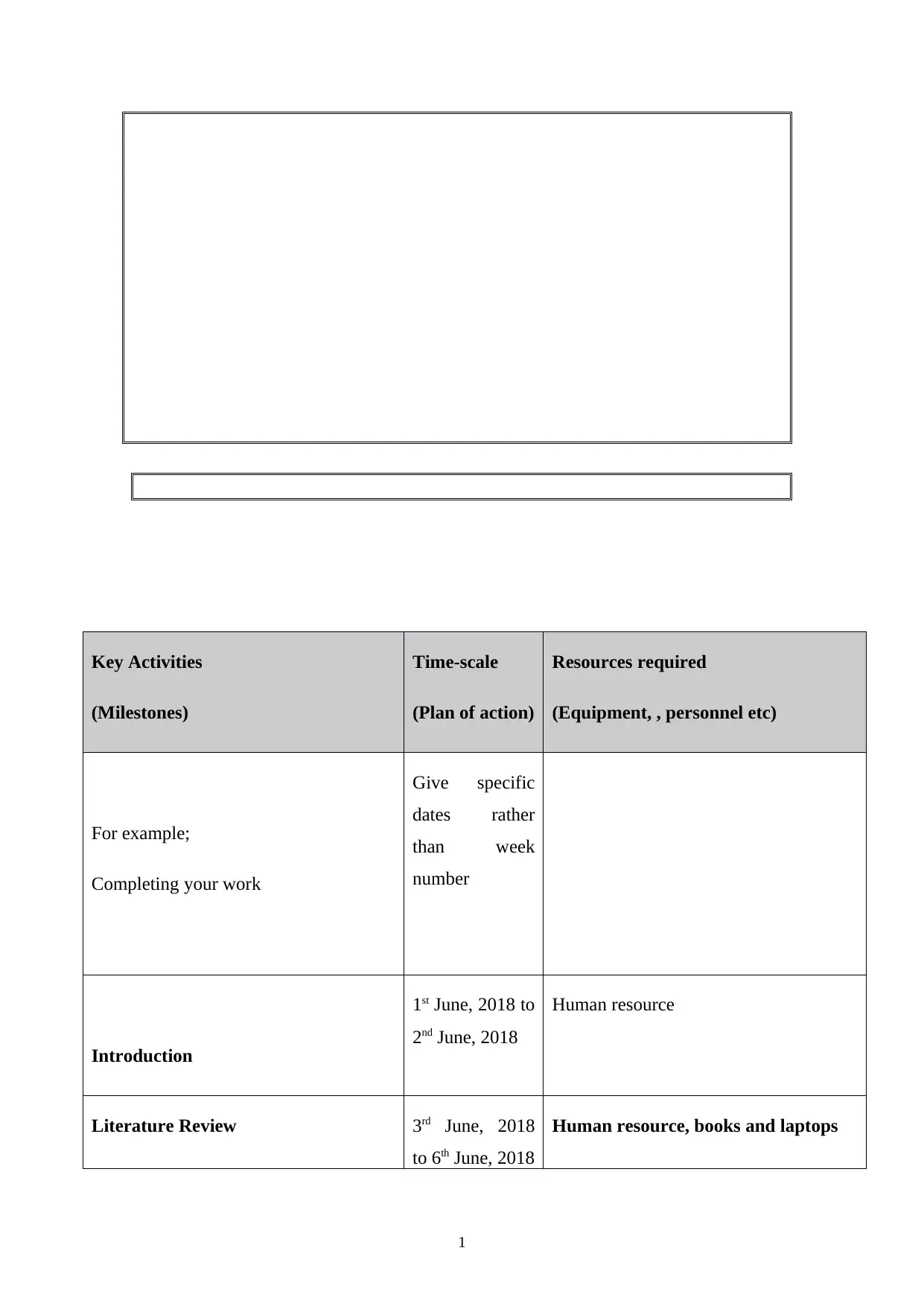
Key Activities
(Milestones)
Time-scale
(Plan of action)
Resources required
(Equipment, , personnel etc)
For example;
Completing your work
Give specific
dates rather
than week
number
Introduction
1st June, 2018 to
2nd June, 2018
Human resource
Literature Review 3rd June, 2018
to 6th June, 2018
Human resource, books and laptops
1
(Milestones)
Time-scale
(Plan of action)
Resources required
(Equipment, , personnel etc)
For example;
Completing your work
Give specific
dates rather
than week
number
Introduction
1st June, 2018 to
2nd June, 2018
Human resource
Literature Review 3rd June, 2018
to 6th June, 2018
Human resource, books and laptops
1
Paraphrase This Document
Need a fresh take? Get an instant paraphrase of this document with our AI Paraphraser
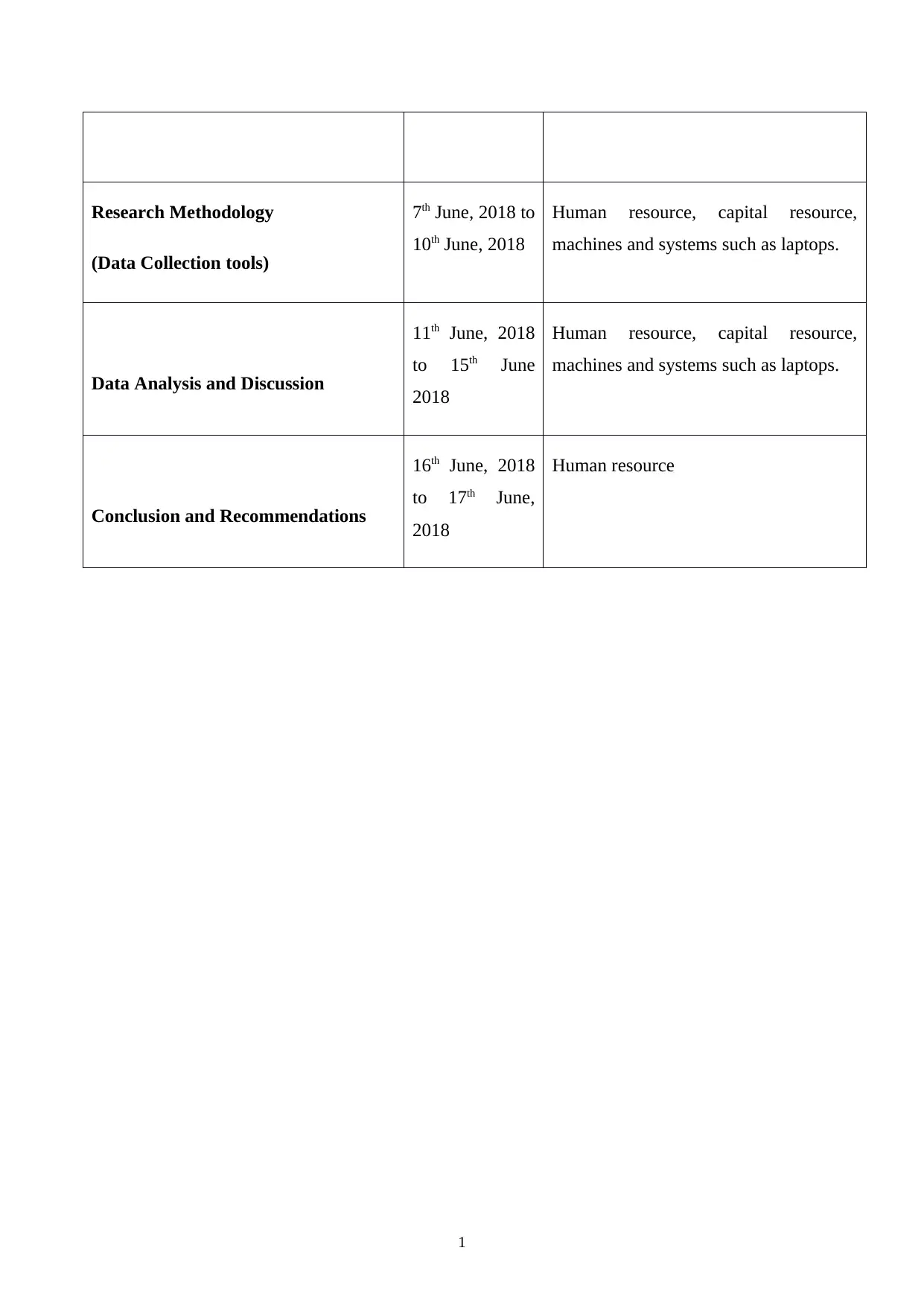
Research Methodology
(Data Collection tools)
7th June, 2018 to
10th June, 2018
Human resource, capital resource,
machines and systems such as laptops.
Data Analysis and Discussion
11th June, 2018
to 15th June
2018
Human resource, capital resource,
machines and systems such as laptops.
Conclusion and Recommendations
16th June, 2018
to 17th June,
2018
Human resource
1
(Data Collection tools)
7th June, 2018 to
10th June, 2018
Human resource, capital resource,
machines and systems such as laptops.
Data Analysis and Discussion
11th June, 2018
to 15th June
2018
Human resource, capital resource,
machines and systems such as laptops.
Conclusion and Recommendations
16th June, 2018
to 17th June,
2018
Human resource
1

1 out of 11


Related Documents


Your All-in-One AI-Powered Toolkit for Academic Success.
+13062052269
info@desklib.com
Available 24*7 on WhatsApp / Email
![[object Object]](/_next/static/media/star-bottom.7253800d.svg)
Unlock your academic potential
Copyright © 2020–2026 A2Z Services. All Rights Reserved. Developed and managed by ZUCOL.