Impact Analysis of Digital Technologies on Travel and Tourism Firms
VerifiedAdded on 2024/05/29
|34
|9347
|469
Report
AI Summary
This research report investigates the impact of digital technologies on business activities within the travel and tourism industry. It identifies emerging digital technologies and evaluates their influence on tourism companies, focusing on the role of technology in enhancing customer engagement through online booking and communication systems. The study aims to understand how digital technology improves service quality, analyze its overall impact on tourism businesses, and explore the implementation of online information and payment systems. Through a literature review and data analysis, the report examines the benefits and challenges of integrating digital technologies, such as the internet and social media, into the tourism sector, highlighting their potential to transform traditional business operations and create new opportunities for economic growth and customer interaction. The research also addresses ethical considerations and limitations, providing a comprehensive overview of the digital transformation in the travel and tourism industry.
RESEARCH PROJECT

Paraphrase This Document
Need a fresh take? Get an instant paraphrase of this document with our AI Paraphraser
Table of Contents
INTRODUCTION.................................................................................................................................2
RESEARCH TITLE..............................................................................................................................3
RESEARCH STATEMENT..................................................................................................................3
RESEARCH AIM AND OBJECTIVES................................................................................................3
RESEARCH QUESTIONS...................................................................................................................3
LITERATURE REVIEW......................................................................................................................4
RESEARCH METHODOLOGY...........................................................................................................8
RESEARCH DESIGN.......................................................................................................................8
DATA COLLECTION......................................................................................................................8
ADVANTAGE AND DISADVANTAGE OF USING QUESTIONNAIRE.....................................8
SAMPLING METHODOLOGY.......................................................................................................9
LIMITATIONS.................................................................................................................................9
LIMITATION OF THE STUDY.......................................................................................................9
RELIABILITY AND VALIDITY.....................................................................................................9
ETHICAL CONSIDERATION.........................................................................................................9
DATA PRESENTATION AND ANALYSIS..................................................................................10
TIMELINE OF RESEARCH ACTIVITIES....................................................................................11
LOG BOOK.................................................................................................................................11
GANTT CHART.........................................................................................................................12
DATA GATHERING AND ANALYSIS............................................................................................13
DISCUSSION, RECOMMENDATION AND CONCLUSION..........................................................24
REFERENCES....................................................................................................................................27
APPENDIX.........................................................................................................................................30
QUESTIONNAIRE.........................................................................................................................30
1
INTRODUCTION.................................................................................................................................2
RESEARCH TITLE..............................................................................................................................3
RESEARCH STATEMENT..................................................................................................................3
RESEARCH AIM AND OBJECTIVES................................................................................................3
RESEARCH QUESTIONS...................................................................................................................3
LITERATURE REVIEW......................................................................................................................4
RESEARCH METHODOLOGY...........................................................................................................8
RESEARCH DESIGN.......................................................................................................................8
DATA COLLECTION......................................................................................................................8
ADVANTAGE AND DISADVANTAGE OF USING QUESTIONNAIRE.....................................8
SAMPLING METHODOLOGY.......................................................................................................9
LIMITATIONS.................................................................................................................................9
LIMITATION OF THE STUDY.......................................................................................................9
RELIABILITY AND VALIDITY.....................................................................................................9
ETHICAL CONSIDERATION.........................................................................................................9
DATA PRESENTATION AND ANALYSIS..................................................................................10
TIMELINE OF RESEARCH ACTIVITIES....................................................................................11
LOG BOOK.................................................................................................................................11
GANTT CHART.........................................................................................................................12
DATA GATHERING AND ANALYSIS............................................................................................13
DISCUSSION, RECOMMENDATION AND CONCLUSION..........................................................24
REFERENCES....................................................................................................................................27
APPENDIX.........................................................................................................................................30
QUESTIONNAIRE.........................................................................................................................30
1
INTRODUCTION
Implementing the emerging technology in the business is its growing necessity. The role of
technology in the business field has grown in recent years. The operations of the business are affected
by the technology used by the company (Buhalis and Amaranggana, 2013). There are both tangible
and intangible benefits of implementing digital technology in the business activities. It is observed
that the activities of the traditional business are fundamentally shifted for using digital technology and
engage with the customers in the recent ten years. The technological changes have a huge impact on
the operations and activities of the business.
One of the popular industries impacted due to emerging technology is the travel and tourism industry.
The use of technology in the travel and tourism industry has made to possible for the travel agents to
customize the travelling packages as per the wishes of the customer (Sigala, et al. 2012). The
components of the tourism industry are benefitted by the inclusion of innovative technologies in
building customer relationships through various applications and sites. The traditional way of
operating business in travel and tourism industry has changed the way of carrying out the business
activity and engage with people. The use of technology in the travel and tourism industry replaces the
issues that were arising in the activities of the business.
With the help of the technology, the company can provide less personalised services thereby
generating higher revenues on the accommodation, meals and at transportation hubs (Schegg and
Stangl, 2017). Technology is a mixture of positive and negative impacts on the travel and tourism
industry as when used ethically will help in increasing the communication and business for the
tourism companies. Unethical use of technology can be hazardous for the tourism companies; it might
result in loss of security and increase in a terrorist attack.
Also, the economic growth can be achieved through the use of technology in travel and tourism field
which garners the economic means for the consumer to travel (Tribe, 2011). The online platform is
used by the travellers and tourist to plan their trips which gives the tourism companies a great
opportunity for customer engagement with the use of the mobile platform by converting these mobile
travellers into tourism boking. It is observed that more than 50 per cent of the people uses internet
nowadays in their decision-making process for both business and leisure travellers (Schegg and
Stangl, 2017).
2
Implementing the emerging technology in the business is its growing necessity. The role of
technology in the business field has grown in recent years. The operations of the business are affected
by the technology used by the company (Buhalis and Amaranggana, 2013). There are both tangible
and intangible benefits of implementing digital technology in the business activities. It is observed
that the activities of the traditional business are fundamentally shifted for using digital technology and
engage with the customers in the recent ten years. The technological changes have a huge impact on
the operations and activities of the business.
One of the popular industries impacted due to emerging technology is the travel and tourism industry.
The use of technology in the travel and tourism industry has made to possible for the travel agents to
customize the travelling packages as per the wishes of the customer (Sigala, et al. 2012). The
components of the tourism industry are benefitted by the inclusion of innovative technologies in
building customer relationships through various applications and sites. The traditional way of
operating business in travel and tourism industry has changed the way of carrying out the business
activity and engage with people. The use of technology in the travel and tourism industry replaces the
issues that were arising in the activities of the business.
With the help of the technology, the company can provide less personalised services thereby
generating higher revenues on the accommodation, meals and at transportation hubs (Schegg and
Stangl, 2017). Technology is a mixture of positive and negative impacts on the travel and tourism
industry as when used ethically will help in increasing the communication and business for the
tourism companies. Unethical use of technology can be hazardous for the tourism companies; it might
result in loss of security and increase in a terrorist attack.
Also, the economic growth can be achieved through the use of technology in travel and tourism field
which garners the economic means for the consumer to travel (Tribe, 2011). The online platform is
used by the travellers and tourist to plan their trips which gives the tourism companies a great
opportunity for customer engagement with the use of the mobile platform by converting these mobile
travellers into tourism boking. It is observed that more than 50 per cent of the people uses internet
nowadays in their decision-making process for both business and leisure travellers (Schegg and
Stangl, 2017).
2
⊘ This is a preview!⊘
Do you want full access?
Subscribe today to unlock all pages.

Trusted by 1+ million students worldwide
RESEARCH TITLE
"An analysis of the impact of digital technologies on the business activities in travel and tourism
industry”
RESEARCH STATEMENT
“What are the impacts of digital technologies on the business activities in travel and tourism
industry?”
RESEARCH AIM AND OBJECTIVES
The main aim of the research is to identify the emerging digital technologies and evaluate its impact
on the business activities of tourism companies in travel and tourism business. The objectives are:
To understand the role of digital technology in the tourism company.
To enable the customers to use online booking and communication system in tourism
company in travel and tourism industry.
To implement the digital technology to improve the quality of services and products in travel
and tourism business.
To analyse the impact of using digital technology on the tourism company.
To implement the online information and payment system for accessing the information and
make payment by tourism company.
RESEARCH QUESTIONS
1. What is the role of digital technology in the tourism company?
2. What is satisfaction level of the customer in using online booking and communication system
in Tourism Company?
3. How does the digital technology help in improving the product and services quality in the
tourism industry?
4. What is the impact of digital technology on the Tourism Company?
5. How the digital technology helps in implementing the online information and payment system
for accessing the information and make payment by Tourism Company?
3
"An analysis of the impact of digital technologies on the business activities in travel and tourism
industry”
RESEARCH STATEMENT
“What are the impacts of digital technologies on the business activities in travel and tourism
industry?”
RESEARCH AIM AND OBJECTIVES
The main aim of the research is to identify the emerging digital technologies and evaluate its impact
on the business activities of tourism companies in travel and tourism business. The objectives are:
To understand the role of digital technology in the tourism company.
To enable the customers to use online booking and communication system in tourism
company in travel and tourism industry.
To implement the digital technology to improve the quality of services and products in travel
and tourism business.
To analyse the impact of using digital technology on the tourism company.
To implement the online information and payment system for accessing the information and
make payment by tourism company.
RESEARCH QUESTIONS
1. What is the role of digital technology in the tourism company?
2. What is satisfaction level of the customer in using online booking and communication system
in Tourism Company?
3. How does the digital technology help in improving the product and services quality in the
tourism industry?
4. What is the impact of digital technology on the Tourism Company?
5. How the digital technology helps in implementing the online information and payment system
for accessing the information and make payment by Tourism Company?
3
Paraphrase This Document
Need a fresh take? Get an instant paraphrase of this document with our AI Paraphraser
LITERATURE REVIEW
According to Buhalis and Jun (2011), one of the most important innovation in the field of technology
is the internet. The emergence of the internet in the travel and tourism led the travellers to plan their
holidays using the internet. It was evident in this research that internet powered business environment
due to the e-business being an essential prerequisite resulted in the success of the tourism companies
in the travel and tourism industry. The activities, process and data handling along with the ability to
function and compete with the rivals in the emerging business environment around the world can be
advantaged by the emerging technologies as the processes in the tourism-related organization go
through the re-engineering process. The purpose of this study was to identify the importance of
information and communication technology and its implications for travel and tourism industry
illuminating the complexity of various types of systems.
Innovation organization need to be assumed a paramount part of accomplishing financial development
by gathering economic methods for buyers should venture out (Tribe, 2011). This framework of the
tourism sector clinched alongside tourism will be greatly complex; provided for the way that those
tourism items public appeals transforms because of progressions in the outside drives that critical
improvement for low expense transporters will be another method for effective innovative requisitions
of the tourism also undertaking business.
The tourism business is regularly considered similarly as the sectored framework for improvement
also creation (Werthner, et al. 2015). The advancement as well as a commitment to air travel a method
for transporting visitors to different areas is a critical commitment to engineering organization of the
tourism head out business. That evolvement and advancement of the majority of the data innovation
organization need along these lines required a massive effect on tourism.
In support of this, Hojeghan and Esfangareh (2011) conducted the study to identify the contribution of
new technologies in the travel and tourism development. The internet serves as a communication tool
between the suppliers, intermediaries in the tourism industry and the end-user of the services, thereby
offering potential information along with the booking facilities that are available to a large number of
potential customers at considerable prices. It was suggested in the most researches that the role of
government is very crucial in facilitating the use of digital technology to increase their ability in the
tourism industry to reap the benefits.
The growing demands of the customers, volatile and unsecured business market increase in the
international competition, customization of tourism packages, potentials in the different market
segments are some of the challenges faced by the companies in the tourism sectors. Internet
innovation picked up imperativeness concerning illustration it got to be the real energy will fill in
securely and successfully. The use of digital technology is directly impacting and shaping the tourism
destination at a significant level. Since the tourism industry is an intensely competitive industry which
is an information sensitive system. Thus a dramatic change has occurred due to the emergence of
4
According to Buhalis and Jun (2011), one of the most important innovation in the field of technology
is the internet. The emergence of the internet in the travel and tourism led the travellers to plan their
holidays using the internet. It was evident in this research that internet powered business environment
due to the e-business being an essential prerequisite resulted in the success of the tourism companies
in the travel and tourism industry. The activities, process and data handling along with the ability to
function and compete with the rivals in the emerging business environment around the world can be
advantaged by the emerging technologies as the processes in the tourism-related organization go
through the re-engineering process. The purpose of this study was to identify the importance of
information and communication technology and its implications for travel and tourism industry
illuminating the complexity of various types of systems.
Innovation organization need to be assumed a paramount part of accomplishing financial development
by gathering economic methods for buyers should venture out (Tribe, 2011). This framework of the
tourism sector clinched alongside tourism will be greatly complex; provided for the way that those
tourism items public appeals transforms because of progressions in the outside drives that critical
improvement for low expense transporters will be another method for effective innovative requisitions
of the tourism also undertaking business.
The tourism business is regularly considered similarly as the sectored framework for improvement
also creation (Werthner, et al. 2015). The advancement as well as a commitment to air travel a method
for transporting visitors to different areas is a critical commitment to engineering organization of the
tourism head out business. That evolvement and advancement of the majority of the data innovation
organization need along these lines required a massive effect on tourism.
In support of this, Hojeghan and Esfangareh (2011) conducted the study to identify the contribution of
new technologies in the travel and tourism development. The internet serves as a communication tool
between the suppliers, intermediaries in the tourism industry and the end-user of the services, thereby
offering potential information along with the booking facilities that are available to a large number of
potential customers at considerable prices. It was suggested in the most researches that the role of
government is very crucial in facilitating the use of digital technology to increase their ability in the
tourism industry to reap the benefits.
The growing demands of the customers, volatile and unsecured business market increase in the
international competition, customization of tourism packages, potentials in the different market
segments are some of the challenges faced by the companies in the tourism sectors. Internet
innovation picked up imperativeness concerning illustration it got to be the real energy will fill in
securely and successfully. The use of digital technology is directly impacting and shaping the tourism
destination at a significant level. Since the tourism industry is an intensely competitive industry which
is an information sensitive system. Thus a dramatic change has occurred due to the emergence of
4
digital technology through information and communication systems in hotels, motels, car rentals,
special tour operators, restaurants and travel agents and so on.
In addition to this, Minghetti and Buhalis (2010) stated that one of the important wealth creators at
both international and national level is tourism industry. The diffusion of the information and
communication technologies in the tourism industry resulted in improved social and economic
impacts beneficial to the people and the organizations in the developing and developed countries. This
study focused on the digital division I the tourism industries in order to explore the relevant factors
leading to inequality in accessibility and usage of information and communication system for tourists
and visitors.
The integration of different aspects such as motivational, social and technical that is derived from the
various approaches to demonstrates the factors that affect the market capacity and effective interaction
in the tourism environment at the global level (Thakran and Verma, 2013). It is evident in this
research that it is essential to expand the use of information and communication technologies in less
technologically developed regions in order to promote the market offerings; reduce dependency on the
intermediaries and interaction with consumers.
In addition to this, Xiang, et al (2015), the sustenance and success of the business depends on the
understanding and capitalization of consumer behaviour trends. The use of internet and different
traditional channels such as online travel agencies and other sources continue to dominate the travel
planning. The use of high-order internet such a social media is prevalent among some of the traveller's
segments while the use of traditional internet means is widespread across all the segments for travel
planning. This study depicts the particulars about the technological trends in travel planning. There is
no change in the patterns of using online tools by traditional online consumers however some of the
groups in the customer segments have adopted the emerging information sources and transaction
channels.
According to Standing, et al (2014), there is a major impact of the internet on the providers and
consumer in the tourism industry. This study classifies and also analyse the wealth of the research
published in the major journals of tourism in the recent decades with the aim to identify the major
focus areas and also the gaps in the research regarding the internet in the tourism industry. Some of
the most important topics for research in the field of tourism regarding the technology is information
research, internet marketing, and website analysis. Some of the researches conducted on the
perspective or e-business or organization so that any issues can be resolved from the past mistakes
and from best practices while internet-related issues are the most common research topics.
In addition to this, Ye, et al (2011), studied the impact of the reviews of online users on the travelling
behaviour. It was revealed in the previous studies that the reviews generated by online users’ impact
the sale of various products such as books, CDs and movies. However, the impact of reviews
generated by online users regarding tourism industry is indefinite to tourism researchers as well as
practitioners. The authors conducted an empirical study with the aim to identify the impact of online
5
special tour operators, restaurants and travel agents and so on.
In addition to this, Minghetti and Buhalis (2010) stated that one of the important wealth creators at
both international and national level is tourism industry. The diffusion of the information and
communication technologies in the tourism industry resulted in improved social and economic
impacts beneficial to the people and the organizations in the developing and developed countries. This
study focused on the digital division I the tourism industries in order to explore the relevant factors
leading to inequality in accessibility and usage of information and communication system for tourists
and visitors.
The integration of different aspects such as motivational, social and technical that is derived from the
various approaches to demonstrates the factors that affect the market capacity and effective interaction
in the tourism environment at the global level (Thakran and Verma, 2013). It is evident in this
research that it is essential to expand the use of information and communication technologies in less
technologically developed regions in order to promote the market offerings; reduce dependency on the
intermediaries and interaction with consumers.
In addition to this, Xiang, et al (2015), the sustenance and success of the business depends on the
understanding and capitalization of consumer behaviour trends. The use of internet and different
traditional channels such as online travel agencies and other sources continue to dominate the travel
planning. The use of high-order internet such a social media is prevalent among some of the traveller's
segments while the use of traditional internet means is widespread across all the segments for travel
planning. This study depicts the particulars about the technological trends in travel planning. There is
no change in the patterns of using online tools by traditional online consumers however some of the
groups in the customer segments have adopted the emerging information sources and transaction
channels.
According to Standing, et al (2014), there is a major impact of the internet on the providers and
consumer in the tourism industry. This study classifies and also analyse the wealth of the research
published in the major journals of tourism in the recent decades with the aim to identify the major
focus areas and also the gaps in the research regarding the internet in the tourism industry. Some of
the most important topics for research in the field of tourism regarding the technology is information
research, internet marketing, and website analysis. Some of the researches conducted on the
perspective or e-business or organization so that any issues can be resolved from the past mistakes
and from best practices while internet-related issues are the most common research topics.
In addition to this, Ye, et al (2011), studied the impact of the reviews of online users on the travelling
behaviour. It was revealed in the previous studies that the reviews generated by online users’ impact
the sale of various products such as books, CDs and movies. However, the impact of reviews
generated by online users regarding tourism industry is indefinite to tourism researchers as well as
practitioners. The authors conducted an empirical study with the aim to identify the impact of online
5
⊘ This is a preview!⊘
Do you want full access?
Subscribe today to unlock all pages.
Trusted by 1+ million students worldwide
user-generated review on the performance of the business using the data extracted from a major online
travel agency. The findings of this research highlighted the importance and significance of the online
user-generated reviews on the performance of the business in the tourism industry.
In support of this, Jacobsen and Munar (2012) provided empirical evidence on the impacts of the
internet and other sources on the destination choices of international tourists regarding the mainstream
summer location. The breakthrough of the technologies enabled the traveller or tourist to book flights,
rent cars, and hotels using the online medium. The digital disruptions in the tourism industry enable
tourism agents and operators to reach out to a larger number of people who are well informed and
high tech. it was highlighted in this research that some of the traditional provisions such as Web 1.0,
direct word-of-mouth and personal experiences are highly robust that influences the decision of the
tourists to spend their summer holiday to a well-known destination. In order to take a decision
regarding the destination, utilitarian information values are more relevant to socialisation
opportunities.
According to Fotis, et al (2012), an empirical study is conducted to present the comprehensive view of
role and impact of using the social media while planning the holiday travel process before, during and
after the tour. It provides the insight into the scope of use, usage levels and level of trust and
influence. The findings of this study represent the predominant use of social media used as an
experience sharing platform after the holidays by tourist and travellers. The correlation between the
perceived influence level from social media and alteration made in the holiday plans as there is
trustworthiness in the perception towards the user-generated content as compared to official tourism
websites mass media advertising and travel agents.
In addition to this, Law, et al (2014), conducted a study on the basis of reviews published in the
journals related to tourism and hospitality between 2009 and 2013. Approximately 107 journals were
reviewed by the authors that were retrieved from three major databases ScienceDirect, EBSCOhost’s
Hospitality and Tourism Complete, Emerald Management eJournals and sage journals. Grouping of
these journals was done into two categories that are supplier and consumer who are considered as the
key players in the tourism industry and other industries as well. The findings of this study were the
wide adoption of the information and communication technology in the hospitality and tourism
industries across different units and in different applications. It was observed that the industry
practitioners need to learn about the updated practices by taking benefits from recent technological
developments based on content analysis.
According to Gretzel (2011), there are fundamental changes in the behaviour and demand along with
the functions and structures of tourism industry due to the changes in the ICT. These intelligent
systems sense their surroundings to implement the actions in order to reach specific goals. The use of
intelligent systems is to support the information search for tourists along with the decision making
and work processes. This study identifies the gap in between the knowledge of the field in order to
gather the information regarding the intelligent system and its impacts. The conceptualisation of the
6
travel agency. The findings of this research highlighted the importance and significance of the online
user-generated reviews on the performance of the business in the tourism industry.
In support of this, Jacobsen and Munar (2012) provided empirical evidence on the impacts of the
internet and other sources on the destination choices of international tourists regarding the mainstream
summer location. The breakthrough of the technologies enabled the traveller or tourist to book flights,
rent cars, and hotels using the online medium. The digital disruptions in the tourism industry enable
tourism agents and operators to reach out to a larger number of people who are well informed and
high tech. it was highlighted in this research that some of the traditional provisions such as Web 1.0,
direct word-of-mouth and personal experiences are highly robust that influences the decision of the
tourists to spend their summer holiday to a well-known destination. In order to take a decision
regarding the destination, utilitarian information values are more relevant to socialisation
opportunities.
According to Fotis, et al (2012), an empirical study is conducted to present the comprehensive view of
role and impact of using the social media while planning the holiday travel process before, during and
after the tour. It provides the insight into the scope of use, usage levels and level of trust and
influence. The findings of this study represent the predominant use of social media used as an
experience sharing platform after the holidays by tourist and travellers. The correlation between the
perceived influence level from social media and alteration made in the holiday plans as there is
trustworthiness in the perception towards the user-generated content as compared to official tourism
websites mass media advertising and travel agents.
In addition to this, Law, et al (2014), conducted a study on the basis of reviews published in the
journals related to tourism and hospitality between 2009 and 2013. Approximately 107 journals were
reviewed by the authors that were retrieved from three major databases ScienceDirect, EBSCOhost’s
Hospitality and Tourism Complete, Emerald Management eJournals and sage journals. Grouping of
these journals was done into two categories that are supplier and consumer who are considered as the
key players in the tourism industry and other industries as well. The findings of this study were the
wide adoption of the information and communication technology in the hospitality and tourism
industries across different units and in different applications. It was observed that the industry
practitioners need to learn about the updated practices by taking benefits from recent technological
developments based on content analysis.
According to Gretzel (2011), there are fundamental changes in the behaviour and demand along with
the functions and structures of tourism industry due to the changes in the ICT. These intelligent
systems sense their surroundings to implement the actions in order to reach specific goals. The use of
intelligent systems is to support the information search for tourists along with the decision making
and work processes. This study identifies the gap in between the knowledge of the field in order to
gather the information regarding the intelligent system and its impacts. The conceptualisation of the
6
Paraphrase This Document
Need a fresh take? Get an instant paraphrase of this document with our AI Paraphraser
technology is essential to understand in order to incorporate in the tourism research in order to focus
on the interactions and uses.
In support of this, Milano, et al (2011) suggested that online social networking sites and Web 2.0
highly impacts the tourism industry through their online activities. Two of the social networking sites
were considered that are Facebook and Twitter. In order to analyse the patterns of the visit, the
relationship between the referrals from these social networking sites and total visits were measured. It
was noted that the role of social media is very important in various aspects of the tourism industry that
is in information search and decision-making behaviours of the tourists. Various countries have
started using these social media sites in order to promote their market offerings in the tourism
industry. The role of social media was considered in the decision-making process of the tourism
planning by tourists and visitors in the tourism industry.
According to Molz (2013) studied the role of social networking technologies on the moral economy of
alternative tourism. This empirical study majorly focuses on the online hospitality exchange network
Couchsurfing. To critically investigate for moral tourism, it does not encourage framing the moral
tourism as a response to the issues of commercial mass tourism. Affordances of Couchsurfing best
settle on sense and indeed, best revolved noticeable in our current reality the place a few routes of
travelling, consuming, and also cooperating would regard ‘better' over others. The idea about ‘moral
affordances' supporters demonstrates how executing or neglecting trust to visitors, offering material
assets to free, and taking part for minding suggestions need aid enabled by different long range
informal communication mechanisms.
In addition to this, Jalilvand and Samiei (2012) studied the reduction in trust among the consumers
regarding the advertisement and organizations in order to gain competitive advantage through word of
mouth. The role of word-of-mouth is important in travel and tourism industry as it is difficult to
evaluate the intangible products before consumption. The purpose of this study is to evaluate the
impact of electronic word-of-mouth in the decision making of the consumers regarding the choices in
tourism destinations.
7
on the interactions and uses.
In support of this, Milano, et al (2011) suggested that online social networking sites and Web 2.0
highly impacts the tourism industry through their online activities. Two of the social networking sites
were considered that are Facebook and Twitter. In order to analyse the patterns of the visit, the
relationship between the referrals from these social networking sites and total visits were measured. It
was noted that the role of social media is very important in various aspects of the tourism industry that
is in information search and decision-making behaviours of the tourists. Various countries have
started using these social media sites in order to promote their market offerings in the tourism
industry. The role of social media was considered in the decision-making process of the tourism
planning by tourists and visitors in the tourism industry.
According to Molz (2013) studied the role of social networking technologies on the moral economy of
alternative tourism. This empirical study majorly focuses on the online hospitality exchange network
Couchsurfing. To critically investigate for moral tourism, it does not encourage framing the moral
tourism as a response to the issues of commercial mass tourism. Affordances of Couchsurfing best
settle on sense and indeed, best revolved noticeable in our current reality the place a few routes of
travelling, consuming, and also cooperating would regard ‘better' over others. The idea about ‘moral
affordances' supporters demonstrates how executing or neglecting trust to visitors, offering material
assets to free, and taking part for minding suggestions need aid enabled by different long range
informal communication mechanisms.
In addition to this, Jalilvand and Samiei (2012) studied the reduction in trust among the consumers
regarding the advertisement and organizations in order to gain competitive advantage through word of
mouth. The role of word-of-mouth is important in travel and tourism industry as it is difficult to
evaluate the intangible products before consumption. The purpose of this study is to evaluate the
impact of electronic word-of-mouth in the decision making of the consumers regarding the choices in
tourism destinations.
7
RESEARCH METHODOLOGY
RESEARCH DESIGN
Research methodologies are broadly classified into qualitative and quantitative research design. The
quantitative research design is used to evaluate or analyse by using measurable data in order to
formulate the facts and unrecovered patterns in the research. It quantifies the attitude, views, opinions
and behaviours and other defined variable into usable statistics for generalizing the results from large
sample population (Egger, 2013). The qualitative research design is used in exploratory research to
gain the insights to understand the underlying opinions and reasons.
The qualitative and quantitative research design is used in this research. Questionnaire survey method
is used to measure the impact of digital technology on the businesses in travel and tourism industry.
Qualitative method is used to analyse the perception and opinions of the tourist which is highly
unpredictable and cannot be calculated mathematically (Bizirgianni and Dionysopoulou, 2013). The
opinions and views of the customers help in understanding the significance of digital technology on
the businesses on travel and tourism industry.
DATA COLLECTION
One of the most important steps in successfully carrying out the research is the data collection
method. There is the difference in the quantity, quality and type of data to be collected on the basis of
objectives of the research. Questionnaire survey method is used in this research to collect the data
(Sharpley, 2018). Primary data is collected by designing and distributing the survey questionnaire
among 100 candidates that is the tourist and visitors to understand the significance of the
incorporating the digital technology in the activities of travel and tourism business such as online
booking and information search, online payment systems and communication system (Neuhofer, et al.
2014). Secondary data is collected from different published research articles of the researchers and
scholars. About 13 researches were included in the literature review of this research to develop the
base for the primary research.
ADVANTAGE AND DISADVANTAGE OF USING QUESTIONNAIRE
The advantage of using the questionnaires method is its efficiency and ease in collecting information
from a large number of participants as it is a highly flexible instrument. It reduces the variability in
research as same questions are received and answered by the respondents which make it easy to code
analyse and also interpret the findings and results (Pendergast, 2010). The disadvantage of using
questionnaire is it is complex to design which is a time-consuming process.
8
RESEARCH DESIGN
Research methodologies are broadly classified into qualitative and quantitative research design. The
quantitative research design is used to evaluate or analyse by using measurable data in order to
formulate the facts and unrecovered patterns in the research. It quantifies the attitude, views, opinions
and behaviours and other defined variable into usable statistics for generalizing the results from large
sample population (Egger, 2013). The qualitative research design is used in exploratory research to
gain the insights to understand the underlying opinions and reasons.
The qualitative and quantitative research design is used in this research. Questionnaire survey method
is used to measure the impact of digital technology on the businesses in travel and tourism industry.
Qualitative method is used to analyse the perception and opinions of the tourist which is highly
unpredictable and cannot be calculated mathematically (Bizirgianni and Dionysopoulou, 2013). The
opinions and views of the customers help in understanding the significance of digital technology on
the businesses on travel and tourism industry.
DATA COLLECTION
One of the most important steps in successfully carrying out the research is the data collection
method. There is the difference in the quantity, quality and type of data to be collected on the basis of
objectives of the research. Questionnaire survey method is used in this research to collect the data
(Sharpley, 2018). Primary data is collected by designing and distributing the survey questionnaire
among 100 candidates that is the tourist and visitors to understand the significance of the
incorporating the digital technology in the activities of travel and tourism business such as online
booking and information search, online payment systems and communication system (Neuhofer, et al.
2014). Secondary data is collected from different published research articles of the researchers and
scholars. About 13 researches were included in the literature review of this research to develop the
base for the primary research.
ADVANTAGE AND DISADVANTAGE OF USING QUESTIONNAIRE
The advantage of using the questionnaires method is its efficiency and ease in collecting information
from a large number of participants as it is a highly flexible instrument. It reduces the variability in
research as same questions are received and answered by the respondents which make it easy to code
analyse and also interpret the findings and results (Pendergast, 2010). The disadvantage of using
questionnaire is it is complex to design which is a time-consuming process.
8
⊘ This is a preview!⊘
Do you want full access?
Subscribe today to unlock all pages.
Trusted by 1+ million students worldwide
SAMPLING METHODOLOGY
Sampling is the process of selecting n number of people from the total population with the aim to
gather data for the current study. Among different sampling methods, the simple random sampling
method is used to select 100 participants for collecting the data for this research. It will help in
understanding the impact of digital technology either positive or negative on the tourism activities in
travel and tourism industry.
LIMITATIONS
As only 100 participants took part in the research project, it became a limiting factor. The
representativeness of the collected data is reduced due to the limited time and resource constraints. It
is also essential to be cautious in generalising the results of the study to the total population.
LIMITATION OF THE STUDY
There are some limitations to this research. The aim and objectives of the research are too broad for
the research study. Another limitation can be the unwillingness of respondents to provide the required
information of the study resulting in data collection errors (Lo, et al. 2011). There was undefined
geographical background which restricted to analyse the impact of digital technology on the tourism
activities in the research. The secondary research is taken as the base for this research, which may
results in lack of certain aspects thereby limiting the research.
RELIABILITY AND VALIDITY
Efforts were made in order to ensure the construction of the questions in consideration with the
research objectives, literature review and conception obtained with the help of other researches about
the digital technology and its impact on tourism industry (Molz, 2012). The validity of this research is
for a limited time period as there is consistent digital evolution and change in perception of people.
ETHICAL CONSIDERATION
The ethical considerations followed in this research are the maintenance of confidentiality of the
people who participated in this survey research and no discrimination is done on the basis of caste,
region, creed or nationality. The data was collected for the research without disclosing the personal
information of the participants. Participants were informed about the aim of the research along with
9
Sampling is the process of selecting n number of people from the total population with the aim to
gather data for the current study. Among different sampling methods, the simple random sampling
method is used to select 100 participants for collecting the data for this research. It will help in
understanding the impact of digital technology either positive or negative on the tourism activities in
travel and tourism industry.
LIMITATIONS
As only 100 participants took part in the research project, it became a limiting factor. The
representativeness of the collected data is reduced due to the limited time and resource constraints. It
is also essential to be cautious in generalising the results of the study to the total population.
LIMITATION OF THE STUDY
There are some limitations to this research. The aim and objectives of the research are too broad for
the research study. Another limitation can be the unwillingness of respondents to provide the required
information of the study resulting in data collection errors (Lo, et al. 2011). There was undefined
geographical background which restricted to analyse the impact of digital technology on the tourism
activities in the research. The secondary research is taken as the base for this research, which may
results in lack of certain aspects thereby limiting the research.
RELIABILITY AND VALIDITY
Efforts were made in order to ensure the construction of the questions in consideration with the
research objectives, literature review and conception obtained with the help of other researches about
the digital technology and its impact on tourism industry (Molz, 2012). The validity of this research is
for a limited time period as there is consistent digital evolution and change in perception of people.
ETHICAL CONSIDERATION
The ethical considerations followed in this research are the maintenance of confidentiality of the
people who participated in this survey research and no discrimination is done on the basis of caste,
region, creed or nationality. The data was collected for the research without disclosing the personal
information of the participants. Participants were informed about the aim of the research along with
9
Paraphrase This Document
Need a fresh take? Get an instant paraphrase of this document with our AI Paraphraser
the disclosure of the results to interested parties (Gretzel, et al. 2015). Participants were free to
withdraw from the questionnaire survey at any stage based on their willingness.
DATA PRESENTATION AND ANALYSIS
Pie charts, tables and ME-Excel are used to represent the data collected for the research. Tables
represent the qualitative data and pie chart represents quantitative data (Sotiriadis and Van Zyl, 2013).
Figures were preferred to interpret the data easily as it indicates the number of occurrences of the
responses for a particular question through graphic representation.
10
withdraw from the questionnaire survey at any stage based on their willingness.
DATA PRESENTATION AND ANALYSIS
Pie charts, tables and ME-Excel are used to represent the data collected for the research. Tables
represent the qualitative data and pie chart represents quantitative data (Sotiriadis and Van Zyl, 2013).
Figures were preferred to interpret the data easily as it indicates the number of occurrences of the
responses for a particular question through graphic representation.
10
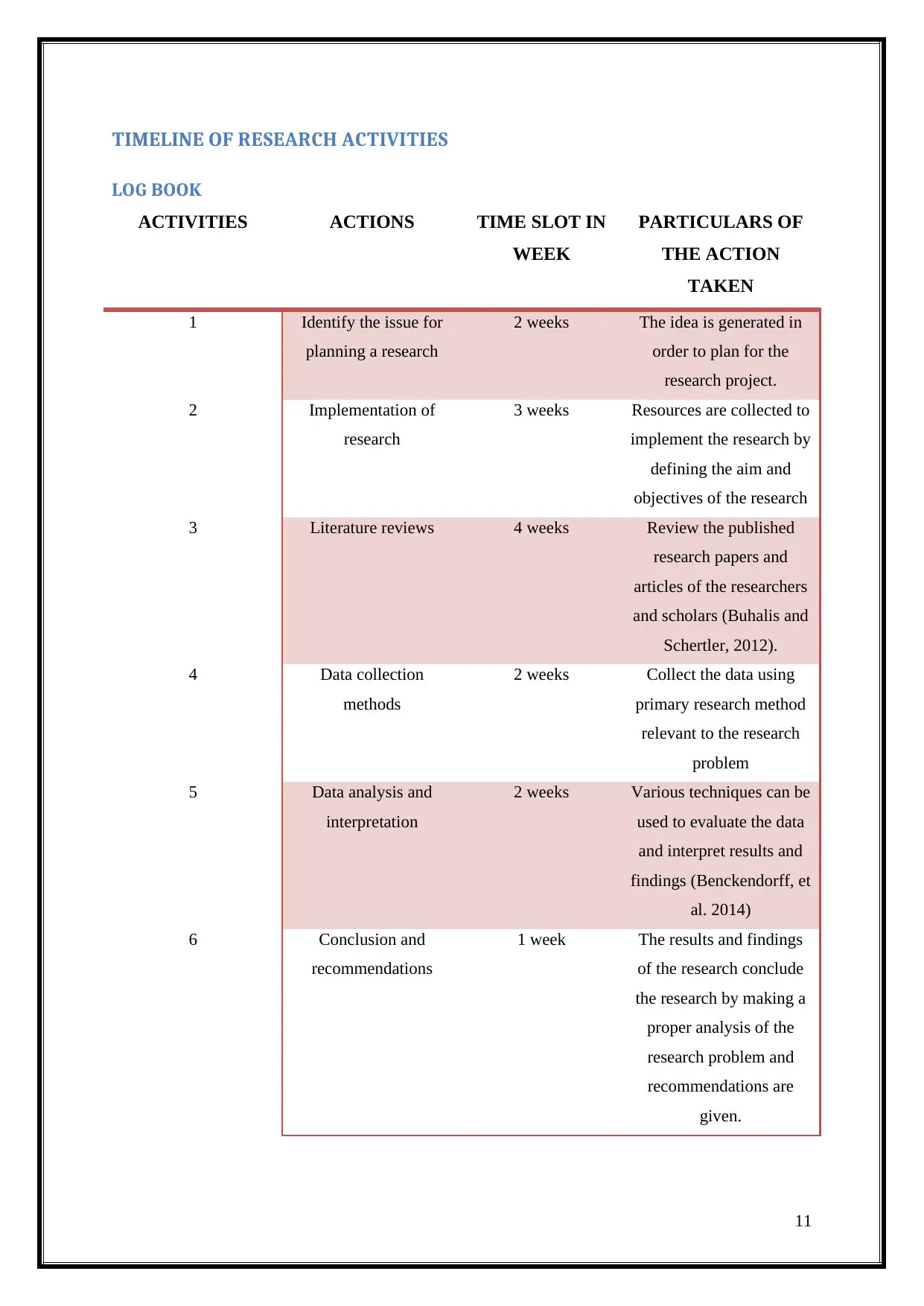
TIMELINE OF RESEARCH ACTIVITIES
LOG BOOK
ACTIVITIES ACTIONS TIME SLOT IN
WEEK
PARTICULARS OF
THE ACTION
TAKEN
1 Identify the issue for
planning a research
2 weeks The idea is generated in
order to plan for the
research project.
2 Implementation of
research
3 weeks Resources are collected to
implement the research by
defining the aim and
objectives of the research
3 Literature reviews 4 weeks Review the published
research papers and
articles of the researchers
and scholars (Buhalis and
Schertler, 2012).
4 Data collection
methods
2 weeks Collect the data using
primary research method
relevant to the research
problem
5 Data analysis and
interpretation
2 weeks Various techniques can be
used to evaluate the data
and interpret results and
findings (Benckendorff, et
al. 2014)
6 Conclusion and
recommendations
1 week The results and findings
of the research conclude
the research by making a
proper analysis of the
research problem and
recommendations are
given.
11
LOG BOOK
ACTIVITIES ACTIONS TIME SLOT IN
WEEK
PARTICULARS OF
THE ACTION
TAKEN
1 Identify the issue for
planning a research
2 weeks The idea is generated in
order to plan for the
research project.
2 Implementation of
research
3 weeks Resources are collected to
implement the research by
defining the aim and
objectives of the research
3 Literature reviews 4 weeks Review the published
research papers and
articles of the researchers
and scholars (Buhalis and
Schertler, 2012).
4 Data collection
methods
2 weeks Collect the data using
primary research method
relevant to the research
problem
5 Data analysis and
interpretation
2 weeks Various techniques can be
used to evaluate the data
and interpret results and
findings (Benckendorff, et
al. 2014)
6 Conclusion and
recommendations
1 week The results and findings
of the research conclude
the research by making a
proper analysis of the
research problem and
recommendations are
given.
11
⊘ This is a preview!⊘
Do you want full access?
Subscribe today to unlock all pages.
Trusted by 1+ million students worldwide

1 out of 34


Related Documents


Your All-in-One AI-Powered Toolkit for Academic Success.
+13062052269
info@desklib.com
Available 24*7 on WhatsApp / Email
![[object Object]](/_next/static/media/star-bottom.7253800d.svg)
Unlock your academic potential
Copyright © 2020–2026 A2Z Services. All Rights Reserved. Developed and managed by ZUCOL.