Report: Impact of Digital Technology on Business Operations
VerifiedAdded on 2020/10/05
|29
|7506
|423
Report
AI Summary
This report critically analyzes the impact of digital technology on business operations, structured into research project management, project implementation and logbook, and research analysis and performance review. It explores both positive outcomes, such as enhanced employee communication and cost reduction, and negative outcomes, including increased costs and loss of personal touch. The report details the project management plan, including costs, scope, and timelines for various deliverables like survey questions, data collection, and analysis. It utilizes both qualitative and quantitative research methods, including secondary data analysis and online surveys, to assess the benefits and shortcomings of digital technology. The conclusion offers recommendations for leveraging digital technology to improve business practices.
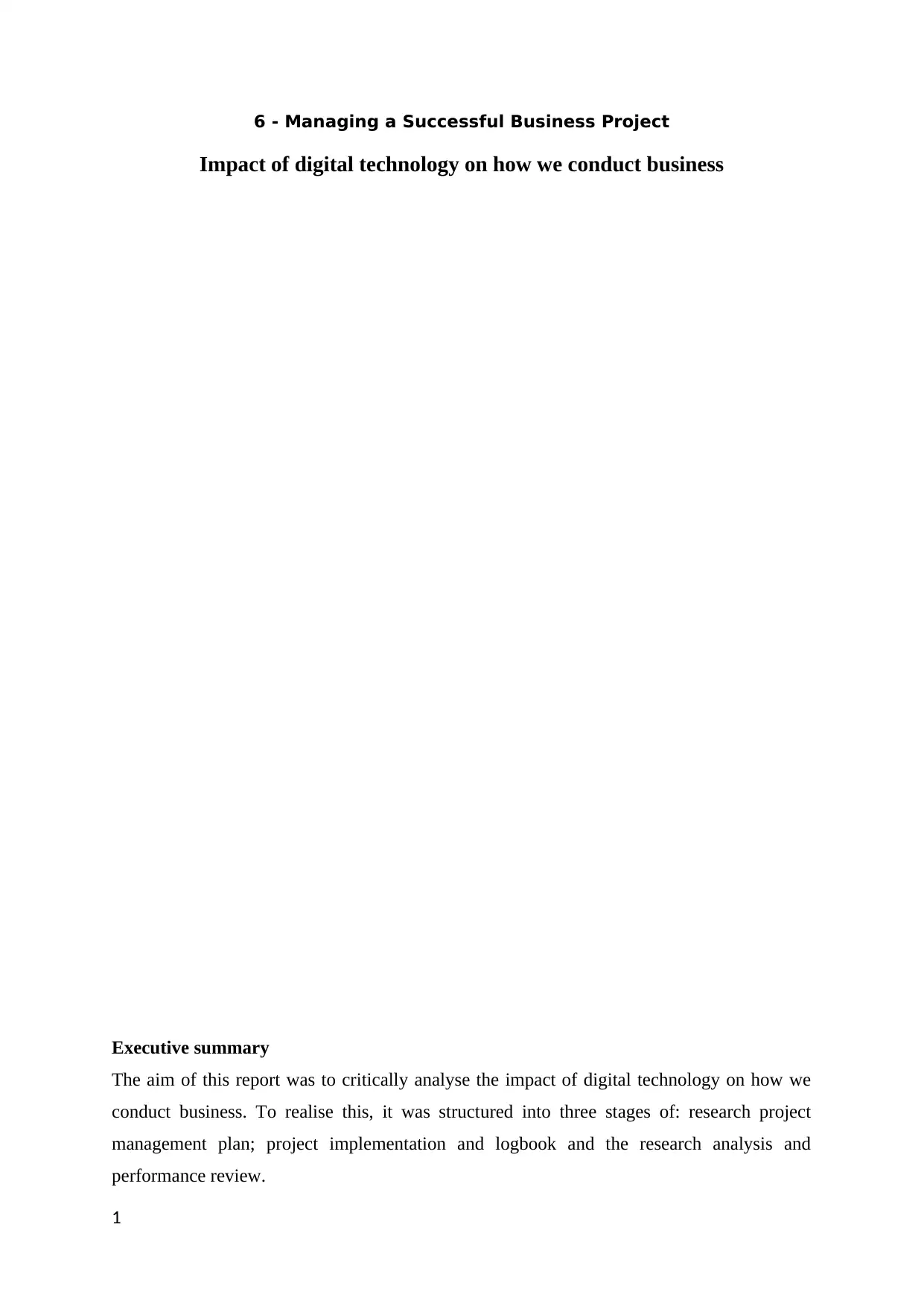
6 - Managing a Successful Business Project
Impact of digital technology on how we conduct business
Executive summary
The aim of this report was to critically analyse the impact of digital technology on how we
conduct business. To realise this, it was structured into three stages of: research project
management plan; project implementation and logbook and the research analysis and
performance review.
1
Impact of digital technology on how we conduct business
Executive summary
The aim of this report was to critically analyse the impact of digital technology on how we
conduct business. To realise this, it was structured into three stages of: research project
management plan; project implementation and logbook and the research analysis and
performance review.
1

Paraphrase This Document
Need a fresh take? Get an instant paraphrase of this document with our AI Paraphraser
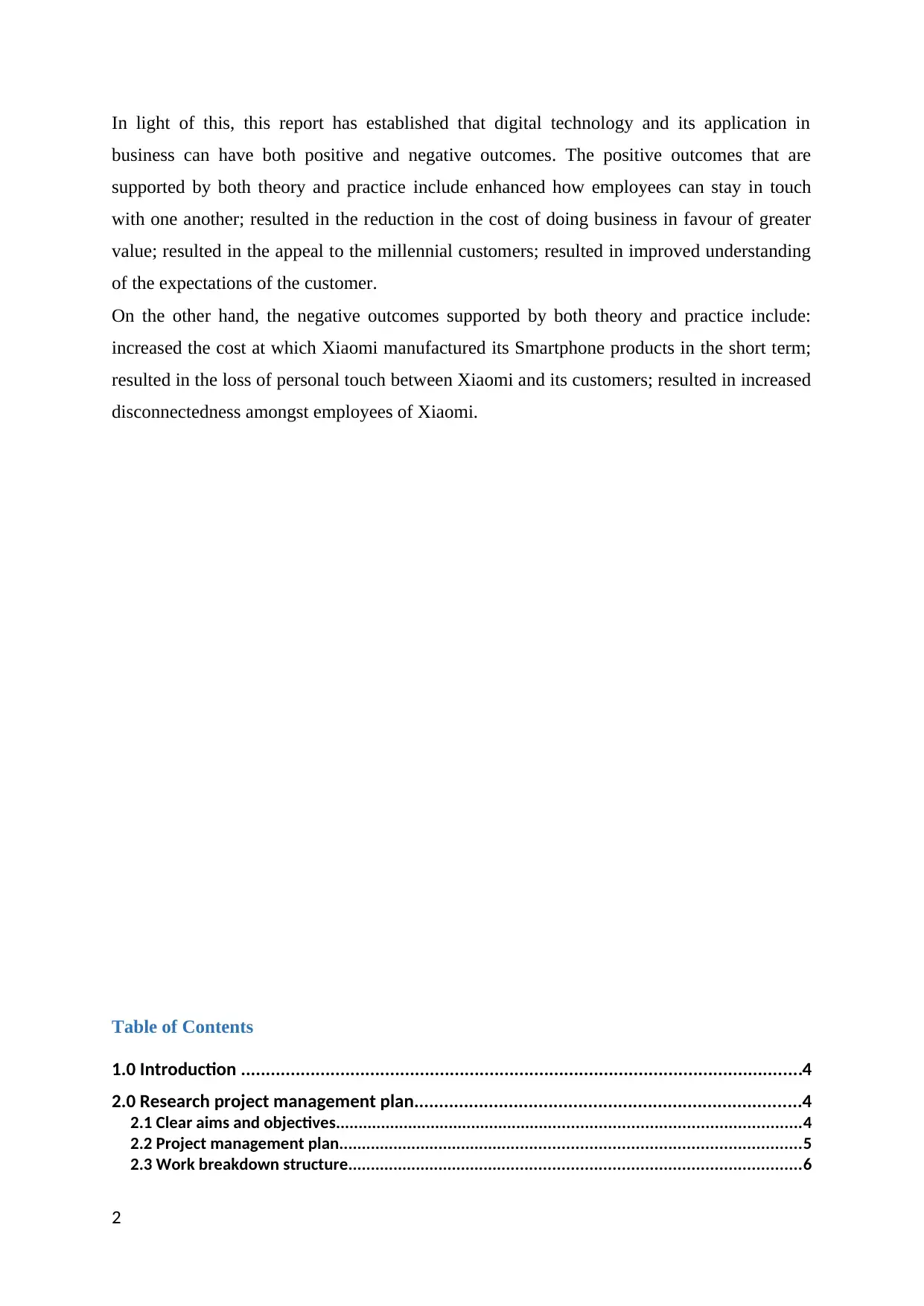
In light of this, this report has established that digital technology and its application in
business can have both positive and negative outcomes. The positive outcomes that are
supported by both theory and practice include enhanced how employees can stay in touch
with one another; resulted in the reduction in the cost of doing business in favour of greater
value; resulted in the appeal to the millennial customers; resulted in improved understanding
of the expectations of the customer.
On the other hand, the negative outcomes supported by both theory and practice include:
increased the cost at which Xiaomi manufactured its Smartphone products in the short term;
resulted in the loss of personal touch between Xiaomi and its customers; resulted in increased
disconnectedness amongst employees of Xiaomi.
Table of Contents
1.0 Introduction .................................................................................................................4
2.0 Research project management plan..............................................................................4
2.1 Clear aims and objectives......................................................................................................4
2.2 Project management plan.....................................................................................................5
2.3 Work breakdown structure...................................................................................................6
2
business can have both positive and negative outcomes. The positive outcomes that are
supported by both theory and practice include enhanced how employees can stay in touch
with one another; resulted in the reduction in the cost of doing business in favour of greater
value; resulted in the appeal to the millennial customers; resulted in improved understanding
of the expectations of the customer.
On the other hand, the negative outcomes supported by both theory and practice include:
increased the cost at which Xiaomi manufactured its Smartphone products in the short term;
resulted in the loss of personal touch between Xiaomi and its customers; resulted in increased
disconnectedness amongst employees of Xiaomi.
Table of Contents
1.0 Introduction .................................................................................................................4
2.0 Research project management plan..............................................................................4
2.1 Clear aims and objectives......................................................................................................4
2.2 Project management plan.....................................................................................................5
2.3 Work breakdown structure...................................................................................................6
2

3.0 Project implementation and log book...........................................................................7
3.1 Research methods................................................................................................................7
3.2 Accuracy and reliability of different research methods..........................................................9
3.2 Project log book and reflections on the business...................................................................9
4.0 Research analysis and performance review.................................................................10
4.1 Analysis of the research and data........................................................................................10
4.2 Communication of appropriate recommendations..............................................................13
4.3 Reflections on value of undertaking the research ...............................................................13
5.0 Conclusion .................................................................................................................14
References.......................................................................................................................15
3
3.1 Research methods................................................................................................................7
3.2 Accuracy and reliability of different research methods..........................................................9
3.2 Project log book and reflections on the business...................................................................9
4.0 Research analysis and performance review.................................................................10
4.1 Analysis of the research and data........................................................................................10
4.2 Communication of appropriate recommendations..............................................................13
4.3 Reflections on value of undertaking the research ...............................................................13
5.0 Conclusion .................................................................................................................14
References.......................................................................................................................15
3
⊘ This is a preview!⊘
Do you want full access?
Subscribe today to unlock all pages.

Trusted by 1+ million students worldwide
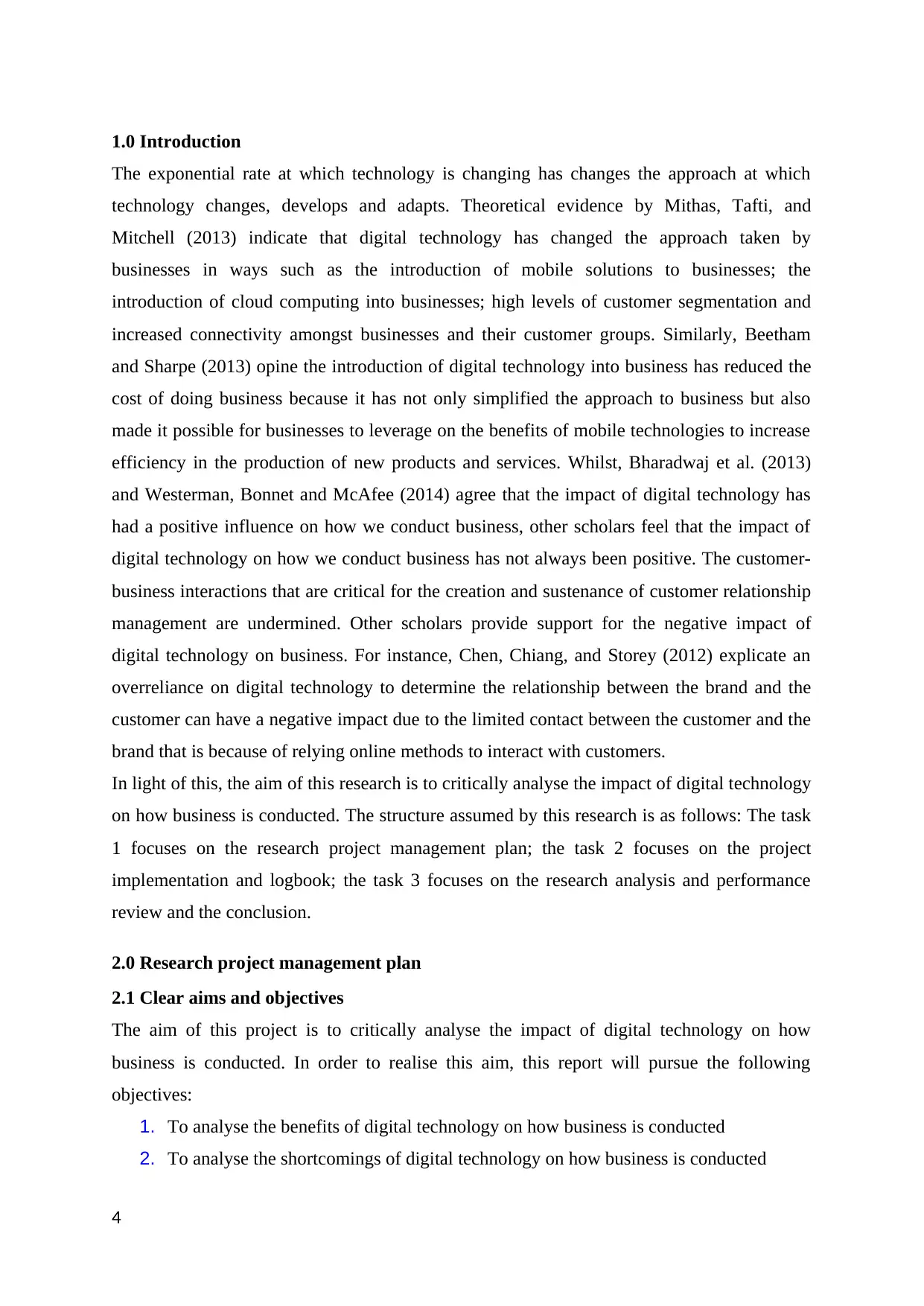
1.0 Introduction
The exponential rate at which technology is changing has changes the approach at which
technology changes, develops and adapts. Theoretical evidence by Mithas, Tafti, and
Mitchell (2013) indicate that digital technology has changed the approach taken by
businesses in ways such as the introduction of mobile solutions to businesses; the
introduction of cloud computing into businesses; high levels of customer segmentation and
increased connectivity amongst businesses and their customer groups. Similarly, Beetham
and Sharpe (2013) opine the introduction of digital technology into business has reduced the
cost of doing business because it has not only simplified the approach to business but also
made it possible for businesses to leverage on the benefits of mobile technologies to increase
efficiency in the production of new products and services. Whilst, Bharadwaj et al. (2013)
and Westerman, Bonnet and McAfee (2014) agree that the impact of digital technology has
had a positive influence on how we conduct business, other scholars feel that the impact of
digital technology on how we conduct business has not always been positive. The customer-
business interactions that are critical for the creation and sustenance of customer relationship
management are undermined. Other scholars provide support for the negative impact of
digital technology on business. For instance, Chen, Chiang, and Storey (2012) explicate an
overreliance on digital technology to determine the relationship between the brand and the
customer can have a negative impact due to the limited contact between the customer and the
brand that is because of relying online methods to interact with customers.
In light of this, the aim of this research is to critically analyse the impact of digital technology
on how business is conducted. The structure assumed by this research is as follows: The task
1 focuses on the research project management plan; the task 2 focuses on the project
implementation and logbook; the task 3 focuses on the research analysis and performance
review and the conclusion.
2.0 Research project management plan
2.1 Clear aims and objectives
The aim of this project is to critically analyse the impact of digital technology on how
business is conducted. In order to realise this aim, this report will pursue the following
objectives:
1. To analyse the benefits of digital technology on how business is conducted
2. To analyse the shortcomings of digital technology on how business is conducted
4
The exponential rate at which technology is changing has changes the approach at which
technology changes, develops and adapts. Theoretical evidence by Mithas, Tafti, and
Mitchell (2013) indicate that digital technology has changed the approach taken by
businesses in ways such as the introduction of mobile solutions to businesses; the
introduction of cloud computing into businesses; high levels of customer segmentation and
increased connectivity amongst businesses and their customer groups. Similarly, Beetham
and Sharpe (2013) opine the introduction of digital technology into business has reduced the
cost of doing business because it has not only simplified the approach to business but also
made it possible for businesses to leverage on the benefits of mobile technologies to increase
efficiency in the production of new products and services. Whilst, Bharadwaj et al. (2013)
and Westerman, Bonnet and McAfee (2014) agree that the impact of digital technology has
had a positive influence on how we conduct business, other scholars feel that the impact of
digital technology on how we conduct business has not always been positive. The customer-
business interactions that are critical for the creation and sustenance of customer relationship
management are undermined. Other scholars provide support for the negative impact of
digital technology on business. For instance, Chen, Chiang, and Storey (2012) explicate an
overreliance on digital technology to determine the relationship between the brand and the
customer can have a negative impact due to the limited contact between the customer and the
brand that is because of relying online methods to interact with customers.
In light of this, the aim of this research is to critically analyse the impact of digital technology
on how business is conducted. The structure assumed by this research is as follows: The task
1 focuses on the research project management plan; the task 2 focuses on the project
implementation and logbook; the task 3 focuses on the research analysis and performance
review and the conclusion.
2.0 Research project management plan
2.1 Clear aims and objectives
The aim of this project is to critically analyse the impact of digital technology on how
business is conducted. In order to realise this aim, this report will pursue the following
objectives:
1. To analyse the benefits of digital technology on how business is conducted
2. To analyse the shortcomings of digital technology on how business is conducted
4
Paraphrase This Document
Need a fresh take? Get an instant paraphrase of this document with our AI Paraphraser
3. To provide recommendations on how businesses can leverage on digital technology to
improve how business is conducted.
2.2 Project management plan
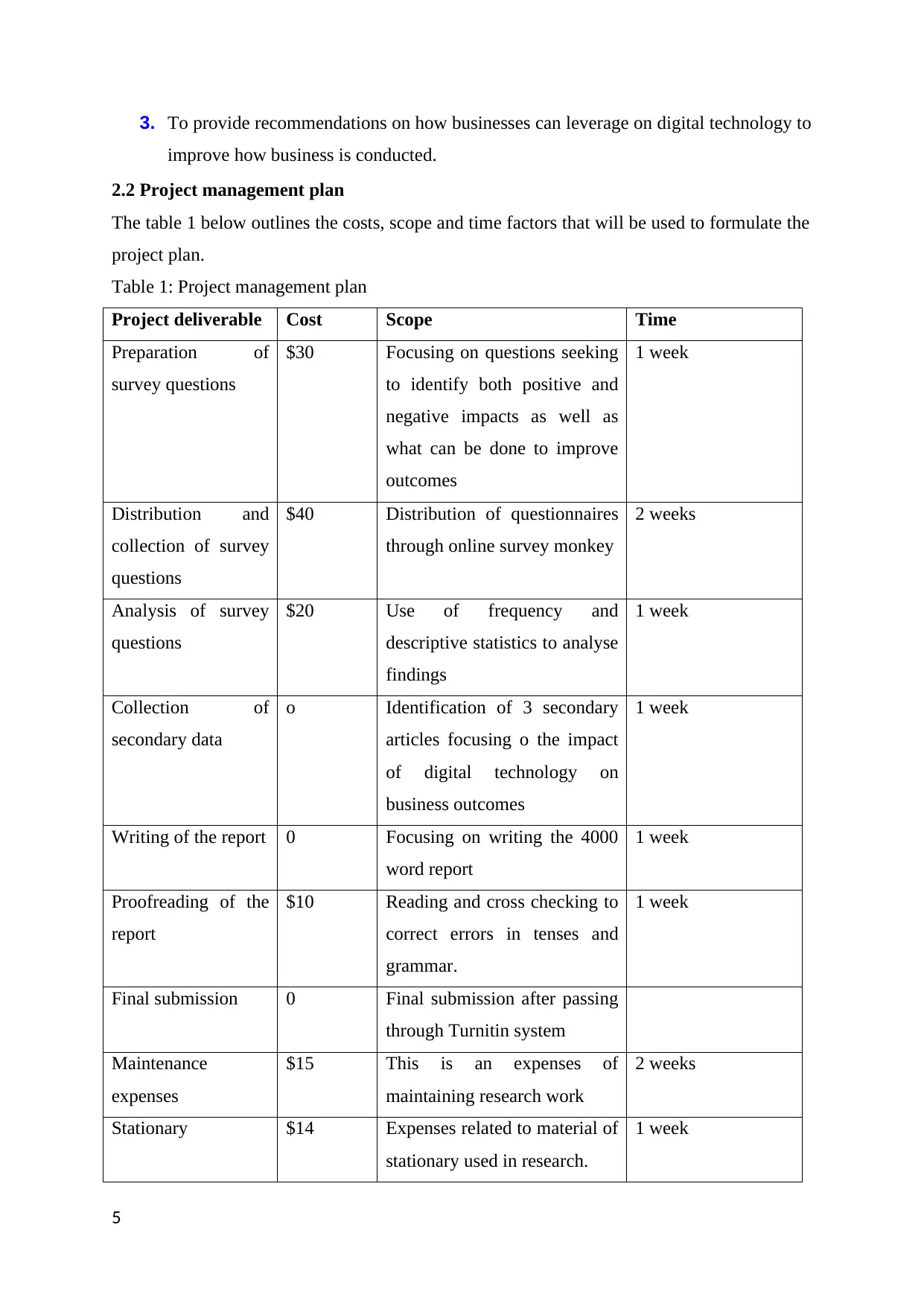
The table 1 below outlines the costs, scope and time factors that will be used to formulate the
project plan.
Table 1: Project management plan
Project deliverable Cost Scope Time
Preparation of
survey questions
$30 Focusing on questions seeking
to identify both positive and
negative impacts as well as
what can be done to improve
outcomes
1 week
Distribution and
collection of survey
questions
$40 Distribution of questionnaires
through online survey monkey
2 weeks
Analysis of survey
questions
$20 Use of frequency and
descriptive statistics to analyse
findings
1 week
Collection of
secondary data
o Identification of 3 secondary
articles focusing o the impact
of digital technology on
business outcomes
1 week
Writing of the report 0 Focusing on writing the 4000
word report
1 week
Proofreading of the
report
$10 Reading and cross checking to
correct errors in tenses and
grammar.
1 week
Final submission 0 Final submission after passing
through Turnitin system
Maintenance
expenses
$15 This is an expenses of
maintaining research work
2 weeks
Stationary $14 Expenses related to material of
stationary used in research.
1 week
5
improve how business is conducted.
2.2 Project management plan
The table 1 below outlines the costs, scope and time factors that will be used to formulate the
project plan.
Table 1: Project management plan
Project deliverable Cost Scope Time
Preparation of
survey questions
$30 Focusing on questions seeking
to identify both positive and
negative impacts as well as
what can be done to improve
outcomes
1 week
Distribution and
collection of survey
questions
$40 Distribution of questionnaires
through online survey monkey
2 weeks
Analysis of survey
questions
$20 Use of frequency and
descriptive statistics to analyse
findings
1 week
Collection of
secondary data
o Identification of 3 secondary
articles focusing o the impact
of digital technology on
business outcomes
1 week
Writing of the report 0 Focusing on writing the 4000
word report
1 week
Proofreading of the
report
$10 Reading and cross checking to
correct errors in tenses and
grammar.
1 week
Final submission 0 Final submission after passing
through Turnitin system
Maintenance
expenses
$15 This is an expenses of
maintaining research work
2 weeks
Stationary $14 Expenses related to material of
stationary used in research.
1 week
5
Source: Summarised by this report
As manifested in the above project management plan, the project on the impact of digital
technology on how we conduct business will involve 7 main deliverables.
In the first deliverable, preparation of the survey questions will be done. Its purpose will be to
prepare the study to collect primary data that will be useful in analysing the research
objectives. This exercise is expected to take 1 week and will cost approximately $30.
In the second deliverable, the online questionnaire will be distributed and collected back from
the respondents after a period of 2 weeks. The assigned cost for this activity is $40 because of
the logistics involved in the distribution and collection of online questionnaires from the
respondents.
In the third deliverable, the analysis of the collected finding is done. The exercise is expected
to take up to 1 week and will involve the use of frequency and descriptive statistics to
leverage on the measures of central tendencies to determine the views of the respondents with
regards to the research objectives laid out. Based on a logistical standpoint, the whole process
is expected to cost $20.
In the fourth deliverable, the identification of three secondary research articles focusing on
the impact of digital technology on business outcomes is done. The exercise of collection will
take up 1 week and will focus on the identification of peer reviewed journal articles. The cost
of the identification and collection of secondary research articles will be zero and it can be
done concurrently with the identification of three secondary research articles.
In the fifth deliverable, the writing of the report is done. This involves the writing of the
report based on the three objectives and sections of: analysis of research project management
plan; project implementation and logbook; research analysis and performance. This
deliverable will cost zero because it does not require any cost to write the report based on the
approach to doing, findings, and their implications. The time implication for writing down the
report will be a one-week period.
In the sixth deliverable, the proofreading of the report is done. This will involve identifying
an independent colleague and asking them to read the report directly and identify any
grammatical errors, tenses errors and other inconsistencies that could undermine the quality
of the findings. This exercise will also take a week but will also be done in concurrence with
the writing of the report.
In the seventh and final deliverable, the final project is delivered. This will involve zero costs
because delivery via Turnitin does not require any additional costs. The process will be dome
6
As manifested in the above project management plan, the project on the impact of digital
technology on how we conduct business will involve 7 main deliverables.
In the first deliverable, preparation of the survey questions will be done. Its purpose will be to
prepare the study to collect primary data that will be useful in analysing the research
objectives. This exercise is expected to take 1 week and will cost approximately $30.
In the second deliverable, the online questionnaire will be distributed and collected back from
the respondents after a period of 2 weeks. The assigned cost for this activity is $40 because of
the logistics involved in the distribution and collection of online questionnaires from the
respondents.
In the third deliverable, the analysis of the collected finding is done. The exercise is expected
to take up to 1 week and will involve the use of frequency and descriptive statistics to
leverage on the measures of central tendencies to determine the views of the respondents with
regards to the research objectives laid out. Based on a logistical standpoint, the whole process
is expected to cost $20.
In the fourth deliverable, the identification of three secondary research articles focusing on
the impact of digital technology on business outcomes is done. The exercise of collection will
take up 1 week and will focus on the identification of peer reviewed journal articles. The cost
of the identification and collection of secondary research articles will be zero and it can be
done concurrently with the identification of three secondary research articles.
In the fifth deliverable, the writing of the report is done. This involves the writing of the
report based on the three objectives and sections of: analysis of research project management
plan; project implementation and logbook; research analysis and performance. This
deliverable will cost zero because it does not require any cost to write the report based on the
approach to doing, findings, and their implications. The time implication for writing down the
report will be a one-week period.
In the sixth deliverable, the proofreading of the report is done. This will involve identifying
an independent colleague and asking them to read the report directly and identify any
grammatical errors, tenses errors and other inconsistencies that could undermine the quality
of the findings. This exercise will also take a week but will also be done in concurrence with
the writing of the report.
In the seventh and final deliverable, the final project is delivered. This will involve zero costs
because delivery via Turnitin does not require any additional costs. The process will be dome
6
⊘ This is a preview!⊘
Do you want full access?
Subscribe today to unlock all pages.
Trusted by 1+ million students worldwide
in the course of 1 week and will be done in concurrence with other activities. The final
submission of the report will signal the completion of the project.
2.3 Work breakdown structure
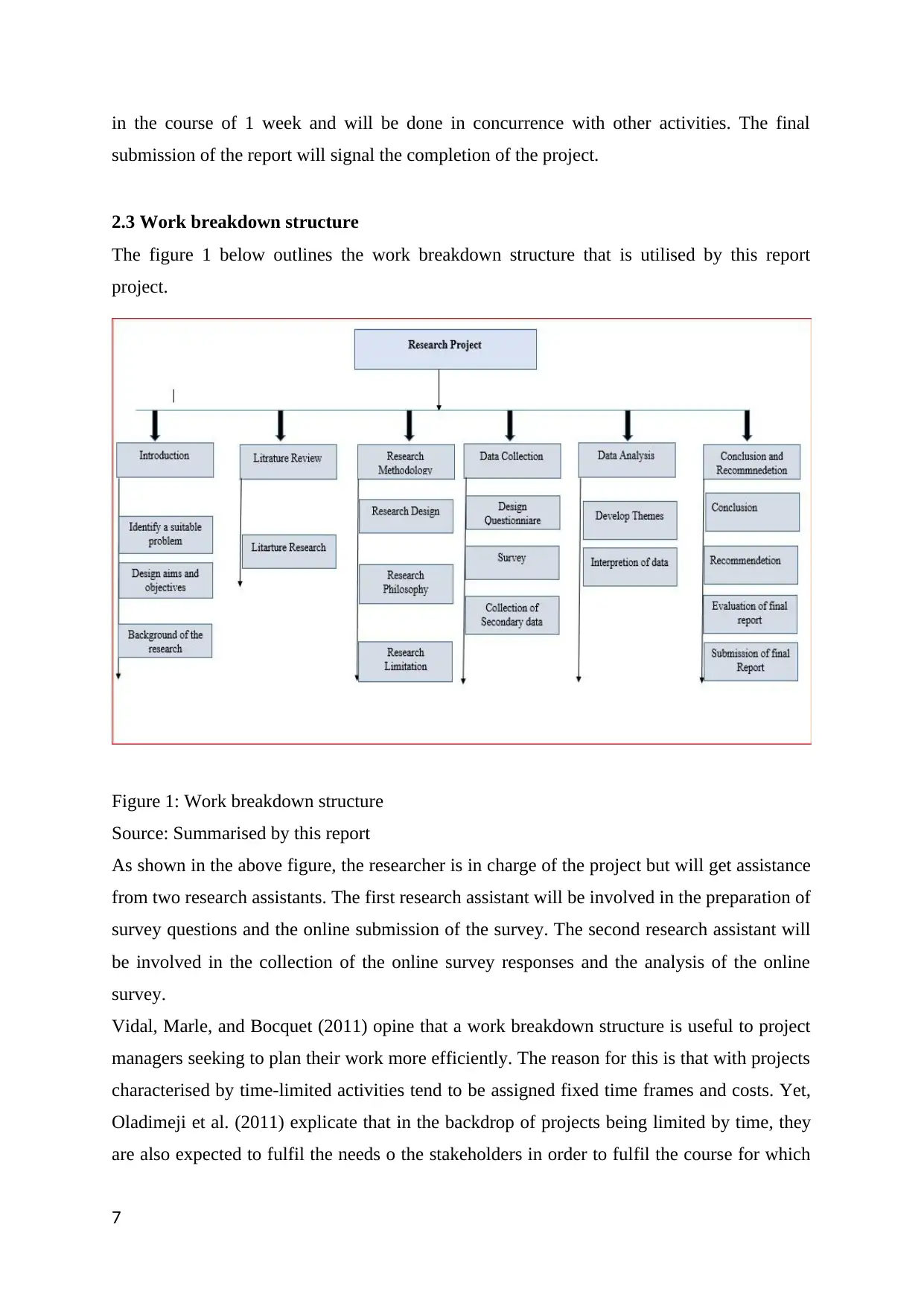
The figure 1 below outlines the work breakdown structure that is utilised by this report
project.
Figure 1: Work breakdown structure
Source: Summarised by this report
As shown in the above figure, the researcher is in charge of the project but will get assistance
from two research assistants. The first research assistant will be involved in the preparation of
survey questions and the online submission of the survey. The second research assistant will
be involved in the collection of the online survey responses and the analysis of the online
survey.
Vidal, Marle, and Bocquet (2011) opine that a work breakdown structure is useful to project
managers seeking to plan their work more efficiently. The reason for this is that with projects
characterised by time-limited activities tend to be assigned fixed time frames and costs. Yet,
Oladimeji et al. (2011) explicate that in the backdrop of projects being limited by time, they
are also expected to fulfil the needs o the stakeholders in order to fulfil the course for which
7
submission of the report will signal the completion of the project.
2.3 Work breakdown structure
The figure 1 below outlines the work breakdown structure that is utilised by this report
project.
Figure 1: Work breakdown structure
Source: Summarised by this report
As shown in the above figure, the researcher is in charge of the project but will get assistance
from two research assistants. The first research assistant will be involved in the preparation of
survey questions and the online submission of the survey. The second research assistant will
be involved in the collection of the online survey responses and the analysis of the online
survey.
Vidal, Marle, and Bocquet (2011) opine that a work breakdown structure is useful to project
managers seeking to plan their work more efficiently. The reason for this is that with projects
characterised by time-limited activities tend to be assigned fixed time frames and costs. Yet,
Oladimeji et al. (2011) explicate that in the backdrop of projects being limited by time, they
are also expected to fulfil the needs o the stakeholders in order to fulfil the course for which
7
Paraphrase This Document
Need a fresh take? Get an instant paraphrase of this document with our AI Paraphraser
they are addressed. Leveraging on this view, it appears that the decision by the researcher to
leverage on the assistance of two research assistants enables the researcher to not only
complete the research project on time but to also conduct it effectively and efficiently by
leveraging on the knowledge of the research assistants.
8
leverage on the assistance of two research assistants enables the researcher to not only
complete the research project on time but to also conduct it effectively and efficiently by
leveraging on the knowledge of the research assistants.
8
3.0 Project implementation and log book
3.1 Research methods
In the choice of research methods, this report utilised both the qualitative and the quantitative
research methods. The choice of the quantitative research methods was informed by the need
to overcome the shortcomings of either choice of research methods. For instance, whilst
scholars such as Bernard and Bernard (2012) and Bowling (2014) agree the qualitative
research method has a weakness of replicability whereby it is not easy to replicate the
findings due to the nature of research participants and methods of inquiry, other scholars are
of the view that by using quantitative research methods, it is possible to replicate research
findings because they are dependent on scientific methodologies (Gill and Johnson, 2010).
Similarly, whilst Tracey (2012) and Punch and Oancea (2014) criticise the quantitative
research method as lacking in conducting an in-depth study, other scholars feel that the
approach used by the qualitative research to query and openly engage the research
participants or phenomenon under study makes it ideal to conduct an in-depth study
(Hennink, Hutter and Bailey, 2010). Therefore, in the context of these views, this report
resolved to carry out a small-scale research that applied a mixed research method because it
would also be positively oriented towards meeting the projects aims and objectives because
of the high level of objectivity it would accord to this research.
In the collection of data, this project report utilised both qualitative and quantitative research
methods because of the need to retain uniformity in the choice of research design. In the
9
3.1 Research methods
In the choice of research methods, this report utilised both the qualitative and the quantitative
research methods. The choice of the quantitative research methods was informed by the need
to overcome the shortcomings of either choice of research methods. For instance, whilst
scholars such as Bernard and Bernard (2012) and Bowling (2014) agree the qualitative
research method has a weakness of replicability whereby it is not easy to replicate the
findings due to the nature of research participants and methods of inquiry, other scholars are
of the view that by using quantitative research methods, it is possible to replicate research
findings because they are dependent on scientific methodologies (Gill and Johnson, 2010).
Similarly, whilst Tracey (2012) and Punch and Oancea (2014) criticise the quantitative
research method as lacking in conducting an in-depth study, other scholars feel that the
approach used by the qualitative research to query and openly engage the research
participants or phenomenon under study makes it ideal to conduct an in-depth study
(Hennink, Hutter and Bailey, 2010). Therefore, in the context of these views, this report
resolved to carry out a small-scale research that applied a mixed research method because it
would also be positively oriented towards meeting the projects aims and objectives because
of the high level of objectivity it would accord to this research.
In the collection of data, this project report utilised both qualitative and quantitative research
methods because of the need to retain uniformity in the choice of research design. In the
9
⊘ This is a preview!⊘
Do you want full access?
Subscribe today to unlock all pages.
Trusted by 1+ million students worldwide
collection of qualitative data, this research opted to rely on secondary data methods. This
would involve the reliance on books, articles, and journals focusing on the impact of digital
technology on how businesses are conducted. The secondary research methods were
perceived as ideal because there were pre-existing studies conducted on the impact of digital
technology on how businesses are conducted. Therefore, this eliminated the need to conduct a
new primary qualitative research that focused on the identification of new insights into the
research objectives. As such, this report focused on the identification of peer-reviewed
articles and journals for the secondary data sources. On the other hand, in the collection of the
quantitative data, a questionnaire was used. A questionnaire formed based on the nature of
the research objectives was formulated and used to collect data from respondents drawn from
Xiaomi. The researcher firstly sought to first inform them of the nature and objective of the
study prior to their involvement. Thereafter, the researcher uploaded the online questionnaire
using the online survey monitor. A 2-week period in which the research data was to be
collected was set aside because it was believed it was the ideal time required in order for the
respondents to holistically finish filling in the research questions posed. After the two-week
period, the researcher went about collecting the questionnaires in order to prepare for the
analysis. Having initially expected to receive about 136 questionnaires, the respondent
managed to collect 100 fully completed questionnaires that could not be used for the process
of collecting data. Therefore, this research relied on 100 fully filled questionnaires for the
analysis of the findings and implications for this research.
3.2 Accuracy and reliability of different research methods
There are two type of research methods used in data collection that gives required
information needs for decision making and draw future planes these are as-
Primary data collection: When data are collected directly by the researchers for the
first time the it is termed as primary data collection method. Primary data is collected through
questionnaire, focus group interviews, projective techniques and through delphi method.
This type of method of data collection is used when information required is important and
specific information is needed.
Secondary data collection: It is referred to the data that is collected by someone who
is other then the user. Common source of data of collection this information is social media,
google or pre statistical information that is collected for some other purpose.
According to Marshall et al. (2010), accuracy in research refers to the closeness that a
particular measured value has to a standard or known value. On the other hand, theoretical
10
would involve the reliance on books, articles, and journals focusing on the impact of digital
technology on how businesses are conducted. The secondary research methods were
perceived as ideal because there were pre-existing studies conducted on the impact of digital
technology on how businesses are conducted. Therefore, this eliminated the need to conduct a
new primary qualitative research that focused on the identification of new insights into the
research objectives. As such, this report focused on the identification of peer-reviewed
articles and journals for the secondary data sources. On the other hand, in the collection of the
quantitative data, a questionnaire was used. A questionnaire formed based on the nature of
the research objectives was formulated and used to collect data from respondents drawn from
Xiaomi. The researcher firstly sought to first inform them of the nature and objective of the
study prior to their involvement. Thereafter, the researcher uploaded the online questionnaire
using the online survey monitor. A 2-week period in which the research data was to be
collected was set aside because it was believed it was the ideal time required in order for the
respondents to holistically finish filling in the research questions posed. After the two-week
period, the researcher went about collecting the questionnaires in order to prepare for the
analysis. Having initially expected to receive about 136 questionnaires, the respondent
managed to collect 100 fully completed questionnaires that could not be used for the process
of collecting data. Therefore, this research relied on 100 fully filled questionnaires for the
analysis of the findings and implications for this research.
3.2 Accuracy and reliability of different research methods
There are two type of research methods used in data collection that gives required
information needs for decision making and draw future planes these are as-
Primary data collection: When data are collected directly by the researchers for the
first time the it is termed as primary data collection method. Primary data is collected through
questionnaire, focus group interviews, projective techniques and through delphi method.
This type of method of data collection is used when information required is important and
specific information is needed.
Secondary data collection: It is referred to the data that is collected by someone who
is other then the user. Common source of data of collection this information is social media,
google or pre statistical information that is collected for some other purpose.
According to Marshall et al. (2010), accuracy in research refers to the closeness that a
particular measured value has to a standard or known value. On the other hand, theoretical
10
Paraphrase This Document
Need a fresh take? Get an instant paraphrase of this document with our AI Paraphraser
evidence by Markon, Chmielesski, and Miller (2011) describe reliability as the degree to
which a particular assessment is likely to produce stable and consistent results.
In the choice of the secondary data collection methods, accuracy and reliability was
determined by the screening of research methods to ensure they were not only academic but
were peer reviewed. In the context of journal articles, utilised, it was screened to ensure that
used sources were not only verified but also sourced from highly reliable websites.
Furthermore, in order to independently verify the accuracy of the secondary data collection
methods, the researcher relied on the research assistants to also check and scrutinise the
research articles and websites used in order to determine if they could be independently
verified. Therefore, by leveraging on these approaches, the researcher ensured that secondary
data methods were objective, accurate, and reliable.
In the choice of the questionnaire data collection method, the researcher ensured that
scientific research methods were utilised. The choice of scientific research methods was
viewed as an embrace of proven approaches that could ensure reliability of the research
findings was guaranteed. Bryman and Bell (2015) argue scientific research methods are free
from the influence and bias of the researcher that is likely to afflict the quality of research.
Therefore, in the choice of the quantitative research methods, this research ensured it utilised
scientific methods of inquiry that are based on a particular proven formula. As such, this
ensured reliability and accuracy of the research findings was guaranteed.
3.2 Project log book and reflections on the business
The direction taken by this project saw me seek out primary data from the employees of
Xiaomi. Having read a lot about Xiaomi, I felt that they posed the ideal organisation for me
to seek out important information regarding my research. I knew that Xiaomi posed the best
possible organisation for me to collect data because as a technology company, they had
heavily relied on digital technology to improve how it conducted its business.
However, the research was not without its challenges. Firstly, there was the challenge of
suspicion. At first, Xiaomi expressed a lot suspicion with regards to the purpose of my
research. They expressed reservations with regards to taking part on the study because they
felt the information could be used to undermine the competitive advantage of Xiaomi by
giving it to its competitors. Yet, after assuring them and showing them my ethical guidelines
that indicated the research was purely academic and its contents would be destroyed once the
findings were analysed, they agreed to take part in the study. Yet, firstly, they requested for
the questions in order to check if there was any question that would prove detrimental to their
11
which a particular assessment is likely to produce stable and consistent results.
In the choice of the secondary data collection methods, accuracy and reliability was
determined by the screening of research methods to ensure they were not only academic but
were peer reviewed. In the context of journal articles, utilised, it was screened to ensure that
used sources were not only verified but also sourced from highly reliable websites.
Furthermore, in order to independently verify the accuracy of the secondary data collection
methods, the researcher relied on the research assistants to also check and scrutinise the
research articles and websites used in order to determine if they could be independently
verified. Therefore, by leveraging on these approaches, the researcher ensured that secondary
data methods were objective, accurate, and reliable.
In the choice of the questionnaire data collection method, the researcher ensured that
scientific research methods were utilised. The choice of scientific research methods was
viewed as an embrace of proven approaches that could ensure reliability of the research
findings was guaranteed. Bryman and Bell (2015) argue scientific research methods are free
from the influence and bias of the researcher that is likely to afflict the quality of research.
Therefore, in the choice of the quantitative research methods, this research ensured it utilised
scientific methods of inquiry that are based on a particular proven formula. As such, this
ensured reliability and accuracy of the research findings was guaranteed.
3.2 Project log book and reflections on the business
The direction taken by this project saw me seek out primary data from the employees of
Xiaomi. Having read a lot about Xiaomi, I felt that they posed the ideal organisation for me
to seek out important information regarding my research. I knew that Xiaomi posed the best
possible organisation for me to collect data because as a technology company, they had
heavily relied on digital technology to improve how it conducted its business.
However, the research was not without its challenges. Firstly, there was the challenge of
suspicion. At first, Xiaomi expressed a lot suspicion with regards to the purpose of my
research. They expressed reservations with regards to taking part on the study because they
felt the information could be used to undermine the competitive advantage of Xiaomi by
giving it to its competitors. Yet, after assuring them and showing them my ethical guidelines
that indicated the research was purely academic and its contents would be destroyed once the
findings were analysed, they agreed to take part in the study. Yet, firstly, they requested for
the questions in order to check if there was any question that would prove detrimental to their
11
efforts to safeguard their intellectual property data. After, this exercise, they green lighted to
the commencement of the project.
Project Logbook
Name:
Project title: Impact of digital technology on how we conduct business
Date:
Update on weekly research/tasks achieved
Points to consider:
What have you completed?
Project on Impact of digital technology on businesses.
Did you fulfil task requirements?
Yes, all the task are attempted by fulfilling all the requirements that are attached in the
brief.
Are you on track and within deadlines set?
Yes, project is submitted on time as provided to complete it.
Did you need to make any changes to your project management plan?
No, there is no requirement to make changes in project management plan.
Any risks and/or issues identified?
Risk in success of business is identified as high level of skills are required to make
complementary success with digital technology.
Points to consider:
Did you identify risks/issues with a lack of skills required for undertaking research/tasks?
Yes, there is a risk with lack of skill requirement as all the employees working in the
organisation are not highly competent to adopt new technologies.
Did you identify any additional risks/issues that have an impact on the project management
plan?
No, there is no additional risk in the business that have impact on the project management
plan.
Problems encountered
Points to consider:
What barriers
did you face?
Lack of skills
and high
12
the commencement of the project.
Project Logbook
Name:
Project title: Impact of digital technology on how we conduct business
Date:
Update on weekly research/tasks achieved
Points to consider:
What have you completed?
Project on Impact of digital technology on businesses.
Did you fulfil task requirements?
Yes, all the task are attempted by fulfilling all the requirements that are attached in the
brief.
Are you on track and within deadlines set?
Yes, project is submitted on time as provided to complete it.
Did you need to make any changes to your project management plan?
No, there is no requirement to make changes in project management plan.
Any risks and/or issues identified?
Risk in success of business is identified as high level of skills are required to make
complementary success with digital technology.
Points to consider:
Did you identify risks/issues with a lack of skills required for undertaking research/tasks?
Yes, there is a risk with lack of skill requirement as all the employees working in the
organisation are not highly competent to adopt new technologies.
Did you identify any additional risks/issues that have an impact on the project management
plan?
No, there is no additional risk in the business that have impact on the project management
plan.
Problems encountered
Points to consider:
What barriers
did you face?
Lack of skills
and high
12
⊘ This is a preview!⊘
Do you want full access?
Subscribe today to unlock all pages.
Trusted by 1+ million students worldwide

1 out of 29


Related Documents


Your All-in-One AI-Powered Toolkit for Academic Success.
+13062052269
info@desklib.com
Available 24*7 on WhatsApp / Email
![[object Object]](/_next/static/media/star-bottom.7253800d.svg)
Unlock your academic potential
Copyright © 2020–2026 A2Z Services. All Rights Reserved. Developed and managed by ZUCOL.