Research Project: Impact of Digital Technology on SME Performance
VerifiedAdded on 2020/06/04
|29
|7844
|134
Project
AI Summary
This research project investigates the influence of digital technology on the business performance of Small and Medium Enterprises (SMEs), using Apple Guest House as a case study. The project begins with an introduction outlining the importance of technology in modern business operations and sets out the aims and objectives, which include identifying the stages of digital transformation, assessing the challenges of technology integration, and evaluating the implications of digital technology on SMEs. The literature review explores themes such as the stages of digital transformation, challenges in integrating technologies, and the implications of digital technologies, as well as stakeholder engagement. The research methodology chapter details the research strategy, approach, and design, along with data collection methods and ethical considerations. The findings are presented with illustrations. The project concludes with reflections, recommendations, and references, providing a comprehensive analysis of the impact of digital technology on the SME under study.

RESEARCH PROJECT

Paraphrase This Document
Need a fresh take? Get an instant paraphrase of this document with our AI Paraphraser
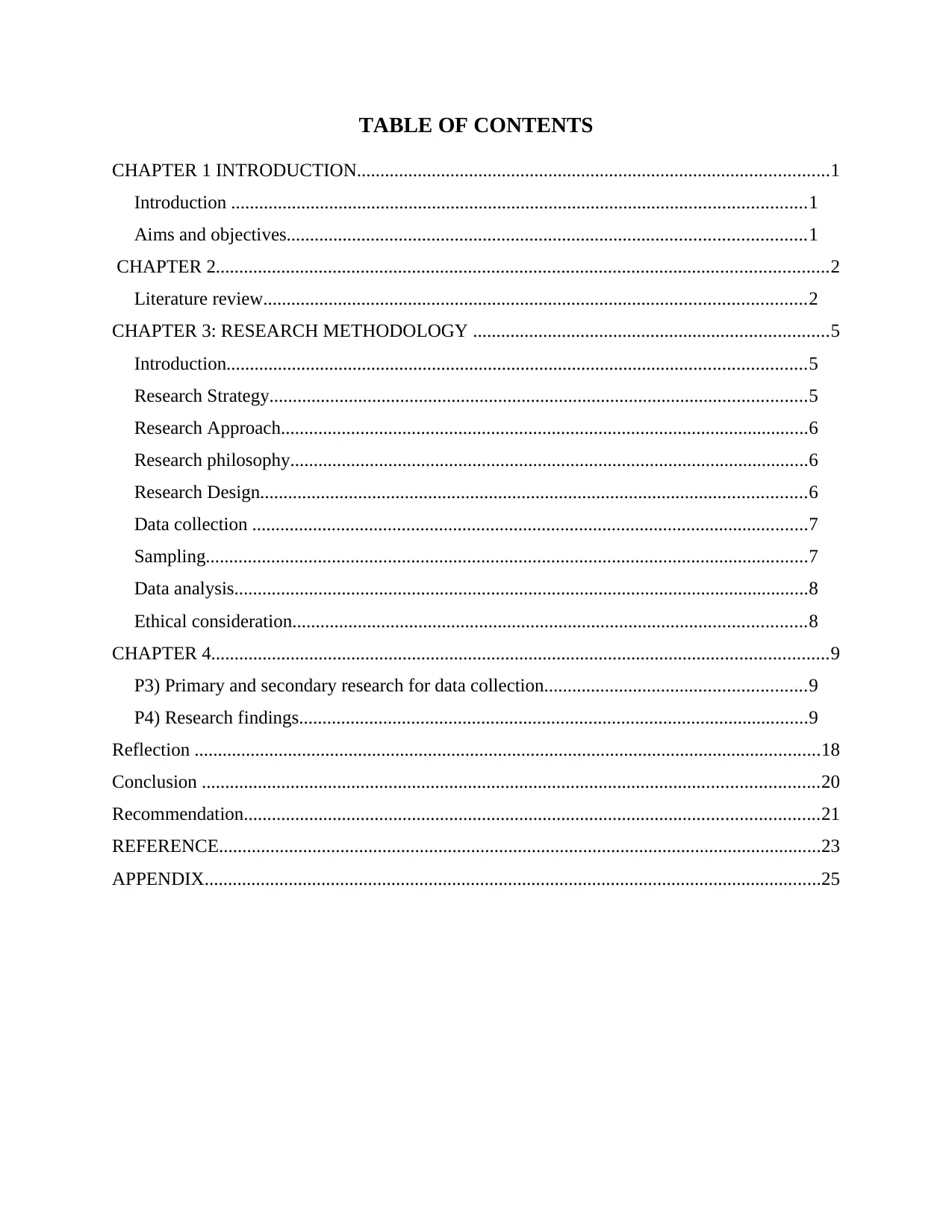
TABLE OF CONTENTS
CHAPTER 1 INTRODUCTION.....................................................................................................1
Introduction ...........................................................................................................................1
Aims and objectives...............................................................................................................1
CHAPTER 2...................................................................................................................................2
Literature review....................................................................................................................2
CHAPTER 3: RESEARCH METHODOLOGY ............................................................................5
Introduction............................................................................................................................5
Research Strategy...................................................................................................................5
Research Approach.................................................................................................................6
Research philosophy...............................................................................................................6
Research Design.....................................................................................................................6
Data collection .......................................................................................................................7
Sampling.................................................................................................................................7
Data analysis...........................................................................................................................8
Ethical consideration..............................................................................................................8
CHAPTER 4....................................................................................................................................9
P3) Primary and secondary research for data collection........................................................9
P4) Research findings.............................................................................................................9
Reflection ......................................................................................................................................18
Conclusion ....................................................................................................................................20
Recommendation...........................................................................................................................21
REFERENCE.................................................................................................................................23
APPENDIX....................................................................................................................................25
CHAPTER 1 INTRODUCTION.....................................................................................................1
Introduction ...........................................................................................................................1
Aims and objectives...............................................................................................................1
CHAPTER 2...................................................................................................................................2
Literature review....................................................................................................................2
CHAPTER 3: RESEARCH METHODOLOGY ............................................................................5
Introduction............................................................................................................................5
Research Strategy...................................................................................................................5
Research Approach.................................................................................................................6
Research philosophy...............................................................................................................6
Research Design.....................................................................................................................6
Data collection .......................................................................................................................7
Sampling.................................................................................................................................7
Data analysis...........................................................................................................................8
Ethical consideration..............................................................................................................8
CHAPTER 4....................................................................................................................................9
P3) Primary and secondary research for data collection........................................................9
P4) Research findings.............................................................................................................9
Reflection ......................................................................................................................................18
Conclusion ....................................................................................................................................20
Recommendation...........................................................................................................................21
REFERENCE.................................................................................................................................23
APPENDIX....................................................................................................................................25
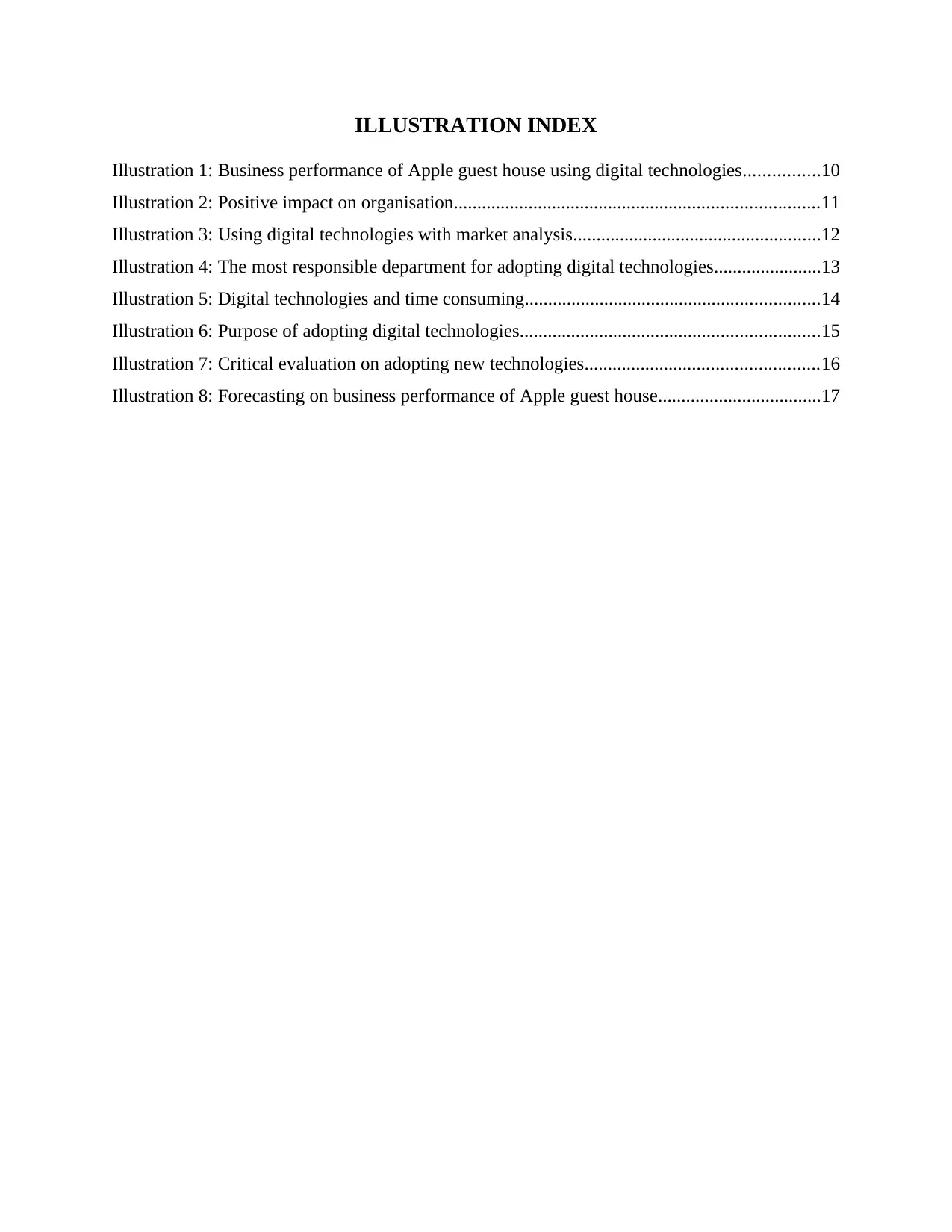
ILLUSTRATION INDEX
Illustration 1: Business performance of Apple guest house using digital technologies................10
Illustration 2: Positive impact on organisation..............................................................................11
Illustration 3: Using digital technologies with market analysis.....................................................12
Illustration 4: The most responsible department for adopting digital technologies.......................13
Illustration 5: Digital technologies and time consuming...............................................................14
Illustration 6: Purpose of adopting digital technologies................................................................15
Illustration 7: Critical evaluation on adopting new technologies..................................................16
Illustration 8: Forecasting on business performance of Apple guest house...................................17
Illustration 1: Business performance of Apple guest house using digital technologies................10
Illustration 2: Positive impact on organisation..............................................................................11
Illustration 3: Using digital technologies with market analysis.....................................................12
Illustration 4: The most responsible department for adopting digital technologies.......................13
Illustration 5: Digital technologies and time consuming...............................................................14
Illustration 6: Purpose of adopting digital technologies................................................................15
Illustration 7: Critical evaluation on adopting new technologies..................................................16
Illustration 8: Forecasting on business performance of Apple guest house...................................17
⊘ This is a preview!⊘
Do you want full access?
Subscribe today to unlock all pages.

Trusted by 1+ million students worldwide
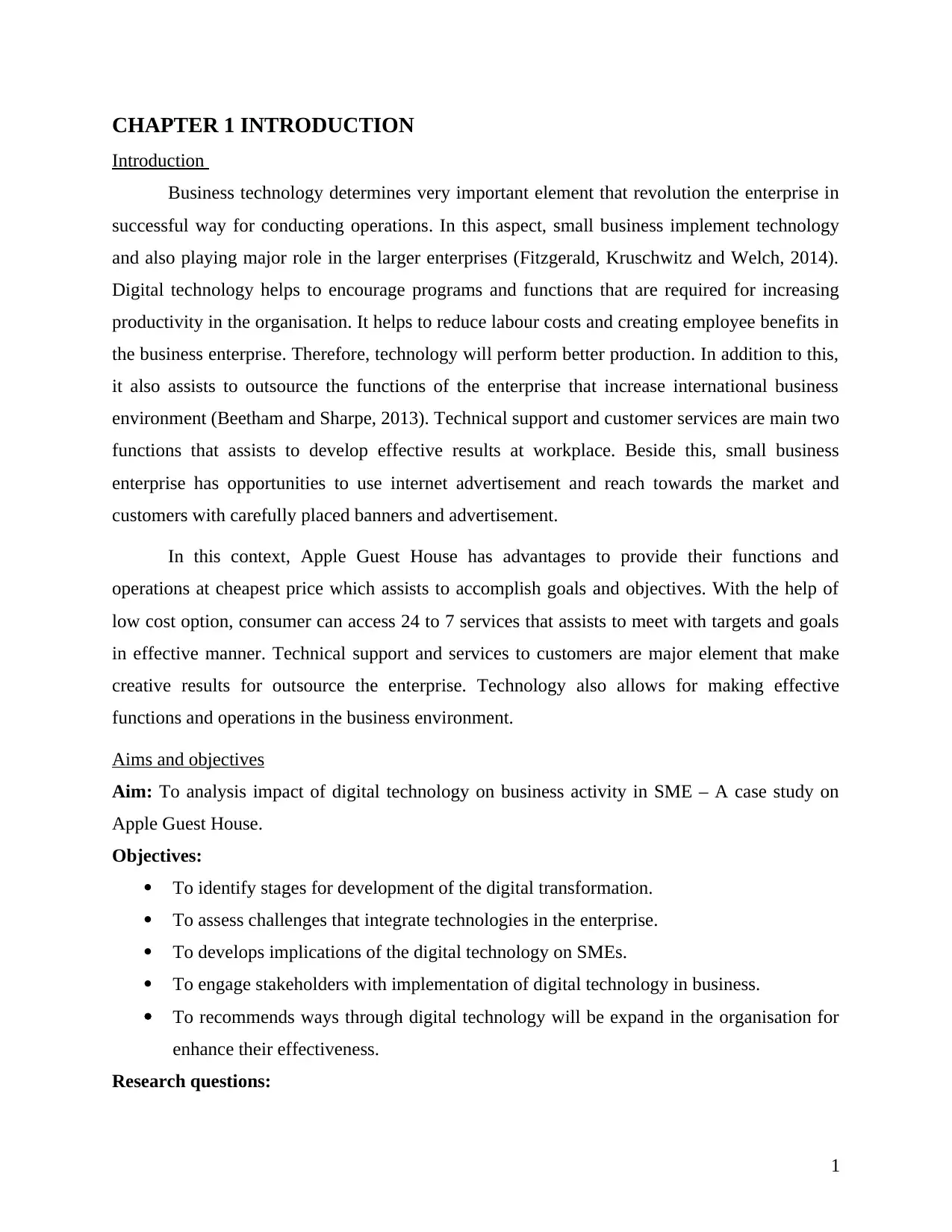
CHAPTER 1 INTRODUCTION
Introduction
Business technology determines very important element that revolution the enterprise in
successful way for conducting operations. In this aspect, small business implement technology
and also playing major role in the larger enterprises (Fitzgerald, Kruschwitz and Welch, 2014).
Digital technology helps to encourage programs and functions that are required for increasing
productivity in the organisation. It helps to reduce labour costs and creating employee benefits in
the business enterprise. Therefore, technology will perform better production. In addition to this,
it also assists to outsource the functions of the enterprise that increase international business
environment (Beetham and Sharpe, 2013). Technical support and customer services are main two
functions that assists to develop effective results at workplace. Beside this, small business
enterprise has opportunities to use internet advertisement and reach towards the market and
customers with carefully placed banners and advertisement.
In this context, Apple Guest House has advantages to provide their functions and
operations at cheapest price which assists to accomplish goals and objectives. With the help of
low cost option, consumer can access 24 to 7 services that assists to meet with targets and goals
in effective manner. Technical support and services to customers are major element that make
creative results for outsource the enterprise. Technology also allows for making effective
functions and operations in the business environment.
Aims and objectives
Aim: To analysis impact of digital technology on business activity in SME – A case study on
Apple Guest House.
Objectives:
To identify stages for development of the digital transformation.
To assess challenges that integrate technologies in the enterprise.
To develops implications of the digital technology on SMEs.
To engage stakeholders with implementation of digital technology in business.
To recommends ways through digital technology will be expand in the organisation for
enhance their effectiveness.
Research questions:
1
Introduction
Business technology determines very important element that revolution the enterprise in
successful way for conducting operations. In this aspect, small business implement technology
and also playing major role in the larger enterprises (Fitzgerald, Kruschwitz and Welch, 2014).
Digital technology helps to encourage programs and functions that are required for increasing
productivity in the organisation. It helps to reduce labour costs and creating employee benefits in
the business enterprise. Therefore, technology will perform better production. In addition to this,
it also assists to outsource the functions of the enterprise that increase international business
environment (Beetham and Sharpe, 2013). Technical support and customer services are main two
functions that assists to develop effective results at workplace. Beside this, small business
enterprise has opportunities to use internet advertisement and reach towards the market and
customers with carefully placed banners and advertisement.
In this context, Apple Guest House has advantages to provide their functions and
operations at cheapest price which assists to accomplish goals and objectives. With the help of
low cost option, consumer can access 24 to 7 services that assists to meet with targets and goals
in effective manner. Technical support and services to customers are major element that make
creative results for outsource the enterprise. Technology also allows for making effective
functions and operations in the business environment.
Aims and objectives
Aim: To analysis impact of digital technology on business activity in SME – A case study on
Apple Guest House.
Objectives:
To identify stages for development of the digital transformation.
To assess challenges that integrate technologies in the enterprise.
To develops implications of the digital technology on SMEs.
To engage stakeholders with implementation of digital technology in business.
To recommends ways through digital technology will be expand in the organisation for
enhance their effectiveness.
Research questions:
1
Paraphrase This Document
Need a fresh take? Get an instant paraphrase of this document with our AI Paraphraser
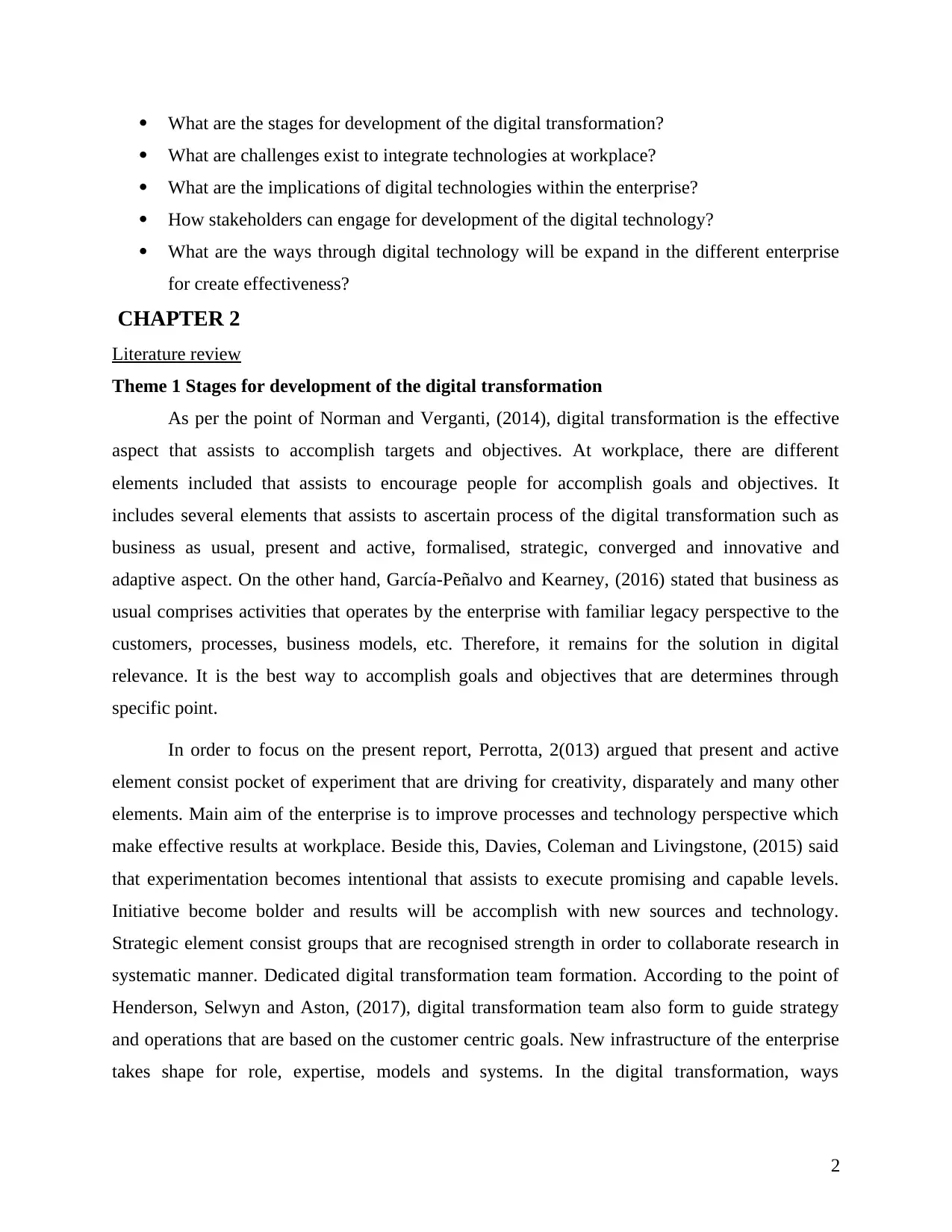
What are the stages for development of the digital transformation?
What are challenges exist to integrate technologies at workplace?
What are the implications of digital technologies within the enterprise?
How stakeholders can engage for development of the digital technology?
What are the ways through digital technology will be expand in the different enterprise
for create effectiveness?
CHAPTER 2
Literature review
Theme 1 Stages for development of the digital transformation
As per the point of Norman and Verganti, (2014), digital transformation is the effective
aspect that assists to accomplish targets and objectives. At workplace, there are different
elements included that assists to encourage people for accomplish goals and objectives. It
includes several elements that assists to ascertain process of the digital transformation such as
business as usual, present and active, formalised, strategic, converged and innovative and
adaptive aspect. On the other hand, García-Peñalvo and Kearney, (2016) stated that business as
usual comprises activities that operates by the enterprise with familiar legacy perspective to the
customers, processes, business models, etc. Therefore, it remains for the solution in digital
relevance. It is the best way to accomplish goals and objectives that are determines through
specific point.
In order to focus on the present report, Perrotta, 2(013) argued that present and active
element consist pocket of experiment that are driving for creativity, disparately and many other
elements. Main aim of the enterprise is to improve processes and technology perspective which
make effective results at workplace. Beside this, Davies, Coleman and Livingstone, (2015) said
that experimentation becomes intentional that assists to execute promising and capable levels.
Initiative become bolder and results will be accomplish with new sources and technology.
Strategic element consist groups that are recognised strength in order to collaborate research in
systematic manner. Dedicated digital transformation team formation. According to the point of
Henderson, Selwyn and Aston, (2017), digital transformation team also form to guide strategy
and operations that are based on the customer centric goals. New infrastructure of the enterprise
takes shape for role, expertise, models and systems. In the digital transformation, ways
2
What are challenges exist to integrate technologies at workplace?
What are the implications of digital technologies within the enterprise?
How stakeholders can engage for development of the digital technology?
What are the ways through digital technology will be expand in the different enterprise
for create effectiveness?
CHAPTER 2
Literature review
Theme 1 Stages for development of the digital transformation
As per the point of Norman and Verganti, (2014), digital transformation is the effective
aspect that assists to accomplish targets and objectives. At workplace, there are different
elements included that assists to encourage people for accomplish goals and objectives. It
includes several elements that assists to ascertain process of the digital transformation such as
business as usual, present and active, formalised, strategic, converged and innovative and
adaptive aspect. On the other hand, García-Peñalvo and Kearney, (2016) stated that business as
usual comprises activities that operates by the enterprise with familiar legacy perspective to the
customers, processes, business models, etc. Therefore, it remains for the solution in digital
relevance. It is the best way to accomplish goals and objectives that are determines through
specific point.
In order to focus on the present report, Perrotta, 2(013) argued that present and active
element consist pocket of experiment that are driving for creativity, disparately and many other
elements. Main aim of the enterprise is to improve processes and technology perspective which
make effective results at workplace. Beside this, Davies, Coleman and Livingstone, (2015) said
that experimentation becomes intentional that assists to execute promising and capable levels.
Initiative become bolder and results will be accomplish with new sources and technology.
Strategic element consist groups that are recognised strength in order to collaborate research in
systematic manner. Dedicated digital transformation team formation. According to the point of
Henderson, Selwyn and Aston, (2017), digital transformation team also form to guide strategy
and operations that are based on the customer centric goals. New infrastructure of the enterprise
takes shape for role, expertise, models and systems. In the digital transformation, ways
2
determines for the business executives and strategies which recognise for change support
transformation are solidified.
Theme 2 Challenges exist to integrate technologies at workplace
As per the point of Thielicke and Stamhuis, (2014), there are several challenges exists
which create impact on the business environment. With this regard, there are several elements
implemented which assists to make effective results in businesses. First challenge in this way
determines is professional development. This challenge faces by the enterprise because of lack of
adequate qualities that are required in employees of the business. Therefore, it consists use of the
specific technology to integrate new capabilities in the business. However, Lloret, Shahab and
Langenberg, (2015) said that results will be develops with new investment and develop process
for innovating and more engaging the customers. It is the best way for ascertain target market for
development of the organisation.
According to the Buckingham, (2013), at workplace of Apple Guest House, resistance to
change is another challenge occurs that create impact on its functions and operations. With this
aspect, researcher identified that create effective functions for job description. There are several
areas in which business will ascertain effective results at workplace. However, Griffin and Care,
(2014) said that new models also develops at workplace that determines effective competition
with traditional aspects in business. Therefore, institution assists to create effectiveness in the
enterprise. Needs of the attention is needed at workplace so that outcomes will be completed in
systematic manner.
As per the point of Niehaves and Plattfaut, (2014), it can be develops that delivering
informal learning is the another crucial challenges that create effective impact on the experiment
that are engages for development of the company. Opportunities also develops in the informal
learning to make creative results at workplace. In addition to this, Ringrose, Harvey and
Livingstone, (2013) argued that informal learning also develop effective results at workplace.
Adequate tools are also helps to make effective functions and operations that are needed for
personalised learning activities. Differentiation instruction and the technologies also available for
determining creative functions.
Theme 3 Implications of digital technologies within the enterprise
3
transformation are solidified.
Theme 2 Challenges exist to integrate technologies at workplace
As per the point of Thielicke and Stamhuis, (2014), there are several challenges exists
which create impact on the business environment. With this regard, there are several elements
implemented which assists to make effective results in businesses. First challenge in this way
determines is professional development. This challenge faces by the enterprise because of lack of
adequate qualities that are required in employees of the business. Therefore, it consists use of the
specific technology to integrate new capabilities in the business. However, Lloret, Shahab and
Langenberg, (2015) said that results will be develops with new investment and develop process
for innovating and more engaging the customers. It is the best way for ascertain target market for
development of the organisation.
According to the Buckingham, (2013), at workplace of Apple Guest House, resistance to
change is another challenge occurs that create impact on its functions and operations. With this
aspect, researcher identified that create effective functions for job description. There are several
areas in which business will ascertain effective results at workplace. However, Griffin and Care,
(2014) said that new models also develops at workplace that determines effective competition
with traditional aspects in business. Therefore, institution assists to create effectiveness in the
enterprise. Needs of the attention is needed at workplace so that outcomes will be completed in
systematic manner.
As per the point of Niehaves and Plattfaut, (2014), it can be develops that delivering
informal learning is the another crucial challenges that create effective impact on the experiment
that are engages for development of the company. Opportunities also develops in the informal
learning to make creative results at workplace. In addition to this, Ringrose, Harvey and
Livingstone, (2013) argued that informal learning also develop effective results at workplace.
Adequate tools are also helps to make effective functions and operations that are needed for
personalised learning activities. Differentiation instruction and the technologies also available for
determining creative functions.
Theme 3 Implications of digital technologies within the enterprise
3
⊘ This is a preview!⊘
Do you want full access?
Subscribe today to unlock all pages.
Trusted by 1+ million students worldwide
As per the point of Ellis and Loveless, (2013), digital technology create effective
functions and operations that has several advantages to ascertain target market. It is important to
defined ability for effective communication tools. It is the best way to make network with
different functions and operations to access and integrate information towards the business. On
the other hand, Moylan, Derr and Lindhorst, (2015) stated that digital technology play vital role
in the success of the organisation that make huge collection of information and data for
accomplish regular task. In the digital literacy, ability also performed to manage, integrate and
evaluate the functions for society. Execution of the successful approach tackle several hazards in
the business unit for technologies transformation.
According to the point of Ilomäki, Paavola and Kantosalo, (2016), global technology also
increasing for several individuals that make successful results in the business enterprise. With
this regard, international challenges also signifies with strategies to solve problems. Literacy and
digital communication also assists to make sure that targets also set for ascertain effectiveness in
the business unit. For catering effective information and objectives, digital technology also
assists to gain better understanding of the needs and problems. On the other hand, Blackwell,
Lauricella and Wartella, (2014) stated that delivering affordable services also assists to gain
better engagement of individuals with several internet sources in attractive way. Consequently, it
also carries international policy goals that assist to overcome the issues and problems. There are
several factors exists such as lack of interest in order to available of the technology.
Theme 4 Stakeholders can engage for development of the digital technology
As per the point of Hollis, Morriss and Lewis, (2015), stakeholders are taking very
important participation to accomplish the objectives and goals. With this regard, development of
the business will be maintain in systematic manner to engage several people in it. There are
several steps will be taken that make valuable access for proposes objectives and goals.
However, Thielicke and Stamhuis, (2014) said that social media is the main element that make
engagement of the organisation to deliver new opportunities and goals. In this regard, common
interest will be identified for coordination and intervention in the business environment. In
addition to this, at chosen business environment there are several terms and conditions will be
implied that make effective results in the organisation. With the help of derive proposition strong
base of customer will be created that develop effectiveness. According to the point of Fitzgerald,
Kruschwitz and Welch, (2014), corporation and stakeholders has effective relationship to
4
functions and operations that has several advantages to ascertain target market. It is important to
defined ability for effective communication tools. It is the best way to make network with
different functions and operations to access and integrate information towards the business. On
the other hand, Moylan, Derr and Lindhorst, (2015) stated that digital technology play vital role
in the success of the organisation that make huge collection of information and data for
accomplish regular task. In the digital literacy, ability also performed to manage, integrate and
evaluate the functions for society. Execution of the successful approach tackle several hazards in
the business unit for technologies transformation.
According to the point of Ilomäki, Paavola and Kantosalo, (2016), global technology also
increasing for several individuals that make successful results in the business enterprise. With
this regard, international challenges also signifies with strategies to solve problems. Literacy and
digital communication also assists to make sure that targets also set for ascertain effectiveness in
the business unit. For catering effective information and objectives, digital technology also
assists to gain better understanding of the needs and problems. On the other hand, Blackwell,
Lauricella and Wartella, (2014) stated that delivering affordable services also assists to gain
better engagement of individuals with several internet sources in attractive way. Consequently, it
also carries international policy goals that assist to overcome the issues and problems. There are
several factors exists such as lack of interest in order to available of the technology.
Theme 4 Stakeholders can engage for development of the digital technology
As per the point of Hollis, Morriss and Lewis, (2015), stakeholders are taking very
important participation to accomplish the objectives and goals. With this regard, development of
the business will be maintain in systematic manner to engage several people in it. There are
several steps will be taken that make valuable access for proposes objectives and goals.
However, Thielicke and Stamhuis, (2014) said that social media is the main element that make
engagement of the organisation to deliver new opportunities and goals. In this regard, common
interest will be identified for coordination and intervention in the business environment. In
addition to this, at chosen business environment there are several terms and conditions will be
implied that make effective results in the organisation. With the help of derive proposition strong
base of customer will be created that develop effectiveness. According to the point of Fitzgerald,
Kruschwitz and Welch, (2014), corporation and stakeholders has effective relationship to
4
Paraphrase This Document
Need a fresh take? Get an instant paraphrase of this document with our AI Paraphraser
identify forms and outcomes with online publications. Therefore, consumer segmentations also
ascertain to conduct present research.
CHAPTER 3: RESEARCH METHODOLOGY
Introduction
It is very important chapter in the investigation, which helps the researcher to find the
appropriate outcome in order to solve the problem. In this researcher where key aim is to analyse
the impact of digital technology over the different activities of the organisation. In order to
achieve the aim of researcher, he or she has done different aspects of research methodology.
There are several parts that are included in the research methodology, that are research approach,
research design, data collection, research philosophies, sampling etc. it is very significant for the
researcher to select the appropriate method of research methodology in order to find the proper
outcome of the investigation. In order to achieve the aim of study, investigator have selected the
qualitative study. It has been analysed that ever method of research methodology have their own
significance, which helps the scholar to attain the objective and find the effective outcome of the
topic (Ilomäki, Paavola and Kantosalo, 2016).
Research Strategy
It is one of the most important chapter in the research methodology, when the researcher
is selecting the research strategy, then it is very important for him or her to select the appropriate
one so that data can be collected and analysed properly. On the basis of research strategy, all the
types of research methodology is dependent. It helps the researcher to collect the relevant data of
the study in order to conduct investigation properly. There are two major types of research
strategy, that are qualitative and quantitative. Selection of research methodology is dependent on
the aim and objectives of the research. Of the study. In this method deep analysis is made by the
researcher with the different concept and theory (Fitzgerald, Kruschwitz and Welch, 2014).
Other than that when it is being discussed about the quantitative researcher strategy, then
researcher use different practical tools and techniques such as regression, correlation, t- test, a
nova test and standard deviation etc. These methods helps the researcher to find the relationship
between the different independent and dependent variable. In this investigation, researcher have
selected qualitative research strategy, which helps the investigator to find the appropriate result
of the study.
5
ascertain to conduct present research.
CHAPTER 3: RESEARCH METHODOLOGY
Introduction
It is very important chapter in the investigation, which helps the researcher to find the
appropriate outcome in order to solve the problem. In this researcher where key aim is to analyse
the impact of digital technology over the different activities of the organisation. In order to
achieve the aim of researcher, he or she has done different aspects of research methodology.
There are several parts that are included in the research methodology, that are research approach,
research design, data collection, research philosophies, sampling etc. it is very significant for the
researcher to select the appropriate method of research methodology in order to find the proper
outcome of the investigation. In order to achieve the aim of study, investigator have selected the
qualitative study. It has been analysed that ever method of research methodology have their own
significance, which helps the scholar to attain the objective and find the effective outcome of the
topic (Ilomäki, Paavola and Kantosalo, 2016).
Research Strategy
It is one of the most important chapter in the research methodology, when the researcher
is selecting the research strategy, then it is very important for him or her to select the appropriate
one so that data can be collected and analysed properly. On the basis of research strategy, all the
types of research methodology is dependent. It helps the researcher to collect the relevant data of
the study in order to conduct investigation properly. There are two major types of research
strategy, that are qualitative and quantitative. Selection of research methodology is dependent on
the aim and objectives of the research. Of the study. In this method deep analysis is made by the
researcher with the different concept and theory (Fitzgerald, Kruschwitz and Welch, 2014).
Other than that when it is being discussed about the quantitative researcher strategy, then
researcher use different practical tools and techniques such as regression, correlation, t- test, a
nova test and standard deviation etc. These methods helps the researcher to find the relationship
between the different independent and dependent variable. In this investigation, researcher have
selected qualitative research strategy, which helps the investigator to find the appropriate result
of the study.
5
Research Approach
This is another important chapter of research methodology by which investigator can
analyse the information about the topic. This method assists the investigator to collect the proper
information about the topic so that appropriate outcome can be identified. There are two basic
types of research approach, that are inductive and deductive. When it is discussed about the
inductive approach, then it creation of new theory emerging from the data. This method is linked
with the qualitative research strategy use research questions in order to construct the scope of the
study. On the other hand, deductive research approach, it always start with construction of
hypothesis which is related to the study (Lloret, Shahab and Langenberg, 2015). It is very
structured type of research approach, this is because here researcher need to attain some aim and
objective. Deductive approach is the fundamental form of valid reasoning. It starting point is
premises and its process includes theory, hypothesis, observation and confirmation. In this
investigation, researcher key aim is to analyse the impact of digital technology over the business
operation of small scale enterprise. In order to achieve this aim and different objectives, scholar
have selected the inductive research approach. This will help the investigator to have effective
knowledge about the subject and collect the primary data for obtaining the result
Research philosophy
It is also another major significant chapter in the research methodology, it consists of
different value, assumption, beliefs related to the particular topic. It deals with the source, nature
and development of the knowledge. It has great impact over the investigator values, beliefs and
assumptions. There are two types of research philosophy, that are interpritivism and positivism.
When it is concerned about the interpritivism philosophy, several factors reflect one single fact.
Other than that when it is being discussed about the positivism research philosophy, scholar
relies upon the certain fact and figure regarding particular aspect (Moylan, Derr and Lindhorst,
2015). Thus, it can be said that both of the research philosophy is different from each other. The
key objective of the investigator is to evaluate the impact of digital technology over the different
operation and activities of small business enterprise. In order to attain this aim, research have
selected interpritivism research philosophy in order to collect the relevant outcome of the study.
Research Design
It is one of the most important chapter of research methodology, which assist in obtaining
the accurate result of the study. It is the process by which data collection is dependent in order to
6
This is another important chapter of research methodology by which investigator can
analyse the information about the topic. This method assists the investigator to collect the proper
information about the topic so that appropriate outcome can be identified. There are two basic
types of research approach, that are inductive and deductive. When it is discussed about the
inductive approach, then it creation of new theory emerging from the data. This method is linked
with the qualitative research strategy use research questions in order to construct the scope of the
study. On the other hand, deductive research approach, it always start with construction of
hypothesis which is related to the study (Lloret, Shahab and Langenberg, 2015). It is very
structured type of research approach, this is because here researcher need to attain some aim and
objective. Deductive approach is the fundamental form of valid reasoning. It starting point is
premises and its process includes theory, hypothesis, observation and confirmation. In this
investigation, researcher key aim is to analyse the impact of digital technology over the business
operation of small scale enterprise. In order to achieve this aim and different objectives, scholar
have selected the inductive research approach. This will help the investigator to have effective
knowledge about the subject and collect the primary data for obtaining the result
Research philosophy
It is also another major significant chapter in the research methodology, it consists of
different value, assumption, beliefs related to the particular topic. It deals with the source, nature
and development of the knowledge. It has great impact over the investigator values, beliefs and
assumptions. There are two types of research philosophy, that are interpritivism and positivism.
When it is concerned about the interpritivism philosophy, several factors reflect one single fact.
Other than that when it is being discussed about the positivism research philosophy, scholar
relies upon the certain fact and figure regarding particular aspect (Moylan, Derr and Lindhorst,
2015). Thus, it can be said that both of the research philosophy is different from each other. The
key objective of the investigator is to evaluate the impact of digital technology over the different
operation and activities of small business enterprise. In order to attain this aim, research have
selected interpritivism research philosophy in order to collect the relevant outcome of the study.
Research Design
It is one of the most important chapter of research methodology, which assist in obtaining
the accurate result of the study. It is the process by which data collection is dependent in order to
6
⊘ This is a preview!⊘
Do you want full access?
Subscribe today to unlock all pages.
Trusted by 1+ million students worldwide
find the appropriate outcome of the study. With help of research design, scholar can able to
represent the collected information and obtain an appropriate outcome. There are two types of
research design, that are descriptive and exploratory. When it is discussed about the exploratory
research design, different ideas and thoughts are discovered. This type of research design is very
flexible, as it included non-probabilistic sampling (Ringrose, Harvey and Livingstone, 2013).
Exploratory research design helps to the scholar to obtain the high quality of result by deep
analysis of the collected information. Other than that when it comes to the descriptive research
design researcher explore and explain an individual, group or a situation. This is very complex
design because probabilistic sampling is being selected. In order to obtain the research objective,
exploratory research design have been selected.
Data collection
It is the most important method of research methodology, this is because proper result is
dependent on the data collection. It is very significant for the researcher to select the appropriate
method of data collection. In the absence of data collection, investigation can not be completed.
There are two ways of data collection, that are primary and secondary. When it is concerned
about the primary data collection, then the information is gathered from those sources from
which data have never been collected. The sources of primary data collection is interview,
observation, survey etc. on the other hand when it discussed about the secondary data collection,
then it is gathering of information from those sources at which data is already being collected.
The sources that are included in the secondary data collection are journal, websites, books,
magazines etc. in this study, data is collected from both of the sources (Hollis, Morriss and
Lewis, 2015). When the data is gathered from primary one, then questionnaire is framed by the
researcher. The questionnaire includes structured question about the topic that is impact of digital
technology on the business operations and activities of small scale enterprise. Other than that
secondary data is also collected by the researcher from the different sources such as journal,
websites, books, magazines etc. Secondary data can assist investigator to know about the
customer behaviour and choice.
Sampling
It is another major important aspect or method of research methodology, which helps the
investigator the select the different samples out of population so that samples can be reflection of
whole population. It is the statistical method which is used in the investigation. In this method,
7
represent the collected information and obtain an appropriate outcome. There are two types of
research design, that are descriptive and exploratory. When it is discussed about the exploratory
research design, different ideas and thoughts are discovered. This type of research design is very
flexible, as it included non-probabilistic sampling (Ringrose, Harvey and Livingstone, 2013).
Exploratory research design helps to the scholar to obtain the high quality of result by deep
analysis of the collected information. Other than that when it comes to the descriptive research
design researcher explore and explain an individual, group or a situation. This is very complex
design because probabilistic sampling is being selected. In order to obtain the research objective,
exploratory research design have been selected.
Data collection
It is the most important method of research methodology, this is because proper result is
dependent on the data collection. It is very significant for the researcher to select the appropriate
method of data collection. In the absence of data collection, investigation can not be completed.
There are two ways of data collection, that are primary and secondary. When it is concerned
about the primary data collection, then the information is gathered from those sources from
which data have never been collected. The sources of primary data collection is interview,
observation, survey etc. on the other hand when it discussed about the secondary data collection,
then it is gathering of information from those sources at which data is already being collected.
The sources that are included in the secondary data collection are journal, websites, books,
magazines etc. in this study, data is collected from both of the sources (Hollis, Morriss and
Lewis, 2015). When the data is gathered from primary one, then questionnaire is framed by the
researcher. The questionnaire includes structured question about the topic that is impact of digital
technology on the business operations and activities of small scale enterprise. Other than that
secondary data is also collected by the researcher from the different sources such as journal,
websites, books, magazines etc. Secondary data can assist investigator to know about the
customer behaviour and choice.
Sampling
It is another major important aspect or method of research methodology, which helps the
investigator the select the different samples out of population so that samples can be reflection of
whole population. It is the statistical method which is used in the investigation. In this method,
7
Paraphrase This Document
Need a fresh take? Get an instant paraphrase of this document with our AI Paraphraser
the population is distributed is small group on the basis of same characteristics. From that group,
samples is being selected. The major objective behind the sampling is to select the numbers of
respondent from the whole people so as required information can collected from various people.
Sampling are selected in such way as to be representative of the population. There two ways of
selecting the samples, probabilistic and non-probabilistic. When it is being discussed about the
probabilistic sampling, which included simple random sampling, under which people are
randomly chosen for the survey method (Moylan, Derr and Lindhorst, 2015). Other than that
when it comes to the non-probabilistic sampling, then samples are drawn randomly. In this
investigation, simple random sampling have been selected, where 10 managers have been
selected to conduct investigation.
Data analysis
It is one of the most important aspect of the research methodology, which helps the
scholar to analysed the collected data in order to find the appropriate outcome. It is a method
which assists in analysing the information of the subject and determine the effective solution of
the research problem. In this aspect several tools and techniques have been selected by the
researcher. There are two ways by which data is being analysed, which is dependent on the
research strategy. When qualitative research have been selected, then thematic analysis have
been done. On the other hand when it is discussed about the qualitative research them regression,
co-relation etc. have been done. In this investigation, qualitative have been selected, thus,
thematic analysis is being done (Fitzgerald, Kruschwitz and Welch, 2014).
Ethical consideration
It is very important chapter of the research methodology where investigator need to keep
several ethical aspect in his of her mind when research have been done. The major aspect in
ethical consideration is data collection. Questionnaire should be framed in such a way that it do
not harm the feeling and emotions of respondent. Other than that researcher need to seek
permission from the top level management of Apple Guest house in order to record the response
of the manager. Other than that when secondary data is collected then proper references and
citation should be done (Hollis, Morriss and Lewis, 2015).
8
samples is being selected. The major objective behind the sampling is to select the numbers of
respondent from the whole people so as required information can collected from various people.
Sampling are selected in such way as to be representative of the population. There two ways of
selecting the samples, probabilistic and non-probabilistic. When it is being discussed about the
probabilistic sampling, which included simple random sampling, under which people are
randomly chosen for the survey method (Moylan, Derr and Lindhorst, 2015). Other than that
when it comes to the non-probabilistic sampling, then samples are drawn randomly. In this
investigation, simple random sampling have been selected, where 10 managers have been
selected to conduct investigation.
Data analysis
It is one of the most important aspect of the research methodology, which helps the
scholar to analysed the collected data in order to find the appropriate outcome. It is a method
which assists in analysing the information of the subject and determine the effective solution of
the research problem. In this aspect several tools and techniques have been selected by the
researcher. There are two ways by which data is being analysed, which is dependent on the
research strategy. When qualitative research have been selected, then thematic analysis have
been done. On the other hand when it is discussed about the qualitative research them regression,
co-relation etc. have been done. In this investigation, qualitative have been selected, thus,
thematic analysis is being done (Fitzgerald, Kruschwitz and Welch, 2014).
Ethical consideration
It is very important chapter of the research methodology where investigator need to keep
several ethical aspect in his of her mind when research have been done. The major aspect in
ethical consideration is data collection. Questionnaire should be framed in such a way that it do
not harm the feeling and emotions of respondent. Other than that researcher need to seek
permission from the top level management of Apple Guest house in order to record the response
of the manager. Other than that when secondary data is collected then proper references and
citation should be done (Hollis, Morriss and Lewis, 2015).
8
CHAPTER 4
P3) Primary and secondary research for data collection
Information are gathered through primary and secondary data collection methods. In
primary data collection method, research conducts survey, face to face interviews and so on for
analysing current position of Apple guest house (Lloret, Shahab and Langenberg, 2015). While,
on the other hand, gathering information at secondary level included tools as ready and materials
like; reading articles, social networking sites etc.
Questionnaire:
Researcher is to conduct survey with 10 managers of Apple guest house regarding asking
their views on influences of digital technologies on its business operations (Thielicke and
Stamhuis, 2014). In this process, he is to prepare a questionnaire consists of questions in relation
to research topic. However, questionnaire is to be identified (See appendix 1st).
P4) Research findings
Thematic analysis:
It is recognised that managers' views are different on impact of digital technologies in
business operations for Apple guest house. In this regard, thematic analysis is to be done by
which variety of ideas can be generated regarding further operations. However, analysis of
collected data can discussed thematically as:
Theme 1: Impact on business performance as using digital technologies for Apple guest
house
Effective 3
Increased 4
Neutral 2
Decreased 1
Total number of respondents 10
9
P3) Primary and secondary research for data collection
Information are gathered through primary and secondary data collection methods. In
primary data collection method, research conducts survey, face to face interviews and so on for
analysing current position of Apple guest house (Lloret, Shahab and Langenberg, 2015). While,
on the other hand, gathering information at secondary level included tools as ready and materials
like; reading articles, social networking sites etc.
Questionnaire:
Researcher is to conduct survey with 10 managers of Apple guest house regarding asking
their views on influences of digital technologies on its business operations (Thielicke and
Stamhuis, 2014). In this process, he is to prepare a questionnaire consists of questions in relation
to research topic. However, questionnaire is to be identified (See appendix 1st).
P4) Research findings
Thematic analysis:
It is recognised that managers' views are different on impact of digital technologies in
business operations for Apple guest house. In this regard, thematic analysis is to be done by
which variety of ideas can be generated regarding further operations. However, analysis of
collected data can discussed thematically as:
Theme 1: Impact on business performance as using digital technologies for Apple guest
house
Effective 3
Increased 4
Neutral 2
Decreased 1
Total number of respondents 10
9
⊘ This is a preview!⊘
Do you want full access?
Subscribe today to unlock all pages.
Trusted by 1+ million students worldwide

1 out of 29


Related Documents


Your All-in-One AI-Powered Toolkit for Academic Success.
+13062052269
info@desklib.com
Available 24*7 on WhatsApp / Email
![[object Object]](/_next/static/media/star-bottom.7253800d.svg)
Unlock your academic potential
Copyright © 2020–2026 A2Z Services. All Rights Reserved. Developed and managed by ZUCOL.