Digital Transformation on Marketing: A Comprehensive Report
VerifiedAdded on 2022/11/14
|8
|2173
|337
Report
AI Summary
This report provides a comprehensive analysis of digital transformation within the marketing domain. It explores how organizations are adapting to new technologies and integrating digital strategies, highlighting the shift from traditional marketing to digital approaches. The report emphasizes the importance of IT-enabled services, customer relationships, and competitive market dynamics. It delves into the impact of big data, consumer analytics, and the evolving role of marketers. The report examines the challenges of digital transformation, focusing on the need for strong digital strategies, commitment from leadership, and the integration of technologies like social media and cloud computing. It also addresses the implications of digital transformation on business processes, customer experience, and the overall competitive advantage for organizations. Furthermore, the report references various research studies to support its findings and discusses the importance of digital marketing in various sectors, including banking and government services. The report concludes by underscoring the ongoing evolution of digital technologies and the necessity for businesses to adapt and embrace digital transformation to remain competitive in the modern market. The report also mentions the importance of digital transformation in government institutions to increase work efficiency and productivity.
Running head: DIGITAL TRANSFORMATION ON MARKETING
DIGITAL TRANSFORMATION ON MARKETING
Name of the Student
Name of the university
Author note
DIGITAL TRANSFORMATION ON MARKETING
Name of the Student
Name of the university
Author note
Paraphrase This Document
Need a fresh take? Get an instant paraphrase of this document with our AI Paraphraser

1DIGITAL TRANSFORMATION ON MARKETING
Digital transformation is a new challenge being faced by organizations. To adapt well
to the technology organizations are establishing digital IT units. The reason behind the
incorporation of IT-enabled services its ease of flexibility and information-centric nature.
Marketers are making use of digital services to align their traditional marketing strategies
with the new technology. Many of the traditional organizations are still struggling with the
various implications of this transformation. As per the research was done by Grishikashvili,
Dibb, and Meadows (2014), failure in adapting to the digital transformation may lead to loss
of control in spheres such as customer relationships and competitive market. Researchers
believe that owing to the ease of accessibility of digital data many organizations are getting
aligned to digital transformation. The sectors that have been highly influenced by this
technology are telecommunications, financial and insurance services. Many of the global
trends related to digitization of business highlight that marketing strategies are effectively
collaborating with digital advancements (Edelman & Heller (2015). There is a vital link
between target-markets selection decisions and emerging digital technology. Researchers
have critically evaluated various implications of the changes with respect to the marketers’
role as well as the functions of the organization. Digital transformation has shifted the
scenario from just having a conceptual concern to a strategic pursuit in managing the
marketing functions. The strategic pursuit is effective in providing a competitive advantage to
the organization. The paper also considers the challenges that can be faced while bringing in
the desired transformations. As per the research done by Quinn et al. (2016), consumer
analytics occupies the epicenter of the ongoing Big Data revolution. In the sphere of
marketing, technology has been of great help in capturing volumes of information of the
customers. These unprecedented volumes of data give an idea of the behavioral insights of
customers. These data are translated by the marketers into their market advantage (Rakic and
Rakic 2017). The potential power of Big Data is its feature of accessibility which is attracting
Digital transformation is a new challenge being faced by organizations. To adapt well
to the technology organizations are establishing digital IT units. The reason behind the
incorporation of IT-enabled services its ease of flexibility and information-centric nature.
Marketers are making use of digital services to align their traditional marketing strategies
with the new technology. Many of the traditional organizations are still struggling with the
various implications of this transformation. As per the research was done by Grishikashvili,
Dibb, and Meadows (2014), failure in adapting to the digital transformation may lead to loss
of control in spheres such as customer relationships and competitive market. Researchers
believe that owing to the ease of accessibility of digital data many organizations are getting
aligned to digital transformation. The sectors that have been highly influenced by this
technology are telecommunications, financial and insurance services. Many of the global
trends related to digitization of business highlight that marketing strategies are effectively
collaborating with digital advancements (Edelman & Heller (2015). There is a vital link
between target-markets selection decisions and emerging digital technology. Researchers
have critically evaluated various implications of the changes with respect to the marketers’
role as well as the functions of the organization. Digital transformation has shifted the
scenario from just having a conceptual concern to a strategic pursuit in managing the
marketing functions. The strategic pursuit is effective in providing a competitive advantage to
the organization. The paper also considers the challenges that can be faced while bringing in
the desired transformations. As per the research done by Quinn et al. (2016), consumer
analytics occupies the epicenter of the ongoing Big Data revolution. In the sphere of
marketing, technology has been of great help in capturing volumes of information of the
customers. These unprecedented volumes of data give an idea of the behavioral insights of
customers. These data are translated by the marketers into their market advantage (Rakic and
Rakic 2017). The potential power of Big Data is its feature of accessibility which is attracting

2DIGITAL TRANSFORMATION ON MARKETING
the marketers towards it. As per the studies conducted, digital transformation is an unsettled
concept as the practitioners and researchers differ in their opinion about the same (Von and
Brønn 2017). The top management officials need to be committed to bringing in the
successful implementation of digital technologies in the operations of an organization.
Studies suggest that digital transformation is a social phenomenon or can also be said to as
cultural evolution. The technological advancements in this sphere provide employment
opportunities as well and one of the main roles is that of Chief Digital Officer. Digital
transformation has been considered as a strategic issue for the organizations.
The rapid expansion in digital technologies has provided the customers with the opportunity
to engage with different brands as and when required. Digital advancements have aided the
marketing strategies of organizations by integrating the messaging strategies as well as tactics
across the available channels and the consumer life cycle. Integrated marketing
communications have been facilitated by digitization. Integrated marketing communication
helps marketers with the creation of synergies across various channels. As per the research
was done by Erevelles, Fukawa, and Swayne (2016), evolving digital businesses focus on the
integration of digital technologies including analytics, social, cloud, and mobile. These
technologies help in transforming business processes. To bring in effective digital
transformation in marketing operations there needs to be a strong digital strategy. The leaders
of the organizations must be committed to the project and be prepared to take the risk
involved in the same. The authors believe that a digital strategy can drive digital maturity.
The studies suggest that incorporating digitization does not depend on the technologies rather
it relies on how well the organization gets adapted to it. With the changing habit of the
customers and competitive market, the banks are also aligning themselves with digital
transformations (Henriette, Feki and Boughzala 2016). The studies focus on the digitization
process of the banks. The digitalization in the marketing strategies of various banking
the marketers towards it. As per the studies conducted, digital transformation is an unsettled
concept as the practitioners and researchers differ in their opinion about the same (Von and
Brønn 2017). The top management officials need to be committed to bringing in the
successful implementation of digital technologies in the operations of an organization.
Studies suggest that digital transformation is a social phenomenon or can also be said to as
cultural evolution. The technological advancements in this sphere provide employment
opportunities as well and one of the main roles is that of Chief Digital Officer. Digital
transformation has been considered as a strategic issue for the organizations.
The rapid expansion in digital technologies has provided the customers with the opportunity
to engage with different brands as and when required. Digital advancements have aided the
marketing strategies of organizations by integrating the messaging strategies as well as tactics
across the available channels and the consumer life cycle. Integrated marketing
communications have been facilitated by digitization. Integrated marketing communication
helps marketers with the creation of synergies across various channels. As per the research
was done by Erevelles, Fukawa, and Swayne (2016), evolving digital businesses focus on the
integration of digital technologies including analytics, social, cloud, and mobile. These
technologies help in transforming business processes. To bring in effective digital
transformation in marketing operations there needs to be a strong digital strategy. The leaders
of the organizations must be committed to the project and be prepared to take the risk
involved in the same. The authors believe that a digital strategy can drive digital maturity.
The studies suggest that incorporating digitization does not depend on the technologies rather
it relies on how well the organization gets adapted to it. With the changing habit of the
customers and competitive market, the banks are also aligning themselves with digital
transformations (Henriette, Feki and Boughzala 2016). The studies focus on the digitization
process of the banks. The digitalization in the marketing strategies of various banking
⊘ This is a preview!⊘
Do you want full access?
Subscribe today to unlock all pages.

Trusted by 1+ million students worldwide

3DIGITAL TRANSFORMATION ON MARKETING
services highlights that digital transformation has given a specific direction to the banking
sector services. The marketers of the banking sector have been successful in making their
customers adapt to digital interaction. The e-banking services are proof that digitization has
taken a huge form in this specific sector. The digital media platforms have brought in a
revolution in the sphere of marketing. Digitalization is offering modern ways to inform, sell,
engage, learn, reach and provide various services to the customers. Marketing practitioners
and academics have experienced a major transformation in the marketing field. The
expansion of social media and other digital technologies has given a new direction to
traditional marketing strategies. The communication between the marketers and the
customers has been easier since the incorporation of digital marketing. Digital technologies
are playing an important role in structuring government institutions as well. Governments are
also opting for innovative digital solutions to increase work efficiency and productivity. The
marketing of government services through digital platforms is helping the government to
reach the people. There are complexities in bringing digital transformations but the future
implications of the technology are convincing organizations and institutions to get aligned
towards it. As per the research done by Horlach, Drews, and Schirmer (2016), digitization has
been attributed to innovative solutions to the business processes.
Digitization aids innovation and facilitates the organizations to progress in their
ventures. Marketing is a vital part of business processes and digital platforms act as the best
medium to promote marketing strategies and aid the organization in capturing the market.
Digital transformations provide a competitive advantage as well. Digitization enhances the
experience of the customers providing them with better services (Vassileva 2017). The
platform provided by the digital world is transforming at a rapid pace. The technologies are
evolving as well as how these are being used. Its popularity among people makes it an
effective marketing tool. Digital technologies are being merged with traditional marketing
services highlights that digital transformation has given a specific direction to the banking
sector services. The marketers of the banking sector have been successful in making their
customers adapt to digital interaction. The e-banking services are proof that digitization has
taken a huge form in this specific sector. The digital media platforms have brought in a
revolution in the sphere of marketing. Digitalization is offering modern ways to inform, sell,
engage, learn, reach and provide various services to the customers. Marketing practitioners
and academics have experienced a major transformation in the marketing field. The
expansion of social media and other digital technologies has given a new direction to
traditional marketing strategies. The communication between the marketers and the
customers has been easier since the incorporation of digital marketing. Digital technologies
are playing an important role in structuring government institutions as well. Governments are
also opting for innovative digital solutions to increase work efficiency and productivity. The
marketing of government services through digital platforms is helping the government to
reach the people. There are complexities in bringing digital transformations but the future
implications of the technology are convincing organizations and institutions to get aligned
towards it. As per the research done by Horlach, Drews, and Schirmer (2016), digitization has
been attributed to innovative solutions to the business processes.
Digitization aids innovation and facilitates the organizations to progress in their
ventures. Marketing is a vital part of business processes and digital platforms act as the best
medium to promote marketing strategies and aid the organization in capturing the market.
Digital transformations provide a competitive advantage as well. Digitization enhances the
experience of the customers providing them with better services (Vassileva 2017). The
platform provided by the digital world is transforming at a rapid pace. The technologies are
evolving as well as how these are being used. Its popularity among people makes it an
effective marketing tool. Digital technologies are being merged with traditional marketing
Paraphrase This Document
Need a fresh take? Get an instant paraphrase of this document with our AI Paraphraser

4DIGITAL TRANSFORMATION ON MARKETING
practices to develop a new version of marketing that is customer friendly. The main aspect of
digital transformation is the challenges that come in its way. As per the research done by
Manser, Peltier, and Barger (2017), digital transformation can be successful only if the
organizations can adapt well with the technicalities of the new technology. In the case of
marketing, the digital transformation makes its presence felt in the purchase making decisions
that include how the customers search for product-related information, evaluation of the
products and the services interacting with the organization and then making purchases (Uhl
and Gollenia 2016). Some organizations are hesitating or are reluctant to bring in the
transformation due to the growing number of data breaches and data thefts. Digital
technologies have been successful in determining significant changes in various aspects of
social as well as economic lives. As per the research was done by Kane et al. (2015), digital
transformation uses modern digital technologies that improvise business processes that
include marketing. A technology-driven transformation considers some of the min
dimensions that include a change in the processes, change in user experience, change in
relationships, change in markets and many more. A technological transformation needs to
have a significant impact on these dimensions. Organizations are laying stress on providing
the customers with better marketing experience thereby strengthening the existing bond
between the customers and the firm. Organizations are incorporating digital transformations
to enhance their business processes and establish good connections with their target
customers (Cuesta, Ruesta, Tuesta and Urbiola 2015). Digital technologies allow marketers to
stay in contact with customers and 24/7 accessibility. The marketers have the advantage of
digitally restructuring the businesses and the organizations are adopting digital technologies
and taking risks to bring is the desired transformation. Organizations are embracing digital
technologies owing to the various advantages that it provides. The digital transformation
considers its users to be the heart of corporate strategies. An organization undergoing digital
practices to develop a new version of marketing that is customer friendly. The main aspect of
digital transformation is the challenges that come in its way. As per the research done by
Manser, Peltier, and Barger (2017), digital transformation can be successful only if the
organizations can adapt well with the technicalities of the new technology. In the case of
marketing, the digital transformation makes its presence felt in the purchase making decisions
that include how the customers search for product-related information, evaluation of the
products and the services interacting with the organization and then making purchases (Uhl
and Gollenia 2016). Some organizations are hesitating or are reluctant to bring in the
transformation due to the growing number of data breaches and data thefts. Digital
technologies have been successful in determining significant changes in various aspects of
social as well as economic lives. As per the research was done by Kane et al. (2015), digital
transformation uses modern digital technologies that improvise business processes that
include marketing. A technology-driven transformation considers some of the min
dimensions that include a change in the processes, change in user experience, change in
relationships, change in markets and many more. A technological transformation needs to
have a significant impact on these dimensions. Organizations are laying stress on providing
the customers with better marketing experience thereby strengthening the existing bond
between the customers and the firm. Organizations are incorporating digital transformations
to enhance their business processes and establish good connections with their target
customers (Cuesta, Ruesta, Tuesta and Urbiola 2015). Digital technologies allow marketers to
stay in contact with customers and 24/7 accessibility. The marketers have the advantage of
digitally restructuring the businesses and the organizations are adopting digital technologies
and taking risks to bring is the desired transformation. Organizations are embracing digital
technologies owing to the various advantages that it provides. The digital transformation
considers its users to be the heart of corporate strategies. An organization undergoing digital

5DIGITAL TRANSFORMATION ON MARKETING
transformation involves its internal staff along with the external customers. As per the
research done by Lamberton and Stephen (2016), implementing digital transformations
involves profound changes to be made to the business model of organizations. Digitalization
represents cultural, organizational and strategic stakes for any organization. The rapid
advancements in technologies are transforming the use as well as the behavior of individuals
and the organization affecting the market structure. Digital transformation in many cases
needs deploying big data analytics which in itself a new concept. Digital transformation in
the business processes saves time and is effective in establishing connections (Janowski
2015). The ease of accessibility of data is one more important aspect of digital transformation
that is not available in the case of the traditional processes. Digital transformations are
creating job opportunities and contributing to the growth of the companies.
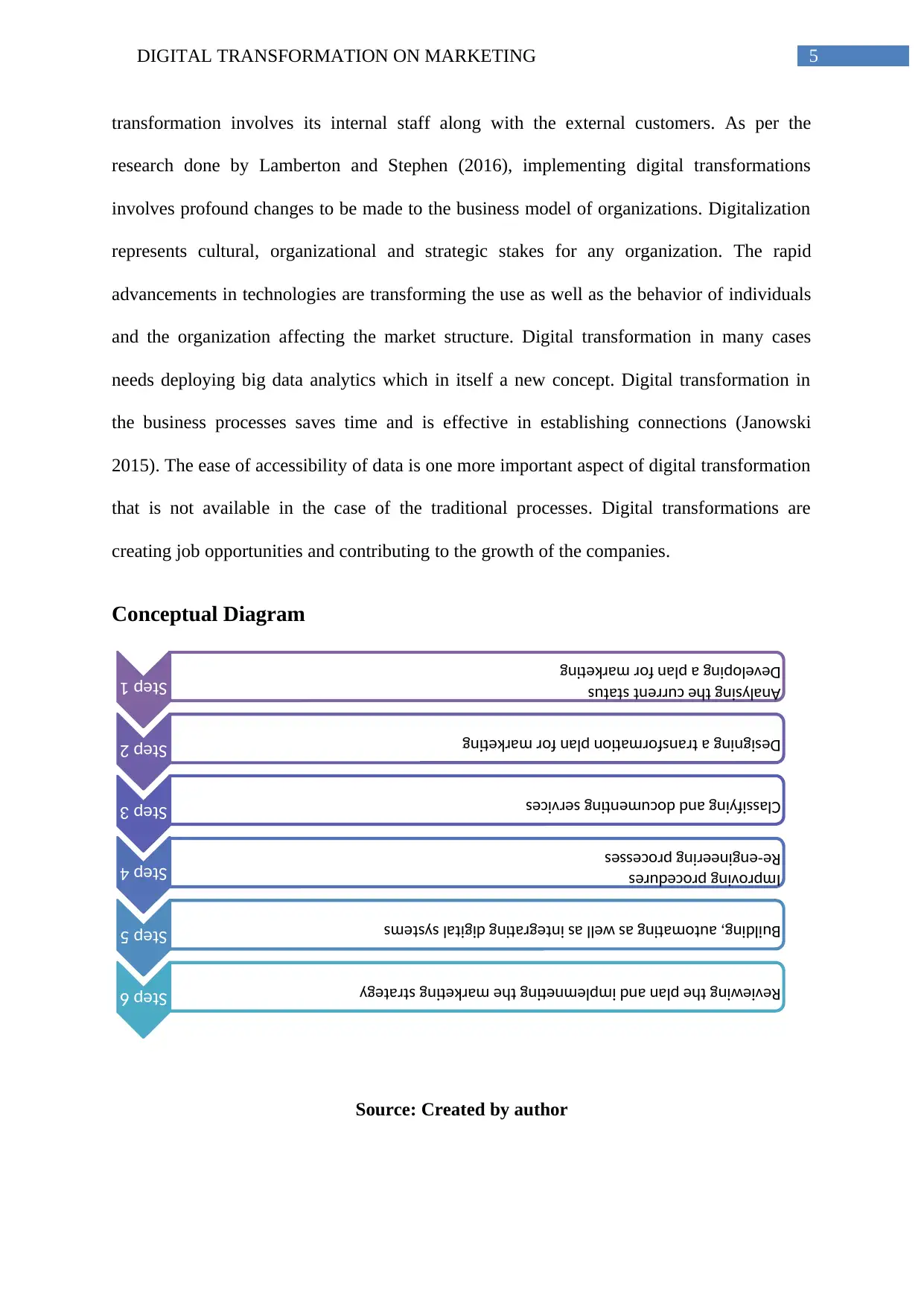
Conceptual Diagram
Source: Created by author
Step 1Analysing the current status
Developing a plan for marketing
Step 2Designing a transformation plan for marketing
Step 3Classifying and documenting services
Step 4Improving procedures
Re-engineering processes
Step 5Building, automating as well as integrating digital systems
Step 6Reviewing the plan and implemneting the marketing strategy
transformation involves its internal staff along with the external customers. As per the
research done by Lamberton and Stephen (2016), implementing digital transformations
involves profound changes to be made to the business model of organizations. Digitalization
represents cultural, organizational and strategic stakes for any organization. The rapid
advancements in technologies are transforming the use as well as the behavior of individuals
and the organization affecting the market structure. Digital transformation in many cases
needs deploying big data analytics which in itself a new concept. Digital transformation in
the business processes saves time and is effective in establishing connections (Janowski
2015). The ease of accessibility of data is one more important aspect of digital transformation
that is not available in the case of the traditional processes. Digital transformations are
creating job opportunities and contributing to the growth of the companies.
Conceptual Diagram
Source: Created by author
Step 1Analysing the current status
Developing a plan for marketing
Step 2Designing a transformation plan for marketing
Step 3Classifying and documenting services
Step 4Improving procedures
Re-engineering processes
Step 5Building, automating as well as integrating digital systems
Step 6Reviewing the plan and implemneting the marketing strategy
⊘ This is a preview!⊘
Do you want full access?
Subscribe today to unlock all pages.

Trusted by 1+ million students worldwide

6DIGITAL TRANSFORMATION ON MARKETING
References
Cuesta, C., Ruesta, M., Tuesta, D. and Urbiola, P., 2015. The digital transformation of the
banking industry. BBVA Research (available at https://www. bbvaresearch. com/wp-
content/uploads/2015/08/EN_Observatorio_Banca_Digital_vf3. pdf).
Edelman, D., & Heller, J. (2015). How digital marketing operations can transform
business. McKinsey Digital Report (July 2015).
Erevelles, S., Fukawa, N. and Swayne, L., 2016. Big Data consumer analytics and the
transformation of marketing. Journal of Business Research, 69(2), pp.897-904.
Grishikashvili, K., Dibb, S. and Meadows, M., 2014, April. Investigation into big data impact
on digital marketing. In International Conference on Communication, Media, Technology
and Design (pp. 146-150).
Henriette, E., Feki, M. and Boughzala, I., 2016, September. Digital Transformation
Challenges. In MCIS (p. 33).
Horlach, B., Drews, P. and Schirmer, I., 2016. Bimodal IT: Business-IT alignment in the age
of digital transformation. Multikonferenz Wirtschaftsinformatik (MKWI), pp.1417-1428.
Janowski, T., 2015. Digital government evolution: From transformation to contextualization.
Kane, G.C., Palmer, D., Phillips, A.N., Kiron, D. and Buckley, N., 2015. Strategy, not
technology, drives digital transformation. MIT Sloan Management Review and Deloitte
University Press, 14(1-25).
Lamberton, C. and Stephen, A.T., 2016. A thematic exploration of digital, social media, and
mobile marketing: Research evolution from 2000 to 2015 and an agenda for future
inquiry. Journal of Marketing, 80(6), pp.146-172.
References
Cuesta, C., Ruesta, M., Tuesta, D. and Urbiola, P., 2015. The digital transformation of the
banking industry. BBVA Research (available at https://www. bbvaresearch. com/wp-
content/uploads/2015/08/EN_Observatorio_Banca_Digital_vf3. pdf).
Edelman, D., & Heller, J. (2015). How digital marketing operations can transform
business. McKinsey Digital Report (July 2015).
Erevelles, S., Fukawa, N. and Swayne, L., 2016. Big Data consumer analytics and the
transformation of marketing. Journal of Business Research, 69(2), pp.897-904.
Grishikashvili, K., Dibb, S. and Meadows, M., 2014, April. Investigation into big data impact
on digital marketing. In International Conference on Communication, Media, Technology
and Design (pp. 146-150).
Henriette, E., Feki, M. and Boughzala, I., 2016, September. Digital Transformation
Challenges. In MCIS (p. 33).
Horlach, B., Drews, P. and Schirmer, I., 2016. Bimodal IT: Business-IT alignment in the age
of digital transformation. Multikonferenz Wirtschaftsinformatik (MKWI), pp.1417-1428.
Janowski, T., 2015. Digital government evolution: From transformation to contextualization.
Kane, G.C., Palmer, D., Phillips, A.N., Kiron, D. and Buckley, N., 2015. Strategy, not
technology, drives digital transformation. MIT Sloan Management Review and Deloitte
University Press, 14(1-25).
Lamberton, C. and Stephen, A.T., 2016. A thematic exploration of digital, social media, and
mobile marketing: Research evolution from 2000 to 2015 and an agenda for future
inquiry. Journal of Marketing, 80(6), pp.146-172.
Paraphrase This Document
Need a fresh take? Get an instant paraphrase of this document with our AI Paraphraser

7DIGITAL TRANSFORMATION ON MARKETING
Manser Payne, E., Peltier, J.W. and Barger, V.A., 2017. Omni-channel marketing, integrated
marketing communications and consumer engagement: A research agenda. Journal of
Research in Interactive Marketing, 11(2), pp.185-197.
Quinn, L., Dibb, S., Simkin, L., Canhoto, A. and Analogbei, M., 2016. Troubled waters: the
transformation of marketing in a digital world. European Journal of Marketing, 50(12),
pp.2103-2133.
Rakic, B. and Rakic, M., 2017. From Marketing Myopia to Contemporary Marketing
Through Marketing (R) Evolutions of Actors: Transformations in Marketing in the Context of
Digitalization and Sustainability (Integration of Traditional, Digital, Co-Creative and
Sustainability-Oriented Mindsets Inside Actors in Contemporary Marketing).
Uhl, A. and Gollenia, L.A., 2016. Digital enterprise transformation: A business-driven
approach to leveraging innovative IT. Routledge.
Vassileva, B., 2017. Marketing 4.0: How technologies transform marketing
organization. Obuda University e-Bulletin, 7(1), p.47.
Von Kutzschenbach, M. and Brønn, C., 2017. Education for managing digital transformation:
a feedback systems approach. J Syst Cybernet Informat JSCI, 15(2), pp.14-19.
Manser Payne, E., Peltier, J.W. and Barger, V.A., 2017. Omni-channel marketing, integrated
marketing communications and consumer engagement: A research agenda. Journal of
Research in Interactive Marketing, 11(2), pp.185-197.
Quinn, L., Dibb, S., Simkin, L., Canhoto, A. and Analogbei, M., 2016. Troubled waters: the
transformation of marketing in a digital world. European Journal of Marketing, 50(12),
pp.2103-2133.
Rakic, B. and Rakic, M., 2017. From Marketing Myopia to Contemporary Marketing
Through Marketing (R) Evolutions of Actors: Transformations in Marketing in the Context of
Digitalization and Sustainability (Integration of Traditional, Digital, Co-Creative and
Sustainability-Oriented Mindsets Inside Actors in Contemporary Marketing).
Uhl, A. and Gollenia, L.A., 2016. Digital enterprise transformation: A business-driven
approach to leveraging innovative IT. Routledge.
Vassileva, B., 2017. Marketing 4.0: How technologies transform marketing
organization. Obuda University e-Bulletin, 7(1), p.47.
Von Kutzschenbach, M. and Brønn, C., 2017. Education for managing digital transformation:
a feedback systems approach. J Syst Cybernet Informat JSCI, 15(2), pp.14-19.
1 out of 8
Related Documents
Your All-in-One AI-Powered Toolkit for Academic Success.
+13062052269
info@desklib.com
Available 24*7 on WhatsApp / Email
Unlock your academic potential
Copyright © 2020–2025 A2Z Services. All Rights Reserved. Developed and managed by ZUCOL.