Change Implementation Plan for Digital Transformation in Agriculture
VerifiedAdded on 2022/10/05
|18
|5460
|318
Report
AI Summary
This report outlines a change implementation plan for a business in the agriculture industry, focusing on the integration of artificial intelligence (AI) to address operational inefficiencies and reduce crop wastage. The plan begins by identifying the problem of increased operational costs due to disease detection challenges and defines the change as implementing AI technologies like robots and sensors for early disease detection. The report details the types of changes, including process and policy changes, and explains the reasons and scope of the transformation. Step 2 delves into the specifics of the change, including the implementation strategy, process adjustments, required people changes, information sharing protocols, and risk assessment. The report then moves on to stakeholder analysis, change approach adaptation, and the roles of a change management team. The subsequent sections detail a comprehensive change implementation plan, including action, communication, training, and business systems plans, as well as a resistance plan. Finally, the report discusses monitoring processes and review strategies to ensure successful implementation and continuous improvement. The organization plans to implement AI solutions such as robotics and sensors to monitor crops, identify diseases early, and minimize waste and operational costs. The report addresses potential risks, including employee resistance and financial risks. The change management plan incorporates stakeholder analysis, including employees, the board of directors, and investors, to facilitate a smooth transition and to ensure that the transformation achieves its goals.
Contents
Step 1- Change proposal........................................................................................................................3
1.1 Identifying the problem-..............................................................................................................3
1.2 Defining the change-....................................................................................................................3
1.3 Type of change-...........................................................................................................................4
1.4 Reason for the change-................................................................................................................4
1.5 Scope of the change-...................................................................................................................5
Step 2 - Particulars of the change..........................................................................................................5
2.1 How will you get there?...............................................................................................................5
2.2 Process change............................................................................................................................6
2.3 People change.............................................................................................................................6
2.4 Information sharing.....................................................................................................................6
2.5 Risk assessment...........................................................................................................................7
Resistance from the employees-...................................................................................................7
Financial and operational risk-.......................................................................................................7
Step 3 - Adaptation (Change Approach)................................................................................................8
3.1 Stakeholder analysis....................................................................................................................8
Employees of the company-..........................................................................................................8
Board of directors and top management-.....................................................................................8
Investors-.......................................................................................................................................9
Most helpful stakeholder...............................................................................................................9
3.2 Resistance to change...................................................................................................................9
3.3 Role of the change management team........................................................................................9
Step -4 Change Implementation Plan..................................................................................................10
4.1 Action Plan.................................................................................................................................10
4.2 Communication plan..................................................................................................................12
4.3 Training plan..............................................................................................................................12
4.4 Business system plan.................................................................................................................12
4.5 Resistance plan..........................................................................................................................13
Step 5- Review change strategy monitor and review...........................................................................13
5.1 Monitoring process....................................................................................................................13
Quantity produced-.....................................................................................................................13
Wastage of plant and crops-........................................................................................................13
5.2 Review.......................................................................................................................................14
1
Step 1- Change proposal........................................................................................................................3
1.1 Identifying the problem-..............................................................................................................3
1.2 Defining the change-....................................................................................................................3
1.3 Type of change-...........................................................................................................................4
1.4 Reason for the change-................................................................................................................4
1.5 Scope of the change-...................................................................................................................5
Step 2 - Particulars of the change..........................................................................................................5
2.1 How will you get there?...............................................................................................................5
2.2 Process change............................................................................................................................6
2.3 People change.............................................................................................................................6
2.4 Information sharing.....................................................................................................................6
2.5 Risk assessment...........................................................................................................................7
Resistance from the employees-...................................................................................................7
Financial and operational risk-.......................................................................................................7
Step 3 - Adaptation (Change Approach)................................................................................................8
3.1 Stakeholder analysis....................................................................................................................8
Employees of the company-..........................................................................................................8
Board of directors and top management-.....................................................................................8
Investors-.......................................................................................................................................9
Most helpful stakeholder...............................................................................................................9
3.2 Resistance to change...................................................................................................................9
3.3 Role of the change management team........................................................................................9
Step -4 Change Implementation Plan..................................................................................................10
4.1 Action Plan.................................................................................................................................10
4.2 Communication plan..................................................................................................................12
4.3 Training plan..............................................................................................................................12
4.4 Business system plan.................................................................................................................12
4.5 Resistance plan..........................................................................................................................13
Step 5- Review change strategy monitor and review...........................................................................13
5.1 Monitoring process....................................................................................................................13
Quantity produced-.....................................................................................................................13
Wastage of plant and crops-........................................................................................................13
5.2 Review.......................................................................................................................................14
1

Paraphrase This Document
Need a fresh take? Get an instant paraphrase of this document with our AI Paraphraser

References...........................................................................................................................................14
2
2
Step 1- Change proposal
Organization under consideration of this report is a business that is operating in the
agriculture industry. The main function of this organization is farming and selling final
products to customers. Due to various problems that are currently being faced in the farming,
management of the organization is considering implementation of artificial intelligence
technology in business. The main focus of this report will be on identifying the issues and
helping business organization in the implementation process.
1.1 Identifying the problem-
Any change management process is initiated if there is a deficiency in the current business
process. In addition to that change can also be brought in is management is of the opinion that
new processor will help in improving efficiency and profitability. In the given scenario there
is increased cost of operation due to inability of management to detect diseases among plants
or crops. Resulting in wastage of crops and overall quantity of product produced by the
organization is also decreasing. This is one of the prime reason that business intelligence has
been proposed to be implemented in order to increase efficiency of Management in disease
detection(Sivertsson & Tell, 2015).
It is expected that management you will face a different kind of challenges during the
implementation process as in production of information technology in agriculture
organization is very difficult. One of the primary reason for increasing the difficulty is
limited knowledge and skills in relation to information technology. In addition to that
bringing change in any kind of established business organization is always difficult as all
business operations will be changed in order to bring change in particular business activity
(Hatten, 2012). Resistance from the current employees of the organization is also expected to
be particular challenges that will be faced during the implementation phase.
1.2 Defining the change-
In order to ensure that the deficiency of disease destruction is reduced, management of the
organization is expected to implement artificial intelligence technology in the business.
Artificial intelligence technologies such as robots and census will be used in this scenario to
ensure that this is this action can be undertaken at early stage. This will help in ensuring that
all the crop are not affected by a particular diseased crop and oven cost of operation is
3
Organization under consideration of this report is a business that is operating in the
agriculture industry. The main function of this organization is farming and selling final
products to customers. Due to various problems that are currently being faced in the farming,
management of the organization is considering implementation of artificial intelligence
technology in business. The main focus of this report will be on identifying the issues and
helping business organization in the implementation process.
1.1 Identifying the problem-
Any change management process is initiated if there is a deficiency in the current business
process. In addition to that change can also be brought in is management is of the opinion that
new processor will help in improving efficiency and profitability. In the given scenario there
is increased cost of operation due to inability of management to detect diseases among plants
or crops. Resulting in wastage of crops and overall quantity of product produced by the
organization is also decreasing. This is one of the prime reason that business intelligence has
been proposed to be implemented in order to increase efficiency of Management in disease
detection(Sivertsson & Tell, 2015).
It is expected that management you will face a different kind of challenges during the
implementation process as in production of information technology in agriculture
organization is very difficult. One of the primary reason for increasing the difficulty is
limited knowledge and skills in relation to information technology. In addition to that
bringing change in any kind of established business organization is always difficult as all
business operations will be changed in order to bring change in particular business activity
(Hatten, 2012). Resistance from the current employees of the organization is also expected to
be particular challenges that will be faced during the implementation phase.
1.2 Defining the change-
In order to ensure that the deficiency of disease destruction is reduced, management of the
organization is expected to implement artificial intelligence technology in the business.
Artificial intelligence technologies such as robots and census will be used in this scenario to
ensure that this is this action can be undertaken at early stage. This will help in ensuring that
all the crop are not affected by a particular diseased crop and oven cost of operation is
3
⊘ This is a preview!⊘
Do you want full access?
Subscribe today to unlock all pages.

Trusted by 1+ million students worldwide
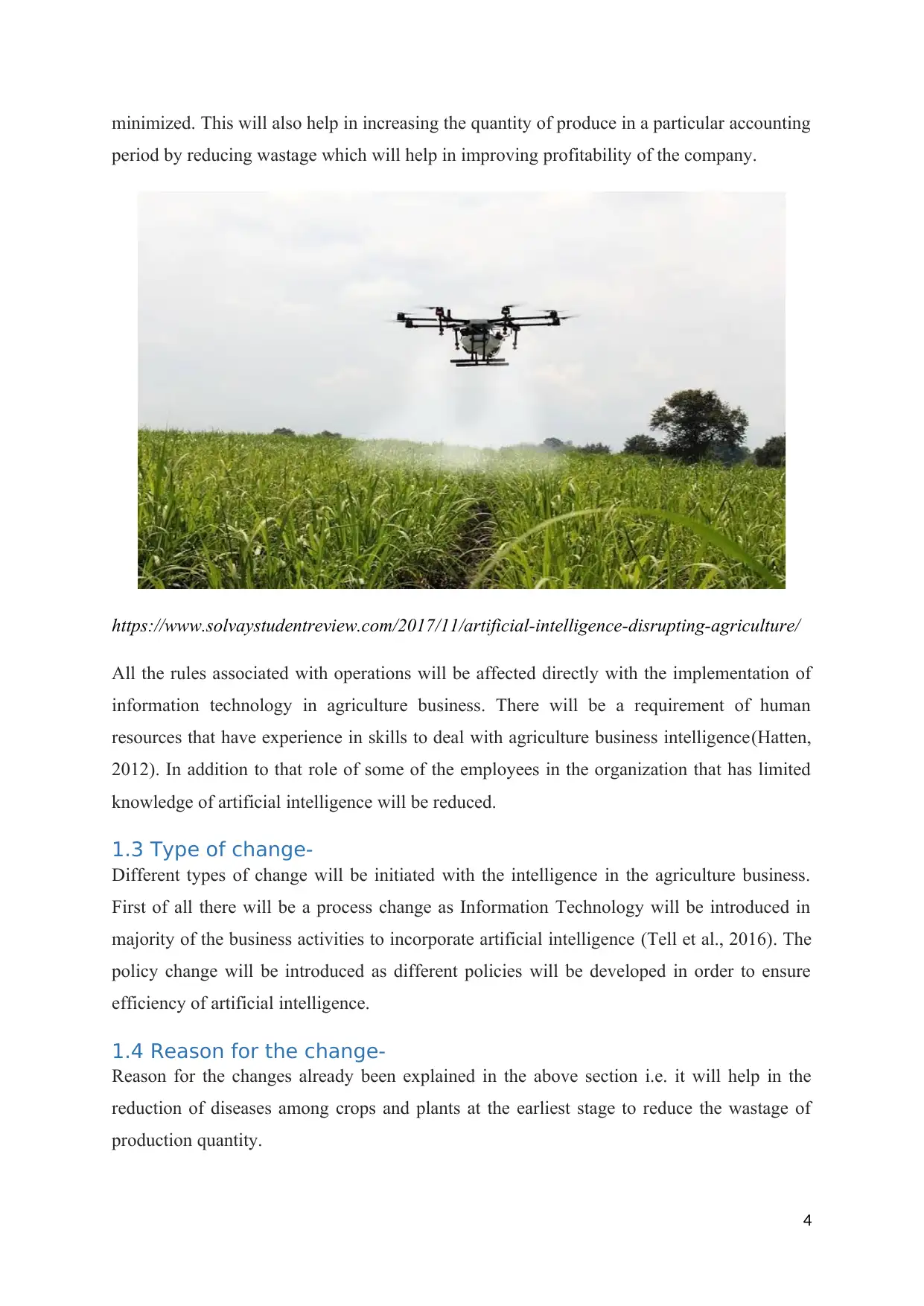
minimized. This will also help in increasing the quantity of produce in a particular accounting
period by reducing wastage which will help in improving profitability of the company.
https://www.solvaystudentreview.com/2017/11/artificial-intelligence-disrupting-agriculture/
All the rules associated with operations will be affected directly with the implementation of
information technology in agriculture business. There will be a requirement of human
resources that have experience in skills to deal with agriculture business intelligence(Hatten,
2012). In addition to that role of some of the employees in the organization that has limited
knowledge of artificial intelligence will be reduced.
1.3 Type of change-
Different types of change will be initiated with the intelligence in the agriculture business.
First of all there will be a process change as Information Technology will be introduced in
majority of the business activities to incorporate artificial intelligence (Tell et al., 2016). The
policy change will be introduced as different policies will be developed in order to ensure
efficiency of artificial intelligence.
1.4 Reason for the change-
Reason for the changes already been explained in the above section i.e. it will help in the
reduction of diseases among crops and plants at the earliest stage to reduce the wastage of
production quantity.
4
period by reducing wastage which will help in improving profitability of the company.
https://www.solvaystudentreview.com/2017/11/artificial-intelligence-disrupting-agriculture/
All the rules associated with operations will be affected directly with the implementation of
information technology in agriculture business. There will be a requirement of human
resources that have experience in skills to deal with agriculture business intelligence(Hatten,
2012). In addition to that role of some of the employees in the organization that has limited
knowledge of artificial intelligence will be reduced.
1.3 Type of change-
Different types of change will be initiated with the intelligence in the agriculture business.
First of all there will be a process change as Information Technology will be introduced in
majority of the business activities to incorporate artificial intelligence (Tell et al., 2016). The
policy change will be introduced as different policies will be developed in order to ensure
efficiency of artificial intelligence.
1.4 Reason for the change-
Reason for the changes already been explained in the above section i.e. it will help in the
reduction of diseases among crops and plants at the earliest stage to reduce the wastage of
production quantity.
4
Paraphrase This Document
Need a fresh take? Get an instant paraphrase of this document with our AI Paraphraser
1.5 Scope of the change-
Organization under consideration is a small-scale organization and it will affect each and
every aspect of business. The change will affect people, process, policy, division, department
and other workgroups.
Step 2 - Particulars of the change
Every process in a particular organization is attached to different other business processes.
Therefore, it can be said that any change brought in a particular business process will require
changes to be made in other business processes in order to incorporate the change. This is the
reason that any change in business affects overall business operations and main objective of
this section of the report will be to identify the affected business operations and policies.
2.1 How will you get there?
First of all, it can be said that overall business structure will be required to be changed to
incorporate the information technology department. Information Technology department is
required to be initiated in this organization as business intelligence is very advanced
technology and management of the organization does not have sufficient human and other
resources to incorporate such technology. In addition to that hiring of new employees experts
in the field of agriculture business intelligence will also be undertaken. New processes will be
required to replace current disease detection process among crop and plants(Berthet, Hickey,
& Klerkx, 2018)
Inter department relationship will also be affected by the introduction of business
intelligence. This is due to the fact that majority of communication after introduction of
business intelligence will be done through information technology. These communication
channels are changed in order to ensure that communication is more transparent and
clear(Fernando Petry, Arcanjo Sebastião, Garcia Martins, & de Azevedo Barros, 2019). There
is a high probability that current business culture of the organization will reject the changes
as this type of change has never been introduced in the organization. Management of the
organization will be required to conduct stakeholder analysis and identify strategies to satisfy
all stakeholders especially internal stakeholders i.e. employees(Kalaitzandonakes,
Carayannis, Grigoroudis, & Rozakis, 2018).
5
Organization under consideration is a small-scale organization and it will affect each and
every aspect of business. The change will affect people, process, policy, division, department
and other workgroups.
Step 2 - Particulars of the change
Every process in a particular organization is attached to different other business processes.
Therefore, it can be said that any change brought in a particular business process will require
changes to be made in other business processes in order to incorporate the change. This is the
reason that any change in business affects overall business operations and main objective of
this section of the report will be to identify the affected business operations and policies.
2.1 How will you get there?
First of all, it can be said that overall business structure will be required to be changed to
incorporate the information technology department. Information Technology department is
required to be initiated in this organization as business intelligence is very advanced
technology and management of the organization does not have sufficient human and other
resources to incorporate such technology. In addition to that hiring of new employees experts
in the field of agriculture business intelligence will also be undertaken. New processes will be
required to replace current disease detection process among crop and plants(Berthet, Hickey,
& Klerkx, 2018)
Inter department relationship will also be affected by the introduction of business
intelligence. This is due to the fact that majority of communication after introduction of
business intelligence will be done through information technology. These communication
channels are changed in order to ensure that communication is more transparent and
clear(Fernando Petry, Arcanjo Sebastião, Garcia Martins, & de Azevedo Barros, 2019). There
is a high probability that current business culture of the organization will reject the changes
as this type of change has never been introduced in the organization. Management of the
organization will be required to conduct stakeholder analysis and identify strategies to satisfy
all stakeholders especially internal stakeholders i.e. employees(Kalaitzandonakes,
Carayannis, Grigoroudis, & Rozakis, 2018).
5
2.2 Process change
Majority of the changes in the given scenario will be introduced in disease detection process
currently undertaken by the organization. Use of sensors and drones will be the primary
change that is required to be incorporated into the processes(Singh, 2016). Regular
monitoring will be undertaken with the help of sensors and cameras in relation to
temperature, moisture, and other environmental-related factors. This will help in ensuring that
any of the factors is not harmful to the crops that lead to diseases among crops and plants.
Standards will be set for the purpose of regular monitoring. This is the primary change that
will arise in process of disease detection(Jaffe, 2016). It can be said that the disease detection
process in the organization is completely replaced with the introduction of new process.
2.3 People change
People change refers to the change in human resources in order to incorporate the changes. It
is already discussed to that implementation and use of business intelligence is very difficult
and management currently does not have suitable human resources(Hollenbeck, 2019). The
process is completely changed as it has increased the component of analytics in the process
rather than manually checking the diseases among crops and plants. It can be said that
majority of the human resources operating in disease detection department will be replaced
with employees that have experience and skill in the field of agriculture business intelligence.
In addition to the training and development programs will be initiated to ensure that current
employees of the organization are aware of the new technology and its use.
Workplace practices will definitely change significantly with the introduction of the changes
and there is also a possibility of negative impact on the overall morale of employees due to
termination of current employees. Management of the organization will be focused on
implementing new behaviour and new relationships in the organization. This will be done by
promoting cooperation among employees with monetary and non-monetary reward strategies.
2.5 Risk assessment
One of the most important parts of implementation process is to identify the risk factors that
can have negative impact on the business. Following are some of the risk factors that can
affect the implementation of business intelligence in the organization-
Resistance from the employees-
One of the primary factor that will affect the efficiency of operations during the initial stages
is resistance created from employees against the changes. After implementation of business
intelligence there will be requirement of terminating employees that are not aware of the use
6
Majority of the changes in the given scenario will be introduced in disease detection process
currently undertaken by the organization. Use of sensors and drones will be the primary
change that is required to be incorporated into the processes(Singh, 2016). Regular
monitoring will be undertaken with the help of sensors and cameras in relation to
temperature, moisture, and other environmental-related factors. This will help in ensuring that
any of the factors is not harmful to the crops that lead to diseases among crops and plants.
Standards will be set for the purpose of regular monitoring. This is the primary change that
will arise in process of disease detection(Jaffe, 2016). It can be said that the disease detection
process in the organization is completely replaced with the introduction of new process.
2.3 People change
People change refers to the change in human resources in order to incorporate the changes. It
is already discussed to that implementation and use of business intelligence is very difficult
and management currently does not have suitable human resources(Hollenbeck, 2019). The
process is completely changed as it has increased the component of analytics in the process
rather than manually checking the diseases among crops and plants. It can be said that
majority of the human resources operating in disease detection department will be replaced
with employees that have experience and skill in the field of agriculture business intelligence.
In addition to the training and development programs will be initiated to ensure that current
employees of the organization are aware of the new technology and its use.
Workplace practices will definitely change significantly with the introduction of the changes
and there is also a possibility of negative impact on the overall morale of employees due to
termination of current employees. Management of the organization will be focused on
implementing new behaviour and new relationships in the organization. This will be done by
promoting cooperation among employees with monetary and non-monetary reward strategies.
2.5 Risk assessment
One of the most important parts of implementation process is to identify the risk factors that
can have negative impact on the business. Following are some of the risk factors that can
affect the implementation of business intelligence in the organization-
Resistance from the employees-
One of the primary factor that will affect the efficiency of operations during the initial stages
is resistance created from employees against the changes. After implementation of business
intelligence there will be requirement of terminating employees that are not aware of the use
6
⊘ This is a preview!⊘
Do you want full access?
Subscribe today to unlock all pages.
Trusted by 1+ million students worldwide
of artificial intelligence country name with his employees will affect the efficiency of
business operations. In addition to the normal day to day operations of employees will change
which will also create negative behavior of employees towards the changes.
Financial and operational risk-
Business intelligence and artificial intelligence will be used in the organization for the first
time and there is a significant operational risk in this scenario. Currently, organization does
not have skilled employees to operate this system and hiring of new employee will result in
increased cost of operation (Cagliano, Grimaldi, & Rafele, 2014). There is a financial risk as
the failure of this project will have significant financial impact on business operations due to
high cost of implementation.
7
business operations. In addition to the normal day to day operations of employees will change
which will also create negative behavior of employees towards the changes.
Financial and operational risk-
Business intelligence and artificial intelligence will be used in the organization for the first
time and there is a significant operational risk in this scenario. Currently, organization does
not have skilled employees to operate this system and hiring of new employee will result in
increased cost of operation (Cagliano, Grimaldi, & Rafele, 2014). There is a financial risk as
the failure of this project will have significant financial impact on business operations due to
high cost of implementation.
7
Paraphrase This Document
Need a fresh take? Get an instant paraphrase of this document with our AI Paraphraser
Step 3 - Adaptation (Change Approach)
3.1 Stakeholder analysis
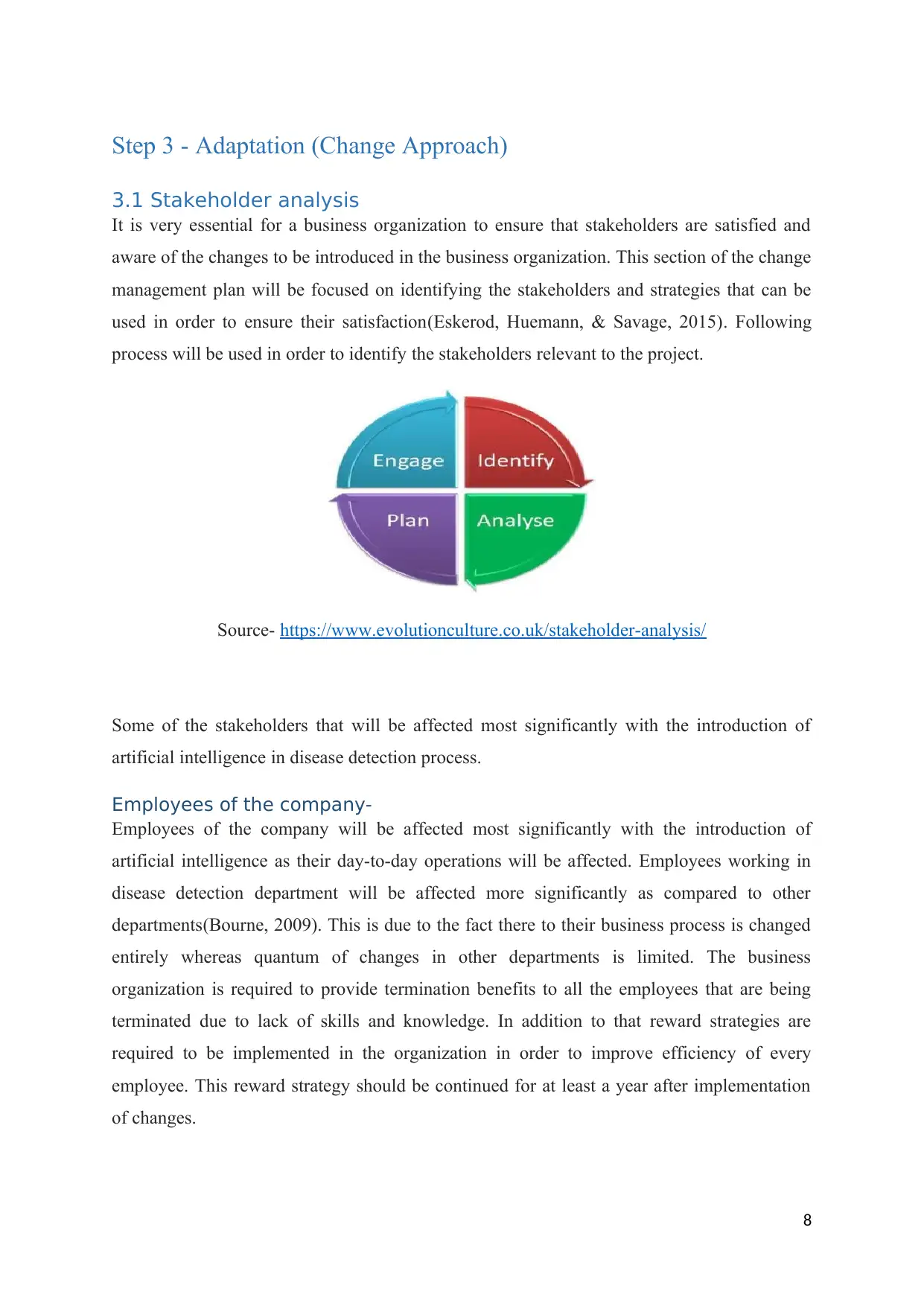
It is very essential for a business organization to ensure that stakeholders are satisfied and
aware of the changes to be introduced in the business organization. This section of the change
management plan will be focused on identifying the stakeholders and strategies that can be
used in order to ensure their satisfaction(Eskerod, Huemann, & Savage, 2015). Following
process will be used in order to identify the stakeholders relevant to the project.
Source- https://www.evolutionculture.co.uk/stakeholder-analysis/
Some of the stakeholders that will be affected most significantly with the introduction of
artificial intelligence in disease detection process.
Employees of the company-
Employees of the company will be affected most significantly with the introduction of
artificial intelligence as their day-to-day operations will be affected. Employees working in
disease detection department will be affected more significantly as compared to other
departments(Bourne, 2009). This is due to the fact there to their business process is changed
entirely whereas quantum of changes in other departments is limited. The business
organization is required to provide termination benefits to all the employees that are being
terminated due to lack of skills and knowledge. In addition to that reward strategies are
required to be implemented in the organization in order to improve efficiency of every
employee. This reward strategy should be continued for at least a year after implementation
of changes.
8
3.1 Stakeholder analysis
It is very essential for a business organization to ensure that stakeholders are satisfied and
aware of the changes to be introduced in the business organization. This section of the change
management plan will be focused on identifying the stakeholders and strategies that can be
used in order to ensure their satisfaction(Eskerod, Huemann, & Savage, 2015). Following
process will be used in order to identify the stakeholders relevant to the project.
Source- https://www.evolutionculture.co.uk/stakeholder-analysis/
Some of the stakeholders that will be affected most significantly with the introduction of
artificial intelligence in disease detection process.
Employees of the company-
Employees of the company will be affected most significantly with the introduction of
artificial intelligence as their day-to-day operations will be affected. Employees working in
disease detection department will be affected more significantly as compared to other
departments(Bourne, 2009). This is due to the fact there to their business process is changed
entirely whereas quantum of changes in other departments is limited. The business
organization is required to provide termination benefits to all the employees that are being
terminated due to lack of skills and knowledge. In addition to that reward strategies are
required to be implemented in the organization in order to improve efficiency of every
employee. This reward strategy should be continued for at least a year after implementation
of changes.
8
Board of directors and top management-
Board of directors and top management will also be affected as a strategic development
process of the organization will be changed. In addition to that management browser required
to identify the sources of financing as cost of implementing artificial intelligence technology
is such as Drone and sensors will be high(Tantalo & Priem, 2016).
Investors-
If the management of the company is using retained earnings or equity financing, then
existing investors in the organization will be affected significantly with the changes. This is
due to the fact that management is using funds of existing investors to implement the
changes.
Most helpful stakeholder
Top management of the company will be the stakeholder that will be most helpful in this
scenario if their involvement is constant and regular. This is due to the fact that the majority
of strategies in business are prepared by these stakeholders and such a significant change
require providing effective strategy and direction to business operations(Eskerod et al., 2015).
3.2 Resistance to change
It is already discussed that the change will affect employees of the company most
significantly, therefore it can be said that there is a probability of resistance from an
employee against the change. This resistance of changes will be created by employees as they
will fear about their existence in the organization. A significant number of employees
working in disease detection department will be terminated and it will create fear of
termination for other employees also(Verbeke & Tung, 2012). All the current employees that
are operating in the organization has never operated artificial intelligence systems such as
camera, drones, and sensors which will add to their insecurity. In addition to that their day-to-
day operations will be affected and their roles and responsibilities will also increase(Freeman
& Moutchnik, 2013). All of these factors will together contribute to creation of resistance on
part of employees.
3.3 Role of the change management team
The change management team will be initiated in the planning stage before implementation
process. This team will be responsible for identifying all the risk factors and other factors that
can have negative impact on implementation process. In addition to that to change
management team will also be responsible for identifying a methodology of implementing
and incorporation of changes(Doh & Quigley, 2014). In the given scenario Change
9
Board of directors and top management will also be affected as a strategic development
process of the organization will be changed. In addition to that management browser required
to identify the sources of financing as cost of implementing artificial intelligence technology
is such as Drone and sensors will be high(Tantalo & Priem, 2016).
Investors-
If the management of the company is using retained earnings or equity financing, then
existing investors in the organization will be affected significantly with the changes. This is
due to the fact that management is using funds of existing investors to implement the
changes.
Most helpful stakeholder
Top management of the company will be the stakeholder that will be most helpful in this
scenario if their involvement is constant and regular. This is due to the fact that the majority
of strategies in business are prepared by these stakeholders and such a significant change
require providing effective strategy and direction to business operations(Eskerod et al., 2015).
3.2 Resistance to change
It is already discussed that the change will affect employees of the company most
significantly, therefore it can be said that there is a probability of resistance from an
employee against the change. This resistance of changes will be created by employees as they
will fear about their existence in the organization. A significant number of employees
working in disease detection department will be terminated and it will create fear of
termination for other employees also(Verbeke & Tung, 2012). All the current employees that
are operating in the organization has never operated artificial intelligence systems such as
camera, drones, and sensors which will add to their insecurity. In addition to that their day-to-
day operations will be affected and their roles and responsibilities will also increase(Freeman
& Moutchnik, 2013). All of these factors will together contribute to creation of resistance on
part of employees.
3.3 Role of the change management team
The change management team will be initiated in the planning stage before implementation
process. This team will be responsible for identifying all the risk factors and other factors that
can have negative impact on implementation process. In addition to that to change
management team will also be responsible for identifying a methodology of implementing
and incorporation of changes(Doh & Quigley, 2014). In the given scenario Change
9
⊘ This is a preview!⊘
Do you want full access?
Subscribe today to unlock all pages.
Trusted by 1+ million students worldwide
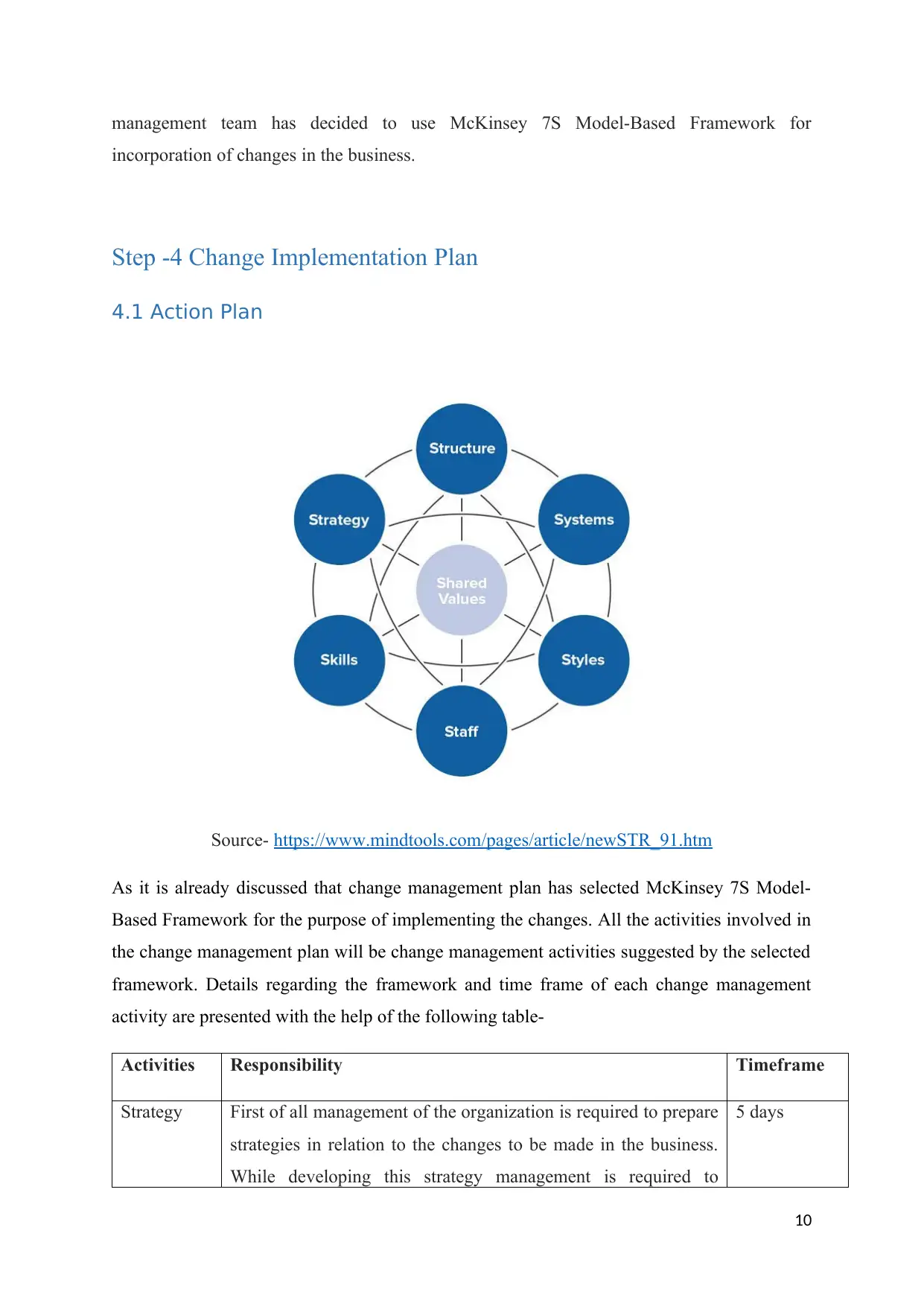
management team has decided to use McKinsey 7S Model-Based Framework for
incorporation of changes in the business.
Step -4 Change Implementation Plan
4.1 Action Plan
Source- https://www.mindtools.com/pages/article/newSTR_91.htm
As it is already discussed that change management plan has selected McKinsey 7S Model-
Based Framework for the purpose of implementing the changes. All the activities involved in
the change management plan will be change management activities suggested by the selected
framework. Details regarding the framework and time frame of each change management
activity are presented with the help of the following table-
Activities Responsibility Timeframe
Strategy First of all management of the organization is required to prepare
strategies in relation to the changes to be made in the business.
While developing this strategy management is required to
5 days
10
incorporation of changes in the business.
Step -4 Change Implementation Plan
4.1 Action Plan
Source- https://www.mindtools.com/pages/article/newSTR_91.htm
As it is already discussed that change management plan has selected McKinsey 7S Model-
Based Framework for the purpose of implementing the changes. All the activities involved in
the change management plan will be change management activities suggested by the selected
framework. Details regarding the framework and time frame of each change management
activity are presented with the help of the following table-
Activities Responsibility Timeframe
Strategy First of all management of the organization is required to prepare
strategies in relation to the changes to be made in the business.
While developing this strategy management is required to
5 days
10
Paraphrase This Document
Need a fresh take? Get an instant paraphrase of this document with our AI Paraphraser
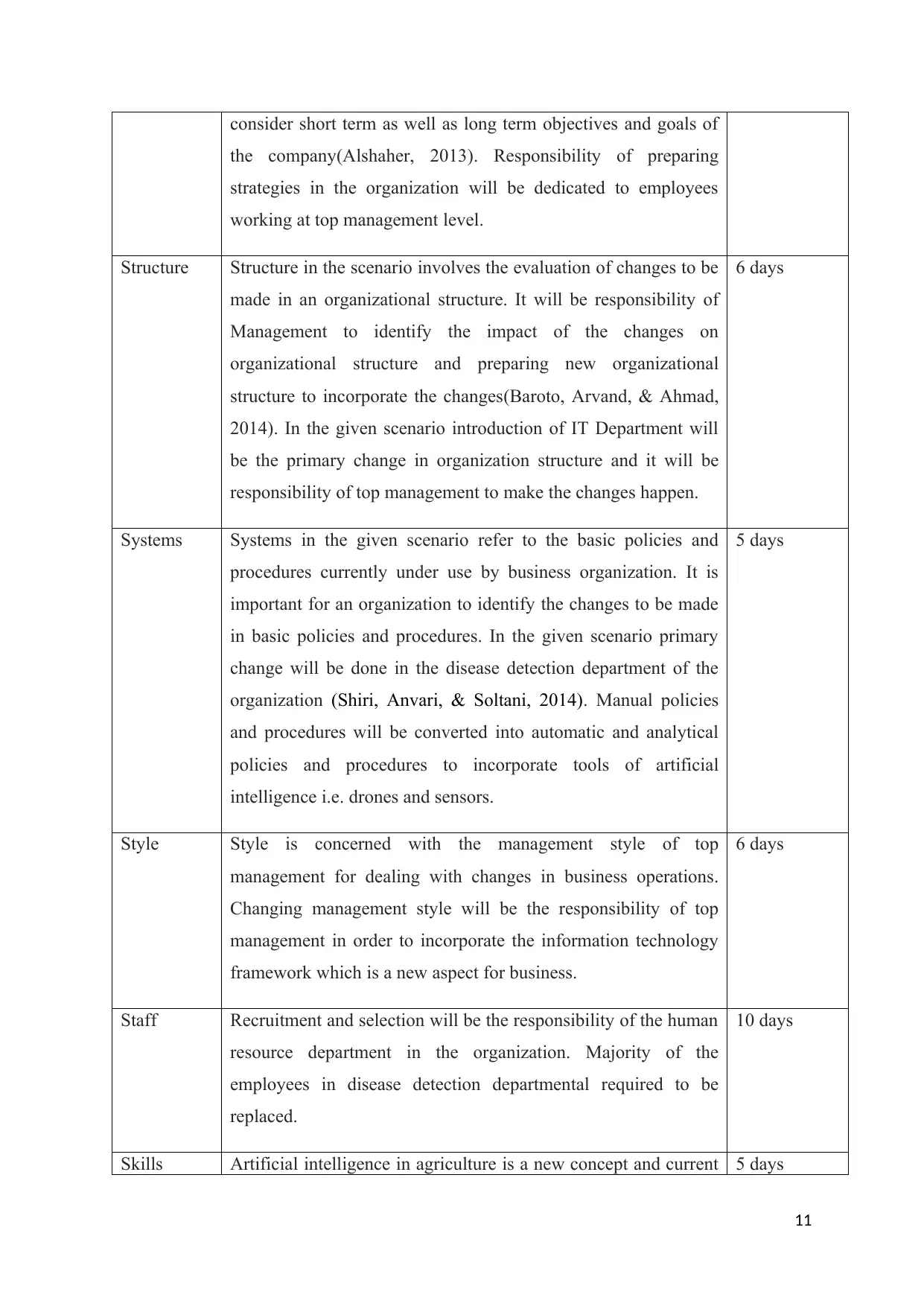
consider short term as well as long term objectives and goals of
the company(Alshaher, 2013). Responsibility of preparing
strategies in the organization will be dedicated to employees
working at top management level.
Structure Structure in the scenario involves the evaluation of changes to be
made in an organizational structure. It will be responsibility of
Management to identify the impact of the changes on
organizational structure and preparing new organizational
structure to incorporate the changes(Baroto, Arvand, & Ahmad,
2014). In the given scenario introduction of IT Department will
be the primary change in organization structure and it will be
responsibility of top management to make the changes happen.
6 days
Systems Systems in the given scenario refer to the basic policies and
procedures currently under use by business organization. It is
important for an organization to identify the changes to be made
in basic policies and procedures. In the given scenario primary
change will be done in the disease detection department of the
organization (Shiri, Anvari, & Soltani, 2014). Manual policies
and procedures will be converted into automatic and analytical
policies and procedures to incorporate tools of artificial
intelligence i.e. drones and sensors.
5 days
Style Style is concerned with the management style of top
management for dealing with changes in business operations.
Changing management style will be the responsibility of top
management in order to incorporate the information technology
framework which is a new aspect for business.
6 days
Staff Recruitment and selection will be the responsibility of the human
resource department in the organization. Majority of the
employees in disease detection departmental required to be
replaced.
10 days
Skills Artificial intelligence in agriculture is a new concept and current 5 days
11
the company(Alshaher, 2013). Responsibility of preparing
strategies in the organization will be dedicated to employees
working at top management level.
Structure Structure in the scenario involves the evaluation of changes to be
made in an organizational structure. It will be responsibility of
Management to identify the impact of the changes on
organizational structure and preparing new organizational
structure to incorporate the changes(Baroto, Arvand, & Ahmad,
2014). In the given scenario introduction of IT Department will
be the primary change in organization structure and it will be
responsibility of top management to make the changes happen.
6 days
Systems Systems in the given scenario refer to the basic policies and
procedures currently under use by business organization. It is
important for an organization to identify the changes to be made
in basic policies and procedures. In the given scenario primary
change will be done in the disease detection department of the
organization (Shiri, Anvari, & Soltani, 2014). Manual policies
and procedures will be converted into automatic and analytical
policies and procedures to incorporate tools of artificial
intelligence i.e. drones and sensors.
5 days
Style Style is concerned with the management style of top
management for dealing with changes in business operations.
Changing management style will be the responsibility of top
management in order to incorporate the information technology
framework which is a new aspect for business.
6 days
Staff Recruitment and selection will be the responsibility of the human
resource department in the organization. Majority of the
employees in disease detection departmental required to be
replaced.
10 days
Skills Artificial intelligence in agriculture is a new concept and current 5 days
11
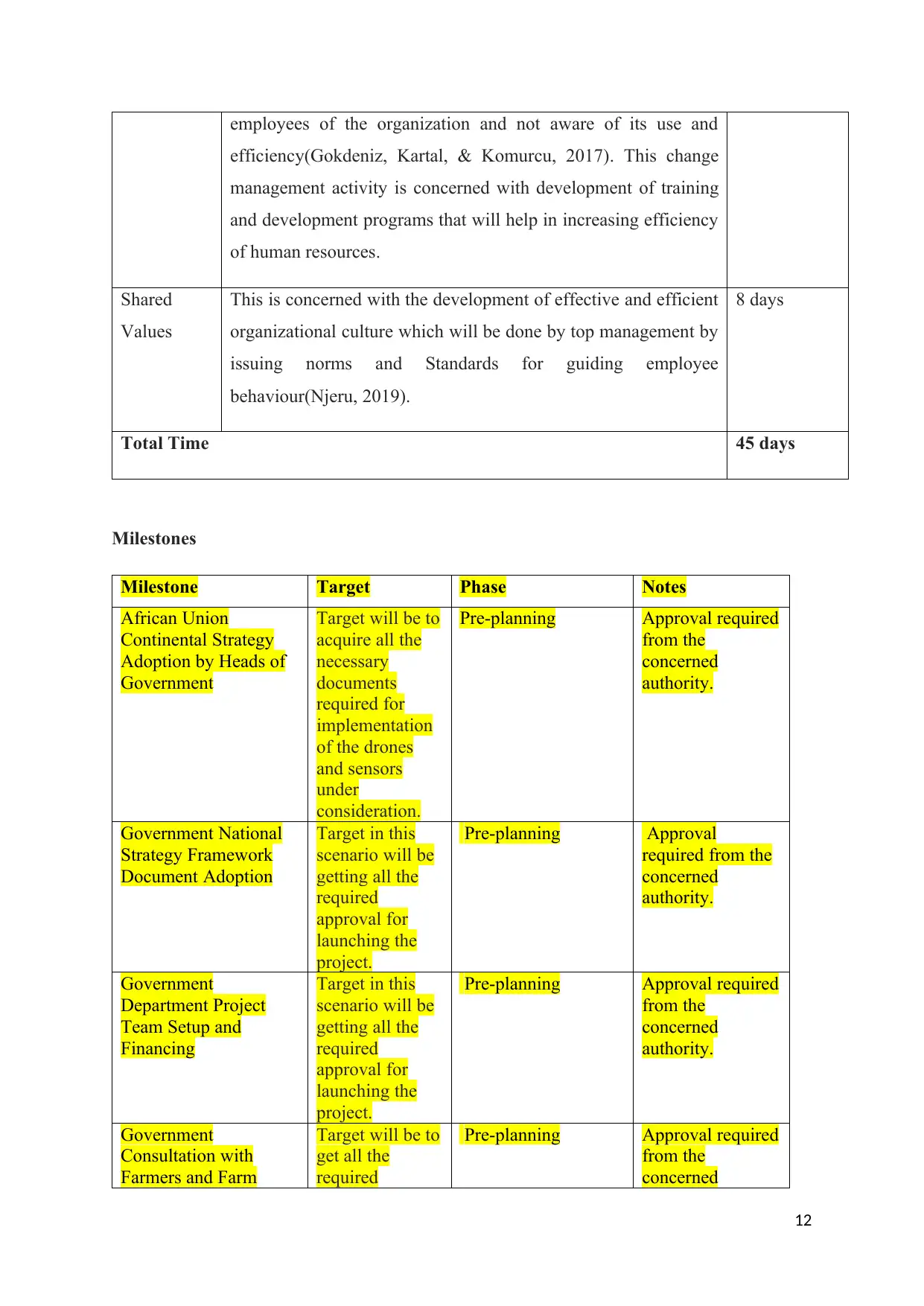
employees of the organization and not aware of its use and
efficiency(Gokdeniz, Kartal, & Komurcu, 2017). This change
management activity is concerned with development of training
and development programs that will help in increasing efficiency
of human resources.
Shared
Values
This is concerned with the development of effective and efficient
organizational culture which will be done by top management by
issuing norms and Standards for guiding employee
behaviour(Njeru, 2019).
8 days
Total Time 45 days
Milestones
Milestone Target Phase Notes
African Union
Continental Strategy
Adoption by Heads of
Government
Target will be to
acquire all the
necessary
documents
required for
implementation
of the drones
and sensors
under
consideration.
Pre-planning Approval required
from the
concerned
authority.
Government National
Strategy Framework
Document Adoption
Target in this
scenario will be
getting all the
required
approval for
launching the
project.
Pre-planning Approval
required from the
concerned
authority.
Government
Department Project
Team Setup and
Financing
Target in this
scenario will be
getting all the
required
approval for
launching the
project.
Pre-planning Approval required
from the
concerned
authority.
Government
Consultation with
Farmers and Farm
Target will be to
get all the
required
Pre-planning Approval required
from the
concerned
12
efficiency(Gokdeniz, Kartal, & Komurcu, 2017). This change
management activity is concerned with development of training
and development programs that will help in increasing efficiency
of human resources.
Shared
Values
This is concerned with the development of effective and efficient
organizational culture which will be done by top management by
issuing norms and Standards for guiding employee
behaviour(Njeru, 2019).
8 days
Total Time 45 days
Milestones
Milestone Target Phase Notes
African Union
Continental Strategy
Adoption by Heads of
Government
Target will be to
acquire all the
necessary
documents
required for
implementation
of the drones
and sensors
under
consideration.
Pre-planning Approval required
from the
concerned
authority.
Government National
Strategy Framework
Document Adoption
Target in this
scenario will be
getting all the
required
approval for
launching the
project.
Pre-planning Approval
required from the
concerned
authority.
Government
Department Project
Team Setup and
Financing
Target in this
scenario will be
getting all the
required
approval for
launching the
project.
Pre-planning Approval required
from the
concerned
authority.
Government
Consultation with
Farmers and Farm
Target will be to
get all the
required
Pre-planning Approval required
from the
concerned
12
⊘ This is a preview!⊘
Do you want full access?
Subscribe today to unlock all pages.
Trusted by 1+ million students worldwide

1 out of 18


Related Documents


Your All-in-One AI-Powered Toolkit for Academic Success.
+13062052269
info@desklib.com
Available 24*7 on WhatsApp / Email
![[object Object]](/_next/static/media/star-bottom.7253800d.svg)
Unlock your academic potential
Copyright © 2020–2026 A2Z Services. All Rights Reserved. Developed and managed by ZUCOL.