Healthcare Literature Review: End-of-Life Care and Dignity
VerifiedAdded on 2022/08/14
|9
|1872
|15
Report
AI Summary
This report presents a literature review on the significance of maintaining patient dignity for informal carers during end-of-life care. It examines ten articles, identifying four key themes: ensuring quality of life, fulfilling holistic needs, improving psychological outcomes, and promoting self-determination. The review highlights that dignified care improves quality of life, fosters patient autonomy, and addresses psychological distress. The findings emphasize the importance of informal carers developing skills to provide dignified care, ultimately contributing to improved patient outcomes and aligning with palliative care standards. The study also emphasizes the importance of communication between patients and family members to ensure better quality of life. The literature review gives implications to family care givers regarding developing skills to provide dignified care to dying patient.
Running head: HEALTH CARE
Health care
Name of the student:
Name of the University:
Author’s note
Health care
Name of the student:
Name of the University:
Author’s note
Paraphrase This Document
Need a fresh take? Get an instant paraphrase of this document with our AI Paraphraser

1HEALTH CARE
Introduction
The National Palliative Care Standards has been developed by Palliative Care Australia
(PCA) to promote quality care at end of life. It laid down eight core values which every health
care workers must follow to provide quality care (Palliative Care Australia 2018). This report
pays emphasis to the core value one which mentions about the endeavor to maintain the dignity
of the care recipient and their family. Patient dignity is an act of showing the patient that their
feelings and concern are respected. Maintaining patient dignity at end of life has become an
important subject in palliative care because people at end of life are highly vulnerable to loss of
dignity. Loss of dignity could lead to depression, hopelessness and suicidal thoughts. Many
external factors like behaviors, beliefs and actions of others also influence the feelings of dignity.
As dignity is a basic human right and respecting dignity is important in medical practice,
considering the role of informal carers in maintaining dignity is important too (Akin Korhan,
Üstün and Uzelli Yilmaz 2018). To get further understanding about the topic, conducting a
literature review on the topic is important. The main purpose of this literature review is to
explore the significance of maintaining dignity of patients for informal carer during end of life
care
Body
Based on the search for articles related to the impact of dignity on end of life care, 10
articles were identified that gave different idea about the benefits of maintaining dignity for
informal care givers at end of life. Based on the review and analysis of the findings, four themes
were identified. The key findings/themes within the analysis of the literature have been presented
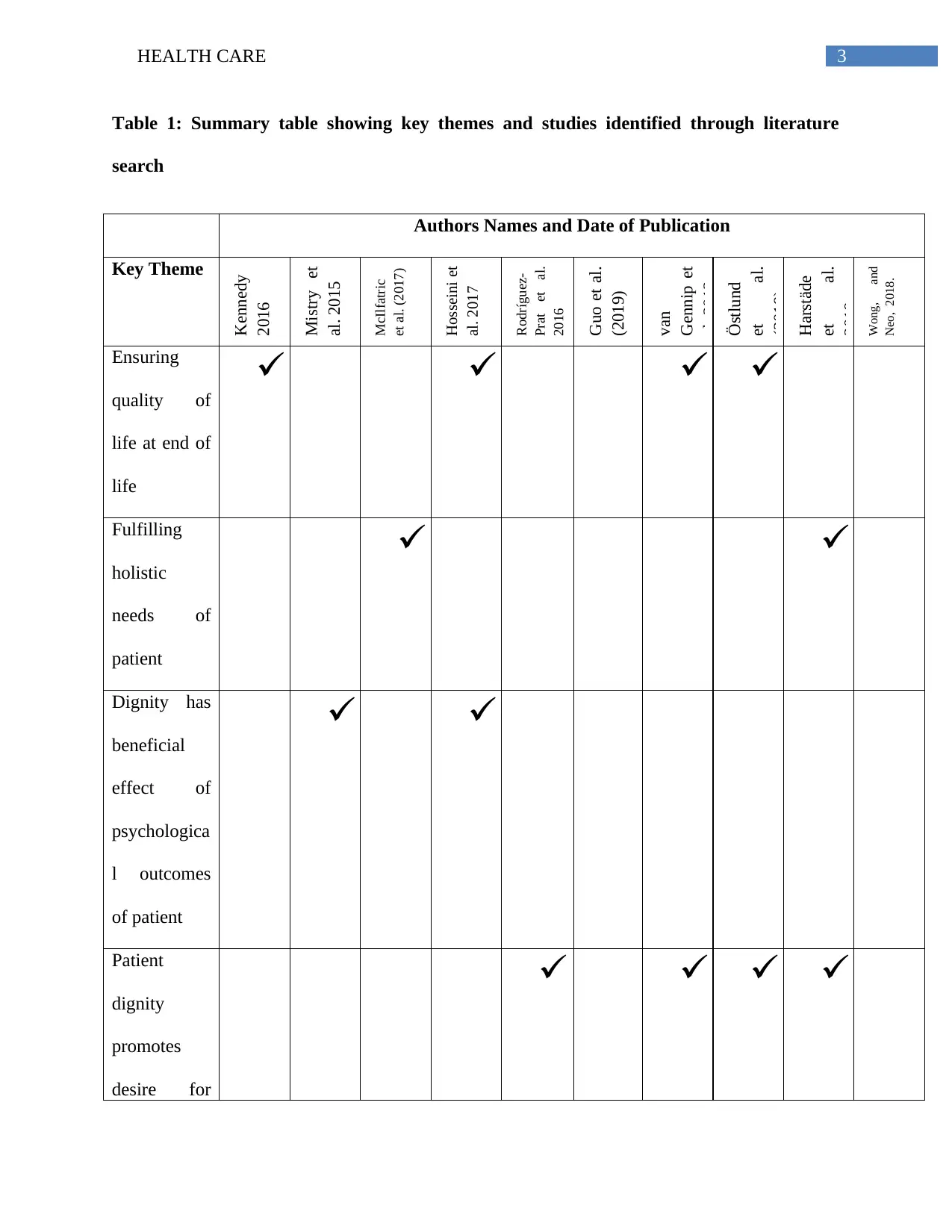
in a summary Table in table 1. These four themes mainly reflects the significance of dignity in
Introduction
The National Palliative Care Standards has been developed by Palliative Care Australia
(PCA) to promote quality care at end of life. It laid down eight core values which every health
care workers must follow to provide quality care (Palliative Care Australia 2018). This report
pays emphasis to the core value one which mentions about the endeavor to maintain the dignity
of the care recipient and their family. Patient dignity is an act of showing the patient that their
feelings and concern are respected. Maintaining patient dignity at end of life has become an
important subject in palliative care because people at end of life are highly vulnerable to loss of
dignity. Loss of dignity could lead to depression, hopelessness and suicidal thoughts. Many
external factors like behaviors, beliefs and actions of others also influence the feelings of dignity.
As dignity is a basic human right and respecting dignity is important in medical practice,
considering the role of informal carers in maintaining dignity is important too (Akin Korhan,
Üstün and Uzelli Yilmaz 2018). To get further understanding about the topic, conducting a
literature review on the topic is important. The main purpose of this literature review is to
explore the significance of maintaining dignity of patients for informal carer during end of life
care
Body
Based on the search for articles related to the impact of dignity on end of life care, 10
articles were identified that gave different idea about the benefits of maintaining dignity for
informal care givers at end of life. Based on the review and analysis of the findings, four themes
were identified. The key findings/themes within the analysis of the literature have been presented
in a summary Table in table 1. These four themes mainly reflects the significance of dignity in

2HEALTH CARE
palliative care to promote quality of patient care, meet holistic needs of patient, improve
psychological outcomes for patient and promote their capacity for self-determination
(autonomy). The most common outcome emerging from most research study was that patient
dignity is essential to maintain quality of life (QoL) at end of life and promote patient autonomy
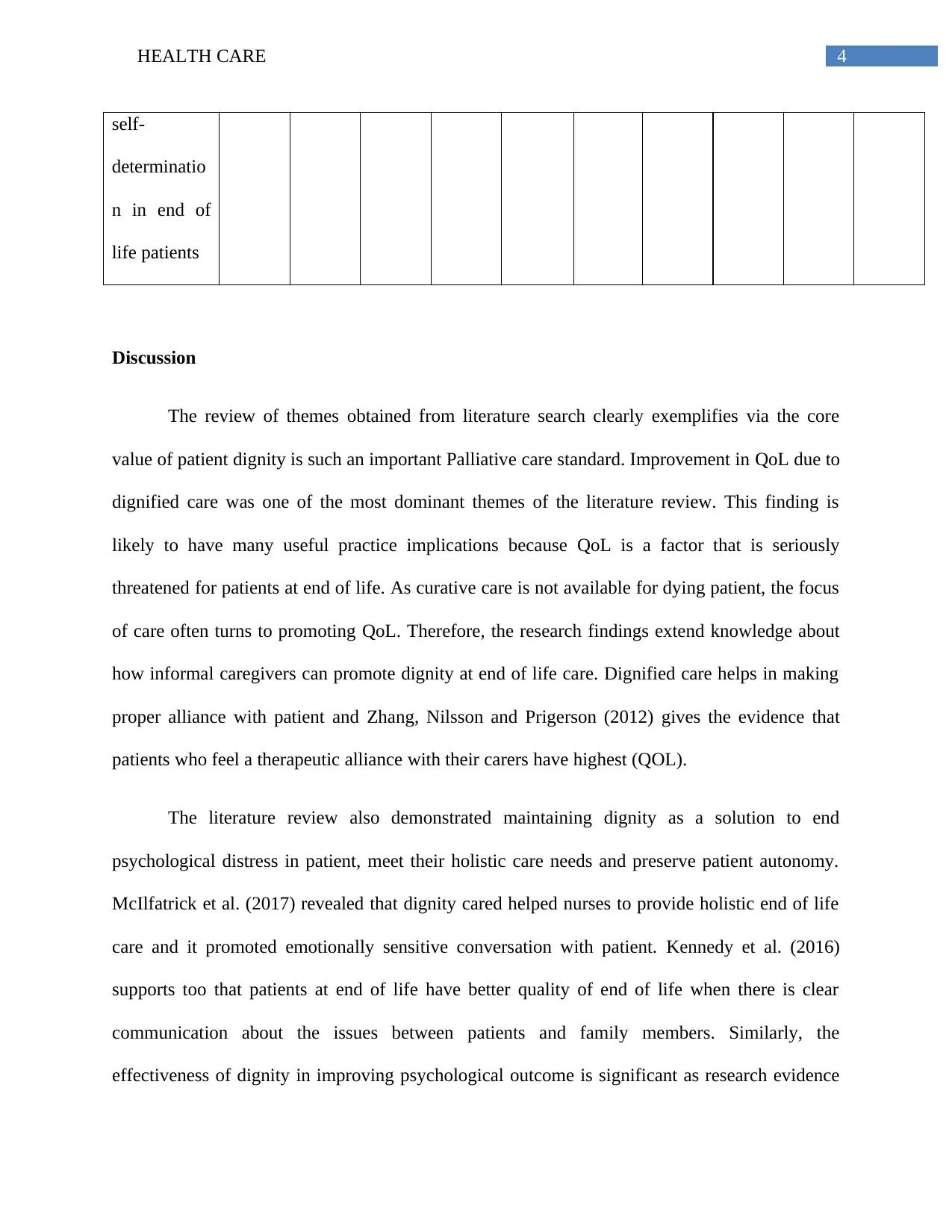
or decision making process during critical stage of illness too. The study by Kennedy et al.
(2016), Hosseini et al. (2017), Van Gannip et al. (2013) and Ostlun et al. (2019) reported about
quality of life related outcomes. Although the findings by Kennedy et al. (2016) lacked validity
because of poor methodological rigour, the other three studies evaluating outcomes from the
perspective of caregivers were highly reliable evidence as the findings were obtained based on
self-reported survey response. For example, family givers reflected increase in QoL by outcomes
like absence of anxiety, peaceful feeling among patients and good communication between
caregivers and end of life patients.
Other important theme was the promotion patient self-determination which was reported
in four studies. This is a very significant outcome as maintaining autonomy is not about giving
patients the choice to take decisions about treatment, instead it promotes patient engagement in
daily activities too. Hence, dying patients or critically ill patients can respond well to treatment if
their caregivers preserved their dignity during the care process. The other two theme of
psychological outcome and fulfilling of holistic needs are equally important outcome that shows
the significance of maintaining dignity to promote patient centered care and quality care at end
of life (Houska and Loučka 2019).
palliative care to promote quality of patient care, meet holistic needs of patient, improve
psychological outcomes for patient and promote their capacity for self-determination
(autonomy). The most common outcome emerging from most research study was that patient
dignity is essential to maintain quality of life (QoL) at end of life and promote patient autonomy
or decision making process during critical stage of illness too. The study by Kennedy et al.
(2016), Hosseini et al. (2017), Van Gannip et al. (2013) and Ostlun et al. (2019) reported about
quality of life related outcomes. Although the findings by Kennedy et al. (2016) lacked validity
because of poor methodological rigour, the other three studies evaluating outcomes from the
perspective of caregivers were highly reliable evidence as the findings were obtained based on
self-reported survey response. For example, family givers reflected increase in QoL by outcomes
like absence of anxiety, peaceful feeling among patients and good communication between
caregivers and end of life patients.
Other important theme was the promotion patient self-determination which was reported
in four studies. This is a very significant outcome as maintaining autonomy is not about giving
patients the choice to take decisions about treatment, instead it promotes patient engagement in
daily activities too. Hence, dying patients or critically ill patients can respond well to treatment if
their caregivers preserved their dignity during the care process. The other two theme of
psychological outcome and fulfilling of holistic needs are equally important outcome that shows
the significance of maintaining dignity to promote patient centered care and quality care at end
of life (Houska and Loučka 2019).
⊘ This is a preview!⊘
Do you want full access?
Subscribe today to unlock all pages.

Trusted by 1+ million students worldwide

3HEALTH CARE
Table 1: Summary table showing key themes and studies identified through literature
search
Authors Names and Date of Publication
Key Theme
Kennedy
2016
Mistry et
al. 2015
McIlfatric
et al. (2017)
Hosseini et
al. 2017
Rodríguez-
Prat et al.
2016
Guo et al.
(2019)
van
Gennip et
al. 2013
Östlund
et al.
(2019)
Harstäde
et al.
2018
Wong, and
Neo, 2018.
Ensuring
quality of
life at end of
life
Fulfilling
holistic
needs of
patient
Dignity has
beneficial
effect of
psychologica
l outcomes
of patient
Patient
dignity
promotes
desire for
Table 1: Summary table showing key themes and studies identified through literature
search
Authors Names and Date of Publication
Key Theme
Kennedy
2016
Mistry et
al. 2015
McIlfatric
et al. (2017)
Hosseini et
al. 2017
Rodríguez-
Prat et al.
2016
Guo et al.
(2019)
van
Gennip et
al. 2013
Östlund
et al.
(2019)
Harstäde
et al.
2018
Wong, and
Neo, 2018.
Ensuring
quality of
life at end of
life
Fulfilling
holistic
needs of
patient
Dignity has
beneficial
effect of
psychologica
l outcomes
of patient
Patient
dignity
promotes
desire for
Paraphrase This Document
Need a fresh take? Get an instant paraphrase of this document with our AI Paraphraser

4HEALTH CARE
self-
determinatio
n in end of
life patients
Discussion
The review of themes obtained from literature search clearly exemplifies via the core
value of patient dignity is such an important Palliative care standard. Improvement in QoL due to
dignified care was one of the most dominant themes of the literature review. This finding is
likely to have many useful practice implications because QoL is a factor that is seriously
threatened for patients at end of life. As curative care is not available for dying patient, the focus
of care often turns to promoting QoL. Therefore, the research findings extend knowledge about
how informal caregivers can promote dignity at end of life care. Dignified care helps in making
proper alliance with patient and Zhang, Nilsson and Prigerson (2012) gives the evidence that
patients who feel a therapeutic alliance with their carers have highest (QOL).
The literature review also demonstrated maintaining dignity as a solution to end
psychological distress in patient, meet their holistic care needs and preserve patient autonomy.
McIlfatrick et al. (2017) revealed that dignity cared helped nurses to provide holistic end of life
care and it promoted emotionally sensitive conversation with patient. Kennedy et al. (2016)
supports too that patients at end of life have better quality of end of life when there is clear
communication about the issues between patients and family members. Similarly, the
effectiveness of dignity in improving psychological outcome is significant as research evidence
self-
determinatio
n in end of
life patients
Discussion
The review of themes obtained from literature search clearly exemplifies via the core
value of patient dignity is such an important Palliative care standard. Improvement in QoL due to
dignified care was one of the most dominant themes of the literature review. This finding is
likely to have many useful practice implications because QoL is a factor that is seriously
threatened for patients at end of life. As curative care is not available for dying patient, the focus
of care often turns to promoting QoL. Therefore, the research findings extend knowledge about
how informal caregivers can promote dignity at end of life care. Dignified care helps in making
proper alliance with patient and Zhang, Nilsson and Prigerson (2012) gives the evidence that
patients who feel a therapeutic alliance with their carers have highest (QOL).
The literature review also demonstrated maintaining dignity as a solution to end
psychological distress in patient, meet their holistic care needs and preserve patient autonomy.
McIlfatrick et al. (2017) revealed that dignity cared helped nurses to provide holistic end of life
care and it promoted emotionally sensitive conversation with patient. Kennedy et al. (2016)
supports too that patients at end of life have better quality of end of life when there is clear
communication about the issues between patients and family members. Similarly, the
effectiveness of dignity in improving psychological outcome is significant as research evidence

5HEALTH CARE
shows widespread prevalence of emotional and psychological distress among critically ill
patients. This is a major burden for family caregivers too (Soto-Rubio et al. 2012). Hence, the
literature review gives implication to family care givers regarding developing skills to provide
dignified care to dying patient. These research findings can be utilized to improve carers
knowledge about dignity and increasing their competency in this area.
Conclusion
To summarize, the literature review on the important of patient dignity for informal
caregivers at end of life patient revealed that dignified care is important to ensure quality of care,
provide holistic care to patients, address psychological distress and maintain patient’s capacity
for self-determined. The 10 studies identified through literature search were categorized into four
themes and the finding thus obtained gives useful practice implications to informal caregivers.
Reference List
Akin Korhan, E., Üstün, Ç. and Uzelli Yilmaz, D., 2018. Practices in Human Dignity in
Palliative Care. Holistic Nursing Practice, 32(2), pp.71-80.
shows widespread prevalence of emotional and psychological distress among critically ill
patients. This is a major burden for family caregivers too (Soto-Rubio et al. 2012). Hence, the
literature review gives implication to family care givers regarding developing skills to provide
dignified care to dying patient. These research findings can be utilized to improve carers
knowledge about dignity and increasing their competency in this area.
Conclusion
To summarize, the literature review on the important of patient dignity for informal
caregivers at end of life patient revealed that dignified care is important to ensure quality of care,
provide holistic care to patients, address psychological distress and maintain patient’s capacity
for self-determined. The 10 studies identified through literature search were categorized into four
themes and the finding thus obtained gives useful practice implications to informal caregivers.
Reference List
Akin Korhan, E., Üstün, Ç. and Uzelli Yilmaz, D., 2018. Practices in Human Dignity in
Palliative Care. Holistic Nursing Practice, 32(2), pp.71-80.
⊘ This is a preview!⊘
Do you want full access?
Subscribe today to unlock all pages.

Trusted by 1+ million students worldwide

6HEALTH CARE
Guo, Q., Zheng, R., Jacelon, C. S., McClement, S., Thompson, G., & Chochinov, H. (2019).
Dignity of the patient-–family unit: further understanding in hospice palliative care. BMJ
supportive & palliative care, bmjspcare-2019.
Harstäde, C. W., Blomberg, K., Benzein, E., & Östlund, U. (2018). Dignity‐conserving care
actions in palliative care: An integrative review of Swedish research. Scandinavian Journal of
caring sciences, 32(1), 8-23.
Hosseini, A., Rezaei, M., Bahrami, M., Abbasi, M. and Hariri, H., 2017. The relationship
between dignity status and quality of life in Iranian terminally ill patients with cancer. Iranian
journal of nursing and midwifery research, 22(3), p.178.
Houska, A. and Loučka, M., 2019. Patients' autonomy at the end of life: A critical
review. Journal of pain and symptom management, 57(4), pp.835-845.
Kennedy, G., 2016. The importance of patient dignity in care at the end of life. The Ulster
medical journal, 85(1), p.45.
McIlfatrick, S., Connolly, M., Collins, R., Murphy, T., Johnston, B. and Larkin, P., 2017.
Evaluating a dignity care intervention for palliative care in the community setting: community
nurses’ perspectives. Journal of clinical nursing, 26(23-24), pp.4300-4312.
Mistry, B., Bainbridge, D., Bryant, D., Toyofuku, S.T. and Seow, H., 2015. What matters most
for end-of-life care? Perspectives from community-based palliative care providers and
administrators. BMJ open, 5(6), p.e007492.
Guo, Q., Zheng, R., Jacelon, C. S., McClement, S., Thompson, G., & Chochinov, H. (2019).
Dignity of the patient-–family unit: further understanding in hospice palliative care. BMJ
supportive & palliative care, bmjspcare-2019.
Harstäde, C. W., Blomberg, K., Benzein, E., & Östlund, U. (2018). Dignity‐conserving care
actions in palliative care: An integrative review of Swedish research. Scandinavian Journal of
caring sciences, 32(1), 8-23.
Hosseini, A., Rezaei, M., Bahrami, M., Abbasi, M. and Hariri, H., 2017. The relationship
between dignity status and quality of life in Iranian terminally ill patients with cancer. Iranian
journal of nursing and midwifery research, 22(3), p.178.
Houska, A. and Loučka, M., 2019. Patients' autonomy at the end of life: A critical
review. Journal of pain and symptom management, 57(4), pp.835-845.
Kennedy, G., 2016. The importance of patient dignity in care at the end of life. The Ulster
medical journal, 85(1), p.45.
McIlfatrick, S., Connolly, M., Collins, R., Murphy, T., Johnston, B. and Larkin, P., 2017.
Evaluating a dignity care intervention for palliative care in the community setting: community
nurses’ perspectives. Journal of clinical nursing, 26(23-24), pp.4300-4312.
Mistry, B., Bainbridge, D., Bryant, D., Toyofuku, S.T. and Seow, H., 2015. What matters most
for end-of-life care? Perspectives from community-based palliative care providers and
administrators. BMJ open, 5(6), p.e007492.
Paraphrase This Document
Need a fresh take? Get an instant paraphrase of this document with our AI Paraphraser

7HEALTH CARE
Östlund, U., Blomberg, K., Söderman, A. and Harstäde, C.W., 2019. How to conserve dignity in
palliative care: suggestions from older patients, significant others, and healthcare professionals in
Swedish municipal care. BMC palliative care, 18(1), p.10.
Palliative Care Australia (PCA) 2018. National Palliative Care Standards. Retrieved from:
https://palliativecare.org.au/wp-content/uploads/dlm_uploads/2018/02/PalliativeCare-National-
Standards-2018_web-3.pdf
Rodríguez-Prat, A., Monforte-Royo, C., Porta-Sales, J., Escribano, X. and Balaguer, A., 2016.
Patient perspectives of dignity, autonomy and control at the end of life: systematic review and
meta-ethnography. PloS one, 11(3).
Soto-Rubio, A., Perez-Marin, M., Tomas Miguel, J. and Barreto Martin, P., 2018. Emotional
distress of patients at end-of-life and their caregivers: interrelation and predictors. Frontiers in
psychology, 9, p.2199.
van Gennip, I.E., Roeline, H., Pasman, W., Kaspers, P.J., Oosterveld-Vlug, M.G., Willems, D.L.,
Deeg, D.J. and Onwuteaka-Philipsen, B.D., 2013. Death with dignity from the perspective of the
surviving family: a survey study among family caregivers of deceased older adults. Palliative
medicine, 27(7), pp.616-624.
Wallace, C.L., 2015. Family communication and decision making at the end of life: a literature
review. Palliative & supportive care, 13(3), pp.815-825.
Wong, V. and Neo, P.S.H., 2018. An Integrative Approach: Dignity-Conserving Practice through
Dyad Art Therapy for Hospice Patients and their Caregivers. Journal of Pain and Symptom
Management, 56(6), pp.e74-e75.
Östlund, U., Blomberg, K., Söderman, A. and Harstäde, C.W., 2019. How to conserve dignity in
palliative care: suggestions from older patients, significant others, and healthcare professionals in
Swedish municipal care. BMC palliative care, 18(1), p.10.
Palliative Care Australia (PCA) 2018. National Palliative Care Standards. Retrieved from:
https://palliativecare.org.au/wp-content/uploads/dlm_uploads/2018/02/PalliativeCare-National-
Standards-2018_web-3.pdf
Rodríguez-Prat, A., Monforte-Royo, C., Porta-Sales, J., Escribano, X. and Balaguer, A., 2016.
Patient perspectives of dignity, autonomy and control at the end of life: systematic review and
meta-ethnography. PloS one, 11(3).
Soto-Rubio, A., Perez-Marin, M., Tomas Miguel, J. and Barreto Martin, P., 2018. Emotional
distress of patients at end-of-life and their caregivers: interrelation and predictors. Frontiers in
psychology, 9, p.2199.
van Gennip, I.E., Roeline, H., Pasman, W., Kaspers, P.J., Oosterveld-Vlug, M.G., Willems, D.L.,
Deeg, D.J. and Onwuteaka-Philipsen, B.D., 2013. Death with dignity from the perspective of the
surviving family: a survey study among family caregivers of deceased older adults. Palliative
medicine, 27(7), pp.616-624.
Wallace, C.L., 2015. Family communication and decision making at the end of life: a literature
review. Palliative & supportive care, 13(3), pp.815-825.
Wong, V. and Neo, P.S.H., 2018. An Integrative Approach: Dignity-Conserving Practice through
Dyad Art Therapy for Hospice Patients and their Caregivers. Journal of Pain and Symptom
Management, 56(6), pp.e74-e75.

8HEALTH CARE
Zhang, B., Nilsson, M.E. and Prigerson, H.G., 2012. Factors important to patients' quality of life
at the end of life. Archives of internal medicine, 172(15), pp.1133-1142.
Zhang, B., Nilsson, M.E. and Prigerson, H.G., 2012. Factors important to patients' quality of life
at the end of life. Archives of internal medicine, 172(15), pp.1133-1142.
⊘ This is a preview!⊘
Do you want full access?
Subscribe today to unlock all pages.

Trusted by 1+ million students worldwide
1 out of 9
Related Documents
Your All-in-One AI-Powered Toolkit for Academic Success.
+13062052269
info@desklib.com
Available 24*7 on WhatsApp / Email
Unlock your academic potential
Copyright © 2020–2025 A2Z Services. All Rights Reserved. Developed and managed by ZUCOL.