Diploma of Building and Construction - Schedule Analysis and Critique
VerifiedAdded on 2021/05/31
|8
|1729
|35
Homework Assignment
AI Summary
This assignment, part of a Diploma of Building and Construction course, focuses on analyzing and critiquing a construction project schedule. It begins by determining accurate material quantities for metalwork and plastering, calculating productivity constants, tradesman hours, and gang sizes. The assignment then evaluates the project's timeline, identifying potential inconsistencies and suggesting changes to improve accuracy and efficiency. Furthermore, it assesses whether the schedule is realistic or optimistic and discusses the implications of accepting or rejecting it. Finally, the assignment explores methods of schedule compression, including working overtime, increasing workdays, and techniques like crashing and fast tracking, to address project delays and manage costs effectively. The student provides insights into optimizing project schedules and resource allocation within the construction industry.
Running head: DIPLOMA OF BUILDING AND CONSTRUCTION 1
Diploma of Building and Construction
Name:
Institution:
Diploma of Building and Construction
Name:
Institution:
Paraphrase This Document
Need a fresh take? Get an instant paraphrase of this document with our AI Paraphraser

DIPLOMA OF BUILDING AND CONSTRUCTION 2
Diploma of Building and Construction
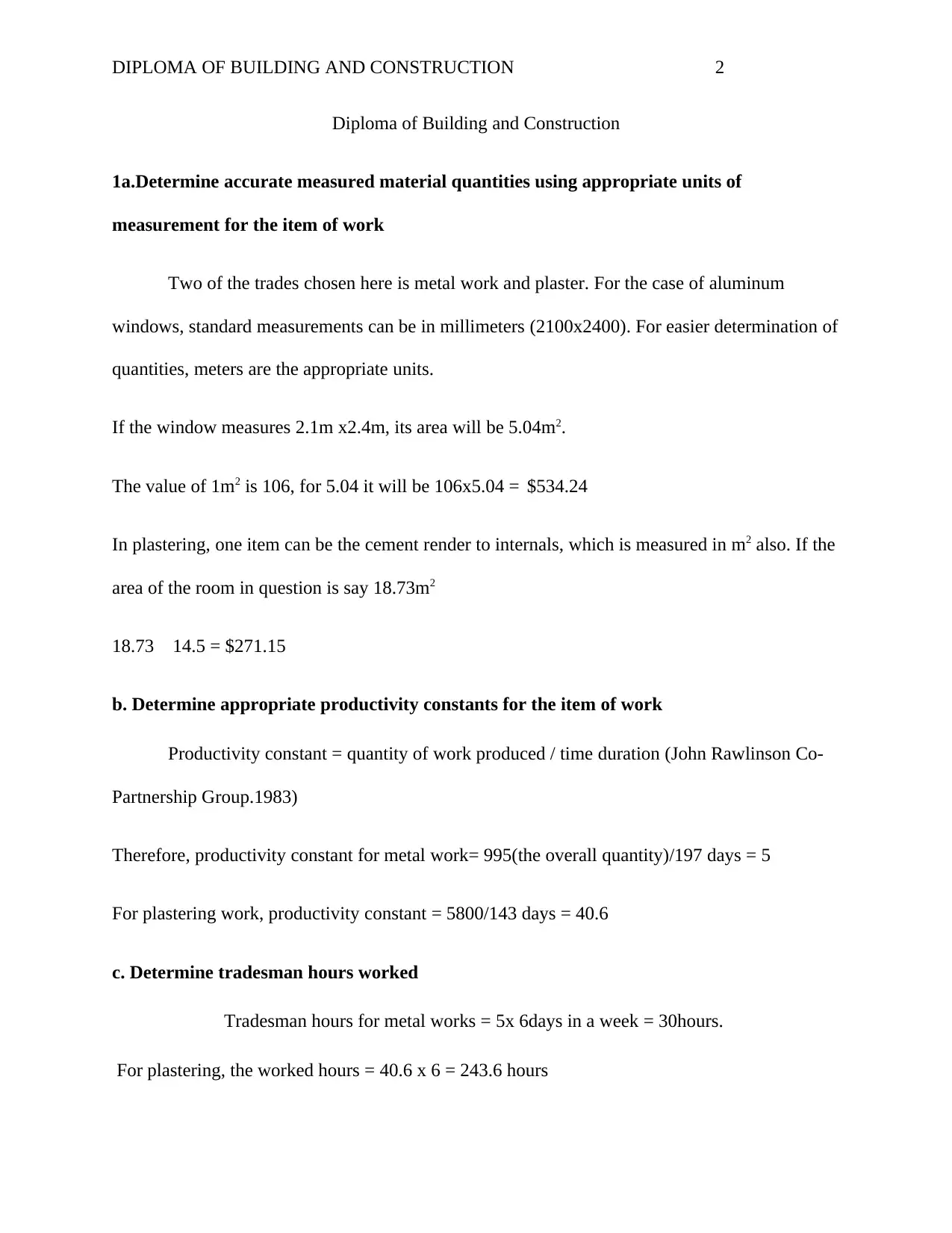
1a.Determine accurate measured material quantities using appropriate units of
measurement for the item of work
Two of the trades chosen here is metal work and plaster. For the case of aluminum
windows, standard measurements can be in millimeters (2100x2400). For easier determination of
quantities, meters are the appropriate units.
If the window measures 2.1m x2.4m, its area will be 5.04m2.
The value of 1m2 is 106, for 5.04 it will be 106x5.04 = $534.24
In plastering, one item can be the cement render to internals, which is measured in m2 also. If the
area of the room in question is say 18.73m2
18.73 14.5 = $271.15
b. Determine appropriate productivity constants for the item of work
Productivity constant = quantity of work produced / time duration (John Rawlinson Co-
Partnership Group.1983)
Therefore, productivity constant for metal work= 995(the overall quantity)/197 days = 5
For plastering work, productivity constant = 5800/143 days = 40.6
c. Determine tradesman hours worked
Tradesman hours for metal works = 5x 6days in a week = 30hours.
For plastering, the worked hours = 40.6 x 6 = 243.6 hours
Diploma of Building and Construction
1a.Determine accurate measured material quantities using appropriate units of
measurement for the item of work
Two of the trades chosen here is metal work and plaster. For the case of aluminum
windows, standard measurements can be in millimeters (2100x2400). For easier determination of
quantities, meters are the appropriate units.
If the window measures 2.1m x2.4m, its area will be 5.04m2.
The value of 1m2 is 106, for 5.04 it will be 106x5.04 = $534.24
In plastering, one item can be the cement render to internals, which is measured in m2 also. If the
area of the room in question is say 18.73m2
18.73 14.5 = $271.15
b. Determine appropriate productivity constants for the item of work
Productivity constant = quantity of work produced / time duration (John Rawlinson Co-
Partnership Group.1983)
Therefore, productivity constant for metal work= 995(the overall quantity)/197 days = 5
For plastering work, productivity constant = 5800/143 days = 40.6
c. Determine tradesman hours worked
Tradesman hours for metal works = 5x 6days in a week = 30hours.
For plastering, the worked hours = 40.6 x 6 = 243.6 hours

DIPLOMA OF BUILDING AND CONSTRUCTION 3
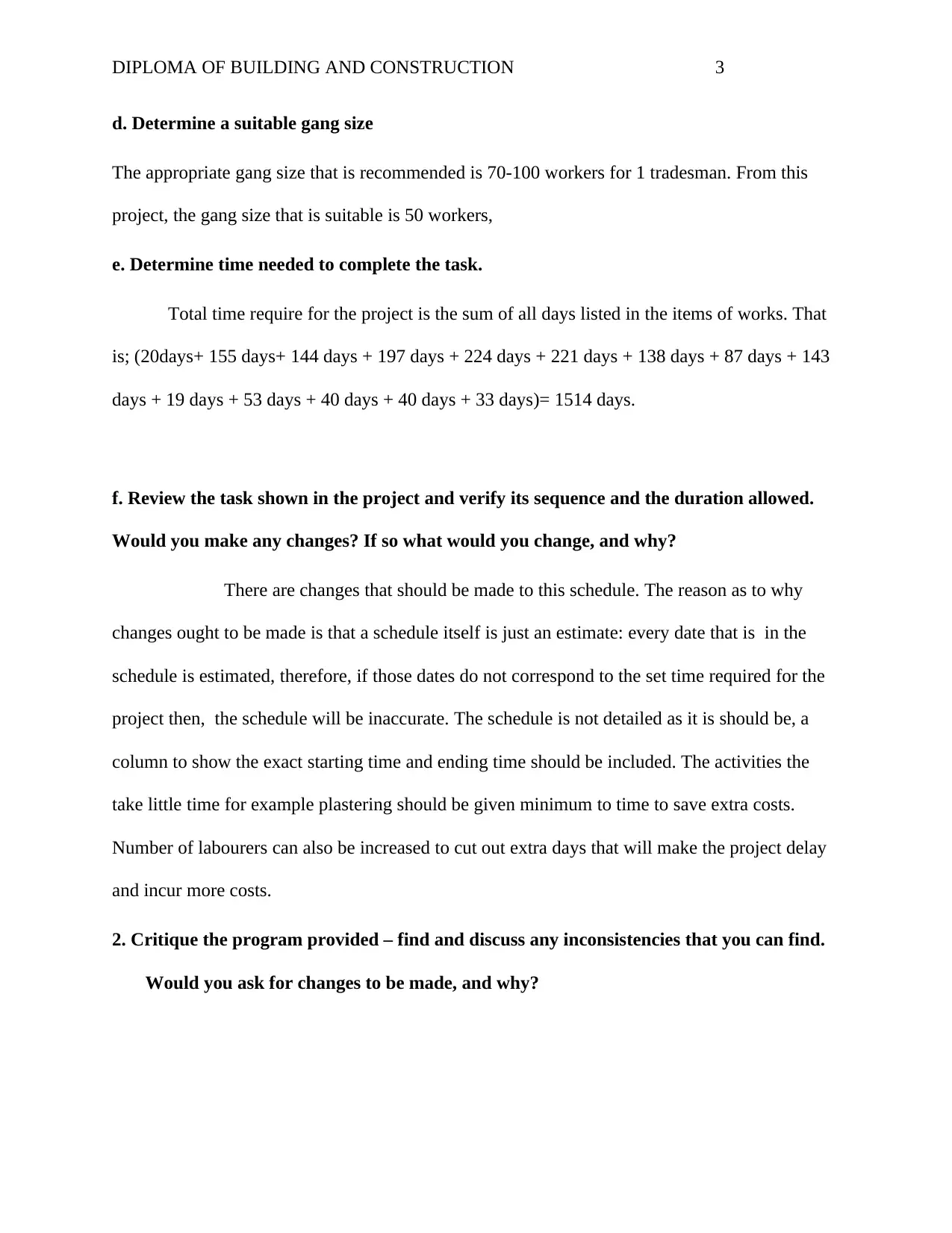
d. Determine a suitable gang size
The appropriate gang size that is recommended is 70-100 workers for 1 tradesman. From this
project, the gang size that is suitable is 50 workers,
e. Determine time needed to complete the task.
Total time require for the project is the sum of all days listed in the items of works. That
is; (20days+ 155 days+ 144 days + 197 days + 224 days + 221 days + 138 days + 87 days + 143
days + 19 days + 53 days + 40 days + 40 days + 33 days)= 1514 days.
f. Review the task shown in the project and verify its sequence and the duration allowed.
Would you make any changes? If so what would you change, and why?
There are changes that should be made to this schedule. The reason as to why
changes ought to be made is that a schedule itself is just an estimate: every date that is in the
schedule is estimated, therefore, if those dates do not correspond to the set time required for the
project then, the schedule will be inaccurate. The schedule is not detailed as it is should be, a
column to show the exact starting time and ending time should be included. The activities the
take little time for example plastering should be given minimum to time to save extra costs.
Number of labourers can also be increased to cut out extra days that will make the project delay
and incur more costs.
2. Critique the program provided – find and discuss any inconsistencies that you can find.
Would you ask for changes to be made, and why?
d. Determine a suitable gang size
The appropriate gang size that is recommended is 70-100 workers for 1 tradesman. From this
project, the gang size that is suitable is 50 workers,
e. Determine time needed to complete the task.
Total time require for the project is the sum of all days listed in the items of works. That
is; (20days+ 155 days+ 144 days + 197 days + 224 days + 221 days + 138 days + 87 days + 143
days + 19 days + 53 days + 40 days + 40 days + 33 days)= 1514 days.
f. Review the task shown in the project and verify its sequence and the duration allowed.
Would you make any changes? If so what would you change, and why?
There are changes that should be made to this schedule. The reason as to why
changes ought to be made is that a schedule itself is just an estimate: every date that is in the
schedule is estimated, therefore, if those dates do not correspond to the set time required for the
project then, the schedule will be inaccurate. The schedule is not detailed as it is should be, a
column to show the exact starting time and ending time should be included. The activities the
take little time for example plastering should be given minimum to time to save extra costs.
Number of labourers can also be increased to cut out extra days that will make the project delay
and incur more costs.
2. Critique the program provided – find and discuss any inconsistencies that you can find.
Would you ask for changes to be made, and why?
⊘ This is a preview!⊘
Do you want full access?
Subscribe today to unlock all pages.

Trusted by 1+ million students worldwide

DIPLOMA OF BUILDING AND CONSTRUCTION 4
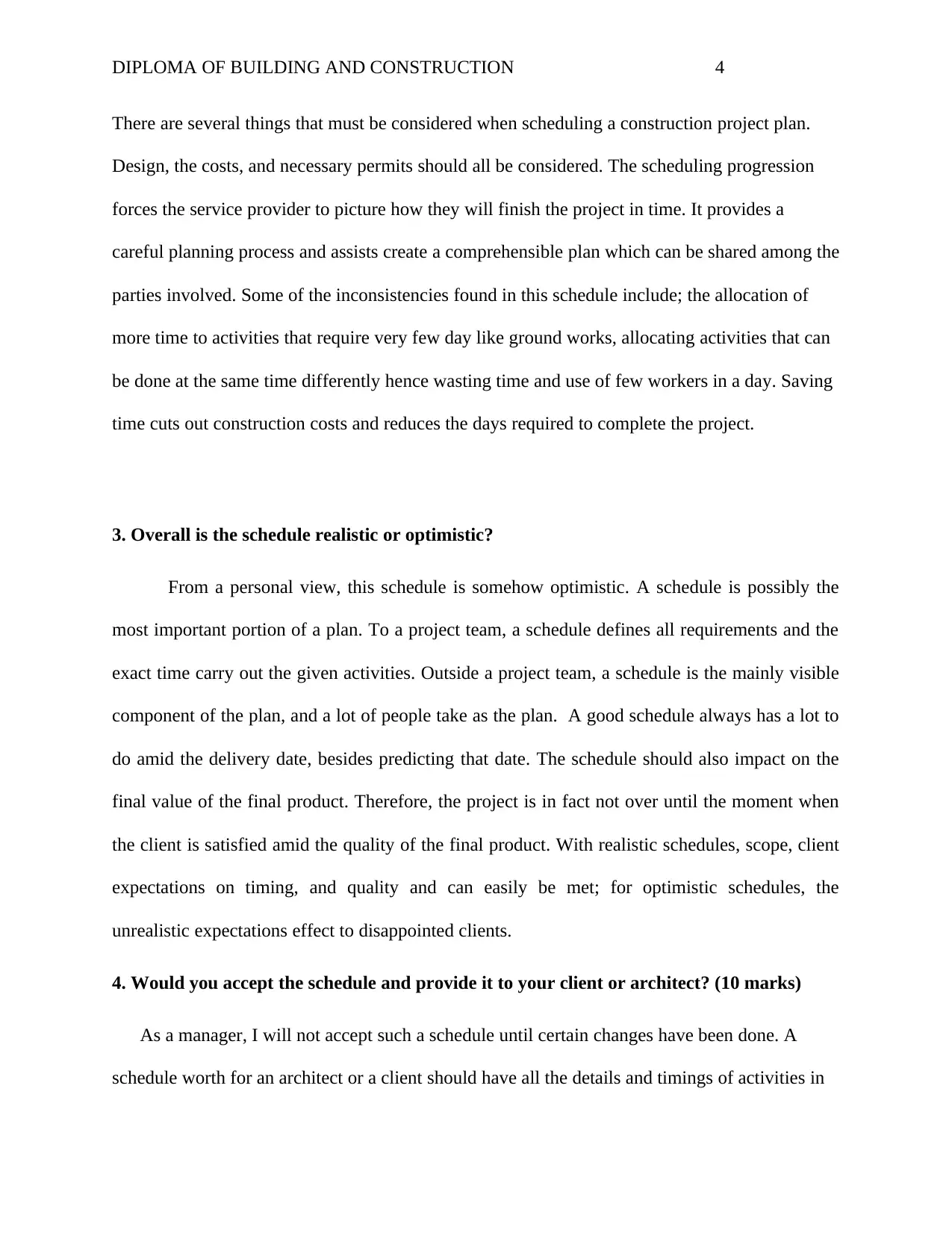
There are several things that must be considered when scheduling a construction project plan.
Design, the costs, and necessary permits should all be considered. The scheduling progression
forces the service provider to picture how they will finish the project in time. It provides a
careful planning process and assists create a comprehensible plan which can be shared among the
parties involved. Some of the inconsistencies found in this schedule include; the allocation of
more time to activities that require very few day like ground works, allocating activities that can
be done at the same time differently hence wasting time and use of few workers in a day. Saving
time cuts out construction costs and reduces the days required to complete the project.
3. Overall is the schedule realistic or optimistic?
From a personal view, this schedule is somehow optimistic. A schedule is possibly the
most important portion of a plan. To a project team, a schedule defines all requirements and the
exact time carry out the given activities. Outside a project team, a schedule is the mainly visible
component of the plan, and a lot of people take as the plan. A good schedule always has a lot to
do amid the delivery date, besides predicting that date. The schedule should also impact on the
final value of the final product. Therefore, the project is in fact not over until the moment when
the client is satisfied amid the quality of the final product. With realistic schedules, scope, client
expectations on timing, and quality and can easily be met; for optimistic schedules, the
unrealistic expectations effect to disappointed clients.
4. Would you accept the schedule and provide it to your client or architect? (10 marks)
As a manager, I will not accept such a schedule until certain changes have been done. A
schedule worth for an architect or a client should have all the details and timings of activities in
There are several things that must be considered when scheduling a construction project plan.
Design, the costs, and necessary permits should all be considered. The scheduling progression
forces the service provider to picture how they will finish the project in time. It provides a
careful planning process and assists create a comprehensible plan which can be shared among the
parties involved. Some of the inconsistencies found in this schedule include; the allocation of
more time to activities that require very few day like ground works, allocating activities that can
be done at the same time differently hence wasting time and use of few workers in a day. Saving
time cuts out construction costs and reduces the days required to complete the project.
3. Overall is the schedule realistic or optimistic?
From a personal view, this schedule is somehow optimistic. A schedule is possibly the
most important portion of a plan. To a project team, a schedule defines all requirements and the
exact time carry out the given activities. Outside a project team, a schedule is the mainly visible
component of the plan, and a lot of people take as the plan. A good schedule always has a lot to
do amid the delivery date, besides predicting that date. The schedule should also impact on the
final value of the final product. Therefore, the project is in fact not over until the moment when
the client is satisfied amid the quality of the final product. With realistic schedules, scope, client
expectations on timing, and quality and can easily be met; for optimistic schedules, the
unrealistic expectations effect to disappointed clients.
4. Would you accept the schedule and provide it to your client or architect? (10 marks)
As a manager, I will not accept such a schedule until certain changes have been done. A
schedule worth for an architect or a client should have all the details and timings of activities in
Paraphrase This Document
Need a fresh take? Get an instant paraphrase of this document with our AI Paraphraser

DIPLOMA OF BUILDING AND CONSTRUCTION 5
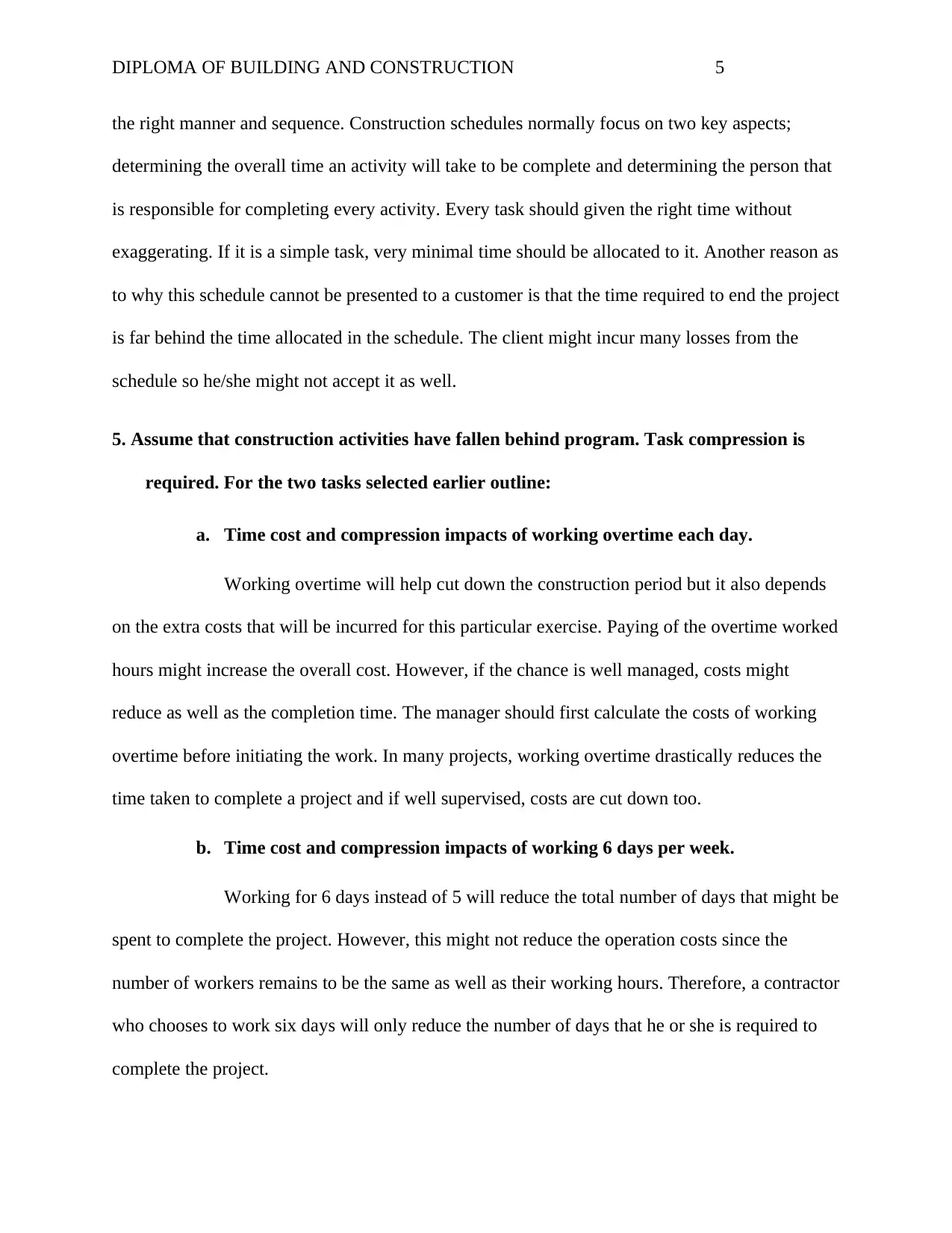
the right manner and sequence. Construction schedules normally focus on two key aspects;
determining the overall time an activity will take to be complete and determining the person that
is responsible for completing every activity. Every task should given the right time without
exaggerating. If it is a simple task, very minimal time should be allocated to it. Another reason as
to why this schedule cannot be presented to a customer is that the time required to end the project
is far behind the time allocated in the schedule. The client might incur many losses from the
schedule so he/she might not accept it as well.
5. Assume that construction activities have fallen behind program. Task compression is
required. For the two tasks selected earlier outline:
a. Time cost and compression impacts of working overtime each day.
Working overtime will help cut down the construction period but it also depends
on the extra costs that will be incurred for this particular exercise. Paying of the overtime worked
hours might increase the overall cost. However, if the chance is well managed, costs might
reduce as well as the completion time. The manager should first calculate the costs of working
overtime before initiating the work. In many projects, working overtime drastically reduces the
time taken to complete a project and if well supervised, costs are cut down too.
b. Time cost and compression impacts of working 6 days per week.
Working for 6 days instead of 5 will reduce the total number of days that might be
spent to complete the project. However, this might not reduce the operation costs since the
number of workers remains to be the same as well as their working hours. Therefore, a contractor
who chooses to work six days will only reduce the number of days that he or she is required to
complete the project.
the right manner and sequence. Construction schedules normally focus on two key aspects;
determining the overall time an activity will take to be complete and determining the person that
is responsible for completing every activity. Every task should given the right time without
exaggerating. If it is a simple task, very minimal time should be allocated to it. Another reason as
to why this schedule cannot be presented to a customer is that the time required to end the project
is far behind the time allocated in the schedule. The client might incur many losses from the
schedule so he/she might not accept it as well.
5. Assume that construction activities have fallen behind program. Task compression is
required. For the two tasks selected earlier outline:
a. Time cost and compression impacts of working overtime each day.
Working overtime will help cut down the construction period but it also depends
on the extra costs that will be incurred for this particular exercise. Paying of the overtime worked
hours might increase the overall cost. However, if the chance is well managed, costs might
reduce as well as the completion time. The manager should first calculate the costs of working
overtime before initiating the work. In many projects, working overtime drastically reduces the
time taken to complete a project and if well supervised, costs are cut down too.
b. Time cost and compression impacts of working 6 days per week.
Working for 6 days instead of 5 will reduce the total number of days that might be
spent to complete the project. However, this might not reduce the operation costs since the
number of workers remains to be the same as well as their working hours. Therefore, a contractor
who chooses to work six days will only reduce the number of days that he or she is required to
complete the project.

DIPLOMA OF BUILDING AND CONSTRUCTION 6
c. Outline other ways to compress the project schedule
Crashing and fast tracking are important procedures in project management, and every
individual participating in a construction project should be aware of them. There are many
reasons you may want to compress the schedule. There are several reasons that can make one to
compress a project schedule. One main reason can be that the project is late; the parties involved
are working hard to get the project back on track. The other reason can be that the manager
intentionally wants to cut down the length of the project, although the project is on track. To get
the project back on time, or rather shorten its duration, one can apply schedule compression
techniques for example crashing and fast tracking.
Fast tracking can be described as a technique of running two or more tasks concurrently and
not in the sequence as presently scheduled. The period can be reduced by first shortening the
longest line of tasks, known as the critical path. This indicates that two or more tasks on every
critical path will be overlapped. Tasks chosen for fast tracking ought to contain a duration which
is longer than the total number of days required to cut down the schedule. One cannot to run two
tasks, one with a period of two days, parallel and expect to save more than three days off a
schedule. The appropriate time that the schedule is to be shortened should be two days and so
any additional activity ought to be chosen for compression.
Crashing is another technique employed to cut down the estimated schedule period for the
slightest incremental price through an addition of more resources. These technique works only
for tasks on a critical path where extra resources will cut down the activity’s duration. Even
though, not all activities will be finished in a shorter instant frame if extra resources are to be
c. Outline other ways to compress the project schedule
Crashing and fast tracking are important procedures in project management, and every
individual participating in a construction project should be aware of them. There are many
reasons you may want to compress the schedule. There are several reasons that can make one to
compress a project schedule. One main reason can be that the project is late; the parties involved
are working hard to get the project back on track. The other reason can be that the manager
intentionally wants to cut down the length of the project, although the project is on track. To get
the project back on time, or rather shorten its duration, one can apply schedule compression
techniques for example crashing and fast tracking.
Fast tracking can be described as a technique of running two or more tasks concurrently and
not in the sequence as presently scheduled. The period can be reduced by first shortening the
longest line of tasks, known as the critical path. This indicates that two or more tasks on every
critical path will be overlapped. Tasks chosen for fast tracking ought to contain a duration which
is longer than the total number of days required to cut down the schedule. One cannot to run two
tasks, one with a period of two days, parallel and expect to save more than three days off a
schedule. The appropriate time that the schedule is to be shortened should be two days and so
any additional activity ought to be chosen for compression.
Crashing is another technique employed to cut down the estimated schedule period for the
slightest incremental price through an addition of more resources. These technique works only
for tasks on a critical path where extra resources will cut down the activity’s duration. Even
though, not all activities will be finished in a shorter instant frame if extra resources are to be
⊘ This is a preview!⊘
Do you want full access?
Subscribe today to unlock all pages.

Trusted by 1+ million students worldwide

DIPLOMA OF BUILDING AND CONSTRUCTION 7
added. Tasks that involve a lot of creativity and communication will probably take longer when
extra resources are added.
Resource reallocation is also another technique which involves shifting resources from the
non-critical tasks to critical tasks with the aim of shortening a critical path. This particular
technique does not alter the scheduling sequence nor does it need extra resources to be allocated
to the project. Instead, it is used to cut down the anticipated schedule period by more effective
consumption of the present project resources (Burford, 2013).
added. Tasks that involve a lot of creativity and communication will probably take longer when
extra resources are added.
Resource reallocation is also another technique which involves shifting resources from the
non-critical tasks to critical tasks with the aim of shortening a critical path. This particular
technique does not alter the scheduling sequence nor does it need extra resources to be allocated
to the project. Instead, it is used to cut down the anticipated schedule period by more effective
consumption of the present project resources (Burford, 2013).
Paraphrase This Document
Need a fresh take? Get an instant paraphrase of this document with our AI Paraphraser

DIPLOMA OF BUILDING AND CONSTRUCTION 8
References
Burford, L. D. (2013). Project management for flat organizations: Cost effective steps to
achieving successful results. Ft. Lauderdale, FL: J. Ross Pub.
John Rawlinson Co-Partnership Group. (1983). Rawlinson's Australian construction handbook.
Perth, W.A.: Rawlhouse Publishing.
References
Burford, L. D. (2013). Project management for flat organizations: Cost effective steps to
achieving successful results. Ft. Lauderdale, FL: J. Ross Pub.
John Rawlinson Co-Partnership Group. (1983). Rawlinson's Australian construction handbook.
Perth, W.A.: Rawlhouse Publishing.
1 out of 8
Related Documents
Your All-in-One AI-Powered Toolkit for Academic Success.
+13062052269
info@desklib.com
Available 24*7 on WhatsApp / Email
Unlock your academic potential
Copyright © 2020–2026 A2Z Services. All Rights Reserved. Developed and managed by ZUCOL.