Direct Digital Synthesis: Significance, Literature Review, Gaps

Verified

Added on  2023/01/19

|2
|1308
|95
Report
AI Summary
This report, prepared by a student, examines Direct Digital Synthesis (DDS), a technology crucial for modern applications such as radar signal processing using Field Programmable Gate Arrays (FPGAs). The report highlights the increasing significance of DDS, particularly in industrial range measurements, improving accuracy, and reducing costs. It reviews existing literature, including Xilinx FPGA-based systems and FMCW radar applications, discussing various methods and technologies. The report identifies gaps in current research, such as the need for more effective output methods and detailed explanations of FPGA-controlled DDS signal generation. The report references several key publications and concludes by emphasizing the potential of DDS for future advancements in signal processing and related fields. This report is available on Desklib, a platform offering AI-powered study tools for students.
Document Page
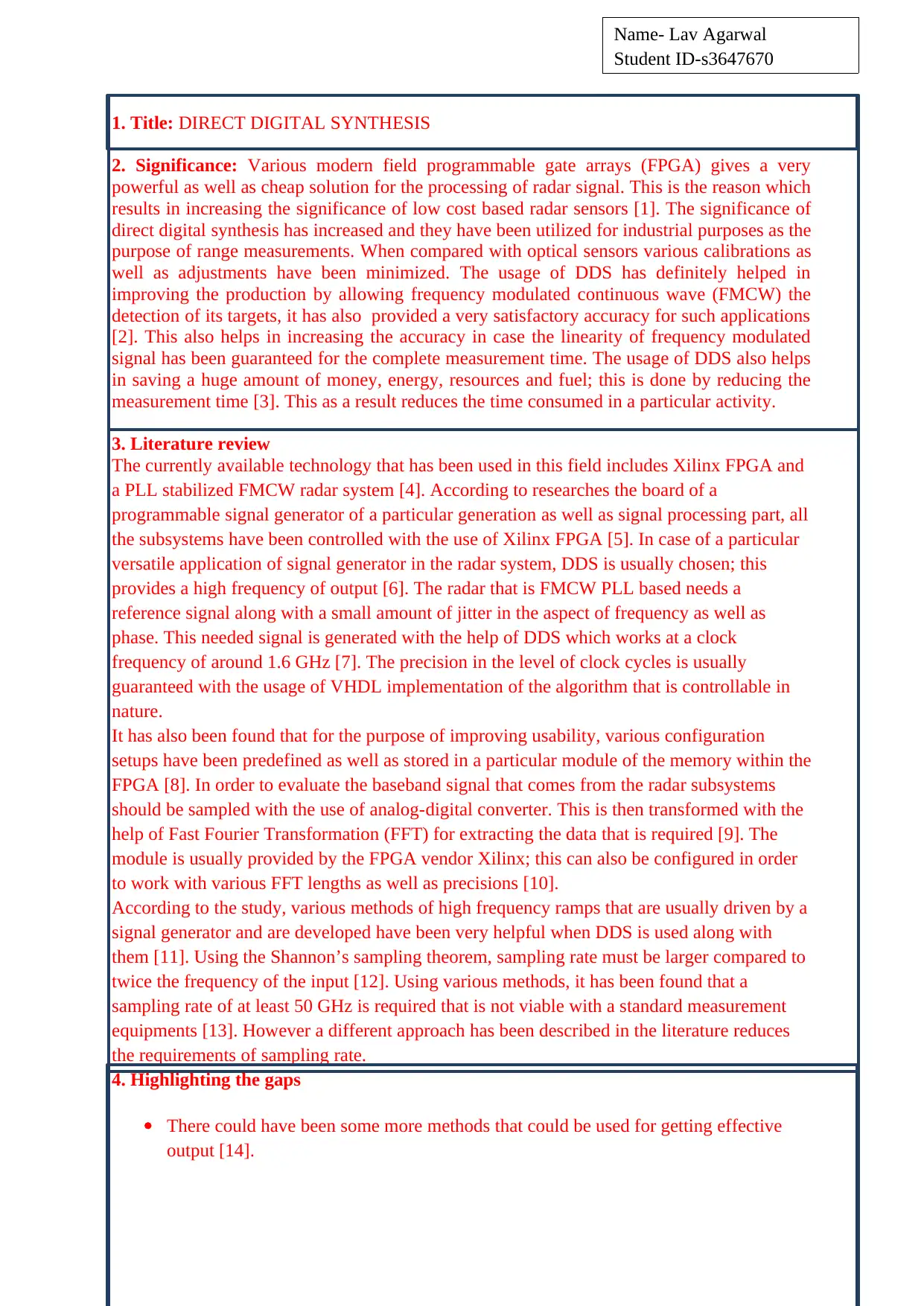
1. Title: DIRECT DIGITAL SYNTHESIS
2. Significance: Various modern field programmable gate arrays (FPGA) gives a very
powerful as well as cheap solution for the processing of radar signal. This is the reason which
results in increasing the significance of low cost based radar sensors [1]. The significance of
direct digital synthesis has increased and they have been utilized for industrial purposes as the
purpose of range measurements. When compared with optical sensors various calibrations as
well as adjustments have been minimized. The usage of DDS has definitely helped in
improving the production by allowing frequency modulated continuous wave (FMCW) the
detection of its targets, it has also provided a very satisfactory accuracy for such applications
[2]. This also helps in increasing the accuracy in case the linearity of frequency modulated
signal has been guaranteed for the complete measurement time. The usage of DDS also helps
in saving a huge amount of money, energy, resources and fuel; this is done by reducing the
measurement time [3]. This as a result reduces the time consumed in a particular activity.
3. Literature review
The currently available technology that has been used in this field includes Xilinx FPGA and
a PLL stabilized FMCW radar system [4]. According to researches the board of a
programmable signal generator of a particular generation as well as signal processing part, all
the subsystems have been controlled with the use of Xilinx FPGA [5]. In case of a particular
versatile application of signal generator in the radar system, DDS is usually chosen; this
provides a high frequency of output [6]. The radar that is FMCW PLL based needs a
reference signal along with a small amount of jitter in the aspect of frequency as well as
phase. This needed signal is generated with the help of DDS which works at a clock
frequency of around 1.6 GHz [7]. The precision in the level of clock cycles is usually
guaranteed with the usage of VHDL implementation of the algorithm that is controllable in
nature.
It has also been found that for the purpose of improving usability, various configuration
setups have been predefined as well as stored in a particular module of the memory within the
FPGA [8]. In order to evaluate the baseband signal that comes from the radar subsystems
should be sampled with the use of analog-digital converter. This is then transformed with the
help of Fast Fourier Transformation (FFT) for extracting the data that is required [9]. The
module is usually provided by the FPGA vendor Xilinx; this can also be configured in order
to work with various FFT lengths as well as precisions [10].
According to the study, various methods of high frequency ramps that are usually driven by a
signal generator and are developed have been very helpful when DDS is used along with
them [11]. Using the Shannon’s sampling theorem, sampling rate must be larger compared to
twice the frequency of the input [12]. Using various methods, it has been found that a
sampling rate of at least 50 GHz is required that is not viable with a standard measurement
equipments [13]. However a different approach has been described in the literature reduces
the requirements of sampling rate.
4. Highlighting the gaps
There could have been some more methods that could be used for getting effective
output [14].
Name- Lav Agarwal
Student ID-s3647670
tabler-icon-diamond-filled.svg

Paraphrase This Document

Need a fresh take? Get an instant paraphrase of this document with our AI Paraphraser
Document Page
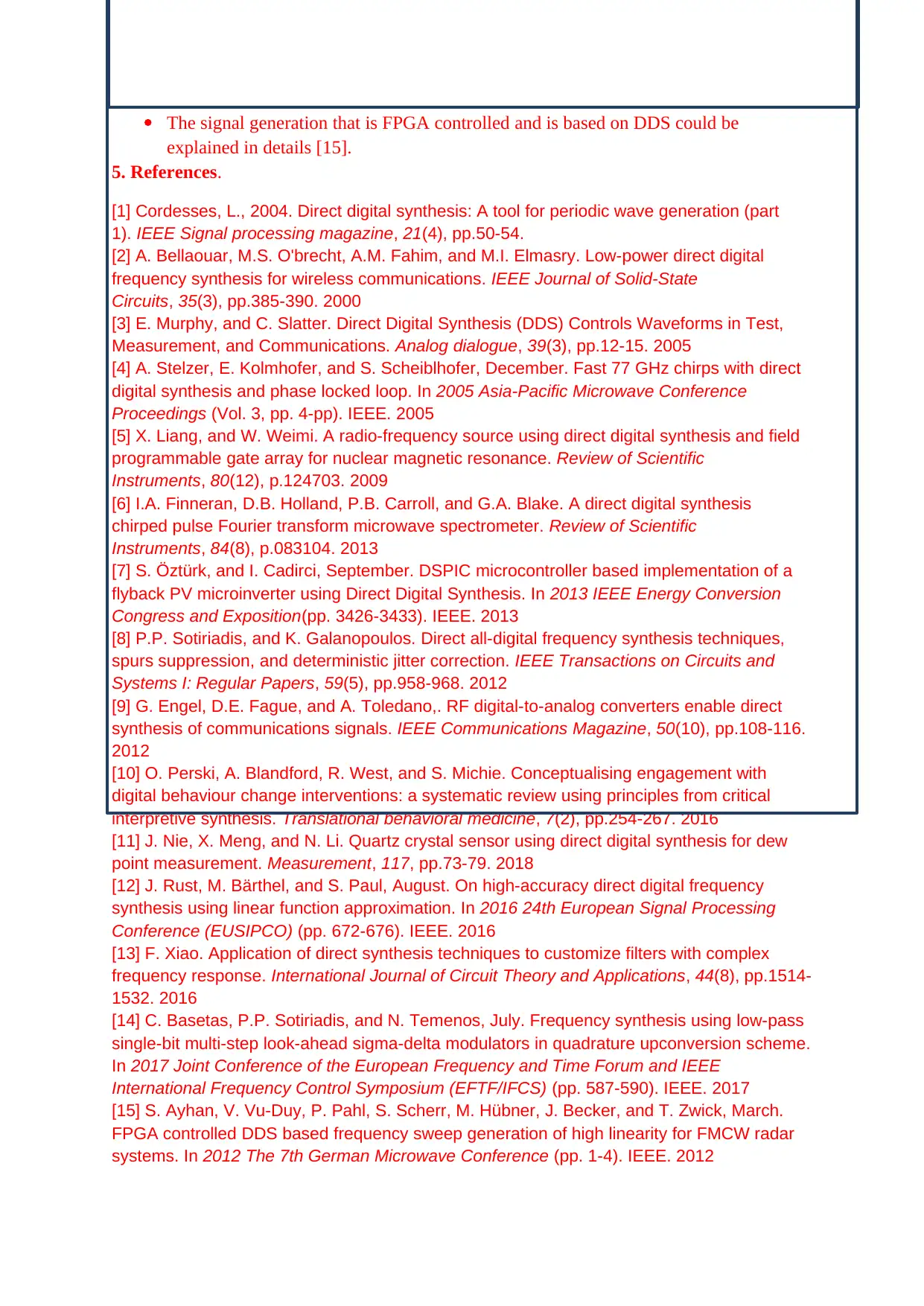
The signal generation that is FPGA controlled and is based on DDS could be
explained in details [15].
5. References.
[1] Cordesses, L., 2004. Direct digital synthesis: A tool for periodic wave generation (part
1). IEEE Signal processing magazine, 21(4), pp.50-54.
[2] A. Bellaouar, M.S. O'brecht, A.M. Fahim, and M.I. Elmasry. Low-power direct digital
frequency synthesis for wireless communications. IEEE Journal of Solid-State
Circuits, 35(3), pp.385-390. 2000
[3] E. Murphy, and C. Slatter. Direct Digital Synthesis (DDS) Controls Waveforms in Test,
Measurement, and Communications. Analog dialogue, 39(3), pp.12-15. 2005
[4] A. Stelzer, E. Kolmhofer, and S. Scheiblhofer, December. Fast 77 GHz chirps with direct
digital synthesis and phase locked loop. In 2005 Asia-Pacific Microwave Conference
Proceedings (Vol. 3, pp. 4-pp). IEEE. 2005
[5] X. Liang, and W. Weimi. A radio-frequency source using direct digital synthesis and field
programmable gate array for nuclear magnetic resonance. Review of Scientific
Instruments, 80(12), p.124703. 2009
[6] I.A. Finneran, D.B. Holland, P.B. Carroll, and G.A. Blake. A direct digital synthesis
chirped pulse Fourier transform microwave spectrometer. Review of Scientific
Instruments, 84(8), p.083104. 2013
[7] S. Öztürk, and I. Cadirci, September. DSPIC microcontroller based implementation of a
flyback PV microinverter using Direct Digital Synthesis. In 2013 IEEE Energy Conversion
Congress and Exposition(pp. 3426-3433). IEEE. 2013
[8] P.P. Sotiriadis, and K. Galanopoulos. Direct all-digital frequency synthesis techniques,
spurs suppression, and deterministic jitter correction. IEEE Transactions on Circuits and
Systems I: Regular Papers, 59(5), pp.958-968. 2012
[9] G. Engel, D.E. Fague, and A. Toledano,. RF digital-to-analog converters enable direct
synthesis of communications signals. IEEE Communications Magazine, 50(10), pp.108-116.
2012
[10] O. Perski, A. Blandford, R. West, and S. Michie. Conceptualising engagement with
digital behaviour change interventions: a systematic review using principles from critical
interpretive synthesis. Translational behavioral medicine, 7(2), pp.254-267. 2016
[11] J. Nie, X. Meng, and N. Li. Quartz crystal sensor using direct digital synthesis for dew
point measurement. Measurement, 117, pp.73-79. 2018
[12] J. Rust, M. Bärthel, and S. Paul, August. On high-accuracy direct digital frequency
synthesis using linear function approximation. In 2016 24th European Signal Processing
Conference (EUSIPCO) (pp. 672-676). IEEE. 2016
[13] F. Xiao. Application of direct synthesis techniques to customize filters with complex
frequency response. International Journal of Circuit Theory and Applications, 44(8), pp.1514-
1532. 2016
[14] C. Basetas, P.P. Sotiriadis, and N. Temenos, July. Frequency synthesis using low-pass
single-bit multi-step look-ahead sigma-delta modulators in quadrature upconversion scheme.
In 2017 Joint Conference of the European Frequency and Time Forum and IEEE
International Frequency Control Symposium (EFTF/IFCS) (pp. 587-590). IEEE. 2017
[15] S. Ayhan, V. Vu-Duy, P. Pahl, S. Scherr, M. Hübner, J. Becker, and T. Zwick, March.
FPGA controlled DDS based frequency sweep generation of high linearity for FMCW radar
systems. In 2012 The 7th German Microwave Conference (pp. 1-4). IEEE. 2012
chevron_up_icon
1 out of 2
circle_padding
hide_on_mobile
zoom_out_icon
[object Object]