LAWS62023 Assignment: Directors' Duties and Conflict of Interest
VerifiedAdded on 2022/02/07
|15
|4035
|30
Essay
AI Summary
This essay delves into the evolving role of directors in company law, highlighting the shift from limited involvement to significant responsibilities centered on shareholder interests, as codified in the Companies Act 2006 (CA). It explores directors' fiduciary duties, emphasizing the duty to avoid conflicts of interest, and examines the landmark case of Aberdeen Railway Co v Blaikie Bros. The essay analyzes the no-conflict-no-profit rule, its rationale, and its application through various case studies, including Bhullar v Bhullar, Foster Bryant Surveying Ltd v Bryant, Industrial development Consultants v Cooley, Cox v Dublin City Distillery (No.2), and Regal (Hastings) Ltd v Gulliver. It further investigates the relationship between the duty to avoid conflict and other directors' duties, such as those concerning benefits, promoting company success, and exercising reasonable care, skill, and diligence. The essay concludes by discussing the call for flexibility in applying the no-conflict-no-profit rule, considering arguments for a more nuanced approach that balances strict liability with the potential for detrimental effects on directors, and the importance of board consent and transparency.
‘Module Name : ‘Company & Commercial Law
‘Module Code : ‘LAWS62023’
‘SU’ Reference’ No: ‘17029395’
‘Word’ ‘Count: ‘2748’
1
‘Module Code : ‘LAWS62023’
‘SU’ Reference’ No: ‘17029395’
‘Word’ ‘Count: ‘2748’
1

Paraphrase This Document
Need a fresh take? Get an instant paraphrase of this document with our AI Paraphraser
INTRODUCTION
The role of directors have changed dramatically in the past 100 years. Earlier,
directors were not expected to devote much time for company businesses. The law now
demands a lot from a director because unlike in the past, the interests of the shareholder is at
center stage and directors have to abstain from making very serious errors. Directors as the
agents of the shareholders have a number of responsibilities.1 These fiduciary responsibilities
were established in English case law which are now codified in ss.171–177 of the Companies
Act 2006 (CA).2 For the purpose of this assessment, in order to understand the duty to avoid
conflict3 and other directors’ duties, it is vital to consider the corresponding common law and
equitable rules.4 This paper will first shed light on the duty to avoid conflict. The author will
then discuss and analyze the facts of Aberdeen Railway Co v Blaikie Bros5 along with
additional cases to illustrate the link between the duty to avoid conflict and the other
directors’ duties. Finally, whether the no-conflict-no-profit rule should be harsh or more
flexible is a broad question that must be discussed in this paper.
Aberdeen Railway Co v Blaikie Bros on s175
The primary provision in question is s175– the duty to avoid conflict.6 Section 170(3)
of the CA states that general duties are derived from old common law rules and equitable
principles and codified under this Act.7 Hence, the interpretations under old case law on
director’s duties shall be referred to apply the provisions under duty to avoid conflict. The
essence of the no-conflict-no-profit rule is that when a director is dealing in a proposed
transaction with the company and in this process has an unauthorized personal interest
conflicting his duty to the company, the contract is then void. Aberdeen Railway Co v
Blaikie Bros8 is the landmark case which set forth this principle on a contract entered by
Aberdeen Railway Co with Blaikie Bros in which Mr.Blaikie, a director in his own company
1 Susan McLaughlin, Unlocking Company Law (3rd edn, Routledge 2015) 326
2 Companies Act 2006, ss 171-177
3 Companies Act 2006, s 175
4 Companies Act 2006, s 170
5 Aberdeen Railway Co v Blaikie Bros [1853] 15 D HL 20
6 Companies Act 2006, s 175
7 Companies Act 2006, s 170(3)
8 Aberdeen Railway Co v Blaikie Bros [1853] 15 D HL 20 (Cranworth LJ)
2
The role of directors have changed dramatically in the past 100 years. Earlier,
directors were not expected to devote much time for company businesses. The law now
demands a lot from a director because unlike in the past, the interests of the shareholder is at
center stage and directors have to abstain from making very serious errors. Directors as the
agents of the shareholders have a number of responsibilities.1 These fiduciary responsibilities
were established in English case law which are now codified in ss.171–177 of the Companies
Act 2006 (CA).2 For the purpose of this assessment, in order to understand the duty to avoid
conflict3 and other directors’ duties, it is vital to consider the corresponding common law and
equitable rules.4 This paper will first shed light on the duty to avoid conflict. The author will
then discuss and analyze the facts of Aberdeen Railway Co v Blaikie Bros5 along with
additional cases to illustrate the link between the duty to avoid conflict and the other
directors’ duties. Finally, whether the no-conflict-no-profit rule should be harsh or more
flexible is a broad question that must be discussed in this paper.
Aberdeen Railway Co v Blaikie Bros on s175
The primary provision in question is s175– the duty to avoid conflict.6 Section 170(3)
of the CA states that general duties are derived from old common law rules and equitable
principles and codified under this Act.7 Hence, the interpretations under old case law on
director’s duties shall be referred to apply the provisions under duty to avoid conflict. The
essence of the no-conflict-no-profit rule is that when a director is dealing in a proposed
transaction with the company and in this process has an unauthorized personal interest
conflicting his duty to the company, the contract is then void. Aberdeen Railway Co v
Blaikie Bros8 is the landmark case which set forth this principle on a contract entered by
Aberdeen Railway Co with Blaikie Bros in which Mr.Blaikie, a director in his own company
1 Susan McLaughlin, Unlocking Company Law (3rd edn, Routledge 2015) 326
2 Companies Act 2006, ss 171-177
3 Companies Act 2006, s 175
4 Companies Act 2006, s 170
5 Aberdeen Railway Co v Blaikie Bros [1853] 15 D HL 20
6 Companies Act 2006, s 175
7 Companies Act 2006, s 170(3)
8 Aberdeen Railway Co v Blaikie Bros [1853] 15 D HL 20 (Cranworth LJ)
2
was also a partner. Here, Mr.Blaikie sacrificed the interests of Aberdeen Co for his own
company, in other words, his personal interest. This is a breach of s175. A remedy for breach
of s175 would be rescission of the contract.9
The rationale for the no-conflict-no-profit rule is to protect companies. Lord
Cranworth in Aberdeen10 made clear a corporate body can only act by agents and thereby it is
the duty of agents to uphold the interests of the company. For this reason, Lord Cranworth
further stipulates that a director as an agent cannot put himself in a position where his interest
and his duty would conflict.11 Therefore, the no-conflict-no-profit rule is a “precaution”
against the abuse of power.
Lord Herschelle described the no-conflict-no-profit rule as in-flexible, his elaboration
in Bray v Ford12 suggest that a director is not allowed to put himself in a position where his
interest and his duty to the company is in conflict because of the high possibility that the
director would give in by interest rather than by duty.13 This was the same approach in
Aberdeen.14 The high possibility that a director would choose his interest over his duty is the
very reason the no-conflict-no-profit rule is harsh.15 Lord Laskin in Canadian Aero Services
Ltd v O’Malley16 reasoned the strict application of the rule is due to the level of control a
director has over the company.17 A director is given the duty to exercise independent
judgment within s173.18 Since Mr.Blaikie had the discretion to use his directorial power
without the interference of others, the delegation of power led to abuse of power. For this
9 Ewan MacIntyre, Essentials of Business Law (3rd edn, Pearson 2011) 173
10 Aberdeen Railway Co v Blaikie Bros [1853] 15 D HL 20 (Cranworth LJ)
11 Robert Flannigan, ‘The adulteration of fiduciary doctrine in corporate law’ (2006) Law Quarterly
Review 450
12 Bray v Ford [1896] AC 44 (Herschelle LJ)
13 Rebecca Lee, ‘In Search of the Nature and Function of Fiduciary Loyalty: Some Observations on
Conaglen's Analysis’ (2007) Oxford University Press 329
14 Aberdeen Railway Co v Blaikie Bros [1853] 15 D HL 20
15 Lee (n13) 330
16 Canadian Aero Service Ltd v O’Malley (‘Canaero’) [1973] 40 DLR 371 (Laskin LJ)
17 James Cox, ‘Managing and Monitoring Conflicts of Interest: Empowering the Outside Directors
with Independent Counsel’ (2003) Villanova Law Review 76
18 Companies Act 2006, s 173
3
company, in other words, his personal interest. This is a breach of s175. A remedy for breach
of s175 would be rescission of the contract.9
The rationale for the no-conflict-no-profit rule is to protect companies. Lord
Cranworth in Aberdeen10 made clear a corporate body can only act by agents and thereby it is
the duty of agents to uphold the interests of the company. For this reason, Lord Cranworth
further stipulates that a director as an agent cannot put himself in a position where his interest
and his duty would conflict.11 Therefore, the no-conflict-no-profit rule is a “precaution”
against the abuse of power.
Lord Herschelle described the no-conflict-no-profit rule as in-flexible, his elaboration
in Bray v Ford12 suggest that a director is not allowed to put himself in a position where his
interest and his duty to the company is in conflict because of the high possibility that the
director would give in by interest rather than by duty.13 This was the same approach in
Aberdeen.14 The high possibility that a director would choose his interest over his duty is the
very reason the no-conflict-no-profit rule is harsh.15 Lord Laskin in Canadian Aero Services
Ltd v O’Malley16 reasoned the strict application of the rule is due to the level of control a
director has over the company.17 A director is given the duty to exercise independent
judgment within s173.18 Since Mr.Blaikie had the discretion to use his directorial power
without the interference of others, the delegation of power led to abuse of power. For this
9 Ewan MacIntyre, Essentials of Business Law (3rd edn, Pearson 2011) 173
10 Aberdeen Railway Co v Blaikie Bros [1853] 15 D HL 20 (Cranworth LJ)
11 Robert Flannigan, ‘The adulteration of fiduciary doctrine in corporate law’ (2006) Law Quarterly
Review 450
12 Bray v Ford [1896] AC 44 (Herschelle LJ)
13 Rebecca Lee, ‘In Search of the Nature and Function of Fiduciary Loyalty: Some Observations on
Conaglen's Analysis’ (2007) Oxford University Press 329
14 Aberdeen Railway Co v Blaikie Bros [1853] 15 D HL 20
15 Lee (n13) 330
16 Canadian Aero Service Ltd v O’Malley (‘Canaero’) [1973] 40 DLR 371 (Laskin LJ)
17 James Cox, ‘Managing and Monitoring Conflicts of Interest: Empowering the Outside Directors
with Independent Counsel’ (2003) Villanova Law Review 76
18 Companies Act 2006, s 173
3
⊘ This is a preview!⊘
Do you want full access?
Subscribe today to unlock all pages.

Trusted by 1+ million students worldwide
reason, the harshness of the rule is necessitated to keep the directors under good behavior to
preserve scrutiny.19
A Director’s Guide to Avoid Allegations
A director can escape the rules of no-conflict-no-profit by two means; an exclusion in
the constitution or ordinary resolution.20 In Aberdeen,21 Mr.Blaikie was a director in both the
companies therefore this would allow more possibility of breach. However, there is no
obstruction that a director cannot be a director in other companies. The reason being that a
director can opt for an ordinary resolution to maintain the transaction22 by ‘declaring his
personal interest to the company board’ within s177.23 In Bhullar v Bhullar,24 Jonathan Parker
LJ held the duty to avoid conflict was breached because the appellant did not first declare
their intentions to the co-directors. Likewise, in Aberdeen,25 Mr.Blaikie did not declare his
interest in the arrangement therefore he is in breach of his duty within s177 and s175 for the
profits he received. By contrast in Foster Bryant Surveying Ltd v Bryant,26 Mr.Bryant had
successfully resigned from the company before taking up the contract so he was no longer a
director, in other words, he was not in the capacity of having a fiduciary relationship.
Therefore, the court held there was no breach of s175 in this case. However, in Industrial
development Consultants v Cooley,27 Mr.Cooley was under the fiduciary duty at the time he
decided to take up a project privately and did not disclose this to the company therefore Lord
Roskill held Cooley accountable for the benefits received. Notice, the directors have to
always declare their personal interests and they cannot hide behind a veil, this underlines
transparency.28 Not to forget, the ordinary resolution brings in the element of ‘board-
consent.’29 The possibility that a director can ‘still carry on’ with the transaction despite a
19 Nicholas Bourne, Bourne on company law (6th edn, Routledge 2013) 175
20 Alan Dignam & John Lowry, Company Law (7th edn, OUP 2012) 382
21 Aberdeen Railway Co v Blaikie Bros [1853] 15 D HL 20
22 Lucy Jones, Introduction to Business Law (2nd edn, OUP 2013) 574
23 Companies Act 2006, s 177
24 Bhullar v Bhullar [2003] 2 BCLC 241 (Parker LJ)
25 Aberdeen Railway Co v Blaikie Bros [1853] 15 D HL 20
26 Foster Bryant Surveying Ltd v Bryant [2007] EWCA Civ 200
27 Industrial Development Consultants (IDC) Ltd v Cooley [1972] 1 WLR 443 (Roskill LJ)
28 Deirdre Ahern, ‘Legislating for the Duty on Directors to Avoid Conflict of Interest and Secret
Profits: The Devil in the Detail’ (2010) Irish Jurist 85
29 Charles Wild & Stuart Weinstein, Smith and Keenan’s Company Law (17th edn, Pearson 2016) 201
4
preserve scrutiny.19
A Director’s Guide to Avoid Allegations
A director can escape the rules of no-conflict-no-profit by two means; an exclusion in
the constitution or ordinary resolution.20 In Aberdeen,21 Mr.Blaikie was a director in both the
companies therefore this would allow more possibility of breach. However, there is no
obstruction that a director cannot be a director in other companies. The reason being that a
director can opt for an ordinary resolution to maintain the transaction22 by ‘declaring his
personal interest to the company board’ within s177.23 In Bhullar v Bhullar,24 Jonathan Parker
LJ held the duty to avoid conflict was breached because the appellant did not first declare
their intentions to the co-directors. Likewise, in Aberdeen,25 Mr.Blaikie did not declare his
interest in the arrangement therefore he is in breach of his duty within s177 and s175 for the
profits he received. By contrast in Foster Bryant Surveying Ltd v Bryant,26 Mr.Bryant had
successfully resigned from the company before taking up the contract so he was no longer a
director, in other words, he was not in the capacity of having a fiduciary relationship.
Therefore, the court held there was no breach of s175 in this case. However, in Industrial
development Consultants v Cooley,27 Mr.Cooley was under the fiduciary duty at the time he
decided to take up a project privately and did not disclose this to the company therefore Lord
Roskill held Cooley accountable for the benefits received. Notice, the directors have to
always declare their personal interests and they cannot hide behind a veil, this underlines
transparency.28 Not to forget, the ordinary resolution brings in the element of ‘board-
consent.’29 The possibility that a director can ‘still carry on’ with the transaction despite a
19 Nicholas Bourne, Bourne on company law (6th edn, Routledge 2013) 175
20 Alan Dignam & John Lowry, Company Law (7th edn, OUP 2012) 382
21 Aberdeen Railway Co v Blaikie Bros [1853] 15 D HL 20
22 Lucy Jones, Introduction to Business Law (2nd edn, OUP 2013) 574
23 Companies Act 2006, s 177
24 Bhullar v Bhullar [2003] 2 BCLC 241 (Parker LJ)
25 Aberdeen Railway Co v Blaikie Bros [1853] 15 D HL 20
26 Foster Bryant Surveying Ltd v Bryant [2007] EWCA Civ 200
27 Industrial Development Consultants (IDC) Ltd v Cooley [1972] 1 WLR 443 (Roskill LJ)
28 Deirdre Ahern, ‘Legislating for the Duty on Directors to Avoid Conflict of Interest and Secret
Profits: The Devil in the Detail’ (2010) Irish Jurist 85
29 Charles Wild & Stuart Weinstein, Smith and Keenan’s Company Law (17th edn, Pearson 2016) 201
4
Paraphrase This Document
Need a fresh take? Get an instant paraphrase of this document with our AI Paraphraser
personal interest provided board-consent depicts the rule is not as harsh as it seems.30
However, a rebuttal to this argument can be made, since the director must first disclose his
personal interest under s17731 and second gain informed consent from the board emphasizes
the rule is in fact harsh.
In Cox v Dublin City Distillery (No.2)32 the company’s articles of association required
directors to vote but not if they had an interest. The result of directors voting on contracts for
their own interests as seen in Cox33 is a breach of s175. For directors to avoid this, s23934
stipulates that in approving any transaction, the interested director may not vote. If the
director is to vote, he must first disclose his interest and then vote on the contract,35 if not it
will be a case of self-dealing and it will no longer be a breach of no-conflict-no-profit duty
but rather a breach of the duty of compliance.36
Breach of s175 to Breach Other Director’s Duties
A breach of the no-conflict-no-profit rule can be seen to direct a breach of other
possible directors’ duties. For example, section 17637 adds the ‘duty not to accept benefits’
meaning directors cannot accept bribes or gain other benefits and notice how s176 shares
similarities with s175 because accepting benefits brings in a conflict of interest and a profit
gain on the director.38 This tells us that the no-conflict-no-profit duty is intermingled or
entangled with other directors’ duties and this also questions if s175 is really necessary.
30 Johnson S, ‘Conflicts of interest and directors’ duties’ (2007) In-House Lawyer 42
31 Companies Act 2006, s 177
32 Cox v Dublin City Distillery (No.2) [1915] 1 IR 345
33 ibid
34 Companies Act 2006, s 239
35 Ewan MacIntyre, Essentials of Business Law (3rd edn, Pearson 2011) 121
36 Nancy Kubasek, Neil Browne, Daniel Herron, Lucien Dhooge & Linda Barkacs, Dynamic Business
Law: The Essentials (3rd edn, McGraw-Hill 2016) 476
37 Companies Act 2006, s 176
38 Ewan MacIntyre, Essentials of Business Law (3rd edn, Pearson 2011) 300
5
However, a rebuttal to this argument can be made, since the director must first disclose his
personal interest under s17731 and second gain informed consent from the board emphasizes
the rule is in fact harsh.
In Cox v Dublin City Distillery (No.2)32 the company’s articles of association required
directors to vote but not if they had an interest. The result of directors voting on contracts for
their own interests as seen in Cox33 is a breach of s175. For directors to avoid this, s23934
stipulates that in approving any transaction, the interested director may not vote. If the
director is to vote, he must first disclose his interest and then vote on the contract,35 if not it
will be a case of self-dealing and it will no longer be a breach of no-conflict-no-profit duty
but rather a breach of the duty of compliance.36
Breach of s175 to Breach Other Director’s Duties
A breach of the no-conflict-no-profit rule can be seen to direct a breach of other
possible directors’ duties. For example, section 17637 adds the ‘duty not to accept benefits’
meaning directors cannot accept bribes or gain other benefits and notice how s176 shares
similarities with s175 because accepting benefits brings in a conflict of interest and a profit
gain on the director.38 This tells us that the no-conflict-no-profit duty is intermingled or
entangled with other directors’ duties and this also questions if s175 is really necessary.
30 Johnson S, ‘Conflicts of interest and directors’ duties’ (2007) In-House Lawyer 42
31 Companies Act 2006, s 177
32 Cox v Dublin City Distillery (No.2) [1915] 1 IR 345
33 ibid
34 Companies Act 2006, s 239
35 Ewan MacIntyre, Essentials of Business Law (3rd edn, Pearson 2011) 121
36 Nancy Kubasek, Neil Browne, Daniel Herron, Lucien Dhooge & Linda Barkacs, Dynamic Business
Law: The Essentials (3rd edn, McGraw-Hill 2016) 476
37 Companies Act 2006, s 176
38 Ewan MacIntyre, Essentials of Business Law (3rd edn, Pearson 2011) 300
5
According to Hogg v Cramphorn,39 if a director benefits financially they will likely
have a breach under s171.40 Therefore, in Aberdeen,41 the fact that Mr.Blaikie had benefitted
financially by lowering cost of iron seats has breached s171 jointly with s175. Secondly,
s17242 requires the director to promote success of the company by considering the best
interest of the company.43 However, the likely consequences of the decision made by
Mr.Blaikie may affect the company in the long term which again would not be in the best
interest of the company and hindering the company success.44 Mr. Blaikie’s actions would be
seen by customers as unfaithful which will lead to even other businesses not willing to
contract with the company hence Mr.Blaikie as a director has failed to consider the need to
maintain high standards in business ethics, consequently breaching s172 as well.45 Thirdly,
Mr.Blaikie has the duty to exercise reasonable care, skill and diligence under s174.46
Factually, Mr.Blaikie has his own company and is also a director at Aberdeen Co and it will
deem he has extra skill, knowledge or experience, hence, he owes a higher standard of care,47
resulting another breach under s174.
Therefore, the situation in Aberdeen Railway Co48 is not purely corresponding with
the no-conflict-no-profit rule, it corresponds with other directors duties as well. This is proof
that the rule needs to be flexible or adjusted because a breach of s175 paves way for other
director’s duties to concern breach.
39 Hogg v Cramphorn [1967] Ch 254
40 Companies Act 2006, s 171
41 Aberdeen Railway Co v Blaikie Bros [1853] 15 D HL 20
42 Companies Act 2006, s 172
43 Ewan MacIntyre, Essentials of Business Law (3rd edn, Pearson 2011) 299
44 Odyssey Entertainment Ltd (In Liquidation) v (1) Kamp & others [2012] EWHC 2316
45 Lucy Jones, Introduction to Business Law (2nd edn, OUP 2013) 571
46 Companies Act 2006, s 174
47 James Marson, Business Law (2nd edn, OUP 2011) 567
48 Aberdeen Railway Co v Blaikie Bros [1853] 15 D HL 20
6
have a breach under s171.40 Therefore, in Aberdeen,41 the fact that Mr.Blaikie had benefitted
financially by lowering cost of iron seats has breached s171 jointly with s175. Secondly,
s17242 requires the director to promote success of the company by considering the best
interest of the company.43 However, the likely consequences of the decision made by
Mr.Blaikie may affect the company in the long term which again would not be in the best
interest of the company and hindering the company success.44 Mr. Blaikie’s actions would be
seen by customers as unfaithful which will lead to even other businesses not willing to
contract with the company hence Mr.Blaikie as a director has failed to consider the need to
maintain high standards in business ethics, consequently breaching s172 as well.45 Thirdly,
Mr.Blaikie has the duty to exercise reasonable care, skill and diligence under s174.46
Factually, Mr.Blaikie has his own company and is also a director at Aberdeen Co and it will
deem he has extra skill, knowledge or experience, hence, he owes a higher standard of care,47
resulting another breach under s174.
Therefore, the situation in Aberdeen Railway Co48 is not purely corresponding with
the no-conflict-no-profit rule, it corresponds with other directors duties as well. This is proof
that the rule needs to be flexible or adjusted because a breach of s175 paves way for other
director’s duties to concern breach.
39 Hogg v Cramphorn [1967] Ch 254
40 Companies Act 2006, s 171
41 Aberdeen Railway Co v Blaikie Bros [1853] 15 D HL 20
42 Companies Act 2006, s 172
43 Ewan MacIntyre, Essentials of Business Law (3rd edn, Pearson 2011) 299
44 Odyssey Entertainment Ltd (In Liquidation) v (1) Kamp & others [2012] EWHC 2316
45 Lucy Jones, Introduction to Business Law (2nd edn, OUP 2013) 571
46 Companies Act 2006, s 174
47 James Marson, Business Law (2nd edn, OUP 2011) 567
48 Aberdeen Railway Co v Blaikie Bros [1853] 15 D HL 20
6
⊘ This is a preview!⊘
Do you want full access?
Subscribe today to unlock all pages.
Trusted by 1+ million students worldwide
Call for Flexibility
In O'Donnell v Shanahan and Another,49 Richard Sheldon QC held Mr.Shanahan’s
interest were not against the company, therefore, there was no breach of s175. This suggests
that a director can have an interest, as long as it is not an interest that conflicts with the
company’s interest. Likewise, what amounts to an interest as set out in Aberdeen50 standards
by Lord Cranworth is that a director must avoid an interest of personal nature which ‘possibly
or may’ conflict with the interests of his responsibilities. The Act refers to ‘any conflict’ and
not a ‘possible conflict’ which indicates the no-conflict-no-profit rule is potentially narrower
than in Lord Cranworth’s approach.51 This suggests the rule has a harsh ‘application.’ The
courts seem to create a higher level of scrutiny on directors although the directors will only
have to avoid ‘actual’ conflicts under s175. However, Lord Upjohn’s dissenting judgement in
Boardman v Phipps52 cleared that what Lord Cranworth meant in Aberdeen was that ‘possibly
may conflict’ requires what a reasonable man given the facts of the case would conclude as a
conflict and not that someone imagine any situation that results in a conflict.53 Despite this
explanation, there is still a concern that the rule is applied strictly by courts although the Act
does not warrant for such harshness.
Prior to the Act, the no-conflict rule and the no-profit rule were similar in nature but
were considered separately because there can be a ‘conflict’ of interest without gaining of
‘profit.’54 An example would be, a director’s decision to give an executive position to an
underqualified employee because of a sexual relationship. Interestingly s17555 has combined
the two rules together. However, taking the same example, even if the director hired the
49 O'Donnell v Shanahan and Another [2009] EWCA Civ 751 (Sheldon LJ)
50 Aberdeen Railway Co v Blaikie Bros [1853] 15 D HL 20 (Cranworth LJ)
51 Michael Christie, ‘The Director’s Fiduciary Duty Not to Compete’ (1992) The Modern Law Review
512
52 Boardman v Phipps [1967] 2 AC 46 (Upjohn LJ)
53 Thomas Courtney, ‘The company director's duty to avoid conflicts: from inner core to outer limits’
(2019) Irish Jurist 27
54 ibid, 29
55 Companies Act 2006, s 175
7
In O'Donnell v Shanahan and Another,49 Richard Sheldon QC held Mr.Shanahan’s
interest were not against the company, therefore, there was no breach of s175. This suggests
that a director can have an interest, as long as it is not an interest that conflicts with the
company’s interest. Likewise, what amounts to an interest as set out in Aberdeen50 standards
by Lord Cranworth is that a director must avoid an interest of personal nature which ‘possibly
or may’ conflict with the interests of his responsibilities. The Act refers to ‘any conflict’ and
not a ‘possible conflict’ which indicates the no-conflict-no-profit rule is potentially narrower
than in Lord Cranworth’s approach.51 This suggests the rule has a harsh ‘application.’ The
courts seem to create a higher level of scrutiny on directors although the directors will only
have to avoid ‘actual’ conflicts under s175. However, Lord Upjohn’s dissenting judgement in
Boardman v Phipps52 cleared that what Lord Cranworth meant in Aberdeen was that ‘possibly
may conflict’ requires what a reasonable man given the facts of the case would conclude as a
conflict and not that someone imagine any situation that results in a conflict.53 Despite this
explanation, there is still a concern that the rule is applied strictly by courts although the Act
does not warrant for such harshness.
Prior to the Act, the no-conflict rule and the no-profit rule were similar in nature but
were considered separately because there can be a ‘conflict’ of interest without gaining of
‘profit.’54 An example would be, a director’s decision to give an executive position to an
underqualified employee because of a sexual relationship. Interestingly s17555 has combined
the two rules together. However, taking the same example, even if the director hired the
49 O'Donnell v Shanahan and Another [2009] EWCA Civ 751 (Sheldon LJ)
50 Aberdeen Railway Co v Blaikie Bros [1853] 15 D HL 20 (Cranworth LJ)
51 Michael Christie, ‘The Director’s Fiduciary Duty Not to Compete’ (1992) The Modern Law Review
512
52 Boardman v Phipps [1967] 2 AC 46 (Upjohn LJ)
53 Thomas Courtney, ‘The company director's duty to avoid conflicts: from inner core to outer limits’
(2019) Irish Jurist 27
54 ibid, 29
55 Companies Act 2006, s 175
7
Paraphrase This Document
Need a fresh take? Get an instant paraphrase of this document with our AI Paraphraser
underqualified employee for such personal interests, there would still be no profit gain.
Therefore, it only makes little sense to combine the rule together.
The courts are seen to stick with strict liability for no-conflict-no-profit cases,
however, there is now a question as to whether it can create a standard that is too harsh. In
Regal (Hastings) Ltd v Gulliver,56 the company wanted to buy cinemas but could not and the
directors together with the shareholders purchased and profited from the cinemas and all
profits were kept for the company. The directors acted bona fide(good faith) but since the
general rule is that directors cannot perform in a manner where their personal interest
conflicts with their duties, by this rule, although the directors acted bona fide contrasting Re
Smith,57 it was irrelevant and the fact that the directors had made a profit caused a
fundamental breach of their fiduciary duty. It is true that the directors had misused the
company property in this case however the company was caused no damage and even the
shareholders gained profits.58 Therefore, a strong argument can be made that there is a call for
flexibility and the standard of the rule is too harsh.
Moreover, the strict application of the rule will find too many innocent directors that
are guilty on mere failure to avoid a conflict of interest, even if they are not biased. However,
Lord Wright’s59 held the courts are only concerned with the ‘benefit-making’ factor of the
directors because it is difficult to ascertain the proof of bona fide and it is a good reason to
stick with strict liability on no-conflict-no-profit cases. 60 Nevertheless, the court’s inflexible
approach brings detriment on the director. For example, an innocent director can be tricked
into foul play but the director will be held liable for breaching s175 because the element of
good faith is neglected by court.61 This is why the no-conflict-no-profit rule is the most
complex out of the other director’s duties. The rule is ideally created to stop directors from
miss using their powers and unfair advantage. However, since the courts only consider the
56 Regal (Hastings) Ltd v Gulliver [1942] 1 All ER 378
57Re Smith and Fawcett Ltd [1942] Ch 304 (Greene LJ)
58 Deirdre Ahern, ‘Legislating for the Duty on Directors to Avoid Conflict of Interest and Secret
Profits: The Devil in the Detail’ (2010) Irish Jurist 85
59 Regal (Hastings) Ltd v Gulliver [1942] 1 All ER 378 (Wrights LJ)
60 Thomas Courtney, ‘The company director's duty to avoid conflicts: from inner core to outer limits’
(2019) Irish Jurist 25
61 Michael Christie, ‘The Director’s Fiduciary Duty Not to Compete’ (1992) The Modern Law Review
508
8
Therefore, it only makes little sense to combine the rule together.
The courts are seen to stick with strict liability for no-conflict-no-profit cases,
however, there is now a question as to whether it can create a standard that is too harsh. In
Regal (Hastings) Ltd v Gulliver,56 the company wanted to buy cinemas but could not and the
directors together with the shareholders purchased and profited from the cinemas and all
profits were kept for the company. The directors acted bona fide(good faith) but since the
general rule is that directors cannot perform in a manner where their personal interest
conflicts with their duties, by this rule, although the directors acted bona fide contrasting Re
Smith,57 it was irrelevant and the fact that the directors had made a profit caused a
fundamental breach of their fiduciary duty. It is true that the directors had misused the
company property in this case however the company was caused no damage and even the
shareholders gained profits.58 Therefore, a strong argument can be made that there is a call for
flexibility and the standard of the rule is too harsh.
Moreover, the strict application of the rule will find too many innocent directors that
are guilty on mere failure to avoid a conflict of interest, even if they are not biased. However,
Lord Wright’s59 held the courts are only concerned with the ‘benefit-making’ factor of the
directors because it is difficult to ascertain the proof of bona fide and it is a good reason to
stick with strict liability on no-conflict-no-profit cases. 60 Nevertheless, the court’s inflexible
approach brings detriment on the director. For example, an innocent director can be tricked
into foul play but the director will be held liable for breaching s175 because the element of
good faith is neglected by court.61 This is why the no-conflict-no-profit rule is the most
complex out of the other director’s duties. The rule is ideally created to stop directors from
miss using their powers and unfair advantage. However, since the courts only consider the
56 Regal (Hastings) Ltd v Gulliver [1942] 1 All ER 378
57Re Smith and Fawcett Ltd [1942] Ch 304 (Greene LJ)
58 Deirdre Ahern, ‘Legislating for the Duty on Directors to Avoid Conflict of Interest and Secret
Profits: The Devil in the Detail’ (2010) Irish Jurist 85
59 Regal (Hastings) Ltd v Gulliver [1942] 1 All ER 378 (Wrights LJ)
60 Thomas Courtney, ‘The company director's duty to avoid conflicts: from inner core to outer limits’
(2019) Irish Jurist 25
61 Michael Christie, ‘The Director’s Fiduciary Duty Not to Compete’ (1992) The Modern Law Review
508
8
benefit-making factor, this rule has now discouraged directors to use their power to make
decisions.62 A mere presence of conflict of interest is not sufficient to determine breach of
s175. Unfortunately, courts are happy to accept a breach of s175 in this fashion. The bigger
concern, however is, the strictness of the rule brings an inflexible application to a variety of
cases therefore an optimal solution is required.
New commercial realities
Today, directors are directors of many companies. Therefore, there can be a clash
with the relationships directors share between these companies and the possibility of
breaching s175 is then higher. No company is more important than the other. Hence, it is
strange for the court to declare a breach of s175 where a director cannot possibly choose
which company he owes a duty to like in Aberdeen Railway Co.63 Ideally, Mr.Blaikie also
owed a duty to his company therefore if his actions were committed vice versa, he would be
in breach of s175 to his own company. At this point, this rule makes no complete sense.
Besides, a director can be in demand due to their name and expertise. If a company brings
this vigorous rule, that company can lose a competent director and jeopardize their business.
Considering this, a flexible application of the rule is vital to maintain good companies.
Recommendations
The current rules on the duty of no-conflict-no-profit has been mostly approved by
court as the law seeks to go by a strict fiduciary rule to ensure the company’s interest are
given first priority. However, it does raise many concerns. The author of this paper has five
suggestions to mitigate the harshness of the rule. One way to water down the harshness is to
take s175 as it is and not by the court’s strict approach. The application prescribed by law is
narrower and this way not as many directors will be caught inside the net of s175. Second,
the application of the rule must vary depending on the case heard. Cases differ, therefore, the
rule needs to apply flexibly based on question of fact. Third, reform is required to modify the
no-conflict-no-profit rule. Reform on conflicts of interest can be predicted to be more
controversial. A rule against unfair advantage and misappropriation of funds is sufficient to
62 Ahern (n58) 85
63 Aberdeen Railway Co v Blaikie Bros [1853] 15 D HL 20
9
decisions.62 A mere presence of conflict of interest is not sufficient to determine breach of
s175. Unfortunately, courts are happy to accept a breach of s175 in this fashion. The bigger
concern, however is, the strictness of the rule brings an inflexible application to a variety of
cases therefore an optimal solution is required.
New commercial realities
Today, directors are directors of many companies. Therefore, there can be a clash
with the relationships directors share between these companies and the possibility of
breaching s175 is then higher. No company is more important than the other. Hence, it is
strange for the court to declare a breach of s175 where a director cannot possibly choose
which company he owes a duty to like in Aberdeen Railway Co.63 Ideally, Mr.Blaikie also
owed a duty to his company therefore if his actions were committed vice versa, he would be
in breach of s175 to his own company. At this point, this rule makes no complete sense.
Besides, a director can be in demand due to their name and expertise. If a company brings
this vigorous rule, that company can lose a competent director and jeopardize their business.
Considering this, a flexible application of the rule is vital to maintain good companies.
Recommendations
The current rules on the duty of no-conflict-no-profit has been mostly approved by
court as the law seeks to go by a strict fiduciary rule to ensure the company’s interest are
given first priority. However, it does raise many concerns. The author of this paper has five
suggestions to mitigate the harshness of the rule. One way to water down the harshness is to
take s175 as it is and not by the court’s strict approach. The application prescribed by law is
narrower and this way not as many directors will be caught inside the net of s175. Second,
the application of the rule must vary depending on the case heard. Cases differ, therefore, the
rule needs to apply flexibly based on question of fact. Third, reform is required to modify the
no-conflict-no-profit rule. Reform on conflicts of interest can be predicted to be more
controversial. A rule against unfair advantage and misappropriation of funds is sufficient to
62 Ahern (n58) 85
63 Aberdeen Railway Co v Blaikie Bros [1853] 15 D HL 20
9
⊘ This is a preview!⊘
Do you want full access?
Subscribe today to unlock all pages.
Trusted by 1+ million students worldwide
protect the company hence a harsh rule is not necessary. The ‘no-conflict’ element adds
harshness to the rule. Therefore, the no-conflict element must be removed from the original
rule to solely form the ‘NO-PROFIT rule.’ Fourth, s175 is not really necessary. The ‘duty not
to accept benefits’ within s176 shares similar elements to s175 as accepting benefits brings in
a conflict of interest and a profit gain on the director, therefore, directors’ duties can do
without s175. Lastly, in cases where the director deals with a third party and there is a breach,
a good remedy would be the profits gained by the director must be held for the company on
constructive trust or a personal obligation to account.
CONCLUSION
To avoid room to fraud, statutory standards draw the line between the duty of a
director and his interest.64 The enactment of the Companies Act 200665 brings clarity and
certainty to directors’ duties. Directors are under scrutiny because they have a high level of
control66 over the company and they are suspected of making very serious errors. These are
the very few reasons why the no-conflict-no-profit rule within s17567 should remain harsh, at
the cost of detriment on directors. There is more damming evidence to show why the rule
should be flexible. The rule is widely applied stringently creating a wide net to trap many
directors. More likely, directors will be sued for a minor failure to avoid a conflict of
interest.68 Further, a breach of the no-conflict-no-profit rule sets a stage for other possible
directors’ duties to concern breach.69 A strict application is difficult to ascertain the policy
behind the rule and it brings uncertainty on company matters.70 Commercially, good directors
make good companies. To give these directors the respect they deserve, the rule has to show
more flexibility. The rule fails to offer respect to the best of directors. The courts seem to care
very little about directors and such judgements can dangerously affect the economy!
64 Susan McLaughlin, Unlocking Company Law (3rd edn, Routledge 2015) 326
65 Companies Act 2006
66 Companies Act 2006, s 173
67 Companies Act 2006, s 175
68 Deirdre Ahern, ‘Legislating for the Duty on Directors to Avoid Conflict of Interest and Secret
Profits: The Devil in the Detail’ (2010) Irish Jurist 85
69 Companies Act 2006, ss 171, 172, 174, 176
70 Thomas Courtney, ‘The company director's duty to avoid conflicts: from inner core to outer limits’
(2019) Irish Jurist 25
10
harshness to the rule. Therefore, the no-conflict element must be removed from the original
rule to solely form the ‘NO-PROFIT rule.’ Fourth, s175 is not really necessary. The ‘duty not
to accept benefits’ within s176 shares similar elements to s175 as accepting benefits brings in
a conflict of interest and a profit gain on the director, therefore, directors’ duties can do
without s175. Lastly, in cases where the director deals with a third party and there is a breach,
a good remedy would be the profits gained by the director must be held for the company on
constructive trust or a personal obligation to account.
CONCLUSION
To avoid room to fraud, statutory standards draw the line between the duty of a
director and his interest.64 The enactment of the Companies Act 200665 brings clarity and
certainty to directors’ duties. Directors are under scrutiny because they have a high level of
control66 over the company and they are suspected of making very serious errors. These are
the very few reasons why the no-conflict-no-profit rule within s17567 should remain harsh, at
the cost of detriment on directors. There is more damming evidence to show why the rule
should be flexible. The rule is widely applied stringently creating a wide net to trap many
directors. More likely, directors will be sued for a minor failure to avoid a conflict of
interest.68 Further, a breach of the no-conflict-no-profit rule sets a stage for other possible
directors’ duties to concern breach.69 A strict application is difficult to ascertain the policy
behind the rule and it brings uncertainty on company matters.70 Commercially, good directors
make good companies. To give these directors the respect they deserve, the rule has to show
more flexibility. The rule fails to offer respect to the best of directors. The courts seem to care
very little about directors and such judgements can dangerously affect the economy!
64 Susan McLaughlin, Unlocking Company Law (3rd edn, Routledge 2015) 326
65 Companies Act 2006
66 Companies Act 2006, s 173
67 Companies Act 2006, s 175
68 Deirdre Ahern, ‘Legislating for the Duty on Directors to Avoid Conflict of Interest and Secret
Profits: The Devil in the Detail’ (2010) Irish Jurist 85
69 Companies Act 2006, ss 171, 172, 174, 176
70 Thomas Courtney, ‘The company director's duty to avoid conflicts: from inner core to outer limits’
(2019) Irish Jurist 25
10
Paraphrase This Document
Need a fresh take? Get an instant paraphrase of this document with our AI Paraphraser
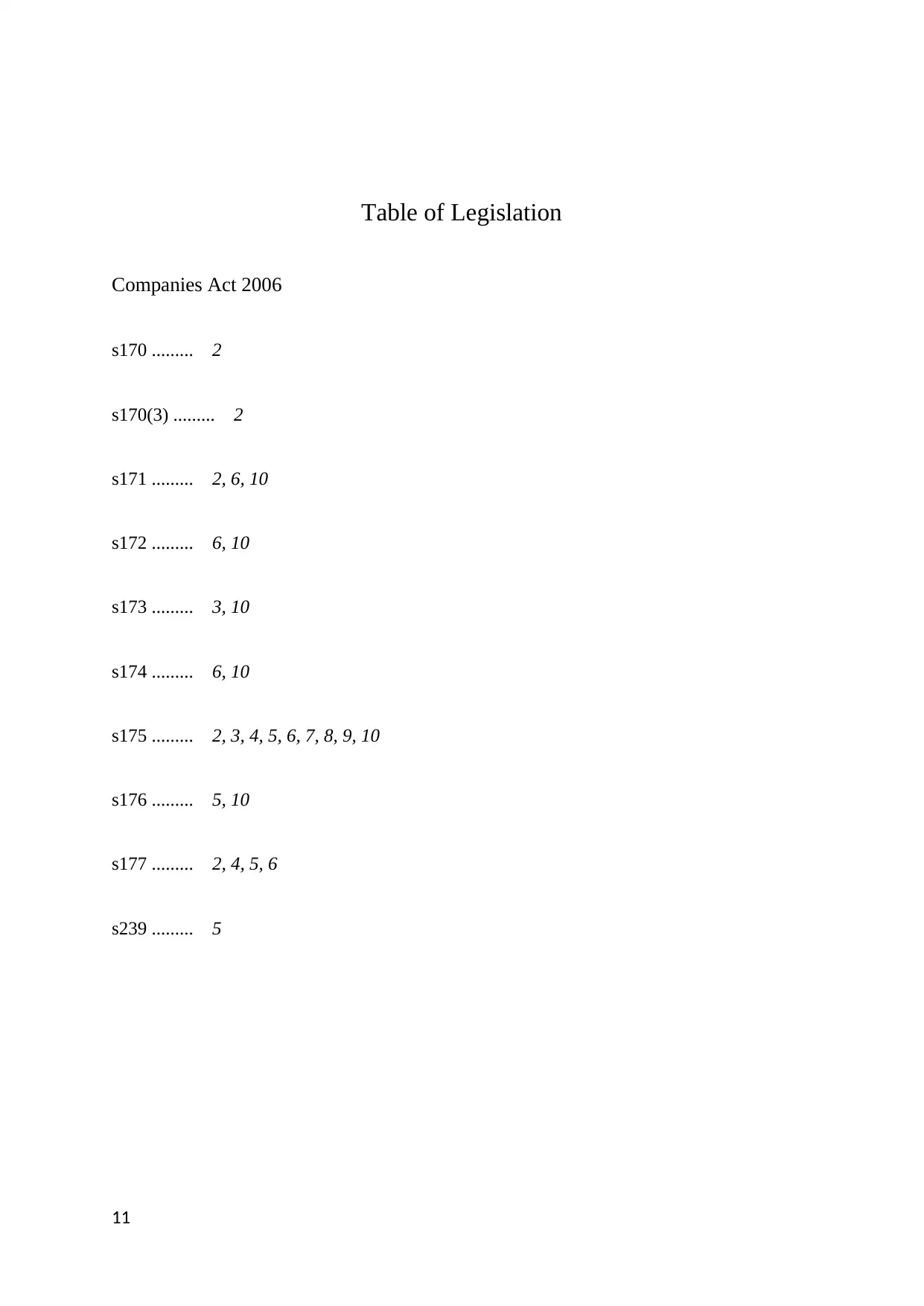
Table of Legislation
Companies Act 2006
s170 ......... 2
s170(3) ......... 2
s171 ......... 2, 6, 10
s172 ......... 6, 10
s173 ......... 3, 10
s174 ......... 6, 10
s175 ......... 2, 3, 4, 5, 6, 7, 8, 9, 10
s176 ......... 5, 10
s177 ......... 2, 4, 5, 6
s239 ......... 5
11
Companies Act 2006
s170 ......... 2
s170(3) ......... 2
s171 ......... 2, 6, 10
s172 ......... 6, 10
s173 ......... 3, 10
s174 ......... 6, 10
s175 ......... 2, 3, 4, 5, 6, 7, 8, 9, 10
s176 ......... 5, 10
s177 ......... 2, 4, 5, 6
s239 ......... 5
11
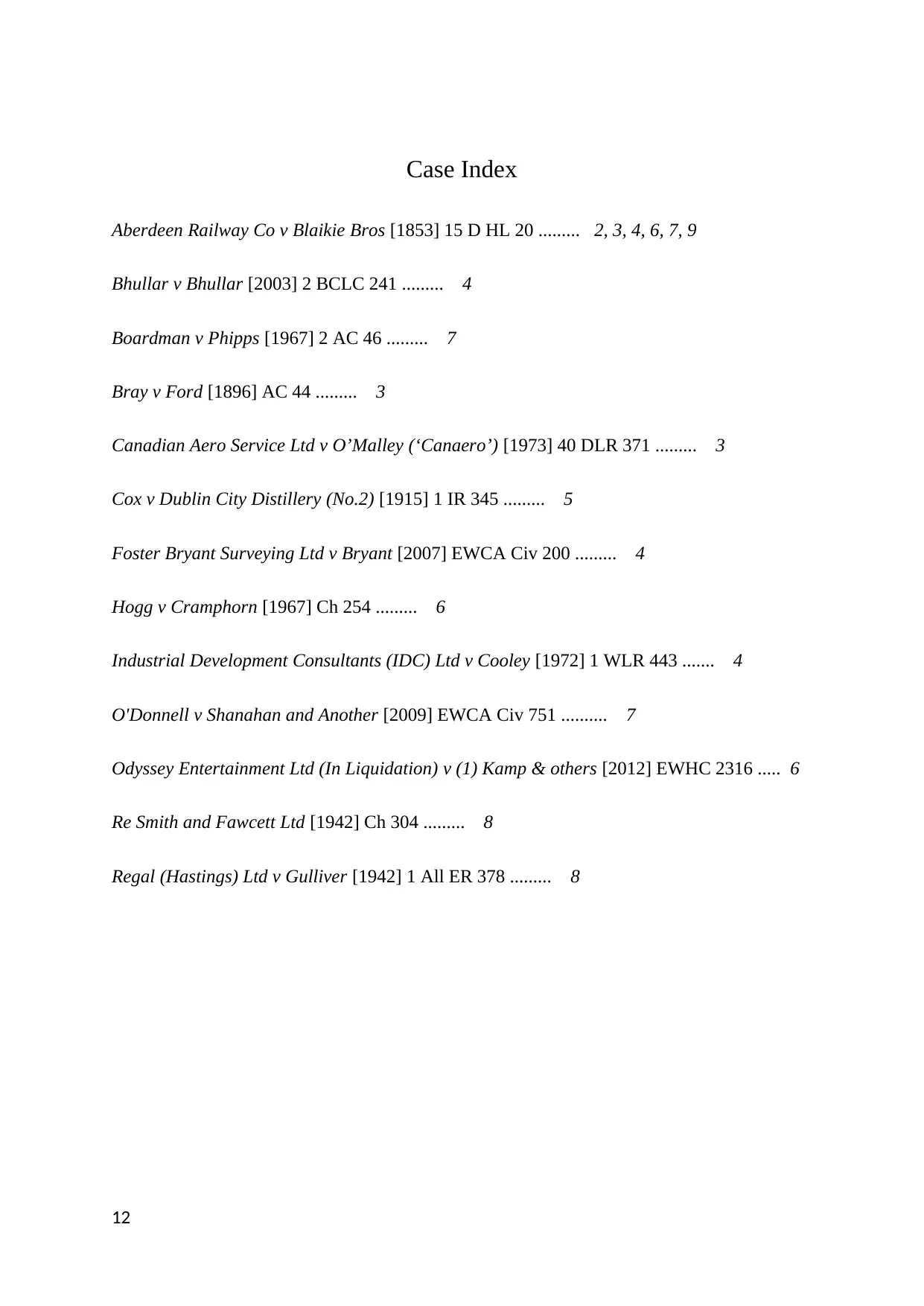
Case Index
Aberdeen Railway Co v Blaikie Bros [1853] 15 D HL 20 ......... 2, 3, 4, 6, 7, 9
Bhullar v Bhullar [2003] 2 BCLC 241 ......... 4
Boardman v Phipps [1967] 2 AC 46 ......... 7
Bray v Ford [1896] AC 44 ......... 3
Canadian Aero Service Ltd v O’Malley (‘Canaero’) [1973] 40 DLR 371 ......... 3
Cox v Dublin City Distillery (No.2) [1915] 1 IR 345 ......... 5
Foster Bryant Surveying Ltd v Bryant [2007] EWCA Civ 200 ......... 4
Hogg v Cramphorn [1967] Ch 254 ......... 6
Industrial Development Consultants (IDC) Ltd v Cooley [1972] 1 WLR 443 ....... 4
O'Donnell v Shanahan and Another [2009] EWCA Civ 751 .......... 7
Odyssey Entertainment Ltd (In Liquidation) v (1) Kamp & others [2012] EWHC 2316 ..... 6
Re Smith and Fawcett Ltd [1942] Ch 304 ......... 8
Regal (Hastings) Ltd v Gulliver [1942] 1 All ER 378 ......... 8
12
Aberdeen Railway Co v Blaikie Bros [1853] 15 D HL 20 ......... 2, 3, 4, 6, 7, 9
Bhullar v Bhullar [2003] 2 BCLC 241 ......... 4
Boardman v Phipps [1967] 2 AC 46 ......... 7
Bray v Ford [1896] AC 44 ......... 3
Canadian Aero Service Ltd v O’Malley (‘Canaero’) [1973] 40 DLR 371 ......... 3
Cox v Dublin City Distillery (No.2) [1915] 1 IR 345 ......... 5
Foster Bryant Surveying Ltd v Bryant [2007] EWCA Civ 200 ......... 4
Hogg v Cramphorn [1967] Ch 254 ......... 6
Industrial Development Consultants (IDC) Ltd v Cooley [1972] 1 WLR 443 ....... 4
O'Donnell v Shanahan and Another [2009] EWCA Civ 751 .......... 7
Odyssey Entertainment Ltd (In Liquidation) v (1) Kamp & others [2012] EWHC 2316 ..... 6
Re Smith and Fawcett Ltd [1942] Ch 304 ......... 8
Regal (Hastings) Ltd v Gulliver [1942] 1 All ER 378 ......... 8
12
⊘ This is a preview!⊘
Do you want full access?
Subscribe today to unlock all pages.
Trusted by 1+ million students worldwide

1 out of 15


Related Documents


Your All-in-One AI-Powered Toolkit for Academic Success.
+13062052269
info@desklib.com
Available 24*7 on WhatsApp / Email
![[object Object]](/_next/static/media/star-bottom.7253800d.svg)
Unlock your academic potential
Copyright © 2020–2026 A2Z Services. All Rights Reserved. Developed and managed by ZUCOL.