HI6027: Directors' Duties and Contract Law Analysis Report

Verified

Added on  2023/06/04

|12
|1043
|371
Report
AI Summary
This report addresses a business and corporations law assignment, analyzing two key areas: contract law and corporate governance. Part A delves into contract formation, examining issues such as offer, acceptance, and revocation, and applies legal principles from cases like Carlill v Carbolic Smoke Ball Company. Part B focuses on directors' duties, including insolvent trading, breach of fiduciary duty, and the responsibilities of directors under the Corporations Act 2001 (Cth). The report assesses the liabilities of directors concerning their actions, non-actions, and potential conflicts of interest, citing relevant legislation and case law such as ASIC v Fortescue Metals Group Ltd. The report provides detailed analysis of the legal concepts and applies them to the given scenarios, offering conclusions on the legal issues presented.
Document Page
COMPANY LAW
AND CONTRACT
LAW
Directors Duties and Contract
Formation
tabler-icon-diamond-filled.svg

Paraphrase This Document

Need a fresh take? Get an instant paraphrase of this document with our AI Paraphraser
Document Page
ISSUE
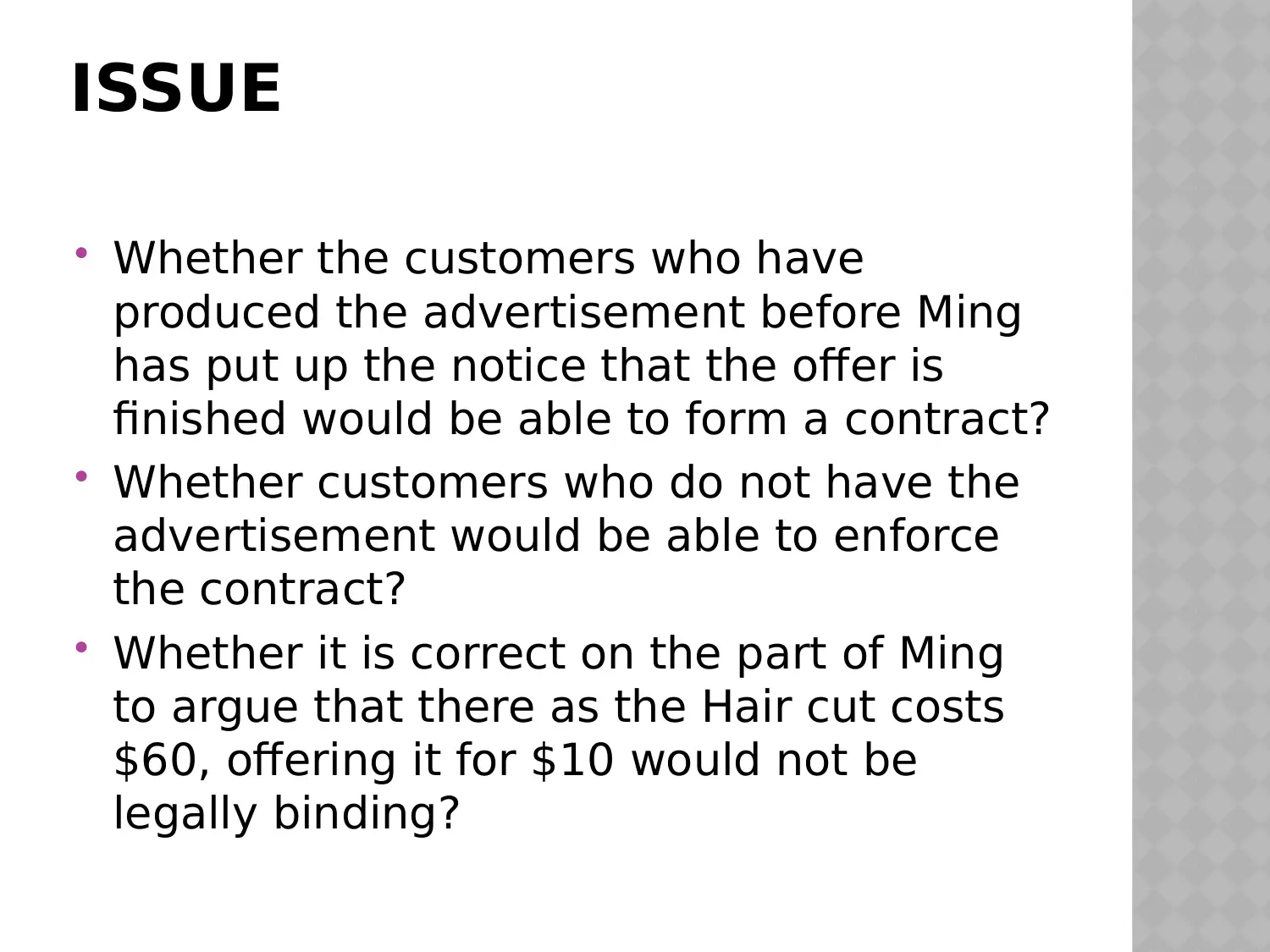
Whether the customers who have
produced the advertisement before Ming
has put up the notice that the offer is
finished would be able to form a contract?
Whether customers who do not have the
advertisement would be able to enforce
the contract?
Whether it is correct on the part of Ming
to argue that there as the Hair cut costs
$60, offering it for $10 would not be
legally binding?
Document Page
CASES
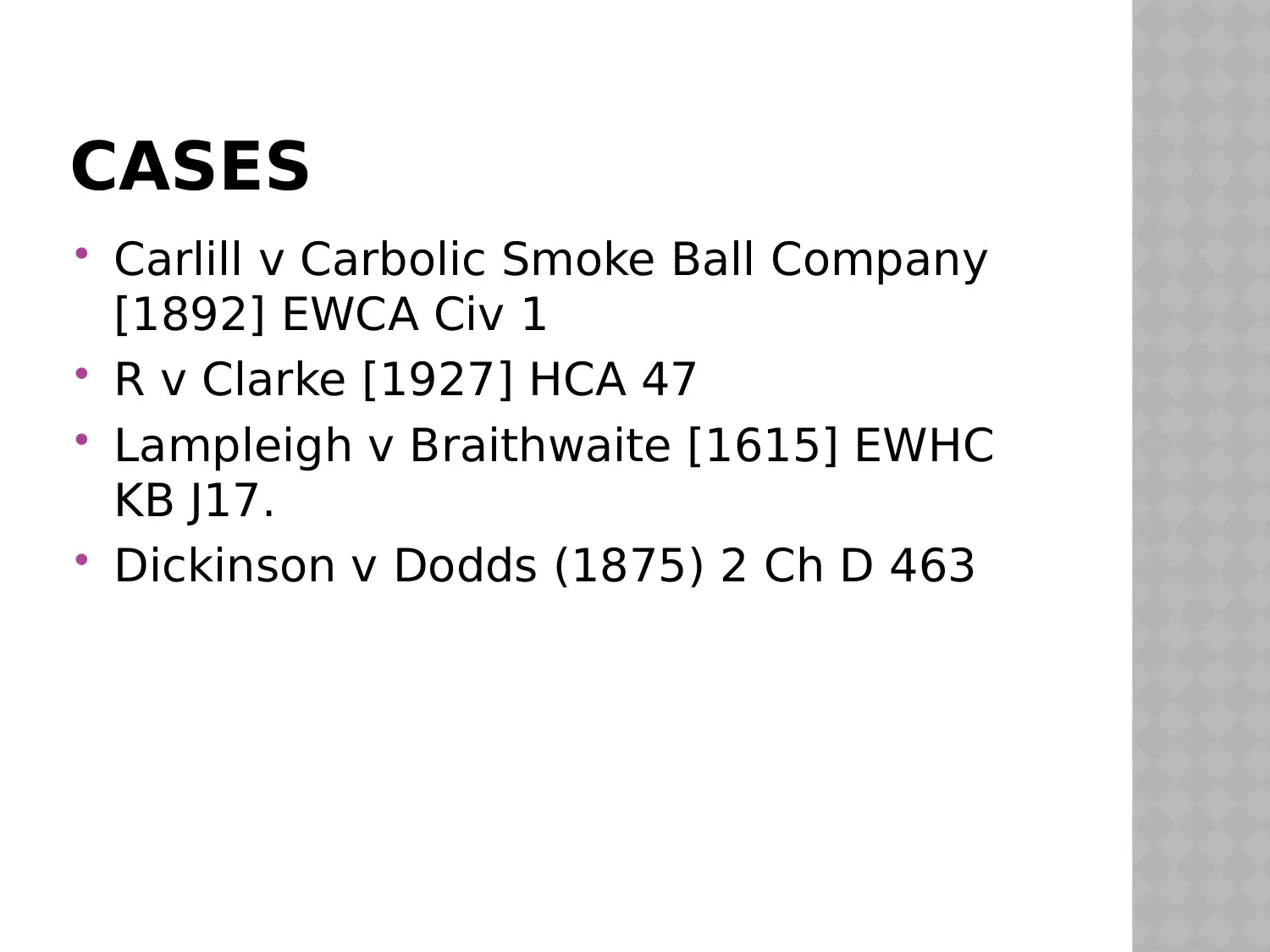
Carlill v Carbolic Smoke Ball Company
[1892] EWCA Civ 1
R v Clarke [1927] HCA 47
Lampleigh v Braithwaite [1615] EWHC
KB J17.
Dickinson v Dodds (1875) 2 Ch D 463
Document Page
RULES
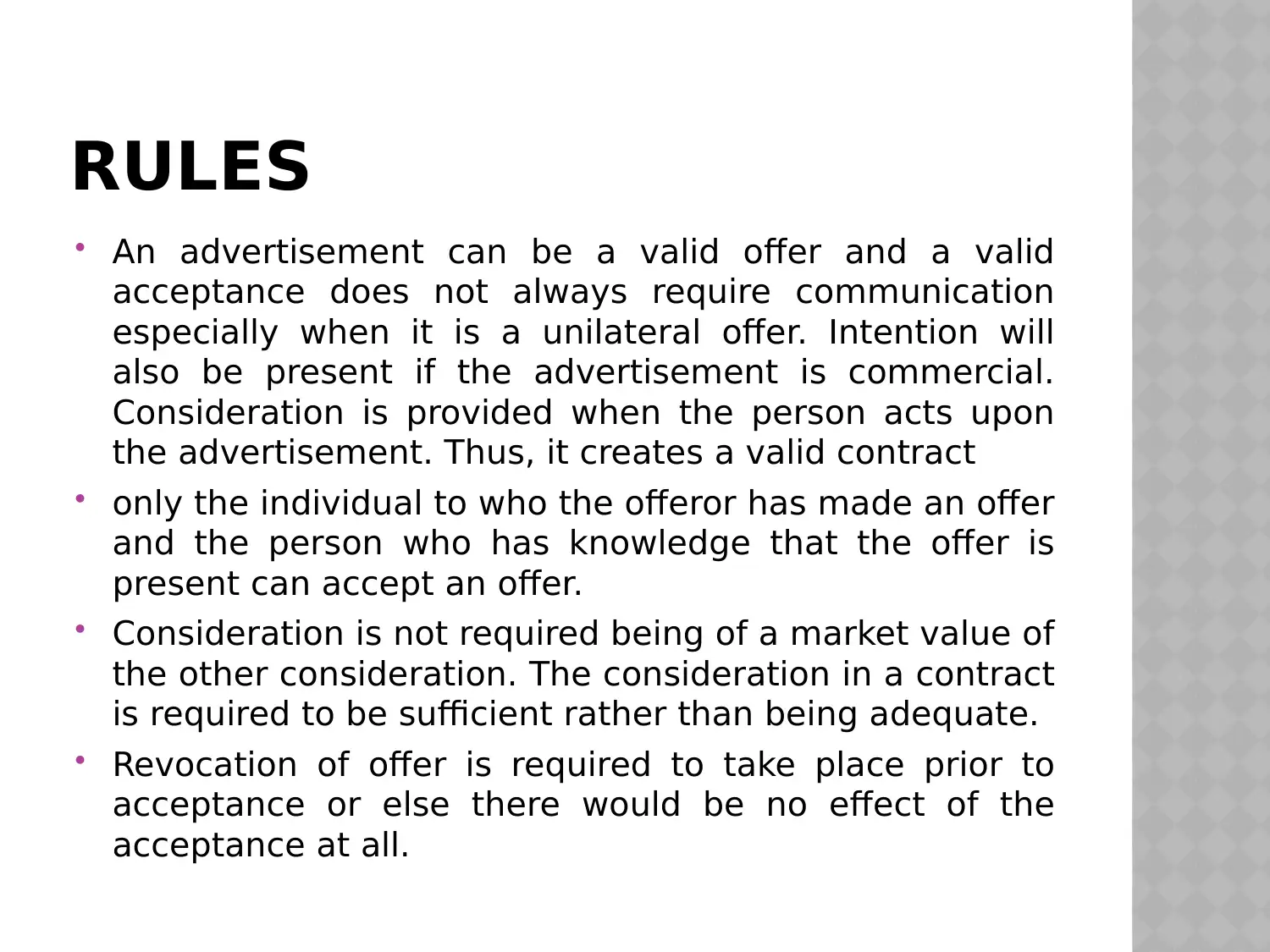
An advertisement can be a valid offer and a valid
acceptance does not always require communication
especially when it is a unilateral offer. Intention will
also be present if the advertisement is commercial.
Consideration is provided when the person acts upon
the advertisement. Thus, it creates a valid contract
only the individual to who the offeror has made an offer
and the person who has knowledge that the offer is
present can accept an offer.
Consideration is not required being of a market value of
the other consideration. The consideration in a contract
is required to be sufficient rather than being adequate.
Revocation of offer is required to take place prior to
acceptance or else there would be no effect of the
acceptance at all.
tabler-icon-diamond-filled.svg

Paraphrase This Document

Need a fresh take? Get an instant paraphrase of this document with our AI Paraphraser
Document Page
APPLICATION
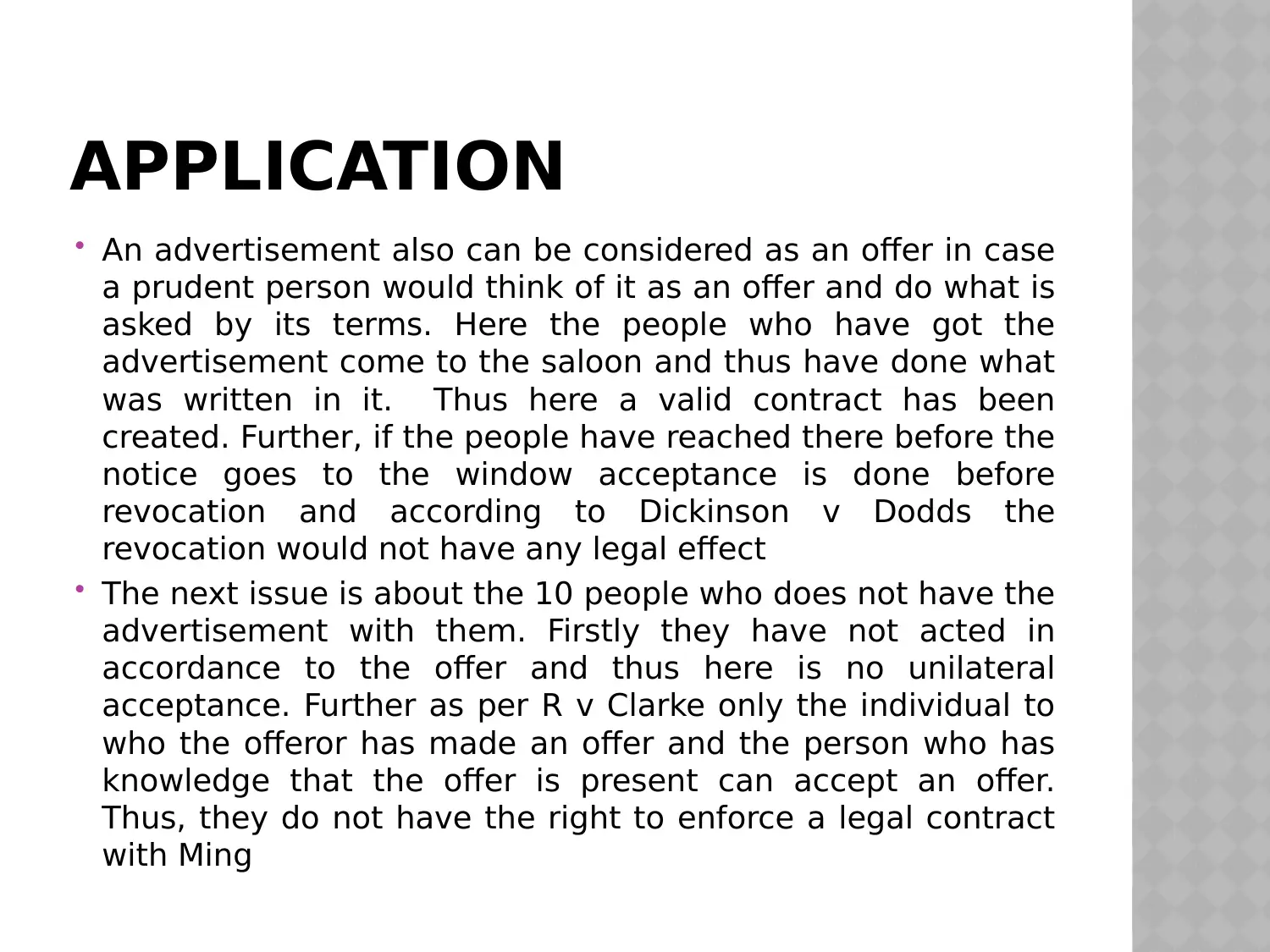
An advertisement also can be considered as an offer in case
a prudent person would think of it as an offer and do what is
asked by its terms. Here the people who have got the
advertisement come to the saloon and thus have done what
was written in it. Thus here a valid contract has been
created. Further, if the people have reached there before the
notice goes to the window acceptance is done before
revocation and according to Dickinson v Dodds the
revocation would not have any legal effect
The next issue is about the 10 people who does not have the
advertisement with them. Firstly they have not acted in
accordance to the offer and thus here is no unilateral
acceptance. Further as per R v Clarke only the individual to
who the offeror has made an offer and the person who has
knowledge that the offer is present can accept an offer.
Thus, they do not have the right to enforce a legal contract
with Ming
Document Page
CONCLUSION
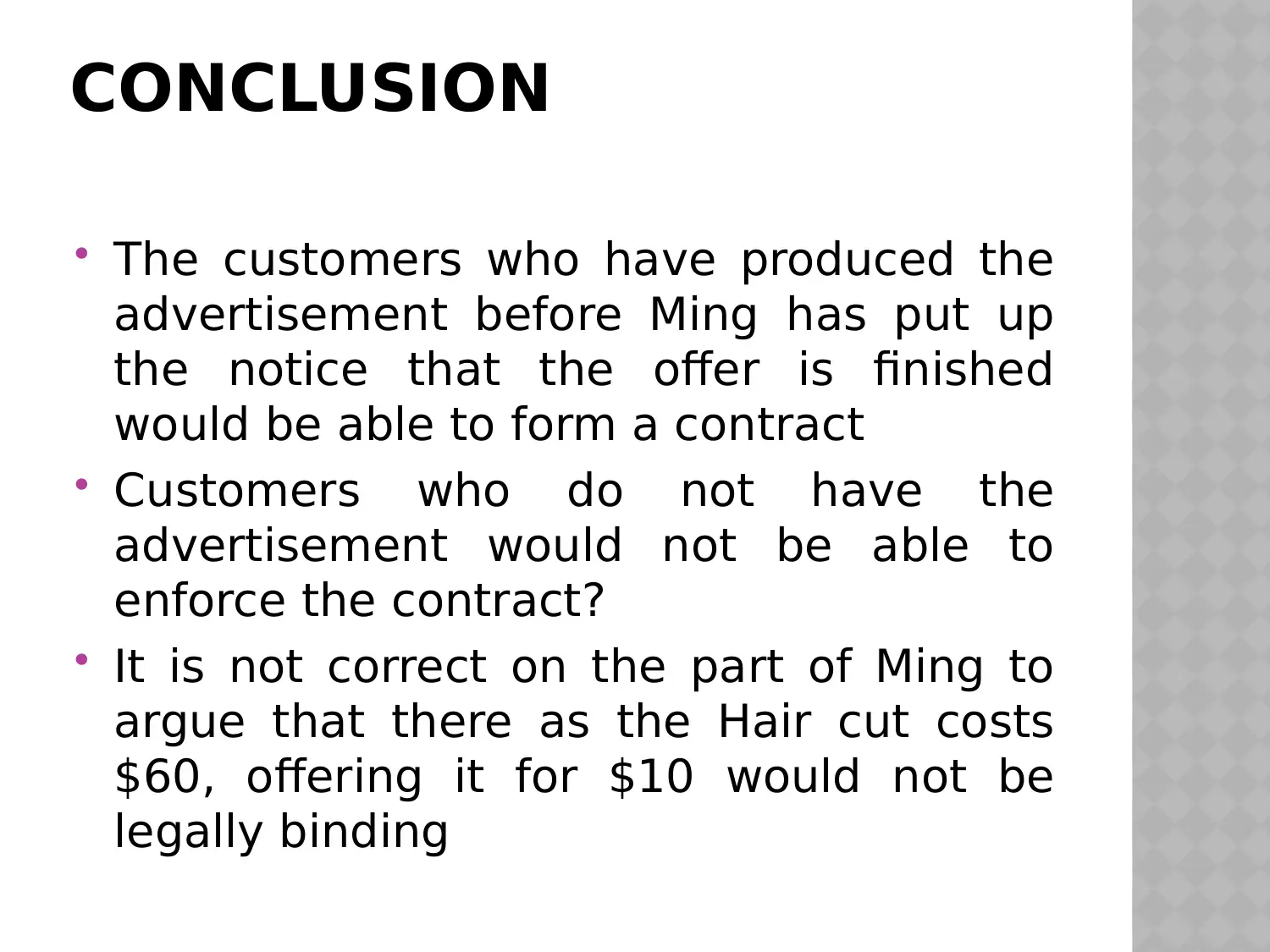
The customers who have produced the
advertisement before Ming has put up
the notice that the offer is finished
would be able to form a contract
Customers who do not have the
advertisement would not be able to
enforce the contract?
It is not correct on the part of Ming to
argue that there as the Hair cut costs
$60, offering it for $10 would not be
legally binding
Document Page
ISSUE 2
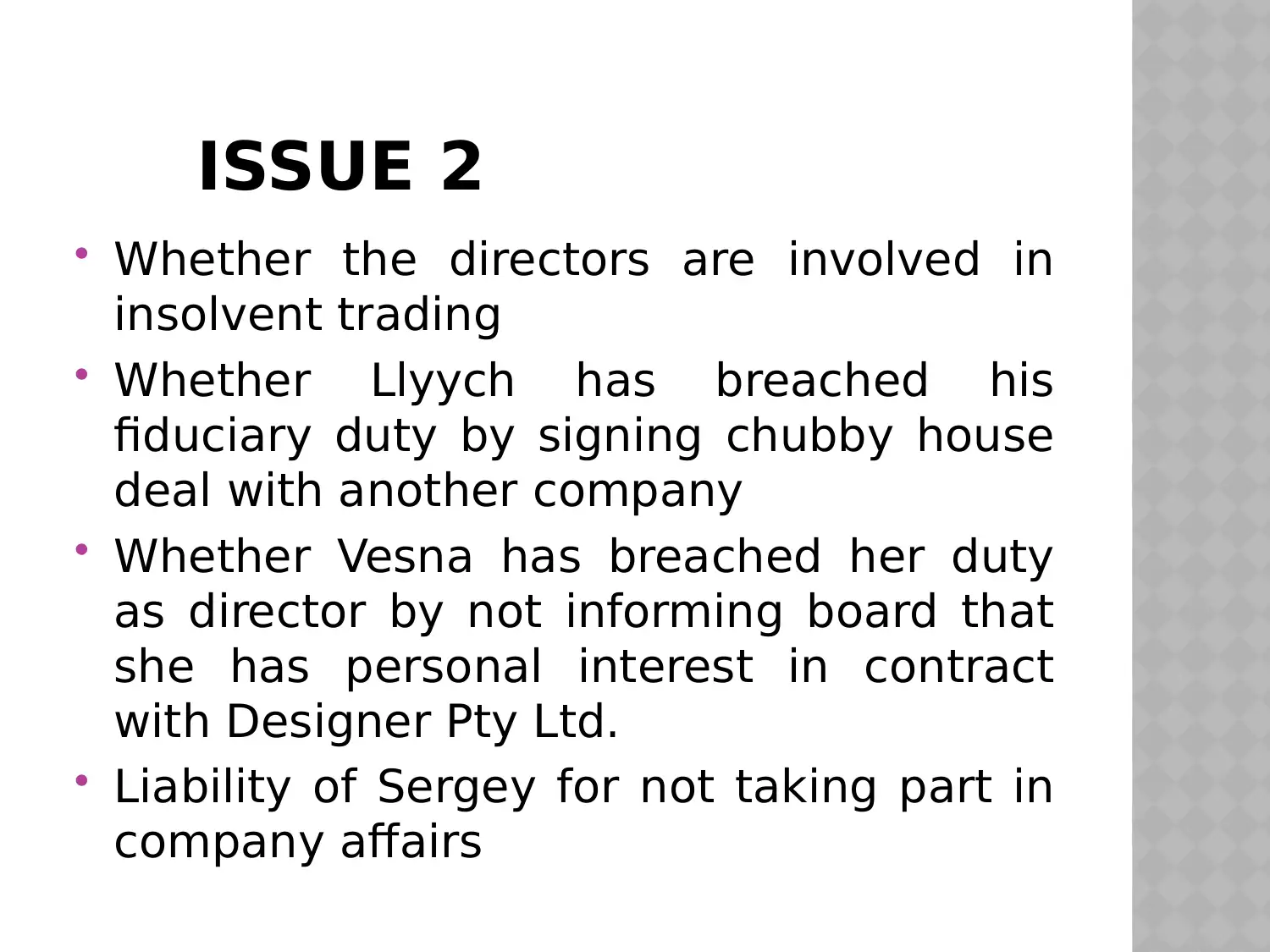
Whether the directors are involved in
insolvent trading
Whether Llyych has breached his
fiduciary duty by signing chubby house
deal with another company
Whether Vesna has breached her duty
as director by not informing board that
she has personal interest in contract
with Designer Pty Ltd.
Liability of Sergey for not taking part in
company affairs
tabler-icon-diamond-filled.svg

Paraphrase This Document

Need a fresh take? Get an instant paraphrase of this document with our AI Paraphraser
Document Page
CASES AND STATUTES
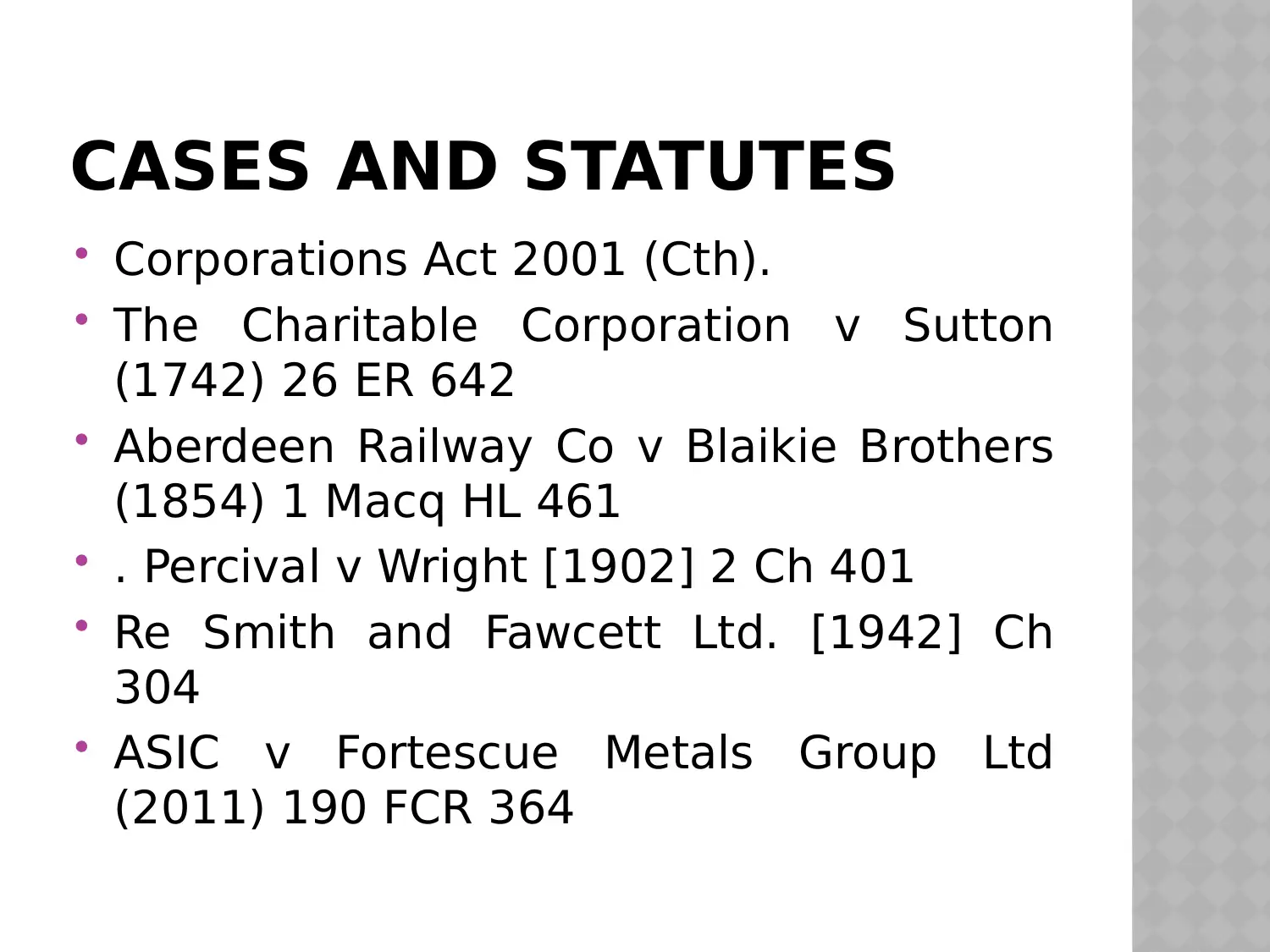
Corporations Act 2001 (Cth).
The Charitable Corporation v Sutton
(1742) 26 ER 642
Aberdeen Railway Co v Blaikie Brothers
(1854) 1 Macq HL 461
. Percival v Wright [1902] 2 Ch 401
Re Smith and Fawcett Ltd. [1942] Ch
304
ASIC v Fortescue Metals Group Ltd
(2011) 190 FCR 364
Document Page
RULES
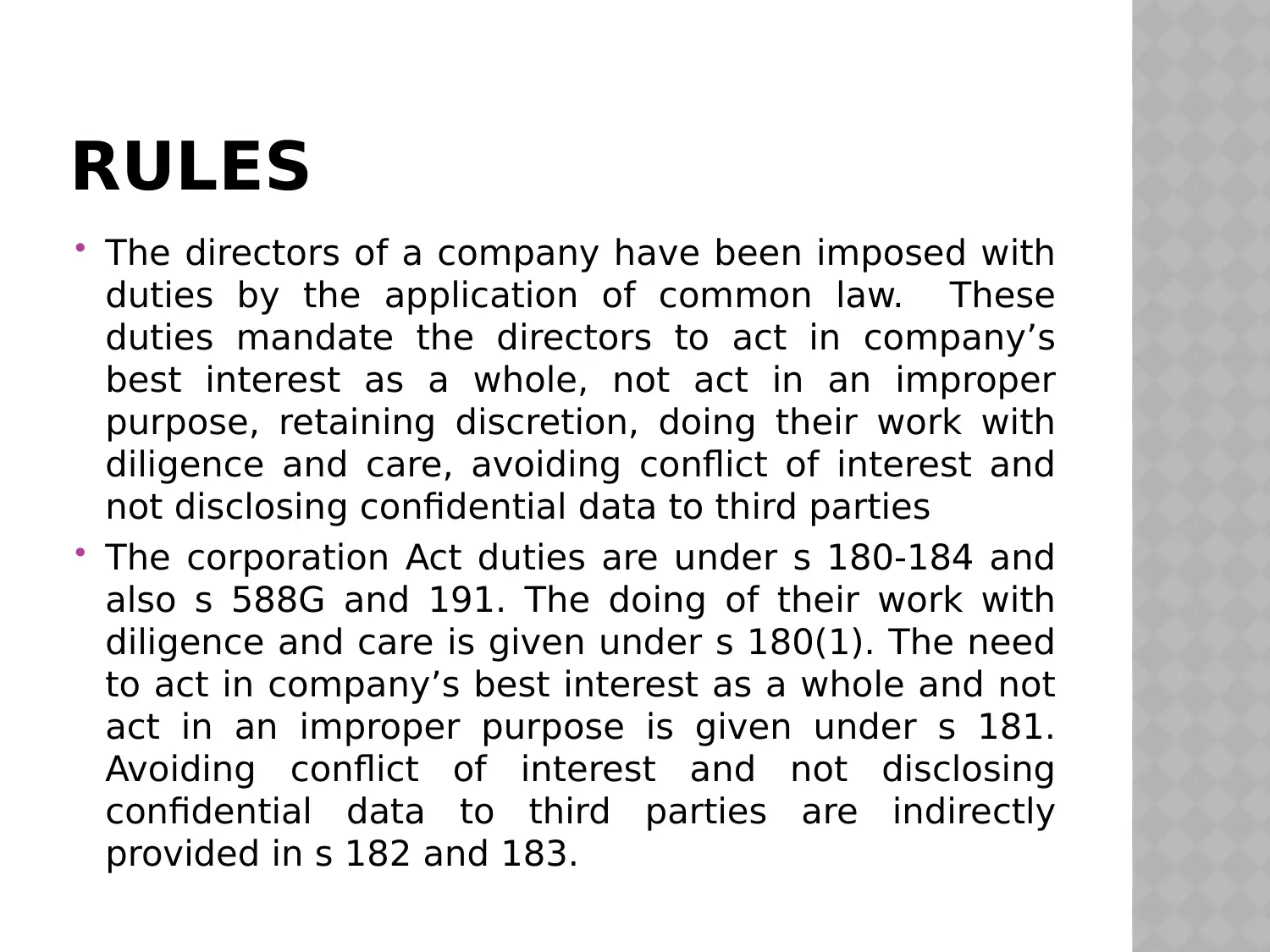
The directors of a company have been imposed with
duties by the application of common law. These
duties mandate the directors to act in company’s
best interest as a whole, not act in an improper
purpose, retaining discretion, doing their work with
diligence and care, avoiding conflict of interest and
not disclosing confidential data to third parties
The corporation Act duties are under s 180-184 and
also s 588G and 191. The doing of their work with
diligence and care is given under s 180(1). The need
to act in company’s best interest as a whole and not
act in an improper purpose is given under s 181.
Avoiding conflict of interest and not disclosing
confidential data to third parties are indirectly
provided in s 182 and 183.
Document Page
APPLICATION
The company is continuing to trade amidst its financial
difficulties under the leadership of the directors. The
directors must restrain from trading when the company is
likely to be insolvent or have already become insolvent as
required under s 588G. Thus, it is likely that if they
continue to trade in times of financial difficulties they may
be liable for breaching the rules of this section.
Sergey is found to be not taking part in company affairs.
Section 180(1) is entitled to be breached by even a non
executive director who did not retain discretion. The
section just compares the action of a director to a
reasonable person in the same circumstances as the
directors and if better diligence and care would have been
taken by the reasonable person the directors is declared to
be guilty of the breach. Thus he may be acting in the
breach of s 180(1) and also the same duty under common
law.
tabler-icon-diamond-filled.svg

Paraphrase This Document

Need a fresh take? Get an instant paraphrase of this document with our AI Paraphraser
Document Page
CONCLUSION
Directors are involved in insolvent
trading
Llyych has breached his fiduciary duty
by signing chubby house deal with
another company Vesna has breached
her duty as director by not informing
board that she has personal interest in
contract with Designer Pty Ltd.
Sergey is liable for not taking part in
company affairs
Document Page
chevron_up_icon
1 out of 12
circle_padding
hide_on_mobile
zoom_out_icon
[object Object]