BULAW5915 Corporate Law Assignment: Directors' Duties and Insolvency
VerifiedAdded on 2022/12/14
|13
|3428
|361
Report
AI Summary
This report analyzes the fiduciary duties of directors, particularly concerning insolvent trading under section 588G of the Corporations Act. It examines the safe harbor defense (section 588GA) and its role in encouraging directors to restructure financially troubled companies. The report compares the safe harbor defense to the business judgment rule (section 180(2)) and discusses the restrictions on the safe harbor defense, including requirements for developing and implementing restructuring plans. The report also addresses recent reforms in corporate insolvency, aiming to reduce costs, increase efficiency, and improve transparency. Furthermore, the report evaluates scenarios involving directors' breaches of duty, including violations of the duty to prevent insolvent trading and misuse of corporate funds, highlighting the importance of acting with care, diligence, and in the best interests of the company. The report concludes by emphasizing the significance of directors' adherence to their legal obligations under the Corporations Act and common law.
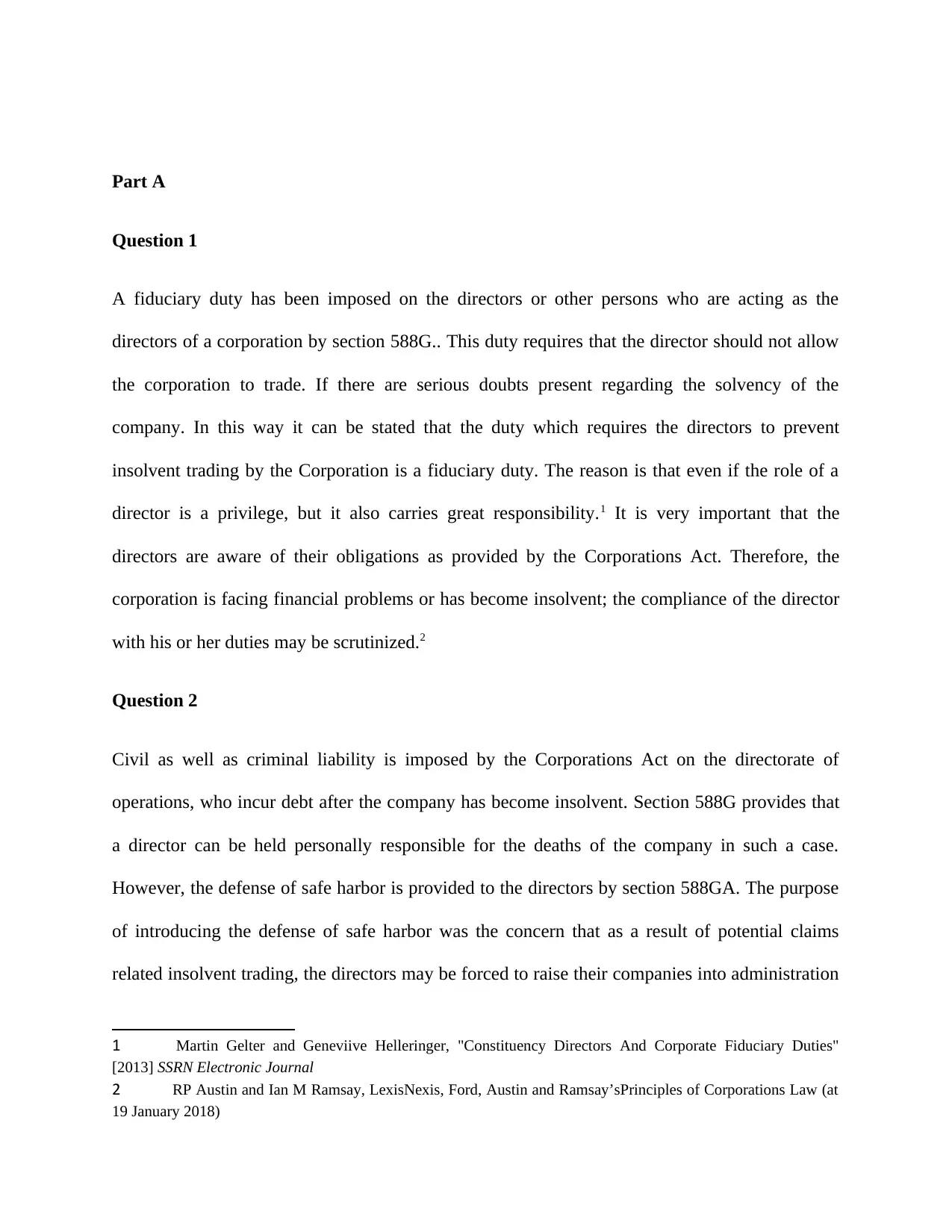
Part A
Question 1
A fiduciary duty has been imposed on the directors or other persons who are acting as the
directors of a corporation by section 588G.. This duty requires that the director should not allow
the corporation to trade. If there are serious doubts present regarding the solvency of the
company. In this way it can be stated that the duty which requires the directors to prevent
insolvent trading by the Corporation is a fiduciary duty. The reason is that even if the role of a
director is a privilege, but it also carries great responsibility.1 It is very important that the
directors are aware of their obligations as provided by the Corporations Act. Therefore, the
corporation is facing financial problems or has become insolvent; the compliance of the director
with his or her duties may be scrutinized.2
Question 2
Civil as well as criminal liability is imposed by the Corporations Act on the directorate of
operations, who incur debt after the company has become insolvent. Section 588G provides that
a director can be held personally responsible for the deaths of the company in such a case.
However, the defense of safe harbor is provided to the directors by section 588GA. The purpose
of introducing the defense of safe harbor was the concern that as a result of potential claims
related insolvent trading, the directors may be forced to raise their companies into administration
1 Martin Gelter and Geneviive Helleringer, "Constituency Directors And Corporate Fiduciary Duties"
[2013] SSRN Electronic Journal
2 RP Austin and Ian M Ramsay, LexisNexis, Ford, Austin and Ramsay’sPrinciples of Corporations Law (at
19 January 2018)
Question 1
A fiduciary duty has been imposed on the directors or other persons who are acting as the
directors of a corporation by section 588G.. This duty requires that the director should not allow
the corporation to trade. If there are serious doubts present regarding the solvency of the
company. In this way it can be stated that the duty which requires the directors to prevent
insolvent trading by the Corporation is a fiduciary duty. The reason is that even if the role of a
director is a privilege, but it also carries great responsibility.1 It is very important that the
directors are aware of their obligations as provided by the Corporations Act. Therefore, the
corporation is facing financial problems or has become insolvent; the compliance of the director
with his or her duties may be scrutinized.2
Question 2
Civil as well as criminal liability is imposed by the Corporations Act on the directorate of
operations, who incur debt after the company has become insolvent. Section 588G provides that
a director can be held personally responsible for the deaths of the company in such a case.
However, the defense of safe harbor is provided to the directors by section 588GA. The purpose
of introducing the defense of safe harbor was the concern that as a result of potential claims
related insolvent trading, the directors may be forced to raise their companies into administration
1 Martin Gelter and Geneviive Helleringer, "Constituency Directors And Corporate Fiduciary Duties"
[2013] SSRN Electronic Journal
2 RP Austin and Ian M Ramsay, LexisNexis, Ford, Austin and Ramsay’sPrinciples of Corporations Law (at
19 January 2018)

Paraphrase This Document
Need a fresh take? Get an instant paraphrase of this document with our AI Paraphraser
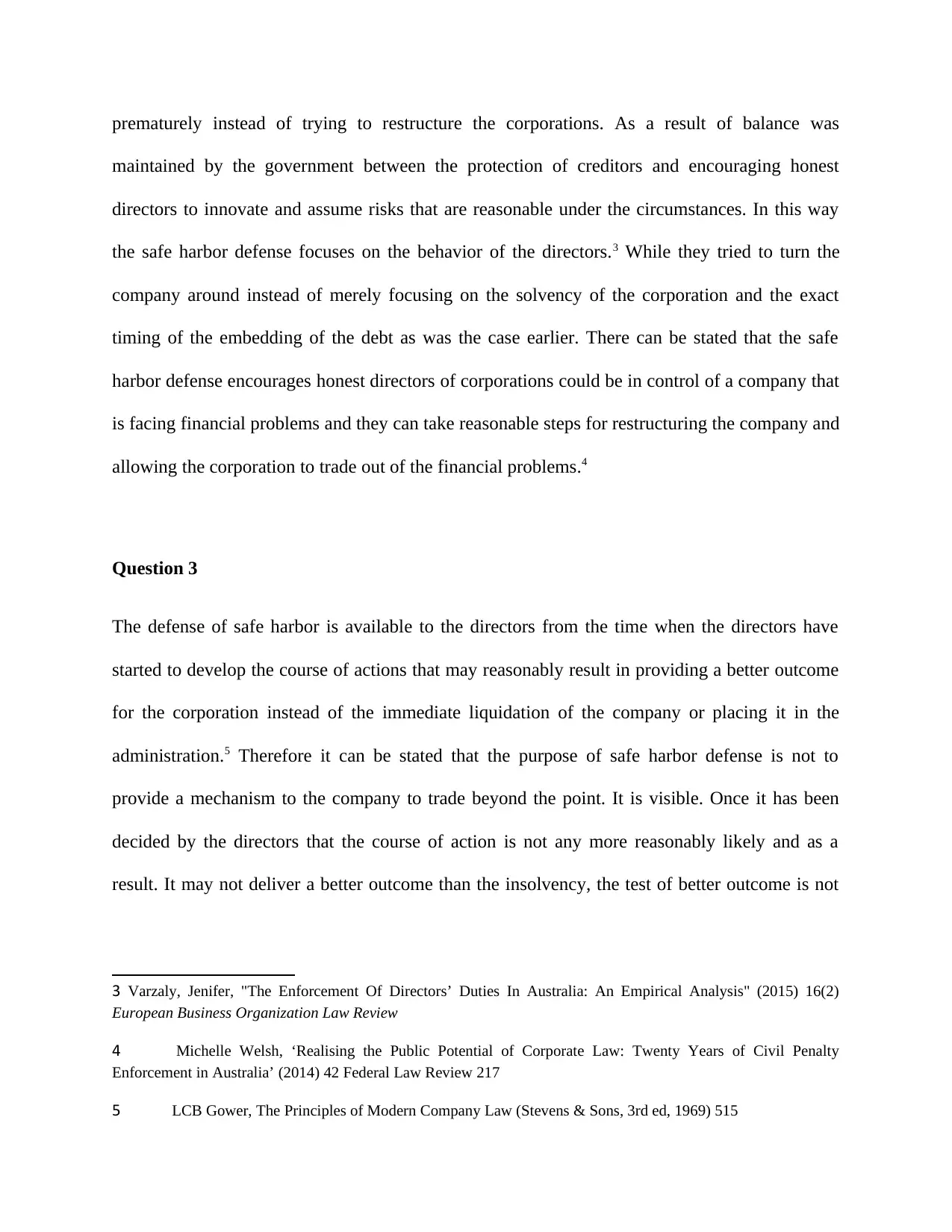
prematurely instead of trying to restructure the corporations. As a result of balance was
maintained by the government between the protection of creditors and encouraging honest
directors to innovate and assume risks that are reasonable under the circumstances. In this way
the safe harbor defense focuses on the behavior of the directors.3 While they tried to turn the
company around instead of merely focusing on the solvency of the corporation and the exact
timing of the embedding of the debt as was the case earlier. There can be stated that the safe
harbor defense encourages honest directors of corporations could be in control of a company that
is facing financial problems and they can take reasonable steps for restructuring the company and
allowing the corporation to trade out of the financial problems.4
Question 3
The defense of safe harbor is available to the directors from the time when the directors have
started to develop the course of actions that may reasonably result in providing a better outcome
for the corporation instead of the immediate liquidation of the company or placing it in the
administration.5 Therefore it can be stated that the purpose of safe harbor defense is not to
provide a mechanism to the company to trade beyond the point. It is visible. Once it has been
decided by the directors that the course of action is not any more reasonably likely and as a
result. It may not deliver a better outcome than the insolvency, the test of better outcome is not
3 Varzaly, Jenifer, "The Enforcement Of Directors’ Duties In Australia: An Empirical Analysis" (2015) 16(2)
European Business Organization Law Review
4 Michelle Welsh, ‘Realising the Public Potential of Corporate Law: Twenty Years of Civil Penalty
Enforcement in Australia’ (2014) 42 Federal Law Review 217
5 LCB Gower, The Principles of Modern Company Law (Stevens & Sons, 3rd ed, 1969) 515
maintained by the government between the protection of creditors and encouraging honest
directors to innovate and assume risks that are reasonable under the circumstances. In this way
the safe harbor defense focuses on the behavior of the directors.3 While they tried to turn the
company around instead of merely focusing on the solvency of the corporation and the exact
timing of the embedding of the debt as was the case earlier. There can be stated that the safe
harbor defense encourages honest directors of corporations could be in control of a company that
is facing financial problems and they can take reasonable steps for restructuring the company and
allowing the corporation to trade out of the financial problems.4
Question 3
The defense of safe harbor is available to the directors from the time when the directors have
started to develop the course of actions that may reasonably result in providing a better outcome
for the corporation instead of the immediate liquidation of the company or placing it in the
administration.5 Therefore it can be stated that the purpose of safe harbor defense is not to
provide a mechanism to the company to trade beyond the point. It is visible. Once it has been
decided by the directors that the course of action is not any more reasonably likely and as a
result. It may not deliver a better outcome than the insolvency, the test of better outcome is not
3 Varzaly, Jenifer, "The Enforcement Of Directors’ Duties In Australia: An Empirical Analysis" (2015) 16(2)
European Business Organization Law Review
4 Michelle Welsh, ‘Realising the Public Potential of Corporate Law: Twenty Years of Civil Penalty
Enforcement in Australia’ (2014) 42 Federal Law Review 217
5 LCB Gower, The Principles of Modern Company Law (Stevens & Sons, 3rd ed, 1969) 515
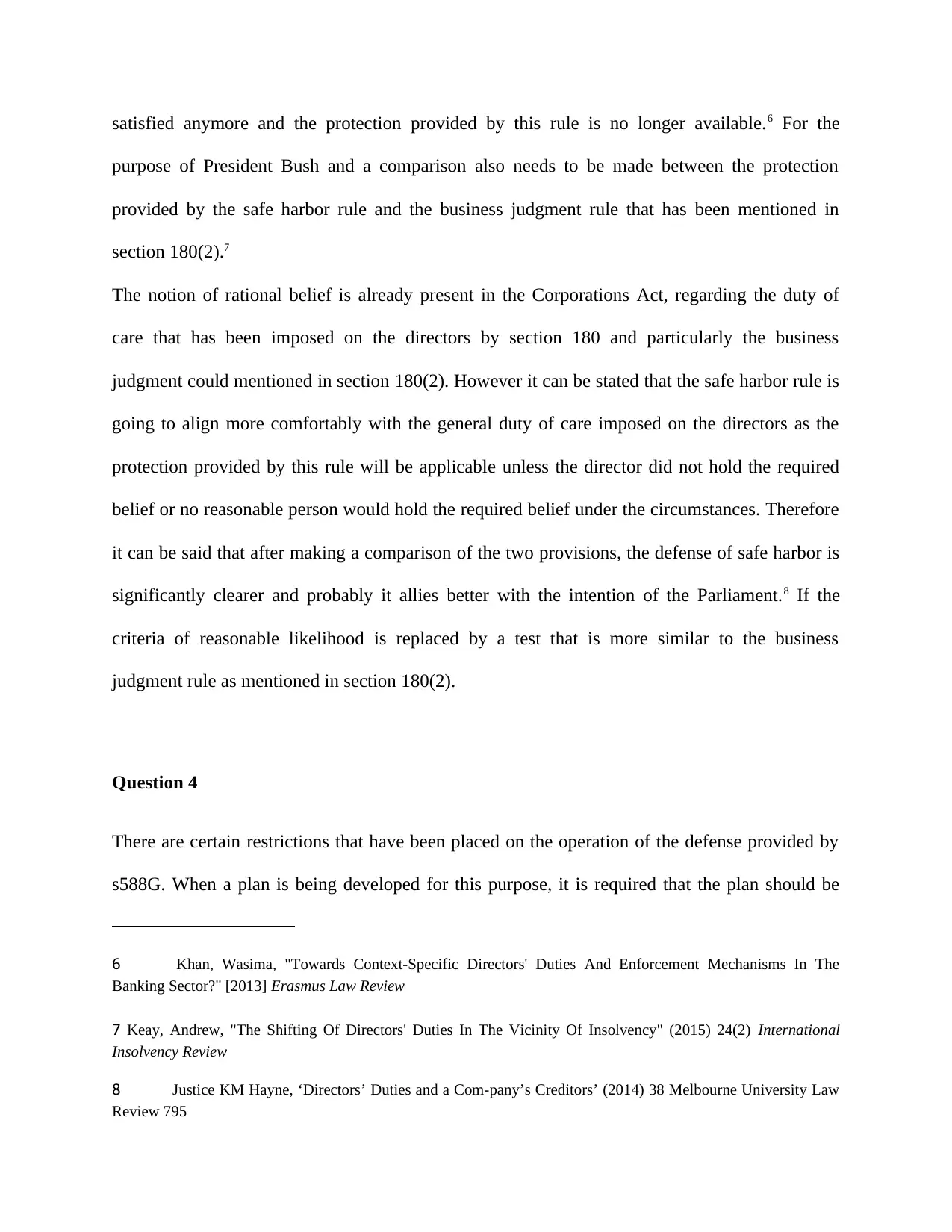
satisfied anymore and the protection provided by this rule is no longer available.6 For the
purpose of President Bush and a comparison also needs to be made between the protection
provided by the safe harbor rule and the business judgment rule that has been mentioned in
section 180(2).7
The notion of rational belief is already present in the Corporations Act, regarding the duty of
care that has been imposed on the directors by section 180 and particularly the business
judgment could mentioned in section 180(2). However it can be stated that the safe harbor rule is
going to align more comfortably with the general duty of care imposed on the directors as the
protection provided by this rule will be applicable unless the director did not hold the required
belief or no reasonable person would hold the required belief under the circumstances. Therefore
it can be said that after making a comparison of the two provisions, the defense of safe harbor is
significantly clearer and probably it allies better with the intention of the Parliament.8 If the
criteria of reasonable likelihood is replaced by a test that is more similar to the business
judgment rule as mentioned in section 180(2).
Question 4
There are certain restrictions that have been placed on the operation of the defense provided by
s588G. When a plan is being developed for this purpose, it is required that the plan should be
6 Khan, Wasima, "Towards Context-Specific Directors' Duties And Enforcement Mechanisms In The
Banking Sector?" [2013] Erasmus Law Review
7 Keay, Andrew, "The Shifting Of Directors' Duties In The Vicinity Of Insolvency" (2015) 24(2) International
Insolvency Review
8 Justice KM Hayne, ‘Directors’ Duties and a Com-pany’s Creditors’ (2014) 38 Melbourne University Law
Review 795
purpose of President Bush and a comparison also needs to be made between the protection
provided by the safe harbor rule and the business judgment rule that has been mentioned in
section 180(2).7
The notion of rational belief is already present in the Corporations Act, regarding the duty of
care that has been imposed on the directors by section 180 and particularly the business
judgment could mentioned in section 180(2). However it can be stated that the safe harbor rule is
going to align more comfortably with the general duty of care imposed on the directors as the
protection provided by this rule will be applicable unless the director did not hold the required
belief or no reasonable person would hold the required belief under the circumstances. Therefore
it can be said that after making a comparison of the two provisions, the defense of safe harbor is
significantly clearer and probably it allies better with the intention of the Parliament.8 If the
criteria of reasonable likelihood is replaced by a test that is more similar to the business
judgment rule as mentioned in section 180(2).
Question 4
There are certain restrictions that have been placed on the operation of the defense provided by
s588G. When a plan is being developed for this purpose, it is required that the plan should be
6 Khan, Wasima, "Towards Context-Specific Directors' Duties And Enforcement Mechanisms In The
Banking Sector?" [2013] Erasmus Law Review
7 Keay, Andrew, "The Shifting Of Directors' Duties In The Vicinity Of Insolvency" (2015) 24(2) International
Insolvency Review
8 Justice KM Hayne, ‘Directors’ Duties and a Com-pany’s Creditors’ (2014) 38 Melbourne University Law
Review 795
⊘ This is a preview!⊘
Do you want full access?
Subscribe today to unlock all pages.

Trusted by 1+ million students worldwide
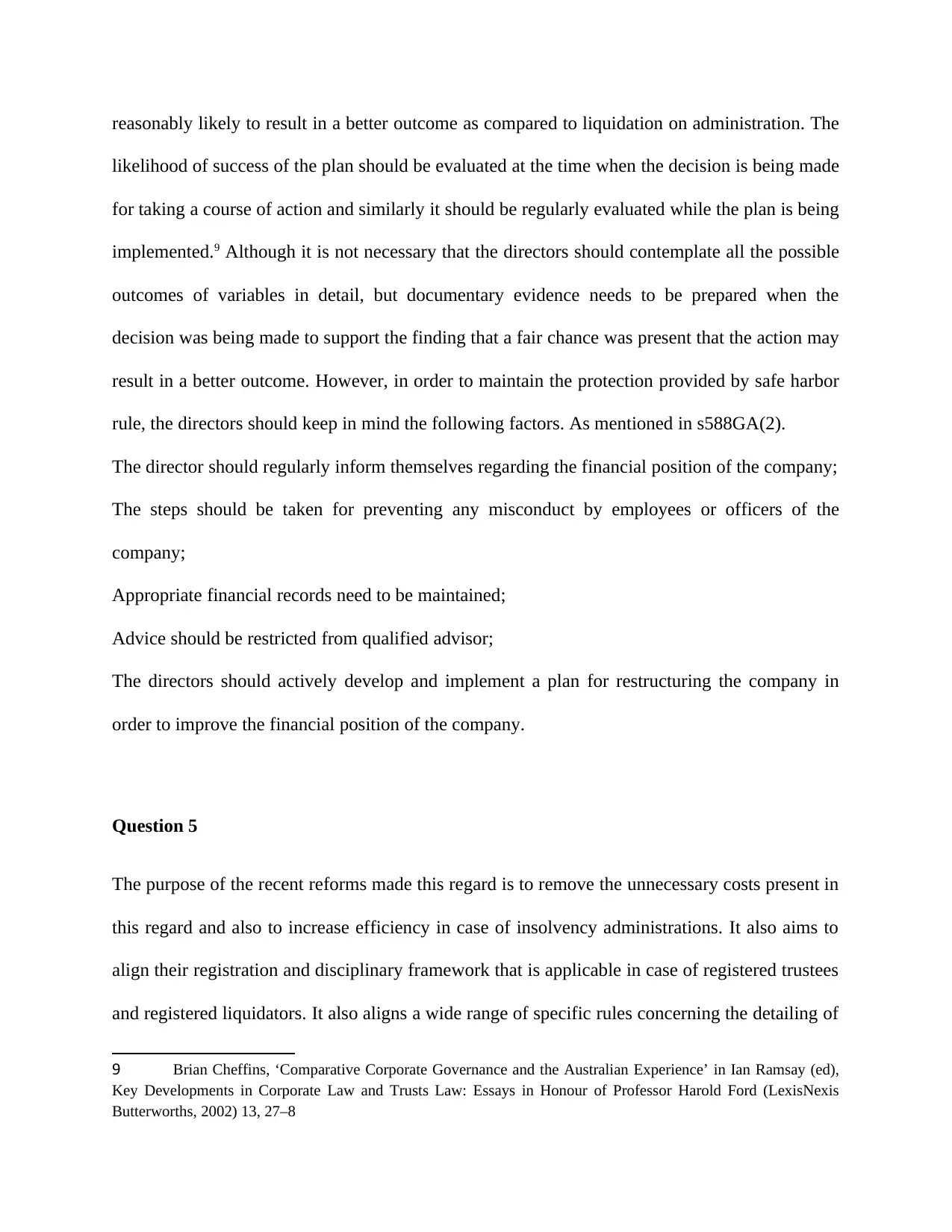
reasonably likely to result in a better outcome as compared to liquidation on administration. The
likelihood of success of the plan should be evaluated at the time when the decision is being made
for taking a course of action and similarly it should be regularly evaluated while the plan is being
implemented.9 Although it is not necessary that the directors should contemplate all the possible
outcomes of variables in detail, but documentary evidence needs to be prepared when the
decision was being made to support the finding that a fair chance was present that the action may
result in a better outcome. However, in order to maintain the protection provided by safe harbor
rule, the directors should keep in mind the following factors. As mentioned in s588GA(2).
The director should regularly inform themselves regarding the financial position of the company;
The steps should be taken for preventing any misconduct by employees or officers of the
company;
Appropriate financial records need to be maintained;
Advice should be restricted from qualified advisor;
The directors should actively develop and implement a plan for restructuring the company in
order to improve the financial position of the company.
Question 5
The purpose of the recent reforms made this regard is to remove the unnecessary costs present in
this regard and also to increase efficiency in case of insolvency administrations. It also aims to
align their registration and disciplinary framework that is applicable in case of registered trustees
and registered liquidators. It also aligns a wide range of specific rules concerning the detailing of
9 Brian Cheffins, ‘Comparative Corporate Governance and the Australian Experience’ in Ian Ramsay (ed),
Key Developments in Corporate Law and Trusts Law: Essays in Honour of Professor Harold Ford (LexisNexis
Butterworths, 2002) 13, 27–8
likelihood of success of the plan should be evaluated at the time when the decision is being made
for taking a course of action and similarly it should be regularly evaluated while the plan is being
implemented.9 Although it is not necessary that the directors should contemplate all the possible
outcomes of variables in detail, but documentary evidence needs to be prepared when the
decision was being made to support the finding that a fair chance was present that the action may
result in a better outcome. However, in order to maintain the protection provided by safe harbor
rule, the directors should keep in mind the following factors. As mentioned in s588GA(2).
The director should regularly inform themselves regarding the financial position of the company;
The steps should be taken for preventing any misconduct by employees or officers of the
company;
Appropriate financial records need to be maintained;
Advice should be restricted from qualified advisor;
The directors should actively develop and implement a plan for restructuring the company in
order to improve the financial position of the company.
Question 5
The purpose of the recent reforms made this regard is to remove the unnecessary costs present in
this regard and also to increase efficiency in case of insolvency administrations. It also aims to
align their registration and disciplinary framework that is applicable in case of registered trustees
and registered liquidators. It also aligns a wide range of specific rules concerning the detailing of
9 Brian Cheffins, ‘Comparative Corporate Governance and the Australian Experience’ in Ian Ramsay (ed),
Key Developments in Corporate Law and Trusts Law: Essays in Honour of Professor Harold Ford (LexisNexis
Butterworths, 2002) 13, 27–8
Paraphrase This Document
Need a fresh take? Get an instant paraphrase of this document with our AI Paraphraser
personal bankruptcies and corporate external administrations. These reforms have also been
introduced with a view to increase transparency and communication among the stakeholders and
to promote competition in the market regarding quality and price. Another purpose is to improve
the powers that have been granted to the corporate regulators for regulating corporate insolvency
market as well as the ability of the regulators for communicating regarding insolvency
practitioners who are operating in personal as well as corporate insolvency markets. Finally it
can be stated that the purpose of these reforms is also to improve the overall confidence in the
competence and professionalism of insolvency practitioners. As a result of these reforms,
significant changes will be made to insolvency practice.
introduced with a view to increase transparency and communication among the stakeholders and
to promote competition in the market regarding quality and price. Another purpose is to improve
the powers that have been granted to the corporate regulators for regulating corporate insolvency
market as well as the ability of the regulators for communicating regarding insolvency
practitioners who are operating in personal as well as corporate insolvency markets. Finally it
can be stated that the purpose of these reforms is also to improve the overall confidence in the
competence and professionalism of insolvency practitioners. As a result of these reforms,
significant changes will be made to insolvency practice.
Part B
Question 1
After listening to the incident involving Mr. Peter Daly, it can be stated that he has violated his
duties as the director of the corporation. While fulfilling their role as a director, they are subject
to the duties and obligations that have been imposed by the Corporations Act, common law and
the Constitution of the company. For example in the present case, Mr. Peter Daly was required to
exercise his powers for the purpose for which they have been granted. He was also under an
obligation to act with care and diligence. An objective test can be applied in these cases for
evaluating the reasonableness of the actions of the director. Therefore it is very important that
when making a business judgment, the director making the judgment should satisfy the duty of
care and diligence regarding such judgment. It is also necessary that the business judgment made
by the director should be a conscious decision that has been made by the director to take or not to
take any action.10
In the present case, there has been a violation of another significant duty imposed by the
Corporations Act. But a significant duty is prescribed by s588G and is known as the duty of the
directors to prevent insolvent trading. According to this provision, it is an obligation imposed on
the directors that they should prevent the company from being involved in insolvent trading.
Apart from it, a safe harbor defense has also been provided to the directors by s588GA. as a
result of this defense, protection has been provided to the directors regarding the debts that have
been incurred by the corporation for the purpose of developing and adopting a course of action
10 Turnbull, Shann, "Rethinking Directors' Duties, Governance And Regulation" [2012] SSRN Electronic
Journal
Question 1
After listening to the incident involving Mr. Peter Daly, it can be stated that he has violated his
duties as the director of the corporation. While fulfilling their role as a director, they are subject
to the duties and obligations that have been imposed by the Corporations Act, common law and
the Constitution of the company. For example in the present case, Mr. Peter Daly was required to
exercise his powers for the purpose for which they have been granted. He was also under an
obligation to act with care and diligence. An objective test can be applied in these cases for
evaluating the reasonableness of the actions of the director. Therefore it is very important that
when making a business judgment, the director making the judgment should satisfy the duty of
care and diligence regarding such judgment. It is also necessary that the business judgment made
by the director should be a conscious decision that has been made by the director to take or not to
take any action.10
In the present case, there has been a violation of another significant duty imposed by the
Corporations Act. But a significant duty is prescribed by s588G and is known as the duty of the
directors to prevent insolvent trading. According to this provision, it is an obligation imposed on
the directors that they should prevent the company from being involved in insolvent trading.
Apart from it, a safe harbor defense has also been provided to the directors by s588GA. as a
result of this defense, protection has been provided to the directors regarding the debts that have
been incurred by the corporation for the purpose of developing and adopting a course of action
10 Turnbull, Shann, "Rethinking Directors' Duties, Governance And Regulation" [2012] SSRN Electronic
Journal
⊘ This is a preview!⊘
Do you want full access?
Subscribe today to unlock all pages.
Trusted by 1+ million students worldwide
that has a reasonable chance of leading to a better outcome for the corporation as compared to
the immediate winding up on voluntary administration.
Question 2
There has been a breach of duty fellow by another director of the company, Paul Raftery can also
be held him accountable for the violation of his duties as director. He was given a personal loan
from the funds belonging to the investors. It has been provided by the corporations law in
Australia that while performing their responsibilities, there are certain obligations and duties that
have been prescribed for the directors by the Corporations Act and the general law. Among these
duties, the duty which appears to be breached by Paul Raftry is the duty of the directors which
requires them to use their powers and fulfill their responsibilities for the purpose for which such
powers have been granted to the directors. Therefore it is very significant that the directors acted
with reasonable care. The city has also been mentioned in section 180. It is a major duty imposed
on the directors and requires the directors with care and diligence. While determining the
reasonableness of the actions of the directors, including the non-executive directors, an objective
test needs to be applied. But it needs to be noted that the position of the director and the specific
responsibilities the director are also relevant when a subjective test is applied. At the same time,
it is also significant that when a business judgment is being made by the director, such judgment
should be able to satisfy the duty of care regarding that particular judgment. As a result, the
business judgment made by the director should be a conscious decision if a particular action
needs to be taken or not.11 Similarly, the directors are also under an obligation which requires
them to use their powers and fulfill their duties in good faith and giving preference to the welfare
11 Angas Law Services Pty Ltd (in liq) v Carabelas (2005) 226 CLR 507
the immediate winding up on voluntary administration.
Question 2
There has been a breach of duty fellow by another director of the company, Paul Raftery can also
be held him accountable for the violation of his duties as director. He was given a personal loan
from the funds belonging to the investors. It has been provided by the corporations law in
Australia that while performing their responsibilities, there are certain obligations and duties that
have been prescribed for the directors by the Corporations Act and the general law. Among these
duties, the duty which appears to be breached by Paul Raftry is the duty of the directors which
requires them to use their powers and fulfill their responsibilities for the purpose for which such
powers have been granted to the directors. Therefore it is very significant that the directors acted
with reasonable care. The city has also been mentioned in section 180. It is a major duty imposed
on the directors and requires the directors with care and diligence. While determining the
reasonableness of the actions of the directors, including the non-executive directors, an objective
test needs to be applied. But it needs to be noted that the position of the director and the specific
responsibilities the director are also relevant when a subjective test is applied. At the same time,
it is also significant that when a business judgment is being made by the director, such judgment
should be able to satisfy the duty of care regarding that particular judgment. As a result, the
business judgment made by the director should be a conscious decision if a particular action
needs to be taken or not.11 Similarly, the directors are also under an obligation which requires
them to use their powers and fulfill their duties in good faith and giving preference to the welfare
11 Angas Law Services Pty Ltd (in liq) v Carabelas (2005) 226 CLR 507
Paraphrase This Document
Need a fresh take? Get an instant paraphrase of this document with our AI Paraphraser
of the company. Similarly, the actions of the directors should be taken for a proper purpose. The
directors should not use their positions in the company or any information received by them on
account of their position in the company for achieving a personal advantage or to cause any harm
to the interests of the company. But in the present case, this duty appears to be breached by
another director of the company, Paul Raftery.
Question 3
A company can be considered to be involved in insolvent trading if it has breached the section
588G, which provides that if the corporation has become insolvent and the director of the
corporation allows the corporation to incur any new debt, in such a case, the director may be held
personally responsible for such debt. The director is made responsible by the law for making sure
that the company is prevented from trading if it is insolvent. This responsibility is, apart from the
general duties imposed on the directors which required them to act with care and in good faith.12
Question 4
The directors are also required to reference to the interests of the corporation. In this regard, a
company can be considered as insolvent if it is not in a position to pay all its debt when they fall
due. It also needs to be noted that straight penalties have been prescribed by the law if the allows
its corporation to trade if the company is insolvent or there are reasonable doubts present to
suspect the insolvency of the company.
It also needs to be loaded in this regard that there are certain defenses available to the directors
against the allegations of the violation of the duty to prevent insolvent trading. Under the
12 Teele Langford, Ian Ramsay and Michelle Welsh, ‘The Origins of Company Di-rectors’ Statutory Duty of
Care’ (2015) 37 Sydney Law Review 489, 492
directors should not use their positions in the company or any information received by them on
account of their position in the company for achieving a personal advantage or to cause any harm
to the interests of the company. But in the present case, this duty appears to be breached by
another director of the company, Paul Raftery.
Question 3
A company can be considered to be involved in insolvent trading if it has breached the section
588G, which provides that if the corporation has become insolvent and the director of the
corporation allows the corporation to incur any new debt, in such a case, the director may be held
personally responsible for such debt. The director is made responsible by the law for making sure
that the company is prevented from trading if it is insolvent. This responsibility is, apart from the
general duties imposed on the directors which required them to act with care and in good faith.12
Question 4
The directors are also required to reference to the interests of the corporation. In this regard, a
company can be considered as insolvent if it is not in a position to pay all its debt when they fall
due. It also needs to be noted that straight penalties have been prescribed by the law if the allows
its corporation to trade if the company is insolvent or there are reasonable doubts present to
suspect the insolvency of the company.
It also needs to be loaded in this regard that there are certain defenses available to the directors
against the allegations of the violation of the duty to prevent insolvent trading. Under the
12 Teele Langford, Ian Ramsay and Michelle Welsh, ‘The Origins of Company Di-rectors’ Statutory Duty of
Care’ (2015) 37 Sydney Law Review 489, 492
corporations’ law, these defenses have been provided by section 588H. Some of the defenses that
are available to the directors in this regard can be described as follows:
Reasonable grounds existed for the director to believe or doubt that the company was solvent at
the relevant time.
Reasonable grounds were present for the director to expect that the company is going to remain
solvent even if it has incurred the debt or any other debts at the relevant time.
In view of the information that is available to the particular director, such director or any other
reasonable person would have arrived at the conclusion in favor of the solvency of the company
at the relevant time.
Positive steps were taken by the director to prevent the company from incurring such debt.
If it can be established by the director that he or she had reasonable grounds, due to which the
director was prevented from taking part in the management of the company.
The director can rely on the advice given by the professionals. However, in such a case, it is
necessary that the director should be established that reasonable grounds were present for the
director to believe that:
The person giving advice was reliable and competent.
are available to the directors in this regard can be described as follows:
Reasonable grounds existed for the director to believe or doubt that the company was solvent at
the relevant time.
Reasonable grounds were present for the director to expect that the company is going to remain
solvent even if it has incurred the debt or any other debts at the relevant time.
In view of the information that is available to the particular director, such director or any other
reasonable person would have arrived at the conclusion in favor of the solvency of the company
at the relevant time.
Positive steps were taken by the director to prevent the company from incurring such debt.
If it can be established by the director that he or she had reasonable grounds, due to which the
director was prevented from taking part in the management of the company.
The director can rely on the advice given by the professionals. However, in such a case, it is
necessary that the director should be established that reasonable grounds were present for the
director to believe that:
The person giving advice was reliable and competent.
⊘ This is a preview!⊘
Do you want full access?
Subscribe today to unlock all pages.
Trusted by 1+ million students worldwide
The person knew and was working according to his role and responsibility.
In view of the information provided, the director believed that the company was solvent at the
relevant time, and it was going to remain solvent even if the debt was incurred.
All reasonable steps were taken by the director to prevent the company from incurring the debt.
Question 5
The safe harbor defense is available to the directors under section 588GA.. It has been provided
by this section, that the duty prescribed for the directors in section 588G(2) is not applicable to a
director and a debt if the conditions mentioned below are fulfilled:
At the relevant time after the director has started to have doubts regarding the insolvency of the
company, the person starts developing one or more courses of action that are reasonably going to
result in a better outcome for the corporation as compared to immediate appointment of
administrator or the liquidator; and if they debt has taken by the corporation, directly or
indirectly, regarding any such course of action, during the reasonable time or when the director
ceases to take such course of action or when the course of action stops being reasonably likely in
the resulting in a better outcome and the appointment of administrator on liquidator.13
With any particular course of action is going to be considered as being reasonably likely to result
in a better outcome for the corporation as compared to immediate appointment of administrator,
has not been clearly mentioned in the Act. However, there has been a non-exhaustive list of
matters present in 588GA(2) that are likely to be considered by the court and is concerned,
13 Sally Ann Burrows, "Directors' Duties (1St Edition)20102Andrew Keay. Directors' Duties (1St Edition).
Jordan Publishing Limited, 2009. 476Pp." (2010) 52(6) International Journal of Law and Management.
In view of the information provided, the director believed that the company was solvent at the
relevant time, and it was going to remain solvent even if the debt was incurred.
All reasonable steps were taken by the director to prevent the company from incurring the debt.
Question 5
The safe harbor defense is available to the directors under section 588GA.. It has been provided
by this section, that the duty prescribed for the directors in section 588G(2) is not applicable to a
director and a debt if the conditions mentioned below are fulfilled:
At the relevant time after the director has started to have doubts regarding the insolvency of the
company, the person starts developing one or more courses of action that are reasonably going to
result in a better outcome for the corporation as compared to immediate appointment of
administrator or the liquidator; and if they debt has taken by the corporation, directly or
indirectly, regarding any such course of action, during the reasonable time or when the director
ceases to take such course of action or when the course of action stops being reasonably likely in
the resulting in a better outcome and the appointment of administrator on liquidator.13
With any particular course of action is going to be considered as being reasonably likely to result
in a better outcome for the corporation as compared to immediate appointment of administrator,
has not been clearly mentioned in the Act. However, there has been a non-exhaustive list of
matters present in 588GA(2) that are likely to be considered by the court and is concerned,
13 Sally Ann Burrows, "Directors' Duties (1St Edition)20102Andrew Keay. Directors' Duties (1St Edition).
Jordan Publishing Limited, 2009. 476Pp." (2010) 52(6) International Journal of Law and Management.
Paraphrase This Document
Need a fresh take? Get an instant paraphrase of this document with our AI Paraphraser
including if the director was properly informed regarding the financial position of the company
and whether the director had taken appropriate sets for preventing misconduct by the employees
of the company or other standards that we have an impact on the ability of the corporation to
repay its debts and if the director received appropriate advice from a qualified entity having
sufficient information for giving such advice.
and whether the director had taken appropriate sets for preventing misconduct by the employees
of the company or other standards that we have an impact on the ability of the corporation to
repay its debts and if the director received appropriate advice from a qualified entity having
sufficient information for giving such advice.
Bibliography
Brian Cheffins, ‘Comparative Corporate Governance and the Australian Experience’ in Ian
Ramsay (ed), Key Developments in Corporate Law and Trusts Law: Essays in Honour of
Professor Harold Ford (LexisNexis Butterworths, 2002) 13, 27–8
Burrows, Sally Ann, "Directors' Duties (1St Edition) 20102 Andrew Keay. Directors' Duties (1St
Edition). Jordan Publishing Limited, 2009. 476Pp." (2010) 52(6) International Journal of Law
and Management
Gelter, Martin and Geneviive Helleringer, "Constituency Directors And Corporate Fiduciary
Duties" [2013] SSRN Electronic Journal
Justice KM Hayne, ‘Directors’ Duties and a Company’s Creditors’ (2014) 38 Melbourne
University Law Review 795
Keay, Andrew, "The Shifting Of Directors' Duties In The Vicinity Of Insolvency" (2015) 24(2)
International Insolvency Review
Khan, Wasima, "Towards Context-Specific Directors' Duties And Enforcement Mechanisms In
The Banking Sector?" [2013] Erasmus Law Review
Michelle Welsh, ‘Realising the Public Potential of Corporate Law: Twenty Years of Civil
Penalty Enforcement in Australia’ (2014) 42 Federal Law Review 217.
RP Austin and Ian M Ramsay, LexisNexis, Ford, Austin and Ramsay’sPrinciples of
Corporations Law (2018)
Brian Cheffins, ‘Comparative Corporate Governance and the Australian Experience’ in Ian
Ramsay (ed), Key Developments in Corporate Law and Trusts Law: Essays in Honour of
Professor Harold Ford (LexisNexis Butterworths, 2002) 13, 27–8
Burrows, Sally Ann, "Directors' Duties (1St Edition) 20102 Andrew Keay. Directors' Duties (1St
Edition). Jordan Publishing Limited, 2009. 476Pp." (2010) 52(6) International Journal of Law
and Management
Gelter, Martin and Geneviive Helleringer, "Constituency Directors And Corporate Fiduciary
Duties" [2013] SSRN Electronic Journal
Justice KM Hayne, ‘Directors’ Duties and a Company’s Creditors’ (2014) 38 Melbourne
University Law Review 795
Keay, Andrew, "The Shifting Of Directors' Duties In The Vicinity Of Insolvency" (2015) 24(2)
International Insolvency Review
Khan, Wasima, "Towards Context-Specific Directors' Duties And Enforcement Mechanisms In
The Banking Sector?" [2013] Erasmus Law Review
Michelle Welsh, ‘Realising the Public Potential of Corporate Law: Twenty Years of Civil
Penalty Enforcement in Australia’ (2014) 42 Federal Law Review 217.
RP Austin and Ian M Ramsay, LexisNexis, Ford, Austin and Ramsay’sPrinciples of
Corporations Law (2018)
⊘ This is a preview!⊘
Do you want full access?
Subscribe today to unlock all pages.
Trusted by 1+ million students worldwide

1 out of 13


Related Documents


Your All-in-One AI-Powered Toolkit for Academic Success.
+13062052269
info@desklib.com
Available 24*7 on WhatsApp / Email
![[object Object]](/_next/static/media/star-bottom.7253800d.svg)
Unlock your academic potential
Copyright © 2020–2026 A2Z Services. All Rights Reserved. Developed and managed by ZUCOL.