Leveraging DiSC Profiles for Enhanced Team Performance Analysis
VerifiedAdded on 2023/04/25
|6
|1251
|412
Report
AI Summary
This report analyzes team member personalities using the DiSC assessment (Dominance, Influence, Steadiness, and Conscientiousness) to identify strengths and potential challenges. The team primarily consists of members with influential (I) personalities, making them enthusiastic and collaborative, but potentially lacking in detail-orientation. Challenges include a lack of uniformity in response to change and potential conflicts between different personality types, particularly between C (Conscientiousness) and I styles. To maximize effectiveness, the report suggests assigning leadership roles to members with iD personalities, entrusting quality checks and creative tasks to those with C personalities, and leveraging S personalities for team harmony and follow-through. By aligning tasks with individual personality traits, the team can balance weaknesses and achieve greater success. Desklib provides past papers and solved assignments to help students understand similar concepts.
Report 1
Name of the Student:
Name of the Institution:
Roll No:
Date of Submission:
Name of the Student:
Name of the Institution:
Roll No:
Date of Submission:
Paraphrase This Document
Need a fresh take? Get an instant paraphrase of this document with our AI Paraphraser

Report 2
Contents
Introduction................................................................................................................................3
Strengths of Team Members......................................................................................................3
Challenges Team May Encounter..............................................................................................4
Steps to Maximize the Effectiveness of Team...........................................................................4
Conclusion..................................................................................................................................5
References..................................................................................................................................6
Contents
Introduction................................................................................................................................3
Strengths of Team Members......................................................................................................3
Challenges Team May Encounter..............................................................................................4
Steps to Maximize the Effectiveness of Team...........................................................................4
Conclusion..................................................................................................................................5
References..................................................................................................................................6

Report 3
Introduction
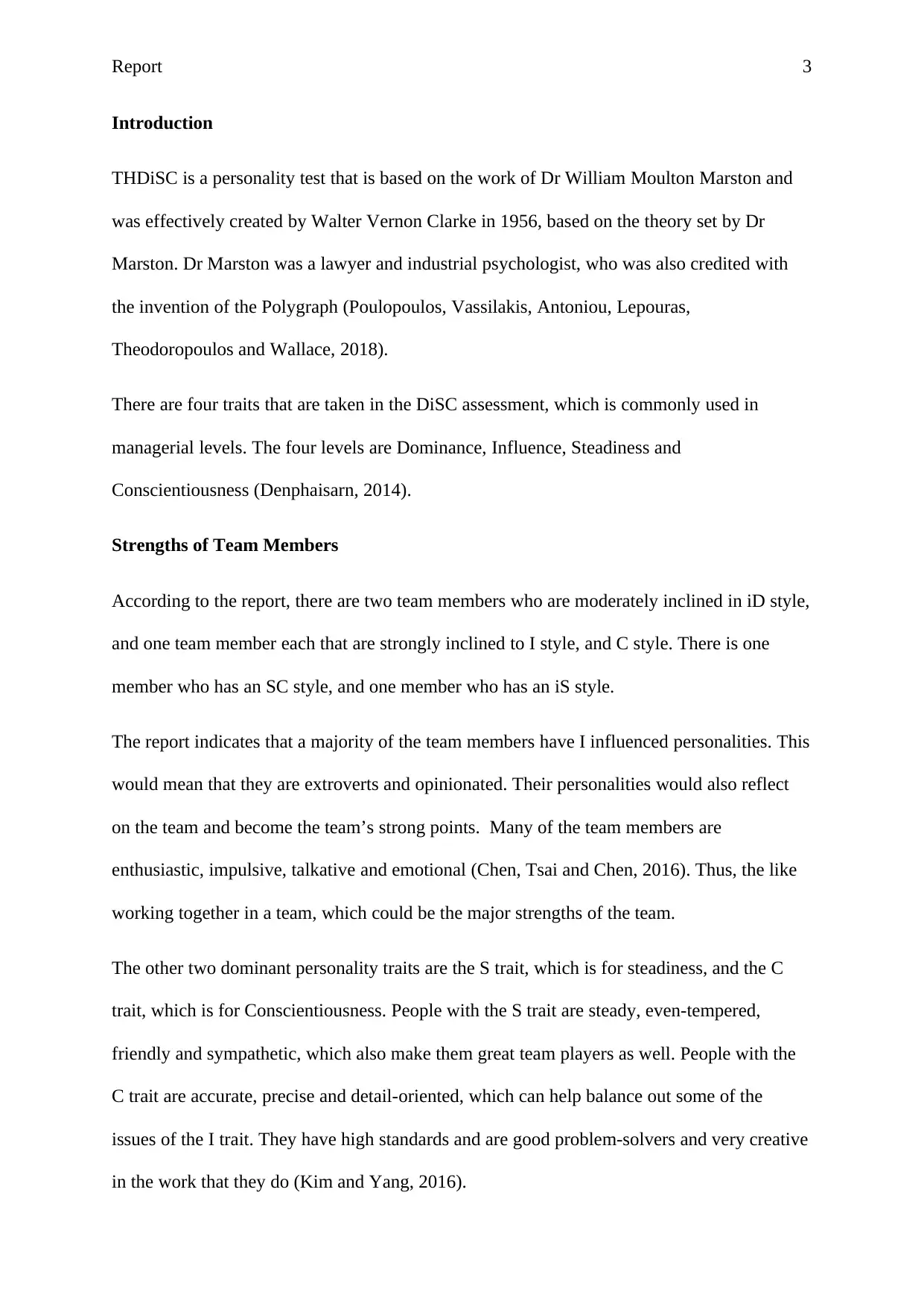
THDiSC is a personality test that is based on the work of Dr William Moulton Marston and
was effectively created by Walter Vernon Clarke in 1956, based on the theory set by Dr
Marston. Dr Marston was a lawyer and industrial psychologist, who was also credited with
the invention of the Polygraph (Poulopoulos, Vassilakis, Antoniou, Lepouras,
Theodoropoulos and Wallace, 2018).
There are four traits that are taken in the DiSC assessment, which is commonly used in
managerial levels. The four levels are Dominance, Influence, Steadiness and
Conscientiousness (Denphaisarn, 2014).
Strengths of Team Members
According to the report, there are two team members who are moderately inclined in iD style,
and one team member each that are strongly inclined to I style, and C style. There is one
member who has an SC style, and one member who has an iS style.
The report indicates that a majority of the team members have I influenced personalities. This
would mean that they are extroverts and opinionated. Their personalities would also reflect
on the team and become the team’s strong points. Many of the team members are
enthusiastic, impulsive, talkative and emotional (Chen, Tsai and Chen, 2016). Thus, the like
working together in a team, which could be the major strengths of the team.
The other two dominant personality traits are the S trait, which is for steadiness, and the C
trait, which is for Conscientiousness. People with the S trait are steady, even-tempered,
friendly and sympathetic, which also make them great team players as well. People with the
C trait are accurate, precise and detail-oriented, which can help balance out some of the
issues of the I trait. They have high standards and are good problem-solvers and very creative
in the work that they do (Kim and Yang, 2016).
Introduction
THDiSC is a personality test that is based on the work of Dr William Moulton Marston and
was effectively created by Walter Vernon Clarke in 1956, based on the theory set by Dr
Marston. Dr Marston was a lawyer and industrial psychologist, who was also credited with
the invention of the Polygraph (Poulopoulos, Vassilakis, Antoniou, Lepouras,
Theodoropoulos and Wallace, 2018).
There are four traits that are taken in the DiSC assessment, which is commonly used in
managerial levels. The four levels are Dominance, Influence, Steadiness and
Conscientiousness (Denphaisarn, 2014).
Strengths of Team Members
According to the report, there are two team members who are moderately inclined in iD style,
and one team member each that are strongly inclined to I style, and C style. There is one
member who has an SC style, and one member who has an iS style.
The report indicates that a majority of the team members have I influenced personalities. This
would mean that they are extroverts and opinionated. Their personalities would also reflect
on the team and become the team’s strong points. Many of the team members are
enthusiastic, impulsive, talkative and emotional (Chen, Tsai and Chen, 2016). Thus, the like
working together in a team, which could be the major strengths of the team.
The other two dominant personality traits are the S trait, which is for steadiness, and the C
trait, which is for Conscientiousness. People with the S trait are steady, even-tempered,
friendly and sympathetic, which also make them great team players as well. People with the
C trait are accurate, precise and detail-oriented, which can help balance out some of the
issues of the I trait. They have high standards and are good problem-solvers and very creative
in the work that they do (Kim and Yang, 2016).
⊘ This is a preview!⊘
Do you want full access?
Subscribe today to unlock all pages.

Trusted by 1+ million students worldwide

Report 4
The major strengths of the group would be that the team is outgoing and friendly, enthusiastic
and optimistic about the work that they do, and are team-workers.
Challenges Team May Encounter
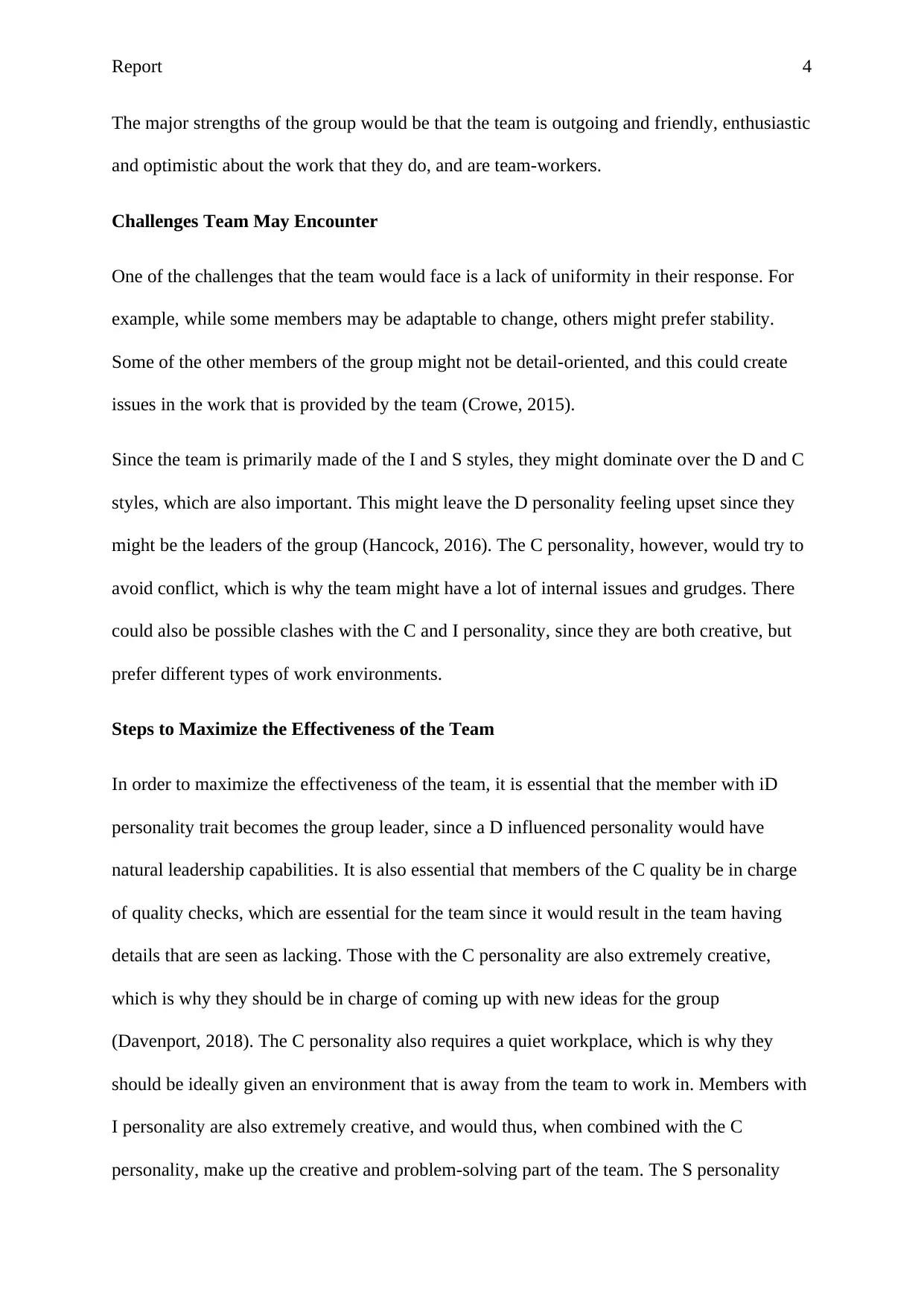
One of the challenges that the team would face is a lack of uniformity in their response. For
example, while some members may be adaptable to change, others might prefer stability.
Some of the other members of the group might not be detail-oriented, and this could create
issues in the work that is provided by the team (Crowe, 2015).
Since the team is primarily made of the I and S styles, they might dominate over the D and C
styles, which are also important. This might leave the D personality feeling upset since they
might be the leaders of the group (Hancock, 2016). The C personality, however, would try to
avoid conflict, which is why the team might have a lot of internal issues and grudges. There
could also be possible clashes with the C and I personality, since they are both creative, but
prefer different types of work environments.
Steps to Maximize the Effectiveness of the Team
In order to maximize the effectiveness of the team, it is essential that the member with iD
personality trait becomes the group leader, since a D influenced personality would have
natural leadership capabilities. It is also essential that members of the C quality be in charge
of quality checks, which are essential for the team since it would result in the team having
details that are seen as lacking. Those with the C personality are also extremely creative,
which is why they should be in charge of coming up with new ideas for the group
(Davenport, 2018). The C personality also requires a quiet workplace, which is why they
should be ideally given an environment that is away from the team to work in. Members with
I personality are also extremely creative, and would thus, when combined with the C
personality, make up the creative and problem-solving part of the team. The S personality
The major strengths of the group would be that the team is outgoing and friendly, enthusiastic
and optimistic about the work that they do, and are team-workers.
Challenges Team May Encounter
One of the challenges that the team would face is a lack of uniformity in their response. For
example, while some members may be adaptable to change, others might prefer stability.
Some of the other members of the group might not be detail-oriented, and this could create
issues in the work that is provided by the team (Crowe, 2015).
Since the team is primarily made of the I and S styles, they might dominate over the D and C
styles, which are also important. This might leave the D personality feeling upset since they
might be the leaders of the group (Hancock, 2016). The C personality, however, would try to
avoid conflict, which is why the team might have a lot of internal issues and grudges. There
could also be possible clashes with the C and I personality, since they are both creative, but
prefer different types of work environments.
Steps to Maximize the Effectiveness of the Team
In order to maximize the effectiveness of the team, it is essential that the member with iD
personality trait becomes the group leader, since a D influenced personality would have
natural leadership capabilities. It is also essential that members of the C quality be in charge
of quality checks, which are essential for the team since it would result in the team having
details that are seen as lacking. Those with the C personality are also extremely creative,
which is why they should be in charge of coming up with new ideas for the group
(Davenport, 2018). The C personality also requires a quiet workplace, which is why they
should be ideally given an environment that is away from the team to work in. Members with
I personality are also extremely creative, and would thus, when combined with the C
personality, make up the creative and problem-solving part of the team. The S personality
Paraphrase This Document
Need a fresh take? Get an instant paraphrase of this document with our AI Paraphraser

Report 5
would be in charge of ensuring that the work that has been started follows through, and
ensuring team harmony in the team meetings (Koffel, Kramer, Arbisi, Erbes, Kaler and
Polusny, 2016).
By giving each of the member's tasks related to their personality trait, it would maximize the
effectiveness of the team.
Conclusion
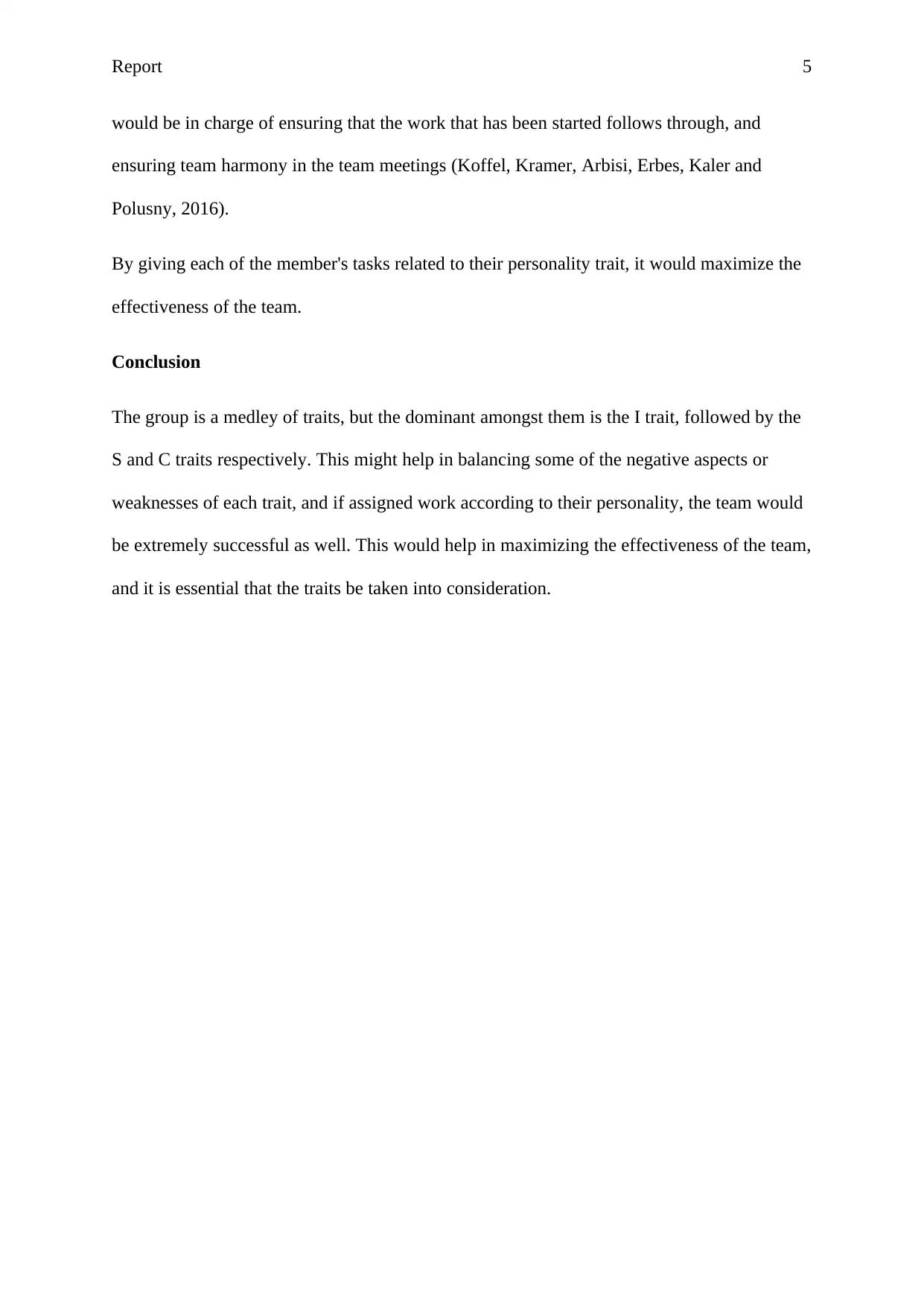
The group is a medley of traits, but the dominant amongst them is the I trait, followed by the
S and C traits respectively. This might help in balancing some of the negative aspects or
weaknesses of each trait, and if assigned work according to their personality, the team would
be extremely successful as well. This would help in maximizing the effectiveness of the team,
and it is essential that the traits be taken into consideration.
would be in charge of ensuring that the work that has been started follows through, and
ensuring team harmony in the team meetings (Koffel, Kramer, Arbisi, Erbes, Kaler and
Polusny, 2016).
By giving each of the member's tasks related to their personality trait, it would maximize the
effectiveness of the team.
Conclusion
The group is a medley of traits, but the dominant amongst them is the I trait, followed by the
S and C traits respectively. This might help in balancing some of the negative aspects or
weaknesses of each trait, and if assigned work according to their personality, the team would
be extremely successful as well. This would help in maximizing the effectiveness of the team,
and it is essential that the traits be taken into consideration.

Report 6
References
Chen, T.Y., Tsai, M.C. and Chen, Y.M., 2016. A user’s personality prediction approach by
mining network interaction behaviors on Facebook. Online Information Review, 40(7),
pp.913-937.
Crowe, C., 2015. Using personality profiles for team management. In Practice, 37(2), p.99.
Davenport, L., 2018. Home Sales Success and Personality Types: Is There a
Connection?. Journal of Real Estate Practice and Education, 21(1), pp.29-57.
Denphaisarn, N., 2014. A new framework for e-learning using learning style and
personality. International Journal of Sciences: Basic and Applied Research, 13(1), pp.145-
159.
Hancock, D., 2016. To test or not to test: Assessing personality traits. Practice
Management, 26(5), pp.23-25.
Kim, S. and Yang, S., 2016. Childcare teachers' job satisfaction: Effects of personality,
conflict-handling, and organizational characteristics. Social Behavior and Personality: an
international journal, 44(2), pp.177-184.
Koffel, E., Kramer, M.D., Arbisi, P.A., Erbes, C.R., Kaler, M. and Polusny, M.A., 2016.
Personality traits and combat exposure as predictors of psychopathology over
time. Psychological medicine, 46(1), pp.209-220.
Poulopoulos, V., Vassilakis, C., Antoniou, A., Lepouras, G., Theodoropoulos, A. and
Wallace, M., 2018. The Personality of the Influencers, the Characteristics of Qualitative
Discussions and Their Analysis for Recommendations to Cultural Institutions. Heritage, 1(2),
pp.239-253.
References
Chen, T.Y., Tsai, M.C. and Chen, Y.M., 2016. A user’s personality prediction approach by
mining network interaction behaviors on Facebook. Online Information Review, 40(7),
pp.913-937.
Crowe, C., 2015. Using personality profiles for team management. In Practice, 37(2), p.99.
Davenport, L., 2018. Home Sales Success and Personality Types: Is There a
Connection?. Journal of Real Estate Practice and Education, 21(1), pp.29-57.
Denphaisarn, N., 2014. A new framework for e-learning using learning style and
personality. International Journal of Sciences: Basic and Applied Research, 13(1), pp.145-
159.
Hancock, D., 2016. To test or not to test: Assessing personality traits. Practice
Management, 26(5), pp.23-25.
Kim, S. and Yang, S., 2016. Childcare teachers' job satisfaction: Effects of personality,
conflict-handling, and organizational characteristics. Social Behavior and Personality: an
international journal, 44(2), pp.177-184.
Koffel, E., Kramer, M.D., Arbisi, P.A., Erbes, C.R., Kaler, M. and Polusny, M.A., 2016.
Personality traits and combat exposure as predictors of psychopathology over
time. Psychological medicine, 46(1), pp.209-220.
Poulopoulos, V., Vassilakis, C., Antoniou, A., Lepouras, G., Theodoropoulos, A. and
Wallace, M., 2018. The Personality of the Influencers, the Characteristics of Qualitative
Discussions and Their Analysis for Recommendations to Cultural Institutions. Heritage, 1(2),
pp.239-253.
⊘ This is a preview!⊘
Do you want full access?
Subscribe today to unlock all pages.

Trusted by 1+ million students worldwide
1 out of 6
Related Documents
Your All-in-One AI-Powered Toolkit for Academic Success.
+13062052269
info@desklib.com
Available 24*7 on WhatsApp / Email
Unlock your academic potential
Copyright © 2020–2025 A2Z Services. All Rights Reserved. Developed and managed by ZUCOL.