A Study on Discrimination and Its Societal Impact in UK Entertainment
VerifiedAdded on 2020/10/22
|10
|2645
|429
Report
AI Summary
This report investigates the impact of discrimination in the UK entertainment industry, focusing on race, ethnicity, gender, disability, and age. The research employs both primary and secondary sources, including interviews with entertainment industry professionals and a review of existing literature. The study aims to raise awareness about discrimination and its effects on society, particularly as the entertainment industry significantly influences global trends and societal mentalities. The findings highlight gender inequality, racial bias, and ethnic discrimination, with primary research revealing that many individuals have experienced discrimination. The report discusses these issues, offering insights into the factors contributing to discrimination and potential solutions, such as stricter regulations and promotion of equality and diversity.
RESEARCH

Paraphrase This Document
Need a fresh take? Get an instant paraphrase of this document with our AI Paraphraser

INTRODUCTION
Research is study which helps scholar in investigating topic of interest for specific
purposes like academic, interest, awareness, etc. The present research is focused on analysing
core issue that is discrimination and its impact on society. The information in this study will be
collected via both the sources, that is, primary and secondary where secondary will be on
articles, online journals, etc. Whereas, primary research will be done by interviewing randomly
sampled participants of UK entertainment industry.
Aim
“To ascertain the impact of discrimination due to race, ethnicity, gender, disability or age
on society: a case study on UK entertainment industry”
The rationale behind choosing this topic is to promote awareness among people, because
every activity of entertainment industry is directly related to society. Also, because individuals
cross the globe are majorly influenced by trends followed in this industry. Therefore, this study
will assist in developing a critical knowledge on the possible situations which leads to
discrimination in entertainment industry.
Literature Review
According to Hook, 2010, it has been stated that discrimination in entertainment industry
is a common issue which is impacting the mentality of society. Film industry is directly related
to society and therefore, the individuals try to follow and implement every trend followed by star
cast, films, serials, etc. Further, author discussed about discrimination in industry on the basis of
gender where growth of females is restricted at every level like women are allowed to be a part
of make-up team and costume department because according to majority to people, individuals
are in capable of handling camera and work at direction department. Further, it is not that the
discrimination in industry is at low level. The disparity is faced by majority of leading star cast.
In accordance with this inequality, it can be said that the industry is insecure from each other
growth due to which everyone is focused on dragging each one of them down from growth lane.
On the contrary, A major new study into gender inequality in the UK film industry, 2016, has
stated about lacking female directors and producers in film making industry due to disparity. In
addition, it has been discovered that approximately, 16.1 % women are working for low budget
1
Research is study which helps scholar in investigating topic of interest for specific
purposes like academic, interest, awareness, etc. The present research is focused on analysing
core issue that is discrimination and its impact on society. The information in this study will be
collected via both the sources, that is, primary and secondary where secondary will be on
articles, online journals, etc. Whereas, primary research will be done by interviewing randomly
sampled participants of UK entertainment industry.
Aim
“To ascertain the impact of discrimination due to race, ethnicity, gender, disability or age
on society: a case study on UK entertainment industry”
The rationale behind choosing this topic is to promote awareness among people, because
every activity of entertainment industry is directly related to society. Also, because individuals
cross the globe are majorly influenced by trends followed in this industry. Therefore, this study
will assist in developing a critical knowledge on the possible situations which leads to
discrimination in entertainment industry.
Literature Review
According to Hook, 2010, it has been stated that discrimination in entertainment industry
is a common issue which is impacting the mentality of society. Film industry is directly related
to society and therefore, the individuals try to follow and implement every trend followed by star
cast, films, serials, etc. Further, author discussed about discrimination in industry on the basis of
gender where growth of females is restricted at every level like women are allowed to be a part
of make-up team and costume department because according to majority to people, individuals
are in capable of handling camera and work at direction department. Further, it is not that the
discrimination in industry is at low level. The disparity is faced by majority of leading star cast.
In accordance with this inequality, it can be said that the industry is insecure from each other
growth due to which everyone is focused on dragging each one of them down from growth lane.
On the contrary, A major new study into gender inequality in the UK film industry, 2016, has
stated about lacking female directors and producers in film making industry due to disparity. In
addition, it has been discovered that approximately, 16.1 % women are working for low budget
1
⊘ This is a preview!⊘
Do you want full access?
Subscribe today to unlock all pages.

Trusted by 1+ million students worldwide
films and only 3.3 % are involved in high budget entertainment series. However, this comparison
denoted the gender disparity in entertainment industry of UK.
Leary, 2016, has discussed about the factors leading to discrimination that is ethnicity
where people belong to different backgrounds and individuals hold the capacity of establishing
innovation in entertainment field. Moreover, the criticisation of people in industry restrict the
growth various individuals especially who from different cultural background. Further, there are
people according to whom females are meant for specific work like make up, wardrobe, costume
specialist and for crew which leads to gender inequality. As per the views of Hunleth, 2011, it
has been analysed that inequality in UK film making industry is also seen due to racism where
the employees are embarrassed and harassed at workplace which is the most unethical practice
which influence society. The trends and practices followed by industry lay typical influence of
people due to which there are majority of workplace other than film industry where employees
faced disparity due to race, gender, ethnicity etc.
According to Lushey and Munro, 2015, there are a million of immigrants in
entertainment industry who are supported by management but are discriminated by employees
and colleges. The differences in opinion, language a background also leads to conflicts between
people due to differences in cultural background. However, the discrimination on the basis of
ethnicity is majorly among employees because the entry of immigrants increases competition for
domestic workers. In addition, author discussed same concept of society where immigrants are
neglected because of differences in background and living style. Thus, author stated that society
seeks for support and negligence and conflict between employees and immigrants in
entertainment industry has been continuously supporting societal exclusion and negligence to
people due to discrimination on the basis of race, ethnicity, gender, etc.
Primary interview to demonstrate the relevancy of scenarioThe interview was conducted with 15
males and 15 females of entertainment industry.
Theme 1: Yes, people have faced discrimination in entertainment industry.
Have you ever faced discrimination in industry? Frequency
Yes 17
May be 8
2
denoted the gender disparity in entertainment industry of UK.
Leary, 2016, has discussed about the factors leading to discrimination that is ethnicity
where people belong to different backgrounds and individuals hold the capacity of establishing
innovation in entertainment field. Moreover, the criticisation of people in industry restrict the
growth various individuals especially who from different cultural background. Further, there are
people according to whom females are meant for specific work like make up, wardrobe, costume
specialist and for crew which leads to gender inequality. As per the views of Hunleth, 2011, it
has been analysed that inequality in UK film making industry is also seen due to racism where
the employees are embarrassed and harassed at workplace which is the most unethical practice
which influence society. The trends and practices followed by industry lay typical influence of
people due to which there are majority of workplace other than film industry where employees
faced disparity due to race, gender, ethnicity etc.
According to Lushey and Munro, 2015, there are a million of immigrants in
entertainment industry who are supported by management but are discriminated by employees
and colleges. The differences in opinion, language a background also leads to conflicts between
people due to differences in cultural background. However, the discrimination on the basis of
ethnicity is majorly among employees because the entry of immigrants increases competition for
domestic workers. In addition, author discussed same concept of society where immigrants are
neglected because of differences in background and living style. Thus, author stated that society
seeks for support and negligence and conflict between employees and immigrants in
entertainment industry has been continuously supporting societal exclusion and negligence to
people due to discrimination on the basis of race, ethnicity, gender, etc.
Primary interview to demonstrate the relevancy of scenarioThe interview was conducted with 15
males and 15 females of entertainment industry.
Theme 1: Yes, people have faced discrimination in entertainment industry.
Have you ever faced discrimination in industry? Frequency
Yes 17
May be 8
2
Paraphrase This Document
Need a fresh take? Get an instant paraphrase of this document with our AI Paraphraser
No 5
As per theme 1, it has been analysed that 17 people of entertainment industry have faced
discrimination due to various disparities. According to the views of these persons, it has been
analysed that industry restricts growth of potential people because of increasing competition.
However, 8 people in interview were not sure but have stated that as per their experiences
inequality in industry occurs especially due to ethnicity (Okechukwu and et.al., 2014). Thus, as
per the analysis it can be stated that majority of employees have faced disparity which denotes
unethical trends of UK entertainment industry which is impacting mentality of society hand in
hand.
Theme 2: Yes, discrimination in industry impacts mentality of society.
Do you believe discrimination in industry impacts mentality of society? Frequency
Yes 20
May be 6
No 4
According to theme 2, it has been analysed that as per 20 employees of entertainment
industry, discrimination impacts the mentality of society. Participants stated that trends of
industry are transparent to people across the globe which are followed in film making industry. .
The individuals stated that there are people who believe in discrimination and trends of films that
make their mentality more powerful. Apart from that, 6 respondents stated that it depends on
people and their opinions over discrimination. Further, as per respondents, it can be concluded
that society is partially responsible for impacting the mentality of society. Apparently, as per 4
respondents in interview, the industry is not at all responsible for societal discrimination because
every individual is aware about their responsibility and practices. Thus, as per these people, no
persons or trends can influence anyone’s opinion over disparity (Lutter, 2015).
Theme 3: People in entertainment industry are generally discriminated on the basis of
gender.
3
As per theme 1, it has been analysed that 17 people of entertainment industry have faced
discrimination due to various disparities. According to the views of these persons, it has been
analysed that industry restricts growth of potential people because of increasing competition.
However, 8 people in interview were not sure but have stated that as per their experiences
inequality in industry occurs especially due to ethnicity (Okechukwu and et.al., 2014). Thus, as
per the analysis it can be stated that majority of employees have faced disparity which denotes
unethical trends of UK entertainment industry which is impacting mentality of society hand in
hand.
Theme 2: Yes, discrimination in industry impacts mentality of society.
Do you believe discrimination in industry impacts mentality of society? Frequency
Yes 20
May be 6
No 4
According to theme 2, it has been analysed that as per 20 employees of entertainment
industry, discrimination impacts the mentality of society. Participants stated that trends of
industry are transparent to people across the globe which are followed in film making industry. .
The individuals stated that there are people who believe in discrimination and trends of films that
make their mentality more powerful. Apart from that, 6 respondents stated that it depends on
people and their opinions over discrimination. Further, as per respondents, it can be concluded
that society is partially responsible for impacting the mentality of society. Apparently, as per 4
respondents in interview, the industry is not at all responsible for societal discrimination because
every individual is aware about their responsibility and practices. Thus, as per these people, no
persons or trends can influence anyone’s opinion over disparity (Lutter, 2015).
Theme 3: People in entertainment industry are generally discriminated on the basis of
gender.
3
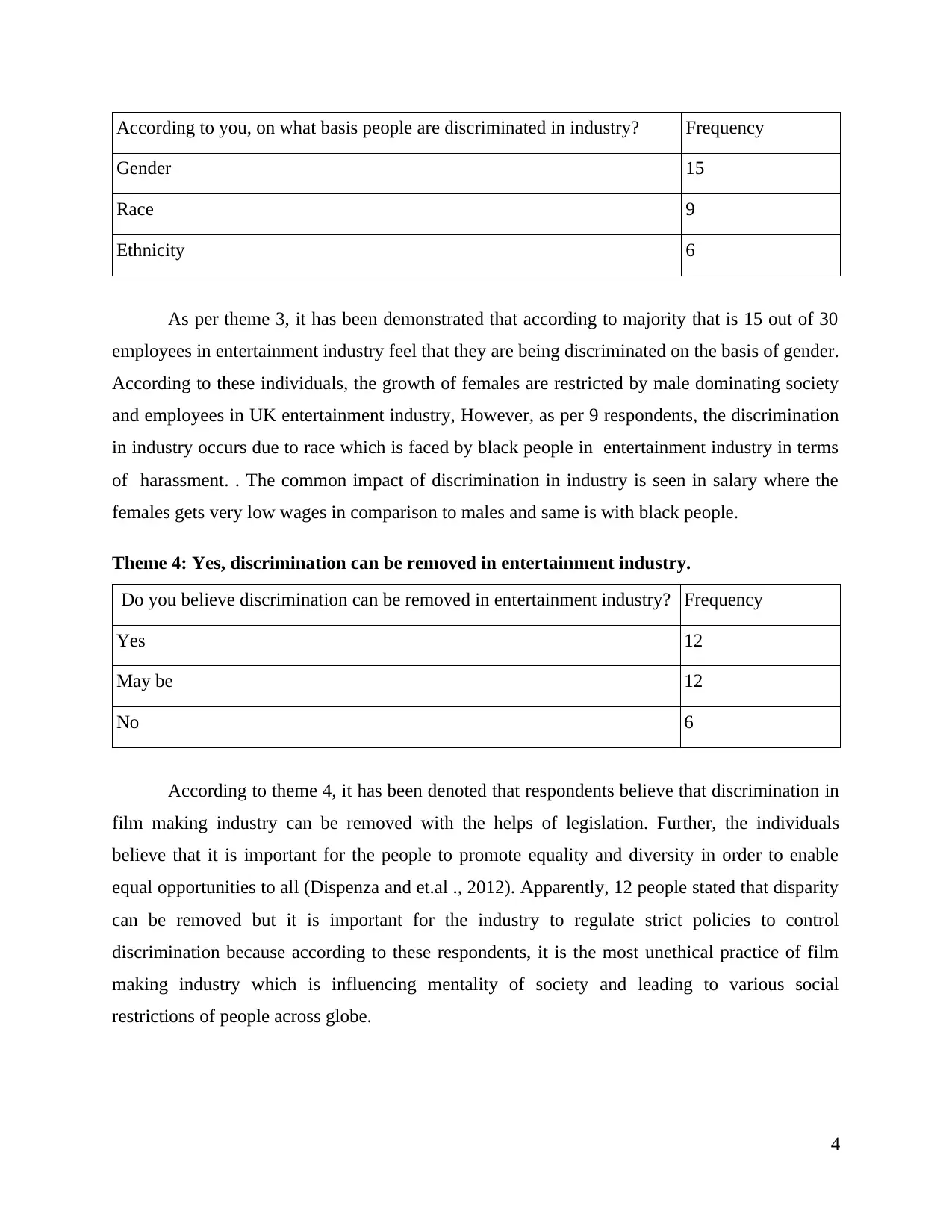
According to you, on what basis people are discriminated in industry? Frequency
Gender 15
Race 9
Ethnicity 6
As per theme 3, it has been demonstrated that according to majority that is 15 out of 30
employees in entertainment industry feel that they are being discriminated on the basis of gender.
According to these individuals, the growth of females are restricted by male dominating society
and employees in UK entertainment industry, However, as per 9 respondents, the discrimination
in industry occurs due to race which is faced by black people in entertainment industry in terms
of harassment. . The common impact of discrimination in industry is seen in salary where the
females gets very low wages in comparison to males and same is with black people.
Theme 4: Yes, discrimination can be removed in entertainment industry.
Do you believe discrimination can be removed in entertainment industry? Frequency
Yes 12
May be 12
No 6
According to theme 4, it has been denoted that respondents believe that discrimination in
film making industry can be removed with the helps of legislation. Further, the individuals
believe that it is important for the people to promote equality and diversity in order to enable
equal opportunities to all (Dispenza and et.al ., 2012). Apparently, 12 people stated that disparity
can be removed but it is important for the industry to regulate strict policies to control
discrimination because according to these respondents, it is the most unethical practice of film
making industry which is influencing mentality of society and leading to various social
restrictions of people across globe.
4
Gender 15
Race 9
Ethnicity 6
As per theme 3, it has been demonstrated that according to majority that is 15 out of 30
employees in entertainment industry feel that they are being discriminated on the basis of gender.
According to these individuals, the growth of females are restricted by male dominating society
and employees in UK entertainment industry, However, as per 9 respondents, the discrimination
in industry occurs due to race which is faced by black people in entertainment industry in terms
of harassment. . The common impact of discrimination in industry is seen in salary where the
females gets very low wages in comparison to males and same is with black people.
Theme 4: Yes, discrimination can be removed in entertainment industry.
Do you believe discrimination can be removed in entertainment industry? Frequency
Yes 12
May be 12
No 6
According to theme 4, it has been denoted that respondents believe that discrimination in
film making industry can be removed with the helps of legislation. Further, the individuals
believe that it is important for the people to promote equality and diversity in order to enable
equal opportunities to all (Dispenza and et.al ., 2012). Apparently, 12 people stated that disparity
can be removed but it is important for the industry to regulate strict policies to control
discrimination because according to these respondents, it is the most unethical practice of film
making industry which is influencing mentality of society and leading to various social
restrictions of people across globe.
4
⊘ This is a preview!⊘
Do you want full access?
Subscribe today to unlock all pages.
Trusted by 1+ million students worldwide
Findings and Discussion
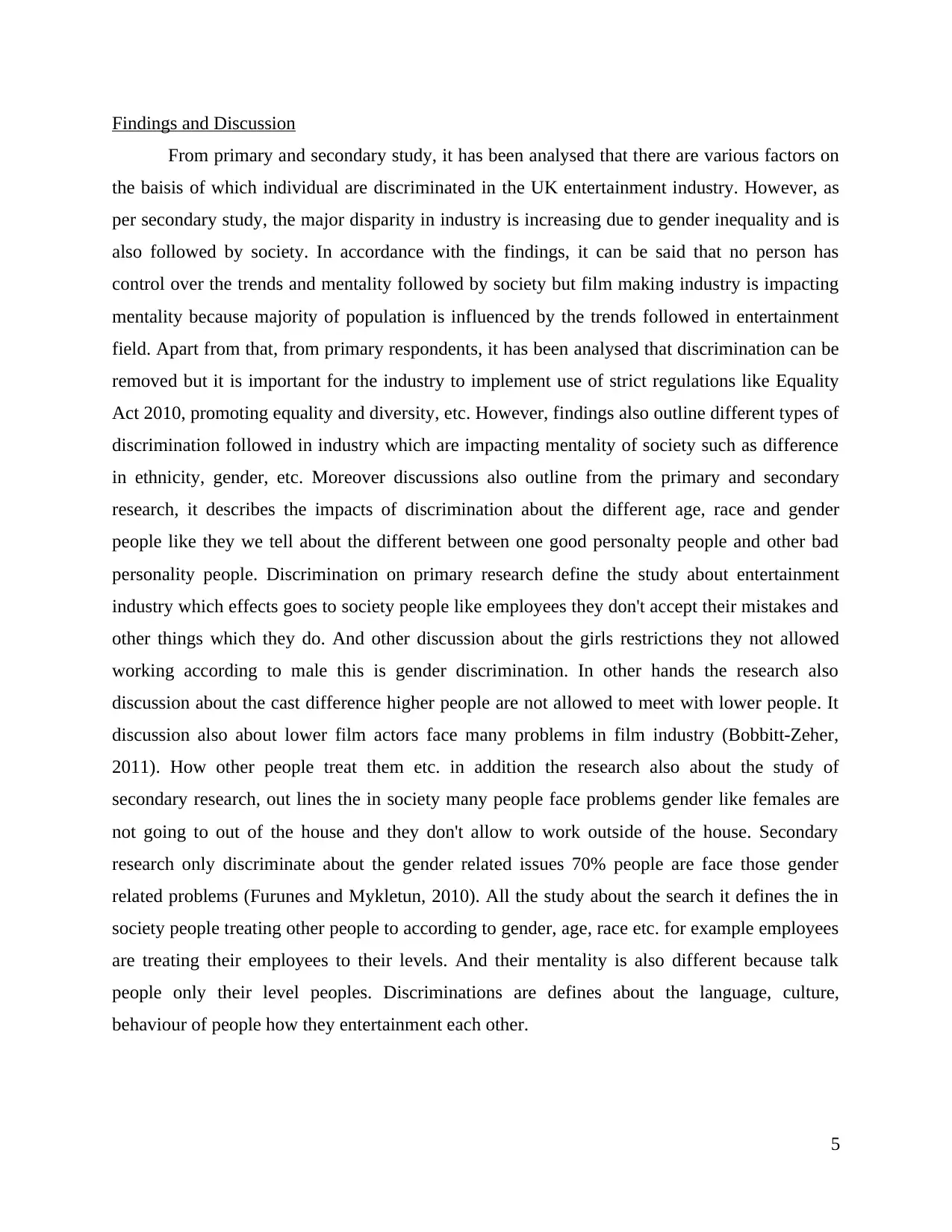
From primary and secondary study, it has been analysed that there are various factors on
the baisis of which individual are discriminated in the UK entertainment industry. However, as
per secondary study, the major disparity in industry is increasing due to gender inequality and is
also followed by society. In accordance with the findings, it can be said that no person has
control over the trends and mentality followed by society but film making industry is impacting
mentality because majority of population is influenced by the trends followed in entertainment
field. Apart from that, from primary respondents, it has been analysed that discrimination can be
removed but it is important for the industry to implement use of strict regulations like Equality
Act 2010, promoting equality and diversity, etc. However, findings also outline different types of
discrimination followed in industry which are impacting mentality of society such as difference
in ethnicity, gender, etc. Moreover discussions also outline from the primary and secondary
research, it describes the impacts of discrimination about the different age, race and gender
people like they we tell about the different between one good personalty people and other bad
personality people. Discrimination on primary research define the study about entertainment
industry which effects goes to society people like employees they don't accept their mistakes and
other things which they do. And other discussion about the girls restrictions they not allowed
working according to male this is gender discrimination. In other hands the research also
discussion about the cast difference higher people are not allowed to meet with lower people. It
discussion also about lower film actors face many problems in film industry (Bobbitt-Zeher,
2011). How other people treat them etc. in addition the research also about the study of
secondary research, out lines the in society many people face problems gender like females are
not going to out of the house and they don't allow to work outside of the house. Secondary
research only discriminate about the gender related issues 70% people are face those gender
related problems (Furunes and Mykletun, 2010). All the study about the search it defines the in
society people treating other people to according to gender, age, race etc. for example employees
are treating their employees to their levels. And their mentality is also different because talk
people only their level peoples. Discriminations are defines about the language, culture,
behaviour of people how they entertainment each other.
5
From primary and secondary study, it has been analysed that there are various factors on
the baisis of which individual are discriminated in the UK entertainment industry. However, as
per secondary study, the major disparity in industry is increasing due to gender inequality and is
also followed by society. In accordance with the findings, it can be said that no person has
control over the trends and mentality followed by society but film making industry is impacting
mentality because majority of population is influenced by the trends followed in entertainment
field. Apart from that, from primary respondents, it has been analysed that discrimination can be
removed but it is important for the industry to implement use of strict regulations like Equality
Act 2010, promoting equality and diversity, etc. However, findings also outline different types of
discrimination followed in industry which are impacting mentality of society such as difference
in ethnicity, gender, etc. Moreover discussions also outline from the primary and secondary
research, it describes the impacts of discrimination about the different age, race and gender
people like they we tell about the different between one good personalty people and other bad
personality people. Discrimination on primary research define the study about entertainment
industry which effects goes to society people like employees they don't accept their mistakes and
other things which they do. And other discussion about the girls restrictions they not allowed
working according to male this is gender discrimination. In other hands the research also
discussion about the cast difference higher people are not allowed to meet with lower people. It
discussion also about lower film actors face many problems in film industry (Bobbitt-Zeher,
2011). How other people treat them etc. in addition the research also about the study of
secondary research, out lines the in society many people face problems gender like females are
not going to out of the house and they don't allow to work outside of the house. Secondary
research only discriminate about the gender related issues 70% people are face those gender
related problems (Furunes and Mykletun, 2010). All the study about the search it defines the in
society people treating other people to according to gender, age, race etc. for example employees
are treating their employees to their levels. And their mentality is also different because talk
people only their level peoples. Discriminations are defines about the language, culture,
behaviour of people how they entertainment each other.
5
Paraphrase This Document
Need a fresh take? Get an instant paraphrase of this document with our AI Paraphraser
CONCLUSION
In the above research scholar collect information about the both secondary and primary
research. The research is based on UK based entertainment industry. The research summaries
bout the both secondary and primary data like impact of discrimination due to race, ethnicity,
gender, disability or age on society (Ghumman ,and et.al ., 2013). The secondary research
describe about the discrimination impact on woman's restrictions and primary research describe
about the UK conduct interview for employees and define the age and upper and lower people.
Above research scholar collect the information form study about the research to finding and
discussion about the all primary and secondary data of the research. This research also collect
rationale behind choosing this topic is to promote awareness among people, because every
activity of entertainment industry is directly related to society. This study will assist in
developing critical knowledge on the possible situation which leads to discrimination in
entertainment industry. The scholar also defines study about the interview of employees where
they describe discriminations of employee age, ethnicity and gender (Offermann and et.al.,
2014). The research also collect the information about the majority of people in film industry.
Where the discrimination define the treating people according to levels, their personality,
position, lifestyle and also social entertainments in industry. The above research of impact on
society to entertainment industry define the discussion and finding summery about the whole
research both secondary and primary. Mainly the aim of the researcher to define the impact of
society on UK entertainments industry and hoe people worked on it to entertainment each other.
6
In the above research scholar collect information about the both secondary and primary
research. The research is based on UK based entertainment industry. The research summaries
bout the both secondary and primary data like impact of discrimination due to race, ethnicity,
gender, disability or age on society (Ghumman ,and et.al ., 2013). The secondary research
describe about the discrimination impact on woman's restrictions and primary research describe
about the UK conduct interview for employees and define the age and upper and lower people.
Above research scholar collect the information form study about the research to finding and
discussion about the all primary and secondary data of the research. This research also collect
rationale behind choosing this topic is to promote awareness among people, because every
activity of entertainment industry is directly related to society. This study will assist in
developing critical knowledge on the possible situation which leads to discrimination in
entertainment industry. The scholar also defines study about the interview of employees where
they describe discriminations of employee age, ethnicity and gender (Offermann and et.al.,
2014). The research also collect the information about the majority of people in film industry.
Where the discrimination define the treating people according to levels, their personality,
position, lifestyle and also social entertainments in industry. The above research of impact on
society to entertainment industry define the discussion and finding summery about the whole
research both secondary and primary. Mainly the aim of the researcher to define the impact of
society on UK entertainments industry and hoe people worked on it to entertainment each other.
6
REFERENCES
Books and Journals
Hook, J.L., 2010. Gender inequality in the welfare state: Sex segregation in housework, 1965–
2003. American journal of sociology. 115(5). pp.1480-1523.
Hunleth, J., 2011. Beyond on or with: Questioning power dynamics and knowledge production in
‘child-oriented’research methodology. Childhood. 18(1). pp.81-93.Lant, A.C.,
2014. Blackout: Reinventing women for wartime British cinema. Princeton University
Press.
Leary, M. R., 2016. Introduction to behavioral research methods. Pearson.
Lushey, C. J. and Munro, E. R., 2015. Participatory peer research methodology: An effective
method for obtaining young people’s perspectives on transitions from care to
adulthood?. Qualitative Social Work. 14(4). pp.522-537.
Lutter, M., 2015. Do women suffer from network closure? The moderating effect of social capital
on gender inequality in a project-based labor market, 1929 to 2010. American
Sociological Review. 80(2). pp.329-358.
Bobbitt-Zeher, D., 2011. Gender discrimination at work: Connecting gender stereotypes,
institutional policies, and gender composition of workplace. Gender & Society. 25(6).
pp.764-786.
Furunes, T. and Mykletun, R.J., 2010. Age discrimination in the workplace: Validation of the
Nordic Age Discrimination Scale (NADS). Scandinavian Journal of Psychology.
51(1).pp.23-30.
Wrench, J., 2016. Diversity management and discrimination: Immigrants and ethnic minorities
in the EU. Routledge.
Ghumman, S.,and et.al ., 2013. Religious discrimination in the workplace: A review and
examination of current and future trends. Journal of Business and Psychology.28(4).
pp.439-454.
Offermann, L.R.,and et.al., 2014. See no evil: Color blindness and perceptions of subtle racial
discrimination in the workplace. Cultural Diversity and Ethnic Minority Psychology.
20(4). p.499.
7
Books and Journals
Hook, J.L., 2010. Gender inequality in the welfare state: Sex segregation in housework, 1965–
2003. American journal of sociology. 115(5). pp.1480-1523.
Hunleth, J., 2011. Beyond on or with: Questioning power dynamics and knowledge production in
‘child-oriented’research methodology. Childhood. 18(1). pp.81-93.Lant, A.C.,
2014. Blackout: Reinventing women for wartime British cinema. Princeton University
Press.
Leary, M. R., 2016. Introduction to behavioral research methods. Pearson.
Lushey, C. J. and Munro, E. R., 2015. Participatory peer research methodology: An effective
method for obtaining young people’s perspectives on transitions from care to
adulthood?. Qualitative Social Work. 14(4). pp.522-537.
Lutter, M., 2015. Do women suffer from network closure? The moderating effect of social capital
on gender inequality in a project-based labor market, 1929 to 2010. American
Sociological Review. 80(2). pp.329-358.
Bobbitt-Zeher, D., 2011. Gender discrimination at work: Connecting gender stereotypes,
institutional policies, and gender composition of workplace. Gender & Society. 25(6).
pp.764-786.
Furunes, T. and Mykletun, R.J., 2010. Age discrimination in the workplace: Validation of the
Nordic Age Discrimination Scale (NADS). Scandinavian Journal of Psychology.
51(1).pp.23-30.
Wrench, J., 2016. Diversity management and discrimination: Immigrants and ethnic minorities
in the EU. Routledge.
Ghumman, S.,and et.al ., 2013. Religious discrimination in the workplace: A review and
examination of current and future trends. Journal of Business and Psychology.28(4).
pp.439-454.
Offermann, L.R.,and et.al., 2014. See no evil: Color blindness and perceptions of subtle racial
discrimination in the workplace. Cultural Diversity and Ethnic Minority Psychology.
20(4). p.499.
7
⊘ This is a preview!⊘
Do you want full access?
Subscribe today to unlock all pages.
Trusted by 1+ million students worldwide
Dispenza, F., and et.al ., 2012. Experience of Career‐Related Discrimination for Female‐to‐Male
Transgender Persons: A Qualitative Study. The Career Development Quarterly.60(1).
pp.65-81.
Okechukwu, C.A., and et.al., 2014. Discrimination, harassment, abuse, and bullying in the
workplace: Contribution of workplace injustice to occupational health disparities.
American journal of industrial medicine.57(5). pp.573-586.
Online
A major new study into gender inequality in the UK film industry. 2016. [Online]. Available
through: <https://stephenfollows.com/gender-inequality-in-the-uk-film-industry/>.
8
Transgender Persons: A Qualitative Study. The Career Development Quarterly.60(1).
pp.65-81.
Okechukwu, C.A., and et.al., 2014. Discrimination, harassment, abuse, and bullying in the
workplace: Contribution of workplace injustice to occupational health disparities.
American journal of industrial medicine.57(5). pp.573-586.
Online
A major new study into gender inequality in the UK film industry. 2016. [Online]. Available
through: <https://stephenfollows.com/gender-inequality-in-the-uk-film-industry/>.
8

1 out of 10


Related Documents


Your All-in-One AI-Powered Toolkit for Academic Success.
+13062052269
info@desklib.com
Available 24*7 on WhatsApp / Email
![[object Object]](/_next/static/media/star-bottom.7253800d.svg)
Unlock your academic potential
Copyright © 2020–2026 A2Z Services. All Rights Reserved. Developed and managed by ZUCOL.