Discrimination & Ethics in Business: Dream Massage Case Study Report
VerifiedAdded on 2023/05/31
|9
|1619
|338
Report
AI Summary
This report provides an overview of employment relationships and discriminatory policies related to employment from an ethical standpoint, specifically from an employer's perspective. It analyzes whether Janice should be classified as an employee or an independent contractor, based on IRS criteria, and argues that Dream Massage's control over Janice's work makes her more akin to an employee. The report discusses how Dream Massage violates employment discrimination laws by preventing Janice from wearing a hijab, highlighting that this infringes upon religious expression. It further examines the ethical considerations associated with maintaining a rigid dress code, emphasizing the importance of accommodating disability, religious, and gender identity considerations to avoid potential lawsuits. The conclusion reiterates that Janice is treated as an employee and that the massage parlor's actions violate employment discrimination laws, emphasizing the need for ethical considerations in dress code policies.
Running head: ETHICAL AND LEGAL TOPICS IN BUSINESS
Running head: MARKETING AND COMMUNICATIONS
Marketing and Communications
Name of the Student:
Name of the University:
Author Note:
Running head: MARKETING AND COMMUNICATIONS
Marketing and Communications
Name of the Student:
Name of the University:
Author Note:
Paraphrase This Document
Need a fresh take? Get an instant paraphrase of this document with our AI Paraphraser

1ETHICAL AND LEGAL TOPICS IN BUSINESS
Ethical and Legal Topics in Business
Name of the Student:
Name of the University:
Author Note:
Ethical and Legal Topics in Business
Name of the Student:
Name of the University:
Author Note:

2ETHICAL AND LEGAL TOPICS IN BUSINESS
Executive Summary:
The aim of the report is to provide an overview of the employment relationships and the
discriminatory policies related to employment from the ethical standpoint in the perspective
of an employer. The report commences with analysis based on the classification of Janice as
an employee or an independent contractor. The report also puts forward how the massage
parlour violates the employee discrimination law in terms of dress code. Further, the report
discusses about the ethical considerations that remains associated with the maintenance of a
rigid dress code.
Executive Summary:
The aim of the report is to provide an overview of the employment relationships and the
discriminatory policies related to employment from the ethical standpoint in the perspective
of an employer. The report commences with analysis based on the classification of Janice as
an employee or an independent contractor. The report also puts forward how the massage
parlour violates the employee discrimination law in terms of dress code. Further, the report
discusses about the ethical considerations that remains associated with the maintenance of a
rigid dress code.
⊘ This is a preview!⊘
Do you want full access?
Subscribe today to unlock all pages.

Trusted by 1+ million students worldwide

3ETHICAL AND LEGAL TOPICS IN BUSINESS
Table of Contents
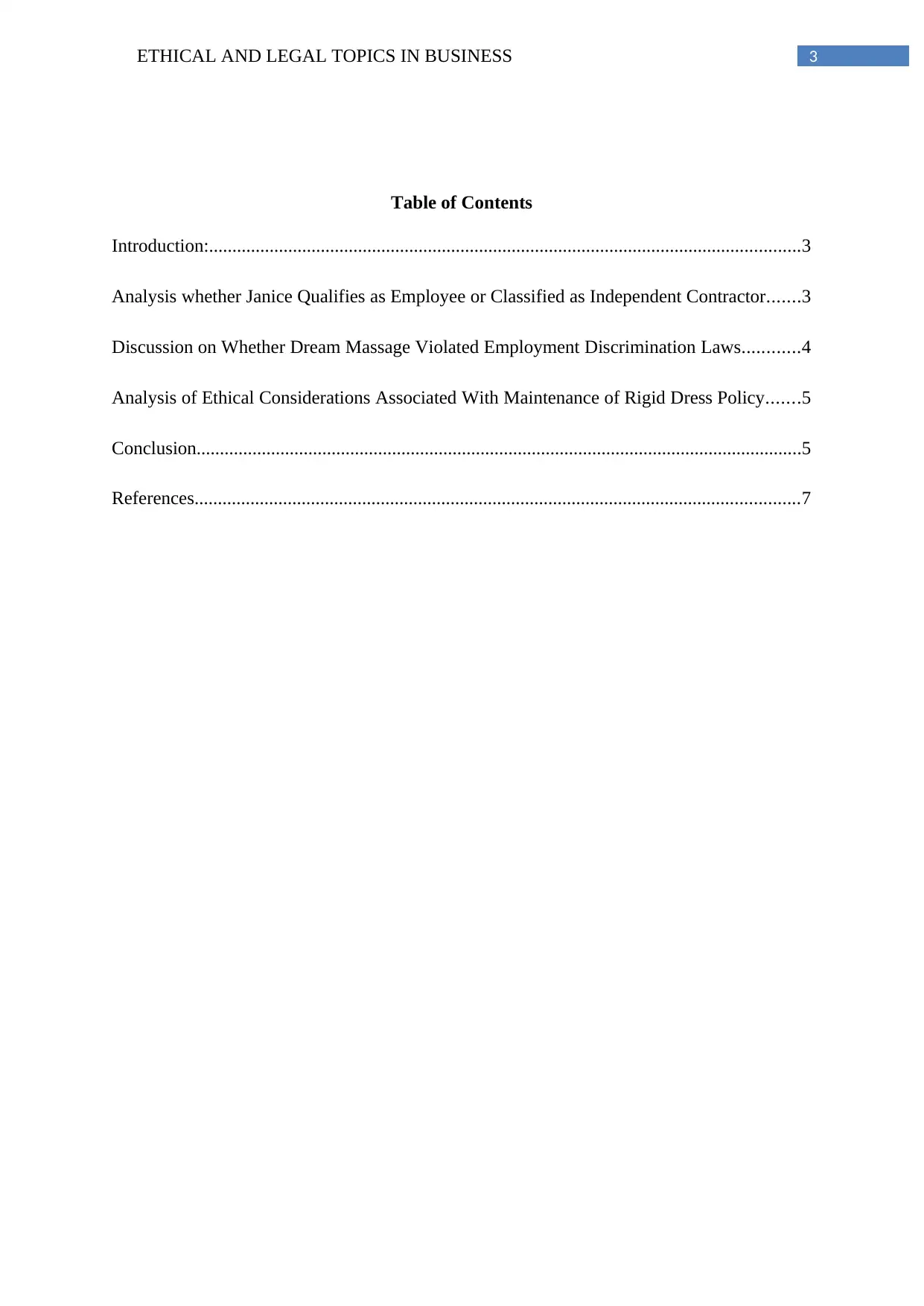
Introduction:...............................................................................................................................3
Analysis whether Janice Qualifies as Employee or Classified as Independent Contractor.......3
Discussion on Whether Dream Massage Violated Employment Discrimination Laws............4
Analysis of Ethical Considerations Associated With Maintenance of Rigid Dress Policy.......5
Conclusion..................................................................................................................................5
References..................................................................................................................................7
Table of Contents
Introduction:...............................................................................................................................3
Analysis whether Janice Qualifies as Employee or Classified as Independent Contractor.......3
Discussion on Whether Dream Massage Violated Employment Discrimination Laws............4
Analysis of Ethical Considerations Associated With Maintenance of Rigid Dress Policy.......5
Conclusion..................................................................................................................................5
References..................................................................................................................................7
Paraphrase This Document
Need a fresh take? Get an instant paraphrase of this document with our AI Paraphraser

4ETHICAL AND LEGAL TOPICS IN BUSINESS
Introduction
The report aims at providing an insight into the potential discriminatory employment
policies and employment relationships from the ethical standpoint from the point of view of
the Human Resource (HR) consultant. The report revolves around the Dream Massage
Company where it recruits Janice as independent contractor and prevents her from wearing
hijab as it violated the dress code policy of the company. The report analyzes whether Janice
should qualify as an employee or classified as independent contractor. There are also
discussions on whether the company potentially violates the employment discrimination
laws. The report also puts forward an analysis on the ethical considerations associated with
the maintenance of a rigid dress code policy at workplace.
Analysis of Janice as either Employee or as Independent Contractor
The distinction between the independent contractor and the employee as put forward
by IRS (Internal Revenue Service) is that an independent contractor refers to the autonomous
businessperson who runs their own business but work for other business while an employee
remains hired by the company for performing a typical task towards the direction of employer
(Katz & Krueger, 20 16). In other words, employees also known as the common law
employees are salaried and subjected to overtime. Employees unlike independent contractor
are taxed on the income and remain withheld from the federal, state and Social Security and
Medicare taxes
The three general criteria put forward by IRS in distinguishing employees and the
independent contractors are as follows:
Introduction
The report aims at providing an insight into the potential discriminatory employment
policies and employment relationships from the ethical standpoint from the point of view of
the Human Resource (HR) consultant. The report revolves around the Dream Massage
Company where it recruits Janice as independent contractor and prevents her from wearing
hijab as it violated the dress code policy of the company. The report analyzes whether Janice
should qualify as an employee or classified as independent contractor. There are also
discussions on whether the company potentially violates the employment discrimination
laws. The report also puts forward an analysis on the ethical considerations associated with
the maintenance of a rigid dress code policy at workplace.
Analysis of Janice as either Employee or as Independent Contractor
The distinction between the independent contractor and the employee as put forward
by IRS (Internal Revenue Service) is that an independent contractor refers to the autonomous
businessperson who runs their own business but work for other business while an employee
remains hired by the company for performing a typical task towards the direction of employer
(Katz & Krueger, 20 16). In other words, employees also known as the common law
employees are salaried and subjected to overtime. Employees unlike independent contractor
are taxed on the income and remain withheld from the federal, state and Social Security and
Medicare taxes
The three general criteria put forward by IRS in distinguishing employees and the
independent contractors are as follows:

5ETHICAL AND LEGAL TOPICS IN BUSINESS
Control over Behaviour: If an employer directs and trains work including the work
hours, tools or equipment used, the task to be performed and the way it need to be done then
the worker represented an employee(Redfearn, 2016). While if the worker is able to set his
own hours and work with no direction or training then he/she is an independent contractor. In
Janice’s case, although she was recruited as independent contractor but the employers of
Dream Massage tried to exercise full control over her thereby making her qualify as an
employee.
Control over Finance: This factor portrays how a worker is paid. A worker who is
paid a salary remains restricted in working with the others and have no participation in the
profit and loss of the company is referred as an employee (Harris & Krueger, 2015). Having a
control on the number of clients and the massage products provided to Janice, she received
treatment more like an employee.
Kind of Relationship: Although the employer contract might indicate, independent
contractor but he or she is entitled as an employee if the worker is entitled to benefits. Janice
received no additional benefits so according to these criteria she remained categorized as an
independent contractor (Stafford, 2016). Nevertheless, she had to perform the core work of
the company under complete control that an employee does.
Discussion on Whether Dream Massage Violated Employment Discrimination Laws
Employment discrimination laws in United States is derived from common law and
remains confided in the numerous federal and the state laws especially in Civil Rights Act of
1964 along with the ordinances of the countries and the municipalities (Zimmer & Sullivan,
2017). The law prohibits discriminations depending on certain protected categories and
Control over Behaviour: If an employer directs and trains work including the work
hours, tools or equipment used, the task to be performed and the way it need to be done then
the worker represented an employee(Redfearn, 2016). While if the worker is able to set his
own hours and work with no direction or training then he/she is an independent contractor. In
Janice’s case, although she was recruited as independent contractor but the employers of
Dream Massage tried to exercise full control over her thereby making her qualify as an
employee.
Control over Finance: This factor portrays how a worker is paid. A worker who is
paid a salary remains restricted in working with the others and have no participation in the
profit and loss of the company is referred as an employee (Harris & Krueger, 2015). Having a
control on the number of clients and the massage products provided to Janice, she received
treatment more like an employee.
Kind of Relationship: Although the employer contract might indicate, independent
contractor but he or she is entitled as an employee if the worker is entitled to benefits. Janice
received no additional benefits so according to these criteria she remained categorized as an
independent contractor (Stafford, 2016). Nevertheless, she had to perform the core work of
the company under complete control that an employee does.
Discussion on Whether Dream Massage Violated Employment Discrimination Laws
Employment discrimination laws in United States is derived from common law and
remains confided in the numerous federal and the state laws especially in Civil Rights Act of
1964 along with the ordinances of the countries and the municipalities (Zimmer & Sullivan,
2017). The law prohibits discriminations depending on certain protected categories and
⊘ This is a preview!⊘
Do you want full access?
Subscribe today to unlock all pages.

Trusted by 1+ million students worldwide

6ETHICAL AND LEGAL TOPICS IN BUSINESS
characteristics. The constitution of United States ensures prohibiting discrimination through
the state and the federal government against the public employees. Undertaking
discrimination in the private sector is not directly constrained by the constitution but is the
subject to the growing body of state and the federal law. The Federal law prohibit
discrimination in areas including recruitment, evaluations of job, policies for promotion,
training, compensation and the disciplinary action while state laws extended protection to
additional employers or categories. However, under the federal law, employers were not
allowed to discriminate employees based on sex, race, religion, pregnancy, disability,
national origin, age, military affiliation or service, bad debts or bankruptcy, genetic
information and status of citizenship.
In this regard, Dream Massage violated employment discrimination law when the
employer informed Janice on the first day of her work that she could not wear a hijab as it
violated the dress code policy of the company. The hijab refers to the distinctive headscarf
worn by the Muslim women as the expression of the faith (Ghumman & Ryan, 2013). The
law never ensured complete prohibition of religious clothing until further reasonable
accommodation.
Analysis of Ethical Considerations Associated With Maintenance of Rigid Dress Policy
The key reason behind the rigid dress policy remains in presenting a visual image that
put across a message that employees are professional. However, the importance of the dress
code for the purpose of professionalism varies based on the industry. The purpose of dress
code lies in providing necessary guidance to employees within an organization. It also acts as
the primary means of helping the employees in learn a skill of keeping the employment
linked with the attire (Crane& Matten, 2016). However, the ethical considerations necessary
characteristics. The constitution of United States ensures prohibiting discrimination through
the state and the federal government against the public employees. Undertaking
discrimination in the private sector is not directly constrained by the constitution but is the
subject to the growing body of state and the federal law. The Federal law prohibit
discrimination in areas including recruitment, evaluations of job, policies for promotion,
training, compensation and the disciplinary action while state laws extended protection to
additional employers or categories. However, under the federal law, employers were not
allowed to discriminate employees based on sex, race, religion, pregnancy, disability,
national origin, age, military affiliation or service, bad debts or bankruptcy, genetic
information and status of citizenship.
In this regard, Dream Massage violated employment discrimination law when the
employer informed Janice on the first day of her work that she could not wear a hijab as it
violated the dress code policy of the company. The hijab refers to the distinctive headscarf
worn by the Muslim women as the expression of the faith (Ghumman & Ryan, 2013). The
law never ensured complete prohibition of religious clothing until further reasonable
accommodation.
Analysis of Ethical Considerations Associated With Maintenance of Rigid Dress Policy
The key reason behind the rigid dress policy remains in presenting a visual image that
put across a message that employees are professional. However, the importance of the dress
code for the purpose of professionalism varies based on the industry. The purpose of dress
code lies in providing necessary guidance to employees within an organization. It also acts as
the primary means of helping the employees in learn a skill of keeping the employment
linked with the attire (Crane& Matten, 2016). However, the ethical considerations necessary
Paraphrase This Document
Need a fresh take? Get an instant paraphrase of this document with our AI Paraphraser

7ETHICAL AND LEGAL TOPICS IN BUSINESS
for maintaining the rigid dress policy within the company remained in including the disability
considerations, religious consideration, gender identity or gender considerations,
considerations of the protected activities and the practical considerations (Flake, 2014). Each
consideration played a bigger role in the possible settlements and lawsuits that the
organization faces while enforcing a firm dress code policy.
Conclusion
On a concluding note, it can be said that although Janice is recruited as an
independent contractor but she remains treated as an employee. This becomes evident from
the three criteria put forward by the IRS. One also comes to know that employment
discrimination law that refers to the state and the federal laws that prohibits the employees in
treating the workers in a different manner based on specific attitude that are not related to the
job performance. It is seen from the report that the massage parlor violated the employee
discrimination law by prohibiting Janice from wearing a hijab to work as it was considered as
the violation of the dress code policy of the organization. The report also highlights the
ethical considerations in maintaining a strict dress policy.
for maintaining the rigid dress policy within the company remained in including the disability
considerations, religious consideration, gender identity or gender considerations,
considerations of the protected activities and the practical considerations (Flake, 2014). Each
consideration played a bigger role in the possible settlements and lawsuits that the
organization faces while enforcing a firm dress code policy.
Conclusion
On a concluding note, it can be said that although Janice is recruited as an
independent contractor but she remains treated as an employee. This becomes evident from
the three criteria put forward by the IRS. One also comes to know that employment
discrimination law that refers to the state and the federal laws that prohibits the employees in
treating the workers in a different manner based on specific attitude that are not related to the
job performance. It is seen from the report that the massage parlor violated the employee
discrimination law by prohibiting Janice from wearing a hijab to work as it was considered as
the violation of the dress code policy of the organization. The report also highlights the
ethical considerations in maintaining a strict dress policy.

8ETHICAL AND LEGAL TOPICS IN BUSINESS
References:
Crane, A., & Matten, D. (2016). Business ethics: Managing corporate citizenship and
sustainability in the age of globalization. Oxford University Press.
Flake, D. F. (2014). Image is everything: Corporate branding and religious accommodation in
the workplace. U. Pa. L. Rev., 163, 699.
Ghumman, S., & Ryan, A. M. (2013). Not welcome here: Discrimination towards women
who wear the Muslim headscarf. Human Relations, 66(5), 671-698.
Harris, S. D., & Krueger, A. B. (2015). A Proposal for Modernizing Labor Laws for Twenty-
First-Century Work: The «Independent Worker». Washington: Brookings.
Katz, L. F., & Krueger, A. B. (2016). The rise and nature of alternative work arrangements
in the United States, 1995-2015 (No. w22667). National Bureau of Economic
Research.
Redfearn III, R. L. (2016). Sharing economy misclassification: Employees and independent
contractors in transportation network companies. Berkeley Tech. LJ, 31, 1023.
Stafford, B. E. (2016). Riding the Line between Employee and Independent Contractor in the
Modern Sharing Economy. Wake Forest L. Rev., 51, 1223.
Zimmer, M. J., & Sullivan, C. A. (2017). Cases and materials on employment discrimination.
Wolters Kluwer Law & Business.
References:
Crane, A., & Matten, D. (2016). Business ethics: Managing corporate citizenship and
sustainability in the age of globalization. Oxford University Press.
Flake, D. F. (2014). Image is everything: Corporate branding and religious accommodation in
the workplace. U. Pa. L. Rev., 163, 699.
Ghumman, S., & Ryan, A. M. (2013). Not welcome here: Discrimination towards women
who wear the Muslim headscarf. Human Relations, 66(5), 671-698.
Harris, S. D., & Krueger, A. B. (2015). A Proposal for Modernizing Labor Laws for Twenty-
First-Century Work: The «Independent Worker». Washington: Brookings.
Katz, L. F., & Krueger, A. B. (2016). The rise and nature of alternative work arrangements
in the United States, 1995-2015 (No. w22667). National Bureau of Economic
Research.
Redfearn III, R. L. (2016). Sharing economy misclassification: Employees and independent
contractors in transportation network companies. Berkeley Tech. LJ, 31, 1023.
Stafford, B. E. (2016). Riding the Line between Employee and Independent Contractor in the
Modern Sharing Economy. Wake Forest L. Rev., 51, 1223.
Zimmer, M. J., & Sullivan, C. A. (2017). Cases and materials on employment discrimination.
Wolters Kluwer Law & Business.
⊘ This is a preview!⊘
Do you want full access?
Subscribe today to unlock all pages.

Trusted by 1+ million students worldwide
1 out of 9
Related Documents
Your All-in-One AI-Powered Toolkit for Academic Success.
+13062052269
info@desklib.com
Available 24*7 on WhatsApp / Email
Unlock your academic potential
Copyright © 2020–2026 A2Z Services. All Rights Reserved. Developed and managed by ZUCOL.