Disintegration of Communist Rule in Eastern Europe: A Case Study

Verified

Added on  2022/10/04

|3
|368
|82
Report
AI Summary
This report delves into the disintegration of Communist rule in Eastern Europe, focusing on its economic consequences and the political shifts that ensued. It explores the symbolic significance of the fall of the Berlin Wall and its impact on the reunification of Germany. The report examines the European Union's role and the emergence of new challenges, including the rise of anti-establishment parties and the impact of terrorism threats. It also touches upon the concept of an optimum currency area and how it applies to the post-Communist landscape. The analysis includes references to relevant literature and provides a comprehensive overview of the transformations in Eastern Europe.
Document Page
Running head: DISINTEGRATION OF COMMUNIST RULE IN EASTERN EUROPE
Global Economy and Disintegration of Communist Rule in Eastern Europe
Name of the Student:
Name of University:
Author Note
tabler-icon-diamond-filled.svg

Paraphrase This Document

Need a fresh take? Get an instant paraphrase of this document with our AI Paraphraser
Document Page
1
DISINTEGRATION OF COMMUNIST RULE IN EASTERN EUROPE
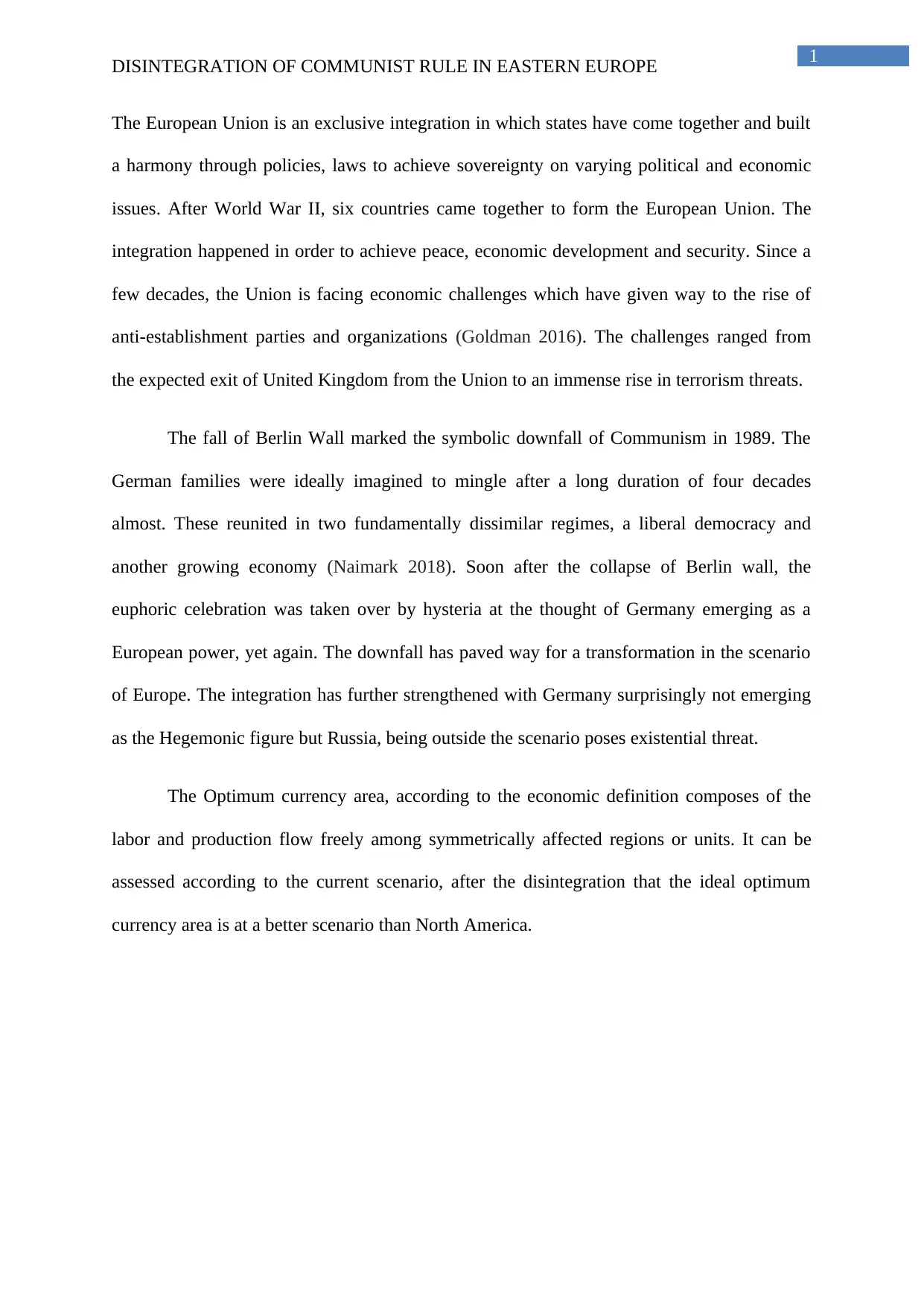
The European Union is an exclusive integration in which states have come together and built
a harmony through policies, laws to achieve sovereignty on varying political and economic
issues. After World War II, six countries came together to form the European Union. The
integration happened in order to achieve peace, economic development and security. Since a
few decades, the Union is facing economic challenges which have given way to the rise of
anti-establishment parties and organizations (Goldman 2016). The challenges ranged from
the expected exit of United Kingdom from the Union to an immense rise in terrorism threats.
The fall of Berlin Wall marked the symbolic downfall of Communism in 1989. The
German families were ideally imagined to mingle after a long duration of four decades
almost. These reunited in two fundamentally dissimilar regimes, a liberal democracy and
another growing economy (Naimark 2018). Soon after the collapse of Berlin wall, the
euphoric celebration was taken over by hysteria at the thought of Germany emerging as a
European power, yet again. The downfall has paved way for a transformation in the scenario
of Europe. The integration has further strengthened with Germany surprisingly not emerging
as the Hegemonic figure but Russia, being outside the scenario poses existential threat.
The Optimum currency area, according to the economic definition composes of the
labor and production flow freely among symmetrically affected regions or units. It can be
assessed according to the current scenario, after the disintegration that the ideal optimum
currency area is at a better scenario than North America.
Document Page
2
DISINTEGRATION OF COMMUNIST RULE IN EASTERN EUROPE
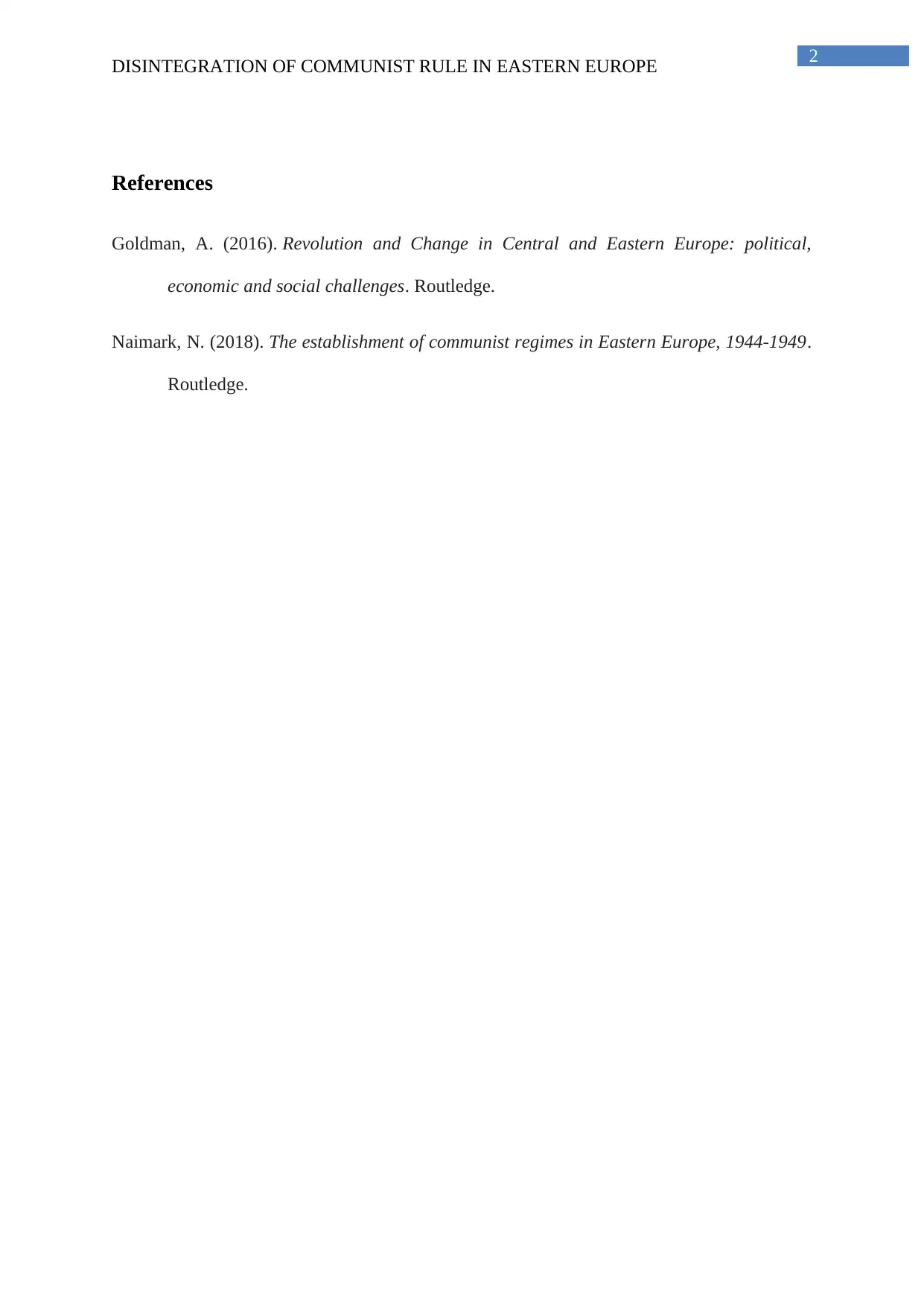
References
Goldman, A. (2016). Revolution and Change in Central and Eastern Europe: political,
economic and social challenges. Routledge.
Naimark, N. (2018). The establishment of communist regimes in Eastern Europe, 1944-1949.
Routledge.
chevron_up_icon
1 out of 3
circle_padding
hide_on_mobile
zoom_out_icon
[object Object]