International Marketing: Disney's Strategies and Challenges
VerifiedAdded on 2021/02/22
|12
|4043
|201
Report
AI Summary
This report, submitted by a student, analyzes Walt Disney's international marketing strategies. It begins with an executive summary and outlines the rationales and objectives of the study, focusing on entry modes such as collaboration and partnership, and the application of culture theory. The report details Disney's strategies for entering international markets, including the use of collaboration with companies like Oriental Land Company and the French Government. It also examines the advantages of these collaborations, such as risk-sharing and knowledge transfer. Furthermore, the report explores Disney's approach to culture theory, including HR policies, employee training through the Disney University, and the creation of a distinct Disney culture. Limitations, both short-term (COVID-19 impacts) and long-term, are also discussed. The report concludes by summarizing the key findings and providing references to support the analysis, offering a comprehensive overview of Disney's international marketing efforts and the challenges it faces.
Student Number: 637940
Module Name: International Marketing
Title: Coursework for International Marketing
Word Count: 2555
COURSEWORK FOR INTERNATIONAL MARKETING
MODULE TITLE: INTERNATIONAL MARKETING
MODULE NUMBER : 661762 - A19 - T3A
MODULE LEADER: Dr. SULTANUL CHOWDHURY
STUENT NAME : LAM HIU YAN
STUDENT NO : 637940
Module Name: International Marketing
Title: Coursework for International Marketing
Word Count: 2555
COURSEWORK FOR INTERNATIONAL MARKETING
MODULE TITLE: INTERNATIONAL MARKETING
MODULE NUMBER : 661762 - A19 - T3A
MODULE LEADER: Dr. SULTANUL CHOWDHURY
STUENT NAME : LAM HIU YAN
STUDENT NO : 637940

Paraphrase This Document
Need a fresh take? Get an instant paraphrase of this document with our AI Paraphraser
Student Number: 637940
Module Name: International Marketing
Title: Coursework for International Marketing
Word Count: 2555
Table of Content
1. Executive Summary ............................................................................................... 3
2. Rationales of Study ................................................................................................ 3
3. Objective ................................................................................................................ 4
3.1 Mode of Entry .................................................................................................. 4
3.2 Culture Theory ................................................................................................. 4
4. Strategy .................................................................................................................. 5
4.1 The strategy for the mode of entry ............................................................ 5
4.1.1 Collaboration......................................................................................... 5
4.1.2 Advantage of using the Collaboration................................................... 6
4.1.3 Partnership ............................................................................................ 7
4.2 The strategy for the Culture Theory........................................................... 7
4.2.1 HR employees and training policy ........................................................ 7
4.2.2 Create the Disney’s Culture .................................................................. 8
5. Limitation ............................................................................................................... 8
5.1 Short Term................................................................................................ 8
5.2 Long Term ................................................................................................ 9
6. Conclusions ............................................................................................................ 9
7. References ............................................................................................................ 10
Module Name: International Marketing
Title: Coursework for International Marketing
Word Count: 2555
Table of Content
1. Executive Summary ............................................................................................... 3
2. Rationales of Study ................................................................................................ 3
3. Objective ................................................................................................................ 4
3.1 Mode of Entry .................................................................................................. 4
3.2 Culture Theory ................................................................................................. 4
4. Strategy .................................................................................................................. 5
4.1 The strategy for the mode of entry ............................................................ 5
4.1.1 Collaboration......................................................................................... 5
4.1.2 Advantage of using the Collaboration................................................... 6
4.1.3 Partnership ............................................................................................ 7
4.2 The strategy for the Culture Theory........................................................... 7
4.2.1 HR employees and training policy ........................................................ 7
4.2.2 Create the Disney’s Culture .................................................................. 8
5. Limitation ............................................................................................................... 8
5.1 Short Term................................................................................................ 8
5.2 Long Term ................................................................................................ 9
6. Conclusions ............................................................................................................ 9
7. References ............................................................................................................ 10
Student Number: 637940
Module Name: International Marketing
Title: Coursework for International Marketing
Word Count: 2555
(Souce: Google)
1. Executive Summary
Walt Disney is one of the famous entertainment companies which based on
American over 90 years. In this paper, analyses on how Walt Disney to face the
challenges of obstacles to the international trading world. Collaboration is one of
the suitable methods for entry mode which involve the investment into the
foreign country directly. It can share the risk, profits and the knowledge and
technology for developing the new products. Also, working as partnership is the
faster and easier way to complementary advantages to each other’s. Moreover,
developed the Disney University is the key of the global entity to recruit
different national employees and provide the on job training to them. And create
the own Disney’s culture is the best idea to attract more global customers to keep
the hit rate.
Therefore, Walt Disney is one of the successful examples by using two
difference international marketing theories to solve the issues when explored
their business into the international market.
2. Rationales of Study
Walt Disney is one of the famous brands which based on American. It was a premier
entertainment company over 90 years. As an international company in the world, Walt
Disney always faces many challenges such as social culture disparity, economic
disparity, political and legal disparity. (Humanities, 2017; Walt Disney, 2020)
Nowadays, Walt Disney got many competitors in difference type of business, such as
Marvel Studio, Universal Studios, DreamWorks Animation & Illumination
Entertainment etc. For fight with all the competitors and the difference challenges on
the international trading world, Walt Disney should have a marketing strategic and
action plan to prevent all the risk which will interrupt on their business. (Miller, 2013;
Leibacher, 2018; Quitoriano, 2019)
Module Name: International Marketing
Title: Coursework for International Marketing
Word Count: 2555
(Souce: Google)
1. Executive Summary
Walt Disney is one of the famous entertainment companies which based on
American over 90 years. In this paper, analyses on how Walt Disney to face the
challenges of obstacles to the international trading world. Collaboration is one of
the suitable methods for entry mode which involve the investment into the
foreign country directly. It can share the risk, profits and the knowledge and
technology for developing the new products. Also, working as partnership is the
faster and easier way to complementary advantages to each other’s. Moreover,
developed the Disney University is the key of the global entity to recruit
different national employees and provide the on job training to them. And create
the own Disney’s culture is the best idea to attract more global customers to keep
the hit rate.
Therefore, Walt Disney is one of the successful examples by using two
difference international marketing theories to solve the issues when explored
their business into the international market.
2. Rationales of Study
Walt Disney is one of the famous brands which based on American. It was a premier
entertainment company over 90 years. As an international company in the world, Walt
Disney always faces many challenges such as social culture disparity, economic
disparity, political and legal disparity. (Humanities, 2017; Walt Disney, 2020)
Nowadays, Walt Disney got many competitors in difference type of business, such as
Marvel Studio, Universal Studios, DreamWorks Animation & Illumination
Entertainment etc. For fight with all the competitors and the difference challenges on
the international trading world, Walt Disney should have a marketing strategic and
action plan to prevent all the risk which will interrupt on their business. (Miller, 2013;
Leibacher, 2018; Quitoriano, 2019)
⊘ This is a preview!⊘
Do you want full access?
Subscribe today to unlock all pages.

Trusted by 1+ million students worldwide
Student Number: 637940
Module Name: International Marketing
Title: Coursework for International Marketing
Word Count: 2555
In this paper, study on Walt Disney how to face the challenge of obstacles to the
international trading world.
3. Objective
3.1 Mode of Entry
Walt Disney started their business with the cartoon characters at the beginning. In the
early 1950s, Walt Disney tried to design a large amusement park to increasing their
reputation and profit for the business. Also, Walt Disney hoped that the theme park
have the value to entertain the adults and child. But Walt Disney was hard to keep the
hit rate for their characters as long time while they only focus on their business in
American. Also, the number of visitors was not easy to maintain during the non-peak
seasons. (History.com, 2009; Kim, 2015; Brown, 2019; Walt Disney, 2020)
The entertaining products are the main income for the Walt Disney to satisfy with
different tastes and preferences for the customers. Also, Walt Disney faced the risk for
their products which can be attracted by other countries. Walt Disney is hard to
control the quality of the products and for foresees the profit. (Brown, 2019; Panda,
2019)
3.2 Culture Theory
Walt Disney is the famous local brand in America; they aim to entertain people
and give the inspiration to people according to the storytelling and the creative
minds in the world. As we known, the mother tongue of Walt Disney was English
and their story mostly base on American culture to develop. However, it is only
can get the empathy for the people who living in American. It is hard to get the
attention and the empathy from foreign people such as Europe, Asia, and South
Africa etc. Also, Walt Disney Theme Park are all over the world, they need to
recruit different national people to acting the Disney characters and using the own
Disney’s languages to act the cheaters as real as they can. Under the difference
culture and language, it is difficult to maintain the Disney brand image to the
people when facing the disparity in culture. (Humanities, 2017; Walt Disney,
2020)
In the 20 Century, people increasing to use multi-media to enjoy the film,
television program and technology products. Base on the culture transforming
change, Walt Disney faced the diversity threatens on their products whatever
Module Name: International Marketing
Title: Coursework for International Marketing
Word Count: 2555
In this paper, study on Walt Disney how to face the challenge of obstacles to the
international trading world.
3. Objective
3.1 Mode of Entry
Walt Disney started their business with the cartoon characters at the beginning. In the
early 1950s, Walt Disney tried to design a large amusement park to increasing their
reputation and profit for the business. Also, Walt Disney hoped that the theme park
have the value to entertain the adults and child. But Walt Disney was hard to keep the
hit rate for their characters as long time while they only focus on their business in
American. Also, the number of visitors was not easy to maintain during the non-peak
seasons. (History.com, 2009; Kim, 2015; Brown, 2019; Walt Disney, 2020)
The entertaining products are the main income for the Walt Disney to satisfy with
different tastes and preferences for the customers. Also, Walt Disney faced the risk for
their products which can be attracted by other countries. Walt Disney is hard to
control the quality of the products and for foresees the profit. (Brown, 2019; Panda,
2019)
3.2 Culture Theory
Walt Disney is the famous local brand in America; they aim to entertain people
and give the inspiration to people according to the storytelling and the creative
minds in the world. As we known, the mother tongue of Walt Disney was English
and their story mostly base on American culture to develop. However, it is only
can get the empathy for the people who living in American. It is hard to get the
attention and the empathy from foreign people such as Europe, Asia, and South
Africa etc. Also, Walt Disney Theme Park are all over the world, they need to
recruit different national people to acting the Disney characters and using the own
Disney’s languages to act the cheaters as real as they can. Under the difference
culture and language, it is difficult to maintain the Disney brand image to the
people when facing the disparity in culture. (Humanities, 2017; Walt Disney,
2020)
In the 20 Century, people increasing to use multi-media to enjoy the film,
television program and technology products. Base on the culture transforming
change, Walt Disney faced the diversity threatens on their products whatever
Paraphrase This Document
Need a fresh take? Get an instant paraphrase of this document with our AI Paraphraser
Student Number: 637940
Module Name: International Marketing
Title: Coursework for International Marketing
Word Count: 2555
movies, television program or the side products in the theme park. Walt Disney’s
Theme Park is critical income for their business, the traditional facilities such as
roller coaster, pirate ship or tea cup are not attractive anymore during the culture
transforming change. Also, another entertainment company rise up and started to
build their theme park like University Studio, legoland etc. All of them are focus
on technology products and services. So that the technology trend also is the threat
for Walt Disney to maintain their hit rate on for their products. (Miller, 2013; Total
Assignment Help, 2016)
4. Strategy
Walt Disney aims to be the one of the world who leading producers and the
providers of entertainment and information. To achieve the mission, Walt Disney
should have a successful strategy plan and improvement plan to enhance the
measures and prevent all the risk and competitor. (Nakajima, 2016; Walt Disney,
2020)
4.1The strategy for the mode of entry
Walt Disney faced the threats to the high competition in entertainment and media
industry. Different locations presented the important threat from severe
competition and ethnic groups for those theme parks and film production
development. (Robles, 1988; Manzano, 2009; QuickMBA, 2010; Kim, 2015)
4.1.1 Collaboration
Collaboration is one of the suitable methods for entry mode which involve the
investment into the foreign country directly. There might involve two different
companies, especially from two different countries, they work together and decide
to corporate a new business or products. It will help the business to go into the
other country. (Lichtenthaler, 2013; Wein, 2017; Puthusserry, Khan and Rodgers,
2018)
As Walt Disney foreseen that it is hard to keep the high reputation, build up the
brand image and increasing the profit if only run the business in America. So that
Walt Disney decided to work with another country, such as Japan and Europe. In
1983, Walt Disney started the first international theme park in Tokyo, Japan. Walt
Disney worked with The Oriental Land Company which is the local company in
Japan. Walt Disney granted full ownership to Oriental Land Company but Walt
Disney collected the fee of licensing from the sales of the ticketing and in-park
purchasing income for the return. (Wein, 2017)
Module Name: International Marketing
Title: Coursework for International Marketing
Word Count: 2555
movies, television program or the side products in the theme park. Walt Disney’s
Theme Park is critical income for their business, the traditional facilities such as
roller coaster, pirate ship or tea cup are not attractive anymore during the culture
transforming change. Also, another entertainment company rise up and started to
build their theme park like University Studio, legoland etc. All of them are focus
on technology products and services. So that the technology trend also is the threat
for Walt Disney to maintain their hit rate on for their products. (Miller, 2013; Total
Assignment Help, 2016)
4. Strategy
Walt Disney aims to be the one of the world who leading producers and the
providers of entertainment and information. To achieve the mission, Walt Disney
should have a successful strategy plan and improvement plan to enhance the
measures and prevent all the risk and competitor. (Nakajima, 2016; Walt Disney,
2020)
4.1The strategy for the mode of entry
Walt Disney faced the threats to the high competition in entertainment and media
industry. Different locations presented the important threat from severe
competition and ethnic groups for those theme parks and film production
development. (Robles, 1988; Manzano, 2009; QuickMBA, 2010; Kim, 2015)
4.1.1 Collaboration
Collaboration is one of the suitable methods for entry mode which involve the
investment into the foreign country directly. There might involve two different
companies, especially from two different countries, they work together and decide
to corporate a new business or products. It will help the business to go into the
other country. (Lichtenthaler, 2013; Wein, 2017; Puthusserry, Khan and Rodgers,
2018)
As Walt Disney foreseen that it is hard to keep the high reputation, build up the
brand image and increasing the profit if only run the business in America. So that
Walt Disney decided to work with another country, such as Japan and Europe. In
1983, Walt Disney started the first international theme park in Tokyo, Japan. Walt
Disney worked with The Oriental Land Company which is the local company in
Japan. Walt Disney granted full ownership to Oriental Land Company but Walt
Disney collected the fee of licensing from the sales of the ticketing and in-park
purchasing income for the return. (Wein, 2017)
Student Number: 637940
Module Name: International Marketing
Title: Coursework for International Marketing
Word Count: 2555
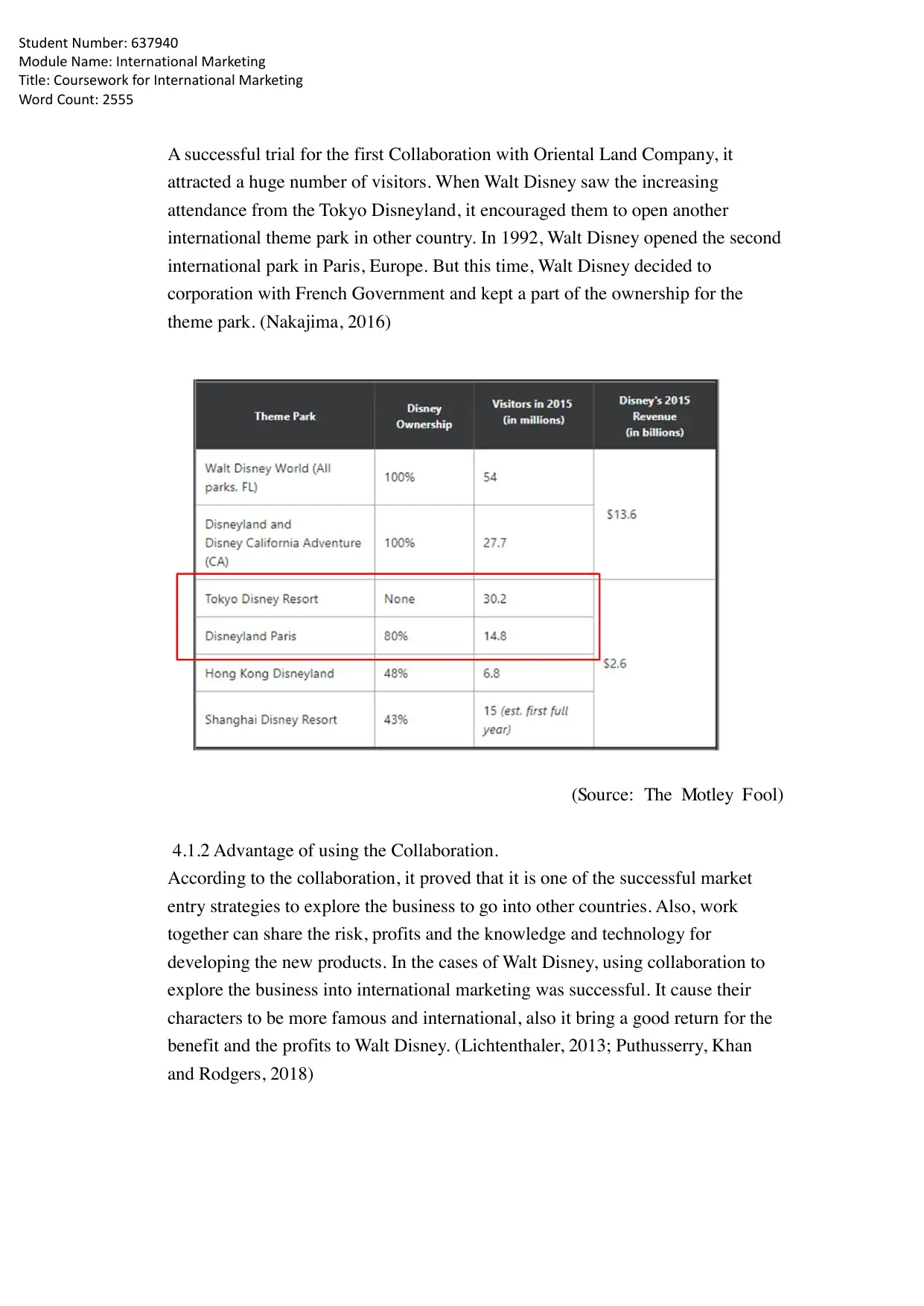
A successful trial for the first Collaboration with Oriental Land Company, it
attracted a huge number of visitors. When Walt Disney saw the increasing
attendance from the Tokyo Disneyland, it encouraged them to open another
international theme park in other country. In 1992, Walt Disney opened the second
international park in Paris, Europe. But this time, Walt Disney decided to
corporation with French Government and kept a part of the ownership for the
theme park. (Nakajima, 2016)
(Source: The Motley Fool)
4.1.2 Advantage of using the Collaboration.
According to the collaboration, it proved that it is one of the successful market
entry strategies to explore the business to go into other countries. Also, work
together can share the risk, profits and the knowledge and technology for
developing the new products. In the cases of Walt Disney, using collaboration to
explore the business into international marketing was successful. It cause their
characters to be more famous and international, also it bring a good return for the
benefit and the profits to Walt Disney. (Lichtenthaler, 2013; Puthusserry, Khan
and Rodgers, 2018)
Module Name: International Marketing
Title: Coursework for International Marketing
Word Count: 2555
A successful trial for the first Collaboration with Oriental Land Company, it
attracted a huge number of visitors. When Walt Disney saw the increasing
attendance from the Tokyo Disneyland, it encouraged them to open another
international theme park in other country. In 1992, Walt Disney opened the second
international park in Paris, Europe. But this time, Walt Disney decided to
corporation with French Government and kept a part of the ownership for the
theme park. (Nakajima, 2016)
(Source: The Motley Fool)
4.1.2 Advantage of using the Collaboration.
According to the collaboration, it proved that it is one of the successful market
entry strategies to explore the business to go into other countries. Also, work
together can share the risk, profits and the knowledge and technology for
developing the new products. In the cases of Walt Disney, using collaboration to
explore the business into international marketing was successful. It cause their
characters to be more famous and international, also it bring a good return for the
benefit and the profits to Walt Disney. (Lichtenthaler, 2013; Puthusserry, Khan
and Rodgers, 2018)
⊘ This is a preview!⊘
Do you want full access?
Subscribe today to unlock all pages.
Trusted by 1+ million students worldwide
Student Number: 637940
Module Name: International Marketing
Title: Coursework for International Marketing
Word Count: 2555
4.1.3 Partnership
Walt Disney tried to work with other media company such as Pixar Animation
Studios and started with the first movie to enhance the value in the market. Toy
Story is the first movie which is corporate with Pixar Animation Studios and the
characters that in the movie were very famous after the movie released. As Walt
Disney known that create more famous characters is the major factor to keep the
competitiveness in the entertainment industry. Partnership is the faster and easier
way to create new characters. Also, it is the way to complementary advantages to
each other’s. (Manzano, 2009; Virginia's Community Colleges, 2012; Panda,
2019)
4.2The strategy for the Culture Theory
When Walt Disney starting the business internationally, the culture disparity was
the critical threat that Walt Disney needed to fixed. In Walt Disney parlance,
always enjoy the show as the reasons of the employees are the actors. That’s why
Walt Disney developed a unique and special language as a key to break through
the remarkable culture. (History.com, 2009; Humanities, 2017; )
4.2.1 HR employees and training policy
Walt Disney was come from American and the mother tongue of the language was
English. Then, language is one the problem when Walt Disney opened the theme
at the other countries, so Walt Disney decided to build the Disney University to
recruit the people who are good at performance and give the training course for all
incoming employees. (Humanities, 2017; Walt Disney, 2020)
Disney University is the key of the global entity to recruit different national
employees and provide the on job training to them. The employees would get
many opportunities to learn about the heritage and tradition of Disney, personal
and professional development. And the training program which includes training
the employees to fit in all the characters’ movement, the tone of voice (different
languages) and dress up like the characters such as Snow White, Cinderella,
Sleeping Beauty or Mickey Mouse is the major reason to attract people to visit the
theme park. It can make sure that they can provide a good performance in front of
the visitor in the park. (Johnson, 2006; Mcgowan, 2018)
Module Name: International Marketing
Title: Coursework for International Marketing
Word Count: 2555
4.1.3 Partnership
Walt Disney tried to work with other media company such as Pixar Animation
Studios and started with the first movie to enhance the value in the market. Toy
Story is the first movie which is corporate with Pixar Animation Studios and the
characters that in the movie were very famous after the movie released. As Walt
Disney known that create more famous characters is the major factor to keep the
competitiveness in the entertainment industry. Partnership is the faster and easier
way to create new characters. Also, it is the way to complementary advantages to
each other’s. (Manzano, 2009; Virginia's Community Colleges, 2012; Panda,
2019)
4.2The strategy for the Culture Theory
When Walt Disney starting the business internationally, the culture disparity was
the critical threat that Walt Disney needed to fixed. In Walt Disney parlance,
always enjoy the show as the reasons of the employees are the actors. That’s why
Walt Disney developed a unique and special language as a key to break through
the remarkable culture. (History.com, 2009; Humanities, 2017; )
4.2.1 HR employees and training policy
Walt Disney was come from American and the mother tongue of the language was
English. Then, language is one the problem when Walt Disney opened the theme
at the other countries, so Walt Disney decided to build the Disney University to
recruit the people who are good at performance and give the training course for all
incoming employees. (Humanities, 2017; Walt Disney, 2020)
Disney University is the key of the global entity to recruit different national
employees and provide the on job training to them. The employees would get
many opportunities to learn about the heritage and tradition of Disney, personal
and professional development. And the training program which includes training
the employees to fit in all the characters’ movement, the tone of voice (different
languages) and dress up like the characters such as Snow White, Cinderella,
Sleeping Beauty or Mickey Mouse is the major reason to attract people to visit the
theme park. It can make sure that they can provide a good performance in front of
the visitor in the park. (Johnson, 2006; Mcgowan, 2018)
Paraphrase This Document
Need a fresh take? Get an instant paraphrase of this document with our AI Paraphraser
Student Number: 637940
Module Name: International Marketing
Title: Coursework for International Marketing
Word Count: 2555
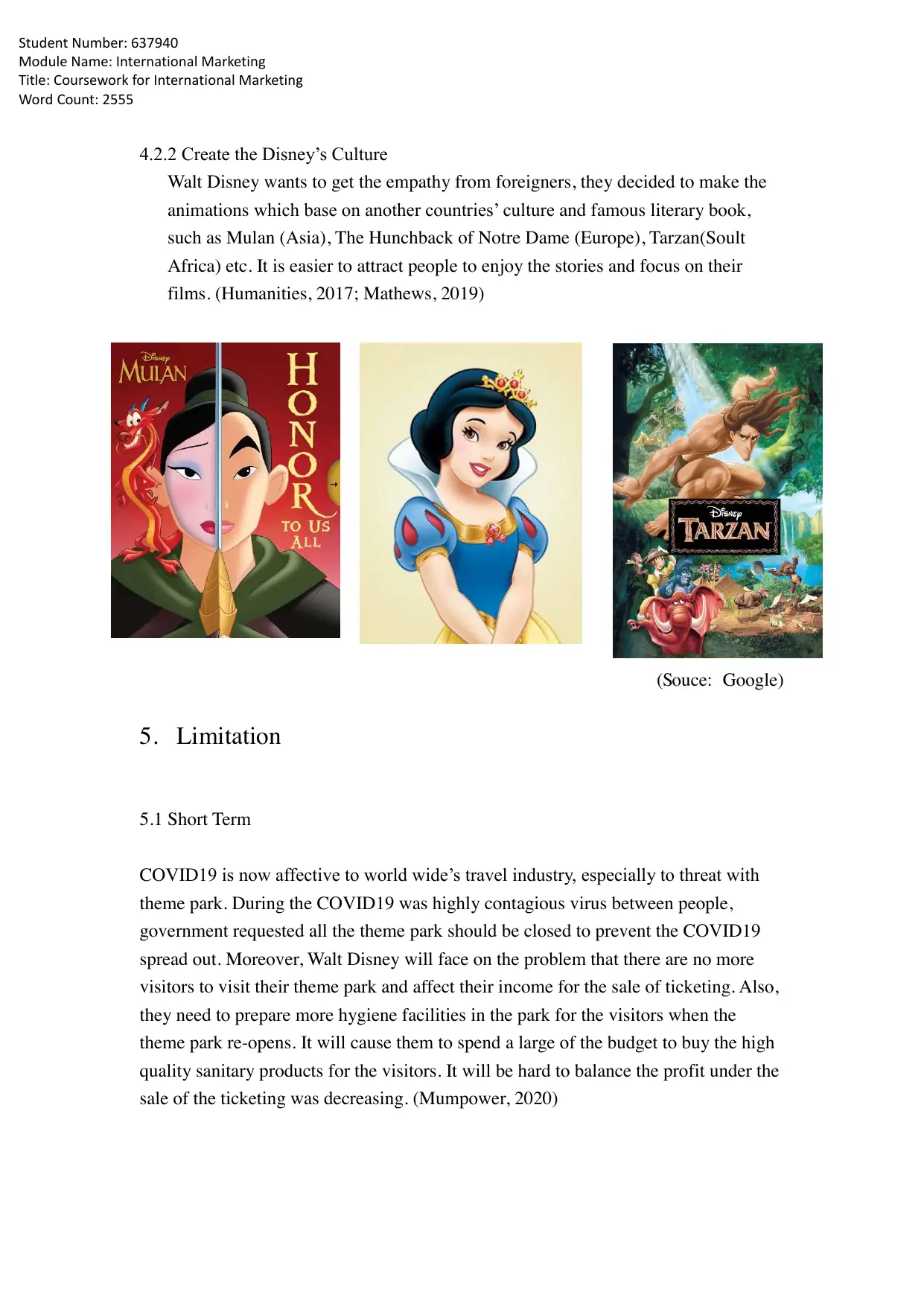
4.2.2 Create the Disney’s Culture
Walt Disney wants to get the empathy from foreigners, they decided to make the
animations which base on another countries’ culture and famous literary book,
such as Mulan (Asia), The Hunchback of Notre Dame (Europe), Tarzan(Soult
Africa) etc. It is easier to attract people to enjoy the stories and focus on their
films. (Humanities, 2017; Mathews, 2019)
(Souce: Google)
5. Limitation
5.1 Short Term
COVID19 is now affective to world wide’s travel industry, especially to threat with
theme park. During the COVID19 was highly contagious virus between people,
government requested all the theme park should be closed to prevent the COVID19
spread out. Moreover, Walt Disney will face on the problem that there are no more
visitors to visit their theme park and affect their income for the sale of ticketing. Also,
they need to prepare more hygiene facilities in the park for the visitors when the
theme park re-opens. It will cause them to spend a large of the budget to buy the high
quality sanitary products for the visitors. It will be hard to balance the profit under the
sale of the ticketing was decreasing. (Mumpower, 2020)
Module Name: International Marketing
Title: Coursework for International Marketing
Word Count: 2555
4.2.2 Create the Disney’s Culture
Walt Disney wants to get the empathy from foreigners, they decided to make the
animations which base on another countries’ culture and famous literary book,
such as Mulan (Asia), The Hunchback of Notre Dame (Europe), Tarzan(Soult
Africa) etc. It is easier to attract people to enjoy the stories and focus on their
films. (Humanities, 2017; Mathews, 2019)
(Souce: Google)
5. Limitation
5.1 Short Term
COVID19 is now affective to world wide’s travel industry, especially to threat with
theme park. During the COVID19 was highly contagious virus between people,
government requested all the theme park should be closed to prevent the COVID19
spread out. Moreover, Walt Disney will face on the problem that there are no more
visitors to visit their theme park and affect their income for the sale of ticketing. Also,
they need to prepare more hygiene facilities in the park for the visitors when the
theme park re-opens. It will cause them to spend a large of the budget to buy the high
quality sanitary products for the visitors. It will be hard to balance the profit under the
sale of the ticketing was decreasing. (Mumpower, 2020)
Student Number: 637940
Module Name: International Marketing
Title: Coursework for International Marketing
Word Count: 2555
5.2 Long Term
Started from the 20 Century, Walt Disney aware that social media is the trend of the
platform to performance entertainment for people. They are facing the threats for the
people who were not interested in visiting their theme park but virtual theme park by
using AR/VR system. (Miller, 2013; Victoria, 2018)
6. Conclusions
In conclusion, Walt Disney is the successful example by using the culture theory
and mode of the entry theory to face the challenge of obstacles to the
international trading world. Collaboration and partnership is the faster and easier
way to build the business into other countries. Also, Disney University is the key
to recruit different national people to work in their company. Although, Walt
Disney may face difference challenges in the future, they will find the most
suitable marketing strategies to solve all the difficulties.
Module Name: International Marketing
Title: Coursework for International Marketing
Word Count: 2555
5.2 Long Term
Started from the 20 Century, Walt Disney aware that social media is the trend of the
platform to performance entertainment for people. They are facing the threats for the
people who were not interested in visiting their theme park but virtual theme park by
using AR/VR system. (Miller, 2013; Victoria, 2018)
6. Conclusions
In conclusion, Walt Disney is the successful example by using the culture theory
and mode of the entry theory to face the challenge of obstacles to the
international trading world. Collaboration and partnership is the faster and easier
way to build the business into other countries. Also, Disney University is the key
to recruit different national people to work in their company. Although, Walt
Disney may face difference challenges in the future, they will find the most
suitable marketing strategies to solve all the difficulties.
⊘ This is a preview!⊘
Do you want full access?
Subscribe today to unlock all pages.
Trusted by 1+ million students worldwide
Student Number: 637940
Module Name: International Marketing
Title: Coursework for International Marketing
Word Count: 2555
7. References
1. Brown, L., 2019. Walt Disney Company PESTEL/PESTLE Analysis
& Recommendations - Panmore Institute. [online] Panmore Institute.
Available at:
<http://panmore.com/walt-disney-company-pestel-pestle-analysis-r
ecommendations> [Accessed 8 July 2020].
2. Choice Reviews Online, 2000. Walt Disney and Europe: European
influences on the animated feature films of Walt Disney. 37(11),
pp.37-6093-37-6093.
3. Hackett, D., 1976. The International Expansion of U.S. Franchise
Systems: Status and Strategies. Journal of International Business
Studies, 7(1), pp.65-75.
4. History.com, 2009. Disneyland Opens. [online] History.com.
Available at:
<https://www.history.com/this-day-in-history/disneyland-opens>
[Accessed 6 July 2020].
5. Humanities, J., 2017. Disney’S Impact On American Culture.
[online] Artificial Empires. Available at:
<https://artificialempires.wordpress.com/2017/02/21/disneys-impac
t-on-american-culture/> [Accessed 11 July 2020].
6. Johnson, M., 2006. The Walt Disney World College Program : What
It Is, What It Is Like, And How It Changed Me : An Honors Thesis
(HONRS 499). [online] Cardinalscholar.bsu.edu. Available at:
<http://cardinalscholar.bsu.edu/handle/handle/191034> [Accessed 6
July 2020].
7. Kim, J., 2015. Factors Influencing the Choice of Entry Modes in
International New Ventures. INTERNATIONAL BUSINESS
REVIEW, 19(3), p.171.
8. Leibacher, H., 2018. Disney And Pixar: A Long And Winding
Relationship – World Of Walt. [online] Worldofwalt.com. Available
at: <https://www.worldofwalt.com/disney-pixar-relationship.html>
[Accessed 5 July 2020].
9. Lichtenthaler, U., 2013. The Collaboration of Innovation
Intermediaries and Manufacturing Firms in the Markets for
Module Name: International Marketing
Title: Coursework for International Marketing
Word Count: 2555
7. References
1. Brown, L., 2019. Walt Disney Company PESTEL/PESTLE Analysis
& Recommendations - Panmore Institute. [online] Panmore Institute.
Available at:
<http://panmore.com/walt-disney-company-pestel-pestle-analysis-r
ecommendations> [Accessed 8 July 2020].
2. Choice Reviews Online, 2000. Walt Disney and Europe: European
influences on the animated feature films of Walt Disney. 37(11),
pp.37-6093-37-6093.
3. Hackett, D., 1976. The International Expansion of U.S. Franchise
Systems: Status and Strategies. Journal of International Business
Studies, 7(1), pp.65-75.
4. History.com, 2009. Disneyland Opens. [online] History.com.
Available at:
<https://www.history.com/this-day-in-history/disneyland-opens>
[Accessed 6 July 2020].
5. Humanities, J., 2017. Disney’S Impact On American Culture.
[online] Artificial Empires. Available at:
<https://artificialempires.wordpress.com/2017/02/21/disneys-impac
t-on-american-culture/> [Accessed 11 July 2020].
6. Johnson, M., 2006. The Walt Disney World College Program : What
It Is, What It Is Like, And How It Changed Me : An Honors Thesis
(HONRS 499). [online] Cardinalscholar.bsu.edu. Available at:
<http://cardinalscholar.bsu.edu/handle/handle/191034> [Accessed 6
July 2020].
7. Kim, J., 2015. Factors Influencing the Choice of Entry Modes in
International New Ventures. INTERNATIONAL BUSINESS
REVIEW, 19(3), p.171.
8. Leibacher, H., 2018. Disney And Pixar: A Long And Winding
Relationship – World Of Walt. [online] Worldofwalt.com. Available
at: <https://www.worldofwalt.com/disney-pixar-relationship.html>
[Accessed 5 July 2020].
9. Lichtenthaler, U., 2013. The Collaboration of Innovation
Intermediaries and Manufacturing Firms in the Markets for
Paraphrase This Document
Need a fresh take? Get an instant paraphrase of this document with our AI Paraphraser
Student Number: 637940
Module Name: International Marketing
Title: Coursework for International Marketing
Word Count: 2555
Technology. Journal of Product Innovation Management, 30,
pp.142-158.
10. Manzano, S., 2009. Entry Modes Into Foreign Markets. [online]
Manzanosbusinessblog.blogspot.com. Available at:
<http://manzanosbusinessblog.blogspot.com/2009/02/entry-modes-
in-forein-markets.html> [Accessed 8 July 2020].
11. Mathews, R., 2019. How Disney Uses Language To Engage Its
Workers. [online] TLNT. Available at:
<https://www.tlnt.com/how-disney-uses-language-to-engage-its-wo
rkers/> [Accessed 4 July 2020].
12. Matusitz, J., 2010. Disneyland Paris: a case analysis demonstrating
how glocalization works. Journal of Strategic Marketing, 18(3),
pp.223-237.
13. Mcgowan, S., 2018. Walt Disney World College Program Cast
Members: Influencers Or Influenced?. [online] Repository.asu.edu.
Available at: <https://repository.asu.edu/items/48268> [Accessed 9
July 2020].
14. Miller, D., 2013. Analysts: Disney Layoffs Tied To Lucasfilm,
Marvel Acquisitions. [online] Los Angeles Times. Available at:
<http://www.latimes.com/entertainment/envelope/cotown/la-et-anal
ysts-disney-layoffs-related-to-lucasfilm-marvel-acquisitions-20130
410,0,6214905.story> [Accessed 9 July 2020].
15. Mumpower, D., 2020. Here Are Some Of The Challenges Disney
Will Face In Re-Opening - Mickeyblog.Com. [online]
MickeyBlog.com. Available at:
<https://mickeyblog.com/2020/04/02/here-are-some-challenges-dis
ney-will-face-re-opening/> [Accessed 7 July 2020].
16. Nakajima, M., 2016. Corporate strategy comparison Walt Disney
and Oriental Land. Journal of Global Tourism Research, 1(1),
pp.77-81.
17. Panda, I., 2019. International Marketing: Walt Disney Company -
2167 Words | Term Paper Example. [online] Free Essays. Available
at:
<https://ivypanda.com/essays/international-marketing-walt-disney-
company/> [Accessed 12 July 2020].
Module Name: International Marketing
Title: Coursework for International Marketing
Word Count: 2555
Technology. Journal of Product Innovation Management, 30,
pp.142-158.
10. Manzano, S., 2009. Entry Modes Into Foreign Markets. [online]
Manzanosbusinessblog.blogspot.com. Available at:
<http://manzanosbusinessblog.blogspot.com/2009/02/entry-modes-
in-forein-markets.html> [Accessed 8 July 2020].
11. Mathews, R., 2019. How Disney Uses Language To Engage Its
Workers. [online] TLNT. Available at:
<https://www.tlnt.com/how-disney-uses-language-to-engage-its-wo
rkers/> [Accessed 4 July 2020].
12. Matusitz, J., 2010. Disneyland Paris: a case analysis demonstrating
how glocalization works. Journal of Strategic Marketing, 18(3),
pp.223-237.
13. Mcgowan, S., 2018. Walt Disney World College Program Cast
Members: Influencers Or Influenced?. [online] Repository.asu.edu.
Available at: <https://repository.asu.edu/items/48268> [Accessed 9
July 2020].
14. Miller, D., 2013. Analysts: Disney Layoffs Tied To Lucasfilm,
Marvel Acquisitions. [online] Los Angeles Times. Available at:
<http://www.latimes.com/entertainment/envelope/cotown/la-et-anal
ysts-disney-layoffs-related-to-lucasfilm-marvel-acquisitions-20130
410,0,6214905.story> [Accessed 9 July 2020].
15. Mumpower, D., 2020. Here Are Some Of The Challenges Disney
Will Face In Re-Opening - Mickeyblog.Com. [online]
MickeyBlog.com. Available at:
<https://mickeyblog.com/2020/04/02/here-are-some-challenges-dis
ney-will-face-re-opening/> [Accessed 7 July 2020].
16. Nakajima, M., 2016. Corporate strategy comparison Walt Disney
and Oriental Land. Journal of Global Tourism Research, 1(1),
pp.77-81.
17. Panda, I., 2019. International Marketing: Walt Disney Company -
2167 Words | Term Paper Example. [online] Free Essays. Available
at:
<https://ivypanda.com/essays/international-marketing-walt-disney-
company/> [Accessed 12 July 2020].
Student Number: 637940
Module Name: International Marketing
Title: Coursework for International Marketing
Word Count: 2555
18. Puthusserry, P., Khan, Z. and Rodgers, P., 2018. International new
ventures market expansion through collaborative entry
modes. International Marketing Review, 35(6), pp.890-913.
19. QuickMBA, 2010. Foreign Market Entry Modes. [online]
Quickmba.com. Available at:
<http://www.quickmba.com/strategy/global/marketentry/>
[Accessed 10 July 2020].
20. Quitoriano, G., 2019. Who Are The Biggest Competitors Of The
Walt Disney Company. [online] Quora. Available at:
<https://www.quora.com/Who-are-the-biggest-competitors-of-The-
Walt-Disney-Company> [Accessed 20 July 2020].
21. Robles, F., 1988. Entry Strategies for International Markets. Journal
of Marketing, 52(4), p.128.
22. Strategies for Reaching Global Markets. 2012. Virginia's
Community Colleges. [online] Available at:
<https://sites.google.com/a/email.vccs.edu/walt-disney-by-christion
-ward/home/strategies-for-reaching-global-markets> [Accessed 4
July 2020].
23. TotalassignmenthelpWalt Disney Culture Case Study: Challenges
And Threats Faced. 2016. Total Assignment Help. [online]
Available at:
<https://www.totalassignmenthelp.com/free-sample/case-study-of-
walt-disney-company> [Accessed 5 July 2020].
24. Victoria, 2018. Challenges For The Walt Disney Company. [online]
StudyBay. Available at:
<https://studybayhelp.co.uk/blog/challenges-for-the-walt-disney-co
mpany/> [Accessed 7 July 2020].
25. Walt Disney, 2020. The Walt Disney Company. [online] The Walt
Disney Company. Available at:
<https://thewaltdisneycompany.com/> [Accessed 7 July 2020].
26. Wein, J., 2017. Disney Doesn't Own Its Tokyo Parks But Still Finds
Them Lucrative. [online] Skift. Available at:
<https://skift.com/2017/08/25/tokyo-disney-resort-remains-a-key-a
sset-in-asia/> [Accessed 20 July 2020].
Module Name: International Marketing
Title: Coursework for International Marketing
Word Count: 2555
18. Puthusserry, P., Khan, Z. and Rodgers, P., 2018. International new
ventures market expansion through collaborative entry
modes. International Marketing Review, 35(6), pp.890-913.
19. QuickMBA, 2010. Foreign Market Entry Modes. [online]
Quickmba.com. Available at:
<http://www.quickmba.com/strategy/global/marketentry/>
[Accessed 10 July 2020].
20. Quitoriano, G., 2019. Who Are The Biggest Competitors Of The
Walt Disney Company. [online] Quora. Available at:
<https://www.quora.com/Who-are-the-biggest-competitors-of-The-
Walt-Disney-Company> [Accessed 20 July 2020].
21. Robles, F., 1988. Entry Strategies for International Markets. Journal
of Marketing, 52(4), p.128.
22. Strategies for Reaching Global Markets. 2012. Virginia's
Community Colleges. [online] Available at:
<https://sites.google.com/a/email.vccs.edu/walt-disney-by-christion
-ward/home/strategies-for-reaching-global-markets> [Accessed 4
July 2020].
23. TotalassignmenthelpWalt Disney Culture Case Study: Challenges
And Threats Faced. 2016. Total Assignment Help. [online]
Available at:
<https://www.totalassignmenthelp.com/free-sample/case-study-of-
walt-disney-company> [Accessed 5 July 2020].
24. Victoria, 2018. Challenges For The Walt Disney Company. [online]
StudyBay. Available at:
<https://studybayhelp.co.uk/blog/challenges-for-the-walt-disney-co
mpany/> [Accessed 7 July 2020].
25. Walt Disney, 2020. The Walt Disney Company. [online] The Walt
Disney Company. Available at:
<https://thewaltdisneycompany.com/> [Accessed 7 July 2020].
26. Wein, J., 2017. Disney Doesn't Own Its Tokyo Parks But Still Finds
Them Lucrative. [online] Skift. Available at:
<https://skift.com/2017/08/25/tokyo-disney-resort-remains-a-key-a
sset-in-asia/> [Accessed 20 July 2020].
⊘ This is a preview!⊘
Do you want full access?
Subscribe today to unlock all pages.
Trusted by 1+ million students worldwide

1 out of 12


Related Documents


Your All-in-One AI-Powered Toolkit for Academic Success.
+13062052269
info@desklib.com
Available 24*7 on WhatsApp / Email
![[object Object]](/_next/static/media/star-bottom.7253800d.svg)
Unlock your academic potential
Copyright © 2020–2026 A2Z Services. All Rights Reserved. Developed and managed by ZUCOL.